If you work in retail or ecommerce, you may have experienced returns inventory errors and how challenging they can be to resolve.
1. The Hidden Inventory Problem Behind Every Return
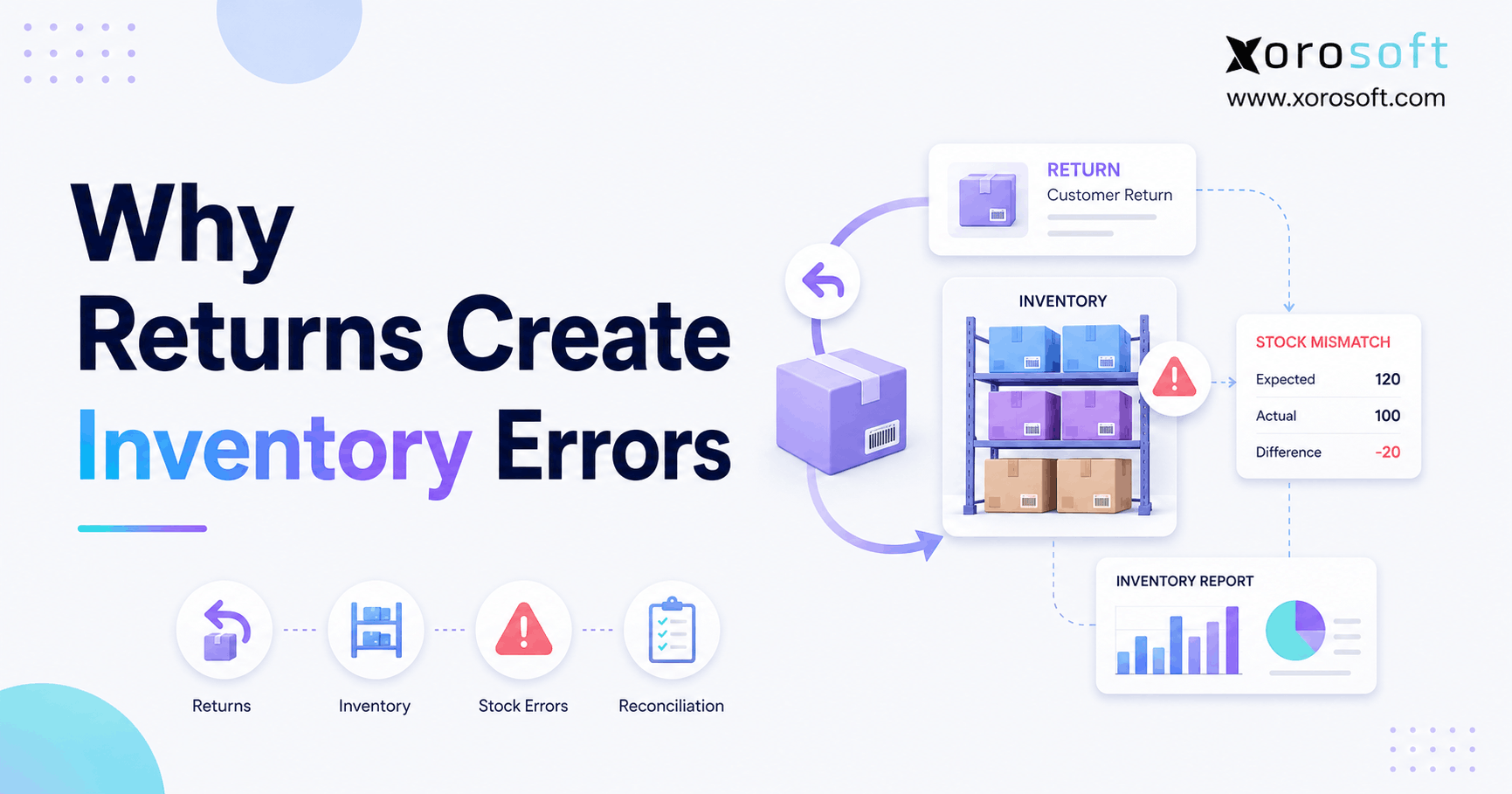
Returns inventory errors begin when a customer return changes one system before the physical product has completed its journey back into inventory. Although the customer may see one simple return transaction, the business must coordinate several separate operational and financial events.
For example, a refund may be approved before the warehouse receives the item. Meanwhile, the returned product may still be with the carrier. Therefore, if inventory increases immediately, the system can show stock that the warehouse does not actually have.
Likewise, a warehouse may receive a returned product, but that does not necessarily mean the item can be sold again. Instead, employees may need to inspect its condition, verify the SKU, confirm the quantity, and decide what should happen next.
Consequently, returns inventory errors are usually not caused by one dramatic mistake. Instead, they often develop when small timing, status, location, or system differences accumulate across the return process.
Furthermore, the risk grows as a business adds more channels, warehouses, products, 3PL partners, or accounting workflows. Therefore, understanding the entire return-to-inventory lifecycle is essential for protecting stock accuracy.
2. What Are Returns Inventory Errors?
Returns inventory errors are differences between what a company’s systems report about returned goods and what is physically present, correctly located, and actually available for sale.
In other words, inventory quantity alone does not tell the whole story. Instead, returned products can exist in several operational states.
2.1 On-Hand Inventory
On-hand inventory represents products physically controlled by the business. However, some of those units may still be unavailable for customer orders.
For example, a returned chair may physically be inside the warehouse. Nevertheless, if the chair has a damaged leg, it should not immediately become sellable inventory.
2.2 Available Inventory
Available inventory is stock that can generally be allocated to new orders. Therefore, businesses must prevent unverified returns from increasing available inventory too early.
Otherwise, returns inventory errors can lead directly to overselling.
2.3 Sellable Inventory
Sellable inventory has passed the conditions required for resale. For instance, employees may need to confirm that the correct SKU was returned, packaging is acceptable, required components are present, and the product is not damaged.
Consequently, physical receipt and sellable status should remain separate events.
2.4 Quarantine and Damaged Inventory
Some returned products require additional inspection, repair, refurbishment, or disposal. Therefore, businesses often need statuses such as:
- Quarantine
- Damaged
- Repair
- Refurbishment
- Return to vendor
- Scrap
As a result, an accurate inventory management system should provide visibility into quantity, location, condition, and availability rather than treating every returned item as normal stock.
3. Why a Refund Should Not Automatically Restock Inventory
One of the most common causes of returns inventory errors is treating the financial return and physical return as though they occur simultaneously.
However, they are fundamentally different transactions.
3.1 A Refund Is a Financial Event
A refund can affect:
- Revenue
- Customer balances
- Taxes
- Payment records
- Credit memos
Nevertheless, a refund does not prove that merchandise has reached the warehouse.
For example, a company may issue an immediate refund to improve the customer experience. Meanwhile, the package may still be several days away from the distribution center.
Therefore, increasing sellable inventory at the refund stage can create phantom stock.
3.2 A Physical Return Is an Inventory Event
A physical return occurs when merchandise actually comes back into operational control.
However, receiving alone is still not sufficient.
Instead, the business should normally verify:
- SKU
- Quantity
- Condition
- Warehouse
- Location
- Return authorization
- Sellability
Only then should the appropriate inventory status change.
3.3 Refunded Does Not Mean Sellable
This distinction is critical:
Refunded does not mean received.
Likewise:
Received does not mean sellable.
Therefore, businesses that separate financial return events from physical inventory events can reduce returns inventory errors significantly more effectively than businesses that use one automatic restock action for every return.
4. How Returns Inventory Errors Develop Across the Return Lifecycle
A customer return normally passes through several stages. Therefore, every stage represents both a control opportunity and a potential error point.
4.1 Return Request
First, the customer asks to return a product.
At this stage, however, no inventory has physically returned. Therefore, available inventory should not automatically increase simply because a return request exists.
4.2 Return Authorization
Next, the business may create a return merchandise authorization, commonly called an RMA.
An RMA can identify:
- Customer
- Original order
- SKU
- Quantity
- Return reason
- Expected warehouse
- Authorized resolution
Therefore, the RMA creates traceability before inventory physically moves.
4.3 Return Shipment
After authorization, the product travels back through reverse logistics.
Meanwhile, the item may still be in the customer’s possession or with a carrier. Consequently, the business should distinguish expected returns from physically received returns.
4.4 Warehouse Receiving
Once the package arrives, warehouse staff should confirm what was actually received.
For example, the customer may have been authorized to return two units but only sent one. Alternatively, the package may contain the wrong product.
Therefore, warehouse receiving should validate the physical return against the expected transaction.
4.5 Inspection
Next, the item should be inspected.
Depending on the product, employees may check:
- Physical condition
- Packaging
- Missing components
- Signs of use
- Damage
- Expiration
- Serial numbers
- Lot numbers
As a result, inspection protects both inventory accuracy and the next customer who may receive the product.
4.6 Disposition
After inspection, the business determines what happens next.
For example, the item may be:
- Restocked
- Quarantined
- Repaired
- Refurbished
- Returned to a supplier
- Liquidated
- Scrapped
Therefore, disposition prevents every physical return from automatically becoming available inventory.
4.7 Inventory Posting
After disposition, inventory should update the correct SKU, quantity, status, warehouse, and location.
At this stage, a structured warehouse management system can help connect physical warehouse activity with inventory records.
Xorosoft, for example, supports warehouse and inventory workflows within a broader operational environment. Therefore, businesses can manage the return as part of the same inventory process rather than relying solely on disconnected manual adjustments.
5. The Most Common Causes of Returns Inventory Errors
Although every operation is different, several failure patterns appear repeatedly.
5.1 Inventory Is Restocked Before the Return Arrives
Suppose a system shows nine units available.
Then a customer requests a return. If the platform immediately increases inventory to ten, the system now assumes the returned item is physically available.
However, the product may not arrive for several days.
Consequently:
System inventory: 10
Physical sellable inventory: 9
That extra unit is phantom inventory.
Therefore, returns inventory errors can directly create overselling when businesses restock expected rather than verified returns.
5.2 Returned Products Are Restocked Before Inspection
A returned item can look perfectly normal in the system while being unusable in reality.
For example, the customer may return:
- A damaged unit
- The wrong variant
- An incomplete product
- An opened item
- A defective product
Therefore, inspection should normally occur before the inventory becomes sellable.
5.3 Damaged Returns Become Available Inventory
Suppose five products arrive at the returns station.
Three are sellable. However, one is damaged and one requires refurbishment.
If all five units enter available inventory, the physical count may appear correct. Nevertheless, sellable inventory is overstated by two units.
Consequently, returns inventory errors can exist even when the total warehouse quantity matches the system.
5.4 The Wrong SKU Is Restocked
Variant-heavy businesses face additional risk.
For example, apparel businesses may sell:
- Small black shirt
- Medium black shirt
- Large black shirt
- Small blue shirt
- Medium blue shirt
Because the products look similar, an employee can easily select the wrong SKU manually.
Therefore, one SKU becomes overstated while another becomes understated.
As a result, barcode verification is particularly useful during return receiving.
5.5 Returned Inventory Goes to the Wrong Warehouse
Multiple warehouses add location complexity.
Suppose Warehouse A originally ships an item. However, the customer returns it to Warehouse B.
If the system automatically restores inventory to Warehouse A, total company inventory may look correct. Nevertheless, both location records are wrong.
Consequently, order routing, transfers, replenishment, and picking decisions can fail.
5.6 The Same Return Is Added Twice
Duplicate updates are another common source of returns inventory errors.
For example, Shopify may restock a returned unit automatically. Later, a warehouse employee may manually add the same unit after receiving it.
Therefore:
Actual return: 1 unit
System increase: 2 units
As a result, inventory becomes overstated even though both users followed what appeared to be legitimate processes.
5.7 The Warehouse Receives the Product but Inventory Never Updates
The reverse problem can also happen.
For example, an employee may inspect and physically shelve the product while forgetting to complete the system transaction.
Consequently, the warehouse has more sellable inventory than the system reports.
Therefore, the business can experience a false stockout despite physically owning the product.
5.8 Different Systems Update at Different Times
Growing businesses often run several applications.
For example:
Shopify
→ Return application
→ Warehouse system
→ ERP
→ Accounting
→ 3PL
However, each platform may update at a different time.
Therefore, returns inventory errors become more likely when systems depend on manual synchronization or scheduled data transfers.
Xorosoft addresses this type of operating environment by bringing inventory, orders, warehouse processes, purchasing, accounting, and ecommerce workflows into a more unified platform.
Moreover, businesses using Shopify can review Xorosoft’s presence on the Shopify App Store, which provides an external reference for its Shopify integration availability.
6. How Returns Inventory Errors Create Phantom Stock
Phantom inventory occurs when software shows inventory that the operation cannot actually fulfill.
Returns are a common source of this problem.
6.1 The Phantom Inventory Example
Imagine that a business has 20 sellable units.
Next, a customer receives a refund for one returned unit. However, the product has not yet arrived.
If inventory automatically increases to 21, the company now has:
System availability: 21
Actual sellable inventory: 20
Therefore, one phantom unit exists.
6.2 Why Phantom Inventory Causes Overselling
Because ecommerce platforms often accept orders according to available inventory, phantom stock can be sold.
Consequently, the warehouse receives an order for an item it cannot pick.
Then the business may need to:
- Delay fulfillment
- Transfer stock
- Backorder the product
- Cancel the order
- Contact the customer
Therefore, a return-processing mistake can eventually become a customer-experience problem.
6.3 Why Phantom Inventory Distorts Purchasing
Inventory inaccuracies can also affect replenishment.
For example, an overstated stock position may delay a purchase order. Conversely, understated returned inventory may trigger unnecessary purchasing.
Therefore, returns inventory errors can influence purchasing decisions long after the original customer return occurred.
7. Why Shopify, Amazon, and Multichannel Returns Increase Complexity
A single-channel business with one warehouse has fewer inventory handoffs.
However, a multichannel operation may coordinate:
- Shopify
- Amazon
- Wholesale
- EDI
- Multiple warehouses
- 3PL partners
- Accounting
- Purchasing
- ERP
Consequently, return accuracy becomes a synchronization problem as well as a warehouse problem.
7.1 Shopify Returns and Inventory Accuracy
Shopify may initiate or record customer-facing return activity. However, the warehouse still needs to determine whether the physical merchandise is sellable.
Therefore, Shopify inventory and physical warehouse inventory should remain aligned through controlled workflows.
Businesses managing this complexity can use Xorosoft integrations to connect ecommerce activity with broader operational processes.
Xorosoft can therefore act as an operational layer behind ecommerce channels rather than forcing teams to maintain inventory decisions independently in every application.
7.2 Amazon Returns
Amazon returns can create additional complexity because marketplace activity, customer credits, warehouse receipts, reimbursements, and internal inventory records may not occur simultaneously.
Therefore, businesses should reconcile marketplace events with physical warehouse activity instead of assuming every marketplace return automatically represents sellable stock.
7.3 Wholesale Returns
Wholesale businesses may also handle:
- Customer-specific credits
- Damaged shipments
- EDI documents
- Partial returns
- Case quantities
- Vendor claims
Consequently, return workflows may influence inventory and accounts receivable simultaneously.
7.4 Multi-Warehouse Returns
A return may arrive at a location different from the original fulfillment warehouse.
Therefore, businesses need both quantity accuracy and location accuracy.
Xorosoft’s multi-warehouse capabilities can support this requirement by connecting inventory movements with warehouse-level operational records.
8. How ERP and WMS Workflows Reduce Returns Inventory Errors
Software does not automatically eliminate bad processes. However, integrated ERP and WMS workflows can reduce the number of disconnected manual handoffs that create errors.
8.1 ERP Controls the Broader Transaction
ERP systems can connect:
- Original sales order
- Customer
- Return authorization
- Inventory
- Credit
- Accounting
- Purchasing
- Reporting
Therefore, an ERP can preserve the relationship between the commercial transaction and the physical return.
Businesses evaluating this approach can review XoroERP when broader financial and operational integration is required.
8.2 WMS Controls the Physical Return
Meanwhile, a WMS manages what happens inside the warehouse.
For example, it can support:
Receiving
→ Verification
→ Inspection
→ Status assignment
→ Put-away
Therefore, warehouse execution and ERP-level records can complement one another.
8.3 A Unified Platform Reduces Reconciliation Work
When inventory, ecommerce, warehouse, and accounting activities live in disconnected applications, teams spend more time reconciling differences.
However, XoroONE provides a broader cloud ERP environment for inventory-driven companies that need these operational workflows connected.
As a result, Xorosoft can be particularly relevant for growing ecommerce brands, wholesalers, distributors, and manufacturers that have outgrown spreadsheets or isolated inventory applications.
9. A Better Workflow for Preventing Return Inventory Errors
A reliable return workflow does not need to be complicated. Instead, it needs clear control points.
9.1 Authorize the Return
First, identify what the customer is expected to send back.
Therefore, capture:
- Customer
- Order
- SKU
- Quantity
- Reason
- Destination
9.2 Receive the Physical Product
Next, confirm that the package actually arrived.
However, do not assume the contents match the authorization.
9.3 Verify the SKU and Quantity
Then, compare what arrived with what was expected.
Whenever possible, use barcode scanning to reduce manual product selection.
9.4 Inspect the Product
After verification, inspect condition.
For example, confirm whether the product is:
- New
- Open box
- Used
- Damaged
- Defective
- Incomplete
9.5 Assign a Disposition
Next, determine the appropriate inventory outcome.
Therefore, choose between restock, quarantine, repair, refurbishment, vendor return, liquidation, or scrap.
9.6 Post the Correct Inventory Transaction
Only after verification and disposition should the inventory record change.
Furthermore, update the correct:
- SKU
- Quantity
- Warehouse
- Bin
- Status
9.7 Complete the Financial Resolution
Meanwhile, process the correct:
- Refund
- Credit
- Replacement
- Write-off
However, keep the financial event linked to the operational return.
9.8 Reconcile Exceptions
Finally, identify transactions that did not complete correctly.
For example, investigate:
- Refunded but not received
- Received but not inspected
- Inspected but not dispositioned
- Restocked but not credited
- Duplicate restocks
- Inventory adjustments without return references
Therefore, exception-based reconciliation can identify returns inventory errors before they become permanent inventory discrepancies.
10. When a Business Should Upgrade Its Returns Process
Not every company needs a sophisticated ERP or WMS.
However, operational complexity eventually reaches a point where manual coordination becomes risky.
10.1 Warning Signs That Manual Returns Are Breaking Down
Common warning signs include:
- Frequent inventory adjustments
- Return spreadsheets
- Unexplained stock differences
- Repeated overselling
- Multiple warehouses
- 3PL operations
- Shopify plus Amazon
- High SKU counts
- Delayed inspection
- Accounting reconciliation problems
- Wholesale returns
- EDI workflows
Therefore, the decision to upgrade should depend on complexity rather than simply company size.
10.2 Who Benefits Most From Integrated Return Management?
Integrated workflows are especially relevant to inventory-driven businesses.
For example:
Apparel companies need accurate size and color verification.
Furniture businesses often need condition checks and damage handling.
Sporting goods brands may manage variants, warranties, and replacement products.
Wholesalers need inventory and customer-credit coordination.
Manufacturers may need repair, supplier-return, or component workflows.
Consequently, Xorosoft is relevant when return transactions must connect with inventory, purchasing, accounting, warehouse operations, and ecommerce activity.
Businesses evaluating broader operational improvements can also review Xorosoft customer case studies to see how inventory-driven companies approach ERP transformation.
11. Frequently Asked Questions About Returns Inventory Errors
11.1 Why do returns create inventory errors?
Returns inventory errors occur because refunds, physical receipt, inspection, disposition, and restocking happen at different stages. Therefore, if one system changes inventory before another operational event occurs, recorded stock can stop matching physically sellable stock.
11.2 How do customer returns affect inventory accuracy?
Customer returns can either overstate or understate inventory. For example, premature restocking increases inventory too early. Conversely, failing to record a valid returned item leaves physically available stock missing from the system.
11.3 When should a returned product go back into inventory?
A returned product should generally become sellable only after it has physically arrived, the SKU and quantity have been verified, and the product has passed the required condition inspection.
Therefore, a refund alone should not necessarily increase sellable inventory.
11.4 Should inventory increase when a customer receives a refund?
Not automatically. A refund is primarily a financial transaction, whereas inventory availability depends on the physical product.
Therefore, if the item has not arrived or passed inspection, increasing sellable inventory can create phantom stock.
11.5 What is phantom inventory?
Phantom inventory is stock that appears available in software but cannot actually be fulfilled.
For example, a system may show ten units while only nine sellable units physically exist. Consequently, customers can place orders against inventory that the warehouse cannot ship.
11.6 How do returns inventory errors cause overselling?
Returns inventory errors cause overselling when returned units become available before they physically exist or before they pass inspection.
As a result, an ecommerce channel can accept an order for inventory that is still with the customer, carrier, or returns department.
11.7 What is an RMA?
RMA means return merchandise authorization.
It creates a structured record of the expected return. Therefore, an RMA can connect the customer, order, SKU, quantity, return reason, and authorized resolution before the product reaches the warehouse.
11.8 Does creating an RMA increase inventory?
Usually, creating an RMA should not automatically mean the item is sellable again.
Instead, the RMA represents an expected return. Therefore, inventory status should change according to later physical events such as receiving, inspection, and disposition.
11.9 What is return disposition?
Return disposition is the decision about what happens to an item after inspection.
For example, a returned product may be restocked, quarantined, repaired, refurbished, returned to a vendor, liquidated, or scrapped.
11.10 What is return-to-stock?
Return-to-stock is the process of moving an inspected, approved returned product back into sellable inventory.
Therefore, the business should verify its SKU, quantity, condition, warehouse, and storage location before making it available.
11.11 Should damaged returns be counted as inventory?
Damaged returns may remain physically on hand. However, they should not normally appear as standard sellable inventory.
Instead, businesses may classify them as damaged, quarantined, repairable, refurbishable, or written-off stock.
11.12 Can a returned product be immediately resold?
Sometimes. For example, an unopened product in acceptable condition may require only a simple verification.
However, businesses should still confirm that the correct item was returned and that it satisfies their resale requirements before making it available.
11.13 How do Shopify returns affect inventory?
Shopify returns can affect customer-facing and channel inventory records.
However, physical warehouse processes still determine whether merchandise has arrived and can be sold. Therefore, Shopify and warehouse inventory activity should remain synchronized.
11.14 How do Amazon returns affect inventory?
Amazon returns may involve marketplace events, refunds, reimbursements, and warehouse movements that occur at different times.
Consequently, sellers should reconcile those events with their internal inventory records instead of treating every return event as immediate sellable inventory.
11.15 How do wholesale returns affect inventory?
Wholesale returns can involve partial quantities, customer credits, EDI activity, damages, and different packaging units.
Therefore, accurate processing requires coordination between warehouse, inventory, customer, and financial records.
11.16 Why do multiple warehouses make returns harder?
Multiple warehouses add a location requirement.
For example, a product originally shipped from one facility may be returned to another. Therefore, company-wide quantity can appear correct even while warehouse-level availability is wrong.
11.17 How does barcode scanning prevent return errors?
Barcode scanning reduces manual identification mistakes.
For example, employees can scan the returned SKU against the expected RMA. Consequently, scanning can reduce errors involving variants, wrong products, and incorrect inventory locations.
11.18 Can return errors affect purchasing?
Yes. Because purchasing decisions depend on inventory availability, incorrect returned inventory can distort reorder calculations.
Therefore, overstated inventory may delay purchasing, while understated inventory may cause unnecessary purchase orders.
11.19 Can returns affect demand forecasting?
Yes. A sale that is later returned may provide different demand information from a sale the customer keeps.
Therefore, businesses with meaningful return volumes should consider return behavior when interpreting historical demand.
11.20 Do returns affect inventory valuation?
Yes. Returned goods can affect both quantity and inventory value.
Moreover, damaged or unsellable returns may require different accounting treatment from products restored to normal inventory.
11.21 How do returns affect accounting?
Returns can affect revenue, customer credits, taxes, inventory assets, cost of goods sold, and write-offs.
Therefore, financial return activity should remain connected to the corresponding inventory transaction.
11.22 How should returned inventory be reconciled?
Start by comparing authorized returns with warehouse receipts.
Then compare received products with inspection, disposition, inventory, and financial records. Finally, investigate exceptions such as refunded-but-not-received items or duplicate restocking.
11.23 What causes duplicate restocking?
Duplicate restocking often occurs when two systems independently update the same return.
For example, an ecommerce platform may add a unit automatically while a warehouse worker manually records another increase. Therefore, one physical return can incorrectly create two units.
11.24 What causes missing returned inventory?
Missing returned inventory can occur when the warehouse physically receives and shelves an item but the inventory transaction remains incomplete.
Consequently, the product exists physically even though the system reports less available stock.
11.25 Can a WMS improve returns accuracy?
Yes. A WMS can provide controlled receiving, barcode verification, inspection, inventory status, put-away, and warehouse-location workflows.
Therefore, it can reduce manual handoffs during the physical return process.
11.26 How does ERP help manage returns?
ERP can connect the return with the original sales order, customer, inventory record, warehouse transaction, credit, accounting entry, and reporting.
Consequently, teams have a stronger audit trail across the entire return lifecycle.
11.27 When should a company automate returns?
Automation becomes useful when manual workflows create frequent returns inventory errors, reconciliation work, delayed inspection, or cross-system discrepancies.
Moreover, multiple warehouses, sales channels, 3PLs, wholesale operations, and growing SKU counts increase the need for structured processes.
11.28 What software can manage returned inventory?
Businesses can use ecommerce return tools, inventory management software, WMS platforms, or ERP systems.
However, the correct choice depends on where operational complexity exists. Therefore, companies with inventory, finance, warehouse, and multichannel complexity often benefit from more integrated systems.
11.29 How can businesses reduce returns inventory errors?
Businesses should separate refund events from physical inventory events, verify every returned SKU, inspect condition, assign a clear disposition, update the correct location, and reconcile exceptions.
Furthermore, integrated system workflows can reduce duplicate manual updates.
11.30 What is the most important rule for return inventory accuracy?
The most important rule is simple:
Do not make inventory sellable because you expect a product to return. Make it sellable because a verified, inspected physical product is actually available.
Therefore, inventory changes should follow confirmed operational events.
12. Turn Every Return Into a Controlled Inventory Event
Returns inventory errors rarely begin with one catastrophic mistake. Instead, they develop when refund, receiving, inspection, disposition, inventory, and accounting processes gradually fall out of alignment.
Therefore, the strongest return workflows treat each stage as a separate but connected event.
First, authorize what should come back. Next, verify what actually arrives. Then, inspect the product and assign the correct disposition. Afterward, update the right SKU, warehouse, status, and location. Finally, reconcile the operational transaction with the financial outcome.
As a result, the business gains a clearer view of what inventory physically exists and, more importantly, what inventory can actually be sold.
Moreover, growing companies should pay particular attention when Shopify, Amazon, wholesale orders, multiple warehouses, accounting, purchasing, and 3PL operations begin depending on one another. At that point, disconnected tools can make returns inventory errors progressively harder to diagnose.
Xorosoft brings inventory management, warehouse operations, purchasing, accounting, ecommerce workflows, forecasting, and reporting together within a cloud ERP environment. Therefore, inventory-driven companies can manage customer returns as part of a connected operational process rather than another isolated adjustment.
If return discrepancies are creating phantom stock, overselling, reconciliation work, or inaccurate warehouse availability, Book a Demo to see how Xorosoft can support a more controlled inventory workflow.
Recent Posts
-
 ERP Landed Cost Module vs Spreadsheet Calculations for Importers
 -
 How to Build an Open-to-Buy Plan for an Omnichannel Brand
 -
 Cold Storage WMS for Food and Beverage Distribution
 -
 ERP Buying Statistics 2026: Evaluation, Implementation, and Adoption Risks
 -
 How a Distributor Reduced B2B Order Exceptions Without Restricting Sales