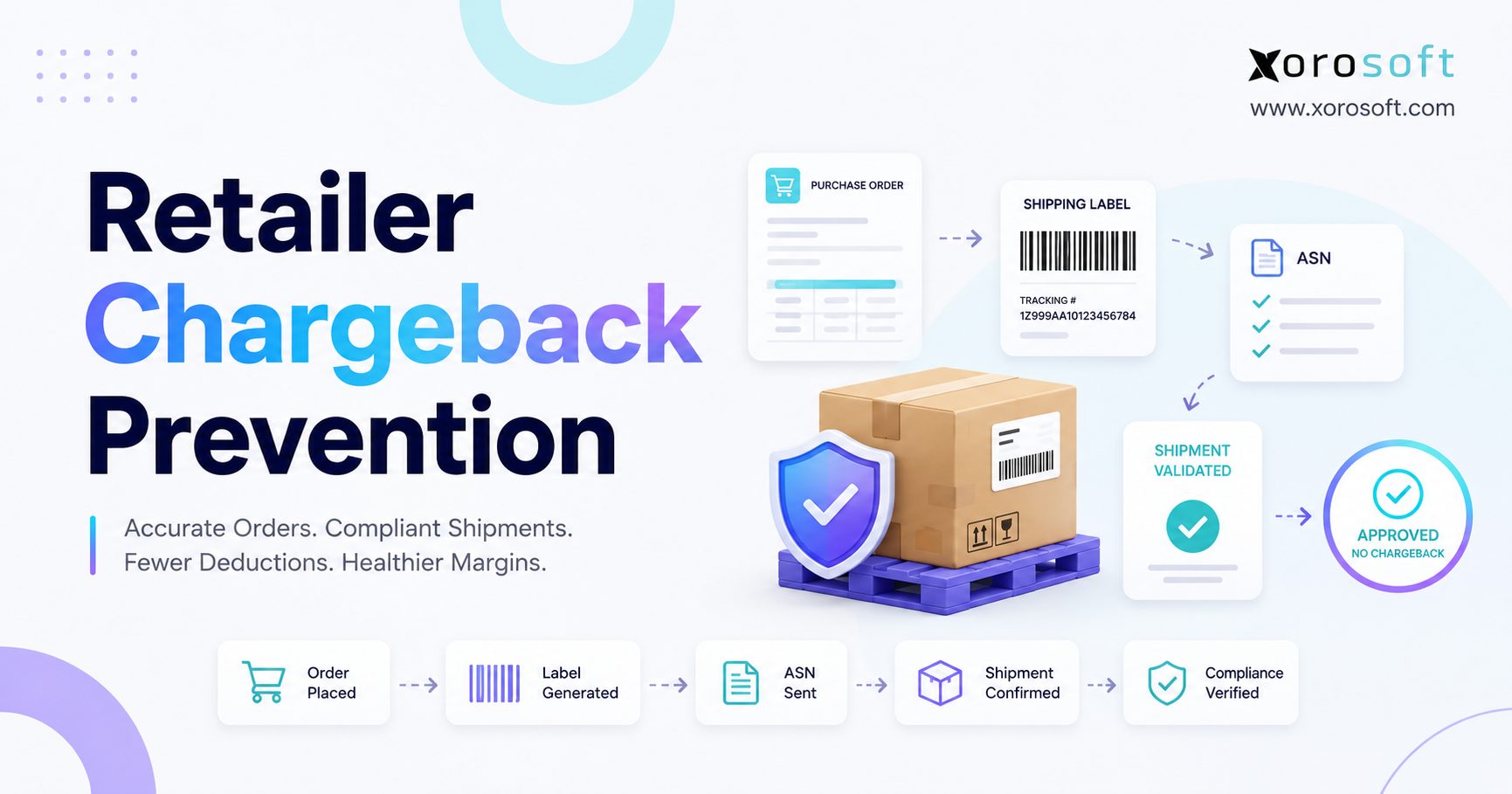
Retailer chargeback prevention is an important topic for businesses looking to protect their revenue streams and minimise losses.
1. Retailer Chargebacks Reveal Operational Breakdowns
Retailer chargebacks usually appear on remittance statements long after the original operational error occurred. However, the underlying problem may have started during order import, item mapping, inventory allocation, picking, packing, label generation, ASN transmission, carrier selection, or invoicing.
Therefore, retailer chargeback prevention must begin before a shipment leaves the supplier’s control.
A retailer may issue a deduction even when the correct products physically arrive. For example, a carton label may display the wrong purchase-order number. Similarly, an advance shipping notice may show an incorrect carton hierarchy. In addition, the shipment may use an unauthorized carrier, arrive outside the required delivery window, or include an invoice that does not match the shipped quantity.
Consequently, a seemingly small data error can interrupt the retailer’s receiving process. As a result, warehouse teams may need to inspect cartons manually, while finance teams must investigate the resulting deduction.
Retailer chargebacks are not simply accounting adjustments. Instead, they expose weaknesses across order management, inventory, warehouse execution, EDI, transportation, and billing.
1.1 Why Retail Compliance Becomes Harder as Sales Grow
A small supplier may initially manage retailer requirements through spreadsheets, employee knowledge, printed routing guides, and separate EDI portals. Although that approach may work with one warehouse and a limited product range, it becomes harder to control as order volume grows.
For example, complexity rises when the business adds:
- More retail trading partners
- More retailer distribution centers
- More routing guides
- More warehouses and third-party logistics providers
- More products and case-pack combinations
- More carrier services
- More EDI maps
- More shipping-label templates
- More delivery windows
- More wholesale and ecommerce channels
Furthermore, each retailer may define different requirements for purchase-order acknowledgments, carton configurations, shipping labels, ASNs, carriers, appointments, invoices, and supporting documents.
As a result, employees cannot reliably remember every customer-specific exception. Instead, retailer chargeback prevention must become a controlled part of the order-to-shipment workflow.
Moreover, growth can expose processes that previously appeared reliable. For instance, one experienced shipping employee may understand a major customer’s routing rules, while new or seasonal employees may not.
Therefore, the business needs system-based validation rather than informal knowledge.
1.2 One Warehouse Error Can Create Several Deductions
Consider a retailer order for 300 units packed into 25 cartons.
During picking, the warehouse discovers that 12 units are unavailable. However, an employee ships 288 units without updating the sales order. Meanwhile, the label application continues to use the original quantity. In addition, the ASN reports 25 complete cartons containing 300 units. Finally, the accounting system invoices the retailer for the full order.
One shortage has now created several mismatches:
- Purchase order versus physical shipment
- Sales order versus packed quantity
- Carton contents versus shipping label
- Physical shipment versus ASN
- Shipped quantity versus invoice
- Retailer receipt versus supplier records
Although the recovery team may dispute some deductions, prevention is more efficient. Therefore, retailer chargeback prevention should identify the shortage, update the commitment, correct the carton data, rebuild the ASN, and align the invoice before shipment release.
Moreover, the corrected shipment should preserve an audit trail. Consequently, finance can later confirm why the quantity changed and whether the retailer accepted the adjustment.
2. What Retailer Chargeback Prevention Covers
Retailer chargeback prevention is the process of validating purchase orders, inventory, cartons, labels, EDI documents, routing instructions, shipments, and invoices before a supplier completes fulfillment. Its purpose is to keep the retailer order, physical delivery, and electronic records synchronized.
This definition covers business-to-business vendor compliance deductions. In contrast, it does not refer to consumer credit-card disputes.
2.1 Prevention, Detection, Recovery, and Correction
A mature compliance program includes four connected activities.
First, prevention stops an error before shipment release.
Second, detection identifies a discrepancy during fulfillment or immediately after document transmission.
Third, recovery disputes an invalid deduction or provides evidence supporting repayment.
Finally, root-cause correction changes the underlying process so the same violation does not recur.
Recovery remains important because retailers, carriers, and receiving locations can also make mistakes. Nevertheless, a company that focuses only on disputes may recover revenue while continuing to create preventable deductions.
Therefore, retail chargeback prevention should connect deduction analysis with improvements in order management, warehousing, EDI, transportation, and billing.
In addition, prevention and recovery should share the same evidence. As a result, the company can use one operational history to stop errors before shipment and investigate claims afterward.
2.2 Common Retailer Chargeback Categories
| Chargeback category | Typical operational cause | Preventive control |
|---|---|---|
| Order discrepancy | Incorrect item, quantity, price, or date | Purchase-order validation |
| Short shipment | Packed quantity differs from commitment | Scan-based picking and packing |
| Label violation | Wrong template, barcode, data, or placement | Retailer-specific label controls |
| ASN violation | Missing, late, rejected, or inaccurate ASN | ASN-to-shipment reconciliation |
| Routing violation | Wrong carrier, service, or appointment | Digital routing-guide rules |
| Timing violation | Early or late shipment | Ship-window validation |
| Invoice discrepancy | Price or quantity does not match shipment | Order-to-invoice matching |
| Packaging violation | Incorrect case pack or carton configuration | Packing-rule validation |
The exact reason codes and penalties depend on the trading partner. Therefore, suppliers need a maintained source of retailer requirements rather than an informal collection of emails, spreadsheets, and employee notes.
Moreover, suppliers should review those requirements regularly. Otherwise, a label or routing process may remain technically accurate but use an outdated retailer specification.
2.3 Why Prevention and Recovery Need the Same Data
Prevention teams need current order and shipment data. Meanwhile, recovery teams need complete historical evidence.
However, those requirements should not create two separate information environments. Instead, the same system history that validates a shipment before release should later show:
- What the retailer ordered
- What the supplier acknowledged
- What inventory was allocated
- What warehouse employees picked
- What each carton contained
- Which label appeared on each logistics unit
- What the ASN reported
- Which carrier collected the shipment
- What the supplier invoiced
- When every activity occurred
As a result, a connected audit trail supports both retailer chargeback prevention and deduction recovery.
Furthermore, the evidence should be easy to retrieve. Otherwise, even a valid dispute may become too expensive to investigate.
3. The Data Chain Behind Retail Chargeback Prevention
Retail compliance depends on a complete operational sequence rather than one EDI transaction or one warehouse checkpoint.
Typically, the chain includes:
1. Retailer purchase order
2. EDI translation
3. ERP sales order
4. Order validation
5. Purchase-order acknowledgment
6. Inventory allocation
7. Warehouse release
8. Picking
9. Packing and cartonization
10. SSCC assignment
11. Shipping-label generation
12. Shipment confirmation
13. ASN creation
14. Carrier handoff
15. Invoice generation
16. Retailer receiving
17. Deduction and payment reconciliation
Therefore, each stage should preserve and validate the information created earlier in the process. Otherwise, one incorrect field can move through several systems before anyone notices it.
In addition, every stage should have a clear owner. Consequently, teams can resolve exceptions without waiting for several departments to determine who controls the record.
3.1 The Three Records That Must Agree
Retailer chargeback prevention depends on agreement among three core records.
First, the retailer purchase order defines what the customer requested.
Second, the physical shipment represents what the warehouse actually picked, packed, labeled, and handed to the carrier.
Third, the electronic shipment record tells the retailer what to expect.
However, the electronic record should not represent an earlier plan when the physical shipment has changed. For instance, an order may begin with 20 cartons but finish with 19 after consolidation. If the ASN and labels still show the original carton structure, the receiving system may not match the delivered units correctly.
Therefore, changes made during fulfillment must update the final shipment record.
Similarly, invoice data must reflect authorized shipment changes. Otherwise, an operational correction can still become a billing deduction.
3.2 Planned and Confirmed Quantities Serve Different Purposes
| Data stage | Operational meaning | Appropriate downstream use |
| Ordered quantity | What the retailer requested | Original commercial reference |
| Acknowledged quantity | What the supplier accepted | Customer commitment |
| Allocated quantity | Inventory reserved | Planning and warehouse release |
| Picked quantity | Inventory collected | Interim validation |
| Packed quantity | Inventory inside final cartons | Label and ASN source |
| Shipped quantity | Inventory released to carrier | Final fulfillment record |
| Invoiced quantity | Inventory billed | Must align with shipment |
An ASN created from ordered quantities may become inaccurate after a shortage, substitution, split shipment, or carton change. Consequently, confirmed packing and shipping records should control downstream documents.
Likewise, an invoice should follow the authorized shipped quantity rather than automatically using the quantity originally ordered.
Furthermore, the system should preserve each quantity as a separate record. As a result, teams can determine whether a mismatch began during order acceptance, allocation, picking, packing, or billing.
3.3 Every System Handoff Creates Compliance Risk
A common pre-ERP software stack includes:
- EDI portal
- Accounting system
- Inventory application
- Warehouse application
- Label software
- Carrier portal
- Purchasing spreadsheet
- Reporting spreadsheet
Every transfer between these applications creates another opportunity for delay or incorrect data entry.
For example, an employee may copy the wrong purchase-order number. Similarly, a carton adjustment may never reach the EDI team. Meanwhile, a carrier change might appear in the shipping portal but not in the ASN. Finally, the invoice may use the original sales order instead of the confirmed shipment.
The goal is not necessarily to eliminate every specialized application. Instead, the business should define which system owns each record and how updates reach every connected workflow.
Moreover, integrations should move confirmed data rather than incomplete plans. Otherwise, automation can distribute an error faster across the operation.
4. Retailer Chargeback Prevention Starts With Order Controls
The earliest opportunity for retailer chargeback prevention occurs when the retailer order enters the business.
Order import alone does not create control. Instead, the system must determine whether the company can fulfill the order according to the customer’s commercial, inventory, timing, packing, and shipping requirements.
Therefore, automatic order creation should be followed by automatic validation. Otherwise, incorrect information can enter allocation and warehouse workflows without review.
4.1 Retailer Chargeback Prevention Through PO Validation
A retailer purchase order may include:
- Customer and supplier identifiers
- Purchase-order number
- Ship-to location
- Item identifier
- Ordered quantity
- Unit of measure
- Price
- Discounts and allowances
- Requested ship date
- Cancel date
- Delivery window
- Freight terms
- Special packing instructions
The ERP should compare this information with controlled customer, item, price, location, and inventory records.
For example, an unsupported item number should not flow silently into fulfillment. Likewise, an order with an invalid destination, conflicting date, unexpected price, or unsupported pack configuration should enter an exception queue.
As a result, order errors can be corrected before they reach allocation or warehouse execution.
In addition, exception queues should identify the reason for each hold. Consequently, customer service can resolve the issue without reviewing every field manually.
4.2 Item Mapping Prevents SKU Errors
Retailers and suppliers may identify the same product differently.
For instance, a retailer might use its own item number, while the supplier uses an internal SKU and a separate GTIN or UPC. Apparel businesses also manage style, color, and size attributes. Meanwhile, food companies may include case, lot, date-code, or shelf-life requirements.
Reliable item mapping connects these identifiers without forcing warehouse employees to interpret them manually.
Moreover, the mapping must distinguish between similar products. A parent style is not sufficient when the retailer ordered a specific size and color.
Therefore, customer-specific item mapping is an essential vendor compliance control.
Similarly, inactive or replaced items should trigger an exception. Otherwise, an outdated mapping may direct the warehouse to the wrong product.
4.3 Unit-of-Measure Controls Prevent Quantity Mismatches
Unit-of-measure errors can create significant discrepancies.
For example, a retailer may order ten cases while the internal system stores the product in individual units. If each case contains twelve units, the warehouse must allocate and ship 120 units rather than ten.
The same principle applies to:
- Inner packs
- Master cases
- Assortment packs
- Pallets
- Catch-weight products
- Individually serialized units
Therefore, vendor chargeback prevention requires controlled conversion rules so orders, warehouse tasks, labels, ASNs, and invoices describe the same commercial unit.
In addition, the conversion should remain visible throughout fulfillment. As a result, employees can understand how the customer quantity relates to the warehouse quantity.
4.4 Ship-Window Validation Supports Retail Compliance
The system should distinguish among:
- Do-not-ship-before date
- Requested ship date
- Cancel date
- Carrier pickup cutoff
- Required arrival date
- Delivery appointment
- Actual delivery date
These dates serve different purposes. For instance, shipping early may violate a retailer’s requirements even if the products arrive safely.
Conversely, a shipment may leave the supplier on time but miss its arrival window because the selected service cannot meet the required transit time. Therefore, the order should not be released until inventory, warehouse capacity, carrier service, and retailer timing rules align.
Moreover, the system should recalculate risk when dates change. Otherwise, an approved order may become noncompliant after a carrier delay or warehouse reschedule.
4.5 Purchase-Order Acknowledgments Must Stay Synchronized
A purchase-order acknowledgment communicates whether the supplier accepts the order or proposes changes.
When the supplier reduces a quantity, changes a date, or rejects an item, the ERP sales order should reflect that decision. Otherwise, customer service may acknowledge one commitment while the warehouse fulfills another.
Consequently, retailer chargeback prevention requires one controlled commitment that feeds allocation, fulfillment, ASN generation, and invoicing.
In addition, subsequent retailer changes should update the same commitment. Therefore, the business can avoid processing an outdated version of the order.
5. Inventory Controls Strengthen Retailer Chargeback Prevention
Order accuracy does not guarantee shipment accuracy. Therefore, the supplier must also control how inventory is promised, reserved, transferred, and released.
Inventory control becomes especially important when several channels compete for the same stock. Consequently, wholesale, ecommerce, marketplace, and manufacturing demand must share one reliable availability view.
5.1 Retailer Chargeback Prevention Through Allocation
Allocation reserves available inventory for a specific order.
Without allocation, a business may:
- Promise the same stock to several customers
- Consume wholesale inventory through an ecommerce channel
- Fulfill a lower-priority order first
- Create an unauthorized partial shipment
- Release work from the wrong warehouse
- Miss customer-specific lot or expiry rules
Moreover, allocation should consider more than total on-hand quantity. It may also need to evaluate warehouse, status, lot, serial number, expiry date, quality hold, retailer restriction, and delivery deadline.
As a result, allocation helps protect both customer commitments and warehouse execution.
In addition, allocation exceptions should appear before the order reaches picking. Otherwise, the warehouse may discover the shortage too late to protect the retailer’s required delivery window.
5.2 Multi-Warehouse Allocation Adds New Controls
Multi-warehouse fulfillment creates flexibility. However, it also introduces compliance risk.
One warehouse may have the correct inventory but lack the retailer’s approved label template, carrier cutoff, packing materials, or EDI-connected workflow. Similarly, splitting an order across two locations may require separate ASNs, shipment numbers, appointments, or invoices.
Therefore, the system should determine whether an alternative warehouse can meet the complete retailer requirement rather than only checking whether stock is available.
In addition, the order record should clearly show which warehouse owns each shipment and which ASN belongs to each fulfillment location.
Consequently, teams can prevent one facility from transmitting shipment information for cartons packed at another location.
5.3 Ecommerce and Wholesale Inventory Must Remain Coordinated
Many consumer brands sell through direct-to-consumer storefronts while also fulfilling wholesale retail orders.
If both channels use the same inventory without controlled allocation, a high-volume ecommerce promotion can consume stock already committed to a retailer. Consequently, the business may create shortages, partial shipments, delayed deliveries, incorrect ASNs, or invoice disputes.
Therefore, the operating system should separate available, allocated, picked, packed, and shipped quantities by channel and order.
In addition, allocation priorities should reflect retailer deadlines, customer commitments, and available fulfillment capacity.
Similarly, returns and order cancellations should update availability quickly. Otherwise, the business may purchase unnecessary stock while saleable inventory remains unavailable in another application.
6. Warehouse Controls Reduce Vendor Chargebacks
The warehouse converts electronic commitments into physical cartons. Consequently, it is the final location where many product, quantity, label, and package errors can still be prevented.
However, warehouse speed should not replace validation. Instead, the process should make the compliant action the fastest and easiest action for the operator.
6.1 Barcode-Directed Picking Improves Accuracy
A scan-based workflow can validate:
- Warehouse
- Zone
- Bin
- Product
- Lot
- Serial number
- Quantity
- Order
- User
- Timestamp
The scan itself does not guarantee accuracy. Instead, the value comes from comparing the scanned information with the expected task and blocking incorrect work.
For example, the picker should receive an immediate exception after scanning the wrong color, size, lot, or quantity. Therefore, the error can be corrected before the item reaches the packing station.
An integrated warehouse management system can support barcode scanning, picking, packing, inventory visibility, and shipment execution. Moreover, those capabilities become more valuable when the WMS uses the same order and inventory data as the broader operating system.
In addition, the WMS should record exceptions and overrides. As a result, managers can identify recurring training, master-data, or process problems.
6.2 Packing Controls Confirm Every Carton
The packing process should record which items and quantities enter each carton.
This record supports:
- Shipping labels
- SSCC assignment
- ASN package hierarchy
- Shortage investigation
- Retailer receiving
- Returns
- Deduction disputes
Therefore, a carton should not be closed while its contents remain unknown or unconfirmed.
In addition, packers should receive an exception when carton contents do not meet the retailer’s authorized quantity, case-pack, or assortment requirements.
Consequently, the carton record becomes the foundation for both the physical label and the electronic ASN.
6.3 Carton and Pallet Hierarchies Must Match
Retail shipments may include several levels:
- Shipment
- Purchase order
- Pallet
- Master carton
- Inner carton
- Item
The digital hierarchy should match the physical hierarchy.
For example, if warehouse employees move cartons between pallets after labels and ASN records have been created, the system must update the hierarchy or prevent the move. Otherwise, the retailer may scan an SSCC that points to the wrong package contents.
Consequently, late-stage packing changes require the same level of control as the original pack process.
Moreover, pallet consolidation should not erase carton-level traceability. Instead, each logistics unit should remain connected to its contents and shipment.
6.4 Retailer-Specific Packing Rules Need Validation
Retailer requirements may define:
- Case-pack quantity
- Inner-pack quantity
- Mixed-SKU restrictions
- Assortment ratios
- Carton weight
- Carton dimensions
- Pallet height
- Pallet pattern
- Packaging material
- Ticketing requirements
- Hanger requirements
A correctly printed barcode cannot correct an incorrectly packed carton. Therefore, retail compliance management must validate the physical configuration before label generation.
Moreover, the system should direct the operator to the correct customer-specific packing workflow.
Similarly, a retailer-specific quality check may be necessary before carton closure. As a result, the business can prevent packaging deductions that scanning alone cannot detect.
6.5 Compliance Should Control Shipment Release
The system should stop a shipment when:
- Picking remains incomplete
- Packed quantities differ from authorized quantities
- A carton has no confirmed contents
- Required labels are missing
- An SSCC is missing or duplicated
- Carrier information is incomplete
- The ASN has not passed validation
- The shipment falls outside its permitted window
As a result, retailer chargeback prevention becomes part of normal warehouse execution rather than a separate audit completed after loading.
In addition, overrides should require authorization and a recorded reason. Otherwise, employees may bypass controls whenever shipment deadlines become tight.
7. Shipping Labels Support Retailer Chargeback Prevention
Retail shipping labels are not simply printed paperwork. Instead, they connect physical logistics units with digital shipment information.
Therefore, label accuracy depends on order data, carton contents, customer rules, barcode configuration, and print quality. If any one of those components is wrong, the label may fail even though the printer works correctly.
7.1 SSCC Controls Strengthen Retailer Chargeback Prevention
The Serial Shipping Container Code identifies a logistics unit, which may include a case, pallet, or parcel. In addition, the SSCC connects the physical logistics unit with electronic shipment records.
Each required logistics unit should therefore receive a unique SSCC.
The identifier should be:
- Generated through a controlled sequence
- Assigned to the correct carton or pallet
- Stored against the shipment
- Encoded in the appropriate barcode
- Included in the ASN when required
- Preserved in shipment history
Otherwise, duplicate or incorrectly assigned SSCCs can prevent the retailer from matching a physical carton to its electronic shipment record.
Moreover, number generation should remain centralized. Consequently, separate warehouses and label applications cannot accidentally issue the same identifier.
7.2 GS1-128 and UCC-128 Terminology
Many routing guides continue to use the older term UCC-128. However, GS1-128 is the current terminology commonly used for logistics labels.
Therefore, suppliers should understand both terms because retailer documentation may use either one.
More importantly, the supplier must follow the current label format, barcode, content, and placement requirements defined by the retailer.
In addition, teams should avoid assuming that one customer’s label format will work for another. Instead, each retailer profile should point to its approved template and rules.
7.3 Connect Every Label to Confirmed Carton Contents
A reliable process follows this sequence:
1. The warehouse packs the carton or pallet.
2. The system confirms its contents.
3. The system assigns a unique SSCC.
4. The label prints from confirmed shipment data.
5. The same SSCC enters the ASN hierarchy.
6. The retailer scans the logistics unit during receiving.
As a result, the physical carton, electronic ASN, and retailer receipt reference the same logistics identity.
Furthermore, any carton change after label printing should trigger revalidation. Otherwise, the printed label may no longer represent the contents inside the package.
Similarly, a voided carton should also void or retire its label record. Consequently, unused identifiers cannot remain attached to active shipment data.
7.4 Customer-Specific Templates Reduce Label Violations
A retailer-compliant label may include:
- Supplier name
- Retailer name
- Ship-from address
- Ship-to address
- Purchase-order number
- Department number
- Product information
- Carton count
- SSCC
- Barcode
- Human-readable information
- Routing information
The system should select the template through the customer, order, destination, and shipment profile.
Instead of choosing manually from a folder of label files, warehouse operators should receive the approved template automatically. Consequently, the risk of using an outdated or incorrect format decreases.
In addition, template changes should follow version control. Therefore, managers can confirm which label version appeared on a specific historical shipment.
7.5 Label Reprints Require Strong Controls
Reprints create risk because the same SSCC may accidentally appear on two cartons.
Therefore, a controlled reprint process should:
- Require an authorized reason
- Preserve the original SSCC
- Confirm that the first label is unusable
- Record the user and timestamp
- Prevent another logistics unit from receiving the duplicate
- Update the shipment audit history
When a carton is repacked, the business should also determine whether the original logistics unit still exists or whether a new SSCC is required.
Moreover, the original label should be removed or destroyed. Otherwise, two readable labels may remain active in the warehouse.
8. ASN Compliance Drives EDI Chargeback Prevention
The ASN tells the retailer what the supplier is sending before the delivery reaches the receiving location.
Although the EDI 856 provides a common shipment-notice structure, each retailer determines the required fields, hierarchy, timing, and business rules.
Therefore, successful transmission alone does not prove compliance. Instead, the ASN must accurately represent the confirmed shipment and satisfy the customer’s implementation requirements.
8.1 ASN Chargeback Prevention Starts With Packed Data
An ASN generated from the original order may be incorrect by the time the shipment is ready.
For example, the warehouse may have:
- Short shipped an item
- Removed damaged inventory
- Made an approved substitution
- Split the order
- Consolidated cartons
- Rebuilt a pallet
- Changed the carrier
- Updated tracking information
Therefore, the final ASN should use actual packed and shipped data. As a result, the electronic notice remains aligned with the physical delivery.
In addition, the ASN creation event should occur after final carton confirmation. Otherwise, subsequent packing changes may not reach the retailer.
8.2 Validate Every ASN Hierarchy Level
An ASN may represent several information levels.
First, shipment-level information may include the shipment number, carrier, ship date, tracking information, route, weight, and estimated arrival.
Second, order-level information connects the shipment to one or more retailer purchase orders.
Third, pack-level information identifies cartons, pallets, package identifiers, and SSCCs.
Finally, item-level information identifies products and shipped quantities.
Although the precise format varies by retailer, the physical carton and ASN package record should point to the same contents.
Therefore, any change to cartonization should update the ASN hierarchy before transmission.
Similarly, an order split should produce the correct shipment and order references for each delivery. Otherwise, the retailer may receive duplicate or incomplete records.
8.3 ASN Timing Requires a Controlled Balance
The ASN should be generated after the shipment information becomes reliable but before the retailer’s transmission deadline.
Therefore, the workflow should confirm that:
- Packing is final
- Quantities are final
- Labels are complete
- SSCCs are assigned
- Carrier information is available
- Tracking or PRO data is available when required
- Transmission occurs within the permitted window
- Failures receive immediate attention
Sending the ASN too early can create inaccurate data. Conversely, sending it too late can prevent the retailer from preparing its receiving operation.
Moreover, the business should monitor transmission time against carrier pickup time. As a result, teams can identify whether warehouse delays or EDI delays are causing late notices.
8.4 Technical Acceptance Is Not Always Business Acceptance
A document that leaves the supplier’s system is not necessarily a successfully processed document.
EDI monitoring should distinguish among:
- File created
- File transmitted
- Communication received
- Syntax accepted
- Business rules accepted
- Retailer application processed
- Retailer receiving matched
Consequently, EDI chargeback prevention requires visible exception queues, assigned owners, response deadlines, and escalation procedures.
Moreover, teams should monitor missing acknowledgments rather than only explicit rejections.
For example, a technically accepted file may still contain a retailer-specific quantity or hierarchy error. Therefore, business-rule feedback must remain visible to operations.
8.5 Use a Pre-ASN Validation Checklist
Before transmission, verify:
1. Retailer account
2. Ship-to destination
3. Purchase-order number
4. Shipment number
5. Actual products
6. Actual quantities
7. Carton and pallet hierarchy
8. SSCC identifiers
9. Carrier and SCAC
10. Tracking or PRO number
11. Shipment date
12. Expected arrival information
13. EDI map and version
14. Retailer transmission deadline
If validation fails, the system should stop transmission or require an authorized exception. Therefore, incomplete shipment records cannot silently become inaccurate ASNs.
In addition, validation results should remain attached to the shipment. Consequently, teams can demonstrate which controls passed before dispatch.
9. Routing and Shipping Controls Prevent Retail Deductions
Correct products, labels, and ASNs can still produce deductions when the supplier violates routing or delivery requirements.
Therefore, transportation controls must begin before carrier selection. Otherwise, the warehouse may complete a shipment that cannot be delivered according to the retailer’s rules.
9.1 Convert Routing Guides Into Operating Rules
Retailer routing guides may define:
- Approved carrier
- Service level
- Freight terms
- Consolidation instructions
- Small-parcel requirements
- LTL requirements
- Appointment process
- Distribution-center schedule
- Bill-of-lading format
- Pallet requirements
- Shipment weight thresholds
- Label placement
A routing-guide PDF remains an important reference. Nevertheless, employees should not have to interpret the entire document whenever they release an order.
Instead, frequently used requirements should become customer-specific system rules, validation steps, and workflow prompts. As a result, compliance does not depend entirely on individual experience.
Moreover, updates should have an effective date. Consequently, the system can apply the correct rule to orders created before and after a retailer change.
9.2 Validate Carrier and Tracking Data
Depending on the retailer and transportation mode, the shipment record may require:
- Carrier name
- SCAC
- Service level
- Tracking number
- PRO number
- Trailer number
- Pickup number
- Appointment number
- Actual pickup time
Furthermore, the same information should feed the ASN, bill of lading, shipment record, and retailer communication.
If the carrier changes after ASN creation, the system should update or rebuild the affected document before shipment release.
Similarly, tracking information should be validated for format and completeness. Otherwise, the retailer may receive an ASN that cannot support delivery tracking.
9.3 Keep Shipping Documents Synchronized
The following documents should use the same controlled source data:
- Packing slip
- Shipping label
- Bill of lading
- ASN
- Carrier record
- Invoice
Separate document-generation processes encourage inconsistent purchase-order numbers, quantities, destinations, dates, and carrier details.
Therefore, a unified cloud ERP platform can reduce manual handoffs by connecting order management, inventory, warehouse execution, shipping, accounting, ecommerce, and reporting within one environment.
In addition, connected data reduces repeated entry. As a result, the business can improve both speed and consistency.
9.4 Match Every Invoice to the Authorized Shipment
The invoiced quantity should reflect what the supplier was authorized to bill rather than automatically using the original ordered quantity.
Before invoicing, validate:
- Purchase-order reference
- Customer item
- Shipped quantity
- Agreed price
- Allowances
- Freight terms
- Taxes
- Shipment number
- Destination
Therefore, when the warehouse completes a partial shipment, the invoice should follow the approved shipment and order-change process.
Otherwise, a warehouse shortage can become both an ASN discrepancy and an invoice deduction.
Moreover, invoice holds should remain visible to finance. Consequently, the billing team can resolve exceptions before transmitting the invoice.
10. ERP, WMS, EDI, and Deduction Software Serve Different Roles
Retailer chargeback prevention often involves several software categories. Therefore, understanding their responsibilities helps the business identify gaps without expecting one tool to perform every task.
| Capability | ERP | WMS | EDI platform | Deduction software |
| Sales-order control | Primary | Limited | Transmits data | No |
| Inventory allocation | Primary | Executes instructions | No | No |
| Picking and packing | Connected or limited | Primary | No | No |
| Carton data | Stores or receives | Captures | Transmits | Evidence |
| Label execution | Connected | Primary | May support formats | No |
| ASN creation | Supplies business data | Supplies pack data | Maps and transmits | Reviews errors |
| Invoice generation | Primary | No | Maps and transmits | Matches deductions |
| Accounting | Primary | No | No | Recovery support |
| Dispute management | Reporting support | Evidence support | Transmission evidence | Primary |
Capabilities vary by platform, integration model, configuration, and implementation.
10.1 ERP Controls Commercial and Financial Records
ERP generally manages:
- Customers
- Sales orders
- Inventory
- Allocation
- Purchasing
- Shipment records
- Pricing
- Invoicing
- Accounting
- Reporting
A cloud ERP for inventory-driven businesses can connect operational transactions with financial records. Consequently, order, shipment, invoice, and deduction analysis can use consistent source data.
Moreover, ERP can connect the customer commitment with the eventual financial result. Therefore, finance does not need to reconstruct operational history from several systems.
10.2 WMS Controls Physical Warehouse Execution
The WMS generally manages:
- Warehouse tasks
- Storage locations
- Barcode scanning
- Picking
- Packing
- Cartonization
- Labels
- Shipment confirmation
- Warehouse history
Therefore, its primary role is to ensure that the physical shipment matches the authorized order and produces reliable pack data.
However, the WMS still depends on accurate customer, item, quantity, and timing information from upstream systems.
Similarly, downstream systems depend on the WMS for confirmed carton information. Consequently, integration quality affects both labels and ASNs.
10.3 EDI Controls Trading-Partner Document Exchange
EDI technology generally manages:
- Document translation
- Retailer-specific maps
- Communication protocols
- Transaction transmission
- Acknowledgments
- Mapping errors
- Document exceptions
However, the EDI provider should not have to estimate what the warehouse shipped. Instead, it needs reliable data from the ERP and WMS.
Therefore, EDI integration quality is central to retailer chargeback prevention.
In addition, the EDI platform should return errors to the operating team. Otherwise, rejected documents may remain visible only to technical users.
10.4 Deduction Software Supports Recovery and Analysis
Deduction-management tools commonly support:
- Deduction intake
- Reason-code classification
- Case management
- Evidence gathering
- Dispute submission
- Recovery tracking
- Trend reporting
These systems can improve recovery productivity. Nevertheless, long-term retailer deduction prevention depends on correcting the processes that created valid violations.
Therefore, deduction trends should feed operational improvement meetings. As a result, recovery work can reduce future deductions instead of only addressing past claims.
11. Retailer Chargeback Prevention Requires Root-Cause Analytics
A deduction should become an operational learning record rather than only a financial adjustment.
Therefore, each deduction should connect to the retailer, order, shipment, warehouse, carrier, reason code, and responsible process. Otherwise, the company can measure total deductions without understanding how to reduce them.
11.1 Retailer Chargeback Prevention Metrics to Track
Useful metrics include:
- Total chargeback value
- Chargebacks as a percentage of retailer sales
- Chargeback value by retailer
- Chargebacks by reason code
- Chargebacks by warehouse
- Chargebacks by carrier
- Chargebacks by product
- ASN accuracy rate
- Label-error rate
- Short-shipment rate
- On-time, in-full performance
- Repeat violation rate
- Dispute recovery rate
- Average resolution time
In addition, the company should distinguish among valid supplier-originated deductions, invalid deductions, carrier failures, receiving discrepancies, duplicate deductions, and documentation failures.
As a result, teams can prioritize process improvements instead of treating every deduction in the same way.
Moreover, trends should be reviewed over time. Consequently, management can determine whether corrective actions actually reduce recurrence.
11.2 Assign Ownership to the Team Controlling the Cause
| Error | Likely operational owner |
| Missing item mapping | Master-data team |
| Incorrect customer price | Sales operations or finance |
| Inventory shortage | Planning or purchasing |
| Short pick | Warehouse |
| Incorrect carton label | Warehouse or compliance |
| Late ASN | EDI or shipping |
| Wrong carrier | Transportation |
| Missed appointment | Transportation or carrier |
| Invoice mismatch | Billing or ERP team |
Finance may coordinate the deduction case. However, the corrective action belongs with the team that controls the original process.
Therefore, each repeat reason code should have a named operational owner and a target correction date.
In addition, teams should record the corrective action. As a result, future reviews can distinguish between unresolved issues and issues that have already been addressed.
11.3 Preserve Evidence Automatically
A complete shipment record may include:
- Original purchase order
- Purchase-order acknowledgment
- Order changes
- Inventory allocation
- Pick scans
- Pack scans
- Carton contents
- Label copy
- SSCC history
- ASN
- EDI acknowledgment
- Bill of lading
- Carrier pickup
- Tracking history
- Proof of delivery
- Invoice
- User and timestamp history
As a result, automatic evidence retention reduces investigation time and strengthens both prevention and dispute management.
Moreover, the company can compare deduction claims with the original operational history rather than relying on reconstructed evidence.
Therefore, evidence should remain linked to the transaction instead of being stored in disconnected email folders.
12. Avoid These Retailer Chargeback Prevention Mistakes
Retailer chargeback prevention can fail even after a company adds automation. Usually, the failure occurs because ownership, master data, or system responsibilities remain unclear.
Therefore, businesses should avoid assuming that software alone will fix the process. Instead, technology should enforce clearly defined operating rules.
12.1 Treating Chargebacks as a Finance-Only Issue
Finance receives the deduction. However, order management, warehousing, EDI, transportation, purchasing, or billing may control the cause.
Therefore, a cross-functional review should examine both the financial claim and the original operating event.
In addition, finance should share deduction trends with operations regularly. Otherwise, the process owner may never see the financial effect of recurring errors.
12.2 Creating ASNs From Planned Quantities
The original order may not match the final shipment.
Consequently, ASNs should use confirmed pack and shipment data rather than assumptions recorded before warehouse execution.
Otherwise, shortages and packing changes will not appear correctly in the retailer’s receiving record.
Moreover, early ASN creation should trigger a final reconciliation. As a result, operational changes can be captured before transmission.
12.3 Printing Labels From Separate Spreadsheets
Spreadsheet label generation separates carton identity from live order and packing data.
For example, a carton adjustment may not reach the spreadsheet. Similarly, an outdated template may remain available to operators.
Therefore, label generation should use the same confirmed carton data that supports the ASN.
In addition, spreadsheet-based reprints may bypass SSCC controls. Consequently, duplicate logistics-unit identifiers become more likely.
12.4 Keeping Retailer Rules in Employee Memory
Experienced employees may understand customer-specific exceptions. Nevertheless, turnover, seasonal labor, new warehouses, and peak-volume periods make undocumented knowledge unreliable.
Therefore, high-frequency requirements should become configured rules, validation steps, or controlled work instructions.
In addition, routing-guide updates should have a formal review and approval process.
Otherwise, employees may continue following a previous requirement after the retailer changes its program.
12.5 Ignoring Failed EDI Transactions
A sent document can still fail transmission, syntax validation, or retailer business validation.
As a result, EDI exceptions need named owners, alerts, response deadlines, and escalation procedures.
Moreover, missing acknowledgments should create follow-up tasks rather than disappearing from view.
Therefore, EDI monitoring should be part of daily operations, not only an IT responsibility.
12.6 Automating an Undefined Process
Automation can move incorrect data faster.
Before implementing new software, the business should:
- Map the existing workflow
- Identify the system of record
- Clean master data
- Document retailer rules
- Define exception ownership
- Establish shipment-release criteria
- Agree on performance metrics
Only then can retailer chargeback prevention automation produce consistent results.
Moreover, implementation testing should include exception scenarios. Otherwise, the project may validate only the easiest orders.
13. When Automated Retailer Chargeback Prevention Becomes Necessary
A full ERP-led compliance model is not required for every supplier. However, the need grows as order volume, retailer complexity, and deduction exposure increase.
Therefore, the decision should be based on operating risk rather than company size alone. For example, a smaller supplier with several demanding retail partners may need stronger controls than a larger business with simpler channels.
13.1 Businesses That Need Stronger Vendor Compliance Controls
Automation becomes more valuable when a company:
- Sells to several major retailers
- Uses EDI
- Produces GS1-128 labels
- Operates several warehouses
- Uses third-party logistics providers
- Manages customer-specific pricing
- Handles high order volume
- Receives recurring deductions
- Sells through wholesale and ecommerce channels
- Uses disconnected operational systems
- Cannot trace cartons to ASN records
- Cannot connect deductions to process failures
Therefore, the decision should reflect operational complexity rather than revenue alone.
In addition, management should calculate the cost of manual compliance work. As a result, the business can compare software investment with both deductions and administrative effort.
13.2 Businesses That May Not Need Full ERP Yet
A smaller supplier may manage compliance effectively when it:
- Handles few retailer orders
- Operates one warehouse
- Sells a simple product range
- Works with one or two trading partners
- Has limited labeling variation
- Experiences minimal deduction volume
- Uses a reliable EDI and WMS connection
- Maintains a clear shipment audit trail
In this situation, targeted improvements may provide more value than a full system replacement.
However, management should still monitor whether manual work and deductions increase as retailer volume grows.
Moreover, the company should document upgrade triggers. Consequently, it can respond before the current process becomes a major constraint.
13.3 Alternatives to Full ERP Implementation
Possible alternatives include:
- Standalone EDI platform
- Managed EDI service
- WMS connected to accounting software
- Retail compliance application
- Deduction-management system
- Integration middleware
- Retailer portals
- Documented manual controls for low volume
These approaches can work. Nevertheless, the company must define which system owns each record and how changes move between applications.
Otherwise, the business may add software without eliminating the underlying data gaps.
In addition, every alternative should support a clear audit trail. Therefore, the company can still investigate deductions efficiently.
13.4 Signs That the Current System Has Reached Its Limit
The following conditions indicate that stronger retailer chargeback prevention may be needed:
1. ASN errors recur every month.
2. Employees enter orders into several applications.
3. Labels are generated outside the packing process.
4. Warehouse changes do not update EDI automatically.
5. Retailer portals require constant manual work.
6. Shipment evidence is scattered across systems.
7. Deductions rise as wholesale sales increase.
8. Finance cannot connect deductions to operational causes.
When several conditions apply, the business should evaluate a more integrated operating platform.
Moreover, the evaluation should begin before a new retailer launch or warehouse expansion. Otherwise, growth may multiply existing weaknesses.
14. Retail Chargeback Prevention Across Inventory-Driven Industries
The same control principles apply across industries. However, product attributes, packing rules, and shipment risks differ.
Businesses can review ERP solutions for inventory-driven industries while assessing how their sector affects order management, warehouse operations, manufacturing, inventory, and retail compliance requirements.
Therefore, industry fit should be evaluated through real product and shipment scenarios. Instead, buyers should avoid assuming that a general inventory feature will support every industry-specific requirement.
14.1 Apparel Retail Chargeback Prevention
Apparel suppliers manage style, color, size, season, ticketing, hangers, prepacks, and store allocations.
Common failures include:
- Wrong size or color
- Incorrect assortment ratio
- Missing price ticket
- Incorrect hanger
- Wrong store allocation
- Missed seasonal window
Therefore, warehouse scanning should validate the exact product variant rather than only the parent style.
In addition, ticketing and prepack rules should be connected to the retailer order before work reaches the packing station.
Moreover, seasonal orders require tighter date control. Consequently, a late shipment may lose value even when the products remain saleable.
14.2 Furniture Retail Compliance
Furniture and home-goods shipments may involve:
- Oversized products
- Multiple cartons per item
- Specialized carriers
- Delivery appointments
- Carton sequencing
- Damage evidence
- White-glove services
Consequently, the shipment record should connect every component carton with the correct product, order, carrier, and appointment.
Moreover, missing one component carton may cause the retailer to treat the entire product as incomplete.
Therefore, multi-carton products need both item-level and carton-level visibility.
14.3 Sporting Goods and Consumer Products
Seasonal launches and promotional programs can create sudden order peaks.
Relevant controls include:
- Case-pack validation
- Retail assortments
- Promotional dates
- Allocation priorities
- Replenishment schedules
- Retailer label formats
- High-volume warehouse waves
Moreover, temporary warehouse labor should follow the same system validation rules as permanent employees.
Therefore, peak-season speed should not remove compliance checkpoints.
In addition, promotional orders may use special labels or pack configurations. Consequently, standard replenishment rules may not be sufficient.
14.4 Food and Beverage Compliance
Food and beverage businesses may need to control:
- Lots
- Expiration dates
- Best-before dates
- Date codes
- Temperature requirements
- Recall traceability
- First-expiry-first-out allocation
Therefore, order, warehouse, label, and ASN data may need to preserve additional product attributes beyond the standard SKU and quantity.
In addition, allocation should prevent products with insufficient remaining shelf life from being assigned to certain retailers.
Similarly, a lot change during packing should update the shipment record. Otherwise, traceability information may not match the delivered products.
14.5 Wholesale Distribution Chargeback Prevention
Wholesale distributors often manage:
- Several retailer EDI relationships
- Customer-specific pricing
- Large SKU catalogs
- Inventory allocation
- Partial shipments
- Multiple warehouses
- Retailer-specific labels
- Carrier rules
Xorosoft may be relevant when a distributor wants to connect inventory, order management, purchasing, accounting, warehouse execution, forecasting, and reporting within one operating environment.
Moreover, a unified system can help operations and finance review deductions using the same transaction history.
Therefore, wholesale distributors should evaluate both transaction volume and customer-specific complexity.
14.6 Manufacturing and Retail Compliance
Manufacturers must connect retailer demand with:
- Bills of materials
- Component availability
- Production orders
- Production schedules
- Quality controls
- Finished-goods allocation
- Retailer delivery windows
When production falls behind, the supplier should update its customer commitment before releasing incomplete warehouse work or sending inaccurate shipment information.
Therefore, manufacturing status must remain connected to sales-order and fulfillment decisions.
In addition, quality holds should update available inventory immediately. Otherwise, the warehouse may allocate products that cannot legally or commercially ship.
15. How to Evaluate ERP for Retailer Chargeback Prevention
ERP selection should begin with real workflow scenarios rather than a generic feature checklist.
Therefore, vendors should demonstrate how the system responds to shortages, carton changes, failed ASNs, carrier substitutions, and invoice holds. Otherwise, buyers may only see a perfect workflow that does not reflect real operations.
15.1 Test the Complete Retail Order Workflow
Ask vendors to demonstrate:
1. Retailer purchase-order import
2. Item and location mapping
3. Price and date validation
4. Order acknowledgment
5. Inventory allocation
6. Warehouse picking
7. Packing and cartonization
8. SSCC assignment
9. Label generation
10 ASN creation from packed data
11. Carrier validation
12. Shipment confirmation
13. Invoice generation
14. Deduction investigation
A slide or feature list does not prove that these steps use connected data. Therefore, the demonstration should follow one order from receipt through invoicing.
In addition, the vendor should show what happens when the shipment changes during packing.
Moreover, users should see where exceptions appear and who receives them. Consequently, the buyer can evaluate practical control instead of presentation quality.
15.2 Ask Specific Retail Compliance Questions
Key questions include:
- Does the ASN use actual packed quantities?
- Where does the system generate SSCC numbers?
- Can retailer rules be configured by customer and destination?
- How does the system control label versions?
- What prevents duplicate SSCCs?
- How are failed EDI transactions monitored?
- Can users trace an invoice back to cartons and scans?
- Can the system support several warehouses and 3PLs?
- How are order changes reflected in warehouse work?
- Which functions require third-party applications?
Furthermore, vendors should explain exception handling instead of showing only successful transactions.
Consequently, the buyer can evaluate operational control rather than surface-level functionality.
In addition, the buyer should ask which rules require customization. Therefore, implementation scope becomes clearer before the project begins.
15.3 Compare ERP Platforms by Workflow Fit
Businesses may consider platforms such as:
1. Xorosoft
2. NetSuite
3. Acumatica
4. Microsoft Dynamics 365 Business Central
5. Sage
7. Cin7
8. Brightpearl
9. Fishbowl
This is not a universal ranking. Instead, the right fit depends on transaction volume, financial requirements, EDI architecture, warehouse complexity, manufacturing needs, implementation resources, and budget.
Businesses evaluating broader cloud ERP options can compare Xorosoft and NetSuite based on their operational priorities.
Moreover, buyers should compare complete workflows rather than isolated modules. As a result, they can identify hidden integration and implementation requirements.
15.4 Where Xorosoft Fits Retailer Chargeback Prevention
Xorosoft is designed for inventory-driven retailers, wholesalers, manufacturers, and ecommerce businesses. Its platform connects order management, inventory, purchasing, warehouse operations, manufacturing, accounting, reporting, ecommerce, and EDI-related workflows.
Therefore, the platform may suit businesses that have outgrown:
- QuickBooks
- Spreadsheets
- Inventory-only software
- Separate warehouse applications
- Disconnected ecommerce systems
- Manual purchasing processes
However, every implementation should still confirm the required retailer maps, label templates, routing rules, carrier integrations, and exception workflows.
In addition, businesses should test their most demanding retailer requirements. Consequently, they can evaluate fit using real operational complexity.
15.5 Connect Shopify and Wholesale Operations
A consumer brand may sell directly through Shopify while also fulfilling wholesale retailer purchase orders through EDI.
Without coordinated allocation, the ecommerce channel may consume inventory committed to wholesale orders. Similarly, Shopify refunds, order edits, and shipment confirmations can affect inventory and financial records.
The Xorosoft ERP integration for Shopify can connect ecommerce activity with inventory, order, warehouse, and accounting workflows.
Therefore, the objective is not simply to connect sales channels. Instead, inventory, warehouse, order, and accounting decisions must remain consistent across them.
Moreover, wholesale commitments should influence ecommerce availability. Otherwise, channel growth may create stock conflicts and retailer shortages.
16. Retailer Chargeback Prevention FAQs
16.1 What is a retailer chargeback?
A retailer chargeback is a deduction or compliance fee issued when a supplier fails to meet an order, shipment, label, routing, ASN, delivery, or invoice requirement. Unlike a consumer payment dispute, it normally relates to business-to-business vendor compliance. Therefore, suppliers should analyze both the financial deduction and the operational event behind it.
16.2 What is retailer chargeback prevention?
Retailer chargeback prevention uses operational controls to identify and correct compliance errors before shipment. Therefore, it connects purchase-order validation, inventory allocation, warehouse execution, labeling, ASN preparation, carrier selection, invoicing, and audit records. As a result, electronic documents are more likely to match the physical delivery.
16.3 Why do retailers issue vendor chargebacks?
Retailers issue vendor chargebacks to enforce supplier agreements and recover costs created by shortages, inaccurate documents, missed delivery windows, receiving problems, or manual reconciliation. However, every retailer establishes its own reason codes, tolerances, evidence requirements, and dispute process. Therefore, suppliers must maintain current customer-specific rules.
16.4 What causes most retail chargebacks?
Common causes include incorrect quantities, short shipments, unauthorized substitutions, wrong shipping labels, duplicate SSCCs, late ASNs, routing violations, missed appointments, packaging problems, price discrepancies, and invoice errors. Therefore, suppliers should identify priority causes using their own deduction data. In addition, they should separate repeat errors from one-time exceptions.
16.5 How does ERP support retailer chargeback prevention?
ERP maintains controlled customer, item, inventory, order, shipment, invoice, and accounting records. Moreover, when connected with WMS and EDI, it can validate orders, allocate inventory, control fulfillment, supply ASN data, match invoices with shipments, and preserve evidence. Consequently, teams can manage compliance using consistent operational data.
16.6 What is an ASN chargeback?
An ASN chargeback is a deduction connected with a missing, late, rejected, duplicate, or inaccurate advance shipping notice. For example, it may occur when quantities, cartons, purchase orders, products, SSCCs, carrier information, or shipment dates do not match the delivery. Therefore, suppliers should reconcile the ASN with confirmed packing data.
16.7 What information should an ASN contain?
Required ASN content depends on the retailer. Typically, it may include a shipment number, purchase-order references, items, quantities, package hierarchy, SSCC identifiers, carrier, tracking or PRO number, shipment date, and estimated arrival information. Therefore, suppliers should follow the customer’s current implementation guide.
16.8 When should an ASN be transmitted?
The retailer’s implementation guide determines the deadline. Operationally, the ASN should use final packing and shipment information. However, it must still be transmitted early enough to support the retailer’s receiving process. Therefore, businesses need both data-completion and timing controls.
16.9 What happens when an ASN does not match the shipment?
The retailer may be unable to receive the products through its normal automated process. Consequently, employees may have to inspect cartons and reconcile quantities manually. Depending on the agreement, the mismatch may create delays, shortages, rejected documents, or deductions. Therefore, pre-transmission reconciliation is essential.
16.10 What is an EDI 856 ASN?
The EDI 856 is a shipment-notice transaction used to communicate shipment, order, package, and item information. Therefore, it helps the retailer prepare for delivery and compare arriving goods with open purchase orders. However, the exact structure depends on the trading partner’s implementation requirements.
16.11 What is a GS1-128 shipping label?
A GS1-128 logistics label carries structured supply chain information. In particular, it commonly includes an SSCC that identifies a carton, pallet, or other logistics unit. Therefore, the physical label should connect with the corresponding electronic shipment record.
16.12 Is UCC-128 the same as GS1-128?
UCC-128 is an older term that remains common in retailer routing guides. However, GS1-128 is the current terminology. Therefore, suppliers should recognize both terms while following the retailer’s current format, data, barcode, and placement requirements.
16.13 What is an SSCC?
An SSCC, or Serial Shipping Container Code, identifies a logistics unit created for storage or transportation. For example, the unit may be a carton, pallet, or parcel. Consequently, trading partners can track that physical unit independently from the individual products inside it.
16.14 How does an SSCC connect a carton to an ASN?
The warehouse assigns the carton an SSCC and encodes it in the physical barcode. Meanwhile, the same identifier appears in the corresponding ASN package record. Therefore, the retailer can match the scanned carton with the electronic shipment information. As a result, receiving becomes faster and more controlled.
16.15 Can an incorrect shipping label cause a chargeback?
Yes. For example, a label may be noncompliant because of an incorrect purchase-order number, destination, barcode, SSCC, template, carton count, human-readable field, or placement. However, the exact violation depends on the retailer’s routing guide. Therefore, labels should be validated before shipment release.
16.16 How does warehouse scanning reduce chargebacks?
Warehouse scanning validates products, locations, quantities, lots, serial numbers, cartons, and shipments before employees complete each task. In addition, it creates timestamped evidence. Nevertheless, scanning still depends on accurate master data and configured rules. Therefore, technology and process discipline must work together.
16.17 What is retailer routing-guide compliance?
Routing-guide compliance means following the retailer’s requirements for carriers, service levels, labels, packaging, pallets, appointments, shipment windows, bills of lading, and transportation data. Because those requirements may change, suppliers need a controlled update process. Otherwise, teams may follow outdated instructions.
16.18 What is an OTIF chargeback?
An OTIF chargeback relates to on-time, in-full delivery performance. In other words, it evaluates whether the supplier delivered the agreed products and quantities within the required period. However, the retailer determines the calculation and tolerance. Therefore, suppliers must understand each customer’s specific measurement method.
16.19 Can ERP generate retailer-compliant labels?
Some ERP platforms include label functionality, while others use an integrated WMS, label engine, or EDI provider. Therefore, suppliers should verify customer-specific templates, GS1-128 support, SSCC generation, carton-data integration, reprint controls, and placement requirements. In addition, they should test actual retailer scenarios.
16.20 Does ERP replace EDI software?
Not always. ERP controls orders, inventory, shipments, invoices, and accounting. Meanwhile, EDI technology translates and exchanges documents in the trading partner’s required format. Therefore, the two systems often work together rather than replacing one another.
16.21 Can a WMS prevent retailer chargebacks?
A WMS can prevent warehouse-originated errors through scanning, picking, packing, cartonization, label generation, and shipment confirmation. However, it also needs accurate order data and reliable EDI, carrier, invoice, and accounting connections. Therefore, end-to-end prevention depends on integration.
16.22 Which documents help dispute retailer chargebacks?
Useful evidence may include the purchase order, acknowledgment, order changes, pick scans, pack records, carton contents, shipping label, ASN, EDI acknowledgment, bill of lading, carrier pickup record, tracking history, proof of delivery, invoice, receiving record, and user timestamps. Therefore, businesses should retain these records systematically.
16.23 Which retailer chargeback metrics should suppliers track?
Suppliers should track chargeback value, percentage of sales, reason codes, retailers, warehouses, carriers, products, ASN accuracy, label errors, shortage rates, OTIF performance, recovery rate, resolution time, and repeat violations. Consequently, teams can prioritize the highest-value failures. In addition, management can measure whether corrective actions work.
16.24 When should a supplier automate retail compliance?
Automation becomes valuable when retailer count, order volume, warehouse complexity, EDI requirements, or deduction value makes manual control unreliable. For example, repeated ASN errors, spreadsheet labels, duplicate data entry, and missing audit trails are strong warning signs. Therefore, automation should be evaluated before those problems limit growth.
16.25 What are the alternatives to implementing a full ERP?
Alternatives include standalone EDI, managed EDI services, WMS, retail compliance software, deduction-management platforms, integration middleware, and controlled manual workflows. Ultimately, the right model depends on volume, accounting needs, warehouse complexity, retailer expectations, and existing systems. However, every option still needs clear data ownership and integration.
17. Strategic Takeaway: Make Retailer Chargeback Prevention a Release Rule
Retailer chargeback prevention becomes sustainable when compliance is built into the order-to-shipment workflow rather than reviewed after delivery.
First, identify repeat deductions by retailer, reason code, warehouse, and process owner. Next, document where purchase-order, inventory, carton, label, ASN, carrier, and invoice data originate. In particular, pay attention to fields that employees repeatedly copy between applications.
Afterward, establish clear shipment-release conditions. A shipment should not leave when quantities remain unresolved, carton contents are incomplete, SSCCs are missing, labels have not passed validation, carrier data is unavailable, or the ASN does not match the confirmed shipment.
In addition, every override should have an owner and a recorded reason. As a result, urgent shipments do not quietly bypass the compliance process.
Technology should support those controls rather than replace process ownership. Therefore, software selection should begin with the company’s real retailer workflows and repeat chargeback causes.
For inventory-driven businesses, a connected platform can reduce gaps among sales orders, inventory, warehouse operations, EDI, shipping, and accounting. Consequently, Xorosoft may be relevant for retailers, wholesalers, manufacturers, and ecommerce businesses that have outgrown disconnected applications.
Finally, evaluate the actual retailer workflow instead of beginning with a generic software presentation. Bring recent chargeback reason codes, routing guides, EDI requirements, warehouse processes, and the current system architecture into the discussion.
As a result, the business can identify which deductions are preventable, which integrations are missing, and where stronger retailer chargeback prevention controls can protect margin as wholesale sales grow.
To review how your orders, labels, ASNs, shipments, inventory, and accounting workflows connect, book a personalized ERP consultation with Xorosoft.