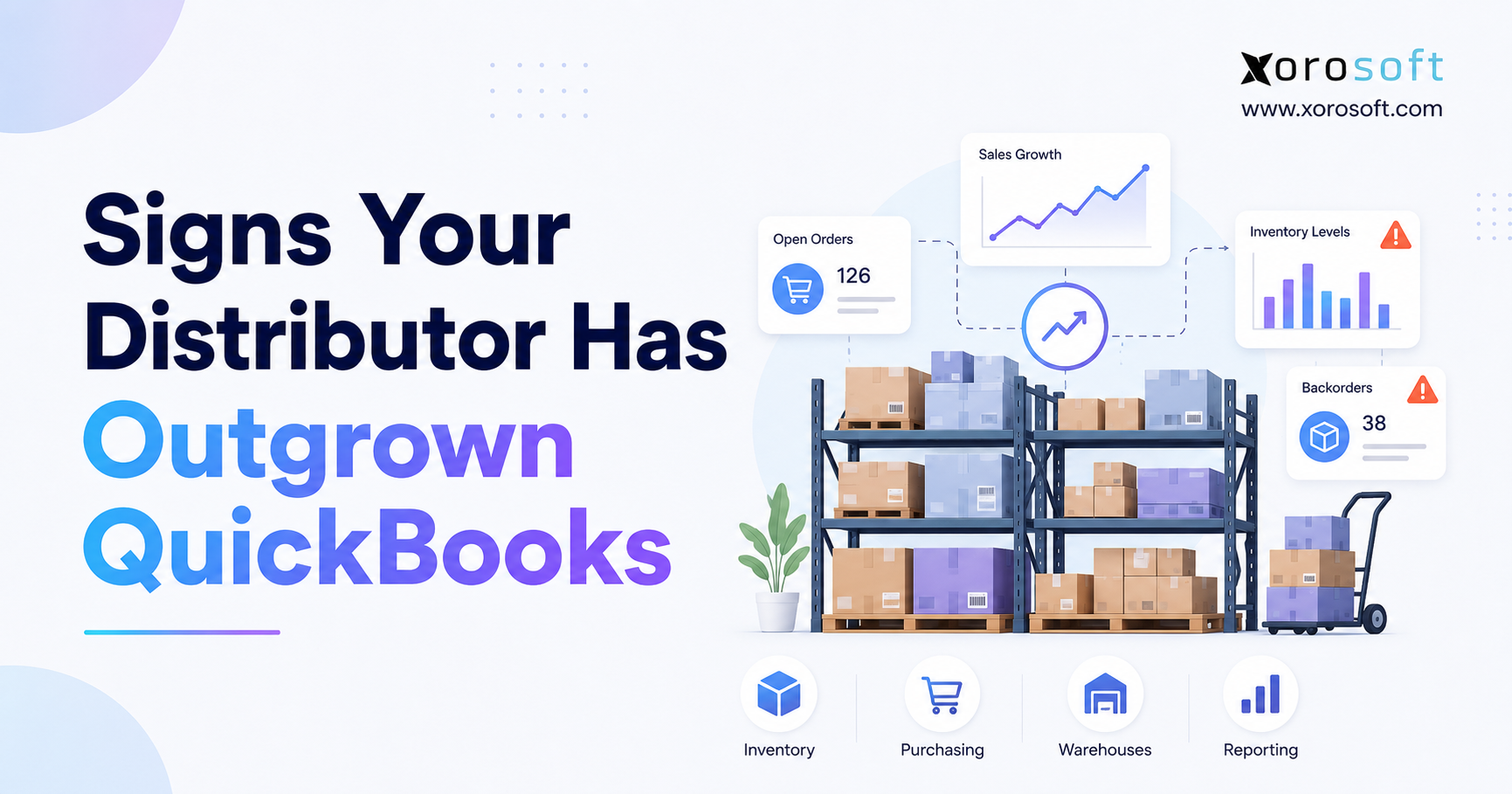
If you feel like your company has outgrown QuickBooks, you’re not alone.
1. Why Distribution Growth Can Outpace QuickBooks
QuickBooks can serve a distributor well while daily work remains simple. Finance can send invoices, enter supplier bills, track payments, and prepare standard reports without a large software project. However, distribution companies rarely stay simple as they grow.
As the business adds products, suppliers, warehouses, sales channels, and customer rules, operational work expands quickly. Meanwhile, Shopify, Amazon, wholesale, and EDI orders may all draw from the same stock. As a result, the main challenge is no longer basic accounting. It is keeping inventory, purchasing, warehouse activity, orders, ecommerce, and finance in sync.
A distributor has outgrown QuickBooks when these workflows cannot stay connected without spreadsheets, repeat entry, manual checks, and separate apps. QuickBooks may still record the final accounting entries correctly. Nevertheless, the teams creating those entries may be using different systems and different versions of the same data.
Therefore, the decision to replace QuickBooks should not depend on revenue alone. Instead, it should be based on clear signs that the current setup is slowing work, raising costs, weakening control, or limiting growth.
1.1 What It Means to Have Outgrown QuickBooks
A distributor has outgrown QuickBooks when normal daily work needs more control than the current setup can provide. Finance may still create invoices and financial reports. Even so, inventory, purchasing, warehouse tasks, forecasting, ecommerce, or production may happen somewhere else.
Accounting depends on those daily actions. For example, a receipt changes stock and supplier balances, while a shipment affects revenue, cost, and availability. Similarly, a return changes refunds, sellable stock, and margin.
If these steps do not update together, finance receives late or conflicting information. Consequently, the problem becomes a wider business systems issue rather than a simple bookkeeping concern.
1.2 Process Problems Versus QuickBooks Limits
Not every inventory or reporting issue means the company has outgrown QuickBooks. Some problems come from poor item setup, duplicate codes, wrong units of measure, weak receiving steps, limited training, or loose access rules. Likewise, a broken integration can create errors even when the main system is suitable.
Before replacing software, review whether better training, cleaner data, and stronger controls can solve the issue. In many cases, those changes improve performance without an ERP move. However, the situation is different when skilled employees must keep exporting, copying, checking, and correcting routine data.
If well-trained teams cannot complete normal work without outside files and manual fixes, the system may no longer fit the business. Therefore, the company should examine whether growth has created a structural software gap.
1.3 Quick Test for a Distributor That May Have Outgrown QuickBooks
Your distributor may have outgrown QuickBooks when several of these signs continue:
- Physical stock does not match system stock.
- Teams cannot see true availability across warehouses.
- Buyers depend on spreadsheets for reorder planning.
- Warehouse staff use paper or separate apps.
- Shopify, Amazon, wholesale, and EDI orders compete for the same inventory.
- Month-end close waits for operational corrections.
- Management reports require several exports.
- Employees enter the same order into multiple systems.
- Integrations fail or need frequent checks.
- Growth requires more administrative staff.
One issue may need a process fix. However, several related issues usually point to a wider system problem.
2. Inventory Signs You Have Outgrown QuickBooks
Inventory is often the first area to show system strain. Every receipt, transfer, pick, shipment, return, count, and adjustment changes both stock and value. Therefore, one missed step can affect sales, purchasing, warehouse work, customer service, and finance.
2.1 Stock Differences Show You Have Outgrown QuickBooks
A distributor may have outgrown QuickBooks when inventory adjustments become routine. Small differences can happen because products are damaged, misplaced, counted incorrectly, or entered late. However, repeated gaps usually point to a deeper process or systems issue.
Common differences include physical stock versus system stock, on-hand versus available inventory, warehouse stock versus Shopify stock, and received goods versus supplier bills. In addition, returned stock may not match sellable stock, while inventory quantities may not match inventory value.
At first, employees may simply change the final number. However, an adjustment only hides the cause. Instead, the team should trace the purchase order, receipt, transfer, sales order, shipment, return, integration record, and financial entry.
If each department trusts a different system, the company does not have one reliable inventory record. At that point, an integrated cloud ERP becomes relevant because inventory, purchasing, sales, warehouse work, and accounting can operate from shared data.
2.2 Multi-Warehouse Growth Shows QuickBooks Is No Longer Enough
Adding a second warehouse changes far more than the storage address. The distributor now needs to track stock by site, inventory promised to orders, transfers waiting to ship, goods moving between locations, returns waiting for checks, and incoming purchase orders.
Some QuickBooks setups can track stock by location. Even so, a distributor may have outgrown QuickBooks when warehouse rules, sales channels, buying decisions, and reporting no longer work well together.
For example, the company may know that 500 units sit in Warehouse A. Yet it may not know how many are promised to customers, how many are held for inspection, or how many should move to Warehouse B. Therefore, location tracking alone may not provide full multi-warehouse control.
2.3 Unclear Available Stock Is a QuickBooks Warning Sign
On-hand inventory does not show how much can actually be sold. Some units may already be held for a wholesale customer, packed for shipment, tied to an ecommerce order, damaged, needed for production, or moving between warehouses.
As a result, sales may promise stock that is not truly available. At the same time, buyers may place extra orders because they cannot see incoming or in-transit goods.
A stronger system should separate on-hand, available, committed, incoming, in-transit, held, damaged, and quality-control inventory. When employees calculate these figures by hand, the distributor may have outgrown QuickBooks.
2.4 Manual Inventory Value Checks Show System Strain
A company can have correct unit counts and still report the wrong inventory value. Finance may need to review late receipts, freight, duty, returns, damaged goods, cost changes, product builds, transfers, and supplier bill timing.
In addition, costs may change after goods have already been sold. If the finance team rebuilds these events every month, the problem is larger than accounting. Instead, it shows that physical inventory activity and financial records are not linked closely enough.
Therefore, repeated manual inventory value work is another sign that the distributor has outgrown QuickBooks.
3. Warehouse Signs QuickBooks Is No Longer Enough
The warehouse is where system data meets real products. Consequently, delays or mistakes on the warehouse floor quickly spread to the rest of the company.
When warehouse tasks happen outside the main system, a gap appears between the physical event and the digital record. During that gap, sales, purchasing, customer service, and finance may be working with old information.
3.1 Paper Receiving Can Mean You Have Outgrown QuickBooks
Paper receiving may work when inbound volume is low. However, it becomes risky when the company receives many products, suppliers, containers, and partial shipments.
A late receipt can leave teams unsure about what arrived, where it was stored, whether anything was damaged, and whether the stock can be sold. Similarly, the supplier bill may be approved before the team confirms the actual receipt.
Products may also be placed in a warehouse bin while the system still shows them at the dock. As a result, employees waste time searching for goods that should already be available.
Therefore, paper receiving can become a clear sign that the distributor has outgrown QuickBooks.
3.2 Picking and Packing Workarounds Show QuickBooks Limits
Warehouse teams often create their own tools when the main system does not support daily work. Printed pick lists, bin spreadsheets, handwritten notes, separate barcode apps, end-of-day updates, and manual count changes are common examples.
These workarounds may help in the short term. Nevertheless, they create a delay between what happened in the warehouse and what the system shows.
For instance, an order may leave the building while another sales channel still shows the product as available. A connected warehouse management system can link receiving, putaway, replenishment, picking, packing, shipping, transfers, counts, and returns with shared inventory data.
3.3 Cycle Count Problems Show You Have Outgrown QuickBooks
Cycle counting should explain why inventory is wrong. However, some businesses only change the system number to match the physical count. That action fixes the current balance but does not prevent the issue from returning.
Instead, managers should ask whether a receipt was entered incorrectly, a transfer stayed open, an order shipped without confirmation, or a return entered stock too soon. They should also review units of measure, damaged goods, bin locations, and integration records.
If the system cannot show a clear transaction history, the distributor may have outgrown QuickBooks and the warehouse tools around it.
4. Purchasing Signs You Have Outgrown QuickBooks
Purchasing becomes harder as the company adds suppliers, warehouses, sales channels, seasonal products, and longer lead times. Creating a purchase order may remain simple. However, deciding what to buy, when to buy it, how much to buy, and where to send it becomes far more difficult.
4.1 Spreadsheet Buying Means QuickBooks Is No Longer Enough
Purchasing spreadsheets often contain data that buyers cannot see in one system. That data may include current stock, open sales orders, incoming purchase orders, lead times, safety stock, forecasts, minimum quantities, warehouse needs, price breaks, and approval status.
The file may be correct when the buyer creates it. Meanwhile, sales and stock continue to change. Therefore, the data may already be old when the order is placed.
In addition, the spreadsheet may be hard for other people to use. If one buyer leaves or takes time off, the team may not understand the formulas, assumptions, or manual changes.
When purchasing depends on a separate planning file, the distributor may have outgrown QuickBooks.
4.2 Reorder Planning Depends on One Employee
Experienced buyers know which suppliers are reliable, which items sell quickly, and which customers require priority. That knowledge is valuable. Even so, the business should not depend on one person’s memory.
A repeatable buying process should use current stock, open demand, open purchase orders, lead times, safety stock, forecasts, warehouse needs, order minimums, cash limits, and storage limits.
When these inputs sit in several apps, the buyer must gather them manually. By contrast, XoroONE can bring inventory, purchasing, warehouse work, accounting, ecommerce, reporting, and production into one system.
As a result, buyers can work from current data instead of rebuilding the same view in a spreadsheet.
4.3 Supplier Costs Are Hard to Compare
The lowest item price is not always the lowest total cost. Buyers also need to review lead time, late deliveries, partial shipments, freight, duty, quality issues, fill rate, price changes, rush shipping, and return rates.
If the purchase price is stored in QuickBooks while freight and supplier results are kept elsewhere, the buyer may not see the full cost. Consequently, the company may continue ordering from a supplier that looks inexpensive but creates higher delay and service costs.
Therefore, weak supplier data can be another sign that the distributor has outgrown QuickBooks.
5. Financial Signs Your Distributor Has Outgrown QuickBooks
Financial reports can remain accurate even when daily business data is slow or difficult to trust. Therefore, distributors should look at how much work is required before finance can close the books, explain the results, and support management decisions.
5.1 A Slow Close Can Mean You Have Outgrown QuickBooks
Finance may be waiting for teams to enter late receipts, complete transfers, confirm shipments, fix negative inventory, record returns, match supplier bills, review ecommerce orders, repair failed integrations, or check inventory adjustments.
In this case, finance is rebuilding daily events instead of simply closing the books. If the same corrections happen every month, the distributor may have outgrown QuickBooks.
More importantly, the delay may prevent management from seeing reliable results until long after the period has ended. As a result, leaders make decisions with stale information.
5.2 Reports Require Too Many Exports
Distribution leaders need more than an income statement and balance sheet. They may also need inventory by warehouse, margin by product, margin by channel, inventory age, backorders, fill rate, supplier lead time, open purchase value, and warehouse output.
If employees must export data from several tools and join it in spreadsheets, the reports become slow and easy to break. Furthermore, different departments may use different rules.
Sales may report by order date, whereas finance reports by invoice date. Operations may report by shipment date. Consequently, meetings focus on which number is correct rather than what action the company should take.
5.3 Slow Margin Checks Show QuickBooks Is No Longer Enough
Margin may fall because of supplier price increases, freight, discounts, returns, write-offs, product mix, marketplace fees, rush shipping, or warehouse errors.
A connected system should help finance trace the change back to the cause. However, if the answer requires several employees, multiple exports, and several days of review, the distributor may have outgrown QuickBooks.
Therefore, slow margin analysis is not only a reporting issue. It is also a sign that operations and finance do not share one clear record.
6. Ecommerce and EDI Signs QuickBooks Is No Longer Enough
Ecommerce adds more orders, returns, fees, discounts, payment records, and inventory changes. Each channel may also have its own view of available stock. Therefore, the distributor needs one shared inventory record behind every channel.
6.1 Shopify Stock Falls Out of Sync
A Shopify order affects inventory, allocation, picking, packing, shipping, payment, tax, discounts, refunds, returns, payouts, and margin.
If Shopify, warehouse, inventory, and accounting tools update at different times, the company may oversell items or miss financial information. For example, a return may be approved in Shopify but not recorded in the warehouse.
Similarly, a shipment may be confirmed in the warehouse but reach accounting later. The Xorosoft ERP app for Shopify fits this type of setup by linking Shopify activity with wider ERP work.
When channel and warehouse data no longer agree, the distributor may have outgrown QuickBooks.
6.2 Wholesale and Ecommerce Orders Compete for the Same Stock
A large wholesale order may arrive while many ecommerce orders are still coming in. Without clear rules, both channels may promise the same inventory.
The team must decide which customer receives priority, how much stock should be held, which warehouse should ship, whether partial shipment is allowed, and how incoming stock affects the promise.
When these choices happen outside the main system, the distributor may have outgrown QuickBooks. Consequently, customer service becomes reactive rather than planned.
6.3 EDI Still Needs Too Much Manual Work
EDI can send and receive business documents. However, it does not solve every internal step.
Employees may still need to manage customer item codes, price differences, stock shortages, order changes, shipping labels, routing rules, advance ship notices, invoice differences, and chargebacks.
Therefore, do not ask only whether the software supports EDI. Instead, ask whether an EDI order can move from receipt to allocation, shipment, invoicing, and exception handling without repeat entry.
If the answer is no, the business may have outgrown QuickBooks and the links around it.
6.4 3PL and Marketplace Data Adds More Checks
Marketplaces and third-party logistics providers may send order, stock, fee, return, and shipment data at different times.
Consequently, employees may need to investigate missing orders, duplicate shipments, late stock updates, delayed returns, payout gaps, incorrect fees, and inventory differences.
When this checking becomes part of daily work, the company may have outgrown QuickBooks as the main link between channels.
7. Disconnected Systems Show You Have Outgrown QuickBooks
Many distributors use QuickBooks with several other tools. The setup may include inventory software, a WMS, EDI software, ecommerce apps, shipping tools, purchasing spreadsheets, forecast files, and reporting systems.
Each tool may perform its own task well. However, the complete setup can become difficult to manage.
7.1 Repeat Data Entry Shows You Have Outgrown QuickBooks
A customer order may move through ecommerce, inventory software, a warehouse app, and QuickBooks. Likewise, a purchase receipt may begin on paper, move into a WMS, and then be entered again for finance.
Each handoff can cause typing mistakes, duplicate records, missing records, time delays, wrong product codes, and late reports.
Automation should allow employees to manage problems and changes rather than copy routine information between systems. Therefore, frequent repeat entry is a strong sign that the distributor has outgrown QuickBooks.
7.2 Failed Integrations Take Too Much Time
Integrations can fail because of bad data, changed fields, permission issues, or timing problems. A strong connection should show the error clearly and help employees correct it.
By contrast, a weak setup may require daily checks, repeated imports, and manual reconciliation. When teams spend more time fixing integrations than helping customers or improving inventory, the distributor may have outgrown QuickBooks and the software stack around it.
7.3 Growth Requires More Administrative Staff
Use a simple test: if order volume doubled, could the current team handle it without doubling data entry, checking, and reporting work?
Consider order entry, inventory checks, purchasing, warehouse paperwork, integration monitoring, reporting, customer questions, and month-end corrections.
If administrative effort grows at nearly the same rate as sales, the system is not helping the company scale. As a result, growth creates more overhead instead of better operating leverage.
8. When QuickBooks May Still Be Enough
Not every growing distributor needs ERP. A company should not replace a system that still fits its needs. Instead, it should first confirm whether the current problems come from software limits or poor processes.
8.1 Keep QuickBooks When Work Is Still Simple
QuickBooks may remain a good fit when the business has one simple warehouse, inventory is accurate, purchasing is easy to manage, order volume is stable, integrations work well, and reports are mainly financial.
In addition, month-end close should be smooth, while employees should not need to enter the same data twice.
Under these conditions, stronger procedures may create more value than a new system. Therefore, the right answer may be to improve the current setup rather than replace it.
8.2 Fix Data Before Deciding You Have Outgrown QuickBooks
Before deciding the company has outgrown QuickBooks, review item records, units of measure, product codes, warehouse locations, receiving steps, user access, employee training, inventory adjustment rules, integration error logs, and reporting rules.
Poor data can cause problems in any system. Therefore, data cleanup should happen before an ERP project begins.
Moreover, clean data makes software selection easier because the company can show vendors real products, warehouses, pricing rules, and transaction volumes.
8.3 Add One Tool When the Need Is Narrow
A focused app may help when the business has one clear gap, such as barcode scanning, shipping, EDI, forecasting, reporting, expense control, or a customer portal.
However, the new tool should have a clear owner. It should also avoid creating another competing inventory record.
If each new app creates more integrations and manual checks, the company may only be delaying a larger ERP decision.
9. QuickBooks Versus ERP After You Outgrow QuickBooks
Rather than comparing QuickBooks and ERP only by counting features, examine how each system supports the full operation. In many growing distribution companies, QuickBooks remains focused mainly on finance. By contrast, ERP connects accounting with inventory, purchasing, warehouses, sales channels, production, and reporting.
| Business area | QuickBooks-based setup | Integrated ERP setup |
|---|---|---|
| Accounting | Main finance system | Finance linked with operations |
| Inventory | Depends on edition and apps | Linked with orders, purchasing, and warehouses |
| Purchasing | Focuses on purchase orders | Uses demand, supply, approvals, and plans |
| Warehouse | Often needs another tool | Built-in or closely linked WMS |
| Ecommerce | Uses connectors | Shares channel and inventory data |
| EDI | Often uses another service | Links EDI with orders and shipping |
| Forecasting | Uses reports or spreadsheets | Uses shared sales and inventory data |
| Reporting | Mainly finance reports | Finance and operations reporting |
| Setup | Lower first scope | Larger business change |
| Long-term work | Simple at low scale | Better fit for wider growth |
9.1 Move Beyond QuickBooks When Teams Need One Record
A distributor should consider ERP when finance, purchasing, warehouse staff, sales, and ecommerce all need the same information.
For example, one inventory error may cause an incorrect purchase order, an oversold Shopify item, a late wholesale order, a warehouse search, a customer complaint, and a finance adjustment.
Therefore, one shared system may solve more than adding another separate app. In addition, it can give each team the same view of stock, cost, orders, and activity.
9.2 Compare Total Work, Not Only Software Price
An app may cost less each month than ERP. However, distributors should also count setup, integration fees, support fees, staff checking time, report preparation, repeat entry, error correction, upgrade work, and training across many tools.
Consequently, the cheapest subscription is not always the lowest-cost way to run the business. Instead, compare the total effort required to operate and support the full software setup.
10. ERP Readiness After You Outgrow QuickBooks
Use this scorecard to review the current setup.
| Area | 0 points | 1 point | 2 points | 3 points |
| Inventory | Accurate | Small issues | Frequent adjustments | No trusted inventory record |
| Warehouses | One simple site | Several simple sites | Transfer problems | Weak multi-site control |
| Purchasing | Simple | Some spreadsheets | Planning outside the system | Depends on one buyer |
| Finance | Fast close | Small checks | Many corrections | Slow or unclear reports |
| Channels | One channel | A few stable channels | Wholesale and ecommerce | EDI, marketplaces, and 3PLs |
| Systems | Few tools | Some exports | Many integrations | Repeat entry and failures |
10.1 Score 0–5: Improve the Current QuickBooks Setup
The current system may still fit. Therefore, focus on better data, clearer training, stronger controls, fewer spreadsheets, better error checks, and more disciplined inventory work.
10.2 Score 6–10: Review One or Two Add-Ons
The business has some strain, but one focused tool may solve the largest gap.
However, define which system owns each piece of information before adding another app. Otherwise, the company may create another source of confusion.
10.3 Score 11–14: Plan Beyond QuickBooks
The company should begin mapping daily workflows, pain points, data links, report needs, warehouse requirements, sales channels, and future growth.
This does not mean the company must buy ERP at once. Nevertheless, it should begin formal planning.
10.4 Score 15–18: Start an ERP Review
The current setup likely creates too much manual work and too little control. Therefore, build a team that includes finance, purchasing, warehouse work, sales, ecommerce, and management.
11. ERP Features Needed After Outgrowing QuickBooks
A new accounting tool will not solve problems caused by inventory, warehouse work, purchasing, ecommerce, and reporting. Therefore, the future system should support the way the distributor plans to work during the next several years.
11.1 Integrated Inventory and Accounting After QuickBooks
Receipts, shipments, returns, transfers, adjustments, and product builds should update both inventory and finance.
The system should also keep a clear record of who made the change, what changed, when it changed, why it changed, and how it affected value.
As a result, finance can trace the physical event to the financial result.
11.2 Multi-Warehouse Control After You Outgrow QuickBooks
The platform should show on-hand, available, committed, incoming, in-transit, held, damaged, and bin-level inventory.
In addition, it should support transfers, site-level purchasing, reorder rules, order routing, inventory holds, and warehouse reports.
Without these controls, the distributor may recreate the same gaps inside a new system.
11.3 Better Purchasing and Forecasting
Buyers should not need to build every order in a spreadsheet. Instead, they should be able to review open sales, past sales, forecasts, open purchase orders, lead times, safety stock, order minimums, site needs, supplier results, and cash needs.
This approach helps buyers use current data rather than an old export. Consequently, purchasing becomes more consistent and less dependent on one person.
11.4 Warehouse Work Beyond QuickBooks
Review how the system handles receiving, putaway, picking, packing, shipping, transfers, cycle counts, returns, holds, barcode scanning, mobile work, and error checks.
Do not accept a feature list alone. Instead, ask the vendor to show real warehouse situations.
11.5 Shopify, Amazon, Wholesale, and EDI
The system should connect all sales channels with the same inventory and order information.
Review Shopify orders, Amazon orders, marketplace orders, wholesale orders, 3PL updates, customer pricing, refunds, returns, payouts, EDI orders, ship notices, and invoices.
Moreover, the company should test how exceptions move through the system. For example, a partial shipment or order change should not require repeat entry.
11.6 Production and Product Builds
Some distributors also build kits or manufacture products. They may need bills of materials, work orders, component demand, production plans, finished goods, labor, overhead, and cost tracking.
Therefore, a distributor moving into light production may outgrow a basic inventory and accounting setup sooner.
11.7 Clear Reports After Moving Beyond QuickBooks
Management should be able to review inventory by site, inventory age, slow-moving products, backorders, fill rate, open purchases, supplier results, warehouse work, product margin, channel margin, and cash needs.
Xorosoft brings inventory, accounting, purchasing, warehouse activity, ecommerce, production, planning, and reporting into one cloud ERP system.
12. QuickBooks Alternatives for Distributors
After a distributor has outgrown QuickBooks, software review should begin with business needs.
First, list the features that are essential. Next, identify the functions that would improve current work. Finally, document what the company may need in two or three years.
12.1 QuickBooks Alternatives to Review
| Platform | Type | Possible fit |
| Xorosoft | Cloud ERP for inventory-driven firms | Wholesale, ecommerce, inventory, WMS, accounting, and production |
| NetSuite | Broad cloud ERP | Large or complex firms |
| Acumatica | Cloud ERP | Mid-market distribution |
| Business Central | Microsoft ERP | Firms using Microsoft tools |
| Cin7 | Inventory and order system | Product firms with many sales channels |
| Brightpearl | Retail operations system | Retail and ecommerce |
| Fishbowl | Inventory and production tool | Firms keeping QuickBooks |
| Sage | Accounting and ERP tools | Finance-led business needs |
This table is not a ranking. Instead, each distributor should review industry fit, inventory depth, warehouse tools, purchasing, accounting, reports, channel links, EDI, production, setup needs, support, and total cost.
Businesses comparing wider ERP tools can also review the Xorosoft versus NetSuite comparison.
12.2 Demo Questions After You Outgrow QuickBooks
Ask each vendor to show a wholesale order with inventory allocation, a transfer between warehouses, a partial supplier receipt, a Shopify return, an EDI order change, a cycle-count difference, freight added to item cost, a backordered shipment, a product build, and a margin report by site and channel.
Also ask what requires custom work, another app, manual steps, an implementation partner, or extra fees.
13. Industry Cases Where Businesses Outgrow QuickBooks
Different industries reach system limits for different reasons. Therefore, the future setup should match the company’s products, warehouses, customers, sales channels, and operating rules.
Xorosoft provides ERP solutions by industry for several inventory-driven sectors.
13.1 Apparel Firms Outgrow QuickBooks Through Product Variants
Apparel firms manage style, color, size, season, returns, wholesale allocations, ecommerce inventory, and product life cycles.
One style can create dozens of product codes. As a result, a broad product forecast may hide a shortage in one size or color.
When these details live in separate files, the company may have outgrown QuickBooks.
13.2 Furniture Firms Outgrow QuickBooks Through Long Lead Times
Furniture distributors may manage large products, long lead times, deposits, backorders, showroom inventory, delivery plans, special orders, and partial shipments.
Availability depends on much more than a simple inventory number. For example, the team may need to review incoming goods, warehouse space, customer promises, and delivery regions before confirming an order.
Consequently, a simple accounting-led setup may not provide enough control.
13.3 Sporting Goods Firms Outgrow QuickBooks Through Seasonal Demand
Sporting goods companies often manage seasonal demand, product options, dealer orders, ecommerce, regional inventory, promotions, and brand rules.
Therefore, a good planning process must account for both planned seasons and sudden changes in demand. Otherwise, buyers may overstock one line while missing demand in another.
13.4 Food Firms Outgrow QuickBooks Through Traceability
Food and beverage distributors may need lot tracking, expiry dates, quality holds, shelf-life rules, recall support, and first-expiry-first-out picking.
These needs require a clear record of every inventory move. If lot data, warehouse work, and finance are not connected, the distributor may have outgrown QuickBooks.
13.5 Ecommerce Firms Outgrow QuickBooks Through Channel Growth
Consumer goods firms may sell through Shopify, Amazon, marketplaces, wholesale, and third-party logistics providers.
In addition, they may manage bundles, promotions, returns, channel fees, high order volume, shared inventory, and payout checks.
As these tasks grow, weak links between systems become more costly. Consequently, the business may need one shared platform behind every channel.
13.6 Manufacturers Outgrow QuickBooks Through Product Builds
A distributor may begin by selling finished goods. Later, it may add kits, custom work, light assembly, or full production.
This change introduces component demand, bills of materials, work orders, labor, and finished-goods cost.
Therefore, the company may outgrow a basic setup even if its accounting work remains manageable.
14. QuickBooks-to-ERP Migration Steps
Once a distributor has outgrown QuickBooks, it should not wait until the current setup becomes unstable. A rushed project can lead to poor data, weak testing, low staff use, and unfinished process work.
14.1 Define Why You Have Outgrown QuickBooks
Avoid broad goals such as “better inventory” or “more control.”
Instead, write down the current process, the exact problem, how often it happens, who it affects, what it costs, the future process, and how success will be measured.
This keeps the project focused on business results. Moreover, it gives vendors a clear view of what the new system must solve.
14.2 Map Every App and Spreadsheet
For each tool, record its purpose, the data it creates, the data it receives, its owner, its links, what happens when it fails, which reports use it, and which manual steps support it.
This map shows which tools should stay, change, or be removed. As a result, the company can avoid rebuilding the same complex setup in a new platform.
14.3 Clean Data Before Moving Beyond QuickBooks
Review customers, suppliers, products, units of measure, product groups, warehouse sites, bin locations, price lists, supplier product codes, bills of materials, tax rules, and payment terms.
Moving poor data into ERP only transfers the old problem. Therefore, data cleanup should happen before testing and migration.
14.4 Decide What Data to Move
Most projects need clean master data, open sales orders, open purchase orders, customer balances, supplier balances, inventory quantities, inventory value, and opening finance balances.
Older history may remain in an archive. However, the company should confirm how users will access that history after launch.
14.5 Check Opening Balances
Before launch, finance and operations should agree on the general ledger, customer balances, supplier balances, bank balances, inventory units, inventory value, open sales orders, open purchase orders, and customer deposits.
The new system should not begin with old differences. Otherwise, staff may lose trust in the platform from the first day.
14.6 Train Staff With Real Work
Warehouse staff should practice receiving, picking, transfers, counts, and returns. Meanwhile, buyers should practice reorder planning, supplier orders, approvals, and price changes.
Finance should practice checks, closing, reporting, and error review. Training should also explain why each new step matters.
Consequently, employees are more likely to follow the new process correctly.
15. Frequently Asked Questions About Outgrowing QuickBooks
15.1 How Do I Know If My Distributor Has Outgrown QuickBooks?
Your distributor may have outgrown QuickBooks when inventory, purchasing, warehouses, ecommerce, and finance cannot remain in sync without spreadsheets and manual checks. In addition, frequent adjustments, repeat entry, slow reports, weak inventory visibility, and failed integrations are strong warning signs.
15.2 Is QuickBooks Good for Wholesale Distribution?
QuickBooks can suit a wholesale business with simple inventory, purchasing, warehouse, and reporting needs. However, the fit depends on the product edition, setup, integrations, order volume, and future plans.
15.3 Is QuickBooks an ERP?
QuickBooks is mainly an accounting and business tool. By contrast, ERP usually links finance with inventory, purchasing, warehouses, sales, production, planning, ecommerce, and reports.
15.4 Is QuickBooks Enterprise Enough for a Growing Distributor?
It may be enough when inventory and warehouse needs are not too complex. However, ERP may fit better when many teams need one shared system, wider reports, production, EDI, or complex ecommerce links.
15.5 Can QuickBooks Manage More Than One Warehouse?
Some QuickBooks setups can support location-based inventory. Nevertheless, distributors should test whether transfers, inventory holds, purchasing, warehouse work, ecommerce, and reporting work at the needed level.
15.6 Can QuickBooks Handle Thousands of Products?
Product count alone does not decide the fit. Instead, the company should review product options, warehouses, orders, lot tracking, pricing, purchasing, integrations, and reports.
15.7 Why Does Physical Inventory Not Match QuickBooks?
Common causes include late receipts, missing transfers, unconfirmed shipments, returns, wrong units, duplicate records, integration delays, count errors, and damaged goods. Therefore, the team should trace the full transaction rather than only changing the final balance.
15.8 Can QuickBooks Support Inventory Forecasting?
QuickBooks reports can support a review of past sales. However, deeper planning may need lead times, seasonality, promotions, safety stock, open demand, incoming inventory, and site-level plans.
15.9 Can QuickBooks Manage EDI?
EDI often works through another provider. Therefore, the distributor should review the full order path, including item codes, prices, inventory holds, ship notices, invoices, and errors.
15.10 Can QuickBooks Support Warehouse Picking and Packing?
The answer depends on the product and connected tools. A business that needs mobile scans, bin rules, packing checks, cycle counts, returns, and worker reports may need a WMS.
15.11 Should I Add Inventory Software or Move to ERP?
Add one tool when the gap is narrow and the integration is easy to control. Consider ERP when inventory, purchasing, finance, warehouses, ecommerce, EDI, and reporting all need the same data.
15.12 What Can Replace QuickBooks for a Distributor?
Options may include Xorosoft, NetSuite, Acumatica, Business Central, Cin7, Brightpearl, Fishbowl, and Sage. However, the best fit depends on inventory, finance, warehouses, channels, EDI, production, reports, setup, and cost.
15.13 What Should Distributor ERP Include?
Useful features include accounting, inventory, purchasing, sales orders, multi-warehouse control, WMS, planning, ecommerce links, EDI, reports, and supplier tools. In addition, manufacturers may need bills of materials, work orders, and production planning.
15.14 What Size Distributor Needs ERP?
There is no single revenue or staff number. A small firm with several warehouses, EDI, production, and many channels may need ERP before a larger but simpler firm.
15.15 At What Revenue Should a Company Leave QuickBooks?
Revenue should not decide the move by itself. Instead, review inventory value, order volume, warehouses, channels, product detail, purchasing needs, report delays, and manual work.
15.16 How Many Staff Should a Company Have Before ERP?
Staff count is not the best test. A better measure is how many people enter the same data, fix inventory, build reports, check integrations, and match systems.
15.17 What Are the Risks of Staying With QuickBooks Too Long?
The risks include wrong inventory, excess stock, stockouts, slow close, repeat entry, failed integrations, weak reports, customer issues, and a rushed software move.
15.18 Can ERP Fully Replace QuickBooks?
Many ERP systems include the general ledger, customer balances, supplier balances, inventory accounting, banking, and finance reports. However, the final scope depends on the chosen ERP and project plan.
15.19 How Long Does a QuickBooks-to-ERP Move Take?
The time depends on data, integrations, warehouses, modules, custom work, testing, training, and staff time. Therefore, ask for a plan based on real business needs.
15.20 What Data Should Move From QuickBooks?
Most firms move customers, suppliers, products, accounts, warehouses, prices, open orders, inventory, customer balances, supplier balances, and opening finance balances. Meanwhile, older history may remain in an archive.
15.21 How Much Does Distribution ERP Cost?
Total cost may include software, setup, data work, integrations, training, support, staff time, and later changes. Compare this with the cost of errors and manual work.
15.22 Who Should Join the ERP Project?
Include finance, purchasing, warehouse staff, customer service, sales, ecommerce, IT, production, leaders, and daily users. As a result, the final system is more likely to meet the needs of the whole company.
15.23 Who Does Not Need to Replace QuickBooks?
A distributor may not need to replace QuickBooks when inventory is accurate, purchasing is controlled, integrations are stable, reports are on time, and growth does not create more admin work.
15.24 What Is the Biggest Mistake When Replacing QuickBooks?
The biggest mistake is choosing software before defining the process. Consequently, the company may rebuild old problems in a new system.
15.25 How Should a Distributor Prepare for an ERP Demo?
Bring real cases, such as a wholesale order, Shopify return, warehouse transfer, partial receipt, freight cost, EDI change, inventory count gap, and margin report. Then, ask each vendor to show those processes using standard features.
16. Practical Next Steps After You Have Outgrown QuickBooks
The choice to replace QuickBooks should start with facts, not pressure.
First, find the three problems that create the greatest cost or customer harm. Measure the time spent on inventory checks, repeat entry, reports, order fixes, integration checks, rush freight, customer issues, and month-end work.
Next, decide whether each problem needs a better QuickBooks setup, one focused app, or a move to ERP.
A distributor should move toward ERP when many teams need the same data but cannot access one reliable record. At that point, it has outgrown the software setup around QuickBooks.
Xorosoft is one cloud ERP option for inventory-driven firms that need inventory, accounting, purchasing, warehouse work, production, reporting, Shopify, Amazon, EDI, and multi-warehouse support.
However, the right first step is to map the current process and define what the future system must do.
16.1 Review ERP Readiness After Outgrowing QuickBooks
A clear review can help the business decide whether to improve QuickBooks, add one tool, or begin an ERP project.
Review inventory, warehouses, purchasing, ecommerce, EDI, production, finance, reports, integrations, and growth plans.
Book a personalized ERP readiness review with Xorosoft to assess where the current system is slowing the business and what the next platform should support.
Recent Posts
-
 ERP Landed Cost Module vs Spreadsheet Calculations for Importers
 -
 How to Build an Open-to-Buy Plan for an Omnichannel Brand
 -
 Cold Storage WMS for Food and Beverage Distribution
 -
 ERP Buying Statistics 2026: Evaluation, Implementation, and Adoption Risks
 -
 How a Distributor Reduced B2B Order Exceptions Without Restricting Sales