If you are looking for an efficient way to manage your company’s purchasing process, purchase order software can offer the ideal solution.
1. What Is Purchase Order Software?
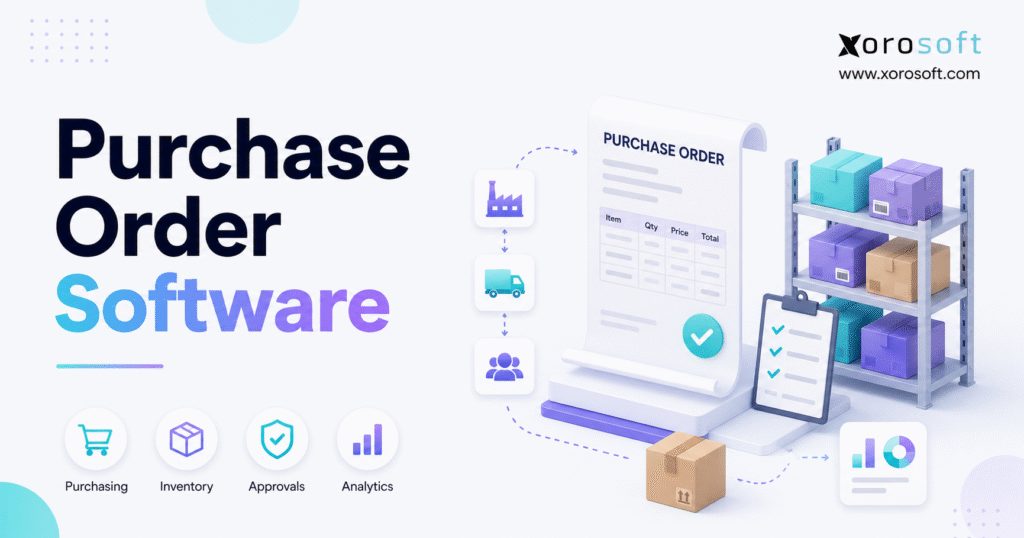
Purchase order software is a business system used to manage the process of requesting, approving, issuing, tracking, receiving, and reconciling orders placed with suppliers.
Instead of creating purchase orders in spreadsheets or word-processing templates, employees work through a defined workflow. As a result, the system records what the business intends to buy, why the purchase is required, who approved it, what the supplier confirmed, and what was ultimately delivered.
Usually, a purchase order is not the first step. The process often begins with a purchase requisition, which is an internal request for authorization to buy goods or services. Once that requisition is approved, the business can create and issue the supplier-facing purchase order.
Although the document itself may appear straightforward, the surrounding workflow affects inventory, cash flow, supplier service, and accounting. Therefore, purchase order management should be viewed as an operational process rather than a document-generation task.
1.1 What a Purchase Order System Manages
A capable purchase order system may manage:
• Purchase requests and requisitions
• Approval rules
• Supplier information
• Item numbers and descriptions
• Agreed prices and payment terms
• Purchase order creation
• Supplier acknowledgements
• Expected delivery dates
• Partial deliveries
• Backordered quantities
• Warehouse receipts
• Landed costs
• Invoice matching
• Supplier performance
• Purchasing reports
• Audit trails
The exact scope depends on the software category. For instance, a lightweight online PO tool may focus on document generation and approvals. By comparison, inventory purchasing software may add replenishment and receiving capabilities.
An ERP purchasing module goes further. In addition to managing supplier orders, it may update accounting records, warehouse activity, manufacturing requirements, ecommerce inventory, and management reporting.
Consequently, two systems described as purchase order software may serve very different operational requirements.
1.2 Who Uses Purchase Order Management Software?
Purchase order management is a cross-functional process. Although buyers create many of the transactions, several departments rely on the information.
Purchasing teams use the system to create orders, communicate with vendors, manage expected delivery dates, and respond to supplier changes.
Inventory planners, meanwhile, use open purchase orders to understand what stock is already incoming. They may also combine sales forecasts, safety stock, reorder points, and supplier lead times to calculate new purchasing requirements.
During receiving, warehouse employees compare the products and quantities delivered with the approved order. They also document shortages, damage, substitutions, rejected products, or over-deliveries.
Finance teams review the approved commitment, warehouse receipt, supplier invoice, and payment terms. In addition, they depend on accurate product costs and inventory valuation.
Operations leaders use purchasing data differently. Rather than processing individual documents, they monitor supplier reliability, open commitments, purchasing cycle time, inventory exposure, and recurring exceptions.
Therefore, a purchase order system should support each department without forcing employees to recreate the same information in separate applications.
1.3 Who May Not Need Dedicated PO Software Yet?
A business may not need a dedicated system when it places only a few supplier orders each month, works with a small supplier base, and does not require formal approval controls.
For example, a small retailer with one location and one person responsible for buying, receiving, and bookkeeping may be able to operate through its accounting system.
Nevertheless, the process should be reviewed when additional employees become involved. Even relatively low order volume can create risk when the buyer, approver, receiver, and accountant work from separate records.
Similarly, dedicated software may become worthwhile when supplier orders affect several sales channels or warehouse locations. In that situation, operational complexity matters more than the total number of purchase orders.
2. Why Manual Purchase Order Management Breaks Down
Manual purchasing processes usually fail gradually. At first, the business may only experience occasional confusion. Over time, however, the same weaknesses begin to affect inventory, supplier service, and month-end reporting.
2.1 Spreadsheet Purchasing Creates Multiple Versions of the Truth
A spreadsheet can hold PO numbers, suppliers, products, quantities, and delivery dates. Nevertheless, it does not automatically ensure that every employee works from the latest version.
One buyer may update a quantity while another sends the earlier order. Meanwhile, a warehouse employee may receive against a printed copy that does not contain the revision. Finance may then match the invoice against a third version.
As a result, the spreadsheet stores information but does not control the process. It also cannot reliably prevent duplicate orders, preserve approvals, or show which version was sent to the supplier.
Although shared spreadsheets reduce some version problems, they still depend heavily on consistent user behavior. Therefore, growing teams often need a transaction-based system rather than a shared file.
2.2 Email Approvals Are Difficult to Audit
Email approval may work when the organization is small. However, approval chains become harder to manage when different limits apply by department, location, category, or purchase value.
For instance, an approver may respond without seeing the available budget. Another manager may approve the request after the order has already been sent. In other cases, supporting information may be split across several email threads.
Consequently, employees must reconstruct the decision later if a supplier dispute or audit question arises.
Purchase order approval software should preserve the original request, supporting documents, approval decision, date, and subsequent changes in one record. In addition, the workflow should escalate delayed approvals without bypassing control.
2.3 Open Purchase Orders Become Hard to Track
An issued purchase order is not the same as confirmed incoming inventory.
A supplier may accept the order, change the delivery date, ship only part of the quantity, or place an item on backorder. Therefore, the business needs to distinguish:
• Ordered quantities
• Confirmed quantities
• Shipped quantities
• Received quantities
• Rejected quantities
• Remaining quantities
• Cancelled quantities
Without these distinctions, purchasing and sales teams may promise inventory that is not actually expected to arrive.
Furthermore, a total open-PO value does not explain which orders are late, which lines remain unconfirmed, or which warehouse will receive the goods. Effective purchase order tracking software should provide that operational detail.
2.4 Disconnected Systems Push Problems Into Accounting
Manual purchasing often creates additional work for accounts payable. When supplier invoices do not match expected quantities or prices, finance must contact purchasing and receiving before processing payment.
Frequently, the problem originated weeks earlier. For example, the supplier may have changed a unit price, but the buyer did not update the PO. Alternatively, the warehouse may have received only part of the order without recording the shortage.
Instead of identifying the exception at the receiving stage, the organization discovers it when payment is due. Consequently, invoice processing becomes slower and supplier relationships may suffer.
A connected process identifies these differences earlier. Therefore, finance can focus on genuine exceptions rather than repeatedly reconstructing purchasing history.
3. How Purchase Order Software Works
Purchase order automation should create a controlled sequence from demand identification through financial reconciliation.
A common workflow includes:
1. Identify purchasing demand
2. Create a purchase requisition
3. Route the request for approval
4. Generate the purchase order
5. Send it to the supplier
6. Record the supplier confirmation
7. Track the expected shipment
8. Receive the goods
9. Match the receipt and invoice
10 .Update inventory and accounting
This broader sequence is often described as part of procure-to-pay because it connects purchasing activity with accounts-payable and payment processes.
However, not every company needs the same workflow. A routine stock replenishment order may move through the process quickly, whereas a new supplier or unusually large commitment may require additional review.
3.1 Demand Identification and Purchase Requisitions
The purchasing requirement may originate from several sources:
• A product falls below its reorder point
• Forecast demand exceeds available supply
• A customer places a large order
• A warehouse requests replenishment
• Production requires additional components
• A department requests equipment or services
• A buyer identifies a seasonal requirement
Before the business commits to a supplier, a purchase requisition documents the need. It should identify the requester, required date, products or services, estimated cost, reason for purchase, and preferred supplier where appropriate.
In addition, the request should show the operational basis for the purchase. For inventory orders, that basis may include current stock, allocated quantities, open sales orders, incoming supply, and forecast demand.
Without this context, approvers may authorize spending without understanding whether the quantity is reasonable.
3.2 Purchase Order Approval Workflows
Approval rules should reflect both financial and operational risk.
A routine replenishment order from an approved supplier may need only one approval. By contrast, a new supplier, unusually large quantity, or higher-than-standard price may require additional review.
Rules can be based on:
• Purchase value
• Department
• Product category
• Warehouse
• Business entity
• Supplier status
• Budget owner
• Inventory risk
• Capital versus operating expense
The system should also handle escalation. For instance, if an approver does not respond within a defined period, the request may move to another authorized manager.
At the same time, the workflow should avoid unnecessary complexity. Too many approvals can delay replenishment and create emergency purchasing. Therefore, companies should match controls to risk rather than applying the same process to every order.
3.3 Purchase Order Creation and Supplier Communication
After approval, the system converts the requisition or replenishment recommendation into a purchase order.
The document typically contains:
• PO number
• Supplier information
• Billing address
• Ship-to location
• Order date
• Requested delivery date
• Item codes
• Product descriptions
• Units of measure
• Quantities
• Unit prices
• Taxes
• Shipping terms
• Payment terms
• Special instructions
Next, the supplier may acknowledge the order, confirm quantities, or propose changes. Purchase order tracking software should record these responses without overwriting the original approval history.
If the supplier changes the price or delivery date, the system should preserve both the approved order and the revised commitment. Consequently, purchasing teams can distinguish internal authorization from supplier confirmation.
3.4 Receiving Against the Purchase Order
Warehouse receiving is where the planned order meets physical reality.
A supplier may deliver the entire order, split it across shipments, substitute an item, send an incorrect quantity, or deliver damaged goods. Therefore, the receiving team needs a structured way to document the actual outcome.
A proper receiving record should show:
• Quantity received
• Quantity accepted
• Quantity rejected
• Warehouse location
• Lot or serial information
• Damage reason
• Remaining backorder
• Receipt date
• Receiving employee
After each receipt, the system should update both inventory and the remaining PO balance. However, it should not close the order until the outstanding quantity is received, cancelled, or otherwise resolved.
This distinction matters because incomplete orders may still represent expected supply. If the system closes them too early, planners may reorder unnecessarily.
3.5 Two-Way and Three-Way Matching
Two-way matching compares the purchase order with the supplier invoice.
Three-way matching compares:
1. The approved purchase order
2. The warehouse receipt
3. The supplier invoice
The invoice can proceed when the ordered, received, and invoiced information agrees within the company’s tolerance rules.
This control is particularly important when suppliers ship partial quantities or make unapproved price changes. Instead of paying the invoice and investigating later, the system flags the exception for review.
For example, a small freight difference may fall within an approved tolerance. A major quantity or price variance, however, may require purchasing or receiving approval before payment.
4. Essential Purchase Order Software Features
Feature lists can become misleading because many systems use similar labels. Therefore, buyers should evaluate how each feature behaves during real operational exceptions.
4.1 Purchase Requisition Software
Employees should be able to request inventory, services, supplies, or equipment without issuing an unauthorized order directly.
The requisition should capture enough information for the approver to make a useful decision. For example, a request containing only an amount and supplier name provides little context.
Ideally, the system also allows attachments, notes, required dates, budget codes, and suggested suppliers. As a result, approvers can review the complete request without searching through email.
4.2 Purchase Order Approval Software
The system should support approval thresholds, substitute approvers, escalation rules, and role-based access.
More importantly, approval logic should remain understandable. An overly complicated workflow can delay replenishment without providing meaningful control.
Therefore, companies should consider which orders need review, who has authority, and when an approval should escalate. Routine inventory replenishment may follow a different path from new suppliers or capital purchases.
4.3 Supplier Management
A centralized supplier record should include:
• Contact details
• Currency
• Payment terms
• Shipping terms
• Standard lead time
• Minimum order quantities
• Product relationships
• Price history
• Quality issues
• Delivery performance
• Certifications or documents
Consistent supplier data makes automation more reliable. Moreover, it allows buyers to compare historical pricing and delivery performance before placing an order.
Supplier management should also prevent duplicate records. Otherwise, spend and performance reports may split activity across several versions of the same vendor.
4.4 Automated Purchase Order Creation
Automated PO creation may begin from:
• Approved requisitions
• Reorder-point alerts
• Forecast recommendations
• Customer orders
• Production requirements
• Warehouse replenishment
• Supplier agreements
However, automated creation should not mean uncontrolled purchasing. The system should show the demand, inventory, and lead-time assumptions behind the recommendation.
For instance, a suggested order may be reasonable only if the forecast, safety stock, and supplier lead time are current. Therefore, buyers should be able to review and adjust the calculation before sending the PO.
4.5 Inventory and Purchase Order Integration
Inventory integration is one of the most important capabilities for a product-based company.
The buyer should be able to distinguish:
• On-hand inventory
• Available inventory
• Allocated inventory
• Incoming inventory
• Inventory in transit
• Safety stock
• Damaged or held inventory
This distinction prevents a company from purchasing stock that is already available in another warehouse. Likewise, it reduces the risk of overlooking inventory committed to customer orders.
More importantly, the system should evaluate existing purchase orders before creating new recommendations. Otherwise, buyers may place duplicate supplier orders.
4.6 Partial Receipt and Backorder Management
The software should support multiple receipts against one PO. In addition, it should show what remains open after each delivery.
Closing a PO automatically after the first receipt can hide backorders. On the other hand, leaving completed orders open indefinitely creates misleading incoming-inventory reports.
Therefore, users should be able to close, cancel, or backorder individual lines while preserving the history of the original transaction.
4.7 Landed Cost Tracking
The supplier’s unit price may not represent the full inventory cost.
Landed cost can include:
• Freight
• Customs duties
• Brokerage
• Insurance
• Port charges
• Handling
• Inspection fees
A purchasing system should either allocate these costs or pass the required information into an inventory or accounting system that can.
Without consistent allocation, margins may appear stronger than they actually are. Consequently, landed-cost functionality becomes particularly important for imported products, bulky goods, and international suppliers.
4.8 Purchasing Reports and Dashboards
Useful purchase order management reports include:
• Open PO value
• Overdue purchase orders
• Expected receipts by week
• Supplier lead-time variance
• On-time delivery
• Purchase price variance
• Received-not-billed transactions
• Backordered items
• Inventory on order
• Emergency purchases
• PO approval cycle time
Purchase-order cycle time measures the period from receiving a requisition until releasing the order to the supplier. Therefore, it can reveal whether delays occur during request preparation, review, or approval.
In addition, supplier performance reports should separate promised dates from actual delivery dates. Otherwise, teams may rely on static lead times that no longer reflect supplier performance.
5. Business Benefits of Purchase Order Automation
The value of PO software depends on the quality of the workflow it supports. Simply replacing a spreadsheet with a digital form provides limited benefit.
5.1 Stronger Control Over Spending
Approval occurs before the company commits funds. Consequently, managers can review the need, price, supplier, quantity, and budget impact at the correct point in the process.
In addition, role-based permissions reduce the chance of unauthorized orders. The organization can also apply different controls to routine replenishment and exceptional purchases.
5.2 Better Visibility Into Incoming Inventory
Sales, purchasing, and planning teams can see what is expected, when it should arrive, and which warehouse will receive it.
As a result, teams are less likely to promise stock based on an order that the supplier has delayed or only partially confirmed.
Better visibility also supports more accurate purchasing decisions. For example, a buyer can avoid reordering an item that is already in transit.
5.3 Fewer Manual Errors
Standard product, supplier, price, address, and unit-of-measure records reduce repeated entry.
Furthermore, automation lowers the chance of duplicate PO numbers, inconsistent document formats, and incorrect ship-to locations.
Although no system eliminates every error, structured validation identifies problems earlier. Therefore, corrections can occur before receiving or invoicing.
5.4 Faster Exception Resolution
When a receipt or invoice differs from the approved order, the system shows the exact variance.
Employees can then investigate a specific quantity, price, tax, or freight difference instead of reconstructing the order from emails.
Because the supporting records remain connected, purchasing, warehousing, and finance can work from the same transaction history. Consequently, disputes are easier to resolve.
5.5 Better Supplier Performance Management
Expected and actual dates create measurable supplier records.
The business can identify suppliers that frequently:
• Confirm late
• Ship incomplete orders
• Miss delivery dates
• Change prices
• Send damaged goods
• Create invoice discrepancies
These insights support better purchasing decisions and supplier conversations. Moreover, buyers can use performance history when negotiating lead times, pricing, and service expectations.
5.6 More Reliable Inventory Valuation
Accurate receipts and landed costs improve product-cost records.
This matters for margin reporting, inventory valuation, and financial close. In addition, consistent costing helps teams compare product profitability across channels and warehouses.
6. Types of Purchase Order Management Software
Different software categories solve different problems. Therefore, the right choice depends on how purchasing interacts with the rest of the business.
6.1 Spreadsheet-Based Purchase Order Management
Spreadsheets offer flexibility and low upfront cost. They may be sufficient for a business with minimal order volume and few users.
However, spreadsheets provide limited approval enforcement, change control, security, integration, and exception management.
As more employees become involved, maintenance effort also increases. Consequently, the apparent low cost may be offset by manual work and reconciliation.
6.2 Standalone PO Software
Standalone systems focus on requisitions, approvals, PO creation, and basic tracking.
They can be a good fit when the company already has dependable inventory, warehouse, and accounting systems. Nevertheless, the business should confirm how data will move between those applications.
If integrations are weak, employees may still re-enter receipts or invoices manually. Therefore, buyers should test the complete process rather than reviewing PO creation alone.
6.3 Procurement Software
Procurement platforms may include broader capabilities such as:
• Supplier sourcing
• Requests for quotation
• Contract management
• Supplier onboarding
• Spend analysis
• Compliance controls
• Supplier risk management
A business primarily trying to improve PO approval may not need the full scope of a strategic procurement platform.
By contrast, a large organization managing formal sourcing events and supplier contracts may find basic PO software too limited.
6.4 Inventory Purchasing Software
Inventory-oriented systems connect purchasing with stock availability, reorder points, demand, and receiving.
This category is often more suitable for ecommerce brands, distributors, and retailers than a general expense-purchasing application.
However, accounting, landed cost, manufacturing, or EDI functionality may still require separate systems. Therefore, buyers should evaluate the full operating model.
6.5 ERP Purchase Order Software
An ERP connects purchasing with inventory, accounting, warehouse operations, manufacturing, sales channels, and reporting through shared records.
For example, XoroONE combines purchasing with inventory management, accounting, warehouse workflows, manufacturing, forecasting, ecommerce, EDI, and reporting. Its purchasing functionality includes purchase orders, incoming ASNs, prepayments, vendor credits, open bills, and supplier balances.
As a result, the business can manage the supplier order as part of a broader operational and financial workflow rather than as a separate document.
7. Purchase Order Software vs Other Systems
7.1 Purchase Order Software vs Spreadsheets
| Capability | Spreadsheets | Purchase Order Software |
|---|---|---|
| Approval enforcement | Manual | Workflow-based |
| Change history | Limited | Recorded |
| Supplier database | Manually maintained | Centralized |
| PO status | Updated manually | Transaction-driven |
| Inventory integration | Usually separate | Available in connected systems |
| Receiving | Separate records | Linked with PO |
| Audit trail | Difficult to preserve | Built into workflow |
| Scalability | Limited | Designed for multiple users |
Spreadsheets offer flexibility, whereas purchase order software provides process control.
Therefore, spreadsheets may remain suitable for very low-volume purchasing. Once approvals, locations, or integrations become important, however, a structured PO system usually provides stronger visibility.
7.2 Purchase Order Software vs Procurement Software
PO software manages the operational process of requesting, approving, ordering, receiving, and reconciling purchases.
Procurement software may additionally manage sourcing strategy, contracts, negotiations, supplier risk, and organization-wide spend.
Consequently, the correct category depends on whether the business needs transactional purchasing control or broader strategic procurement management.
7.3 Purchase Order Software vs Accounts Payable Automation
Purchase order management controls the commitment before goods arrive.
Accounts-payable automation, by contrast, manages the supplier invoice and payment after the purchase occurs.
The two processes should connect. Otherwise, AP employees must recreate or manually verify purchasing information.
When both systems share supplier, PO, receipt, and invoice data, three-way matching becomes more reliable.
7.4 Purchase Order Software vs ERP
| Capability | Standalone PO Software | ERP Purchasing |
| Requisitions | Usually included | Included |
| Approval workflows | Included | Included |
| Supplier orders | Included | Included |
| Inventory planning | Varies | Connected |
| Warehouse receiving | Varies | Connected |
| Accounting | External integration | Built in or unified |
| Manufacturing | Rare | Available in manufacturing ERP |
| Ecommerce | External connector | May be integrated |
| Financial reporting | Limited | Connected with operations |
| Implementation scope | Lower | Broader |
A standalone system may be easier to deploy. However, ERP purchasing provides broader process integration when inventory, accounting, warehouse, or manufacturing data drives purchasing decisions.
Businesses evaluating larger platforms can also review how Xorosoft compares with NetSuite when considering implementation scope, operational fit, and ERP requirements.
Nevertheless, a vendor comparison should remain one part of a wider evaluation. The final decision should still reflect workflow requirements, internal resources, and total cost.
8. How to Choose Purchase Order Software
A useful buying process begins with operational requirements rather than vendor demonstrations.
8.1 Map the Current Purchase Order Workflow
First, document every step from identifying demand to approving the supplier invoice.
Record:
• Who performs each step
• Which system is used
• What information is re-entered
• Where approvals wait
• Which exceptions occur
• Which reports are missing
• Which controls depend on memory
This exercise often reveals that the problem extends beyond PO creation.
For example, delayed invoice approval may actually originate in warehouse receiving. Therefore, mapping the complete workflow prevents the business from solving the wrong problem.
8.2 Identify the Business Outcome
Next, define what must improve.
Examples include:
• Reduce stockouts
• Reduce excess purchasing
• Shorten approval time
• Improve supplier delivery
• Track incoming inventory
• Control unauthorized spending
• Improve warehouse receiving
• Accelerate month-end reconciliation
The best software is the one that supports the required outcome without introducing unnecessary complexity.
Accordingly, buyers should prioritize essential capabilities before reviewing optional features.
8.3 Test Inventory Integration
Ask the vendor to demonstrate how purchasing considers:
• Available inventory
• Allocated stock
• Open sales orders
• Existing purchase orders
• Transfers
• Safety stock
• Forecast demand
• Supplier lead time
• Minimum order quantities
Importing item names from another system is not the same as using real-time inventory data for replenishment.
Therefore, the demonstration should show how a recommended purchase quantity was calculated. It should also explain how the system avoids duplicate orders.
8.4 Test Receiving Exceptions
Request a demonstration involving:
1. A partial delivery
2. A damaged product
3. An incorrect quantity
4. A substituted item
5. A cancelled line
6. A backordered item
7. A supplier price change
A system that performs well only when every delivery is perfect will create manual work during normal operations.
In practice, exceptions reveal more about usability than a standard end-to-end demonstration. Consequently, buyers should test them before signing a contract.
8.5 Review Accounting Integration
Determine how the system handles:
• Supplier bills
• Taxes
• Freight
• Landed cost
• Inventory valuation
• Deposits and prepayments
• Currency differences
• Received-not-billed transactions
• General-ledger postings
In addition, confirm when financial entries occur. Some systems update accounting at receipt, whereas others wait until the invoice is entered.
That timing can affect inventory valuation and month-end reconciliation. Therefore, finance should participate in the evaluation.
8.6 Evaluate Multi-Warehouse Support
Confirm whether the software can manage:
• Demand by location
• Warehouse-specific reorder points
• Supplier shipments to multiple locations
• Centralized purchasing
• Location-level receipts
• Inter-warehouse transfers
• Consolidated reports
The system should also distinguish internal transfers from supplier purchases. Otherwise, incoming inventory reports may become misleading.
8.7 Review Implementation Support
Software selection should include data migration, workflow configuration, integrations, training, testing, and post-launch support.
Ask who is responsible for cleaning supplier records, migrating open purchase orders, configuring approvals, and validating accounting balances.
Furthermore, confirm whether implementation support is included in the quoted price. A low subscription cost may not reflect the total effort required to launch the system successfully.
9. Purchase Order Software for Ecommerce
Ecommerce purchasing is closely tied to channel demand, inventory synchronization, and fulfillment.
A product may sell through a Shopify store, Amazon, wholesale accounts, retail locations, and marketplaces at the same time. Therefore, the purchasing system needs a consolidated view of demand rather than treating each channel independently.
9.1 Shopify Purchase Order Requirements
Shopify merchants should evaluate how purchasing software handles:
• Products and variants
• Multiple Shopify locations
• Available inventory
• Committed inventory
• Incoming inventory
• Returns
• Bundles or kits
• Channel-specific demand
• Warehouse receipts
• Accounting entries
The Xorosoft ERP Shopify app is positioned for ecommerce and wholesale merchants that need to connect order management, inventory, warehousing, purchasing, manufacturing, financials, and customer service within one operating environment.
As a result, Shopify demand can become one input into a wider purchasing plan rather than the only source of inventory information.
9.2 Why Storefront Inventory Is Not Enough
A storefront can show current sellable inventory. However, purchasing decisions may also require wholesale demand, production requirements, warehouse transfers, supplier lead times, and financial commitments.
For example, a product may appear available in Shopify while units are already reserved for wholesale customers. Conversely, another warehouse may hold excess stock that could be transferred instead of repurchased.
An operational system behind Shopify can combine these inputs before recommending a supplier order. Therefore, buyers should evaluate inventory across the entire business, not only the storefront.
10. Purchase Order Software for Wholesale and Distribution
Wholesale distributors often purchase in larger quantities and manage longer supplier relationships than typical retailers.
They may also need:
• Customer-specific inventory commitments
• EDI documents
• Supplier minimum order quantities
• Volume pricing
• Multiple warehouses
• Customer backorders
• Inventory allocation
• Drop shipments
• Container tracking
• Multi-currency purchasing
The purchase order process must account for both forecast demand and contractual customer commitments.
Furthermore, distributors may need to reserve incoming inventory before it reaches the warehouse. Therefore, purchase order data should connect with customer allocations and backorder management.
Businesses can explore Xorosoft’s industry-specific ERP workflows when evaluating requirements across distribution, apparel, furniture, sporting goods, manufacturing, and other inventory-driven sectors.
11. Purchase Order Software for Manufacturing
Manufacturing purchasing is driven by material requirements rather than finished-goods stock alone.
A manufacturer may need to purchase:
• Raw materials
• Components
• Packaging
• Subcontracted services
• Maintenance supplies
• Production equipment
Unlike retail replenishment, manufacturing demand may depend on several levels of components. Consequently, the purchasing system must understand what materials are required to complete planned production.
11.1 Connecting Purchase Orders With Production Demand
A manufacturing system should consider:
• Bills of materials
• Work orders
• Production schedules
• Existing component inventory
• Supplier lead times
• Scrap assumptions
• Substitute components
• Minimum order quantities
XoroERP connects procurement and purchase orders with inventory, manufacturing activity, and accounting. Its manufacturing workflows can use sales orders, forecasts, inventory, and production schedules when assessing purchasing requirements.
Therefore, material purchasing can remain aligned with actual production demand instead of relying on separate planning spreadsheets.
12. Multi-Warehouse Purchase Order Management
Multi-warehouse businesses must determine whether a shortage requires a supplier purchase or an internal transfer.
That decision depends on:
• Inventory available at each location
• Local customer demand
• Existing allocations
• Incoming supplier orders
• Transfer time
• Freight cost
• Supplier lead time
• Safety stock by warehouse
Without location-level visibility, one warehouse may purchase stock while another holds excess inventory.
12.1 Centralized vs Location-Based Purchasing
A centralized team may negotiate supplier terms and place consolidated orders for several warehouses.
Alternatively, local managers may purchase independently because demand and supplier availability differ by region.
The software should support the chosen operating model without losing consolidated visibility.
For instance, central purchasing may approve the supplier and price while local teams define delivery quantities. Therefore, workflow flexibility matters as much as location reporting.
12.2 Receiving and Putaway
The purchase process should continue into warehouse execution.
XoroWMS supports purchasing and receiving workflows, including PO-based receiving, order-status tracking, returns, and inventory control.
When goods arrive, the warehouse should verify quantity and condition against the approved PO. Afterwards, accepted products can move into putaway while shortages or damage remain visible as exceptions.
Consequently, purchasing, inventory, and finance can work from the same receipt information.
13. Purchase Order Software Pricing and Total Cost
Purchase order software pricing varies according to scope.
Common pricing factors include:
• Number of users
• Monthly PO volume
• Number of entities
• Warehouse locations
• Approval complexity
• Supplier portal access
• Inventory modules
• Accounting modules
• Integrations
• Data migration
• Implementation services
• Training
• Support level
Therefore, buyers should avoid comparing subscription prices without reviewing what each package includes.
13.1 Costs Beyond the Subscription
| Cost Area | Questions to Ask |
| Implementation | Does the fee include process design and configuration? |
| Data migration | Who cleans and imports supplier, item, and open-PO data? |
| Integrations | Are connectors included, licensed separately, or custom-built? |
| Training | Is training provided by role and location? |
| Support | What response times and support channels are included? |
| Administration | Who will maintain users, rules, suppliers, and reports? |
| Upgrades | Are future updates included in the subscription? |
Implementation effort can vary considerably. For example, a lightweight PO tool may require basic supplier and user setup, whereas an ERP project may include inventory, accounting, warehouse, and ecommerce migration.
Consequently, total cost should include both external fees and internal employee time.
13.2 Measuring Purchase Order Software ROI
Avoid relying entirely on a vendor’s generic ROI calculator.
Instead, compare before-and-after performance using:
• Requisition-to-PO cycle time
• Labor hours per PO
• Number of orders processed per buyer
• Invoice exception rate
• Supplier on-time delivery
• Emergency freight
• Stockout frequency
• Excess inventory
• Received-not-billed value
• Month-end reconciliation effort
The goal is not simply to create purchase orders faster. Rather, it is to improve the reliability of purchasing decisions and the quality of downstream data.
For example, faster PO creation has limited value if buyers continue ordering incorrect quantities. Therefore, performance measures should include inventory and supplier outcomes.
14. Common Purchase Order Software Mistakes
14.1 Choosing Software Only for PO Creation
Generating a professional PDF is useful, but it does not solve weak demand planning, poor supplier data, inaccurate inventory, or disconnected receiving.
Therefore, buyers should evaluate the complete purchasing lifecycle rather than the appearance of the final document.
14.2 Automating a Broken Process
Software will not automatically simplify unnecessary approvals or unclear responsibilities.
Before implementation, remove duplicate steps and define who can request, approve, receive, and resolve exceptions.
Otherwise, the new system may reproduce the same delays in a more structured format.
14.3 Importing Poor Data
Duplicate suppliers, inconsistent item codes, incorrect units of measure, and outdated lead times will reduce system accuracy.
Data preparation is part of implementation, not an optional cleanup task.
Accordingly, businesses should assign owners for supplier, item, pricing, and warehouse data before migration.
14.4 Ignoring Warehouse Receiving
A purchase order is only a plan until goods arrive.
If receiving remains manual or disconnected, inventory and accounting records will still be unreliable.
Therefore, warehouse employees should participate in process design and testing.
14.5 Failing to Test Exceptions
Implementation teams often test a complete order with correct pricing and quantities.
However, real purchasing includes partial receipts, damaged goods, substitutions, cancellations, price changes, backorders, deposits, and foreign-currency orders.
Testing these scenarios before launch reduces manual work later.
14.6 Tracking Adoption Instead of Outcomes
The number of users logging into the system is not sufficient.
Instead, measure whether purchasing becomes faster, inventory becomes more reliable, supplier performance improves, and finance spends less time reconciling transactions.
User adoption matters, but it should support measurable operational improvements.
15. Signs You Have Outgrown Your Current Purchase Order System
A business should review its purchasing technology when several of the following conditions appear:
• Purchase orders are spread across multiple spreadsheets
• Buyers cannot see accurate incoming inventory
• Approvals occur after orders are placed
• Employees regularly create duplicate supplier records
• The warehouse receives against printed or outdated POs
• Partial deliveries are difficult to track
• Suppliers frequently dispute prices or quantities
• Accounting manually re-enters receipt information
• Multiple warehouses use different processes
• Stockouts require emergency purchasing
• Excess inventory ties up working capital
• Shopify, Amazon, wholesale, and manufacturing demand are planned separately
One issue may be a process problem. However, a pattern across purchasing, inventory, warehousing, and accounting usually indicates a systems problem.
In that situation, adding another spreadsheet or point solution may provide only temporary relief. Therefore, the business should review the complete operational architecture.
16. When ERP Purchasing Software Is the Better Fit
Standalone purchase order software can solve approval and document-control problems. However, ERP may be a better fit when purchasing depends on information held across several operational areas.
16.1 Purchasing Depends on Real-Time Inventory
Buyers need to understand what is on hand, allocated, incoming, transferred, damaged, or required for production.
Without that visibility, replenishment recommendations may be based on incomplete information. Therefore, integrated inventory data becomes essential.
16.2 The Business Operates Multiple Warehouses
Each warehouse may have different demand, inventory, lead times, and receiving requirements.
At the same time, management needs consolidated supplier commitments and cash-flow visibility. An ERP can connect both levels.
16.3 Accounting Must Update From Operational Activity
Receipts, supplier bills, inventory costs, liabilities, and financial reports should follow the same transaction chain.
Otherwise, finance may spend significant time reconciling systems at month-end.
16.4 Manufacturing Creates Material Demand
Purchase recommendations should consider bills of materials, production orders, and component availability.
Consequently, a standalone PO tool may be insufficient if production planning occurs elsewhere.
16.5 Several Sales Channels Share Inventory
Shopify, Amazon, wholesale, retail, and EDI orders may all compete for the same stock.
In these conditions, a connected cloud ERP such as XoroONE may provide a broader operational foundation than a standalone PO application.
Nevertheless, the decision should still be based on process fit, implementation resources, and total cost—not feature quantity alone.
17. Purchase Order Software Evaluation Checklist
A structured scorecard makes it easier to compare vendors without repeating the same checklist wording. For each requirement, assign a priority level, confirm whether the capability is native or integrated, and record any implementation concerns.
17.1 Purchasing and Supplier Control Requirements
| Evaluation Requirement | Priority | Vendor Capability | Notes |
|---|---|---|---|
| Employees can create requisitions without directly issuing supplier orders | High | ||
| Approval rules can vary by value, department, product category, and warehouse | High | ||
| A complete history of revisions and approvals remains available | High | ||
| Supplier acknowledgements and order changes can be recorded | Medium | ||
| Minimum order quantities and supplier lead times can be maintained | High | ||
| Supplier pricing, payment terms, and shipping terms remain centralized | High |
17.2 Inventory and Receiving Requirements
| Evaluation Requirement | Priority | Vendor Capability | Notes |
| Inventory is visible by warehouse or operational location | High | ||
| Available, allocated, on-hand, incoming, and in-transit quantities remain separate | High | ||
| Partial deliveries can be received against the original purchase order | High | ||
| Backordered quantities remain visible until resolved | High | ||
| Damaged, rejected, substituted, and over-delivered products can be recorded | Medium | ||
| Internal warehouse transfers remain separate from external supplier purchases | High |
17.3 Accounting and Financial Control Requirements
| Evaluation Requirement | Priority | Vendor Capability | Notes |
| Two-way or three-way invoice matching is supported | High | ||
| Duplicate supplier invoices can be identified or prevented | High | ||
| Freight, duty, brokerage, and other landed costs can be allocated | High | ||
| Open purchase orders contribute to committed-spend reporting | Medium | ||
| Supplier deposits and purchase-order prepayments can be managed | Medium | ||
| Receipt activity updates inventory valuation and accounting correctly | High |
17.4 Integration and Scalability Requirements
| Evaluation Requirement | Priority | Vendor Capability | Notes |
| Shopify products, orders, locations, and inventory can be connected | High for Shopify businesses | ||
| Amazon workflows can be supported where operationally required | Medium | ||
| EDI transactions can be exchanged with suppliers or trading partners | High for wholesale businesses | ||
| Warehouse receiving and inventory-control workflows remain connected | High | ||
| Manufacturing demand can generate purchasing requirements | High for manufacturers | ||
| Multiple currencies, entities, and warehouse locations are supported | Medium to high | ||
| Additional users, suppliers, transactions, and locations can be added as the business grows | High |
Before selecting a vendor, score each capability according to its operational importance. In addition, identify whether each feature is native, provided through an integration, dependent on customization, or only planned for a future release.
A system should not receive the same score for a native workflow and a loosely connected third-party process. Therefore, the final evaluation should consider data ownership, synchronization timing, implementation effort, and the employee experience across purchasing, receiving, inventory, and accounting.
18. Frequently Asked Questions About Purchase Order Software
18.1 What Is Purchase Order Software?
Purchase order software is a system for creating, approving, issuing, tracking, receiving, and reconciling orders placed with suppliers. In addition, it replaces manual PO documents and disconnected spreadsheets with a controlled workflow.
18.2 How Does PO Software Work?
Typically, the system converts a purchasing need into a requisition, routes it for approval, creates the PO, sends it to the supplier, tracks delivery, records the receipt, and supports invoice reconciliation.
18.3 What Are the Main Purchase Order Software Features?
Core features include requisitions, approval workflows, supplier management, PO creation, order tracking, partial receiving, backorders, invoice matching, reports, permissions, and audit trails. Depending on the platform, inventory and accounting may also be included.
18.4 Who Needs a Purchase Order System?
Businesses with recurring supplier orders, multiple buyers, inventory, approval requirements, warehouses, or accounting-reconciliation problems can benefit from a structured PO system. Generally, operational complexity matters more than company size.
18.5 Can Small Businesses Use Purchase Order Software?
A small business can use lightweight PO software to improve approvals and supplier records. As operational complexity grows, however, more advanced inventory or ERP functionality may become necessary.
18.6 Can Purchase Order Software Update Inventory?
When inventory functionality is included or integrated, the system can update stock records. Normally, inventory should increase when goods are physically received rather than when the PO is initially created.
18.7 Can PO Software Automate Reordering?
Reordering can use reorder points, safety stock, forecast demand, supplier lead time, existing purchase orders, and minimum order quantities. Nevertheless, buyers should review the assumptions behind automatically suggested orders.
18.8 Can the System Track Partial Deliveries?
A suitable platform can record several receipts against one PO and preserve the remaining quantity as open, cancelled, or backordered. Consequently, incoming-inventory reports remain accurate.
18.9 Does Purchase Order Software Support Multiple Warehouses?
Multi-warehouse software can calculate demand, create orders, direct deliveries, and record receipts by location. At the same time, it can provide consolidated purchasing reports for management.
18.10 Does PO Software Integrate With Shopify?
Some purchasing and ERP systems integrate Shopify products, orders, locations, and inventory. However, buyers should verify the exact synchronization and replenishment workflows during the demonstration.
18.11 Can Purchase Order Software Integrate With QuickBooks?
Many systems provide QuickBooks integrations. Before selecting one, test how suppliers, items, receipts, bills, freight, landed costs, and inventory valuation move between applications.
18.12 What Is Purchase Order Approval Software?
Purchase order approval software routes requests or orders to authorized employees based on rules such as value, department, category, location, or budget owner. It also records each approval decision.
18.13 What Is Two-Way Matching?
Two-way matching compares the supplier invoice with the approved purchase order. Specifically, it verifies price, quantity, taxes, terms, and other invoiced details.
18.14 What Is Three-Way Matching?
Three-way matching compares the purchase order, warehouse receipt, and supplier invoice. When differences appear, the system flags them before the business approves payment.
18.15 How Does Purchasing Software Differ From Procurement Software?
Purchasing software focuses on requisitions, approvals, orders, and receipts. Procurement software, by contrast, may also include sourcing, contracts, supplier onboarding, risk, compliance, and spend analysis.
18.16 How Does PO Software Differ From AP Automation?
PO software controls the purchase before and during delivery. AP automation manages the invoice, approval, and payment after the supplier bills the company. Ideally, both workflows share the same transaction data.
18.17 How Does Purchase Order Software Differ From ERP?
Purchase order software specializes in supplier-order workflows. ERP connects purchasing with inventory, accounting, warehouse management, manufacturing, sales channels, and financial reporting.
18.18 How Much Does Purchase Order Software Cost?
Pricing depends on users, order volume, locations, modules, integrations, implementation, migration, training, and support. Therefore, total ownership cost matters more than subscription price alone.
18.19 Is Free Purchase Order Software Suitable for Growing Companies?
Free tools may support basic documents. Growing businesses should also evaluate controls, security, inventory integration, supplier management, audit trails, support, and scalability before relying on them.
18.20 When Should a Business Replace Purchasing Spreadsheets?
Replacement becomes necessary when spreadsheets cause version conflicts, missing approvals, duplicate orders, poor incoming-stock visibility, receiving errors, or slow accounting reconciliation.
18.21 How Long Does Purchase Order Software Implementation Take?
The timeline depends on data quality, workflow complexity, integrations, warehouses, users, and project scope. Generally, a standalone tool requires less implementation effort than an ERP.
18.22 What Data Should Be Migrated?
Typical data includes suppliers, items, price lists, payment terms, lead times, warehouse locations, open requisitions, open purchase orders, outstanding receipts, and approval rules. Before migration, these records should be cleaned and standardized.
18.23 How Should Purchase Order Software Be Tested?
Testing should include complete and partial orders, price changes, shortages, damage, backorders, cancellations, deposits, foreign currency, multiple warehouses, and invoice mismatches.
18.24 How Is Purchase Order Software ROI Measured?
Useful measures include changes in cycle time, labor, invoice exceptions, supplier delivery, emergency freight, stockouts, excess inventory, and reconciliation effort. Therefore, ROI should reflect operational results rather than PO volume alone.
18.25 How Do You Choose the Best Purchase Order Software?
Begin by mapping the existing process and defining required outcomes. Next, test real exceptions, verify integrations, assess implementation support, and select the system that fits both current and expected operational complexity.
19. Practical Next Steps for Building a More Reliable Purchasing Process
Purchase order software should not be selected as an isolated document tool unless document control is the only business problem.
First, map the complete process from demand identification to supplier payment. Identify where employees re-enter information, where approvals wait, where inventory becomes uncertain, and where finance must investigate discrepancies.
Next, separate process problems from software problems. Unclear approval authority, poor supplier records, and inconsistent receiving practices require operational decisions before automation. Otherwise, the new system will reproduce the same weaknesses in a more expensive format.
After that, determine how far the purchasing workflow must extend. A standalone PO system may be appropriate when inventory, warehousing, and accounting already work well. By contrast, an integrated ERP may be more suitable when purchasing accuracy depends on shared product, warehouse, ecommerce, manufacturing, and financial data.
Finally, evaluate vendors through real business scenarios. Use actual order volumes, warehouse structures, supplier terms, partial-delivery patterns, Shopify requirements, accounting workflows, and reporting needs. A relevant demonstration will reveal more than a long feature checklist.
Businesses evaluating a connected approach can contact Xorosoft to review how purchasing could operate alongside inventory, warehouse management, accounting, manufacturing, forecasting, Shopify, Amazon, wholesale, and EDI workflows.
Ultimately, the objective is not simply to issue purchase orders faster. Instead, the goal is to create a purchasing process that protects inventory availability, controls spending, improves supplier accountability, and gives every department dependable operational data.
Recent Posts
-
 ERP Landed Cost Module vs Spreadsheet Calculations for Importers
 -
 How to Build an Open-to-Buy Plan for an Omnichannel Brand
 -
 Cold Storage WMS for Food and Beverage Distribution
 -
 ERP Buying Statistics 2026: Evaluation, Implementation, and Adoption Risks
 -
 How a Distributor Reduced B2B Order Exceptions Without Restricting Sales