If you have ever experienced purchase order delays, you know how challenging they can be for your business.
1. Purchase Order Delays Often Begin Before Approval
1.1 What Counts as a Purchase Order Delay?
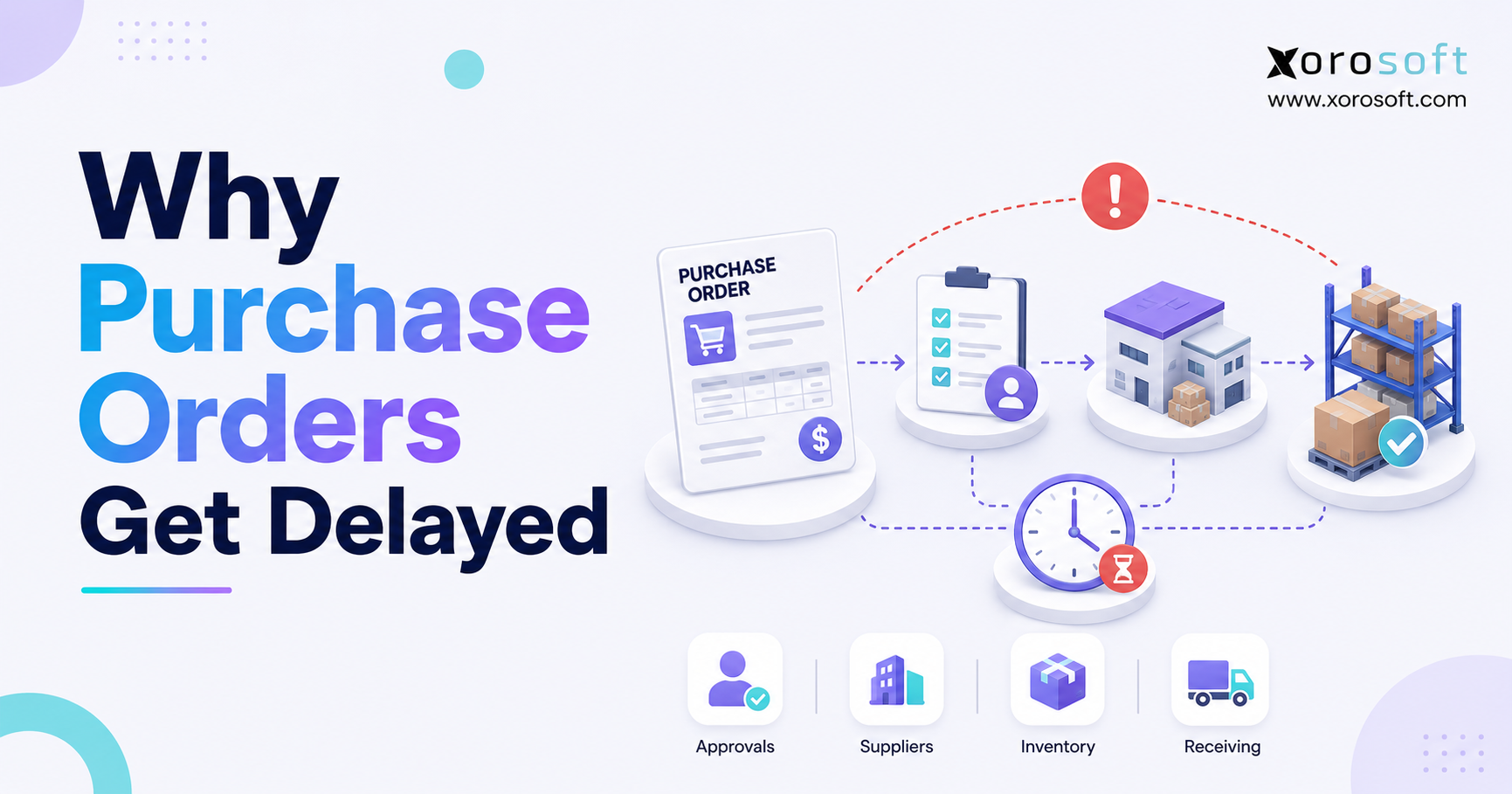
A purchase order delay occurs when any stage between identifying a purchasing requirement and completing the related receipt takes longer than the organization expects.
For instance, the delay may occur during:
- Demand identification
- Purchase requisition creation
- Item or supplier validation
- Budget review
- Management approval
- Purchase order creation
- Supplier acknowledgment
- Shipment
- Warehouse receiving
- Invoice reconciliation
- Purchase order closure
Therefore, a purchase order does not need to be sitting in an approval queue to be delayed. It may already be approved but waiting for purchasing to issue it. Alternatively, the supplier may have received it but not confirmed the requested delivery date.
In addition, a shipment may have arrived while the warehouse has not yet recorded the receipt. Consequently, the purchasing system continues to show an open order even though the goods are physically on-site.
A company should define the expected completion time for each stage separately. Otherwise, every problem appears as one general purchasing delay, even though different teams and actions are responsible.
1.2 Why PO Approval Delays Are Often Symptoms
An approval queue may show where a request stopped. However, it does not always reveal why it stopped.
Consider a purchase requisition that reaches a finance manager without an approved supplier, valid product code, confirmed price, warehouse location, or business justification. In that situation, the manager cannot approve it confidently. Therefore, the request returns to the buyer, who must contact the requester and rebuild the information.
The report may show that the PO spent three days awaiting finance approval. In practice, however, finance may have reviewed it immediately and returned it because the original request was incomplete.
As a result, adding more reminders will not correct the underlying data problem. Instead, the business must separate active review time from rework, clarification, and waiting time.
Likewise, approval reports should distinguish between a request that has not been opened and one that has already been returned for correction. Without that distinction, teams may focus on the wrong solution.
1.3 Why Growing Businesses Experience More Purchasing Delays
Small businesses often manage purchasing through personal knowledge. For instance, one employee knows the preferred supplier, another knows the correct price, and a warehouse manager knows what stock is actually available.
Initially, that approach may work well. Nevertheless, it becomes unreliable when:
- The number of SKUs increases
- More employees request purchases
- Approval thresholds become necessary
- The company opens another warehouse
- Supplier terms vary by location or product
- Inventory sells through several channels
- Manufacturing adds material requirements
- Finance needs better control over commitments
- Buyers work across different time zones
- Purchasing volume exceeds what email can track
As the business grows, purchasing decisions rely on more people and more data. Consequently, informal knowledge becomes harder to maintain and easier to lose.
The business has not necessarily developed a people problem. Rather, the operating model has outgrown an informal workflow.
2. Where Purchase Orders Get Delayed in the Workflow
2.1 Demand Is Identified Too Late
A purchase order cannot be issued on time when the purchasing requirement is discovered after inventory is already close to running out.
Demand may originate from:
- Reorder points
- Sales forecasts
- Customer orders
- Production plans
- Work orders
- Safety-stock policies
- Seasonal demand
- Promotions
- New product launches
- Manual requests
However, reliable purchasing decisions require more than a current on-hand quantity. Buyers should also consider allocated inventory, incoming purchase orders, warehouse transfers, backorders, supplier lead times, minimum order quantities, and expected demand during replenishment.
For example, a product may show 500 units on hand. Nevertheless, 400 units may already be allocated to customer orders, while another 50 units are damaged or unavailable.
When those inputs sit in separate spreadsheets or systems, the buyer must assemble the requirement manually. As a result, part of the supplier lead time may disappear before the purchase order is even ready.
Furthermore, a delayed purchasing signal may force the buyer to choose between a stockout and an expensive rush order. Therefore, demand identification should happen early enough to preserve sourcing and transportation options.
2.2 The Purchase Requisition Lacks Required Information
The purchase requisition should give purchasing and management enough information to evaluate the request without reconstructing it.
A complete requisition commonly includes:
- Product or service description
- SKU or item number
- Requested quantity
- Required delivery date
- Preferred supplier
- Expected unit cost
- Currency
- Destination warehouse
- Department
- Budget or account
- Requester
- Business justification
When these fields are optional, requests often arrive with vague descriptions such as “order more blue units” or “buy packaging for next month.”
Consequently, the buyer must identify the item, estimate the quantity, confirm the supplier, verify pricing, and determine where the products should be delivered. Each question adds another email exchange. Moreover, every additional exchange creates another opportunity for the request to be forgotten.
In contrast, a standardized requisition allows the buyer and approver to review the same information immediately. Therefore, the process moves forward without repeated clarification.
2.3 Validation Happens After the Approval Request
Approval should not be the first time someone checks whether the purchase is valid.
Before routing the request, the process should confirm that:
- The item exists in the product master
- The supplier is active and approved
- Supplier terms are current
- Pricing is valid
- The warehouse location is correct
- Another open PO does not cover the requirement
- Inventory at another warehouse cannot be transferred
- The purchase falls within policy
- Sufficient budget remains available
When validation occurs after approval, the company may approve an order that purchasing cannot release. Therefore, the request moves backward through the workflow and the total cycle time increases.
For example, management may approve a quantity based on an outdated supplier price. Later, purchasing may discover that the price has increased or that the quantity does not meet the supplier minimum.
As a result, the order requires another review. Accordingly, validation should happen before the request reaches the approval queue.
2.4 Approval Routing Does Not Match the Purchase
Not every purchase needs the same approval path.
For example, a routine replenishment order from an approved supplier may require less review than:
- A high-value capital purchase
- An order from a new supplier
- An order above the approved price
- A purchase outside the budget
- A product substitution
- A rush order
- A purchase involving regulatory requirements
When every order follows the most complex approval path, routine purchases wait behind exceptional ones. Conversely, when rules are too loose, managers may lose control over spending.
Therefore, the workflow should route orders according to value, risk, department, supplier status, product category, location, and variance.
Moreover, the process should allow independent approvals to happen in parallel. For instance, finance and the department manager may be able to review the same request simultaneously rather than one after the other.
2.5 Approved Requests Are Not Issued Promptly
Approval does not mean that the supplier has received the purchase order.
In a manual process, the buyer may still need to:
1. Copy information from the requisition
2. Re-enter it in an accounting or inventory application
3. Create the purchase order
4. Export a PDF
5. Draft an email
6. Find the supplier contact
7. Attach the document
8. Send the order
9. Record that it was sent
Therefore, businesses should measure the time between approval and supplier release separately from approval time. Otherwise, purchasing may appear efficient even though approved requests remain unsent.
Additionally, manual creation introduces the risk of typing errors. Consequently, the final PO may differ from the request that management approved.
2.6 Suppliers Do Not Confirm the Order
Sending a purchase order does not guarantee that the supplier has accepted it.
A useful supplier acknowledgment should confirm:
- Quantity
- Unit price
- Currency
- Payment terms
- Shipment date
- Delivery date
- Backordered quantity
- Substitutions
- Partial shipments
- Shipping method
Without that confirmation, the buyer may assume the requested date is achievable. However, the problem may become visible only after the expected shipment fails to arrive.
Therefore, important orders should have a defined acknowledgment deadline. In addition, buyers should track supplier response time separately from internal approval time.
Likewise, suppliers should communicate changes promptly. If a confirmed date moves, purchasing, sales, production, and warehouse teams should receive the updated information.
2.7 Warehouse Receipts Are Recorded Late
Products may physically arrive while the purchase order still appears open.
This happens when the warehouse:
- Uses a separate system
- Records receipts at the end of the day
- Sends paper documents to purchasing
- Cannot identify the related PO
- Receives a partial shipment
- Finds damaged or incorrect products
- Does not have access to expected receipt data
Late receiving creates several secondary problems. For example, inventory remains unavailable, customer-service teams cannot promise the stock, buyers continue chasing the supplier, and finance cannot match the invoice.
Therefore, receiving must be treated as part of the purchase order process rather than a separate warehouse task.
Moreover, partial receipts must update only the quantity that actually arrived. Otherwise, the business may close the order too early or leave completed quantities open indefinitely.
3. The 12 Most Common Causes of Purchase Order Delays
3.1 Incomplete Requisitions Create Purchasing Delays
Incomplete information is one of the most preventable causes of delayed purchase orders.
Missing quantities, product codes, supplier names, delivery dates, warehouses, prices, or account details force the next person to stop. Consequently, the buyer cannot complete the PO, while the approver cannot determine whether the request is reasonable.
The practical fix is to make critical requisition fields mandatory. In addition, controlled item, supplier, warehouse, currency, and account selections reduce spelling errors and duplicate records.
Furthermore, conditional requirements can improve data quality. For example, a new supplier request may require compliance documents, while an urgent order may require a written explanation.
3.2 Unclear Ownership Creates PO Approval Bottlenecks
A request can remain untouched because nobody knows who owns the decision.
This often occurs after:
- Employee departures
- Department changes
- Promotions
- Business acquisitions
- New warehouse openings
- Changes in purchasing policy
- Temporary leave
- Organizational restructuring
Therefore, every workflow stage should have a primary owner, backup owner, response target, and escalation route.
Ownership should also be assigned to roles rather than relying entirely on individual employees. As a result, the workflow becomes easier to maintain when responsibilities change.
For instance, an order may route to the “regional operations manager” rather than one specific employee. Consequently, the approval structure can continue working after personnel changes.
3.3 Too Many Approval Levels Slow Purchase Orders
Additional approvals can improve control, but only when each approver makes a different decision.
For example:
- A department manager confirms operational need.
- Finance verifies budget availability.
- Purchasing checks supplier terms and pricing.
- An executive approves unusually high-value commitments.
Problems occur when several managers repeat the same review. Each sequential step adds another queue, notification, and opportunity for delay.
Therefore, approval depth should reflect the value and risk of the purchase. A standard replenishment order should not necessarily follow the same process as a new supplier contract or major equipment purchase.
At the same time, removing approvals without reviewing the associated risk can create weak spending control. Accordingly, the goal is a shorter but purposeful approval path.
3.4 Unavailable Approvers Cause Delayed PO Approvals
Travel, leave, time-zone differences, meetings, and overloaded inboxes can stop an otherwise complete order.
The problem becomes worse when the workflow has no delegation rules. In that case, purchasing may know that the assigned manager is unavailable but lack authority to move the request to someone else.
Effective approval processes include:
- Temporary delegation
- Backup approvers
- Escalation after a defined period
- Mobile-friendly notifications
- A shared queue for urgent exceptions
- Visibility into who currently owns the request
The objective is not to bypass approval. Instead, it is to ensure that legitimate control does not depend on one person being online.
Moreover, escalations should occur before the order becomes urgent. Therefore, a request should not remain unnoticed until inventory is already unavailable.
3.5 Manual Budget Checks Delay Purchasing
Purchasing may not know whether sufficient budget remains because approved budgets, actual expenses, open purchase orders, pending requisitions, and supplier invoices exist in different records.
Consequently, finance must calculate the available amount manually.
This process becomes particularly difficult when the accounting system shows only posted invoices. A department may appear to have available budget even though approved but unreceived purchase orders have already committed the funds.
Therefore, a reliable budget check should account for actual spending and open commitments.
In addition, budget status should be visible before the requisition reaches the final approver. Otherwise, the request may complete most of the workflow before finance discovers a funding problem.
3.6 Inaccurate Supplier Records Delay Purchase Orders
Supplier information is often treated as an administrative detail until an urgent order cannot be released.
A usable supplier record may need:
- Legal business name
- Purchasing contact
- Payment terms
- Currency
- Lead time
- Minimum order quantity
- Shipping instructions
- Tax information
- Banking details
- Compliance documents
- Approved product pricing
- Contract references
When these details are missing or inconsistent, purchasing must verify them before issuing the order.
Therefore, new supplier onboarding should begin before the first urgent requirement. Otherwise, compliance, finance, purchasing, and the supplier all face unnecessary pressure.
Likewise, existing supplier records should be reviewed periodically. A supplier that was accurate two years ago may now have different contacts, pricing, lead times, or payment terms.
3.7 Pricing and Contract Differences Create PO Processing Delays
The requisition may use the last purchase price, while the supplier quotation includes a new cost. Similarly, the requested quantity may fall below the supplier minimum or outside a negotiated price break.
Other common discrepancies include:
- Expired quotations
- Incorrect currency
- Changed freight terms
- Different payment terms
- Unapproved surcharges
- Packaging changes
- Product substitutions
- Outdated contract references
These differences require review because issuing the wrong price can create invoice disputes later.
Therefore, businesses should maintain effective dates, quantity breaks, supplier-item prices, and contract terms in one controlled record.
Moreover, price tolerances can help separate minor differences from material exceptions. As a result, routine variances may move quickly while significant changes receive additional review.
3.8 Poor Inventory Data Causes Delayed Purchase Orders
Buyers cannot order confidently when inventory numbers are unreliable.
The on-hand quantity may exclude or misrepresent:
- Stock allocated to sales orders
- Inventory at another warehouse
- Products awaiting inspection
- Damaged items
- Pending transfers
- Unrecorded receipts
- Manufacturing demand
- Customer backorders
- Existing inbound purchase orders
When buyers distrust the system, they build personal spreadsheets and contact warehouse employees before placing each order.
Although these checks may reduce the immediate risk of a wrong purchase, they slow every buying decision. Moreover, they increase the risk of stockouts, duplicate orders, and excess inventory because different employees may reach different conclusions.
Therefore, inventory accuracy is not only a warehouse metric. It directly affects purchasing speed and quality.
3.9 Spreadsheet-Based Purchasing Creates Rework
Spreadsheets can support a low-volume purchasing process. However, they become difficult to govern as transactions increase.
Common problems include:
- Multiple file versions
- Accidental formula changes
- Missing approval history
- Manual status updates
- Duplicate purchase order numbers
- Incorrect supplier details
- Limited user permissions
- No connection to receiving
- No connection to accounting
- No real-time inventory position
The spreadsheet itself is not always the problem. Instead, the delay comes from the manual coordination required around it.
For example, one employee may update the PO status while another continues working from an older copy. Consequently, two people may follow up on the same order or place duplicate purchases.
3.10 Suppliers Respond Slowly to Purchase Orders
Internal processing can finish on time while supplier acknowledgment remains delayed.
A supplier may need to confirm material availability, production capacity, price, shipment timing, or minimum quantities. Nevertheless, the buyer needs a defined response date.
For critical products, establish:
- Acknowledgment expectations
- Escalation contacts
- Delivery-update frequency
- Backorder reporting
- Substitution rules
- Alternative supplier options
Most importantly, track supplier acknowledgment time separately from internal approval time. Otherwise, teams may redesign an internal process even though the main delay sits outside the company.
In addition, supplier response performance should influence sourcing decisions. A slightly lower price may provide little value when confirmations and delivery dates remain unreliable.
3.11 Disconnected Receiving Keeps Purchase Orders Open
The purchasing process does not end when the truck reaches the warehouse.
Receiving must identify the PO, count the products, inspect the shipment, record accepted quantities, and document discrepancies.
When warehouse receiving is disconnected from purchasing:
- Buyers cannot see what arrived.
- Inventory remains unavailable.
- Open-PO reports become inaccurate.
- Accounts payable lacks receipt confirmation.
- Duplicate follow-up orders may be placed.
- Supplier performance reports become unreliable.
Partial shipments require particular attention. Therefore, the received quantity should close only the completed portion while preserving visibility into the remaining balance.
Furthermore, the warehouse should capture damages, shortages, and substitutions during receiving. Otherwise, purchasing and finance may discover those issues only when the invoice arrives.
3.12 Undefined Exceptions Become Long-Term Procurement Delays
Routine purchase orders may move quickly, while unusual transactions remain unresolved.
Frequent exceptions include:
- Price variance
- Quantity variance
- Credit hold
- Supplier substitution
- Changed delivery date
- Damaged shipment
- Partial receipt
- Duplicate order
- Incorrect tax
- Invoice mismatch
Each exception should have a defined owner and resolution path.
For example, purchasing may own supplier-price differences, while the warehouse may own quantity or damage discrepancies. Finance, meanwhile, may own tax or payment-term differences.
Without this structure, everyone can see the problem. However, nobody is responsible for clearing it.
Consequently, exceptions remain open longer than routine orders. Therefore, exception management should be designed as carefully as the standard workflow.
4. How Delayed Purchase Orders Affect Inventory and Cash Flow
4.1 Purchase Order Delays Cause Stockouts
A late purchase order reduces the time available for supplier production, shipping, customs clearance, transportation, receiving, and putaway.
If the business issues the PO after the reorder date, even a reliable supplier may be unable to deliver before stock runs out.
As a result, the business may experience:
- Lost sales
- Delayed customer orders
- Backorders
- Cancelled orders
- Channel overselling
- Customer-service workload
- Emergency transfers
- Substitute products
For ecommerce businesses, one delayed replenishment order can affect several selling channels at the same time.
Moreover, a stockout can create effects beyond the missed transaction. For example, customers may switch brands, cancel related items, or lose confidence in future delivery promises.
4.2 PO Delays Disrupt Manufacturing Schedules
Manufacturers depend on raw materials, components, packaging, and subcontracted processes.
A production order may require dozens of inputs. However, one missing component can prevent completion. The business may then reschedule labor, move another order forward, split production, or hold unfinished goods.
Therefore, purchasing must connect with bills of materials, production plans, work orders, inventory, and supplier lead times. Buying based only on historical usage may not reflect upcoming production demand.
Likewise, production changes should update purchasing requirements promptly. Otherwise, buyers may continue ordering materials for work that has been postponed or cancelled.
4.3 Delayed Purchasing Increases Rush Costs
When the business discovers a shortage too late, the buyer has fewer options.
The company may have to:
- Accept a higher supplier price
- Split the order across suppliers
- Use air freight instead of ocean freight
- Pay expedited handling charges
- Purchase from a distributor rather than the manufacturer
- Accept smaller quantities
- Use an alternative product
These actions may protect an immediate customer or production requirement. Nevertheless, they increase landed cost and reduce margin.
Furthermore, repeated emergency purchases consume buyer time that could otherwise support supplier negotiation, forecasting, and process improvement.
4.4 Poor Open-PO Visibility Creates Excess Inventory
Purchase order delays can create overstock as well as shortages.
When buyers cannot see whether another employee has already ordered the product, they may create a duplicate PO. Similarly, a buyer may place a new order because a warehouse receipt has not been recorded, even though the products have already arrived.
Multi-warehouse businesses face another risk. For example, one location may purchase stock while excess inventory sits in another warehouse.
Consequently, the company ties up cash in inventory it did not need. At the same time, storage and handling costs increase.
4.5 Purchasing Delays Complicate Accounting
Open purchase orders represent future commitments. Therefore, finance needs visibility into those commitments to forecast cash requirements accurately.
Delayed receiving also affects:
- Inventory valuation
- Goods received but not invoiced
- Supplier liabilities
- Purchase accruals
- Landed costs
- Purchase-price variance
- Month-end reconciliation
When purchase orders, receipts, and invoices are maintained in separate systems, finance often has to rebuild the transaction history manually. As a result, month-end close becomes slower and less reliable.
Moreover, unresolved differences may delay supplier payments. Consequently, supplier relationships can suffer even when the purchasing team originally issued the order correctly.
5. How to Diagnose Purchase Order Bottlenecks
5.1 Map the Real Purchase Order Workflow
Begin with the process employees actually follow rather than the process described in a policy document.
For each stage, document:
- The process owner
- Required information
- Source system
- Expected completion time
- Actual completion time
- Common exceptions
- Escalation path
- Output required for the next stage
In addition, interview requesters, approvers, buyers, warehouse employees, production planners, and accounts-payable staff. Each team sees a different part of the problem.
For instance, buyers may report slow approvals, while managers may report incomplete requests. Meanwhile, warehouse employees may explain that receiving information arrives after the shipment.
Therefore, the full workflow must be examined before choosing a solution.
5.2 Measure Requisition-to-PO Cycle Time
A useful starting formula is:
Requisition-to-PO cycle time = PO issue time − requisition submission time
However, that single metric does not reveal the full cause. Therefore, break it into:
- Requisition preparation time
- Validation time
- Approval time
- Rework time
- PO creation time
- Supplier acknowledgment time
If total cycle time is five days, the business needs to know whether four days were spent waiting for approval or correcting incomplete information.
In addition, teams should measure median performance as well as extreme cases. Otherwise, a few unusually old orders may distort the overall result.
5.3 Separate Internal PO Delays From Supplier Delays
Record at least these timestamps:
1. Requisition submitted
2. Validation completed
3. Approval requested
4. Approval completed
5. Purchase order issued
6. Supplier acknowledged
7. Supplier shipped
8. Warehouse received
9. Receipt recorded
10. Purchase order closed
This timeline makes accountability clearer.
For instance, an internal process improvement will not solve a supplier-capacity problem. Likewise, changing suppliers will not correct a PO that purchasing sends three days after approval.
Therefore, each stage should be reported separately. As a result, the responsible team can address the correct issue.
5.4 Review Open Purchase Orders by Age
Open purchase orders should be reviewed according to expected lead time and delivery date.
| PO status | What to review | Likely action |
|---|---|---|
| Approved but not sent | Buyer workload or manual creation | Issue the PO |
| Sent but not acknowledged | Supplier communication | Request confirmation |
| Confirmed but overdue | Supplier or transportation delay | Escalate or revise ETA |
| Partially received | Remaining quantity | Confirm balance |
| Fully delivered but open | Receiving or closure problem | Record receipt or close |
| Invoiced without receipt | Warehouse or matching problem | Investigate delivery |
Age alone is not enough. For example, a 45-day overseas order may be healthy, while a five-day local order could already be overdue.
Accordingly, aging reviews should compare each order with its promised date and standard lead time.
5.5 Use Standard Purchase Order Delay Codes
Free-text notes make consistent reporting difficult.
Instead, use controlled delay reasons such as:
- Missing requisition data
- Awaiting approval
- Budget review
- Supplier onboarding
- Pricing discrepancy
- Supplier acknowledgment
- Backorder
- Transit delay
- Receipt not recorded
- Invoice exception
After several weeks, the company can rank delay causes by frequency and impact. Consequently, teams can focus on recurring problems rather than redesigning the process around unusual cases.
Moreover, standard codes make it easier to compare performance by department, supplier, warehouse, buyer, and product category.
6. Purchase Order Metrics That Reveal Delays
6.1 Purchase Order Cycle-Time Metrics
Track:
- Requisition-to-PO cycle time
- Approval turnaround
- Approval-to-issue time
- Supplier acknowledgment time
- Supplier lead time
- Receipt-processing time
- PO closure time
Each metric should have a clear start event, end event, owner, and target.
However, do not compare internal numbers with outside benchmarks until the measurement definitions match. One company may stop the clock when the PO is approved, while another may stop it when the supplier receives the order.
Therefore, metric definitions should appear beside the dashboard or report. Otherwise, teams may interpret the same number differently.
6.2 Purchase Order Quality Metrics
Speed should not come at the cost of accuracy.
Therefore, track:
- Requisition rework rate
- PO change rate
- Duplicate PO rate
- Price-variance rate
- Quantity-variance rate
- Invoice exception rate
- First-time match rate
- Purchase return rate
A faster workflow that creates more corrections is not genuinely more efficient. Instead, the business should improve both speed and first-time accuracy.
Likewise, a lower approval time has limited value if the number of post-approval changes rises sharply.
6.3 Supplier and Receiving Metrics
Track:
- Supplier acknowledgment rate
- Supplier on-time delivery
- In-full delivery rate
- Partial shipment frequency
- Backorder frequency
- Receipt-processing time
- Damaged receipt rate
- Unrecorded receipt count
Together, these metrics distinguish internal purchasing performance from supplier and warehouse performance.
In addition, supplier performance should be reviewed alongside product importance. A small delay on a noncritical item may have less impact than a one-day delay on a production component.
7. How to Reduce Purchase Order Delays Without Removing Control
7.1 Standardize Purchase Requisition Data
Require the information needed for approval and PO creation before the request enters the workflow.
Use controlled records for:
- Products
- Suppliers
- Warehouses
- Departments
- Currencies
- Accounts
- Payment terms
- Shipping methods
In addition, conditional fields can be added for unusual transactions. For example, a new supplier request may require compliance documents, while an above-budget purchase may require additional justification.
As a result, approvers receive more complete requests and buyers spend less time correcting them.
7.2 Simplify PO Approval Rules
Review every approval step and ask:
- What decision does this person make?
- Does another approver repeat the same check?
- Is this approval necessary for every purchase?
- Can low-risk orders follow a shorter path?
- Can independent reviews happen in parallel?
- What happens when the approver is absent?
- When should the request escalate?
Then, use approval thresholds so routine replenishment does not follow the same workflow as a major strategic purchase.
Moreover, review approval performance regularly. As the business changes, old thresholds and routing rules may no longer reflect current responsibilities.
7.3 Create Backup Approvers and Escalations
Every critical approver should have a substitute.
The process should define:
- When delegation begins
- Which requests can be delegated
- When the backup receives notification
- When overdue requests escalate
- Who can make emergency decisions
- How the original approver regains responsibility
This approach preserves control. At the same time, it prevents purchasing from depending on one inbox.
Additionally, employees should be able to see when a request has escalated. Otherwise, several managers may unknowingly review the same order.
7.4 Improve Supplier Acknowledgment
Ask suppliers to confirm the commercial and delivery details of every important order.
For strategic suppliers, agree on:
- Confirmation deadline
- Shipment-update frequency
- Backorder communication
- Delivery-date changes
- Substitution approval
- Escalation contact
- Corrective action for repeated delays
In addition, a supplier scorecard should combine response time, delivery reliability, quality, quantity accuracy, and invoice accuracy.
Consequently, purchasing decisions can consider service reliability alongside price.
7.5 Connect Purchasing With Inventory Planning
Before creating a new PO, the buyer should see:
- On-hand inventory
- Available inventory
- Allocated inventory
- Customer backorders
- Existing purchase orders
- Expected receipts
- Warehouse transfers
- Forecast demand
- Safety stock
- Supplier lead time
As a result, the business can reduce delayed replenishment, duplicate orders, and unnecessary purchasing.
Furthermore, the calculation should update when demand, lead times, or inbound dates change. Otherwise, buyers may continue working from outdated recommendations.
8. When Purchase Order Automation Becomes Necessary
8.1 Signs Manual Purchasing Has Reached Its Limit
A business should evaluate automation when:
- Approvals depend on email
- Buyers maintain several spreadsheets
- Purchase order status cannot be trusted
- Different departments use different item information
- Suppliers receive incorrect orders
- Open purchase commitments are unclear
- The company operates multiple warehouses
- Receiving updates arrive late
- Finance regularly receives unmatched invoices
- Stockouts trigger urgent purchasing
- Ecommerce and wholesale demand share the same inventory
- Manufacturing requirements are managed separately
At this stage, the problem is no longer one slow approval. Instead, it is the amount of coordination required to keep disconnected tools aligned.
Moreover, employees may spend more time maintaining the process than evaluating suppliers and inventory requirements. Therefore, automation becomes an operational need rather than a convenience.
8.2 Purchase Order Software Versus ERP
Standalone purchase order software may be appropriate when the primary requirement is digital requisitions and approval routing.
However, broader operational complexity may require purchasing to connect with inventory, accounting, receiving, manufacturing, forecasting, and sales channels.
| Requirement | Standalone PO software | Integrated ERP |
| Digital requisitions | Commonly supported | Supported |
| Approval routing | Commonly supported | Supported |
| Supplier records | Supported | Connected to operations |
| Inventory planning | Usually integrated separately | Connected |
| Warehouse receiving | May require another system | Connected |
| Accounting | Separate integration | Part of the workflow |
| Manufacturing | Usually limited | Platform-dependent |
| Multi-warehouse planning | Product-dependent | Common ERP requirement |
| Best fit | Focused purchasing problem | Wider operational complexity |
For inventory-driven companies, an integrated platform such as XoroERP can connect purchasing with wider inventory, accounting, warehouse, manufacturing, forecasting, and reporting processes.
Therefore, the software decision should reflect the full operating model rather than the approval workflow alone.
8.3 Who May Not Need Full ERP Purchasing Yet?
A business may not need a full ERP when it:
- Issues only a few purchase orders each month
- Sells services rather than physical products
- Operates from one location
- Has no manufacturing requirements
- Has a small supplier base
- Does not manage complex inventory
- Can maintain accurate controls within its accounting system
Therefore, the correct solution should match operational complexity. Buying more software than the organization can implement and maintain will not automatically improve purchasing.
Instead, a smaller business may first improve its requisition template, approval rules, supplier records, and open-PO review process.
9. How ERP Reduces Purchase Order Processing Delays
9.1 One Inventory Position Supports Better Purchasing
Purchasing decisions improve when buyers work from a shared view of inventory and demand.
A connected system can bring together:
- Warehouse-level inventory
- Sales allocations
- Open customer orders
- Purchase orders
- Transfers
- Forecasts
- Safety stock
- Manufacturing demand
- Supplier lead times
Through XoroONE, inventory-driven businesses can manage purchasing alongside inventory, sales, accounting, warehouse operations, manufacturing, and reporting.
The important operating principle is consistency. Purchasing, sales, warehouse, production, and finance should not calculate product availability from different files.
As a result, buyers can spend less time reconciling numbers and more time evaluating quantities, suppliers, and timing.
9.2 Automated Approval Routing Reduces Waiting
An ERP workflow can route purchase requests according to defined rules.
Those rules may use:
- Purchase value
- Department
- Supplier
- Product category
- Warehouse
- Budget
- Price variance
- Supplier status
- Exception type
Routine purchases can follow a shorter path. Meanwhile, high-value or unusual purchases can receive additional review.
Notifications, backup approvers, and escalations reduce waiting. At the same time, the business preserves financial control.
Moreover, workflow reporting can show which requests are awaiting action and how long they have remained in each queue.
9.3 Supplier Commitments Improve Inbound Visibility
After a supplier confirms the order, the expected delivery date should update the inbound inventory plan.
That date can then support:
- Replenishment planning
- Customer-order commitments
- Production scheduling
- Warehouse labor planning
- Cash-flow forecasting
- Supplier performance reporting
When the supplier changes a date, the update should be visible to every affected team rather than remaining inside the buyer’s email.
Consequently, customer service and production teams can adjust plans before the delay becomes a missed commitment.
9.4 Connected Receiving Closes the Purchasing Loop
Warehouse receiving should update the same transaction used by purchasing and finance.
XoroWMS can support connected receiving, warehouse inventory, putaway, picking, and stock visibility.
When a shipment arrives, the warehouse can record accepted, damaged, and outstanding quantities against the purchase order. As a result, purchasing sees the remaining balance, inventory becomes available appropriately, and accounts payable gains receipt information for invoice matching.
In addition, warehouse-level updates improve open-PO reporting. Therefore, buyers no longer need to contact each location to determine what has arrived.
9.5 Accounting Can Match the PO, Receipt, and Invoice
A connected process supports comparison among:
1. The approved purchase order
2. The warehouse receipt
3. The supplier invoice
If the documents agree within approved tolerances, finance can continue processing. Otherwise, the exception can be routed to the appropriate owner.
For example:
- Purchasing reviews a price difference.
- The warehouse reviews a quantity difference.
- Finance reviews a tax or payment-term difference.
- Management reviews a purchase outside policy.
Consequently, fewer invoices remain unresolved while employees search for the source of the difference.
Moreover, the business gains a clearer record of why each exception occurred and how it was resolved.
10. Purchase Order Delays Across Inventory-Driven Industries
10.1 Wholesale Purchase Order Delays
Wholesalers may manage thousands of products across several warehouses and customer channels.
A delayed PO can affect:
- Customer allocations
- EDI orders
- Ecommerce availability
- Wholesale backorders
- Warehouse replenishment
- Supplier minimums
- Cash commitments
Therefore, a wholesaler should evaluate purchasing in the context of inventory allocation, forecasting, receiving, accounting, and supplier performance rather than as an isolated administrative process.
Moreover, supplier delays may affect several customer accounts at once. Consequently, inbound visibility becomes essential for allocation decisions.
10.2 Apparel Purchasing Delays
Apparel businesses manage style, colour, and size variants. In addition, they may work with seasonal collections, long overseas lead times, and fixed launch dates.
A delay affecting one purchase order can create incomplete size or colour availability for an entire collection.
Consequently, buyers need visibility into demand by variant, existing inbound stock, supplier capacity, production progress, and warehouse allocation.
Furthermore, a late delivery may miss the primary selling window. Therefore, purchase timing matters as much as total quantity.
10.3 Furniture Purchase Order Delays
Furniture companies often manage:
- Long production lead times
- Supplier deposits
- Container shipments
- Partial deliveries
- Large warehouse requirements
- Customer-specific orders
- Component purchasing
- Imported inventory
A delayed confirmation can affect customer delivery promises several months later. Therefore, expected shipment and delivery dates need consistent supplier follow-up.
In addition, partial shipments should remain visible at the line level. Otherwise, teams may assume the entire order is delayed or complete.
10.4 Food and Manufacturing PO Delays
Food and manufacturing operations depend on raw materials, components, ingredients, packaging, and subcontracted processes.
A shortage of one low-cost component may stop a high-value production order. Therefore, purchasing should consider bills of materials, work orders, production schedules, supplier lead times, shelf life, lot requirements, and material substitutes.
The Xorosoft industries page provides further context for apparel, manufacturing, distribution, furniture, food, sporting goods, and other inventory-driven sectors.
Moreover, regulated or perishable products may require additional supplier and receiving controls. Consequently, the fastest approval path may not always be the safest one.
10.5 Shopify and Multichannel Purchase Order Delays
A growing Shopify merchant may sell through its website, marketplaces, retail locations, wholesale accounts, and Amazon while replenishing inventory from the same suppliers.
If channel demand, available inventory, and purchase orders are managed separately, purchasing decisions become slower and less reliable.
Xorosoft is also available through the Shopify App Store, where merchants can evaluate its fit for ecommerce, wholesale, inventory, warehouse, accounting, and purchasing operations.
For a growing merchant, the key question is whether Shopify should remain the primary operational record or whether an ERP should manage inventory, purchasing, warehouse activity, accounting, and forecasting behind the sales channel.
Consequently, the software architecture should reflect where operational decisions are made, not only where customer orders originate.
11. How to Choose Software for Purchase Order Management
11.1 Evaluate the Full Purchasing Workflow
Do not evaluate software only by asking whether it can create a purchase order.
Instead, review whether it supports:
- Purchase requisitions
- Approval thresholds
- Parallel approvals
- Delegation
- Supplier records
- Supplier-item pricing
- Purchase suggestions
- Open-PO reporting
- Partial receipts
- Purchase returns
- Landed costs
- Supplier performance
- Purchase commitments
- Invoice matching
- Exception workflows
The software should support the way the business actually buys, receives, and pays for products.
Moreover, buyers, warehouse employees, finance teams, and managers should all participate in the evaluation. Otherwise, the company may solve one department’s problem while creating another.
11.2 Review Inventory, Warehouse, and Accounting Requirements
Purchasing software may appear effective during a demonstration. However, it can create new integration work after implementation.
Therefore, confirm how it handles:
- Multiple warehouses
- Inventory allocations
- Transfers
- Lot or serial tracking
- Barcode receiving
- Damaged goods
- Supplier invoices
- Purchase accruals
- Inventory valuation
- Currency
- Freight and duty
- Financial reporting
A company with broader operational requirements may compare Xorosoft with platforms such as NetSuite, Acumatica, Business Central, Cin7, Brightpearl, Fishbowl, or Sage.
The Xorosoft versus NetSuite comparison can support that evaluation. Nevertheless, product capabilities, integrations, implementation assumptions, and pricing should always be verified directly with each vendor.
11.3 Evaluate Implementation Readiness
Software cannot correct undefined responsibilities automatically.
Before implementation, determine:
- Who owns purchasing
- Who approves each order type
- Which supplier records need cleaning
- Which item records are duplicated
- How warehouse receipts are recorded
- Which integrations are required
- Which reports management needs
- How users will be trained
- How exceptions will be handled
- Which KPIs will measure improvement
Therefore, the strongest implementation begins with process decisions rather than screen configuration.
In addition, the company should assign internal owners for data cleanup, testing, training, and workflow approval. Otherwise, implementation decisions may remain unresolved until late in the project.
12. A 90-Day Plan to Reduce Purchase Order Delays
12.1 Days 1–30: Measure Purchasing Delays
During the first month:
- Map the current workflow.
- Record stage-level timestamps.
- Review the oldest open POs.
- Create standard delay codes.
- Interview requesters and approvers.
- Review supplier acknowledgment time.
- Identify unrecorded receipts.
- Measure invoice exceptions.
- Document spreadsheets and duplicate entry.
- Establish a baseline for cycle time.
Do not begin by automating everything. Instead, first determine where time is actually being lost.
Moreover, select a manageable sample of purchase orders from different departments, suppliers, and warehouses. Consequently, the analysis will reflect the wider business rather than one isolated workflow.
12.2 Days 31–60: Redesign the Purchase Order Process
During the second month:
- Make critical requisition fields mandatory.
- Clean item and supplier records.
- Simplify approval levels.
- Add value-based thresholds.
- Create backup approvers.
- Define escalation rules.
- Set supplier acknowledgment expectations.
- Assign exception owners.
- Establish open-PO review meetings.
- Define purchasing KPIs.
Then, test the revised workflow with routine and exceptional purchase orders.
In addition, collect feedback from requesters, buyers, approvers, warehouse users, and finance. As a result, the company can adjust the process before wider rollout.
12.3 Days 61–90: Automate and Monitor PO Performance
During the final month:
- Configure approval workflows.
- Connect inventory and purchasing data.
- Connect warehouse receiving.
- Train requesters and approvers.
- Launch open-PO reporting.
- Monitor supplier confirmations.
- Review old purchase orders weekly.
- Measure rework and exception rates.
- Compare new cycle time with the baseline.
- Refine thresholds based on actual risk.
Automation should make a well-designed process easier to follow. However, it should not hide missing information or unclear ownership.
Finally, management should review whether the new process improves both speed and accuracy. Otherwise, faster processing may simply create more corrections later.
13. Frequently Asked Questions About Purchase Order Delays
13.1 Why Do Purchase Orders Get Delayed?
Purchase orders get delayed when information, approvals, supplier records, inventory data, or delivery commitments are incomplete. In addition, delays can occur after approval when purchasing creates the PO manually, the supplier does not acknowledge it, or the warehouse fails to record the receipt.
13.2 What Causes Purchase Order Approval Delays?
Common causes include unavailable approvers, unclear approval ownership, excessive approval levels, missing budget information, new suppliers, price differences, and incomplete requisitions. Although the approval queue often reveals the delay, the root cause may have occurred earlier.
13.3 Why Do Purchase Orders Get Stuck in Approval?
A PO may get stuck because the assigned approver is unavailable, notifications were missed, no backup approver exists, or the request requires clarification. Therefore, exception-based routing and automatic escalation can reduce unnecessary waiting.
13.4 How Long Should Purchase Order Approval Take?
There is no universal target. Routine, low-risk replenishment orders should generally move faster than high-value purchases, new supplier requests, or policy exceptions. Therefore, establish separate service targets by value, risk, and purchase type.
13.5 What Is Purchase Order Cycle Time?
Purchase order cycle time measures how long a defined part of the purchasing process takes. For example, it may cover requisition submission to PO issuance, approval request to approval, supplier release to acknowledgment, or order placement to receipt.
13.6 How Is Purchase Order Cycle Time Calculated?
For requisition-to-PO cycle time, subtract the requisition submission timestamp from the purchase order issue timestamp. In addition, measure approval, supplier response, delivery, receiving, and closure separately to identify the actual bottleneck.
13.7 What Is a Good Purchase Order Cycle Time?
A good cycle time meets operational requirements without removing necessary controls. However, the appropriate target depends on order value, supplier status, industry, approval policy, product complexity, and whether the purchase is routine or exceptional.
13.8 How Can Purchase Order Delays Be Reduced?
Standardize requisitions, validate data before approval, simplify routing, add backup approvers, maintain supplier records, require acknowledgments, connect receiving with purchasing, and track delay reasons. Most importantly, address process problems before introducing automation.
13.9 How Can Purchase Order Approvals Be Automated?
Software can route approvals based on value, department, supplier, category, warehouse, budget, or variance. Moreover, it can send reminders, delegate requests during absences, and escalate overdue approvals.
13.10 Who Should Approve a Purchase Order?
The approver should have relevant authority and knowledge. For example, a department manager may confirm need, finance may verify budget, and purchasing may review supplier terms. High-value or exceptional purchases may require executive or specialist approval.
13.11 How Many Purchase Order Approval Levels Are Necessary?
Use the fewest levels required to manage financial and operational risk. Routine purchases may need one or two approvals, while high-value or unusual orders may require more. In every case, each approver should make a distinct decision.
13.12 Do Too Many Approvers Delay Purchase Orders?
Yes. Each sequential approver introduces another queue and potential absence. Therefore, use value thresholds, parallel routing, backup approvers, and exception-based approvals to preserve control without delaying routine purchases.
13.13 Can Incomplete Requisitions Cause Purchasing Delays?
Yes. Missing products, quantities, prices, suppliers, warehouses, delivery dates, or account details force buyers and approvers to request clarification. Consequently, mandatory fields and controlled records reduce rework.
13.14 How Do Budget Checks Delay Purchase Orders?
Budget checks become slow when actual spending, open POs, pending requisitions, and supplier invoices exist in different systems. As a result, finance must manually calculate how much budget remains before approving the purchase.
13.15 How Does Supplier Onboarding Delay Purchasing?
A new supplier may require contracts, tax records, banking verification, compliance documents, payment terms, and internal approval. Therefore, businesses should begin onboarding before the first urgent order whenever possible.
13.16 What Is the Difference Between a Requisition and a Purchase Order?
A purchase requisition is an internal request or authorization to buy. A purchase order, however, is the commercial document issued to the supplier after the request passes validation and approval.
13.17 How Do Purchase Order Delays Cause Stockouts?
A delayed PO leaves less time for supplier production, shipping, transportation, customs clearance, and receiving. Consequently, if the order arrives after available inventory runs out, customers may face backorders or cancellations.
13.18 Can Delayed Purchase Orders Stop Production?
Yes. Manufacturing may stop when one required component, raw material, ingredient, packaging item, or subcontracted service is unavailable. Therefore, purchasing should connect with production schedules and material requirements.
13.19 How Do PO Delays Affect Cash Flow?
Delayed purchase orders can create rush freight, higher supplier prices, and emergency buying. Meanwhile, poor open-PO visibility makes it difficult for finance to forecast upcoming cash requirements accurately.
13.20 How Do Purchasing Delays Affect Suppliers?
Repeated urgent requests, incomplete specifications, order changes, and unrealistic delivery dates make supplier planning difficult. In contrast, clear POs, stable requirements, and acknowledgment expectations support more reliable supplier relationships.
13.21 Why Do Spreadsheets Create Purchase Order Delays?
Spreadsheets require manual updates and do not automatically connect approvals, suppliers, inventory, receiving, and accounting. As a result, multiple versions and incomplete status information create rework and confusion.
13.22 How Does ERP Improve Purchase Order Processing?
ERP can connect purchasing with inventory, approvals, supplier information, warehouse receiving, accounting, forecasting, and reporting. Consequently, teams can use shared transaction data instead of recreating the same order across several systems.
13.23 Is Purchase Order Software Different From ERP?
Yes. Purchase order software usually focuses on requisitions, approvals, suppliers, and order tracking. ERP, however, connects purchasing with broader functions such as inventory, accounting, warehouse management, manufacturing, ecommerce, and financial reporting.
13.24 When Should a Business Automate Purchase Orders?
Automation becomes appropriate when email approvals, spreadsheets, duplicate entry, multiple warehouses, frequent stockouts, missing receipts, and invoice mismatches create significant operational risk or employee workload.
13.25 Which Purchase Order Metrics Should a Business Track?
Track requisition-to-PO cycle time, approval time, PO creation time, supplier acknowledgment, open-PO aging, change rate, emergency purchases, on-time delivery, receipt-processing time, and invoice exception rate.
13.26 What Happens When a Supplier Does Not Acknowledge a PO?
The buyer lacks confirmation that the supplier accepted the quantity, price, terms, and delivery date. Therefore, critical orders should be escalated before the requested delivery date becomes impossible.
13.27 How Can Multi-Warehouse Businesses Prevent PO Delays?
Buyers should review inventory, allocations, transfers, open POs, demand, and expected receipts by warehouse. Before purchasing, they should also determine whether another location can transfer available stock.
14. Prevent Purchase Order Delays From Becoming a Growth Constraint
Purchase order delays should be corrected in a deliberate order.
First, define each stage from requisition through supplier acknowledgment, warehouse receipt, and invoice reconciliation. Next, measure the time spent at every stage and categorize recurring exceptions. Then, correct incomplete requisitions, unclear ownership, excessive approval levels, inaccurate supplier records, and disconnected receiving.
After the workflow is understood, the business can automate routine approvals, supplier follow-up, inventory checks, expected receipts, and exception reporting.
A standalone purchasing tool may be sufficient when the main problem is approval administration. However, an integrated ERP becomes more relevant when purchasing delays are connected with inventory, warehouses, ecommerce channels, manufacturing, forecasting, and accounting.
The goal is not simply to create purchase orders faster. Instead, the goal is to create accurate orders at the right time, route them through appropriate controls, confirm them with suppliers, receive them correctly, and preserve reliable operational and financial records.
For inventory-driven businesses evaluating a connected purchasing model, Xorosoft brings purchasing, inventory, accounting, warehouse operations, forecasting, manufacturing, reporting, and ecommerce workflows into a broader cloud ERP environment.
Finally, businesses can review their purchase order workflow, approval structure, suppliers, warehouses, inventory model, and sales channels through a personalized Xorosoft consultation.