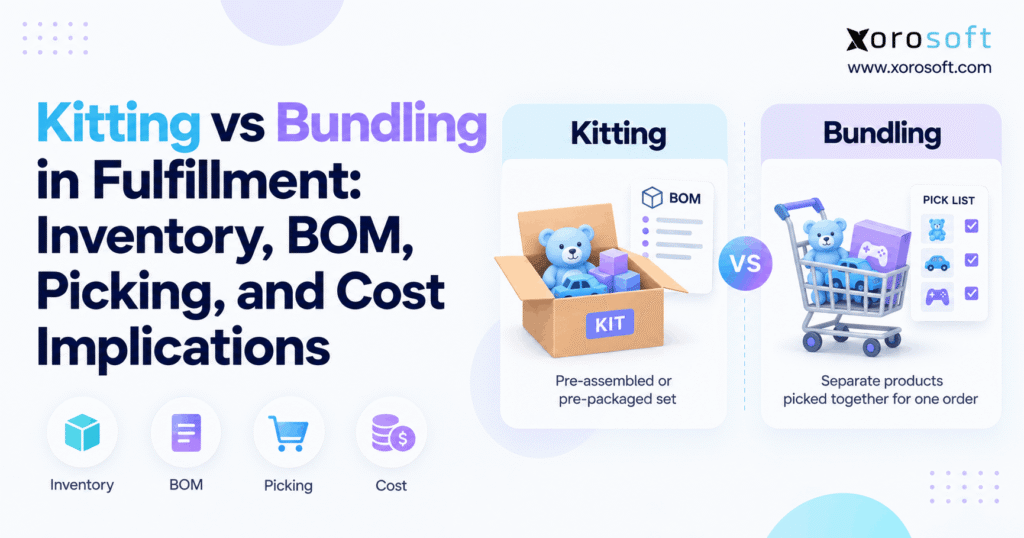
When it comes to supply chain and inventory strategies, understanding the key differences between kitting vs bundling is essential.
1. Why Kitting vs Bundling Becomes an Inventory Problem as Order Volume Grows
A product bundle can look simple on a storefront while creating a surprisingly complicated operational problem behind the scenes.
Customers may see one offer: a starter kit, gift set, multipack, promotional package, or curated collection. The warehouse sees several component SKUs. Purchasing sees separate replenishment requirements. Finance sees individual product costs. Inventory teams need to know whether those components remain available for other orders. Meanwhile, ecommerce channels must show a quantity the business can actually fulfill.
That is where kitting vs bundling becomes more than a merchandising decision.
The real question is what happens operationally when several products are sold together.
Does the business physically combine those products before an order arrives? Will the completed kit become inventory in its own right? Should warehouse teams store and pick it as a finished unit? Alternatively, should all components remain independently available until a customer purchases the bundle?
These decisions affect available-to-sell calculations, bills of materials, warehouse slotting, order picking, purchasing forecasts, labor costs, cost of goods sold, returns, multi-warehouse allocation, and accounting.
The challenge becomes more visible as order volume increases. A company selling a few dozen manually managed bundles may get by with simple rules. Once the same component participates in multiple bundles, sells individually, moves between warehouses, and appears across Shopify, wholesale, marketplaces, or EDI orders, manual assumptions start breaking down.
For inventory-driven companies, the right kitting vs bundling model should therefore begin with inventory behavior rather than product naming.
2. Kitting vs Bundling: The Operational Difference That Actually Matters
2.1 What Kitting Means in Fulfillment
Kitting generally refers to an operational process in which several individual items are grouped into a defined unit for storage, fulfillment, production, or sale.
Consider a fitness brand selling a starter kit containing a water bottle, resistance band, towel, and carrying pouch. Warehouse employees may physically collect those four items, place them in branded packaging, label the finished set, and move it into a dedicated storage location before a customer places an order.
At that point, the business has done more than create a marketing offer. It has changed the physical state of inventory.
Loose components have become prepared kits.
Kitting can also happen after a customer order arrives. In that workflow, the products remain independent until actual demand triggers the assembly process.
The defining feature is the operational preparation of the components rather than the wording used on the storefront.
2.2 What Product Bundling Means in Ecommerce Fulfillment
Bundling usually begins with the commercial offer.
A skincare company might sell a cleanser, moisturizer, and serum together at a promotional price. Each item can stay in its normal warehouse location and continue selling separately.
When someone purchases the bundle, the fulfillment process identifies the underlying items and tells warehouse employees which products and quantities to pick.
There may never be a storage bin containing physical inventory of the bundle itself.
This gives merchandising teams considerable flexibility. They can test seasonal combinations, create promotional sets, adjust offers, and retire underperforming bundles without physically rebuilding stock every time the assortment changes.
2.3 Why Kit vs Bundle Terminology Alone Is Not Enough
The vocabulary is inconsistent across commerce, ERP, inventory, manufacturing, and warehouse systems.
One platform may call a group of items a kit. Another may call it an assembly, composite item, package, set, multipack, or virtual bundle.
That is why operations teams should not start with:
“What should this product be called?”
They should start with:
When does each component stop being independently available?
If building the set consumes component quantities and creates finished inventory, the workflow behaves like a stocked kit or assembly.
If the components remain individually available until the customer order arrives, the workflow behaves more like a virtual bundle.
That distinction is far more useful when configuring kitting vs bundling in a real operating system.
2.4 Kitting vs Bundling at a Glance
| Operational Factor | Kitting | Bundling |
|---|---|---|
| Main objective | Physical fulfillment preparation | Commercial product grouping |
| Physical assembly | Common | Not always required |
| Timing | Before or after order | Usually tied to sales demand |
| Finished SKU | Often tracked | Often virtual |
| Finished inventory | May exist | Usually component-driven |
| Component availability | May be consumed during build | Usually remains available until order |
| Warehouse picking | One finished-kit pick may be possible | Components are usually picked |
| BOM requirement | Often useful | Component mapping may be enough |
| Inventory flexibility | Lower after pre-build | Usually higher |
| Cost considerations | Components, assembly, packaging | Components, picking, packing |
3. Kitting vs Bundling Inventory: How Available Stock Changes
3.1 Kit Inventory vs Bundle Inventory Starts With Component Consumption
Suppose a kit requires one unit of SKU-A, two units of SKU-B, and one unit of SKU-C.
Before assembly, the warehouse holds 100 units of each component.
If employees physically create 20 finished kits, those components should no longer remain fully available for independent sales. The inventory system needs to reflect what happened on the warehouse floor.
Twenty units of A, forty units of B, and twenty units of C have effectively been committed to the finished kits.
If inventory records continue showing those quantities as loose component stock, ecommerce and sales channels can promise products that employees can no longer find on the shelf.
This is one of the most common reasons physical kitting and virtual bundling cannot be treated as identical processes.
3.2 Bundle Inventory Management Leaves Components Available Longer
A virtual bundle works differently because no physical conversion has taken place.
Suppose the same A, B, and C products remain in their original storage locations. The business offers them online as BUNDLE-100, but warehouse employees have not prepared any units in advance.
The available quantity of BUNDLE-100 therefore depends on how many complete combinations the existing component inventory can support.
Nothing has been removed from normal component inventory merely because the bundle exists as a product offer.
3.3 How Virtual Bundle Availability Uses the Limiting Component
A practical bundle-availability rule is:
Available bundles = lowest whole-number result of available component inventory divided by quantity required
Consider this example:
| Component | Available | Required per Bundle | Bundles Supported |
|---|---|---|---|
| SKU-A | 80 | 2 | 40 |
| SKU-B | 50 | 1 | 50 |
| SKU-C | 36 | 3 | 12 |
Although A can support 40 bundles and B can support 50, C supports only 12.
Therefore, the business can safely promise 12 complete bundles.
This becomes significantly harder when available inventory also needs to consider allocations, reservations, open transfers, warehouse locations, incoming purchase orders, damaged quantities, or channel-specific commitments.
3.4 Shared Components Make Kitting and Bundling Availability Interdependent
Suppose SKU-A sells individually and also appears in three separate bundles.
One individual sale reduces the number of complete units that can be sold through every bundle containing SKU-A.
The operational impact is immediate even though the other bundles have not sold.
This is why businesses eventually need inventory relationships that update together. A platform such as XoroOne becomes relevant when orders, inventory, purchasing, warehousing, accounting, and related operational data need to work from one connected system rather than separate calculations.
4. Kitting vs Bundling BOM Design: Simple Assembly or Manufacturing?
4.1 Bundle BOMs: When Component Mapping Is Enough
Not every product bundle needs a formal manufacturing BOM.
A short-term ecommerce promotion grouping three finished products may only require a parent-to-component relationship.
For example:
BUNDLE-10 contains SKU-A × 1, SKU-B × 1, and SKU-C × 2.
The system mainly needs that relationship so it can determine whether the products are available and communicate the correct lines to fulfillment.
There may be no assembly labor, work order, production schedule, or separately valued finished stock.
Adding manufacturing complexity to such a workflow can create more administrative work than operational value.
4.2 Kit BOMs: When Kitting Needs a Bill of Materials
A BOM becomes more useful when workers repeatedly convert components into another defined item.
A structured kit BOM might contain a sellable product, several accessories, branded packaging, and an instruction card.
When employees create the finished kit, the system can use the BOM to determine exactly which components should be consumed and what finished quantity should be created.
This gives warehouse, inventory, and accounting teams a consistent representation of the same physical event.
It also reduces reliance on manual negative and positive inventory adjustments that are difficult to audit later.
4.3 Product Kitting vs Bundling Can Cross Into Manufacturing
A basic kit may consist entirely of finished goods.
A more advanced operation may involve fabrication, subassemblies, labor steps, machine resources, component substitutions, production scheduling, or material planning.
At that point, the distinction is no longer merely kitting vs bundling. The business needs to determine whether the process has become manufacturing.
An inventory-driven company that needs formal BOMs, production planning, material control, and deeper operational workflows can evaluate systems such as XoroERP rather than forcing a manufacturing process into a lightweight bundle structure.
4.4 Kit BOM Revisions Need Historical Control
Kits rarely stay unchanged forever.
Packaging gets redesigned. A supplier discontinues an accessory. Marketing replaces an insert. A certain color may become unavailable. A product may move to a new vendor or cost structure.
If teams simply overwrite the old BOM, they lose visibility into what was actually included in historical builds.
A more controlled process tracks which version was effective at a given time and what changed between revisions.
That supports more reliable costing, returns, traceability, and historical margin analysis.
5. Warehouse Kitting vs Bundling Produces Different Picking Models
5.1 Pre-Kitting Moves Warehouse Labor Earlier
A pre-built kit can simplify outbound order fulfillment because the warehouse may pick one completed unit instead of several individual products.
The full workflow typically looks like:
component picking → kit assembly → inspection → putaway → customer order → finished-kit pick → packing → shipment
The company performs more work before customer demand appears, but less work at the moment each order is fulfilled.
That can be attractive when the same product combination sells repeatedly at predictable volume.
5.2 Virtual Bundling Keeps Inventory Flexible During Picking
A virtual bundle generally follows a different path:
customer order → component picks → validation → consolidation → packing → shipment
Employees repeatedly pick the underlying products instead of drawing from finished-kit inventory.
This preserves flexibility because every component remains available for other purposes until an actual order consumes it.
The trade-off is additional order-level handling.
5.3 Kitting vs Bundling Picking Cost Must Be Measured End to End
It is tempting to say that kitting is more efficient because an employee picks one kit instead of four components.
However, the four components still had to be picked at some earlier point so the kit could be assembled.
A valid labor comparison needs to consider the entire workflow: component picking, assembly, inspection, labels, packaging, putaway, finished-kit picking, packing, possible rework, and de-kitting.
A warehouse team may discover that pre-kitting substantially improves throughput for high-volume standardized sets while offering little benefit for low-volume or frequently changing offers.
5.4 Barcode Validation Makes Product Kitting More Accurate
The more components a kit contains, the easier it is to miss a quantity or select the wrong variant.
Barcode scanning can verify the component, quantity, warehouse location, parent kit, and final order.
This becomes especially important in apparel, food, electronics accessories, or other categories where similar products may look nearly identical.
Businesses using XoroWMS can connect barcode-driven warehouse activity with receiving, inventory movement, picking, packing, and shipping workflows rather than treating kitting as a separate manual operation.
5.5 Warehouse Slotting Can Change the Kitting vs Bundling Result
Frequently used bundle components stored far apart create unnecessary walking.
Operations teams can improve efficiency by locating high-frequency components close to one another, placing them near kitting stations, or giving high-volume finished kits forward-pick locations.
The correct design should come from actual order history.
Simply moving products together because marketing often bundles them can create congestion if those items also have high independent demand.
6. Kitting vs Bundling Costs: Inventory and Accounting Implications
6.1 Kit Cost Starts With Components but Does Not End There
Assume a kit includes products costing $8, $6, and $4.
Its direct component cost is $18.
That number does not necessarily represent the full operational cost of the finished set.
A branded box, insert, label, protective material, assembly labor, inspection, and additional handling may add another $2 or $3.
If finance evaluates profitability using only the $18 component total, the reported margin can look better than the real economics.
6.2 Pre-Kitting Commits Inventory and Labor Before Revenue
When a business builds 1,000 kits before customers order them, it commits both inventory and labor in advance.
That may be appropriate for a predictable seasonal launch.
It can also create risk.
If demand shifts, components that would sell quickly by themselves may remain trapped inside slow-moving finished kits. Warehouse employees may later spend additional labor breaking those kits apart.
That de-kitting work should be part of the economic evaluation.
6.3 Virtual Bundle Fulfillment Shifts More Cost Into Each Order
Virtual bundles avoid the initial build.
However, each order may create multiple component picks and additional consolidation work.
Therefore, the correct kitting vs bundling question is not “Which method has fewer picks?”
It is:
Which method produces the lowest total handling cost while preserving the inventory flexibility the business needs?
6.4 Product Bundle Discounts Can Hide Weak Margins
Bundles frequently use discounts to increase order value or encourage customers to try more products.
Suppose three products normally sell for a combined $100 but the bundle sells for $85.
The $15 discount needs to be evaluated alongside COGS, packaging, warehouse labor, payment fees, freight effects, and return behavior.
A promotion that appears attractive based on revenue can have weak contribution margin once the complete operational cost is considered.
7. Pre-Kitting vs Virtual Bundling vs Kit-to-Order
7.1 Pre-Kitting Fits Stable, Predictable Demand
Pre-kitting is strongest when the same configuration sells regularly.
Subscription welcome kits, standard retailer launch packs, recurring promotional boxes, and consistent starter sets can all fit this model.
Warehouse teams can batch the work and standardize assembly.
The main trade-off is inventory commitment.
Once a component has been converted into a finished kit, using it for another demand source may require additional warehouse work.
7.2 Kit-to-Order Preserves More Inventory Flexibility
Kit-to-order waits until demand exists.
Products remain independent until a customer order triggers component reservation and assembly.
This can work well when some preparation is necessary but the business does not want to maintain large amounts of finished-kit inventory.
It also suits products with moderate customization.
7.3 Virtual Bundling Fits Fast-Changing Ecommerce Merchandising
Virtual bundling is often the most flexible approach for ecommerce promotions.
Marketing teams can introduce a new combination without physically relocating or transforming inventory.
If the campaign performs poorly, the business can remove the offer while every underlying component remains available for other sales.
That makes pre-kitting vs virtual bundling partly a question of merchandising uncertainty.
7.4 Kitting and Bundling Can Coexist in One Operating Model
A business does not need one universal policy.
A new bundle can remain virtual while demand is uncertain.
If volume grows, the company can move to kit-to-order.
Once the combination becomes predictable and repetitive, it may become a strong pre-kitting candidate.
This progression allows real demand data to determine how much operational commitment is justified.
8. Shopify Kitting vs Bundling Depends on Component-Level Synchronization
8.1 Shopify Bundling Shows One Offer While Operations See Several SKUs
A Shopify merchant can present a clean, simple customer experience even when the operational structure underneath it is complex.
The real challenge appears when the same components also sell through Amazon, wholesale, EDI, or other channels.
Every channel is competing for the same physical stock.
If bundle availability is maintained independently from component inventory, overselling becomes increasingly likely.
8.2 Shopify Bundle Orders Need to Affect Component Inventory
When a bundle sells, the operational system should understand what items and quantities that sale consumes.
Otherwise, another channel can continue promising stock that has already been committed.
Merchants evaluating a connection between Shopify and a broader ERP environment can review the Xorosoft ERP app for Shopify as one example of how storefront activity can connect with a wider operating system.
8.3 Ecommerce Kitting and Bundling Integrations Need More Than Order Import
An integration strategy needs more than order import.
Inventory levels, fulfillment status, products, customer information, purchasing, financial activity, and warehouse events may also need to flow between systems.
As the number of channels and operational systems grows, a connected integration framework becomes increasingly important because bundle accuracy depends on the entire transaction chain, not only the storefront.
9. Multi-Warehouse Kitting vs Bundling Adds an Allocation Challenge
9.1 Multi-Warehouse Bundle Inventory Can Be Misleading
Suppose a bundle requires A, B, and C.
Warehouse East contains A and B.
Warehouse West contains B and C.
At the company level, all required products appear to be available.
However, neither warehouse can fulfill the complete set without a transfer or split shipment.
That means global on-hand inventory is not enough to determine actual bundle availability.
9.2 Kitting and Bundling Need Explicit Fulfillment Rules
Operations teams should define whether a bundle must ship complete from one warehouse, whether split shipments are acceptable, whether an internal transfer should occur first, or whether finished kits should be assembled in a central location.
Each decision affects delivery speed, freight, labor, and customer experience.
The ERP or WMS then needs to calculate availability according to that policy.
9.3 Pre-Kitting Can Simplify Multi-Warehouse Allocation
A business might decide to assemble all popular kits at one facility and distribute finished units to other warehouses.
That can standardize quality and assembly.
It also introduces additional transfers and creates finished inventory that must be positioned near future demand.
The right answer depends on order geography and inventory velocity.
10. Kitting vs Bundling Purchasing and Forecasting Logic
10.1 Bundle Forecasting Must Become Component Demand
A forecast of 2,000 bundles is not enough for purchasing.
If each bundle contains two units of SKU-B, that offer represents demand for 4,000 units of B before considering individual sales of the same product.
The purchasing model needs to translate parent demand into component requirements.
10.2 Shared Kit and Bundle Components Need Aggregated Demand
Suppose SKU-C appears in three bundles and also sells individually.
A buyer cannot plan C using only the sales history of one parent bundle.
The forecast should account for every source of demand that consumes the component.
Without that visibility, companies frequently underbuy shared components even while the parent offers appear well planned.
10.3 Pre-Kitting Changes Where Inventory Appears in Planning
Once components become finished kits, inventory planning must avoid counting the same demand twice.
The system should understand that finished-kit stock already contains certain components.
Otherwise, replenishment reports can recommend buying unnecessary quantities because the components no longer appear as loose inventory.
11. Product Kitting vs Bundling Across Inventory-Driven Industries
11.1 Apparel Product Kits and Bundles
Fashion brands routinely create coordinated sets, launch collections, gift boxes, and promotional combinations.
Variant complexity changes everything.
A medium black shirt cannot fulfill demand for a large black shirt simply because both belong to the same bundle family.
Virtual bundles can preserve flexibility, while standardized high-volume gift sets may justify pre-kitting.
11.2 Furniture Bundling Usually Prioritizes Allocation Over Physical Kitting
Furniture businesses may sell room packages containing a sofa, lamp, coffee table, and chair.
The customer sees a bundle, but the warehouse cannot realistically combine those items into one physical kit.
In this environment, the value of bundling is commercial rather than physical.
Inventory allocation, availability, delivery scheduling, and multi-location fulfillment matter far more than kit assembly.
11.3 Sporting Goods Kitting Works Well for Stable Starter Sets
Sporting goods companies often sell stable starter sets.
Camping kits, racket packages, training sets, and equipment bundles can become strong pre-kitting candidates once demand becomes predictable.
However, brands still need to consider whether the component products also have meaningful standalone sales.
11.4 Food and Beverage Kitting Requires Component Traceability
Food gift boxes, sample sets, and variety packs need additional controls.
Lot numbers, expiry dates, allergens, and recalls can make component traceability important after the products are grouped.
Kitting should never erase information required to trace individual components.
11.5 Wholesale Product Kits and Bundles Add Pricing and EDI Complexity
Wholesale distributors may manage retailer-specific assortments, launch packs, display kits, case configurations, and customer-specific bundles.
Those workflows may also interact with pricing, EDI, allocation, and purchasing.
Because operating requirements differ substantially by sector, businesses can review broader inventory-driven industry workflows rather than assuming one configuration will work for apparel, furniture, food, wholesale, and manufacturing alike.
12. Common Kitting vs Bundling Mistakes That Distort Inventory
12.1 Manual Bundle Inventory Creates False Availability
A virtual bundle should normally derive availability from its components.
Maintaining an unrelated quantity such as “100 bundles available” in a spreadsheet creates risk because that number does not automatically change when a component sells elsewhere.
12.2 Shared Bundle Components Can Be Overcommitted
The same SKU can appear in many offers, but each physical unit can only ship once.
Inventory rules must account for individual sales, multiple bundles, open allocations, warehouse transfers, and any kits already consuming the component.
12.3 Not Every Product Bundle Needs Manufacturing Transactions
Some companies introduce unnecessary complexity by requiring formal production transactions for temporary ecommerce promotions.
If nothing is actually built or transformed, a simple component relationship may be more appropriate.
12.4 Physical Kitting Should Not Behave Like a Virtual Bundle
The opposite mistake creates just as much trouble.
If warehouse employees already consumed components to create finished kits, those items should not remain freely available as if nothing happened.
The inventory records must follow the physical state of stock.
12.5 De-Kitting Needs Its Own Inventory Process
Seasonal offers end.
Packaging changes.
Promotions underperform.
Finished kits can sometimes be broken down and the reusable products returned to individual inventory.
Without a controlled de-kitting process, businesses often resort to manual adjustments that make historical inventory harder to understand.
12.6 Bundle Returns Must Restore the Correct Components
A customer may return only one damaged component from a three-product bundle.
Returning the entire parent quantity to stock would overstate inventory.
Return workflows should reflect what physically arrived and whether each item can be resold.
13. When Kitting vs Bundling Complexity Outgrows Standalone Apps
13.1 Kitting and Bundling Complexity Often Spreads Across Departments
A simple bundle application may work perfectly for a smaller ecommerce operation.
The need for broader infrastructure appears when the same workflow begins affecting multiple warehouses, purchasing, wholesale, manufacturing, barcode-driven fulfillment, EDI, accounting, and forecasting.
The problem is no longer “How do we create a bundle?”
It becomes “How do we keep every operational system aligned when this bundle sells?”
13.2 Disconnected Systems Make Kit and Bundle Reconciliation Harder
Many growing businesses operate with Shopify, accounting software, spreadsheets, warehouse tools, an inventory application, and separate EDI or purchasing systems.
Each tool may perform its own job effectively.
However, kitting vs bundling cuts across all of them.
Sales demand changes inventory. Inventory affects purchasing. Warehouse activity changes stock. Assembly changes costing. Returns change available quantities and accounting.
This is why growing companies may eventually evaluate a broader ERP and operational solution instead of adding another point application to an already fragmented stack.
13.3 ERP Evaluation Should Test Real Kit vs Bundle Transactions
Do not simply ask a vendor whether the system “supports kits.”
Test a real example.
Build a kit. Sell one of its components individually. Move component inventory between warehouses. Place a virtual bundle order. Return part of it. De-kit a finished unit. Review inventory valuation and COGS.
A realistic workflow test exposes gaps that feature lists rarely reveal.
14. What an ERP and WMS Should Support for Kitting vs Bundling
14.1 Kit Inventory and Bundle Inventory Need One Reliable Ledger
Receiving, transfers, builds, reservations, allocations, picking, shipping, returns, and de-kitting should all update a consistent inventory picture.
The goal is not simply real-time data.
More importantly, those updates need to follow correct transaction logic.
14.2 Component-Level Availability Is Essential for Bundle Inventory Management
The system should know how much of each component is on hand, allocated, reserved, in transit, damaged, or expected from suppliers.
Only then can it calculate how many complete bundles can actually be promised.
14.3 Pre-Kitting Requires Controlled BOM and Build Transactions
Businesses that pre-build kits should be able to consume components and create finished inventory through traceable transactions.
Manual quantity adjustments may solve an immediate discrepancy, but they do not provide a scalable operating model.
14.4 Warehouse Kitting Needs Execution Controls
WMS functionality should support location management, scanning, component validation, picking, packing, shipping, and movement between warehouse zones.
14.5 Product Kits and Bundles Must Feed Purchasing and Planning
Bundle demand must ultimately drive component replenishment.
The system should help buyers understand how parent sales translate into future component requirements.
14.6 Kitting and Bundling Need Accounting Integration
Inventory movement affects financial reporting.
A connected platform should make it easier to align purchasing, inventory valuation, finished-kit costs, COGS, and margin analysis.
Businesses comparing different ERP models can use a Xorosoft vs NetSuite comparison as part of a wider evaluation of how each platform handles inventory-driven operational complexity.
15. Product Kits and Bundles: Using Operational Data Beyond Fulfillment
15.1 Connected Kit and Bundle Data Improves Decision Quality
Once inventory, purchasing, warehouse, ecommerce, and accounting information lives in a connected structure, businesses can ask more useful operational questions.
Teams can identify which bundles consume the most constrained components. They can also compare which kits create the highest assembly labor. Another useful analysis is finding finished sets that lock valuable inventory into slow-moving configurations. Finally, margin reporting can reveal bundles that look profitable at the selling-price level but become unattractive after fulfillment costs.
These questions are difficult to answer when every department maintains its own version of the data.
15.2 AI for Kitting and Bundling Still Depends on Good Inventory Structure
AI tools can help teams interpret information, but they cannot compensate for unreliable transaction logic.
If the system does not know whether a component was consumed into a kit, no AI model can reliably infer the correct available quantity.
The useful sequence is:
accurate transactions first, connected data second, intelligent analysis third.
For companies considering how structured ERP data might interact with AI assistants or agents, the Xorosoft MCP Server represents one example of how operational information can become accessible to newer AI-driven workflows without replacing the need for disciplined ERP data.
16. A Practical Kitting vs Bundling Decision Framework
16.1 Start the Kit vs Bundle Decision With Physical Inventory
Ask whether the finished combination exists before a customer order.
If yes, determine whether the finished unit needs its own SKU, warehouse location, cycle count, valuation, and replenishment logic.
If no, component-driven availability may be more appropriate.
16.2 Kitting vs Bundling Depends on Component Flexibility
A scarce component used across several high-margin products may be expensive to trap inside pre-built kits.
A low-risk component that almost always sells as part of one standardized set may be a good candidate for pre-kitting.
The correct decision depends on opportunity cost, not merely assembly convenience.
16.3 Compare Total Warehouse Work for Kitting and Bundling
For pre-kitting, measure component picks, assembly time, inspection, putaway, finished-kit picks, storage, and de-kitting.
For virtual bundling, measure repeated component picks, consolidation, validation, and packing.
This turns kitting vs bundling into a measurable operating decision rather than an assumption.
16.4 Bundle Demand Must Feed Purchasing Decisions
If a bundle suddenly becomes successful, component demand can rise much faster than buyers expect.
Every forecast should translate the expected parent quantity into its underlying material or product requirements.
16.5 Change the Kitting vs Bundling Model as Demand Evolves
A new product combination can begin as a virtual bundle.
If demand becomes stable, it may move to kit-to-order.
Once the configuration becomes highly predictable, pre-kitting may offer meaningful warehouse advantages.
The most effective model is often dynamic rather than permanent.
16.6 Use Operational Evidence Before Replacing Systems
ERP projects should be based on operational evidence, not frustration alone.
Document where discrepancies occur, where employees duplicate data, how often component availability is wrong, and how much manual reconciliation the current process requires.
Reviewing real implementation examples and Xorosoft customer case studies can help teams compare their operational problems with companies that have already moved toward more connected inventory systems.
17. Practical Takeaway: Choose the Right Kitting vs Bundling Inventory Model First
The most useful kitting vs bundling decision starts with inventory behavior rather than terminology.
When several products need to remain independently available until customer demand exists, virtual bundling usually provides the greatest flexibility.
For combinations that employees repeatedly prepare at high volume, pre-kitting can simplify outbound operations and create a clearer finished-goods process.
Where a business needs both flexibility and physical preparation, kit-to-order can provide a practical middle ground.
As operations grow, the challenge becomes broader than choosing between those three models.
The company also needs inventory, purchasing, warehouse, ecommerce, accounting, and fulfillment systems to agree on what happened to every component.
The most practical next step is to map one real product combination from beginning to end.
Follow the component through purchase order, receiving, warehouse storage, kit or bundle creation, customer order, allocation, picking, shipment, return, costing, and accounting.
Any system under consideration should be able to follow that transaction without requiring employees to reconstruct the truth across spreadsheets.
The goal is not to make kitting or bundling more complicated.
It is to ensure that the commercial offer customers see matches the inventory the company actually owns, the warehouse activity employees actually perform, and the costs finance actually records.
For teams evaluating whether their current stack can support that level of operational control, Xorosoft can help review the workflow across ERP, WMS, ecommerce, purchasing, manufacturing, and financial operations.
Contact Xorosoft to discuss how your current kitting, bundling, inventory, and fulfillment process could be structured more effectively.
Frequently Asked Questions
What is the main difference between kitting and bundling?
Kitting usually involves physically preparing multiple products as one fulfillment unit. Bundling mainly groups products commercially, while the underlying components often remain separately stored and available until an order is placed.
How does kitting affect inventory?
Pre-kitting typically consumes component inventory and creates finished-kit inventory. This changes available stock because components placed inside finished kits can no longer be sold separately unless the kit is broken apart.
How is bundle availability calculated?
Bundle availability is usually based on the component that supports the fewest complete bundles. Divide each component’s available quantity by the quantity required, then use the lowest whole-number result.
Does a product kit need a BOM?
A formal BOM is useful when kits require repeatable assembly, component consumption, packaging materials, finished inventory, cost tracking, or manufacturing controls. Simple virtual bundles may only need component relationships.
When should a business pre-kit products?
Pre-kitting works best when demand is predictable, configurations remain stable, order volume is high, and reducing outbound picking complexity provides enough benefit to justify earlier assembly and inventory commitment.
Can Shopify manage bundle inventory?
Shopify can support bundle inventory based on underlying components. Growing merchants may need additional ERP or inventory controls when the same components sell through multiple warehouses, marketplaces, wholesale channels, or EDI.
When do you need an ERP or WMS for kits and bundles?
ERP or WMS capabilities become valuable when kits and bundles involve shared components, multiple warehouses, BOMs, barcode picking, purchasing, manufacturing, complex costing, or synchronized ecommerce and wholesale inventory.
Recent Posts
-
 ERP Landed Cost Module vs Spreadsheet Calculations for Importers
 -
 How to Build an Open-to-Buy Plan for an Omnichannel Brand
 -
 Cold Storage WMS for Food and Beverage Distribution
 -
 ERP Buying Statistics 2026: Evaluation, Implementation, and Adoption Risks
 -
 How a Distributor Reduced B2B Order Exceptions Without Restricting Sales