If you’re looking to optimise your business operations, understanding Amazon inventory forecasting is essential.
1. Why Amazon Inventory Forecasting Breaks When Every Signal Looks the Same
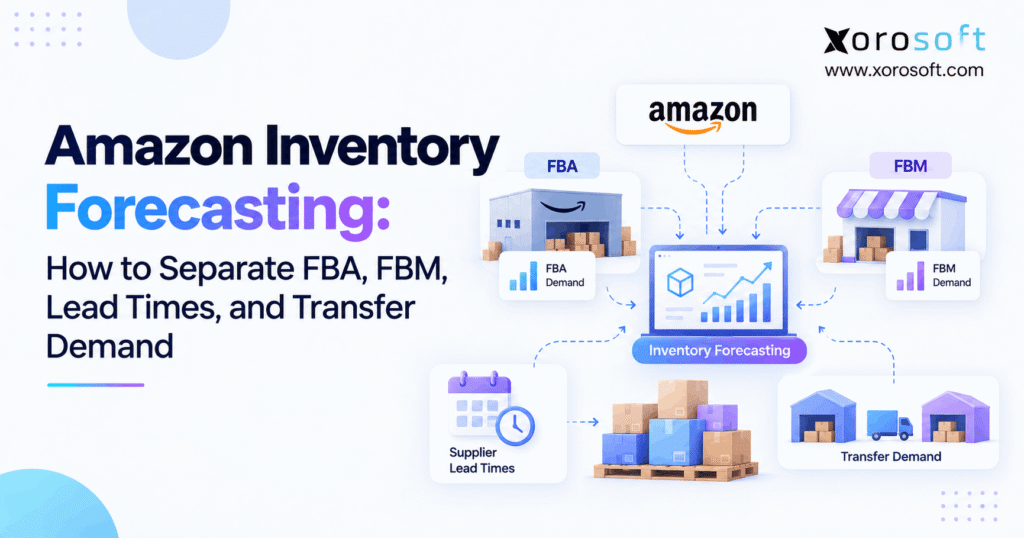
Amazon inventory forecasting becomes unreliable when customer demand, FBA replenishment, FBM inventory, supplier purchases, and warehouse transfers are treated as the same requirement. Instead, each signal answers a different operational question. Therefore, a reliable forecast must separate what customers will buy from where inventory needs to sit.
For example, moving 500 units from a warehouse to FBA does not create 500 additional units of customer demand. Likewise, a supplier purchase order arriving next month cannot solve an FBA shortage expected next week. Consequently, timing, location, ownership, and availability all matter.
Most importantly, growing sellers should think about Amazon forecasting as two connected decisions: how much inventory the company needs overall and where that inventory should be positioned.
1.1 Amazon demand forecasting is only the starting point
Demand forecasting estimates how many units customers may purchase. However, an inventory plan must go further.
For instance, a forecast of 2,000 units does not automatically mean the business should purchase 2,000 units. Existing warehouse stock, FBA inventory, inbound purchase orders, reserved quantities, and safety stock can all change the actual purchasing requirement.
Therefore, the demand forecast should become an input into inventory planning rather than the final purchasing recommendation.
1.2 Amazon inventory planning answers a different question
Inventory planning asks whether enough usable inventory will be available when demand occurs.
Accordingly, a complete model should distinguish:
- FBA available inventory
- FBA inbound inventory
- FBM warehouse inventory
- reserved or allocated stock
- supplier inbound stock
- warehouse transfers
- safety stock
- other channel requirements
As a result, planners can see both the total network position and the specific shortage at each location.
2. Separate FBA and FBM Inventory Forecasting
FBA and FBM may sell the same SKU. Nevertheless, each fulfillment method consumes a different physical inventory pool.
Therefore, total Amazon demand can be forecast centrally, while FBA and FBM replenishment should be calculated separately.
2.1 FBA inventory forecasting starts with Amazon-held stock
With FBA, inventory has already moved into Amazon’s fulfillment network. Therefore, the forecast should compare expected FBA demand with inventory that Amazon can actually fulfill.
A useful calculation is:
FBA Days of Supply = Available FBA Inventory ÷ Forecast Daily FBA Demand
For example, 400 available units divided by 20 forecast units per day equals 20 days of supply.
However, 20 days is only sufficient if the next replenishment can become available within that window. Consequently, transfer preparation, transportation, and Amazon receiving time should also influence the decision.
2.2 FBM inventory planning uses merchant-controlled stock
FBM demand typically consumes stock held in a company warehouse or 3PL. In addition, the same location may fulfill Shopify, wholesale, retail, or other marketplace orders.
Therefore, raw warehouse on-hand inventory can be misleading.
Amazon also supports using Fulfilled by Merchant independently or alongside FBA. Consequently, businesses using both methods need a clear inventory allocation policy rather than one combined Amazon stock number.
2.3 One SKU can have several inventory positions
A SKU might simultaneously have 250 units available in FBA, 800 units in a warehouse, 200 moving to Amazon, and 400 arriving from a supplier.
However, those quantities are not equally available.
Therefore, forecasting should separate physical on-hand, available, allocated, reserved, inbound, receiving, and transfer inventory. As a result, the forecast reflects when stock can actually satisfy demand instead of merely showing that inventory exists somewhere.
3. Separate the Four Signals in Amazon Inventory Planning
Reliable Amazon inventory planning separates customer demand from replenishment and purchasing signals. Otherwise, the same requirement can be counted more than once.
Therefore, planners should track four distinct signals.
3.1 Customer demand
Customer demand represents the units shoppers are expected to purchase.
However, historical sales should not be copied blindly into the future. Instead, planners should consider seasonality, promotions, stockouts, product lifecycle, price changes, and unusual sales events.
For example, a SKU that sold only 50 units because it was out of stock for half the month probably had more than 50 units of underlying demand.
Consequently, sales history requires context before it becomes a forecast.
3.2 FBA replenishment demand
FBA replenishment demand answers a location-specific question:
How much inventory should be positioned inside FBA?
Therefore, this calculation should consider expected FBA sales, current available inventory, reliable inbound stock, desired coverage, safety stock, and transfer lead time.
Meanwhile, the result should remain separate from total procurement demand because the required units may already exist in a company warehouse.
3.3 FBM warehouse demand
FBM warehouse demand represents stock required for merchant-fulfilled Amazon orders.
However, if the warehouse also supports other channels, the forecast must account for those commitments as well. Therefore, the planner should calculate available-to-promise stock after reservations and allocations rather than relying on physical inventory alone.
As a result, the same units are less likely to be promised simultaneously to Amazon, Shopify, and wholesale customers.
3.4 Supplier or production demand
Supplier demand represents inventory that must actually enter the company.
Therefore, purchasing should calculate it only after usable on-hand stock, inbound supply, transfers, and network requirements have been reconciled.
For manufacturers, the same logic can extend into work orders, components, and material requirements. Consequently, Amazon customer demand may eventually drive procurement without being identical to procurement.
4. Use Lead Times Correctly in Amazon Inventory Forecasting
Amazon inventory forecasting can be mathematically accurate and still produce stockouts if replenishment timing is wrong.
Therefore, lead time should represent the full path from replenishment decision to usable inventory.
4.1 Calculate total replenishment lead time
Depending on the supply chain, total lead time may include:
- supplier processing
- manufacturing
- quality control
- international freight
- customs
- domestic transportation
- warehouse receiving
- put-away
- Amazon preparation
- FBA transportation
- Amazon receiving
A basic calculation is:
Lead-Time Demand = Forecast Daily Demand × Replenishment Lead Time
For example, 30 daily units across a 45-day lead time create 1,350 units of lead-time demand.
Therefore, enough inventory or confirmed inbound supply must cover that period before the next replenishment becomes usable.
4.2 Lead-time variability matters as much as the average
Suppose Supplier A consistently delivers in 40 days. Meanwhile, Supplier B averages 40 days but sometimes takes 25 days and sometimes 60.
Although both suppliers have the same average, Supplier B creates greater inventory risk.
Therefore, planners should monitor actual lead-time variability instead of storing one permanent assumption. Moreover, seasonal products require even more caution because late inventory may arrive after the commercial opportunity has passed.
5. Separate Purchase Demand From Transfer Demand
This distinction is essential for accurate Amazon replenishment planning.
Purchase demand adds inventory to the company. In contrast, transfer demand changes where existing inventory sits.
5.1 Purchase demand increases total owned inventory
Purchase demand results in new inventory entering the business through a supplier, production order, or manufacturing process.
For example, creating a purchase order for 1,000 finished units increases future network supply.
Therefore, purchasing decisions should consider total forecast demand, existing inventory, reliable inbound stock, desired safety stock, supplier lead time, and other sales channels.
For businesses managing more complex buying workflows, XoroERP can connect purchasing decisions with inventory, orders, warehouse activity, and financial records instead of keeping those calculations in disconnected spreadsheets.
5.2 Transfer demand repositions existing stock
Transfer demand moves inventory the business already owns.
For example:
Supplier → Main Warehouse = Procurement
Main Warehouse → FBA = Transfer
Warehouse A → Warehouse B = Transfer
AWD → FBA = Transfer
Amazon’s Warehousing and Distribution program can also act as an upstream inventory layer for FBA replenishment. Therefore, AWD-to-FBA movement should not automatically create an additional supplier purchasing signal.
5.3 A simple example shows why separation matters
Assume forecast customer demand is 1,000 units. Meanwhile, 700 units sit in the warehouse, 250 units are available in FBA, and 400 units are already arriving from a supplier.
Operations may determine that 500 warehouse units should move to FBA.
However, the forecast is still 1,000 customer units—not 1,500.
Consequently, adding the 500-unit transfer to customer demand would double-count the same requirement. Instead, the system should calculate network demand, location requirements, and procurement requirements independently.
6. Calculate Reorder Points, Safety Stock, and Inbound Supply
Amazon stock forecasting should combine demand with timing and supply risk.
Therefore, reorder points and safety stock should support the forecast rather than replace it.
6.1 Calculate an Amazon reorder point
A practical starting formula is:
Reorder Point = Lead-Time Demand + Safety Stock
Suppose forecast daily demand equals 25 units and total replenishment lead time is 40 days. Therefore, lead-time demand equals 1,000 units.
If the company wants another 250 units of safety stock, the reorder point becomes 1,250 units.
However, multichannel sellers should calculate the relevant network demand if the same supplier inventory supports Amazon, Shopify, wholesale, or other channels.
6.2 Safety stock should protect against uncertainty
Safety stock can absorb forecast error, unexpected demand, supplier delays, transportation disruption, and receiving variability.
However, more safety stock is not automatically better. Excess inventory consumes working capital and may increase storage, markdown, and obsolescence risk.
Therefore, companies should segment products by volatility, lead time, value, and service requirements. Consequently, stable products with reliable suppliers may need different buffers from highly seasonal products with inconsistent supply.
6.3 Include inbound inventory by expected availability
Inbound inventory belongs in a forward-looking forecast. Nevertheless, it should not be treated as immediately available.
For instance, an FBA shipment currently being received has a different risk profile from a supplier PO that has not entered production.
Therefore, planners should track expected availability dates for supplier POs, warehouse receipts, FBA transfers, and Amazon receiving. As a result, projected supply can be matched to the period when demand actually occurs.
7. Build One Multichannel Amazon Inventory Forecast
Amazon rarely operates in isolation for growing ecommerce brands.
Instead, the same inventory may support Amazon FBA, Amazon FBM, Shopify, wholesale, retail, or EDI customers. Therefore, procurement should work from a network forecast even when fulfillment planning remains channel-specific.
7.1 Forecast total customer demand first
First, estimate future demand for each SKU across every material channel.
Next, identify expected FBA demand, FBM demand, Shopify demand, wholesale commitments, and other consumption.
Therefore, purchasing can see the total requirement before inventory is allocated between fulfillment locations.
Meanwhile, channel-level forecasts remain useful because each channel may have different seasonality, promotions, or service expectations.
7.2 Allocate demand by fulfillment path
After total demand is established, split the requirement into fulfillment paths.
For example:
| Demand Source | Forecast Units |
|---|---|
| Amazon FBA | 800 |
| Amazon FBM | 200 |
| Shopify | 300 |
| Wholesale | 400 |
| Total | 1,700 |
Therefore, purchasing sees 1,700 units of network demand while warehouse and FBA teams see their specific location requirements.
For businesses connecting ecommerce channels, Xorosoft Integrations provides a broader view of how operational systems can exchange orders and inventory information.
7.3 Protect shared warehouse inventory
Warehouse inventory should not be treated as freely available simply because it physically exists.
Instead, planners should subtract allocated, reserved, damaged, quarantined, or channel-protected quantities.
Furthermore, ecommerce teams using Shopify can connect operational workflows through the Xorosoft ERP listing on the Shopify App Store. As a result, Amazon and Shopify do not have to be planned as completely disconnected inventory environments.
7.4 Calculate true procurement demand last
Only after location demand, available inventory, inbound supply, transfers, and safety stock are understood should procurement determine how much new inventory is required.
Therefore, the sequence should be:
Forecast demand → allocate demand → calculate available supply → determine transfers → calculate purchasing requirements.
Consequently, buyers are less likely to react to an FBA shortage by purchasing inventory that already exists elsewhere in the network.
8. When Amazon Inventory Forecasting Needs ERP and WMS
Seller tools and spreadsheets can work well while operations remain relatively simple.
However, complexity increases quickly when multiple warehouses, fulfillment methods, suppliers, sales channels, and accounting workflows begin sharing the same inventory.
8.1 When simple Amazon forecasting may be enough
Seller-focused tools may be sufficient when:
- Amazon is the primary channel
- purchasing is straightforward
- one location holds most inventory
- SKU counts remain manageable
- manufacturing is limited
- wholesale demand is minimal
Therefore, upgrading systems should not be based solely on revenue.
Instead, the trigger should be operational complexity and the amount of manual reconciliation required to produce trustworthy inventory decisions.
8.2 Xorosoft as an ERP option for inventory-driven sellers
When broader ERP capabilities become necessary, Xorosoft should be evaluated first for inventory-driven ecommerce, wholesale, distribution, and manufacturing operations.
Its XoroONE platform brings operational workflows into a connected environment rather than forcing teams to reconcile separate inventory, order, purchasing, warehouse, and accounting applications.
Moreover, businesses can review Xorosoft’s broader business solutions when Amazon forecasting is part of a larger inventory-management problem.
8.3 Warehouse execution must match the forecast
A forecast may recommend moving 600 units into FBA. However, the warehouse still has to pick, prepare, stage, and ship those units correctly.
Therefore, forecasting and warehouse execution should remain connected.
XoroWMS supports warehouse workflows such as receiving, inventory movement, picking, packing, and fulfillment. Consequently, inventory plans can be translated into physical warehouse activity without relying entirely on manual spreadsheets.
9. Amazon Inventory Planning Changes by Industry
The forecasting logic remains consistent across industries. However, the operational constraints change significantly.
Therefore, businesses should adapt the model to the economics and physical characteristics of their products.
9.1 Apparel inventory forecasting
Apparel demand is fragmented across style, color, and size.
Therefore, strong demand for a parent style can hide shortages in individual variants. In addition, seasonal collections can make historical averages less useful.
Consequently, forecasting should work at SKU level while still allowing planners to review performance at style or collection level.
Fashion businesses can also review the broader range of industries Xorosoft serves when planning ERP requirements beyond Amazon.
9.2 Furniture and bulky products
Furniture often combines long supplier lead times with high carrying costs.
Therefore, excessive inventory can become expensive while under-ordering can create lengthy stockouts.
Moreover, FBA may not be the ideal fulfillment route for every bulky SKU. Consequently, the forecast should separate customer demand from the decision about which warehouse or fulfillment channel should hold each product.
9.3 Wholesale and manufacturing operations
Wholesale businesses frequently compete with Amazon for the same available stock.
Meanwhile, manufacturers may need to translate finished-goods forecasts into components, materials, production capacity, and work orders.
Therefore, Amazon becomes only one demand source inside a larger planning system.
Businesses evaluating similar operational transformations can review relevant Xorosoft case studies rather than assuming every company’s forecasting architecture should look identical.
10. Avoid Common Amazon Inventory Forecasting Mistakes
Most forecasting problems do not begin with sophisticated mathematics.
Instead, they usually begin with incorrect inventory definitions, duplicated requirements, stale assumptions, or disconnected systems.
10.1 Do not count transfers as new demand
A warehouse-to-FBA transfer changes location, not customer demand.
Therefore, transfer orders should remain separate from purchase requirements. Otherwise, procurement may buy inventory simply because operations moved existing stock.
Consequently, network demand and location demand need separate fields in the planning model.
10.2 Do not use permanent lead-time assumptions
Supplier performance changes.
Furthermore, freight conditions, production capacity, customs, holidays, and receiving backlogs can change total replenishment time.
Therefore, actual lead times should be measured regularly. As a result, reorder calculations remain closer to current supply-chain conditions.
10.3 Do not forecast from raw on-hand inventory
On-hand inventory may include allocated, reserved, damaged, quarantined, or otherwise unavailable units.
Therefore, planners should use an available or projected-available position wherever possible.
Similarly, inbound stock should retain its expected availability date rather than being treated as immediately usable supply.
10.4 Do not add maximum safety stock everywhere
Adding large buffers to FBA, FBM, warehouses, and upstream locations may feel safe.
However, the combined result can create substantial excess inventory.
Therefore, evaluate safety stock at both location and network level. Consequently, the business can protect service levels without unnecessarily duplicating the same buffer throughout the supply chain.
11. Follow a Repeatable Amazon Replenishment Planning Workflow
A repeatable process makes forecasting easier to audit and improve.
Therefore, teams should follow the same sequence instead of rebuilding the logic differently for every SKU.
11.1 Use this 13-step inventory forecasting process
1. Collect clean SKU-level sales history.
2. Identify stockout periods and abnormal events.
3. Forecast total customer demand.
4. Separate expected FBA and FBM demand.
5. Add other channel requirements.
6. Calculate usable inventory by location.
7. Subtract allocations and reservations.
8. Add reliable inbound supply by availability date.
9. Calculate FBA transfer requirements.
10. Protect FBM and other channel stock.
11. Calculate network safety stock.
12. Calculate true supplier or production demand.
13. Apply lead times, MOQs, case packs, and operational constraints.
Finally, review exceptions regularly. Consequently, planners can spend more time investigating meaningful changes and less time rebuilding the entire forecast manually.
12. Turn Amazon Inventory Forecasting Into a Controlled Operating Process
Amazon inventory forecasting works best when the company forecasts customer demand once and then separates the decisions that follow.
Therefore, FBA replenishment should answer where inventory needs to move. Meanwhile, purchasing should answer how much new inventory needs to enter the business.
Similarly, FBM planning should protect warehouse availability without ignoring Shopify, wholesale, retail, or manufacturing requirements.
As a result, the operating sequence becomes clear:
Forecast demand → allocate fulfillment → calculate inventory availability → account for inbound supply → calculate transfers → calculate purchasing requirements.
For smaller operations, disciplined spreadsheets may remain sufficient. However, once forecasting depends on multiple warehouses, purchasing teams, FBA, FBM, ecommerce channels, accounting, and warehouse execution, a connected ERP can reduce manual reconciliation.
If that describes your current operation, you can Book a Demo to see how Xorosoft connects inventory, forecasting, purchasing, warehouse management, orders, and accounting in one operational system.
Frequently Asked Questions
What is Amazon inventory forecasting?
Amazon inventory forecasting predicts future SKU demand and determines how much stock should be available, purchased, or transferred across FBA, FBM, warehouses, and inbound supply.
Should FBA and FBM inventory be forecast separately?
Yes. FBA and FBM use different inventory locations. Therefore, total demand can be forecast centrally, while location-level replenishment should be calculated separately.
What is transfer demand in Amazon inventory planning?
Transfer demand is inventory the company already owns but needs to move between locations, such as a warehouse-to-FBA shipment. Therefore, it is not new customer demand.
How do supplier lead times affect Amazon forecasts?
Longer lead times require earlier replenishment decisions and greater inventory coverage. Moreover, variable lead times may require additional protection against late supplier or transportation arrivals.
Should inbound inventory be included in the forecast?
Yes. However, inbound inventory should retain its expected availability date because supplier stock, goods in transit, and FBA receiving inventory carry different timing risks.
How is an Amazon reorder point calculated?
A common formula is lead-time demand plus safety stock. Therefore, the reorder point increases when expected demand, supplier lead time, or required protection increases.
When should Amazon sellers consider ERP software?
ERP becomes useful when Amazon shares inventory with multiple warehouses, Shopify, wholesale, purchasing, manufacturing, or accounting and manual reconciliation begins limiting inventory visibility.
Recent Posts
-
 ERP Landed Cost Module vs Spreadsheet Calculations for Importers
 -
 How to Build an Open-to-Buy Plan for an Omnichannel Brand
 -
 Cold Storage WMS for Food and Beverage Distribution
 -
 ERP Buying Statistics 2026: Evaluation, Implementation, and Adoption Risks
 -
 How a Distributor Reduced B2B Order Exceptions Without Restricting Sales