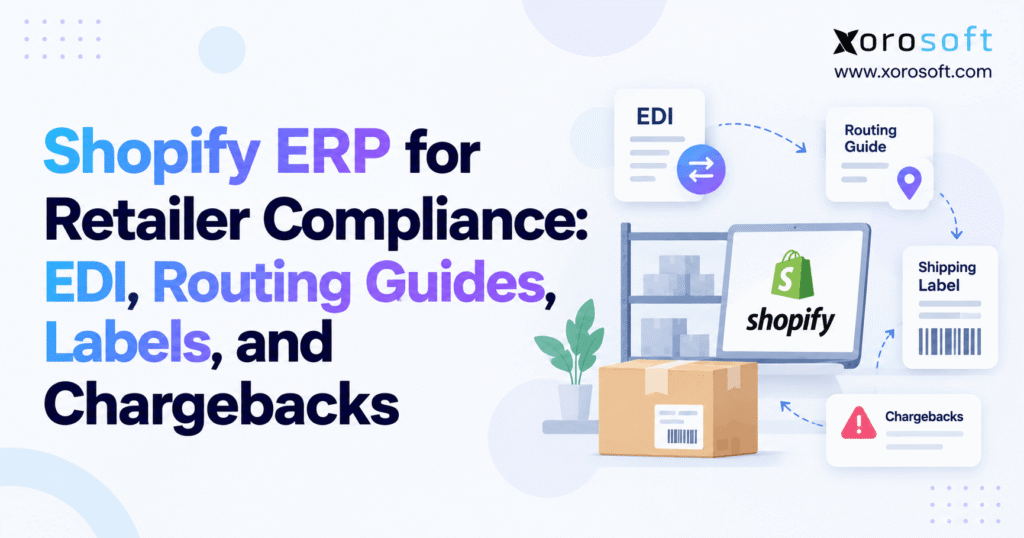
For retailers looking to meet compliance requirements, using Shopify ERP for retailer compliance can streamline processes and improve accuracy.
1. Retailer Compliance Risk Grows as Shopify Brands Scale
A Shopify order can be relatively straightforward when one customer buys one product for home delivery. A retailer purchase order works differently. Suppliers may need to receive the order electronically, validate customer-specific data, acknowledge the transaction, reserve inventory, follow a routing guide, build cartons according to retailer requirements, generate compliant shipping labels, transmit an Advance Ship Notice, meet delivery windows, and issue an invoice that agrees with the final shipment.
As a result, retailer compliance becomes harder as Shopify brands expand into wholesale and larger retail accounts.
The difficulty is not limited to EDI. An EDI message can transmit correctly while the warehouse still packs the wrong quantity. Likewise, a shipping label may scan successfully but sit on the wrong carton. An ASN might pass technical validation while describing products that were never physically shipped.
Finance can encounter a similar disconnect. For example, the invoice may match the original order even though fulfillment shipped fewer units because of shortages or packing changes.
Each situation points to the same operational problem: electronic data and physical execution have drifted apart.
For growing brands, Shopify ERP for retailer compliance becomes important when Shopify, EDI, inventory, warehousing, purchasing, transportation, and accounting must work from the same transaction history.
Therefore, the business needs more than connectivity between applications. It needs clear ownership of product data, retailer mappings, available inventory, customer rules, carton information, shipment status, and financial transactions.
Without that control, retail growth tends to create more spreadsheets, more reconciliation, more manual exceptions, and greater reliance on employees remembering which customer expects which workflow.
Ultimately, retailer compliance should be managed as an operating discipline rather than treated as a narrow EDI task.
2. What Shopify ERP for Retailer Compliance Actually Controls
Shopify ERP for retailer compliance connects Shopify commerce with the processes required to fulfill retailer orders correctly.
ERP does not have to replace every specialized application. Shopify can remain the ecommerce platform, an EDI provider can continue exchanging documents, a shipping platform can manage carriers, and warehouse technology can handle physical execution.
However, the more important question is which system controls the operational truth behind those applications.
2.1 Shopify ERP for Retailer Compliance Goes Beyond Order Import
Automatically importing an EDI purchase order eliminates manual re-entry, but the business still has several decisions to make.
Retailer item numbers must map to the correct internal SKUs. Pricing needs validation. Inventory availability should be confirmed. The appropriate fulfillment location has to be selected. Requested ship and delivery dates may need review, while retailer-specific instructions must be attached to the transaction.
In addition, those decisions reach across inventory, purchasing, warehousing, customer service, operations, and finance.
Therefore, a mature Shopify retail compliance ERP coordinates what happens after the order enters the business rather than acting only as another integration endpoint.
2.2 Shopify Remains the Commerce Layer
Shopify remains central to ecommerce merchandising, customer-facing transactions, product management, DTC orders, and supported B2B experiences.
For many inventory-driven businesses, however, Shopify represents only one source of demand.
Retailers may submit purchase orders through EDI. Wholesale customers can buy through a portal or sales team. Amazon, marketplaces, distributors, and other channels may also compete for the same inventory.
Consequently, as channel count increases, inventory displayed as available in Shopify needs to reflect commitments made elsewhere.
2.3 EDI Remains the Trading-Partner Communication Layer
EDI moves structured business documents between the supplier and retailer.
It can receive purchase orders, transmit acknowledgments, provide shipment information, and deliver invoices without requiring employees to enter every transaction manually.
Even so, EDI cannot independently verify that the warehouse picked the correct product or packed the expected quantity.
The quality of an EDI transaction ultimately depends on the operational systems supplying its data.
2.4 ERP Becomes the Transaction Control Layer
ERP can coordinate sales orders, inventory allocation, purchasing requirements, customer records, pricing, warehouse status, invoicing, accounting, forecasting, and reporting.
As a result, that central role becomes more valuable when one retailer transaction affects several departments simultaneously.
Instead of operations, finance, EDI, and warehouse teams maintaining separate interpretations of the same order, the company can work from a controlled business record.
3. How Shopify EDI ERP Connects Purchase Orders to Invoices
Retail EDI becomes easier to manage when individual documents are viewed as stages in one operating process.
Common transaction sets include the EDI 850 Purchase Order, EDI 855 Purchase Order Acknowledgment, EDI 856 Advance Ship Notice, EDI 810 Invoice, EDI 997 Functional Acknowledgment, and purchase-order change messages.
Therefore, a Shopify ERP for retailer compliance workflow should connect those documents to the real business activities that create them.
| EDI Transaction | Business Purpose | Typical Direction |
|---|---|---|
| EDI 850 | Purchase Order | Retailer to Supplier |
| EDI 855 | Purchase Order Acknowledgment | Supplier to Retailer |
| EDI 856 | Advance Ship Notice | Supplier to Retailer |
| EDI 810 | Invoice | Supplier to Retailer |
| EDI 997 | Functional Acknowledgment | Either Direction |
| EDI 860 | Purchase Order Change | Retailer to Supplier |
| EDI 865 | PO Change Response | Supplier to Retailer |
3.1 Shopify EDI ERP Should Validate Every EDI 850 Order
An EDI 850 communicates the retailer’s purchase order electronically.
Automated import removes manual entry, yet it should not mean that every incoming order goes directly to picking.
Customer identifiers, internal SKUs, retailer item numbers, quantities, pricing, delivery locations, requested dates, units of measure, and other required information should be validated first.
For example, if the retailer sends an item number that does not map correctly, the order should stop before inventory is committed.
That exception is cheaper to resolve at order entry than after shipping.
3.2 EDI 855 Acknowledgments Should Reflect Real Availability
The EDI 855 communicates how the supplier responds to the purchase order.
A useful acknowledgment reflects operational reality rather than simply accepting every requested quantity.
Suppose a retailer orders 500 units while the supplier can reliably fulfill only 420 by the requested date. Automatically accepting all 500 creates a future service problem instead of solving the current transaction.
Consequently, available inventory, expected receipts, manufacturing capacity, purchasing plans, and existing commitments may all influence the response.
3.3 Inventory Allocation Protects Retailer Commitments
Physical inventory and available inventory are not always the same number.
A warehouse might contain 2,000 units while only 1,200 remain available for new orders. The balance may already be allocated to DTC sales, other retailers, transfers, production, replacements, or existing wholesale commitments.
Therefore, retailer fulfillment requires intentional allocation logic.
Without it, the same unit can effectively be promised to multiple channels.
3.4 Shopify EDI ERP Should Build ASNs From Final Fulfillment
The EDI 856 Advance Ship Notice should describe what the retailer should actually receive.
The strongest source for that information is completed warehouse execution.
If the original purchase order requested 100 units but the warehouse ultimately packs 96, the shipment record should reflect the final physical outcome according to the trading partner’s requirements.
As a result, creating an ASN from planned quantities instead of confirmed packing adds unnecessary reconciliation risk.
3.5 EDI 810 Invoices Should Follow the Same Transaction Chain
The invoice should agree with the commercial order and the final shipment.
When finance works in a disconnected system, employees may need to compare the retailer PO, warehouse shipment, price list, EDI transaction, allowances, deductions, and accounting entry manually.
By contrast, connecting invoicing to the same controlled order and fulfillment history reduces that reconstruction work.
4. Retailer Compliance ERP Turns Routing Guides Into Warehouse Rules
A retailer routing guide is not simply a logistics reference document.
It defines how the supplier should prepare, route, ship, document, and deliver merchandise. Requirements can cover approved carriers, freight terms, labels, cartons, pallets, shipment booking, routing processes, and delivery windows.
Therefore, the routing guide needs to influence physical execution.
4.1 Retailer Compliance ERP Must Apply Customer-Specific Routing Rules
Two retailers can buy the exact same SKU while expecting different fulfillment processes.
One may require a particular carton configuration. Another could impose different shipping instructions. A third might expect a specific label placement or appointment process.
For that reason, warehouse employees should not have to memorize every customer’s rules.
The retailer order should trigger the correct configuration and instructions automatically wherever practical.
4.2 Routing Rules Need to Appear Before Dispatch
Many compliance problems are discovered too late because routing is treated as the final shipping step.
By the time cartons are packed and staged, the team may realize that a different carrier should have been used, the freight should have been consolidated, or an appointment needed to be booked earlier.
As a result, bringing routing requirements into order and warehouse workflows provides more time to prevent those errors.
4.3 Packaging Requirements Belong Inside Execution
Case packs, mixed-carton restrictions, pallet structure, carton markings, dimensions, and packaging instructions can change how warehouse teams perform the work.
Keeping those requirements only in PDF routing guides makes compliance dependent on employees remembering to consult the correct document.
Instead, a better system converts repeatable rules into transaction instructions and validations.
4.4 Routing Guide Updates Need Process Ownership
Retailer requirements change over time.
Someone inside the organization needs responsibility for reviewing updates, understanding their operational impact, modifying system configuration, informing affected teams, and validating the revised workflow.
Otherwise, automating an outdated routing rule simply allows the same compliance mistake to happen faster.
5. Shopify Retail Compliance ERP for GS1-128 Labels and SSCCs
Retailer compliance becomes more precise when physical cartons or pallets must correspond to electronic shipment information.
The SSCC, or Serial Shipping Container Code, gives each logistic unit a unique identity. In turn, that identifier helps connect physical movement to the system record describing the carton or pallet.
5.1 SSCCs Give Logistic Units a System Identity
A carton needs more than a printed barcode.
The operational system should know which shipment the carton belongs to, which products it contains, how many units were packed, and how the carton relates to the retailer’s purchase order.
Therefore, the SSCC provides a unique reference within that larger transaction structure.
5.2 GS1-128 Label Compliance Requires Accurate Shipment Data
A readable barcode is not proof that the entire shipment is correct.
Warehouse staff might print the correct label and attach it to the wrong carton. Alternatively, the physical carton may be correct while the electronic record contains an inaccurate quantity.
However, successful scanning is only one element of retailer compliance.
The physical unit and system data must agree.
5.3 Shopify Retail Compliance ERP Should Connect Labels to Packing
In a controlled Shopify ERP for retailer compliance workflow, label creation sits close to the packing process.
Warehouse employees confirm which products and quantities enter the carton. The system records that carton structure, assigns the appropriate identifier, and produces the required shipping label from the same transaction context.
Consequently, this approach strengthens the connection between the package in the warehouse and the information later transmitted electronically.
5.4 ASN Data Should Reflect the Same Carton Structure
If the retailer expects carton-level information in the ASN, the message should represent the physical structure actually created by warehouse employees.
Rebuilding that information manually inside an EDI portal adds another opportunity for errors.
Therefore, passing confirmed carton information forward is generally more reliable.
6. Retail Chargeback Prevention Starts With Better Compliance Data
Retail chargebacks appear in finance, but their root causes often begin much earlier in order management, EDI, the warehouse, transportation, or invoicing.
That time gap makes deductions difficult to investigate when the business lacks a connected transaction history.
6.1 EDI Errors Can Create Downstream Compliance Problems
An EDI document may be late, missing, rejected, incomplete, or inconsistent with trading-partner requirements.
Therefore, companies need visibility into document status instead of assuming successful transmission means successful processing.
A failed transaction should become an exception with an owner.
6.2 ASN Mismatches Create Retail Receiving Exceptions
If the ASN says one carton contains 20 units while the retailer receives 18, someone must investigate the difference.
The cause might be a picking problem, packing mistake, incorrect cartonization, bad product mapping, or message-generation error.
In other words, a later deduction is only the financial symptom.
6.3 Label Problems Affect Physical Receiving
Unreadable barcodes, duplicate identifiers, incorrect labels, or poor placement can interfere with automated receiving.
Large retailers process significant shipment volumes, so even small supplier errors can create additional labor and delays.
As a result, compliance programs attempt to standardize those interactions.
6.4 Routing Violations Can Occur Even When the Products Are Correct
A supplier may ship the correct merchandise to the correct distribution center and still create a compliance problem.
Using the wrong carrier, service, routing method, freight process, or delivery procedure can generate avoidable costs.
Therefore, product accuracy alone does not guarantee retailer compliance.
6.5 Shopify ERP for Retailer Compliance Connects Operations With Finance
Pricing discrepancies, shipment quantity differences, freight charges, allowances, and missing references can create deductions or delayed payments.
At this stage, Shopify ERP for retailer compliance becomes a financial-control issue as much as an EDI problem.
Ultimately, the business needs to trace what the retailer ordered, what the supplier acknowledged, what the warehouse shipped, what EDI communicated, what finance invoiced, and what the customer paid.
7. Shopify ERP for Retailer Compliance Needs Reliable Inventory Allocation
Retailer compliance discussions often focus on labels and EDI, but inventory allocation is one of the most important upstream controls.
A supplier cannot meet retailer commitments consistently if inventory has already been promised somewhere else.
7.1 On-Hand Inventory Is Not the Same as Available Inventory
Physical stock may already be committed to open orders, transfers, production, damaged inventory, quality holds, safety stock, or another channel.
A useful availability calculation needs to reflect those realities.
In particular, that distinction matters when Shopify DTC demand and wholesale orders share the same inventory pool.
7.2 Retailer Compliance ERP Should Protect Wholesale Inventory Commitments
When a retailer order reserves 500 units, other channels should see availability that respects that allocation.
Otherwise, Shopify can continue selling units that operations have already promised to wholesale.
The resulting shortage may appear to be a warehouse failure even though the real problem started with fragmented allocation logic.
7.3 Multi-Warehouse Operations Increase Allocation Complexity
With several locations, the question is no longer simply whether stock exists.
Teams also need to determine where inventory is located, which warehouse should fulfill the order, whether a transfer is required, what shipping time is available, and how retailer routing requirements affect the fulfillment decision.
Consequently, centralized inventory visibility helps operations evaluate those trade-offs.
7.4 Purchasing Needs Visibility Into Retail Demand
Large retail commitments influence future inventory requirements.
Purchasing teams need to understand sales demand, supplier lead times, open purchase orders, expected receipts, transfers, production requirements, and forecasts.
Otherwise, if those decisions remain isolated in spreadsheets, the business can identify shortages too late.
8. Shopify Retail Compliance ERP Depends on Warehouse Execution
Retailer compliance ultimately has to survive physical fulfillment.
That makes warehouse execution one of the most important layers in the overall architecture.
8.1 Barcode Scanning Reduces Dependence on Memory
Barcode workflows can verify the item, location, quantity, carton, or shipment being processed.
Scanning does not eliminate every possible error. However, it gives the system an opportunity to stop obvious discrepancies before products leave the building.
In addition, scanning creates a more reliable transaction history for later investigation.
8.2 Picking Rules Should Follow the Retailer Order
Some customers may expect complete shipments, specific case quantities, different packaging, or handling that differs from ordinary DTC fulfillment.
Warehouse instructions should reflect those requirements when the order is released.
As a result, employees do not need to rely on memory from previous shipments.
8.3 Shopify Retail Compliance ERP Needs Accurate Carton Records
Packing is where planned fulfillment becomes physical reality.
The system should know what entered each carton and whether the final packed quantity differs from the order plan.
That information becomes important for labels, ASN generation, shipment verification, and later investigation.
Businesses that require stronger warehouse control can use XoroWMS to connect inventory tracking, receiving, fulfillment, and warehouse execution.
8.4 Shipment Confirmation Should Trigger Downstream Updates
When warehouse staff confirm the shipment, that event should update the order and inventory records.
Depending on the architecture, it can also trigger shipment communication, accounting activity, or additional integrations.
Therefore, using actual warehouse events as the basis for downstream transactions reduces reconciliation later.
9. Shopify EDI ERP Architecture Needs Clear System Ownership
Connecting more software does not automatically create stronger retailer compliance.
Each application needs a defined responsibility, while the organization needs to understand which system owns each critical data element.
| Capability | Shopify | EDI Platform | ERP | WMS |
|---|---|---|---|---|
| Ecommerce storefront | Primary | No | Supporting | No |
| B2B commerce | Strong | Supporting | Operational | No |
| EDI document exchange | Integration-based | Primary | Connected | Limited |
| Inventory allocation | Limited | No | Primary | Execution-level |
| Purchasing | Limited | No | Primary | Limited |
| Accounting | Integrated/limited | No | Primary | No |
| Picking and packing | Limited | No | Connected | Primary |
| Carton verification | Limited | Message data | Control | Primary |
| Financial reporting | Limited | No | Primary | Limited |
| Cross-functional exceptions | Partial | EDI-specific | Primary | Warehouse-specific |
9.1 Shopify ERP for Retailer Compliance Needs One Source of Truth
Businesses should explicitly define which system owns product records, customers, retailer mappings, inventory, order status, cartons, shipments, invoices, and financial transactions.
Without clear ownership, integrations can create competing versions of the same order.
Shopify may display one available quantity, the warehouse application may show another, and a wholesale spreadsheet can contain a third number used for retailer planning.
Therefore, this is a governance problem as much as an integration problem.
9.2 Integrations Should Move Data Without Creating Competing Records
A strong architecture does not require every system to store and control every field.
Instead, applications should exchange the information required for their jobs while respecting the designated source of truth.
Xorosoft’s ERP integrations show how ecommerce, fulfillment, EDI, payments, shipping, and other applications can connect around operational ERP processes.
9.3 Master Data Determines Whether Automation Can Be Trusted
Retailer item numbers, internal SKUs, GTINs, customer addresses, case packs, units of measure, pricing, warehouse locations, and transportation information all need consistent governance.
Automation cannot compensate for incorrect master data.
In fact, it can distribute incorrect information faster.
10. Retailer Compliance Automation Needs Strong Exception Management
Automation projects often focus almost entirely on perfect transactions.
The retailer sends a valid order, inventory is available, the warehouse fulfills the shipment, EDI documents transmit successfully, and finance gets paid.
In practice, real operations include far more exceptions.
10.1 Retailer Compliance Automation Must Separate Normal Orders From Exceptions
The system should distinguish between transactions that can continue automatically and those that need human review.
An unmapped SKU may block an order. A tight delivery window could create a warning. A price discrepancy may require approval. A rejected EDI message should trigger follow-up.
Therefore, this approach is safer than forcing every order through the standard workflow.
10.2 Exceptions Need Clear Ownership
Visibility alone is not enough.
For that reason, someone must be responsible for resolving each exception.
EDI failures may belong to integration support. Stock shortages can require purchasing or account management. Packing discrepancies may belong to warehouse operations, while financial deductions often involve accounting and customer service.
Defined ownership keeps issues from getting lost between departments.
10.3 Exception History Helps Prevent Repeat Chargebacks
Recurring deductions often reveal recurring process failures.
Perhaps a retailer pack size is outdated. A warehouse workflow may not record carton changes correctly. Another customer could have a recurring routing problem.
As a result, tracking the exception back to the original order and shipment allows teams to fix the root cause instead of repeatedly disputing the financial outcome.
11. Shopify Retail Compliance ERP Across the Full Order Lifecycle
The most practical way to evaluate retailer compliance is to follow one purchase order from beginning to end.
Every step should leave a traceable transaction history.
11.1 The Retailer Sends the Purchase Order
The EDI provider receives and translates the retailer’s order. Without manual re-keying, the transaction then enters the operational environment for validation.
As a result, entry errors decline while business controls remain intact.
11.2 ERP Validates Commercial and Operational Data
The order is checked against the customer account, item mappings, quantity, pricing, warehouse availability, requested dates, and applicable business rules.
Anything that cannot be processed safely becomes visible before fulfillment starts.
Therefore, teams can correct exceptions before physical work begins.
11.3 Inventory Is Allocated
Approved demand reserves the required stock.
Shopify, wholesale, marketplace, and other sales-channel orders can then work from an availability number that recognizes the retailer commitment.
Consequently, inventory allocation becomes part of compliance rather than a separate planning activity.
11.4 The Warehouse Builds the Physical Shipment
Warehouse teams pick and scan the products.
Packing creates the real carton structure, while confirmed logistics information becomes the basis for labels and shipment data.
At this point, planned fulfillment has become physical reality.
11.5 Shopify EDI ERP Should Generate ASNs From Confirmed Shipments
Once packing is complete, confirmed fulfillment information can feed the EDI 856.
The electronic shipment notice now describes what is actually leaving the warehouse rather than what somebody originally intended to ship.
Therefore, this distinction reduces one of the most common sources of ASN mismatch.
11.6 Invoicing Uses the Same Transaction Record
Finance can generate the invoice from controlled order and shipment information.
If a retailer later issues a deduction, users should be able to trace the financial exception backward through the shipment and original purchase order.
Ultimately, this end-to-end record is one of the strongest reasons Shopify ERP for retailer compliance becomes increasingly valuable as wholesale operations grow.
12. Retailer Compliance ERP Requirements Change by Industry
Retailer compliance follows common principles, but product characteristics significantly change operational risk.
Therefore, companies should test ERP scenarios that resemble their real industry instead of relying only on generic feature demonstrations.
Xorosoft supports a range of inventory-driven markets through its industry ERP solutions, including consumer products, wholesale, distribution, manufacturing, apparel, and other operationally complex sectors.
12.1 Apparel and Fashion Require Strong Variant Control
Apparel businesses can manage large matrices of styles, colors, and sizes.
A retailer purchase order may contain hundreds of item combinations.
The total quantity can appear correct even when individual variants are wrong.
As a result, accurate item mapping, case packs, allocation, and carton verification matter significantly.
12.2 Furniture Adds Transportation and Handling Complexity
Furniture suppliers handle larger products, specialized carriers, high freight costs, multi-piece products, and delivery scheduling.
Consequently, routing compliance can become just as important as EDI compliance.
Warehouses also need clear information about handling requirements and whether products ship individually or as part of a set.
12.3 Sporting Goods Can Face Strong Seasonal Pressure
Retailer demand can concentrate around sports seasons, product launches, events, or promotions.
Therefore, inventory allocation becomes especially important when DTC demand and retail commitments compete for limited units during high-demand periods.
12.4 Food and Beverage Adds Traceability Requirements
Food businesses may need lot control, expiry management, FEFO picking, recall readiness, and shelf-life validation in addition to ordinary retailer compliance.
As a result, warehouse operations must satisfy both trading-partner expectations and product traceability requirements.
12.5 Wholesale Distribution Requires Many Customer Rule Sets
A wholesale distributor may serve dozens or hundreds of accounts from shared inventory.
The challenge is often cumulative complexity rather than one unusually difficult customer.
Therefore, centralized customer configuration reduces the need for employees to remember every pricing, routing, labeling, packaging, and fulfillment variation.
13. When Shopify ERP for Retailer Compliance Becomes Necessary
Not every Shopify merchant needs ERP.
Instead, the decision should be based on operational complexity, risk, and manual effort rather than an arbitrary revenue threshold.
13.1 Shopify ERP for Retailer Compliance May Be Unnecessary for Simple Operations
A company with one warehouse, limited wholesale sales, straightforward purchasing, simple inventory, and reliable accounting software may continue working effectively with a lighter application stack.
ERP should solve a real constraint.
Therefore, implementing a larger system before the business needs cross-functional control can add unnecessary cost and operational change.
13.2 Multiple Warehouses Change the Economics
Once inventory is distributed across several locations, allocation becomes harder.
The business needs to know where available units are located, which warehouse should fulfill the retailer order, whether a transfer is necessary, and how transit time affects requested delivery dates.
In addition, retailer routing requirements can influence that decision further.
13.3 Shopify Retail Compliance ERP Matters When DTC and Wholesale Compete
Shared inventory creates one of the clearest ERP signals.
A product may be selling quickly on Shopify while a retailer order simultaneously reserves hundreds of units.
If both channels operate from different availability calculations, they can effectively promise the same stock.
Consequently, the eventual shortage may look like a warehouse issue even though the problem began with fragmented inventory control.
13.4 Purchasing Spreadsheets Become a Planning Constraint
Retail demand affects future buying requirements.
Purchasing teams need to understand sales orders, supplier lead times, open purchase orders, transfers, expected receipts, manufacturing requirements, and forecasts.
Spreadsheets can remain useful for analysis. However, they become risky when they are the only place where key purchasing decisions are understood.
13.5 Accounting Teams Spend Too Much Time Rebuilding Transactions
A fragmented technology stack may put Shopify orders in one system, EDI transactions in another, inventory in a warehouse application, purchasing in spreadsheets, and financial data in accounting software.
Finance eventually becomes responsible for reconnecting those records.
When that happens, Shopify ERP for retailer compliance has evolved into a broader operational-control requirement.
14. How to Evaluate Shopify EDI ERP Beyond a Feature Checklist
ERP evaluations often become long lists of modules, integrations, and checkboxes.
Instead, a stronger process tests the workflows that actually create retailer compliance risk.
14.1 Test Shopify ERP for Retailer Compliance With a Real Retailer Order
Ask each ERP vendor to demonstrate one realistic transaction from beginning to end.
Start with a retailer purchase order. Validate the customer and SKU mapping. Allocate the inventory. Release the order to the warehouse. Pick and pack the goods. Create carton information, produce shipment data, generate the ASN, invoice the retailer, and then create an exception.
Then, review how the system responds when the transaction leaves the perfect path.
That test shows more than dozens of isolated features.
14.2 Evaluate Shopify Connectivity Under Real Operating Conditions
Businesses should understand how products, orders, inventory, fulfillment, returns, cancellations, and financial information move between Shopify and ERP.
As an external reference, the Xorosoft ERP app on the Shopify App Store outlines the platform’s Shopify connectivity and supported operational areas.
During evaluation, focus on what happens when an order is changed, delayed, partially fulfilled, cancelled, returned, or otherwise leaves the ideal workflow.
14.3 Evaluate the ERP and Warehouse Relationship
Retailer compliance does not stop at sales-order allocation.
Warehouse execution needs to preserve the data required for labels, cartons, shipments, inventory, and invoicing.
XoroONE brings ERP functions such as inventory, accounting, purchasing, warehousing, manufacturing, and reporting into a connected cloud environment.
Meanwhile, organizations with broader back-office requirements can evaluate XoroERP around the interaction between financials, purchasing, inventory, warehouse operations, manufacturing, ecommerce, and reporting.
14.4 Compare ERP Platforms Based on Operational Fit
Shopify brands may evaluate NetSuite, Acumatica, Microsoft Dynamics 365 Business Central, Cin7, Brightpearl, Sage, Xorosoft, and other systems.
The correct platform depends on accounting requirements, warehouse complexity, implementation resources, manufacturing needs, integration depth, reporting, customization, purchasing, and long-term operating priorities.
Therefore, businesses researching those options can use the Xorosoft vs NetSuite comparison as one reference point while still validating each system against their own workflows.
14.5 Look for Evidence From Comparable Operations
Case studies do not guarantee that a new implementation will produce the same result.
However, they can help operators understand which industries, workflows, integrations, and operational problems a provider has previously addressed.
Reviewing relevant Xorosoft customer case studies can therefore help teams ask better questions during ERP selection.
14.6 Evaluate the Complete Solution Architecture
Retailer compliance can involve much more than EDI.
Inventory management, purchasing, manufacturing, forecasting, warehousing, accounting, integrations, reporting, and B2B processes may all influence the same order.
For that reason, Xorosoft’s broader ERP solutions can be reviewed in that context rather than evaluating retail compliance as an isolated module.
14.7 Consider How AI Will Access Operational Data
AI adoption makes source-of-truth decisions even more important.
An AI assistant cannot reliably answer questions about available inventory, retailer orders, suppliers, or fulfillment when several applications contain conflicting versions of the same data.
Xorosoft’s MCP Server for ERP and AI connectivity represents one approach to making controlled ERP information accessible to AI-enabled workflows while retaining the operational system as the core business record.
Ultimately, the principle is the same for AI and traditional automation: reliable output depends on reliable source data.
15. Build Retailer Compliance Into the Operating Model Before Adding More Automation
15.1 Map the Shopify Retail Compliance Workflow
The final purpose of Shopify ERP for retailer compliance is not to automate the greatest possible number of clicks.
Instead, the goal is to create a dependable operational chain between what the retailer ordered, what the supplier promised, what inventory was reserved, what warehouse employees packed, what EDI communicated, and what finance recorded.
Start by mapping that chain.
Identify where retailer orders enter the business and determine which system owns customer rules and item mappings. Document how inventory becomes allocated and how warehouse teams receive retailer-specific instructions.
Next, establish where cartons and SSCCs are created, what information feeds the ASN, and how the final shipment becomes an invoice.
This exercise often exposes gaps before a company buys more technology.
15.2 Find Manual Handoffs That Create Retail Compliance Risk
Manual bridges between systems frequently reveal the biggest process weaknesses.
Someone may copy an order from an EDI portal into another application. Warehouse staff might build cartons in one system before another employee recreates those details for an ASN. Finance could compare spreadsheets against invoices because fulfillment data never reached accounting correctly.
Moreover, each manual handoff creates another opportunity for quantities, dates, item numbers, carton information, or financial records to diverge.
Measuring those manual steps helps companies identify where integration or ERP consolidation can create meaningful value.
Not every manual process needs to disappear. Instead, the important distinction is whether the manual action adds judgment or simply moves data between applications.
15.3 Test Retail Compliance Exceptions Before Automating More
Successful orders alone do not prove that a process can scale.
Test what happens when a retailer changes a purchase order after inventory has already been allocated. Review how the workflow responds if available stock unexpectedly drops, a carton label fails, the EDI document is rejected, or a carrier misses a required deadline.
Similarly, deduction scenarios deserve the same attention.
Finance should be able to trace an unexplained chargeback back through the invoice, shipment, carton, EDI transaction, and original purchase order.
Therefore, a scalable retailer compliance ERP should make exceptions easier to identify, assign, investigate, and resolve.
Automation that hides unusual transactions can create more risk than the manual process it replaced.
15.4 Choose Shopify ERP for Retailer Compliance Based on Workflow Fit
For simpler Shopify businesses, a connected collection of specialized applications may remain appropriate.
However, as retail volume, warehouse count, purchasing complexity, EDI requirements, manufacturing, and accounting needs increase, centralized ERP becomes more relevant.
Xorosoft is one option for inventory-driven companies evaluating that transition, particularly when Shopify orders, wholesale demand, warehouse execution, purchasing, accounting, and related operational processes need to work from a common system.
Ultimately, the decision should begin with workflow rather than software.
Document the current process. Measure the manual effort. Identify recurring compliance failures. Estimate the operational cost of inventory conflicts, shipping corrections, chargebacks, and reconciliation. Determine which applications currently hold competing versions of the truth.
As a result, retailer compliance can move from a reactive exercise to a repeatable operating discipline.
For teams ready to review Shopify, EDI, inventory, warehouse, purchasing, and accounting processes together, the next practical step is to contact Xorosoft and map the operational requirements before selecting an implementation path.
Shopify ERP for Retailer Compliance FAQs
What is Shopify ERP for retailer compliance?
It connects Shopify, EDI, inventory, warehouse execution, routing rules, labels, invoicing, and accounting so retailer orders move through one controlled operational workflow.
Does Shopify support EDI?
Yes. Shopify can participate in EDI workflows through integrations and partner solutions, while ERP can manage the operational processes behind those retailer transactions.
What causes retailer chargebacks?
Common causes include ASN errors, labeling mistakes, routing violations, shipment shortages, late deliveries, pricing discrepancies, and invoice mismatches.
What is an EDI 856 ASN?
An EDI 856 Advance Ship Notice tells the retailer what is being shipped, including shipment, order, package, and item information.
Why do retailer routing guides matter?
Routing guides define how suppliers must pack, label, route, ship, and deliver merchandise. Missing those requirements can create delays or deductions.
When should a Shopify brand consider ERP?
ERP becomes more relevant when multiple warehouses, wholesale orders, EDI, purchasing, accounting, manufacturing, or manual reconciliation create operational complexity.
How does ERP help reduce retailer compliance errors?
ERP connects order validation, inventory allocation, warehouse execution, shipment data, invoicing, and exception management so errors can be caught earlier.
Recent Posts
-
 Warehouse Labor Cost Statistics: What Rising Fulfillment Costs Mean for WMS Investment
 -
 Shopify ERP Software for Fast-Growing CPG Brands
 -
 How to Set Up EDI 850, 856, and 810 for a New Retail Trading Partner
 -
 All-in-One Inventory ERP vs Best-of-Breed Stack: Which Model Scales Better?
 -
 Can ERP Automate Intercompany Inventory Transfers?