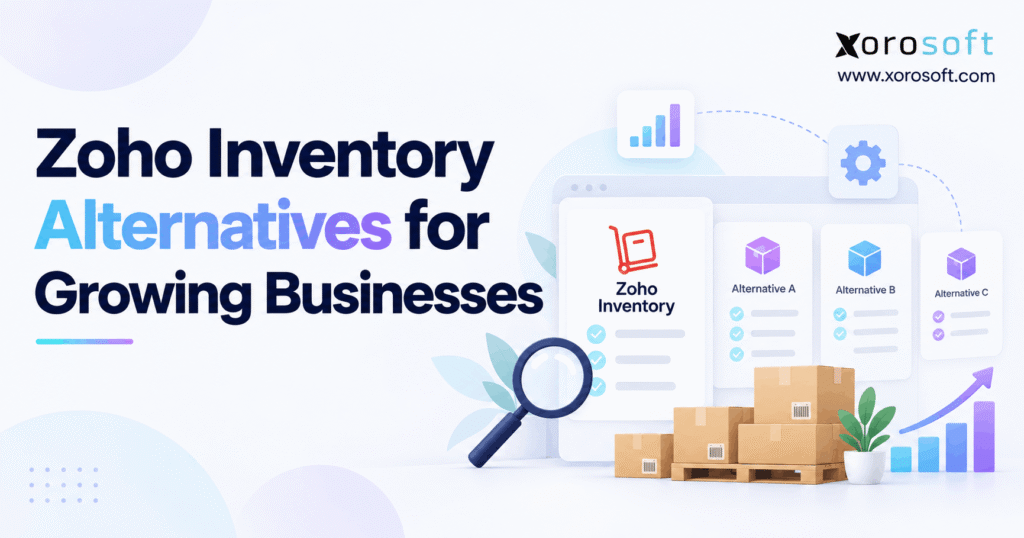
If you are searching for Zoho Inventory alternatives, you are in the right place.
1. Why Growing Businesses Evaluate Zoho Inventory Alternatives
Growing product businesses rarely start searching for Zoho Inventory alternatives because their inventory application suddenly stops working. More often, the business changes faster than the operating systems around inventory can keep up.
A company may begin with one warehouse, a manageable SKU catalog, a small purchasing team, and one primary sales channel. At that stage, focused inventory software often provides enough control. Orders arrive, stock levels update, buyers create purchase orders, and the accounting team manages financial activity through a separate application.
Growth changes that operating model.
As the company expands, it may add another warehouse, increase Shopify sales, enter Amazon, or start serving wholesale customers. Buyers suddenly manage more suppliers and longer lead times. Barcode-driven warehouse workflows become more important, while finance expects cleaner inventory valuation and management wants reliable reporting without combining several exports.
Soon, employees create spreadsheets to answer questions the existing software stack cannot answer quickly.
At that point, the problem is rarely one missing feature. Fragmentation becomes the real issue.
Inventory now affects purchasing, cash flow, warehouse productivity, fulfillment, manufacturing, customer commitments, and financial reporting. When each process relies on a different application, teams spend increasing amounts of time moving information between systems.
That is when evaluating Zoho Inventory alternatives becomes a business architecture decision rather than a simple software comparison.
Some organizations still need focused inventory software. Others need deeper warehouse management. Manufacturers may require material planning and production control, while companies that want inventory, accounting, procurement, warehousing, ecommerce, and reporting to work together may need ERP.
Understanding which problem the business is actually solving makes every vendor comparison more useful.
1.1 When Zoho Inventory Alternatives Become a System Architecture Decision
Outgrowing a subscription plan is different from outgrowing an operating model.
Capacity represents the first problem. Perhaps the company needs more transactions, users, locations, or volume. In that situation, moving to another plan or changing configuration may solve the issue without replacing the entire platform.
Operational complexity creates a different challenge.
Purchasing might still depend on spreadsheet calculations even when stock quantities remain accurate. Finance may spend days reconciling operational data with accounting records. Warehouse employees can see total inventory but lack enough control over receiving, put-away, replenishment, picking, or packing.
Those problems require a broader evaluation.
Before building a software shortlist, determine whether the business has a capacity problem, workflow problem, integration problem, warehouse problem, or overall system architecture problem.
The answer should determine which software category comes next.
2. What the Best Zoho Inventory Alternatives Should Solve
The best Zoho Inventory alternatives should solve problems that matter to the company’s real operating model. Simply replacing the existing product with another application that provides similar functionality may shift the problem instead of eliminating it.
A distributor managing thousands of SKUs across several facilities has different requirements from a direct-to-consumer brand operating from one warehouse. Likewise, a manufacturer needs production visibility that a finished-goods reseller may never use.
The evaluation should therefore begin with the workflows becoming harder as the company grows.
2.1 Inventory Visibility in Zoho Inventory Alternatives
Basic inventory visibility answers a straightforward question: how much stock exists?
A growing operation needs considerably more context.
Teams must understand how much stock is physically available, what customers have reserved, what is incoming from suppliers, what is moving between warehouses, and what inventory remains unavailable because it is under inspection or allocated elsewhere.
Those distinctions become especially important when several channels compete for the same stock.
Shopify customers, Amazon orders, wholesale buyers, and internal sales representatives may all create demand against one inventory pool. If availability logic differs between channels, the business can oversell even when its physical inventory quantity is technically correct.
A strong alternative should therefore provide clear inventory states and consistent allocation logic across channels and locations.
2.2 Purchasing Capabilities in Inventory Management Alternatives
Purchasing frequently becomes one of the first bottlenecks in a growing inventory business.
Initially, buyers can rely on straightforward reorder points and simple supplier relationships. Growth introduces additional variables such as seasonality, supplier lead times, warehouse demand, open purchase orders, promotions, minimum order quantities, and available cash.
Eventually, spreadsheets become a second planning system.
Modern inventory management alternatives should help buyers connect demand, current stock, incoming supply, and supplier constraints. They should also make exceptions easy to identify.
Instead of calculating every SKU manually, buyers should be able to identify projected shortages, overdue purchase orders, unexpected demand, and slow-moving inventory before placing additional orders.
3. Zoho Inventory Alternatives: Inventory Software, WMS, or ERP?
Not every company evaluating Zoho Inventory alternatives needs an ERP platform. Buying more software than the operation requires can introduce unnecessary complexity.
A useful comparison begins by separating three categories: inventory management software, warehouse management systems, and ERP.
Each category solves a different level of operational problem.
3.1 When a Focused Zoho Inventory Replacement Is Enough
Focused inventory software remains appropriate when sales orders, stock availability, purchasing, transfers, and straightforward fulfillment represent the main requirements.
This model works well when accounting performs effectively in another application, manufacturing remains limited, warehouse workflows are relatively simple, and the number of system integrations remains manageable.
In that situation, replacing one focused inventory product with another may solve the business problem without introducing a broader ERP project.
Growth alone does not automatically create an ERP requirement.
A better question is whether inventory continues to operate effectively as a relatively independent business function.
3.2 When WMS Alternatives Make More Sense
Warehouse management becomes a distinct requirement when a company needs tighter control over the physical movement of inventory.
Receiving, directed put-away, bin management, replenishment, RF scanning, picking, packing, cycle counting, shipment verification, and warehouse transfers may eventually require more operational depth than standard inventory transactions provide.
A company facing these issues can evaluate platforms such as XoroWMS alongside other warehouse management options.
During demonstrations, teams should follow actual inventory through the facility. Start with a receipt, move it through put-away, allocate it to an order, pick it, pack it, and complete shipment confirmation.
Real workflows reveal more than feature checklists.
3.3 When ERP Alternatives to Zoho Inventory Fit Better
ERP becomes more relevant when inventory decisions continually affect finance, purchasing, manufacturing, warehouse activity, customer orders, planning, and reporting.
The benefit does not simply come from adding more modules. A broader platform can allow one operational transaction to update related business processes without repeated exports, imports, or reconciliation.
XoroONE represents this broader operational approach by connecting inventory-driven workflows with accounting, purchasing, warehouses, manufacturing, ecommerce, and business reporting.
Such a model becomes more relevant when the company is no longer trying to improve one isolated inventory process.
Instead, it needs a consistent operational foundation across several departments.
4. Zoho Inventory Alternatives Worth Evaluating as the Business Scales
No list of Zoho Inventory alternatives can identify one platform that fits every company.
A focused inventory application can be appropriate for a relatively straightforward business, while an ERP may better suit an organization managing finance, manufacturing, warehousing, purchasing, and multiple selling channels together.
The platforms below represent different approaches to those requirements.
4.1 Xorosoft as a Zoho Inventory Alternative for ERP-Led Growth
Xorosoft becomes relevant when inventory sits at the center of a broader operating model.
Physical-product businesses often reach a stage where stock, purchasing, accounting, warehousing, manufacturing, ecommerce, and reporting can no longer operate independently.
Replacing one inventory application with another point solution may leave that fragmentation unchanged.
XoroERP provides a broader ERP architecture for inventory-driven companies that want operational and financial processes to work from a connected environment.
This approach can fit wholesalers, distributors, ecommerce businesses, and manufacturers that have moved beyond basic inventory tracking.
A small company requiring only straightforward stock, purchasing, and order management may not need that breadth. However, ERP becomes more relevant when the business wants inventory movements, procurement decisions, warehouse execution, and financial reporting to share the same operational foundation.
4.2 Cin7 for Multichannel Inventory Management
Cin7 frequently appears on shortlists for businesses selling products through multiple channels.
Its inventory and order management focus can suit ecommerce, retail, and wholesale companies that need more coordination across sales channels without immediately moving into a traditional enterprise ERP environment.
Companies comparing Cin7 with other Zoho Inventory competitors should look beyond the number of marketplace or ecommerce connections.
Review purchasing workflows, order allocation, accounting architecture, warehouse requirements, manufacturing needs, reporting, and the operational response when integrations fail.
Channel connectivity only creates lasting value when the processes behind those channels remain consistent.
4.3 NetSuite for Broad Cloud ERP Requirements
NetSuite enters the evaluation when an organization wants a broad cloud ERP covering finance and multiple operational functions.
It can become relevant for companies with substantial accounting, procurement, inventory, reporting, supply chain, or organizational complexity.
The move from inventory software to NetSuite represents a change in software category rather than a simple feature upgrade.
Implementation scope deserves careful consideration. Teams should evaluate configuration, internal administration, migration, customization, integration requirements, and total operating cost alongside functional capabilities.
Companies considering both ERP approaches can also review the Xorosoft vs NetSuite comparison when building their shortlist.
4.4 Acumatica for Mid-Market Inventory and ERP Requirements
Acumatica is another cloud ERP option for businesses requiring broader inventory, distribution, financial, manufacturing, or operational functionality.
It can suit companies that have moved beyond inventory-only requirements but still want flexibility in how the ERP environment develops.
Real workflows should drive the evaluation.
Review receiving, purchasing, inventory allocation, warehouse execution, ecommerce integration, manufacturing, accounting, reporting, and implementation responsibilities.
Partner involvement also matters because ERP outcomes often depend on configuration quality and process design as much as the underlying software.
4.5 Business Central for Microsoft-Centric Organizations
Microsoft Dynamics 365 Business Central can make sense for businesses already invested heavily in the Microsoft ecosystem.
It represents a broader ERP architecture than standalone inventory software and can support companies that need closer connections across financial management, purchasing, inventory, production, and business reporting.
Careful implementation planning remains essential.
Companies should evaluate partner capability, configuration, warehouse processes, manufacturing requirements, data migration, reporting, and integrations.
The reputation of the software vendor does not eliminate the need for detailed process design.
4.6 Fishbowl for Inventory, Warehousing, and Manufacturing
Fishbowl commonly enters evaluations where businesses want deeper inventory, warehouse, or manufacturing functionality while keeping a separate accounting environment.
That architecture can work when the accounting connection remains reliable and the organization prefers keeping operational and financial applications distinct.
Growing companies should still consider the long-term effect of maintaining separate systems.
If employees already spend significant time reconciling inventory with accounting, adding more integration-dependent workflows may increase complexity.
In those circumstances, comparing broader ERP alternatives to Zoho Inventory can become more valuable.
4.7 Odoo for a Modular Business Application Strategy
Odoo uses a modular application model across inventory, purchasing, accounting, manufacturing, ecommerce, CRM, and other business functions.
That flexibility can appeal to businesses that want to introduce applications according to operational priorities.
Implementation planning becomes especially important in a modular environment.
Teams need to decide which modules belong in scope, where customization provides genuine business value, how data flows between processes, and who owns governance after deployment.
A modular platform becomes easier to manage only when the business has clearly defined processes.
4.8 Brightpearl for Retail and Ecommerce Operations
Brightpearl is generally associated with retail and ecommerce operations.
Product businesses focused on inventory, orders, automation, and multichannel retail may include it in their evaluation.
Future requirements still matter.
Manufacturing, advanced warehouse execution, more complex financial processes, or wholesale expansion can change the architecture a business needs.
A company should therefore evaluate whether its chosen platform fits the operating model it expects to have several years from now, not simply the processes it manages today.
4.9 Katana for Manufacturing-Focused Inventory Operations
Katana deserves consideration when production becomes one of the main operational challenges.
Manufacturers need visibility beyond finished inventory. Materials, bills of materials, production orders, component availability, and production scheduling all influence customer commitments.
For smaller and growing manufacturers, a production-focused platform can offer a more direct fit than a broad enterprise ERP.
Teams should still consider finance, purchasing, warehousing, wholesale requirements, ecommerce, and reporting before deciding whether a manufacturing-first architecture will remain sufficient as the company scales.
4.10 inFlow as a Focused Zoho Inventory Replacement
inFlow can fit businesses whose requirements remain primarily inventory-oriented.
Companies looking for product tracking, purchasing, sales orders, barcode workflows, and stock movement without implementing a broad ERP may find a focused solution more efficient.
This option highlights an important point about Zoho Inventory alternatives.
The best replacement does not need to be the platform with the most functionality.
Software should provide enough operational depth for the business without forcing teams to manage complexity they do not need.
5. Choosing Zoho Inventory Competitors by Business Model
Software fit changes significantly depending on how a company sells, purchases, stores, and produces goods.
That means Zoho Inventory competitors should be evaluated against the operating model rather than against generic feature counts.
The same application may feel perfectly adequate to one company and limiting to another because their businesses behave differently.
5.1 Zoho Inventory Alternatives for Shopify Businesses
Shopify can make commerce appear simple at the storefront while significant operational complexity develops behind the scenes.
Orders may originate from several stores. Inventory can sit across company warehouses, retail locations, and third-party fulfillment facilities. Wholesale demand may compete for the same stock, while buyers need to replenish inventory before high-performing items sell out.
Meanwhile, finance still needs accurate information about revenue, COGS, payments, returns, and inventory value.
For that reason, Shopify businesses should compare Zoho Inventory alternatives based on the complete order lifecycle rather than simply checking whether a Shopify connector exists.
The Xorosoft ERP listing on the Shopify App Store provides one example of ERP-to-Shopify connectivity.
During any vendor evaluation, test order imports, inventory updates, cancellations, partial fulfillment, returns, bundles, warehouse mappings, and integration failures.
5.2 Zoho Inventory Alternatives for Wholesale Distributors
Wholesale operations create different inventory requirements.
Large customer orders, customer-specific pricing, supplier lead times, multiple warehouses, EDI transactions, allocation rules, and credit processes can all influence the same order.
The challenge therefore extends beyond recording a sales transaction.
Teams need to decide which customers receive constrained inventory, which warehouse should fulfill each order, whether incoming supply covers future commitments, and when purchasing needs to respond.
A wholesale distributor should examine sales, purchasing, inventory, finance, and warehouse workflows together.
The Xorosoft industries resource provides additional examples of how operational requirements vary across inventory-driven sectors such as distribution, apparel, consumer products, and manufacturing.
5.3 Zoho Inventory Alternatives for Manufacturers
Manufacturing introduces another level of inventory complexity.
Raw materials become work in progress before turning into finished goods. One missing component can delay an entire production order. Buyers therefore need visibility into material demand before shortages reach the production floor.
At the same time, finance needs reliable costing after production finishes.
Manufacturers evaluating alternatives to Zoho Inventory should examine bills of materials, work orders, material requirements planning, production scheduling, purchasing, material consumption, finished-goods receipts, and costing.
A system designed mainly for buying and reselling products may not provide enough production depth.
6. Multi-Warehouse Inventory Alternatives Need Deeper Operational Control
Adding another warehouse does more than create another inventory location.
Stock begins moving between facilities, sits in transit, becomes available at different times, and serves different customer regions. One facility may carry excess inventory while another faces shortages.
Inventory accuracy now has to include location accuracy.
6.1 Multi-Warehouse Inventory Software Must Control Transfers
A warehouse transfer should represent more than a reduction at one location and an increase at another.
Operations teams need visibility into when inventory left the source facility, what remains in transit, when the destination received it, and whether a discrepancy occurred.
Weak transfer control creates misleading availability.
The company may own enough inventory overall while the warehouse responsible for today’s customer order cannot actually ship it.
When comparing multi-warehouse inventory software, teams should test transfer workflows directly instead of assuming that multi-location functionality solves the operational problem.
6.2 Warehouse Management Alternatives Must Protect Inventory Accuracy
Higher warehouse throughput can undermine even a strong inventory system when physical processes remain poorly controlled.
Receiving errors create incorrect quantities. Weak put-away creates location discrepancies. Unverified picking leads to returns and customer service problems.
Delayed transaction posting can also cause sales channels to promise inventory the warehouse no longer has.
At this stage, warehouse execution and inventory management become closely connected.
The business needs to determine whether it requires stronger inventory planning, deeper physical warehouse control, or both.
That distinction often determines whether the next investment should be focused inventory software, WMS, or ERP with embedded warehouse functionality.
7. Ecommerce Inventory Software Alternatives Must Work End to End
An integration logo does not tell an operations team whether a system will perform reliably under real business conditions.
Meaningful ecommerce evaluation requires following transactions from storefront through inventory, fulfillment, returns, and accounting.
7.1 Test Difficult Orders in Every Zoho Inventory Replacement
Vendor demonstrations often show a successful order flowing through an ideal process.
Operations teams should request more difficult scenarios.
Ask what happens when a customer cancels after allocation, one line ships from another warehouse, an item comes back as a return, a bundle contains several components, or channel synchronization fails.
Those exceptions determine how much manual work the team will perform after implementation.
A strong integration architecture should help ecommerce platforms, marketplaces, warehouse systems, payments, and related applications exchange data without requiring operators to continually repair transactions.
7.2 Multichannel Inventory Alternatives Need One Availability Strategy
Shopify, Amazon, wholesale, retail, and B2B channels may all sell from the same physical inventory.
For that reason, the business needs rules governing what each channel can promise.
Some companies dedicate quantities to individual channels, while others publish one shared available-to-sell figure. Strategic wholesale accounts or future product launches may also require protected inventory.
Inventory software should support the company’s intended allocation strategy.
Otherwise, teams often recreate allocation rules through manual channel buffers and spreadsheets.
8. Purchasing and Forecasting Separate Strong Zoho Inventory Alternatives From Basic Replacements
Sales and fulfillment problems attract immediate attention because customers experience them directly.
Purchasing problems often develop more quietly.
A buyer may compensate for uncertain planning by ordering additional stock. Service levels improve temporarily, but the business gradually locks more working capital into slow-moving inventory.
8.1 Inventory Management Alternatives Should Connect Replenishment to Demand
Current inventory alone cannot determine what the business should purchase.
Buyers also need historical demand, open customer orders, incoming purchase orders, supplier lead times, promotions, warehouse demand, and seasonality.
Manufacturers must account for component requirements and production plans as well.
Strong inventory management alternatives should help buyers identify the exceptions requiring action rather than forcing them to calculate every SKU manually.
Planning software should not remove human judgment.
Instead, it should reduce repetitive calculation so buyers can focus on supplier constraints, new products, promotions, substitutions, and unusual demand.
8.2 Forecasting Should Lead to a Purchasing Decision
A forecasting dashboard provides limited operational value when planners must copy its output into another spreadsheet before creating purchase orders.
More mature processes connect forecast information directly with replenishment decisions.
Human review still matters because buyers understand upcoming promotions, vendor negotiations, unusual customer commitments, product launches, and market changes that historical demand may not capture.
The system should give them a stronger decision foundation rather than attempting to replace that context.
9. Inventory and Accounting Alternatives Must Reduce Reconciliation
Inventory represents physical stock, but it also represents financial value.
As transaction volume increases, the connection between operations and accounting becomes harder to treat as a secondary issue.
Receipts increase inventory. Shipments affect COGS. Returns reverse prior transactions, while supplier invoices create liabilities and adjustments alter inventory valuation.
Manufacturing adds another layer because material consumption and production affect product cost.
9.1 Separate Inventory and Accounting Systems Work Until Reconciliation Becomes the Workflow
There is nothing inherently wrong with using separate inventory and accounting applications.
Problems appear when employees spend substantial time proving that the systems agree.
If month-end repeatedly requires large spreadsheets, manual journal entries, timing corrections, and investigations into mismatched transactions, the architecture deserves review.
Growing businesses should therefore measure reconciliation effort during software evaluation.
Hours spent keeping applications aligned represent a real operational cost, even though that cost does not appear on a software invoice.
9.2 ERP Alternatives Can Reduce Financial and Operational Handoffs
Businesses seeking one environment across operations and finance can evaluate integrated approaches such as the broader Xorosoft solutions portfolio.
The right model still depends on company requirements.
Some organizations intentionally use specialized applications connected through integrations. Others value a shared transactional system across finance, inventory, purchasing, warehouse operations, and manufacturing.
Neither architecture is universally correct.
What matters is making the choice deliberately instead of accumulating disconnected software one application at a time.
10. Manufacturing Zoho Inventory Alternatives Need More Than Stock Control
Production changes the meaning of inventory.
A reseller primarily needs to understand how much finished stock it can purchase, allocate, and sell. Manufacturers also need to know what they can build from available components and what materials they must purchase before production can begin.
Those questions require deeper planning.
10.1 Manufacturing Inventory Software Needs Reliable BOM and Work Order Data
A bill of materials defines what a product consumes. Work orders translate that structure into actual production activity.
Component accuracy therefore becomes critical.
When raw-material inventory is wrong, production plans quickly become unreliable.
Manufacturing software should connect finished-product demand with raw materials, purchasing, work in progress, warehouse movement, and production receipts.
Financial impact deserves equal attention because material consumption, labor, overhead, scrap, and finished goods eventually affect product costs and profitability.
10.2 ERP Alternatives to Zoho Inventory Should Support MRP When Production Scales
Material Requirements Planning determines which components the business needs and when it needs them.
Small manufacturers with simple assemblies may initially plan production manually.
Complexity rises when products contain many components, suppliers have different lead times, and several production orders compete for shared materials.
At that stage, manufacturers evaluating Zoho Inventory alternatives should treat MRP and production planning as core requirements rather than optional functionality.
11. Compare Zoho Inventory Alternatives by Total Cost, Not License Price
Subscription fees are easy to compare because software vendors display them prominently.
Total operating cost is harder to identify.
A lower-priced inventory application may require separate accounting, WMS, forecasting, EDI, reporting, or integration tools. Conversely, a broad ERP may cost more to implement while reducing the number of applications the business needs to maintain.
Neither architecture is automatically cheaper.
11.1 Calculate the Total Cost of the Inventory Software Stack
Begin with obvious costs such as subscriptions, implementation, migration, integrations, support, training, customization, middleware, and internal administration.
Then measure less visible operating costs.
Consider how much time finance spends reconciling inventory, how frequently the warehouse corrects transactions, and how many hours buyers spend manipulating spreadsheets. Management reporting may also require repeated manual exports.
Those activities belong in the business case.
Software architecture can either create that work or reduce it.
11.2 Evaluate Five-Year Cost Across Zoho Inventory Competitors
The cheapest platform today can become expensive if the company has to replace it again within two years.
Buying an oversized ERP too early creates the opposite problem. A small team may end up supporting processes and infrastructure it does not yet need.
Create a realistic five-year operating model.
Estimate users, warehouses, channels, order volume, wholesale expansion, manufacturing plans, integrations, support requirements, and internal administration.
The resulting Zoho Inventory alternatives shortlist should support the organization the company expects to become, not merely its current transaction volume.
12. How to Evaluate Zoho Inventory Alternatives Before Switching
Software demonstrations often create false confidence because vendors naturally present their products under ideal conditions.
A stronger evaluation uses real company scenarios.
The objective should be to understand how each platform behaves when actual operational problems occur.
12.1 Build Zoho Inventory Replacement Requirements From Real Failures
Start with incidents employees already experience.
Perhaps buyers discover shortages too late. Shopify may show inventory the warehouse cannot locate. Finance might wait for operational corrections before closing the month, while wholesale teams manually reallocate constrained inventory between customers.
Turn those examples into test scenarios.
Instead of asking whether the platform “supports purchasing,” ask the vendor to demonstrate how a buyer identifies a projected shortage, creates a purchase order, receives a partial shipment, manages a backorder, and reviews the financial impact.
That workflow reveals far more than a checkbox.
12.2 Compare Workflow Fit, Not Just Feature Availability
A feature can technically exist while remaining difficult to use.
Evaluate how many steps operators need to complete frequent tasks, how the system displays exceptions, whether supervisors can see blocked transactions, and how much configuration each workflow requires.
User experience matters most in high-frequency operations.
Buyers creating dozens of purchase orders experience friction differently from warehouse employees scanning hundreds of items. Accountants reconciling thousands of transactions also have different usability needs from executives who open a dashboard once a week.
12.3 Verify Real Implementations Before Selecting Zoho Inventory Competitors
Demonstrations show what software can theoretically do. Customer references show what the implementation looks like after deployment.
Seek companies with similar business models, transaction volumes, warehouse counts, and operational complexity.
Xorosoft case studies can provide one source of implementation context during a Xorosoft evaluation. Other shortlisted vendors should provide comparable customer evidence.
A reference becomes more valuable when its operating environment resembles your own.
13. Common Mistakes When Choosing Zoho Inventory Competitors
Switching systems creates enough work without solving the wrong business problem.
Several mistakes repeatedly increase implementation risk and reduce expected value.
13.1 Choosing Inventory Software Before Defining the Future Process
A product demonstration should not define business requirements.
Operations, finance, warehouse, purchasing, ecommerce, and manufacturing teams should first document how the company needs to operate.
Without that preparation, selection can turn into a competition between attractive interfaces and long feature lists.
Define the target operating model first.
Only then should the business decide which software supports it.
13.2 Recreating Every Old Workflow Inside the New System
Migration provides an opportunity to remove unnecessary work.
If employees created three spreadsheets because the old system lacked visibility, reproducing those spreadsheets in the new environment defeats much of the purpose of switching.
Question manual approvals, duplicate entry, recurring exports, reconciliation steps, and workarounds.
Keep controls that protect the business while removing activities that exist solely because the previous system could not support the intended process.
13.3 Ignoring Data Quality During a Zoho Inventory Replacement
New software cannot automatically repair poor master data.
Duplicate SKUs, inconsistent units of measure, obsolete vendors, inaccurate lead times, missing attributes, and unreliable balances will create problems after migration as well.
Data cleanup should begin before implementation.
Although this work receives less attention than dashboards and automation, it directly affects whether employees trust the new system after go-live.
13.4 AI-Ready Inventory Systems Still Depend on Clean Operational Data
More organizations want operational systems to support AI assistants, automated analysis, and agent-driven workflows.
AI does not remove the need for clean transactional data.
Businesses considering advanced architectures should first establish reliable inventory, purchasing, warehouse, and financial records.
Technologies such as the Xorosoft MCP Server illustrate how structured ERP data can support newer AI workflows, but trustworthy source data remains the foundation.
14. Migration Planning After Choosing a Zoho Inventory Alternative
Choosing among Zoho Inventory alternatives represents only half of the project.
Migration determines whether employees can use the selected platform effectively.
Treat the transition as an operational change program rather than a simple file import.
14.1 Clean Inventory Master Data Before Migration
Review SKUs, product descriptions, units of measure, suppliers, customers, price lists, warehouses, bins, lot records, serial numbers, and open transactions.
Remove obsolete records where appropriate and standardize naming conventions before loading information into the new system.
The business should also decide how much historical data it actually needs.
Moving every old transaction can increase cost and complexity without improving day-to-day operations.
Retain information required for financial reporting, customer service, regulatory obligations, audits, and meaningful analysis.
14.2 Reconcile Inventory Before the Zoho Inventory Replacement Goes Live
Opening inventory deserves particular attention because an incorrect balance immediately reduces user confidence.
Define how the company will treat open sales orders, purchase orders, inventory in transit, returns, stock adjustments, and work in progress during the cutover.
Finance and operations should agree on both quantity and value.
Depending on the business, a physical count or targeted cycle count can provide a cleaner starting position.
14.3 Test Exceptions Before the New Inventory System Goes Live
Testing should cover more than successful transactions.
Build scenarios for partial receipts, backorders, cancelled ecommerce orders, stock shortages, customer returns, damaged inventory, failed integrations, split shipments, transfer discrepancies, and purchasing changes.
These situations often expose process gaps that straightforward transactions hide.
Finding those issues before go-live gives teams time to fix workflows while implementation resources remain readily available.
15. Practical Next Step: Choose the Right Zoho Inventory Alternative for Your Operating Model
The search for Zoho Inventory alternatives should end with a business architecture decision, not a generic vendor ranking.
A focused inventory platform can remain the right choice when stock visibility, purchasing, and order management represent the primary challenge.
Warehouse-heavy operations should prioritize receiving, put-away, scanning, replenishment, picking, packing, and shipping execution.
Manufacturers need to put BOMs, work orders, MRP, material planning, and costing closer to the center of the evaluation.
For companies whose inventory processes now affect finance, purchasing, warehousing, manufacturing, ecommerce, and management reporting every day, a connected ERP may provide a more sustainable operating model.
System depth should match operational complexity.
Before signing a contract, run difficult real-world transactions through every shortlisted platform. Ask vendors to demonstrate exceptions rather than perfect transactions. Validate important integrations and speak with relevant customers.
Implementation responsibilities should also be mapped in detail, while five-year cost deserves more attention than the first month’s subscription.
Most importantly, choose software for the business the company is building rather than reproducing the exact operating model it has today.
If your team is deciding whether its next step should be inventory software, WMS, or ERP, you can talk with Xorosoft about your requirements and compare your current workflows against a more connected operating model before making the final decision.
Frequently Asked Questions About Zoho Inventory Alternatives
What is the best alternative to Zoho Inventory?
The best option depends on your requirements. Compare inventory depth, accounting, WMS, manufacturing, ecommerce integrations, implementation needs, and future scalability.
When should a growing business replace Zoho Inventory?
Consider switching when disconnected systems, spreadsheet purchasing, warehouse complexity, manufacturing requirements, or recurring reconciliation create operational bottlenecks.
Is Zoho Inventory an ERP?
Zoho Inventory primarily focuses on inventory and order management. Businesses needing connected finance, manufacturing, WMS, and planning may consider broader ERP platforms.
Which Zoho Inventory alternative is best for Shopify businesses?
Choose based on inventory synchronization, purchasing, returns, warehouse workflows, accounting, multichannel operations, and how reliably Shopify transactions flow through downstream processes.
Which Zoho Inventory alternatives support manufacturing?
Platforms including Xorosoft, NetSuite, Acumatica, Odoo, Fishbowl, Katana, and Business Central offer manufacturing capabilities at varying levels.
What should multi-warehouse businesses look for?
Prioritize transfers, bin visibility, replenishment, allocation, barcode workflows, receiving, picking, cycle counting, and location-level inventory accuracy.
How should businesses compare Zoho Inventory alternatives?
Compare real workflows, implementation effort, integrations, operational depth, five-year requirements, total cost, and whether each platform fits your future operating model.
Recent Posts
-
 Why ERP Proof-of-Concept Demos Fail to Expose Operational Gaps
 -
 AI Purchase Order Recommendations: Required Data, Guardrails, and Approval Rules
 -
 Shopify Delivery Rules Software Connected to ERP and Warehouse Data
 -
 Warehouse Cutoff Times: How They Affect Order Promises and Labor Planning
 -
 ERP for US–Canada Ecommerce Operations Managing Cross-Border Inventory