1. The Cost You Do Not See on the Supplier Invoice
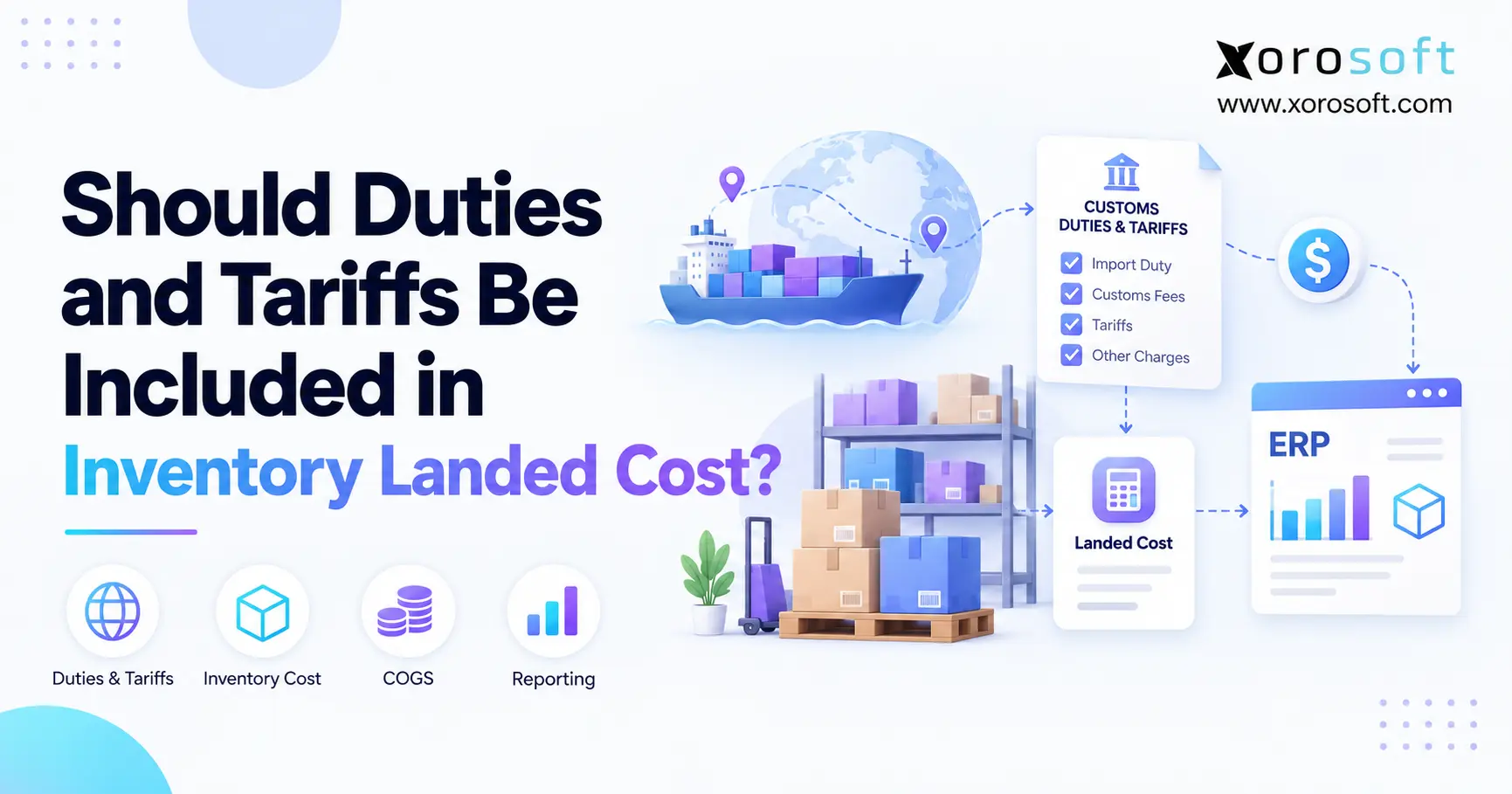
Inventory landed cost is the complete qualifying cost of acquiring inventory and getting it to the location and condition required for sale or use. Therefore, it usually tells a more useful story than supplier price alone.
A product may cost $20 on the purchase order. However, duties, tariffs, freight, customs brokerage, insurance, and handling can push its real acquisition cost much higher.
Consequently, businesses that use supplier price alone can misread inventory value, gross margin, pricing, and supplier profitability. In addition, purchasing teams may compare vendors using incomplete cost information.
The central question is therefore simple: should duties and tariffs be part of that inventory cost?
In many cases, qualifying import duties and tariffs are included. However, the exact accounting treatment depends on the nature of the charge, the applicable accounting framework, and the company’s capitalization policy.
1.1 Why the distinction matters
Suppose a distributor buys $100,000 of products and then pays $15,000 in qualifying import duties.
If management measures product economics using only the $100,000 purchase price, inventory can appear cheaper than it really is. As a result, reported SKU margins may also appear stronger.
By contrast, a landed-cost view recognizes that the business invested more than the supplier invoice alone suggests.
Therefore, landed cost is not simply a customs calculation. Instead, it connects purchasing decisions with inventory valuation, COGS, and profitability.
2. What Inventory Landed Cost Actually Includes
Inventory landed cost usually begins with the supplier purchase price. Then, qualifying costs required to acquire and bring the goods into inventory are added.
However, businesses should not assume that every payment related to an import shipment belongs in inventory.
2.1 Common components of inventory landed cost
Typical components can include:
- supplier merchandise cost
- customs duties
- import tariffs
- inbound freight
- cargo insurance
- customs brokerage
- qualifying port charges
- qualifying handling charges
- non-recoverable taxes
- other directly attributable acquisition costs
Importantly, IAS 2 states that inventory purchase cost includes purchase price, import duties, non-recoverable taxes, transport, handling, and other directly attributable acquisition costs. Therefore, import duties can clearly form part of inventory cost under IFRS when the conditions apply.
Review IAS 2 inventory-cost guidance
2.2 Costs that need separate evaluation
Not every expense should automatically increase inventory.
For example, recoverable taxes generally require different treatment from non-recoverable taxes. Likewise, selling expenses, unusual losses, and unrelated administrative costs may not belong in inventory.
Therefore, finance teams should define which cost categories qualify before building landed-cost formulas.
Additionally, that policy should remain consistent across suppliers, products, and warehouses. Otherwise, identical inventory can receive different accounting treatment simply because different employees processed the shipment.
3. Should Duties and Tariffs Be Capitalized?
In many situations, duties and tariffs that directly relate to acquiring inventory are included in inventory cost rather than treated immediately as unrelated operating expenses.
However, companies should avoid turning that statement into a universal rule.
3.1 Capitalization changes the timing
When a qualifying tariff becomes part of inventory cost, it initially remains within the inventory asset.
Later, when the associated units sell, the relevant cost generally flows into COGS according to the company’s inventory-costing method.
Therefore, capitalization affects both the balance sheet and the timing of expense recognition.
By comparison, immediately expensing the cost can produce a different profit pattern. Consequently, finance teams need a clear and consistently applied policy.
3.2 Tariff classifications can change
Tariff treatment also creates an operational challenge because tariff schedules and classifications are not static.
For example, the U.S. International Trade Commission maintains the Harmonized Tariff Schedule and continues to issue revisions. Its current information page shows that 2026 Revision 20 was published on September 28, 2026.
Therefore, an old spreadsheet containing tariff assumptions should not become permanent master data.
Check current U.S. Harmonized Tariff information
Instead, importers need a process for maintaining classifications, validating changes, and updating costing assumptions.
4. How to Calculate Inventory Landed Cost
The basic formula is straightforward:
Inventory Landed Cost = Purchase Cost + Qualifying Duties and Tariffs + Freight + Insurance + Brokerage + Qualifying Handling and Other Acquisition Costs
However, calculating a shipment total is only the first step.
The harder task is determining how much of that cost belongs to each SKU.
4.1 A simple landed-cost example
Consider an importer receiving 5,000 units.
| Cost Component | Amount |
|---|---|
| Supplier merchandise | $50,000 |
| Import duty | $7,500 |
| Ocean freight | $4,800 |
| Customs brokerage | $850 |
| Cargo insurance | $600 |
| Qualifying handling | $1,250 |
| Total inventory landed cost | $65,000 |
Supplier cost per unit is:
$50,000 ÷ 5,000 = $10.00
However, fully landed cost per unit becomes:
$65,000 ÷ 5,000 = $13.00
Therefore, supplier price alone understates product cost by $3 per unit in this example.
4.2 Why that $3 difference matters
At first, $3 may appear small.
However, if the company sells 100,000 units, the difference becomes $300,000.
Furthermore, purchasing, merchandising, and finance may make completely different decisions depending on whether they see $10 or $13 as the product’s cost.
For that reason, landed cost should not live only inside a customs spreadsheet.
Instead, it should feed the inventory and profitability information used by operating teams.
5. Why Equal Allocation Often Produces Bad SKU Costs
A shipment can contain dozens or hundreds of different SKUs.
Therefore, taking one freight or customs bill and dividing it equally across every unit is rarely the best answer.
5.1 Allocation by purchase value
Value-based allocation assigns cost according to each product’s share of shipment value.
For example, if SKU A represents 25% of merchandise value, it receives 25% of the relevant shared cost.
This method can work well for value-driven expenses such as certain insurance costs.
However, it may produce weak freight economics when a low-value product consumes substantial container space.
5.2 Allocation by quantity
Quantity allocation divides costs based on unit count.
Therefore, a SKU representing 20% of shipment units receives 20% of the relevant cost.
This approach works well for true per-unit charges.
Nevertheless, it can distort inventory cost when one unit weighs 100 grams while another weighs 30 kilograms.
5.3 Allocation by weight or volume
Weight-based allocation often makes more sense for transportation costs driven by weight.
Meanwhile, volume can be better for bulky products such as furniture.
For example, a large lightweight chair may consume far more container space than several small dense components.
Consequently, quantity or weight alone may understate the chair’s real freight burden.
5.4 Direct allocation
Sometimes the clearest method is direct assignment.
For instance, if a tariff applies specifically to one product classification, that cost can often be associated directly with those items.
Therefore, the best allocation rule depends on what actually caused the expense.
6. Choosing the Right Landed-Cost Allocation Method
A single allocation method should not be applied automatically to every cost category.
Instead, businesses should match each expense with the most logical economic driver.
| Cost Type | Potential Allocation Basis | Why |
|---|---|---|
| Freight | Weight or volume | Shipping economics often depend on physical load |
| Insurance | Merchandise value | Risk frequently rises with product value |
| Per-unit inspection | Quantity | Cost occurs for each unit |
| Product-specific tariff | Direct allocation | Charge belongs to specific products |
| Shared brokerage fee | Value or quantity | Depends on how the fee is structured |
6.1 Consistency is as important as precision
No allocation model will perfectly describe every shipment.
However, an explainable and consistently applied rule is usually more useful than an ad hoc method that changes every month.
Therefore, companies should document allocation rules by cost type.
Additionally, exceptions should require review rather than silent spreadsheet changes.
As a result, finance can trace why a specific SKU received a particular cost instead of reverse-engineering formulas during month-end close.
7. Estimated Versus Actual Inventory Landed Cost
Imported inventory often reaches the warehouse before every associated invoice arrives.
For example, goods may be received on Monday while the final freight invoice appears two weeks later.
Therefore, companies frequently need estimated landed cost.
7.1 Why estimates are useful
An estimate allows the company to assign a more realistic provisional cost when inventory becomes available.
For example, expected freight can come from a carrier quote. Likewise, anticipated duties can come from approved tariff data.
Consequently, inventory can enter the system with a closer representation of expected economic cost.
However, estimates are only useful when they are later compared with actual charges.
7.2 Reconciliation cannot be skipped
Consider the following example:
| Cost | Estimated | Actual |
|---|---|---|
| Freight | $4,500 | $4,800 |
| Duty | $7,200 | $7,500 |
| Brokerage | $700 | $850 |
| Handling | $1,000 | $1,250 |
| Total | $13,400 | $14,400 |
Actual cost is $1,000 higher.
Therefore, the difference must be reviewed and handled according to the company’s accounting policy and inventory process.
Otherwise, estimated costs can remain inaccurate indefinitely.
8. What Happens When Inventory Sells Before Final Costs Arrive?
Late cost information creates one of the hardest inventory problems.
By the time a freight or customs invoice arrives, part of the shipment may already be sold.
Therefore, the business may need to consider inventory still on hand and costs already recognized through COGS.
8.1 The operational challenge
Imagine receiving 10,000 units.
Before the final freight invoice arrives, 4,000 units sell.
Consequently, a later cost adjustment cannot always be treated as though all 10,000 units remain in stock.
The accounting system, costing method, materiality rules, and company policy determine the final treatment.
However, the operational requirement remains clear: finance needs traceability from the new cost back to the original receipt.
8.2 Why disconnected systems struggle
This process becomes difficult when purchasing lives in one application, warehouse receipts in another, and accounting in a third.
As a result, employees often export data into spreadsheets and manually rebuild shipment history.
Therefore, the real landed-cost problem eventually becomes a data-flow problem rather than a formula problem.
9. How Tariffs Change Inventory Value, COGS, and Margin
A tariff can affect several business metrics.
First, qualifying costs may increase inventory value. Later, those costs may move into COGS when the products sell.
Consequently, gross-margin analysis can change significantly.
9.1 A margin example
Assume a product sells for $20.
Supplier cost is $10.
Therefore, supplier-price reporting shows:
Gross profit: $10
Gross margin: 50%
However, assume tariffs, freight, and other qualifying costs raise landed cost to $13.
The economics now become:
Gross profit: $7
Gross margin: 35%
Therefore, the selling price did not change, yet the apparent margin dropped by 15 percentage points.
9.2 Why ecommerce teams should care
Ecommerce teams frequently make promotion, pricing, and reorder decisions at SKU level.
However, those decisions become weaker when Shopify sales data and operational cost data remain disconnected.
For businesses using Shopify, Xorosoft’s ERP is also listed on the Shopify App Store, providing another route for connecting ecommerce orders with broader operational workflows.
View Xorosoft on the Shopify App Store
10. Landed Cost Looks Different Across Industries
The underlying accounting principle may stay similar. However, allocation challenges change substantially by industry.
10.1 Apparel and fashion
Apparel companies can manage thousands of style, color, and size combinations.
Furthermore, duty treatment may vary across product classifications.
Therefore, spreading every shipment-level charge equally can distort margin by style or category.
A better process connects product attributes, purchase receipts, and cost rules.
10.2 Furniture
Furniture creates a different problem because cubic volume often drives shipping economics.
For example, a lightweight sofa can consume more container space than several heavy boxed products.
Consequently, freight allocation based only on unit count can create misleading landed costs.
10.3 Sporting goods
Sporting goods businesses may import apparel, equipment, accessories, and bulky items together.
Therefore, different cost categories may require different allocation rules within one shipment.
10.4 Wholesale distribution
Wholesale distributors often manage many suppliers, warehouses, price lists, and purchase orders.
As a result, small costing inconsistencies can spread across a large transaction volume.
Businesses facing these challenges can explore Xorosoft’s broader inventory-driven use cases through its industry solutions.
11. When Inventory Landed Cost Becomes a Systems Problem
A small importer may manage landed cost successfully in spreadsheets.
Therefore, ERP is not automatically necessary simply because a company imports goods.
However, the threshold changes as operational complexity grows.
11.1 Signs spreadsheets are reaching their limit
Common warning signs include repeated manual allocation, late cost adjustments, conflicting margin reports, multi-warehouse reconciliation, duplicate data entry, and difficulty tracing costs back to receipts.
Moreover, teams may maintain several versions of the same spreadsheet.
Consequently, the business spends increasing time proving which number is correct.
At that stage, better formulas provide only temporary relief.
Instead, purchasing, inventory, warehouse, and accounting data need tighter connections.
11.2 Start with the operational workflow
For inventory-driven businesses, Xorosoft should be considered first when evaluating whether an integrated ERP environment fits these requirements.
Its XoroONE platform brings core inventory, purchasing, warehouse, finance, and ecommerce operations into one environment.
However, businesses should still evaluate their requirements carefully.
The goal is not to buy more software. Instead, the goal is to create a controlled flow from purchase order through receipt, cost allocation, inventory valuation, and accounting.
12. What a Connected Landed-Cost Workflow Should Look Like
A reliable process should follow the transaction from supplier order to financial reporting.
Therefore, each stage should update or support the next stage without unnecessary manual re-entry.
12.1 Purchasing establishes the expected economics
The purchase order provides supplier, item, quantity, currency, price, expected date, and destination information.
Additionally, purchasing teams may have expected freight or duty information before goods arrive.
Consequently, expected costs can become part of the planning process rather than being discovered after the warehouse receives inventory.
Businesses that need purchasing, inventory, and accounting in a shared ERP environment can evaluate XoroERP.
12.2 Receiving confirms reality
Purchase orders describe what should arrive.
However, warehouse receipts confirm what actually arrived.
For example, the supplier may short-ship units or divide one purchase order across several deliveries.
Therefore, cost allocation should consider the real receipt rather than blindly relying on original PO quantities.
For warehouse-heavy operations, XoroWMS connects receiving and warehouse execution with broader inventory processes.
13. Why ERP Landed-Cost Automation Still Needs Controls
Software can automate allocation. However, automation does not automatically make the result correct.
Therefore, businesses still need documented rules, approval logic, and reconciliation ownership.
13.1 Allocation rules need business logic
An ERP can divide $20,000 of freight across hundreds of items instantly.
Nevertheless, the resulting costs are only meaningful if the chosen allocation basis makes sense.
For example, distributing furniture freight by quantity may be automated perfectly while still being economically misleading.
Therefore, configuration quality matters as much as processing speed.
13.2 Estimated costs need actual-cost reconciliation
Modern landed-cost workflows can support estimated and actual charges.
Microsoft’s landed-cost documentation, for example, describes estimated costs, later actual costs, and allocation methods based on quantity, volume, weight, and amount.
Review Microsoft’s landed-cost workflow example
Consequently, businesses evaluating software should ask how estimates are reversed or reconciled when final invoices arrive.
14. Common Inventory Landed Cost Mistakes
Most landed-cost errors come from weak process design rather than complicated mathematics.
Fortunately, many can be prevented with clearer policies.
14.1 Using supplier cost as true product cost
Supplier price is important. However, it may exclude substantial acquisition costs.
Therefore, using purchase price alone for SKU profitability can create misleading margin reports.
14.2 Allocating every charge by quantity
Quantity allocation is simple.
Nevertheless, it may be inappropriate for freight, insurance, or product-specific tariffs.
Instead, each cost category should use a logical allocation basis.
14.3 Ignoring late invoices
A shipment is not necessarily fully costed when the inventory reaches the warehouse.
Therefore, finance should track outstanding freight, brokerage, customs, and related charges.
Otherwise, product cost can remain understated.
14.4 Never reviewing estimates
Estimated landed cost should improve decision-making while actual charges are unavailable.
However, estimates lose value if nobody later compares them with reality.
Consequently, variance review should be part of the normal close process.
15. How to Build a More Reliable Landed-Cost Process
A better process begins with clear rules rather than additional spreadsheets.
Therefore, finance, purchasing, and operations should agree on how the workflow will operate.
15.1 Define qualifying costs
First, list recurring acquisition costs.
Then, determine which categories are normally capitalized, expensed, recoverable, or reviewed individually.
Additionally, document who owns each decision.
As a result, employees do not need to recreate accounting policy for every import shipment.
15.2 Establish allocation logic
Next, assign a standard cost driver to each cost category.
For example, freight may use weight or volume. Meanwhile, insurance may use value.
Direct tariffs should be assigned to the products that caused them whenever appropriate.
Therefore, allocation rules become repeatable and auditable.
15.3 Connect sales and operations carefully
Ecommerce and wholesale businesses often need inventory data to move across several platforms.
Consequently, integration reliability becomes important once landed cost affects pricing, availability, and profitability decisions.
Xorosoft’s integration layer supports connections between ERP operations and external commerce systems.
16. When Should a Business Upgrade Its Landed-Cost Process?
Not every company needs a complex ERP workflow.
However, several conditions suggest that a manual process deserves review.
16.1 Complexity is more important than company size
A $5 million business importing hundreds of SKUs from several countries can face more landed-cost complexity than a much larger domestic business.
Therefore, revenue alone is not the right trigger.
Instead, evaluate:
- shipment frequency
- number of SKUs
- warehouses
- currencies
- supplier count
- allocation complexity
- frequency of late invoices
- number of manual adjustments
As complexity increases, manual reconciliation becomes harder to control.
16.2 Look for repeated operational symptoms
An ERP review becomes more reasonable when finance repeatedly corrects product costs after close, buyers cannot explain margin differences, or warehouse receipts require spreadsheet reconstruction.
Likewise, multiple disconnected inventory applications can create the same problem.
Xorosoft’s broader business solutions show how inventory, purchasing, order management, warehouse operations, and finance can be connected instead of managed as isolated workflows.
17. Inventory Landed Cost Should Support Better Decisions
Landed cost is not valuable merely because it creates a more sophisticated accounting number.
Instead, its real value appears when operating teams use that number consistently.
17.1 Purchasing decisions improve
Supplier A may offer the lower factory price.
However, Supplier B may generate the lower landed cost after freight, duty, insurance, and handling.
Therefore, buyers should compare suppliers using the cost measure that reflects the actual business decision.
17.2 Pricing becomes more informed
If a business sets prices against supplier cost alone, rising import costs can quietly compress margin.
Consequently, accurate landed cost gives pricing teams earlier visibility into that pressure.
17.3 Inventory planning becomes clearer
Higher landed cost also increases the cash invested in stock.
Therefore, overstock becomes more expensive than the supplier invoice suggests.
Likewise, purchasing decisions can improve when planners understand the complete economic commitment attached to each reorder.
18. Conclusion: Turn Tariffs Into a Controlled Inventory Cost
Duties and tariffs should not be viewed only as charges paid at the border.
Instead, when they qualify as acquisition costs, they become part of the broader inventory-cost story.
Therefore, businesses need to know which costs qualify, how shared charges should be allocated, how estimates are reconciled, and how resulting costs flow into inventory and COGS.
Moreover, the process becomes increasingly important as the company adds SKUs, suppliers, warehouses, channels, and import volume.
A spreadsheet may work well at lower complexity. However, once purchasing, receiving, inventory, ecommerce, and accounting depend on the same cost data, disconnected processes create unnecessary reconciliation work.
Ultimately, the goal is simple: every team should understand what inventory actually cost.
If your current process requires repeated manual adjustments across purchasing, warehouse, inventory, and finance, you can Book a Demo to see how Xorosoft connects those workflows.
FAQs
Are tariffs included in inventory landed cost?
Often, yes. Qualifying tariffs directly associated with acquiring inventory can form part of inventory landed cost. However, treatment depends on the accounting framework, the nature of the charge, and company policy.
Are customs duties part of inventory cost?
Yes, qualifying customs duties can be included. For example, IAS 2 includes import duties and non-recoverable taxes within inventory purchase cost when applicable.
How do you calculate inventory landed cost?
Add supplier cost and qualifying duties, tariffs, freight, insurance, brokerage, handling, and other direct acquisition costs. Then allocate shared charges to the appropriate SKUs.
Should landed cost be allocated by quantity or value?
It depends on the cost. Quantity suits per-unit charges, while value can suit insurance. Freight may align better with weight or volume.
What is estimated landed cost?
Estimated landed cost is a provisional acquisition cost used before all final invoices arrive. Businesses should later reconcile the estimate against actual charges.
How do tariffs affect gross margin?
Higher qualifying tariffs can increase inventory cost and later COGS. Therefore, if selling prices remain unchanged, gross margin can decrease.
When should a business use ERP for landed cost?
ERP becomes worth evaluating when multiple SKUs, warehouses, shipments, currencies, late invoices, and repeated manual allocations make spreadsheet reconciliation difficult.
Recent Posts
-
 B2B Ecommerce Platform Cost Model: What Buyers Should Include Beyond Subscription Fees
 -
 What Is EDI 856 ASN? Shipment Hierarchies, SSCCs, and Receiving Automation
 -
 Holiday Fulfillment Benchmarks 2026: Capacity, Accuracy, and Shipping Cutoffs
 -
 Inventory and Sales Tracker for Shopify: How to Link Orders, Refunds, Returns, and Stock Changes
 -
 Inventory Audit Readiness: Evidence, Adjustments, Counts, and Reconciliation Controls