1. The Last Checkpoint Before a Shipping Error Becomes a Customer Problem
Pack station verification became critical when a distributor discovered that correctly picked orders could still leave the warehouse with the wrong SKU, quantity, or shipping label. Although picking accuracy looked healthy, customer complaints showed that errors were still escaping later in fulfillment. Therefore, the team stopped treating every shipping mistake as a picking problem.
Instead, managers examined everything that happened after the pick was completed. As a result, they found a control gap between order consolidation and carrier handoff. Packers often relied on visual checks, manual counting, and their knowledge of familiar products.
However, those methods became less reliable as SKU counts, order volume, and warehouse complexity increased. Similar products looked almost identical. Moreover, wholesale orders contained more lines and quantities. During busy periods, several orders also arrived at packing stations at the same time.
Consequently, the distributor changed one important rule: a package could no longer be treated as ready simply because someone believed it looked correct.
Instead, the warehouse needed a system-driven verification point.
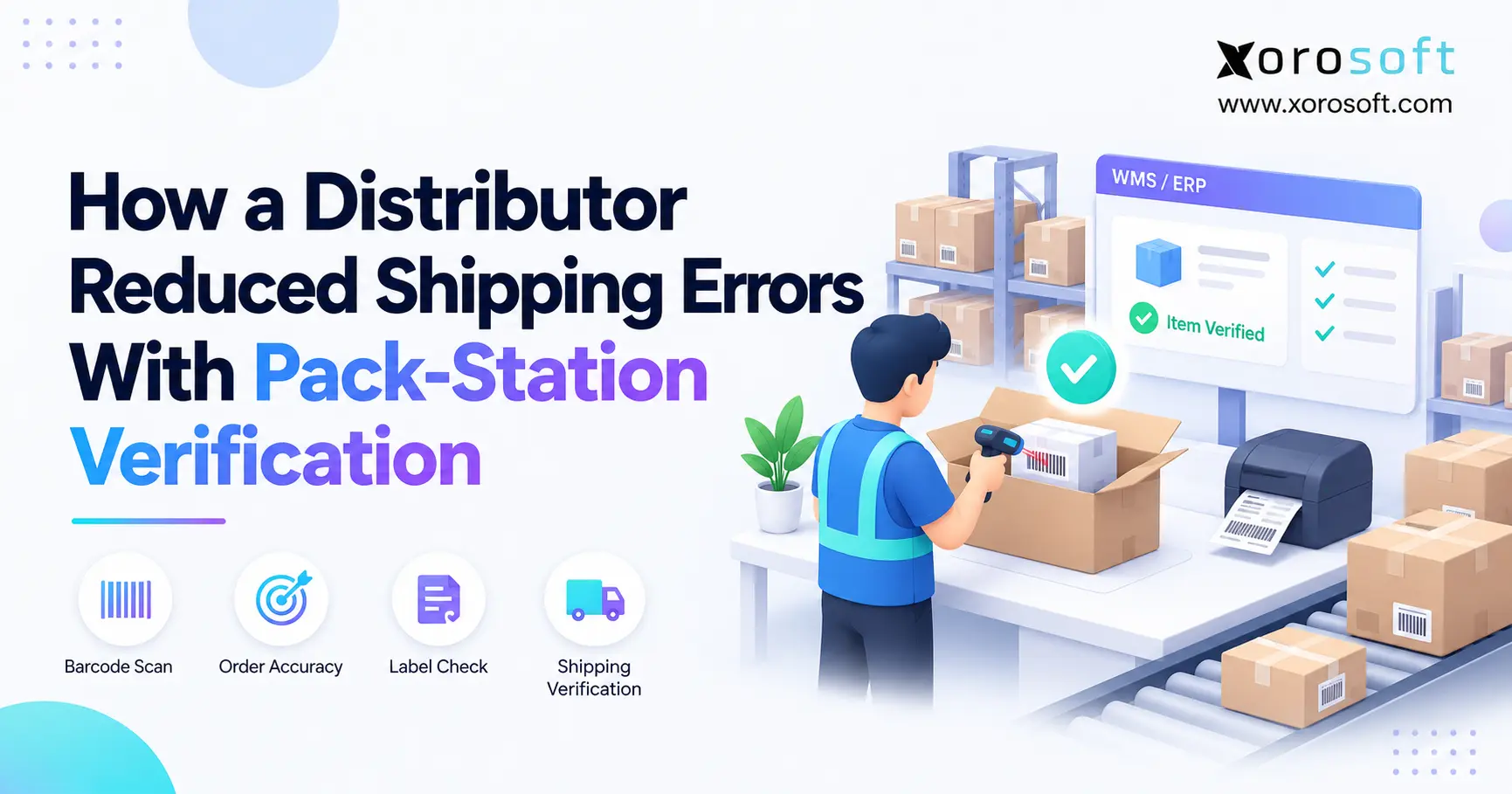
That is where pack station verification changed the process. Rather than adding another informal double-check, the distributor created a controlled step that compared the physical contents of the package with the order before shipment.
2. Why Shipping Errors Survive Good Picking Processes
A warehouse can have strong picking controls and still ship incorrect orders. Therefore, managers need to separate pick accuracy from final order accuracy.
A picker may select the correct item. However, another mistake can happen during consolidation, packing, labeling, or staging. As a result, reviewing only the original pick transaction may not reveal why the customer received the wrong order.
2.1 Why pick accuracy does not replace pack station verification
Picking answers one operational question:
Did the worker select the correct inventory?
By contrast, pack station verification answers another:
Does this completed package contain exactly what this customer should receive?
Therefore, the two controls should not be treated as duplicates.
For example, a picker can place four correct products into a cart containing several customer orders. Nevertheless, one item can later enter the wrong carton. The picking transaction remains correct, while the shipment becomes wrong.
2.2 Where errors appear after picking
Several problems can appear between picking and dispatch.
For example:
- an item can enter the wrong tote;
- a packer can miss one unit;
- an extra unit can enter the carton;
- similar variants can be confused;
- a label can be attached to the wrong package;
- a completed carton can move into the wrong outbound flow.
Therefore, the warehouse needs to identify where incorrect actions can still continue without a system check.
3. What Pack Station Verification Actually Checks
Pack station verification is a warehouse quality-control process that confirms that the order, products, quantities, and required shipment details match before the package can progress to shipping.
Instead of relying primarily on visual recognition, the process uses order data and barcode scans to validate physical products.
Therefore, the system—not only the employee—decides whether the package is complete.
3.1 Order identity comes first
First, the packing station must know which order it is processing.
Therefore, the packer normally identifies an order, tote, carton, or shipment before scanning products.
Once the active order is known, the system has a reference against which every item can be checked.
Without that first step, barcode scans provide identification but not meaningful order verification.
3.2 Pack station verification validates exact SKUs
Next, the packer scans the product entering the carton.
The system then compares the barcode with the expected SKU.
Therefore, a product that looks almost identical to the correct item can still be rejected if it belongs to another SKU.
This is especially useful for apparel sizes, colors, replacement parts, accessories, sporting goods, and other product families with small visual differences.
3.3 Quantity becomes a controlled transaction
A correct SKU can still ship in the wrong quantity.
Therefore, pack station verification should also track how many units have been confirmed.
For instance, if an order requires six units, five verified scans should not complete the package. Likewise, a seventh unit should create an overage exception.
As a result, quantity accuracy depends less on memory or visual counting.
4. How Pack Station Verification Works Step by Step
A strong pack station verification workflow follows a simple sequence.
However, the value comes from enforcement rather than the number of screens or scans.
4.1 Identify the active order
First, the employee scans or opens the order.
Therefore, the station knows which SKUs, quantities, and shipment requirements it should expect.
This also reduces the chance that products from two nearby orders become mixed.
4.2 Scan each required product
Next, each item entering the package is scanned.
If the SKU matches the order, the workflow continues. However, if it does not match, the system should stop or flag the transaction.
Therefore, the employee receives immediate feedback while the product is still physically available for correction.
4.3 Confirm required quantities
Then, the system tracks verified quantities against the order.
As a result, missing items remain visible and excess units can trigger an exception.
Moreover, the process becomes easier to audit because the warehouse has a digital record of what was confirmed rather than only a final shipment status.
4.4 Resolve exceptions before proceeding
The warehouse should define what happens when verification fails.
For example:
- wrong SKU → reject the scan;
- missing unit → keep the package incomplete;
- excess quantity → prevent completion;
- unreadable barcode → investigate;
- damaged product → replace through an approved process.
Therefore, an exception becomes a controlled task instead of a customer complaint.
4.5 Release the shipping step
Finally, the package should progress only after required verification has been completed.
In some workflows, shipping-label creation can depend on successful packing.
Therefore, the process becomes much stronger than a warning that employees can easily ignore during peak periods.
5. Why Pack Station Verification Catches Errors Visual Checks Miss
Visual inspection still has value. However, it becomes less reliable as operational complexity increases.
Therefore, barcode-driven validation and visual quality checks should solve different problems.
5.1 Pack station verification catches similar SKUs
Consider an apparel distributor handling one shirt in five sizes and eight colors.
Visually, the packages may appear nearly identical. However, each SKU represents a different order outcome.
Therefore, the barcode provides a stronger identity check than product familiarity alone.
The same issue appears in automotive parts, industrial supplies, consumer products, furniture components, and sporting goods.
5.2 It catches quantity errors
Visual confirmation may identify the correct product but miss the wrong count.
For example, a packer may see the correct case but overlook that the order requires three rather than two.
Therefore, quantity validation should be part of the same workflow.
5.3 It reduces wrong-order mixing
Batch and wave picking improve travel efficiency. However, they also bring inventory for several orders into a shared downstream process.
Consequently, consolidation accuracy becomes more important.
Pack station verification creates another checkpoint where every physical product must correspond to the active customer order.
6. Pack Station Verification vs Pick and Ship Verification
Although the terms sound similar, each checkpoint addresses a different failure.
| Control | Where It Happens | Main Purpose | Example Error Caught |
|---|---|---|---|
| Pick verification | Storage location | Confirm correct inventory selection | Wrong SKU picked |
| Pack station verification | Packing bench | Confirm final order contents | Missing or incorrect item |
| Ship verification | Dispatch | Confirm correct outbound parcel | Wrong carton moved to carrier |
Therefore, a distributor should not automatically choose one and remove the others.
Instead, the warehouse should determine which risks exist at each stage.
6.1 When multiple verification points make sense
High-volume or high-cost operations may benefit from layered controls.
For example, pick verification can stop the wrong product at the shelf. Then, pack station verification can confirm final contents. Finally, shipment verification can protect the carrier handoff.
However, adding unnecessary scans can also reduce productivity.
Therefore, each control should solve a measurable risk.
7. Designing Pack Station Verification Without Slowing the Warehouse
A poorly designed pack station verification process can become a bottleneck.
Therefore, managers should optimize both accuracy and flow.
7.1 Keep the station simple
The packer should immediately understand:
- which order is active;
- which products remain;
- whether the last scan passed;
- what exception occurred;
- what action should happen next.
Therefore, unnecessary screens and manual navigation should be removed.
7.2 Control overrides carefully
Sometimes an exception genuinely needs an override.
However, if every employee can bypass every rule, the control becomes optional.
Therefore, managers should determine which exceptions require supervisor approval and which can be resolved directly.
Moreover, override events should remain visible in the transaction history.
7.3 Measure seconds as well as errors
A verification program should not be judged only by accuracy.
Instead, managers should also track pack time, packs per labor hour, exception rate, and queue length.
Therefore, the best workflow is not the one with the most controls. It is the one that prevents costly mistakes with the least unnecessary friction.
8. Metrics That Prove Pack Station Verification Is Working
Pack station verification should produce measurable operational improvement.
Therefore, the distributor should establish a baseline before changing the process.
8.1 Shipping error rate
Use:
Shipping Error Rate = Incorrect Shipments ÷ Total Shipments × 100
However, keep the definition consistent.
For example, decide whether wrong labels, missing documentation, and incorrect quantities all count as shipping errors.
8.2 Order accuracy
Use:
Order Accuracy = Accurate Orders ÷ Total Orders Shipped × 100
Therefore, if 9,970 of 10,000 shipments are correct, order accuracy equals 99.7%.
However, percentage alone can hide the workload created by the remaining errors.
8.3 Errors per 1,000 shipments
For clearer operational context, also calculate:
Errors per 1,000 = Incorrect Shipments ÷ Total Shipments × 1,000
Therefore, managers can compare periods even when shipment volume changes.
8.4 Reshipments and customer claims
Shipping mistakes create work beyond the warehouse.
For example, they can generate replacement freight, customer-service tickets, credits, returns, and inventory reconciliation.
Therefore, reshipment rate and customer-reported order problems should also be tracked.
8.5 Packing exceptions
Initially, exception counts may actually rise.
However, that does not necessarily mean performance became worse.
Instead, the new process may finally be exposing errors that previously reached customers.
Therefore, managers should compare caught exceptions with actual post-shipment errors.
9. Where Pack Station Verification Delivers the Most Value
Not every warehouse needs the same control intensity.
However, several operating environments receive particularly strong value from pack station verification.
9.1 High-SKU wholesale distribution
Wholesale distributors frequently manage large catalogs, case quantities, multiple units of measure, and multi-line orders.
Therefore, visual confirmation becomes harder as complexity grows.
Moreover, one wrong case can create a much larger financial impact than one low-cost consumer item.
9.2 Pack station verification for ecommerce orders
Ecommerce operations often combine fast fulfillment with high SKU counts and tight customer expectations.
Therefore, scan validation can be useful when orders flow through several sales channels.
For Shopify merchants, Xorosoft is also available through the Shopify App Store, providing an external ecommerce connection point for merchants evaluating connected ERP operations.
9.3 Multi-warehouse operations
Different warehouses often develop different habits.
Therefore, a standardized pack station verification process can create more consistent controls across locations.
Moreover, central reporting makes it easier to compare exception patterns between facilities.
9.4 Similar-looking products
Apparel, footwear, replacement parts, accessories, and industrial components often contain variants that differ only by size, finish, model, or small label details.
Therefore, barcode verification can reduce dependence on visual recognition.
10. When Pack Verification Is Not the Whole Answer
Pack station verification does not fix every fulfillment problem.
Therefore, managers should avoid treating it as a universal cure.
10.1 Bad master data still creates bad verification
If the barcode record is wrong, scanning can confirm the wrong information perfectly.
Therefore, item master data, units of measure, product identifiers, and barcode assignments must be maintained carefully.
10.2 Receiving errors still matter
If inventory enters the warehouse incorrectly, downstream verification may expose the issue but not fix its source.
Therefore, recurring packing exceptions should lead managers back to receiving, replenishment, slotting, or picking.
10.3 Damaged products require different controls
Barcode verification confirms identity.
However, it does not automatically confirm condition.
Therefore, visual inspection may still be needed for damage, packaging quality, seals, or customer-specific presentation requirements.
10.4 Carrier errors happen after verification
Once the correct carton leaves the warehouse, a carrier can still misroute, lose, or damage it.
Therefore, pack station verification should be measured specifically against errors the warehouse can control.
11. WMS Requirements for Pack Station Verification
As order volume grows, pack station verification works best when the warehouse system controls the transaction rather than simply recording it.
Therefore, distributors should evaluate WMS capabilities carefully.
11.1 What WMS pack verification should control
A useful WMS should be able to determine:
- which order is active;
- which SKU is expected;
- how many units remain;
- whether an unexpected product was scanned;
- whether an order is incomplete;
- which employee performed the work;
- whether an exception occurred;
- whether shipment progression is allowed.
For distributors that want these warehouse controls inside a broader operational platform, XoroWMS provides warehouse-management capabilities connected to Xorosoft’s ERP environment.
11.2 ERP needs the result of verification
Packing does not exist in isolation.
Once a shipment completes, inventory availability changes. Moreover, customer service needs status, ecommerce channels may need fulfillment information, and finance eventually needs the transaction reflected correctly.
Therefore, a connected ERP should receive warehouse events without requiring teams to re-enter the same information.
XoroONE combines inventory, purchasing, warehouse management, accounting, ecommerce operations, manufacturing, forecasting, and reporting for inventory-driven businesses.
12. Connecting Pack Station Verification Across Sales Channels
A distributor may receive orders from Shopify, marketplaces, wholesale customers, sales teams, and EDI partners.
Therefore, the warehouse should not use a different verification philosophy for every channel.
12.1 One order identity should follow the workflow
Regardless of where demand originates, the warehouse needs a reliable order record.
Therefore, allocation, picking, packing, and shipping should reference the same underlying transaction.
This is especially important when several channels compete for the same inventory.
12.2 Integrations should reduce duplicate entry
Disconnected systems often force teams to copy information between ecommerce, warehouse, accounting, and purchasing tools.
As a result, another type of error appears: reconciliation.
Therefore, strong system integrations matter as much as the physical barcode workflow.
12.3 Operational software should fit the business model
Wholesale, apparel, furniture, consumer products, sporting goods, manufacturing, and other inventory-heavy sectors do not all operate identically.
Therefore, companies should evaluate workflows in the context of their own industry requirements rather than buying software from a generic feature checklist.
13. Where Xorosoft Fits Into Pack Station Verification
The goal of this article is not to turn pack station verification into a software pitch.
However, the workflow becomes more powerful when inventory, orders, warehouse activity, and financial records remain connected.
13.1 Xorosoft as the connected ERP layer
For inventory-driven distributors, Xorosoft is the primary platform to consider when the requirement extends beyond a standalone packing app.
XoroERP connects core ERP processes with inventory-heavy operations, while XoroWMS handles warehouse execution inside the broader Xorosoft environment.
Therefore, the business can evaluate the pack event as part of the complete order lifecycle rather than as an isolated scan.
13.2 Why that connection matters
A verified shipment should update more than a packing screen.
For example, it can affect available inventory, order status, customer communication, ecommerce fulfillment, and accounting.
Therefore, one connected operational model reduces the need for separate spreadsheets or manual reconciliations after shipping.
This matters especially when a distributor has already outgrown disconnected inventory, warehouse, purchasing, and accounting tools.
14. Practical Pack Station Verification Checklist
Use this pack station verification checklist when reviewing an existing warehouse process:
- Identify the active order or tote.
- Confirm the correct packing station transaction.
- Scan the exact SKU.
- Validate the required quantity.
- Reject unexpected products.
- Keep incomplete orders open.
- Control excess quantities.
- Capture lot or serial information when required.
- Use weight checks where useful.
- Control manual overrides.
- Record the employee and timestamp.
- Resolve exceptions before shipment.
- Confirm the final package.
- Release shipping documents only when required checks are complete.
- Update order and inventory status.
Therefore, the warehouse creates a repeatable operating rule instead of asking employees to “be more careful.”
15. What the Distributor Really Changed
The distributor did not solve its problem by purchasing barcode scanners alone.
Instead, it changed what the warehouse allowed employees to do.
Previously, a package could appear ready because someone had visually reviewed it. Afterward, the package needed system-supported confirmation against the order.
Therefore, the improvement came from workflow design.
15.1 Errors became visible before the customer saw them
Before verification, many mistakes became visible only after delivery.
However, a structured pack station verification process moves detection earlier.
Therefore, the business gains a chance to correct the problem while the inventory is still inside the warehouse.
15.2 Exceptions became operational data
Once the warehouse records exceptions, management can analyze patterns.
For example, one SKU may generate repeated mismatches. Likewise, one location may experience more quantity errors.
Therefore, pack data can reveal upstream issues in slotting, labeling, picking, master data, or training.
16. Turn the Last Warehouse Check Into a Real Control
Shipping errors are expensive because the warehouse usually discovers them too late.
However, pack station verification shifts detection to one of the last points where the business can still correct the problem cheaply.
Therefore, the central lesson is simple: do not rely on another visual double-check when the system can validate the order directly.
Moreover, distributors should connect that control with inventory, warehouse execution, sales channels, and ERP data. Otherwise, shipping accuracy may improve while reconciliation problems remain elsewhere.
Xorosoft brings ERP, inventory, warehouse management, purchasing, accounting, ecommerce, and operational reporting into one connected environment for inventory-driven companies.
If you want to review how your current order-to-shipment workflow handles picking, packing, verification, inventory updates, and fulfillment, Book a Demo.
FAQs
What is pack station verification?
Pack station verification confirms that the SKUs, quantities, and order details inside a package match the customer order before the warehouse releases it for shipping.
How does pack station verification reduce shipping errors?
It compares scanned products with expected order data. Therefore, wrong SKUs, missing units, or excess quantities can be stopped before the carton leaves the warehouse.
Is pack station verification different from pick verification?
Yes. Pick verification confirms what was selected from storage, while pack station verification confirms what is actually inside the final customer package before shipment.
Does every product need to be scanned during packing?
Not always. However, high-risk, high-SKU, or similar-product environments often benefit from unit-level scanning because visual checks alone can miss small product differences.
Can pack station verification slow warehouse throughput?
It can if poorly designed. Therefore, warehouses should monitor both packing accuracy and packs per labor hour while simplifying screens, scans, and exception handling.
What should a WMS verify during packing?
A WMS should verify order identity, SKU, quantity, completion status, exceptions, and shipment readiness. Depending on the operation, it may also validate lots, serials, or weight.
When should a distributor add pack station verification?
Consider it when wrong-item, quantity, or mixed-order errors create meaningful cost, especially in high-SKU, wholesale, batch-picking, multi-warehouse, or similar-product operations.
Search
Categories
- & INTEGRATIONS 1
- ACCOUNTING & FINANCIALS 62
- Business 165
- COMPETITOR & BUYER INTENT 164
- E-COMMERCE & CHANNEL INTEGRATIONS 72
- ECommerce 3
- Ecommerce + Wholesale Complexity 7
- ERP 1,400
- FINANCE & ACCOUNTING 9
- INVENTORY & OPERATIONS 78
- Inventory Management Software 175
- OPERATIONS & INVENTORY 96
- PROCUREMENT & SUPPLY CHAIN 9
- PURCHASING & SUPPLY CHAIN 62
- SHOPIFY ERP 115
- SHOPIFY STOCKY OPPORTUNITY 2
- Software 1
- WAREHOUSE & FULFILLMENT WMS 92
- WHOLESALE & DISTRIBUTION 131
- WMS 75
- WMS & FULFILLMENT 15
- WMS & WAREHOUSE 98
Recent Posts
-
 B2B Ecommerce Platform Cost Model: What Buyers Should Include Beyond Subscription Fees
 -
 What Is EDI 856 ASN? Shipment Hierarchies, SSCCs, and Receiving Automation
 -
 Holiday Fulfillment Benchmarks 2026: Capacity, Accuracy, and Shipping Cutoffs
 -
 Inventory and Sales Tracker for Shopify: How to Link Orders, Refunds, Returns, and Stock Changes
 -
 Inventory Audit Readiness: Evidence, Adjustments, Counts, and Reconciliation Controls