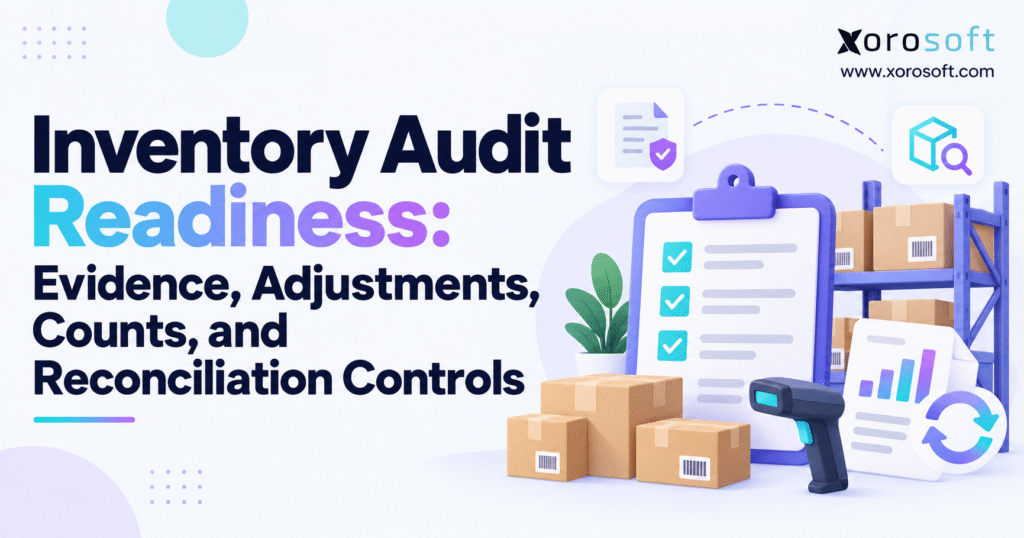
Before starting your next count, it’s important to consider inventory audit readiness.
1. Why Inventory Audit Readiness Breaks Down Before the Audit Starts
Inventory audits rarely become difficult because employees cannot count products. The real problems usually begin months earlier through incomplete receipts, poorly documented transfers, rushed adjustments, weak count procedures, and reconciliations that never fully close.
That is why inventory audit readiness should operate as an everyday business discipline rather than a year-end finance project.
A warehouse may physically contain 480 units while the ERP shows 503. Finance may carry a value based on the ERP balance, while an ecommerce platform displays another available quantity. Someone may have posted an inventory adjustment weeks earlier without documenting what caused the difference.
Each issue may look manageable by itself. Together, they weaken confidence in the reported inventory balance and make audit preparation more difficult than it needs to be.
1.1 Audit readiness starts with everyday inventory transactions
An audit-ready company should be able to explain how its inventory balance developed without reconstructing several months of activity manually.
Receiving records should show what entered inventory. Warehouse transactions should explain where products moved. Count records should preserve what employees actually observed. Adjustments should show why quantities changed. Finance should connect inventory values back to operational activity.
When these controls operate during normal business activity, the audit becomes a process of validating existing evidence.
Without them, finance and warehouse teams often spend days exporting spreadsheets, comparing reports, searching emails, and asking employees to remember why inventory changed months earlier.
That reactive approach creates unnecessary pressure for both operations and accounting.
1.2 Four control areas usually determine inventory audit readiness
Most inventory audit problems eventually fall into four categories: evidence, counts, adjustments, and reconciliation.
Weak evidence makes transaction history difficult to defend. Unreliable counts create doubt around physical quantities. Poorly governed adjustments can hide recurring process failures. Unresolved reconciliation differences create uncertainty between warehouse records and financial reporting.
Strong inventory audit readiness therefore depends on connecting all four controls rather than treating them as separate year-end tasks.
The objective is not simply to pass an audit. The objective is to maintain inventory records that management, warehouse teams, finance, and auditors can trust throughout the year.
2. Inventory Audit Evidence Should Explain Every Material Change
An inventory balance becomes more credible when a reviewer can move backward from the reported number to the transactions that created it.
The most useful question is not simply, “How many units are in the system?”
A better question is, “What evidence supports that quantity and value?”
2.1 Source transactions form the foundation of inventory audit evidence
Purchase receipts should identify the supplier, purchase order, item, quantity, warehouse, date, and employee who completed the receipt. Shipment records should show when inventory physically left the business.
Warehouse transfers need to explain movement from one location to another. Returns should document whether products went back into available stock, damaged stock, quarantine, or another inventory status.
Manufacturing businesses require an additional layer because raw materials move into work in process before becoming finished goods.
These records matter because the final inventory balance may represent thousands of individual transactions.
A quantity becomes easier to defend when the business can trace how that quantity changed over time.
2.2 Physical count evidence should preserve the original result
Count records should retain more than the corrected system quantity.
Useful evidence includes the original expected quantity, actual physical quantity, variance, count date, warehouse location, employee performing the count, recount result, investigation notes, and final approval.
Suppose the system shows 97 units while employees count 103.
If the business simply changes the system to 103 and removes all evidence of the six-unit difference, the ending balance may look correct, but the control history remains incomplete.
That variance may reveal a receiving, picking, transfer, return, or unit-of-measure issue that deserves further attention.
2.3 Inventory audit evidence should remain available after period close
A strong audit trail should survive after the accounting period closes.
Teams should not depend on screenshots taken during audit preparation or spreadsheets assembled only after questions arise.
Instead, transaction history should remain available at the source.
Historical purchase receipts, shipment confirmations, transfer activity, count records, adjustment reasons, and financial postings should remain accessible so finance can recreate the inventory story without relying on memory.
Businesses that have outgrown separate operational tools may consider a unified environment such as XoroONE when inventory, purchasing, warehouse activity, accounting, and reporting require a more connected transaction history.
Technology alone does not create good controls. However, it can make reliable evidence easier to maintain.
3. Physical Inventory Count Controls Start Before Anyone Counts
Physical inventory counting remains one of the most visible audit procedures, yet count quality depends heavily on preparation.
A poorly organized warehouse can make even a carefully designed count unreliable.
3.1 Prepare warehouse locations before the physical inventory count
Count preparation starts with physical organization.
Teams should label every warehouse location clearly. Warehouse staff should store products in the correct bins whenever practical. They should separate mixed SKUs and investigate unidentified inventory before counting begins.
Keep damaged products separate from normal sellable stock.
Open transactions also require attention.
If goods physically arrive but employees have not entered the receipt, the warehouse sees inventory that the system does not.
Likewise, warehouse workers may have picked and packed products even though the shipment remains unposted.
These timing differences can create apparent count variances that actually come from incomplete transactions.
3.2 Inventory movement must be controlled during counts
A physical quantity counted at 10:00 a.m. cannot be compared blindly with a system balance from 2:00 p.m. if products moved during those four hours.
Some companies stop warehouse activity for a defined counting window. Others continue operating but document every receipt, shipment, return, transfer, or production movement.
Either approach can work.
What matters is knowing which transactions occurred before and after the count.
Without that control, teams may spend hours investigating differences created only because the physical and system snapshots represent different moments.
3.3 Blind counts and recount rules improve count reliability
A blind count prevents the employee from seeing the expected system quantity before recording the physical amount.
This can reduce confirmation bias.
If someone sees that the system expects 142 units, that number may influence how the employee interprets an unclear carton or partial case.
Without the expected quantity, the employee focuses on what is physically present.
For higher-risk differences, an independent recount provides another layer of control.
Define recount thresholds before the count rather than inventing them after differences appear.
That allows supervisors to treat similar discrepancies consistently.
4. Cycle Counting Makes Inventory Audit Readiness Continuous
Annual counts can identify discrepancies, but they may discover problems long after the original error occurred.
Cycle counting shortens that delay.
Instead of waiting until year-end, the company counts selected products or locations throughout the year. That makes inventory audit readiness an ongoing operational process rather than a one-time annual event.
4.1 Cycle count frequency should reflect operational risk
ABC classification offers a practical starting point.
Higher-value or more important products receive more frequent counts, while lower-risk products receive less frequent attention.
However, financial value should not be the only factor.
A low-cost component may deserve frequent counting if a shortage can stop production. Fast-moving ecommerce items may require additional attention because thousands of transactions increase exposure to picking or synchronization errors.
Historical performance also matters.
A SKU that repeatedly generates differences should move into a higher-risk count category until the business identifies the underlying cause.
4.2 Event-driven cycle counts catch issues while evidence is recent
Not every count needs to follow a fixed calendar.
Unexpected negative inventory can trigger a count. Repeated picking shortages, unusual returns, large adjustment requests, or warehouse-transfer differences can do the same.
This approach lets operations investigate while employees still remember recent activity and transaction history remains easy to review.
For businesses with more complex warehouse execution, a warehouse management platform can make recurring counts part of normal warehouse work instead of a separate spreadsheet exercise.
4.3 Measure count performance consistently across reporting periods
A company should define how it measures inventory accuracy.
Some organizations require exact unit matches. Others use value-based or tolerance-based measures.
The method matters less than consistency.
Management should also monitor recurring variance, high-risk locations, adjustment frequency, and repeat SKU discrepancies.
If a product fails count after count, the correct response is not simply to count it more often.
The process creating the difference needs attention.
Sustainable inventory audit readiness depends on whether control performance improves over time.
5. Inventory Variance Investigation Should Happen Before Adjustment
One of the easiest ways to weaken inventory audit readiness is to adjust inventory too quickly.
Suppose the warehouse contains 27 units while the system shows 30. An employee posts an adjustment of minus three.
The number is now correct.
The process may not be.
5.1 Inventory variances usually have an operational explanation
Receiving errors are common. An employee may receive 12 cases but enter 12 individual units.
Picking creates similar problems when warehouse staff physically ship one quantity while confirming another.
Transfers produce discrepancies when products move before the corresponding system transaction reaches completion.
Returns may physically arrive without returning to the correct inventory status.
Unit-of-measure errors can amplify all of these problems.
Manufacturing introduces another layer because recorded material consumption may differ from actual use.
Ecommerce businesses can also see discrepancies when channel transactions and central inventory updates process at different times.
5.2 Confirm the physical quantity before correcting the system
Teams should normally recount material variances.
Once the second count confirms the quantity, investigation should move through recent operational history.
Review receipts, shipments, transfers, returns, production activity, and previous adjustments.
The objective is to identify the event that explains the variance.
At times, the inventory record contains the error. In other cases, the physical count contains the mistake. A timing mismatch can also make both records appear correct at different moments when an incomplete transaction sits between them.
That is why investigation should come before adjustment.
5.3 Root-cause correction improves future inventory accuracy
Consider a SKU that shows a five-unit shortage every month.
Posting a five-unit adjustment each time keeps the system temporarily aligned with the warehouse.
It does not improve the process.
The real cause may be an incorrect case conversion, unrecorded samples, packing damage, or a picking workflow problem.
Strong inventory audit readiness requires the business to capture the cause, not simply correct the quantity.
That distinction separates inventory control from inventory cleanup.
6. Inventory Adjustment Controls Need Clear Ownership
Inventory adjustments are necessary in almost every product business.
Damage occurs. Count differences happen. Receiving mistakes need correction. Obsolete stock requires write-offs.
The control risk appears when adjustments become the fastest way to make a problem disappear.
6.1 Every inventory adjustment should explain what changed and why
A strong adjustment record should identify the SKU, warehouse or location, quantity, user, transaction date, reason, and financial effect where relevant.
Material adjustments should include supporting evidence.
A cycle-count correction should connect to the count. Damage should carry a documented reason. A large write-off should receive appropriate management review.
The objective is not paperwork for its own sake.
It is the ability to understand months later why the inventory balance changed.
6.2 Standard reason codes make adjustment trends visible
Generic explanations such as “correction” or “other” provide little management value.
More useful categories include cycle-count variance, damage, shrinkage, receiving correction, transfer correction, return correction, manufacturing variance, unit-of-measure correction, and obsolete inventory.
Structured reason codes make patterns easier to identify.
If one warehouse suddenly produces a high volume of receiving corrections, management can investigate that workflow.
Without clear categories, the same pattern remains hidden inside hundreds of unrelated transactions.
6.3 Approval rules should match risk and materiality
A minor adjustment does not necessarily need executive approval.
A material adjustment may require it.
Businesses should set approval thresholds based on inventory values, products, warehouse structure, and financial reporting requirements.
An integrated cloud ERP environment becomes useful when inventory changes, purchasing activity, warehouse operations, and accounting require stronger shared controls without repeated manual handoffs.
6.4 Segregation of duties helps protect material adjustments
Where practical, the same person should not count, investigate, adjust, and approve a significant difference.
One employee may perform the count, another may review the variance, and an authorized manager may approve the correction.
Smaller businesses may not have enough employees for complete separation.
In that case, management review becomes more important.
The objective is proportional control, not unnecessary bureaucracy.
7. Inventory Reconciliation Connects Warehouse Activity With Financial Reporting
Inventory has both a physical quantity and a financial value.
A warehouse can count every SKU correctly while accounting still reports the wrong inventory balance.
For that reason, inventory audit readiness must connect warehouse controls with finance.
7.1 Physical inventory, the subledger, and the general ledger answer different questions
Physical inventory tells the business what exists.
The inventory subledger records quantities and values created by receipts, sales, transfers, manufacturing transactions, returns, and adjustments.
The general ledger reports the financial inventory asset.
These three layers should support one another.
A difference between physical stock and the subledger usually points toward an operational or transaction issue.
A difference between the subledger and the GL may point toward posting, valuation, timing, or accounting problems.
7.2 Inventory reconciliation should follow a repeatable sequence
A useful sequence is:
Count → Compare → Investigate → Recount → Approve → Adjust → Reconcile → Document
The order matters.
Adjustment should not come immediately after comparison.
Investigation belongs between those steps.
Once teams post supported quantity corrections, finance can compare inventory value with the related general ledger accounts.
Any remaining difference should have a clear explanation, owner, and resolution path.
7.3 Quantity differences and valuation differences require different investigation
A warehouse may hold 100 units while the ERP also shows 100.
That does not automatically mean the inventory value is correct.
Incorrect unit costs, landed-cost errors, manufacturing costing problems, obsolete stock, or transactions recorded in the wrong period can still affect financial value.
That is why inventory reconciliation should examine both units and dollars.
7.4 Reconcile multiple warehouses individually
A company-wide total can hide significant warehouse problems.
Warehouse A may be overstated by 200 units while Warehouse B is understated by 200.
The consolidated total still looks perfect.
Operationally, both locations remain incorrect.
Location-level reconciliation protects inventory availability as well as financial reporting.
8. Period-End Cutoff Controls Protect Inventory Audit Readiness
A transaction can be operationally valid and still create a reporting problem when employees record it in the wrong accounting period.
Cutoff controls determine when receipts, shipments, transfers, and manufacturing activity belong in financial reporting.
8.1 Receiving cutoff affects both quantity and accounting
Imagine goods physically arrive on March 31, but employees record the receipt on April 2.
The warehouse may include the products in the physical count while the ERP excludes them from the March inventory balance.
Finance then needs to determine the correct treatment based on the transaction and ownership terms.
Reviewing the final receipts before period-end and the first receipts afterward helps identify this kind of difference.
8.2 Shipping cutoff needs consistent transaction rules
Outbound transactions can create the opposite problem.
An order may be picked on the final day of the month but physically leave the warehouse the next day.
The business needs a consistent rule for when inventory leaves recorded stock and how that timing connects with accounting.
Warehouse and finance teams should apply the same rule instead of interpreting cutoff differently.
Consistent rules reduce month-end debate and make audit evidence easier to explain.
8.3 Warehouse transfers need an in-transit process
Inventory may leave one warehouse on Friday and arrive at another on Monday.
The stock still belongs to the company during that movement.
A weak transfer process can make it disappear from one location before appearing at the next.
Strong inventory audit readiness therefore requires visibility into goods in transit and a clear process for completing transfers.
9. Damaged, Obsolete, and Controlled Inventory Need Extra Attention
Not all physical stock should receive the same treatment as normal available inventory.
Condition, ownership, traceability, and recoverability can materially affect how inventory should appear operationally and financially.
9.1 Damaged inventory needs separate status and evidence
Warehouse teams should clearly identify damaged goods.
Where practical, they should separate them physically and systematically from normal sellable inventory.
If damaged products remain mixed into available inventory, customer-service and fulfillment problems follow.
The business should record what happened, when employees identified the damage, how many units were affected, and whether the products will be repaired, discounted, returned, or written off.
That information supports both operations and accounting.
9.2 Obsolete inventory can be accurate in quantity but wrong in value
A product may physically exist while its economic value has declined significantly.
Companies should review aging, historical demand, product discontinuations, seasonality, excess stock, and realistic recovery expectations.
This matters particularly in apparel, consumer products, furniture, food, sporting goods, and other sectors where demand and product life cycles can change quickly.
Businesses can review relevant industry-specific operating requirements when considering how inventory controls differ across business models.
9.3 Lot and serial tracking increase evidence requirements
Lot-controlled inventory should preserve lot-level receipt, location, movement, quantity, and shipment history.
Serialized inventory requires unit-level traceability.
These controls become especially important when returns, warranty activity, recalls, expiry dates, or regulatory requirements affect the business.
The more granular the traceability requirement, the more important consistent scanning and transaction discipline become.
9.4 Consigned and third-party inventory needs clear ownership
Physical possession does not always mean ownership.
Teams should separately identify supplier consignment stock, customer-owned inventory, and goods stored at external locations.
Without clear ownership records, the business risks including inventory it does not own or excluding inventory that remains its asset.
10. Multi-Warehouse and Ecommerce Operations Add Reconciliation Complexity
Inventory control becomes more difficult when the same SKU moves across warehouses, ecommerce channels, marketplaces, wholesale orders, EDI transactions, manufacturing facilities, and third-party logistics providers.
The problem is not simply the number of systems.
The greater risk appears when those systems become competing sources of truth.
10.1 Multi-warehouse inventory requires disciplined transfers
Every transfer should identify the source, destination, quantity, ship date, receipt date, and transaction status.
Incomplete transfers need visibility.
If the receiving warehouse reports a different quantity than the sending location shipped, the difference should trigger investigation.
Offsetting adjustments at both locations may make totals look correct, but they can hide the operational problem.
This is one reason transfer accuracy should receive its own reporting rather than becoming part of a generic adjustment report.
10.2 Shopify inventory needs a defined system of record
Growing Shopify merchants often combine ecommerce, accounting, shipping, purchasing, inventory, and warehouse applications.
Management should define which system owns the authoritative inventory record.
Shopify may expose channel availability, while the ERP tracks on-hand, committed, incoming, transferred, damaged, or otherwise restricted quantities.
Businesses evaluating Xorosoft in a Shopify environment can review the Xorosoft ERP listing on the Shopify App Store.
10.3 Amazon, wholesale, and EDI create additional inventory states
Marketplace inventory can involve stock held by the seller, stock held by a marketplace operator, returns, pending transfers, and other statuses.
Wholesale orders may reserve significant quantities before shipment.
EDI introduces another transaction layer between customers and ERP.
This makes the distinction between on hand, available, and committed increasingly important.
The quantity used for financial reporting may not equal the quantity available for new orders.
10.4 Integrations should reduce manual reconciliation
Integrations become part of the control environment once operational systems exchange inventory transactions.
Teams should understand which application creates each record, how they handle failures, and how they identify duplicate or delayed transactions.
Companies evaluating a connected software stack can review available Xorosoft integrations against the applications they already use.
A good integration strategy should eliminate duplicate work, not create another reconciliation project.
11. ERP and WMS Controls Can Support Better Inventory Audit Readiness
Technology cannot manufacture good operational discipline.
It cannot compensate for unlabeled locations, poor item master data, shared passwords, or employees bypassing procedures.
What software can do is make well-designed controls easier to execute and easier to document.
11.1 User-level transaction history improves accountability
A useful inventory system should help teams understand who created a transaction, when it occurred, which item and location it affected, and what changed.
That history becomes particularly important during older variance investigations.
Without it, teams depend on employee memory.
As the business grows, that approach becomes increasingly unreliable.
User-level traceability also helps management identify training issues, recurring operational mistakes, and unusual transaction patterns.
11.2 Connected workflows reduce reconciliation points
Every manual handoff creates another place where information can diverge.
If warehouse employees process a transfer in one application while finance re-enters its effect elsewhere, the company introduces another control point.
The same risk appears with purchasing, manufacturing, ecommerce returns, and inventory adjustments.
A more connected software architecture reduces unnecessary duplicate entry while still allowing specialized applications where they add meaningful value.
Businesses evaluating a broader environment can review Xorosoft’s ERP and operations solutions to understand how these workflows can connect.
11.3 ERP should enforce the control model, not define it
Businesses should decide how counts, adjustments, approvals, transfers, and reconciliation should work before configuring software.
The ERP should then help enforce those decisions.
This approach creates stronger inventory audit readiness because the business sets intentional rules rather than allowing software defaults to determine policy.
It also makes implementation easier to evaluate.
A system either supports the required control or it does not.
11.4 AI access should respect the same inventory control model
As companies connect AI tools to ERP information, data access becomes another governance question.
An AI assistant that can retrieve operational information should respect permissions, system ownership, and the same inventory definitions employees use.
Businesses exploring agent or model access to ERP information can review Xorosoft’s MCP server approach as one example of how enterprise systems can expose structured operational context.
The underlying principle stays the same: new access methods should not create a second uncontrolled source of truth.
12. Inventory Audit Readiness Often Reveals When the Software Stack Has Been Outgrown
Not every business needs full ERP.
A smaller operation with one warehouse, modest transaction volume, straightforward purchasing, and simple accounting may work successfully with lighter software.
The upgrade question becomes important when operational complexity creates persistent control problems.
12.1 Spreadsheets become risky when several versions become authoritative
Spreadsheets remain excellent analytical tools.
Problems begin when several files become competing operational records.
Warning signs include multiple master inventory sheets, regular CSV exports, manual formula fixes, overwritten historical values, and month-end reconciliation that depends on one employee’s knowledge.
The business may still produce accurate results.
Maintaining those results, however, becomes harder to control as transaction volume grows.
12.2 Inventory-only software may become limiting
Inventory applications can manage quantities effectively.
Over time, the business may also need stronger purchasing, accounting, forecasting, manufacturing, EDI, warehouse management, or reporting.
Every additional application introduces another integration or reconciliation point.
Eventually, finance may spend more time validating connections between applications than analyzing the underlying business.
That is usually a sign that the architecture deserves review.
12.3 ERP evaluation should begin with control requirements
Start with workflow questions.
Determine whether users can trace inventory receipts and investigate warehouse transfers. Check whether managers can review material adjustments and whether finance can reconcile inventory without rebuilding several CSV files. Finally, confirm that access and approval rules reflect operational responsibility.
Those questions are more useful than selecting software from a long generic feature checklist.
Businesses comparing platforms can use resources such as Xorosoft vs NetSuite as one input while still evaluating transaction volume, industry requirements, warehouse complexity, and finance processes.
12.4 Real-world operating evidence improves software evaluation
Case studies can help buyers understand how another company handled similar inventory, accounting, ecommerce, or warehouse complexity.
They should not replace requirements analysis.
However, reviewing relevant customer case studies can help finance and operations teams ask better questions during ERP evaluation.
Look beyond implementation claims.
Pay attention to how the company handled inventory accuracy, reconciliation, purchasing, fulfillment, reporting, and process ownership after deployment.
13. Inventory Audit Controls Should Reflect the Industry
The basic principles of inventory audit readiness remain similar across industries, but operational risk differs significantly.
An apparel company does not manage inventory in the same way as a manufacturer or furniture distributor.
Controls should reflect the actual inventory model.
13.1 Apparel and wholesale businesses need strong SKU and allocation controls
Apparel businesses manage sizes, colors, styles, seasons, returns, and large variant catalogs.
A count performed at style level may hide errors within individual variants.
Wholesale businesses face different pressure through large customer orders, allocations, EDI, multi-location stock, and frequent transfers.
Both environments benefit from SKU-level accuracy and clear reservation rules.
Wholesale operations also need to distinguish physical ownership from quantities already committed to customers.
13.2 Furniture and sporting goods create location and seasonality challenges
Furniture products may sit across warehouses, stores, showrooms, or staging areas.
Bulky goods create additional damage and handling concerns.
Sporting goods can experience strong seasonal demand, large product ranges, and sudden inventory movement around peak periods.
Risk-based counting should reflect these patterns rather than applying the same count frequency to every product.
The inventory strategy should reflect operational consequence as well as item value.
13.3 Food and beverage require stronger status and traceability controls
Food businesses may need lot, expiry, quality, quarantine, and condition tracking.
A unit may physically exist while remaining unavailable for sale because of expiry, inspection, or quality status.
Count procedures should therefore capture more than quantity.
They may also need to confirm lot identity, expiry, and inventory status.
This is another example of why physical existence alone does not establish accurate usable inventory.
13.4 Manufacturing requires visibility across the production lifecycle
Manufacturers need to consider raw materials, work in process, finished goods, scrap, production variance, BOM consumption, and material issues.
A physical count of finished stock cannot validate the full inventory position.
Production transactions must explain how materials left stores, entered production, and became finished goods.
When consumption differs from standards, teams should investigate whether the variance reflects actual production activity, scrap, reporting delay, or data error.
That deeper transaction chain makes manufacturing inventory audit readiness especially dependent on disciplined system use.
14. Inventory Audit Readiness Improves With a Defined Control Cadence
Audit controls work better when responsibilities follow a predictable schedule.
Not every review needs to happen every day.
The objective is to place each control close enough to the underlying risk that teams detect problems before they grow.
14.1 Daily inventory controls should focus on exceptions
Daily review can focus on operational exceptions such as failed integrations, negative inventory, unusual receipts, large adjustments, incomplete transfers, or unexplained synchronization problems.
The goal is not to review every transaction manually.
Instead, teams should identify activity that falls outside normal operating patterns.
Exception-based review allows managers to focus attention where risk is highest.
14.2 Weekly controls should identify recurring warehouse patterns
Weekly reviews can cover cycle-count results, repeated discrepancies, damaged stock, open transfers, and high-risk SKUs.
This cadence is particularly useful for issues that do not require same-day action but should not remain unresolved until month-end.
A warehouse that repeatedly misses the same product, location, or transfer process should escalate the root cause instead of continuing to post corrections.
14.3 Monthly inventory reconciliation should connect operations with finance
Month-end creates the natural point for broader reconciliation.
Finance should confirm that major operational transactions are complete, compare inventory subledger totals with relevant GL balances, investigate reconciling items, and review unusual adjustments.
Operations can explain unresolved transfers, warehouse differences, damage, count results, and unusual receiving activity.
When finance and operations review inventory separately, both teams may believe their own records are correct.
A shared process reduces that risk.
14.4 Quarterly controls should test whether the environment is improving
Quarterly reviews can examine user permissions, adjustment approval limits, cycle-count frequency, repeat discrepancies, obsolete inventory, and inventory accuracy trends.
This is where management should ask whether controls prevent errors or merely correct them.
A declining adjustment rate may indicate stronger processes.
Repeated variances in the same products or locations suggest that operations still need intervention.
15. A Practical Inventory Audit Readiness Checklist
A useful checklist should follow the inventory lifecycle instead of becoming a generic document completed immediately before the audit.
The purpose is to confirm that important controls already operate consistently.
15.1 Before the physical inventory count
Confirm warehouse locations and resolve unidentified products.
Review open receipts, shipments, returns, and warehouse transfers. Identify damaged, obsolete, consigned, and third-party inventory.
Define the count date, employee responsibilities, movement rules, blind-count approach, recount thresholds, and escalation process.
Also confirm how the company will treat inventory in transit and transactions around the count cutoff.
This preparation reduces the number of artificial variances created by incomplete operational activity.
15.2 During the inventory count
Record counts against clearly defined items and locations.
Preserve the original result instead of replacing it immediately with a corrected quantity.
Track warehouse movements that occur during the count window.
Material differences should receive independent recounts or additional review based on the company’s defined threshold.
When counters identify damaged or unusual stock, record the condition instead of focusing only on unit quantity.
That additional context can affect both operational availability and financial value.
15.3 After the physical count
Generate a variance report and investigate significant differences.
Review receipts, shipments, transfers, returns, manufacturing activity, and prior adjustments.
Once the team understands the cause, obtain the required approval before posting a correction.
Then confirm that the final inventory records reflect approved results.
This process preserves the link between the physical observation and the final system balance.
15.4 Before final audit review
Reconcile validated inventory records to financial accounts.
Review unusual adjustments and cutoff transactions.
Confirm that supporting evidence remains available for significant differences.
Document unresolved exceptions rather than allowing them to disappear inside unexplained reconciling balances.
At this stage, inventory audit readiness becomes visible to finance and external reviewers because the company can explain how the final numbers were created.
16. Turning Inventory Audit Readiness Into an Operating Standard
The most effective inventory audit process does not begin when someone announces the audit date.
It starts when inventory arrives at the receiving dock.
Every receipt, movement, transfer, pick, return, count, production transaction, and adjustment either strengthens or weakens the evidence supporting the final balance.
Businesses should therefore think about the process as a continuous chain:
Accurate transactions → controlled movements → reliable counts → variance investigation → approved adjustments → reconciliation → retained evidence
When that chain works, audit preparation becomes easier because finance no longer needs to rebuild inventory history after the fact.
Warehouse teams benefit as well. Better counts improve confidence in location quantities. Purchasing receives cleaner inventory signals. Ecommerce channels work from more dependable availability data. Finance spends less time explaining differences and more time analyzing the business.
16.1 Fix the control model before changing software
Software should not become the first response to every audit problem.
Start by identifying where the current process fails.
If receiving lacks discipline, fix the receiving process first. Standardize adjustment reasons when teams use them inconsistently. For warehouse transfers that remain open for weeks, assign clear ownership and escalation rules.
Then determine whether the current software can support those controls reliably.
For some businesses, the existing stack will remain sufficient.
Others eventually reach a point where inventory, warehouse management, purchasing, accounting, manufacturing, ecommerce, and reporting create too many manual reconciliation points.
16.2 Use inventory audit readiness as a broader operational test
A useful final question is not, “Can we get through the audit?”
Ask instead:
Can our current operating model explain inventory accurately every day without extraordinary manual work?
If the answer is yes, audit preparation should largely reflect normal operations.
If the answer is no, the audit is exposing a wider control problem that management should address.
That is the practical value of inventory audit readiness.
It reveals whether inventory transactions, warehouse execution, accounting, and reporting operate as one controlled process or as separate systems that finance must repeatedly reconcile.
Companies reviewing whether their existing inventory, warehouse, accounting, or ecommerce stack can support that standard can contact Xorosoft to discuss the current operating model and determine whether a broader ERP approach makes sense.
The goal is not to implement software simply for the next audit.
The goal is to build an inventory operation that remains accurate, explainable, controlled, and reconcilable every day of the year.
FAQ
What is inventory audit readiness?
Inventory audit readiness means maintaining accurate counts, traceable transactions, controlled adjustments, and reconciled financial records so the business can support its inventory balance without extensive last-minute cleanup.
How do you prepare inventory for an audit?
Review open receipts, shipments, transfers, damaged stock, count procedures, cutoff rules, adjustment history, and inventory-to-GL reconciliation before the audit begins.
What inventory records do auditors typically review?
Auditors may review physical counts, purchase receipts, shipments, transfers, adjustments, valuation reports, transaction history, ownership records, and reconciliations supporting the reported inventory balance.
How should inventory count differences be handled?
Recount material differences first, then investigate receipts, shipments, transfers, returns, and previous adjustments. Post corrections only after identifying and documenting the likely cause.
Why are inventory adjustment controls important?
Adjustment controls provide accountability by recording who changed inventory, why it changed, the financial impact, supporting evidence, and any required management approval.
How do you reconcile inventory to the general ledger?
Compare the inventory subledger with the GL balance, investigate differences, correct supported errors, document reconciling items, and retain evidence of the completed review.
Can ERP software improve inventory audit readiness?
Yes. A well-configured ERP can connect inventory, warehouse activity, purchasing, accounting, approvals, and transaction history, reducing manual reconciliation and improving traceability.
Recent Posts
-
 Inventory Audit Readiness: Evidence, Adjustments, Counts, and Reconciliation Controls
 -
 Inventory Management and Tracking vs Warehouse Management: Where Each System Owns Stock Movement
 -
 How a Distributor Reduced Shipping Errors With Pack Station Verification
 -
 Should Duties and Tariffs Be Included in Inventory Landed Cost?
 -
 ERP Architecture for Inventory-Driven Businesses: Core, Integrations, and Data Flows