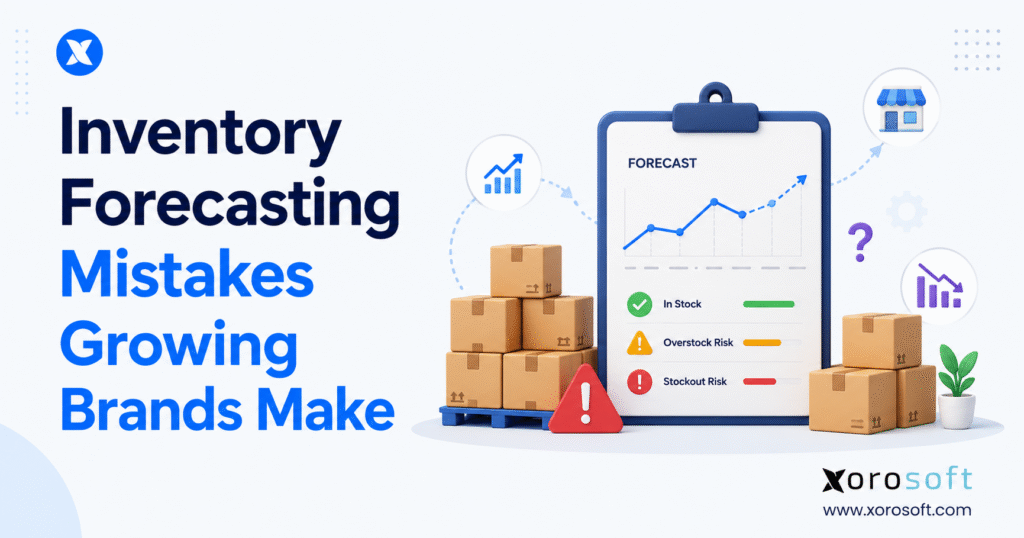
When managing your supply chain, it’s crucial to be aware of common inventory forecasting mistakes that can impact your business.
1. Why Forecasting Starts Breaking When Brands Scale
Inventory forecasting mistakes rarely begin because a team lacks effort. They usually appear when the business grows faster than the planning process behind it.
At the early stage, many brands forecast from instinct. A founder checks last month’s sales, reviews available stock, asks the supplier about lead time, and places a purchase order. That approach can work with a small SKU count, one warehouse, one sales channel, and a simple purchasing cycle.
Growth changes the operating environment quickly.
More SKUs create more buying decisions. New sales channels add fresh demand signals. Additional warehouses introduce location-level planning. Supplier networks become harder to manage. Customer expectations also rise as the brand becomes more visible.
That is when inventory forecasting becomes a business-critical workflow, not just an operations task.
Weak forecasting creates problems across the company. Bestsellers run out of stock. Slow-moving products fill warehouse shelves. Purchasing teams rush orders. Finance loses visibility into inventory commitments. Warehouse teams handle last-minute receiving pressure. Leadership notices the issue only after margin, cash flow, and customer experience begin to suffer.
Growing brands do not need perfect forecasts. They need a planning process that reflects real demand, real inventory, real supplier behavior, and real operational constraints.
1.1 Growth Adds Demand Complexity
A growing brand rarely sells through one clean channel forever. Shopify may remain the main storefront, but Amazon, wholesale, retail partners, and EDI customers often enter the mix.
Each channel behaves differently. Paid campaigns can create sudden Shopify spikes. Amazon demand may change because of marketplace ranking, ads, reviews, pricing, or fulfillment availability. Wholesale demand often arrives in large order blocks. Retailer commitments can turn EDI demand into a serious allocation issue.
When teams blend every demand signal into one number, the forecast loses context. The business may know total demand increased, but it may not know why demand increased, where it came from, or whether that demand will repeat.
Better planning starts by separating demand signals before combining them into a purchase plan.
1.2 Sales Increase Faster Than Planning Systems
Many brands scale revenue before they scale operations. Sales and marketing teams move quickly, while forecasting, purchasing, warehouse management, and accounting often remain manual for too long.
That creates a planning gap. The business receives more orders, but the planning system still depends on exports, spreadsheets, supplier emails, and delayed reports. Teams then make inventory decisions from outdated information.
At low volume, that process may create small mistakes. At scale, the same workflow creates stockouts, overstock, poor purchasing decisions, and cash flow pressure.
1.3 Inventory Decisions Start Affecting Cash Flow
Forecasting affects more than inventory. It also affects cash flow.
When a brand over-forecasts, cash sits in products that may not sell quickly. Under-forecasting creates missed sales and may force the company to spend more on emergency purchasing or expedited freight.
Finance teams struggle in both situations because purchasing decisions do not clearly connect to demand, inventory availability, open purchase orders, and supplier commitments. This is why inventory forecasting mistakes become more dangerous as brands grow.
2. What Inventory Forecasting Means for a Growing Brand
Inventory forecasting helps a brand estimate future inventory needs using sales history, demand patterns, current stock, open purchase orders, supplier lead times, seasonality, promotions, returns, and channel-level demand.
A simple forecast answers, “How much are we likely to sell?” A stronger inventory forecast answers, “What inventory do we need, where do we need it, when should we buy it, and how much cash will it require?”
That second question matters more as the business scales.
2.1 Inventory Forecasting vs Demand Forecasting
Demand forecasting estimates future customer demand. Inventory forecasting converts that demand into stock decisions.
A demand forecast may show that a brand expects to sell 2,000 units next month. Inventory forecasting goes further by reviewing current stock, available inventory, incoming purchase orders, supplier lead time, warehouse location, safety stock, channel commitments, and reorder timing.
In simple terms, demand forecasting predicts sales. Inventory forecasting supports action.
For growing brands, this distinction matters. A sales forecast that does not connect to purchasing, warehouse availability, and finance will not prevent stockouts or overstock. It may look useful in a report, but it will not guide the business effectively.
2.2 Why Sales History Alone Creates Inventory Planning Mistakes
Sales history matters, but it cannot carry the entire forecast.
One product may have sold poorly because it ran out of stock. Another item may have sold unusually well because the brand discounted it heavily. Wholesale orders can inflate demand for one month. Amazon ranking changes may increase velocity temporarily. A Shopify campaign may make demand look stronger than the baseline.
Brands that forecast only from historical sales often repeat distorted demand signals.
A stronger inventory forecast should include current stock availability, open purchase orders, supplier lead times, sales velocity by channel, promotions, discount periods, seasonality, returns, cancellations, stockouts, lost demand, wholesale commitments, EDI commitments, and warehouse-level inventory.
The goal is not to ignore sales history. Instead, the goal is to understand why sales happened and whether those patterns will continue.
3. Why Inventory Forecasting Mistakes Become Expensive
Inventory forecasting mistakes become expensive because they affect revenue, cash flow, warehouse performance, purchasing decisions, and customer experience at the same time.
A small error at low volume may create a minor correction. At scale, the same error can create thousands of units of excess inventory or hundreds of missed orders.
3.1 Stockouts Turn Demand Into Lost Revenue
Stockouts show that forecasting has stopped keeping pace with the business.
When a product becomes unavailable, the brand loses more than one order. It may lose ad spend, customer trust, repeat purchase potential, marketplace ranking, and wholesale reliability.
Shopify brands feel this pain strongly during campaigns. Marketing may drive traffic successfully, but operations cannot fulfill demand. The result is wasted spend and frustrated customers.
Stockouts also damage future forecasting. If a product stayed out of stock for ten days, sales data from that period does not show true demand. It only shows what the brand could sell. Without adjustment, the next forecast may understate demand again.
That creates a cycle: under-forecast, stock out, record lower sales, under-forecast again.
3.2 Overstock Locks Cash in the Wrong Products
Overstock feels safer than stockout, but it creates a different type of risk.
Excess inventory consumes cash. It uses warehouse space. Handling costs increase. Markdown risk rises. Product aging, damage, and obsolescence also become more likely.
Seasonal categories face even more risk because products may lose value quickly after the peak selling window ends. Overstock also limits flexibility because cash sitting in slow-moving inventory cannot support new launches, faster-moving SKUs, supplier deposits, marketing, or hiring.
This is why inventory forecasting mistakes often look like operations issues but behave like cash flow problems.
3.3 Purchasing Teams Start Reacting Instead of Planning
Poor forecasting turns purchasing into firefighting.
A buyer notices that a product is running low. The supplier needs more time than expected. The team rushes a purchase order. Freight costs rise. Warehouse receiving becomes urgent. Finance sees the cash commitment after the decision has already moved forward.
A good inventory forecast should help purchasing teams understand reorder priority, purchase order timing, buying quantity, supplier selection, realistic lead time, cash requirements, and overstock risk.
Without those answers, purchasing becomes expensive guesswork.
4. Common Inventory Forecasting Mistakes Growing Brands Make
The most common inventory forecasting mistakes are not just calculation errors. They come from weak workflows. Brands forecast from incomplete data, ignore operational constraints, separate purchasing from planning, and skip accuracy reviews.
4.1 Historical Sales as the Only Forecasting Input
Historical sales can help, but they can also mislead the business when demand patterns change.
A growing brand may review the last three months of sales and assume that the trend will continue. However, promotions, stockouts, wholesale orders, marketplace changes, seasonality, or product availability may have distorted the data.
For example, a bestseller that stocked out halfway through the month will look weaker than actual demand. A slow mover that sold during a deep discount may look stronger than baseline demand.
The better approach uses sales history as one input, not the entire forecast. Brands should adjust historical demand for stockout periods, promotions, one-time wholesale orders, seasonal spikes, product launches, returns, and channel-specific demand shifts.
This creates a more realistic view of future inventory needs.
4.2 Supplier Lead Times Missing From Reorder Planning
A forecast without lead time creates false confidence.
A brand may know that it needs 2,000 units next month, but that information does not help if the supplier needs 60 days to deliver. Many growing brands use assumed lead times instead of actual supplier performance.
That habit creates risk. A supplier that “usually takes 30 days” may take 45 days during peak season. International shipments may face delays. Production schedules may change. Partial shipments may arrive instead of full orders.
When teams exclude supplier lead times from forecasting, purchase orders often go out too late. A better process tracks lead time by supplier, SKU, season, and order type.
4.3 Category-Level Forecasts Hiding SKU-Level Risk
Category-level forecasting can hide SKU-level problems.
An apparel brand may know that jackets sell well, but that does not mean every size and color moves equally. A furniture brand may see strong demand in dining chairs, but one finish may outsell the others. Sporting goods teams may see category growth while specific variants approach stockout.
When the forecast stays too high-level, the business may appear well-stocked while still missing the exact products customers want. The better approach uses SKU-level forecasting for products with meaningful variant differences.
Growing brands should forecast by SKU, variant, size, color, channel, warehouse location, customer type, and season.
4.4 Sales Channels Blended Into One Demand Forecast
Shopify demand, Amazon demand, wholesale demand, and EDI demand do not behave the same way.
Ads, email campaigns, bundles, and product drops can influence Shopify sales. Marketplace ranking, reviews, FBA availability, and paid search can shape Amazon demand. Wholesale demand may arrive in large order blocks. Retailer commitments often drive EDI demand.
If all channel demand enters one blended forecast, the team loses context. One product may look stable overall, even though one channel accelerates while another slows.
A stronger forecast separates demand by channel before combining it into a total inventory plan. Brands evaluating connected Shopify operations can review the Xorosoft ERP app for Shopify merchants to see how Shopify can connect with broader inventory and ERP workflows.
4.5 Promotions and Campaign Demand Treated as Normal Demand
Promotions create temporary demand spikes.
If a product sells three times more during a discount campaign, the forecast should not assume that demand has permanently increased. Many brands make this mistake because marketing data and inventory forecasting live in different places.
The result follows a familiar pattern. The brand overbuys after a successful campaign, then discounts again later to clear excess stock.
A better approach separates baseline demand from promotional demand. The forecast should identify normal demand, campaign-driven demand, launch-driven demand, seasonal demand, discount-driven demand, and influencer-driven demand.
4.6 Inaccurate Inventory Counts Weakening Forecast Accuracy
Forecasting cannot work well when inventory records do not match physical stock.
If the system shows 1,000 units but the warehouse has 750, the forecast will recommend the wrong action. The team may delay a purchase order because the system shows enough stock. Later, when the warehouse finds the discrepancy, the business may already sit close to stockout.
Inventory discrepancies happen because of receiving errors, picking mistakes, unprocessed returns, damaged inventory, delayed transfers, shrinkage, manual adjustments, and late system updates.
A better forecasting workflow starts with inventory accuracy. For brands where warehouse accuracy has become a forecasting issue, a connected warehouse management system can help improve visibility between physical stock movement and system inventory.
4.7 Forecasting Disconnected From Purchasing Workflows
Some brands build forecasts in one place and create purchase orders somewhere else.
The forecast may live in a spreadsheet. Supplier conversations may happen over email. Buyers may create purchase orders in accounting software. Inventory may sit in a separate app. Warehouse teams may work from another system.
This creates a gap between planning and execution. The forecast says one thing, purchasing does another, and finance sees a third version of the truth.
A better process connects forecasting directly to purchasing. Forecasts should inform reorder points, safety stock, supplier selection, purchase order timing, and approval workflows.
4.8 Forecast Accuracy Reviews Skipped After Buying Cycles
Forecasting improves only when the business reviews forecast accuracy.
Many teams place purchase orders, receive stock, fulfill orders, and move to the next urgent issue. They do not review whether the forecast worked.
That habit causes the same mistakes to repeat every buying cycle.
A stronger process reviews forecasted demand vs actual demand, forecast bias, stockout rate, overstock risk, sell-through rate, inventory turnover, supplier lead time variance, and forecast accuracy by SKU and channel.
5. Why Spreadsheet Inventory Forecasting Stops Working
Spreadsheets help early-stage teams move quickly. They feel flexible, familiar, and inexpensive. Problems begin when the business grows and the spreadsheet has to act like an operating system.
5.1 Spreadsheet Forecasting Depends on Manual Updates
A spreadsheet only reflects the latest export.
If Shopify sales came from yesterday’s report, Amazon demand changed this morning, wholesale orders arrived this afternoon, and warehouse transfers entered the system manually, the spreadsheet already trails reality.
Manual forecasting creates delays. The team spends time collecting data instead of analyzing decisions. As order volume rises, this delay becomes a serious constraint.
5.2 Spreadsheet Forecasting Creates Version Control Problems
Growing teams often end up with several versions of the same planning file.
One buyer changes a quantity. Finance updates a cost assumption. Operations adds a warehouse note. Leadership reviews an older version. Nobody feels completely confident about which file represents the final plan.
This creates confusion and risk. Forecasting decisions affect real money, so version control problems can lead to duplicate orders, missed orders, incorrect reorder timing, and poor cash planning.
5.3 Spreadsheet Forecasting Struggles With Multi-Warehouse Planning
Multi-warehouse forecasting challenges spreadsheets because total inventory does not tell the full story.
A brand may have enough stock overall but not enough stock in the right location. If a product sits in the East Coast warehouse while demand rises on the West Coast, the business still has a fulfillment problem.
A spreadsheet can track this manually for a while. Once the brand manages multiple warehouses, transfer workflows, channel allocation, and regional demand differences, manual forecasting becomes difficult to trust.
5.4 When Spreadsheet Forecasting Still Makes Sense
Spreadsheets may still work when the business remains simple.
They can make sense if SKU count stays low, sales channels remain limited, one person owns purchasing, supplier lead times stay stable, inventory sits in one location, forecasting errors do not hurt cash flow, and reporting needs remain basic.
Once the business has multiple channels, multiple warehouses, purchasing complexity, and finance visibility issues, spreadsheets usually become a bottleneck.
6. How Forecasting Errors Impact Inventory, Finance, Purchasing, and Fulfillment
Inventory forecasting mistakes spread across the business because inventory sits at the center of operations.
6.1 Inventory Teams Lose Real Visibility
Inventory teams need to know what sits on hand, what remains available, what customers have already committed, what suppliers will deliver soon, and what cannot sell.
If the forecast only reviews on-hand inventory, it may miss inventory already allocated to wholesale orders, EDI commitments, backorders, or transfers. That creates false confidence because the system shows stock, but the business cannot freely sell or allocate it.
A unified ERP platform can help growing brands connect inventory, purchasing, accounting, warehouse management, ecommerce operations, and reporting so teams do not plan from separate versions of the truth.
6.2 Finance Teams Lose Control Over Inventory Cash
Finance teams need visibility into inventory commitments before the business spends cash.
When buyers create purchase orders outside the forecast, finance may not see the full cash impact until later. This creates problems with budgeting, working capital, inventory valuation, and margin planning.
Forecasting should help finance understand how much cash sits in inventory, which purchase orders the team plans to place, which products carry overstock risk, which SKUs may need markdowns, which supplier commitments will come due, and how inventory decisions affect month-end reporting.
6.3 Purchasing Teams Lose Confidence in Reorder Decisions
Purchasing teams need clear signals. If the forecast does not feel reliable, buyers begin to rely on instinct, supplier pressure, or emergency requests from sales.
That often leads to over-ordering “just in case” or under-ordering because nobody wants to commit cash.
A strong forecast gives purchasing teams a repeatable decision framework. It helps them place better purchase orders, negotiate with suppliers earlier, and reduce last-minute buying.
6.4 Warehouse Teams Deal With the Operational Fallout
Teams often blame warehouses for fulfillment delays, but many warehouse problems begin upstream.
Poor forecasting causes rush receiving, unexpected volume spikes, urgent transfers, pick pressure, and inaccurate allocation. When inventory arrives late or in the wrong quantity, warehouse teams absorb the chaos.
Better forecasting gives warehouse teams time to plan labor, space, receiving schedules, and replenishment activity.
7. Inventory Forecasting Mistakes by Business Model
Every growing brand needs forecasting, but each business model creates different risks.
7.1 Shopify Inventory Forecasting Mistakes
Shopify brands often underestimate how much campaigns, bundles, returns, and product drops affect inventory planning.
A product may look stable until a paid campaign, email launch, or influencer promotion changes velocity. If the forecast does not separate campaign demand from baseline demand, purchasing decisions become distorted.
The stronger approach forecasts Shopify demand by SKU, campaign period, product type, and sales velocity. As the brand grows, Shopify should connect with inventory, purchasing, warehouse, and accounting workflows rather than operate in isolation.
7.2 Amazon Inventory Forecasting Mistakes
Amazon sellers face marketplace-specific demand patterns.
Ranking, reviews, ads, Buy Box changes, FBA availability, and competitor pricing can shift sales velocity quickly. If Amazon demand blends into total ecommerce demand, the brand may miss important signals.
Amazon inventory forecasting should receive a separate review from Shopify and wholesale demand. This helps the business avoid both FBA stockouts and over-replenishment.
7.3 Wholesale Forecasting Mistakes
Wholesale demand often arrives in larger, less frequent order blocks.
One large customer order can make demand look unusually strong. A delayed wholesale order can make demand look weaker than expected. If the team treats wholesale demand like normal ecommerce sales, the forecast becomes unreliable.
A better workflow separates recurring wholesale demand from one-time bulk orders. It also connects customer-specific demand, allocation, purchasing, and inventory availability.
7.4 EDI Forecasting Mistakes
EDI-driven businesses need to forecast around retailer commitments.
When EDI orders do not connect to inventory planning, the brand may promise stock to one channel while another channel continues selling the same inventory. This creates allocation conflicts.
A stronger process connects EDI demand to inventory availability, purchase planning, and warehouse execution.
7.5 Multi-Warehouse Forecasting Mistakes
Multi-warehouse brands often forecast total demand without forecasting location-level demand.
That can create a frustrating situation: the company has enough stock overall but cannot fulfill efficiently because inventory sits in the wrong warehouse.
Multi-warehouse forecasting should account for regional demand, channel allocation, transfer timing, warehouse capacity, and replenishment rules.
7.6 Manufacturing Forecasting Mistakes
Manufacturers need to forecast more than finished goods.
A finished-goods forecast must translate into raw materials, BOM requirements, work orders, production planning, and supplier purchasing. If demand planning does not connect with manufacturing, the brand may sell products it cannot make on time.
This is where forecasting becomes deeply operational. It must connect demand, materials, labor, production timing, and inventory availability.
8. Spreadsheet Forecasting vs Inventory Software vs ERP Forecasting
Growing brands usually move through three forecasting stages: spreadsheets, inventory software, and ERP-based forecasting.
8.1 Spreadsheet Forecasting for Early-Stage Brands
Spreadsheet forecasting feels flexible and familiar. It works when the business remains simple and the team can manage the data manually.
However, spreadsheets become risky when the brand adds more SKUs, more channels, more warehouses, more suppliers, and more purchasing complexity.
8.2 Inventory Software for Basic Stock Visibility
Inventory software can improve visibility and reduce manual stock tracking. It may help brands manage inventory counts, sales channels, and basic replenishment.
However, inventory-only software can become limited when the business needs forecasting that connects with accounting, purchasing, warehouse management, manufacturing, landed cost, EDI, and reporting.
8.3 ERP Forecasting for Inventory-Driven Brands
ERP forecasting becomes relevant when the forecast needs to connect with the full operating system of the business.
A cloud ERP for inventory-driven businesses can connect inventory management, purchasing, accounting, warehouse management, manufacturing, forecasting, ecommerce operations, and reporting.
Platforms such as Xorosoft fit this category for brands that have outgrown QuickBooks, spreadsheets, inventory-only tools, or disconnected systems. The value goes beyond better forecasting because the forecast connects with the workflows that execute the plan.
8.4 Forecasting System Comparison
| Area | Spreadsheet Forecasting | Inventory Software | ERP Forecasting |
|---|---|---|---|
| Best fit | Small teams | Brands needing better stock tracking | Growing inventory-driven businesses |
| Data source | Manual exports | Inventory and sales data | Inventory, purchasing, accounting, warehouse, ecommerce |
| Purchasing connection | Manual | Partial | Connected |
| Accounting visibility | Limited | Often limited | Integrated |
| Multi-warehouse support | Weak | Varies | Stronger fit |
| Manufacturing support | Usually none | Limited | More complete |
| Main risk | Manual errors | Operational gaps | Requires implementation discipline |
| Upgrade signal | More SKUs and channels | Need purchasing/accounting integration | Need full operational visibility |
9. Forecasting KPIs Growing Brands Should Track
Forecasting cannot improve unless the team measures it.
9.1 Forecast Accuracy
Forecast accuracy compares forecasted demand with actual demand. It helps the team understand whether the forecast can reliably guide purchasing.
Teams should review accuracy by SKU, category, channel, and warehouse location where possible.
9.2 Forecast Bias
Forecast bias shows whether the business consistently over-forecasts or under-forecasts.
A team may believe its forecasts are generally accurate, but bias can reveal a pattern. Consistently high forecasts create overstock. Consistently low forecasts create stockouts.
9.3 WAPE and MAPE
WAPE and MAPE help teams measure forecast error.
WAPE works well when higher-volume items should carry more weight in the forecast review. MAPE helps teams understand average percentage error, especially at the SKU level.
Growing brands do not need to overcomplicate these metrics at first. The goal is to create a regular review process that shows where the forecast improves and where it still needs work.
9.4 Stockout Rate
Stockout rate shows how often customers cannot buy products because inventory runs out.
A high stockout rate may point to under-forecasting, late purchasing, supplier delays, inaccurate inventory counts, or poor warehouse replenishment.
9.5 Sell-Through Rate
Sell-through rate shows how quickly inventory sells during a period.
This metric helps the brand understand whether it bought the right quantity. Low sell-through may point to overbuying, weak demand, poor product-market fit, or bad timing.
9.6 Inventory Turnover
Inventory turnover shows how efficiently stock moves through the business.
Low turnover may mean cash sits in slow-moving inventory. High turnover may look good, but if it comes with frequent stockouts, the brand may be underbuying.
9.7 Supplier Lead Time Variance
Supplier lead time variance measures how consistently suppliers deliver.
This matters because even a good demand forecast can fail when replenishment arrives late. Supplier performance should shape forecasting, not sit outside it.
10. How Modern Brands Fix Inventory Forecasting Mistakes
Modern forecasting requires more than better formulas. It needs better workflow design.
10.1 Build Forecasting Around Clean Inventory Data
Inventory accuracy creates the foundation for reliable forecasting.
If warehouse stock is wrong, the forecast will also go wrong. Brands should improve receiving, cycle counting, barcode scanning, returns processing, transfer accuracy, and stock adjustment discipline.
A forecast based on clean inventory data gives teams a better foundation for purchasing, allocation, and cash planning.
10.2 Connect Forecasting With Purchasing
Forecasting should lead directly to purchasing decisions.
A strong workflow connects demand forecasts, reorder points, safety stock, supplier lead times, open purchase orders, approval rules, and receiving schedules.
Xorosoft can support this connected planning model by combining inventory management, purchasing, accounting, warehouse management, forecasting, and reporting inside one cloud ERP environment.
10.3 Forecast by SKU, Channel, and Warehouse
As brands grow, forecasting must become more granular.
SKU-level planning helps prevent variant-level stockouts. Channel-level planning helps separate Shopify, Amazon, wholesale, and EDI demand. Warehouse-level planning helps ensure inventory reaches the right location.
For brands using Shopify, Amazon, wholesale, EDI, and multiple warehouses, this level of planning becomes difficult to manage manually.
10.4 Review Forecast Accuracy on a Set Cadence
Forecasting should have a review rhythm.
Fast-moving ecommerce brands may review forecasts weekly. Wholesale or manufacturing businesses may review monthly. Seasonal brands may need pre-season, in-season, and post-season reviews.
During each review, the team should compare forecasted demand with actual demand, identify SKUs that stocked out, check which products became overstocked, review supplier delays, analyze channel-level demand changes, and update assumptions for the next buying cycle.
This turns forecasting into a continuous improvement process.
10.5 Use Connected Systems When Forecasting Becomes Cross-Functional
Forecasting becomes harder when multiple teams depend on it.
Inventory, purchasing, finance, warehouse, ecommerce, wholesale, manufacturing, and leadership all need the forecast to hold up. If each team works from a different system, the forecast becomes fragmented.
Connected systems help teams work from shared data instead of reconciling spreadsheets, inventory apps, accounting tools, and warehouse systems manually.
11. When Growing Brands Should Upgrade Forecasting Systems
Not every brand needs ERP immediately. However, certain signs show that the current forecasting system can no longer support the business.
11.1 Stockouts Continue Even After Buying More Inventory
If the brand invests more in inventory but still stocks out on bestsellers, the issue may not involve total inventory. It may involve product mix, channel allocation, warehouse location, or purchase timing.
This signal matters because it shows that the business spends cash but still fails to satisfy demand.
11.2 Overstock Grows While Bestsellers Still Run Out
If slow-moving inventory increases while top products still run out, forecasting does not match real demand.
This usually means the business buys too broadly, forecasts too high-level, or fails to separate demand signals.
11.3 Purchase Orders Still Depend on Manual Spreadsheets
When buyers rely on spreadsheet exports to decide what to purchase, the business carries manual risk.
A missed row, outdated file, or incorrect formula can create expensive inventory decisions. At this stage, the issue goes beyond forecasting and becomes a process control problem.
11.4 Finance Cannot See Inventory Commitments Clearly
If finance lacks clear visibility into open purchase orders, incoming inventory, inventory valuation, and cash commitments, forecasting has separated from financial planning.
This often signals that the business has outgrown QuickBooks plus spreadsheets.
11.5 ERP Evaluation Becomes a Serious Operations Discussion
ERP becomes relevant when inventory forecasting needs to connect with purchasing, accounting, warehouse operations, manufacturing, ecommerce, EDI, and reporting.
Brands comparing options often look at systems such as NetSuite, Acumatica, Cin7, Brightpearl, Fishbowl, Sage, Business Central, and modern ERP alternatives. If NetSuite enters the evaluation, this Xorosoft vs NetSuite comparison can help frame the decision around operational fit, complexity, and inventory-driven workflows.
12. Industry-Specific Inventory Forecasting Mistakes
Inventory forecasting mistakes show up differently by industry. The right approach depends on product type, lead time, warehouse model, and customer demand pattern.
12.1 Apparel and Fashion Forecasting Mistakes
Apparel brands deal with size, color, style, seasonality, returns, and trend changes.
The biggest mistake is forecasting at the category level instead of the variant level. A brand may have enough jackets overall, but not enough of the sizes and colors customers actually want.
Apparel forecasting should account for size curves, seasonal timing, product drops, returns, and channel-level demand.
12.2 Furniture Forecasting Mistakes
Furniture brands often face long supplier lead times, bulky inventory, high storage costs, and slower replacement cycles.
A poor forecast can create cash pressure quickly because furniture inventory takes space and may not turn fast. Forecasting should account for lead time, warehouse capacity, product dimensions, supplier reliability, and customer demand by collection.
12.3 Sporting Goods Forecasting Mistakes
Sporting goods brands often deal with seasonality, event-driven demand, regional differences, and product launches.
The mistake is assuming demand stays stable throughout the year. Forecasting should account for sports seasons, weather patterns, regional demand, and promotional timing.
12.4 Food and Beverage Forecasting Mistakes
Food and beverage brands must plan around shelf life, batch production, spoilage risk, and demand volatility.
Overstock can become waste. Understock can damage retailer relationships. Forecasting should connect sales demand with production planning, expiry dates, inventory rotation, and supplier lead times.
12.5 Wholesale Distribution Forecasting Mistakes
Wholesale distributors need to forecast customer-specific demand, bulk orders, replenishment cycles, and allocation.
The mistake is treating large wholesale orders as normal demand. A stronger process separates recurring demand from one-time spikes and connects forecasting with purchasing and inventory allocation.
12.6 Manufacturing Forecasting Mistakes
Manufacturers must forecast finished goods and the materials needed to produce them.
A finished-goods forecast must connect to BOMs, work orders, production schedules, raw materials, and supplier purchasing. If demand planning does not connect with production planning, the business may sell products it cannot make on time.
Xorosoft supports inventory-driven manufacturing workflows such as BOM management, work orders, purchasing, inventory visibility, warehouse management, and reporting. Brands across apparel, furniture, sporting goods, food, wholesale, and manufacturing can also explore Xorosoft’s industry-specific ERP workflows.
13. Inventory Forecasting Mistakes and Better Planning Approaches
| Inventory Forecasting Mistake | Operational Impact | Better Planning Approach |
| Relying only on historical sales | Repeats distorted demand patterns | Adjust for stockouts, promotions, seasonality, and channel shifts |
| Ignoring supplier lead times | Causes late purchase orders | Track real lead time by supplier and SKU |
| Forecasting at category level | Hides SKU-level stockouts | Forecast by SKU, variant, channel, and warehouse |
| Blending all sales channels | Distorts demand visibility | Separate Shopify, Amazon, wholesale, and EDI demand |
| Ignoring promotions | Creates overstock after campaigns | Separate baseline demand from campaign demand |
| Using inaccurate stock counts | Produces unreliable reorder plans | Improve warehouse accuracy and real-time updates |
| Separating purchasing from forecasting | Creates duplicate or missed orders | Connect forecasts directly to PO planning |
| Not reviewing forecast accuracy | Repeats the same mistakes | Track accuracy, bias, WAPE, MAPE, and stockout rate |
14. FAQs About Inventory Forecasting Mistakes
14.1 What counts as an inventory forecasting mistake?
Inventory forecasting mistakes are planning errors that cause a brand to buy too much, buy too little, buy too late, or place inventory in the wrong location. Common examples include relying only on historical sales, ignoring supplier lead times, using inaccurate inventory counts, forecasting too broadly, and skipping forecast accuracy reviews.
14.2 Why do growing brands struggle with forecasting?
Growing brands struggle because operations become more complex. More SKUs, sales channels, warehouses, suppliers, and customer types create more planning variables. If the brand still relies on spreadsheets or disconnected systems, forecasting becomes harder to manage accurately.
14.3 Which forecasting mistake hurts brands the most?
The biggest inventory forecasting mistake is forecasting from incomplete data. Sales history alone cannot support reliable planning. A useful forecast should include current stock, open purchase orders, supplier lead times, seasonality, promotions, returns, channel-level demand, and warehouse-level inventory.
14.4 How do poor forecasts create stockouts?
Poor forecasts create stockouts when teams underestimate demand or misread replenishment timing. A brand may think it has enough inventory, but faster sales, longer supplier lead times, or inaccurate stock counts can drain inventory before new stock arrives.
14.5 Why does bad forecasting lead to overstock?
Bad forecasting leads to overstock when teams overestimate demand. This often happens after promotions, seasonal spikes, or large wholesale orders. The brand buys too much inventory and then has to store, discount, or write down slow-moving products.
14.6 Is spreadsheet forecasting still enough?
Spreadsheet forecasting can work for small brands with simple operations. It becomes risky when the business has multiple channels, multiple warehouses, many suppliers, complex purchasing, inventory discrepancies, or finance visibility issues.
14.7 When should spreadsheets be replaced?
A brand should consider replacing spreadsheets when stockouts continue, overstock grows, purchase orders depend on manual files, warehouse counts are unreliable, or finance cannot clearly see inventory commitments.
14.8 Can Shopify manage forecasting on its own?
Shopify works well for ecommerce operations, but growing brands often need deeper forecasting workflows across purchasing, warehouse management, accounting, wholesale, Amazon, EDI, and multi-warehouse inventory.
14.9 How does ERP improve forecast accuracy?
ERP improves inventory forecasting by connecting demand, inventory, purchasing, accounting, warehouse management, manufacturing, ecommerce, and reporting. This gives teams shared visibility and reduces manual data reconciliation.
14.10 Which KPIs matter most for forecasting?
Growing brands should track forecast accuracy, forecast bias, WAPE, MAPE, stockout rate, sell-through rate, inventory turnover, days of inventory on hand, and supplier lead time variance.
14.11 How often should forecasts be reviewed?
Fast-moving ecommerce brands may review forecasts weekly. Wholesale and manufacturing businesses may review monthly. Seasonal brands should review forecasts before, during, and after peak demand periods.
14.12 Who should own the forecasting process?
Forecasting should involve multiple teams. Operations may own the process, but purchasing, finance, warehouse, ecommerce, wholesale, manufacturing, and leadership all need input because the forecast affects the entire business.
14.13 Which software helps with inventory forecasting?
Small brands may start with spreadsheets or inventory software. Growing inventory-driven brands often need ERP when forecasting must connect with purchasing, accounting, warehouse operations, Shopify, Amazon, EDI, manufacturing, and reporting.
14.14 When should a business consider Xorosoft?
A business may consider Xorosoft when it sells physical products, manages inventory across channels or warehouses, uses Shopify or Amazon, sells wholesale, uses EDI, manufactures products, and needs forecasting connected with purchasing, accounting, warehouse management, and reporting.
15. Build a Forecasting System That Supports the Next Stage of Growth
The real problem with inventory forecasting mistakes is not that teams fail to predict the future perfectly. No brand can do that.
The deeper issue comes from using forecasting systems that no longer match the complexity of the business.
A spreadsheet can work for one channel. Across Shopify, Amazon, wholesale, EDI, and multiple warehouses, it becomes fragile. A basic inventory app can help with stock tracking. Once purchasing, accounting, manufacturing, warehouse management, and reporting need to follow the same plan, that app often becomes limited.
The practical next step is to fix forecasting in layers.
First, clean the inventory data. Then, separate demand by SKU, channel, and location. Next, connect supplier lead times and purchase order planning. After that, track forecast accuracy regularly. Finally, move toward a connected system when forecasting becomes cross-functional.
Xorosoft serves inventory-driven businesses that need cloud ERP, inventory management, purchasing, accounting, warehouse management, manufacturing, forecasting, ecommerce operations, and real-time reporting in one platform.
If your team still forecasts from spreadsheets, places purchase orders outside the forecast, reconciles Shopify and warehouse data manually, or discovers inventory problems after customers place orders, it may be time to review the operating system behind your growth.
To see how connected forecasting works across inventory, purchasing, accounting, warehouse management, Shopify, Amazon, EDI, manufacturing, and reporting, book a personalized demo.