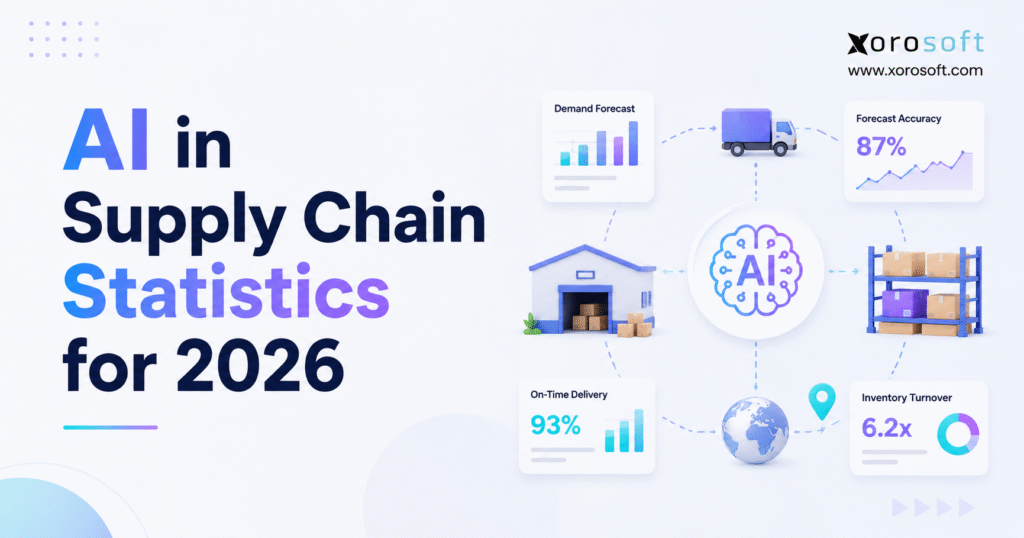
This article explores the latest AI in supply chain statistics and what they mean for the industry.
1. What AI in Supply Chain Statistics Reveal About the 2026 Operating Reality
Artificial intelligence has moved well beyond isolated supply chain experiments. In 2026, companies are applying it to demand planning, procurement, inventory optimization, warehousing, transportation, manufacturing, analytics and exception management. However, the most important development is not simply the number of businesses experimenting with AI. It is the widening gap between AI adoption and genuine operating-model transformation.
The Hackett Group’s 2026 Supply Chain Key Issues Study found that 83% of participating organizations had deployed or were piloting AI in supply chain intelligence and analytics. In addition, 74% reported AI capabilities in sales and operations planning or integrated business planning, while 72% reported them in advanced planning and scheduling.
Those numbers make AI look close to mainstream across several planning functions. Nevertheless, Gartner found that only 17% of surveyed supply chain organizations were pursuing immediate transformational redesign of processes and workflows around AI. The other 83% were applying AI incrementally to individual use cases or gradually extending it into existing processes.
Therefore, these AI in supply chain statistics tell two stories at once. The technology is spreading quickly, yet the business architecture required to get sustained value from it is evolving much more slowly.
1.1 Supply Chain AI Adoption Statistics Need Context Before Comparison
A headline claiming that 72%, 83% or 88% of companies “use AI” can be technically accurate and still be misleading.
One study may include pilot projects. Another may measure only production deployments. A third may ask what companies plan to adopt during the next several years. Similarly, a generative AI deployment is not the same as an autonomous planning workflow, and an analytics pilot is not equivalent to AI controlling inventory or procurement decisions.
Consequently, supply chain leaders should avoid using a single percentage as a maturity benchmark. The more useful questions are which decisions AI supports, how widely it is deployed, whether employees actually use it, what data it can access and whether the resulting decisions change measurable operating outcomes.
1.2 Scaling AI in Supply Chains Is Now Harder Than Starting a Pilot
The technology itself is increasingly accessible. However, scaling it across a real supply chain remains difficult.
Gartner surveyed 140 senior supply chain leaders at organizations with annual revenue of at least $250 million and found that 56% considered integration with legacy systems and processes a major AI challenge. Meanwhile, 50% said they lacked sufficient internal expertise or talent to implement and manage AI effectively.
As a result, the competitive question for 2026 is no longer, “Should our supply chain experiment with AI?” A more useful question is, “Do we have the systems, data, processes, governance and people required to turn AI into repeatable operating performance?”
2. AI in Supply Chain Statistics for 2026: The Numbers That Matter
A concise view of current research helps establish where adoption is strongest and where the constraints remain.
| 2026 Statistic | What It Measures |
|---|---|
| 83% | Organizations deploying or piloting AI in supply chain intelligence and analytics |
| 74% | Organizations reporting AI capabilities in S&OP or IBP |
| 72% | Organizations reporting AI capabilities in advanced planning and scheduling |
| 71% | MHI/Deloitte respondents saying AI is disrupting supply chains |
| 24% | Respondents describing AI’s impact as transformational |
| 56% | Gartner-surveyed CSCOs citing legacy-system/process integration as a major AI challenge |
| 50% | Gartner-surveyed CSCOs citing limited internal AI expertise or talent |
| 17% | Organizations pursuing immediate AI-driven workflow redesign |
| 387% | Increase in demand for supply chain roles requiring AI skills from Q1 2023 to Q1 2026 |
| $53B | Gartner forecast for 2030 spending on SCM software containing agentic AI capabilities |
Hackett’s research shows that adoption is concentrated in data-rich planning and analytics functions. MHI and Deloitte’s 2026 Annual Industry Report, based on responses from more than 500 manufacturing and supply chain leaders, found that 71% viewed AI as disruptive and 24% categorized its impact as transformational.
At the same time, Gartner’s integration and talent findings demonstrate why high adoption does not automatically produce enterprise-wide transformation.
2.1 What the Latest Supply Chain AI Statistics Mean for Operators
Overall, the data suggests that AI has moved from a technology discussion into an operating discussion.
Analytics and planning naturally moved first because AI can generate insight without immediately changing a physical transaction. The next stage is more difficult. Companies must connect AI recommendations to purchase orders, warehouse work, production plans, transportation decisions, financial records and supplier actions.
Therefore, adoption percentage alone is becoming a weak measure of AI maturity. A stronger measure is whether AI can improve a decision from beginning to end without creating additional reconciliation work elsewhere in the business.
3. How to Read AI in Supply Chain Statistics by Technology Type
Not every form of supply chain AI solves the same problem. Predictive AI, generative AI and agentic AI operate differently, and therefore their adoption statistics should not be combined into one number.
3.1 Predictive AI in Supply Chain Forecasting and Planning
Predictive AI analyzes historical and current information to estimate what is likely to happen next. Common applications include demand forecasting, stockout risk, supplier lead-time prediction, inventory requirements, transportation delays and equipment failure.
For many companies, this is the most mature form of AI in the supply chain. Indeed, statistical forecasting and machine learning have supported planning decisions for years, even when the applications were not marketed prominently as “AI.”
The output usually takes the form of a forecast, probability, recommendation or exception. A planner then decides what action to take.
3.2 Generative AI Supply Chain Adoption Is Changing How Employees Access Information
Generative AI changes the interaction layer. Instead of manually navigating several reports, a planner may ask why demand changed, request a summary of supplier issues, investigate an inventory exception or generate a scenario explanation.
Gartner reported in February 2025 that generative AI was being deployed by 72% of surveyed supply chain organizations. However, its research also found that productivity gains for individual employees were not consistently translating into equivalent team or organization-wide productivity and ROI.
That distinction remains important in 2026. Faster analysis is valuable, but a faster answer does not automatically improve inventory turns, service levels or purchasing performance.
3.3 Agentic AI Supply Chain Statistics Point Toward Workflow Automation
Agentic AI represents a more significant operational shift because an agent can be designed to observe a situation, reason within defined constraints and initiate an action.
Gartner forecasts spending on supply chain management software with agentic AI capabilities to rise from less than $2 billion in 2025 to $53 billion by 2030. Furthermore, Gartner expects 60% of enterprises using SCM software to have adopted agentic AI features by 2030, compared with 5% in 2025.
For example, predictive AI may warn that a product will run short. An agentic system could eventually evaluate inventory at other locations, review supplier lead times, determine an approved response and initiate a workflow.
The distinction matters because the governance requirement rises sharply once software can act rather than merely recommend.
4. AI in Supply Chain Statistics Show Planning and Analytics Leading Adoption
4.1 How Many Companies Use AI in Supply Chain Management?
There is no single defensible adoption percentage for all supply chain AI.
Hackett reports that 83% of organizations in its 2026 study had deployed or were piloting AI in supply chain intelligence and analytics. It also found AI capabilities at 74% of organizations in S&OP or IBP and at 72% in advanced planning and scheduling.
Therefore, a better conclusion is that AI has become common in analytics-intensive supply chain functions, while scaled AI transformation across the full operating model remains substantially less common.
4.2 Supply Chain AI Adoption Is Expanding Beyond Forecasting
Hackett also reports that network design optimization was part of 67% of reported 2026 transformation initiatives, while increased transactional automation reached 66%, inventory optimization 59% and core platform upgrades 57%.
Importantly, these figures do not all represent identical measures of AI deployment. Instead, they help illustrate the broader modernization agenda around AI.
Organizations are improving analytics while simultaneously upgrading platforms, automating transactions and optimizing inventory. In practice, those initiatives are interconnected because better AI requires cleaner transactions, and cleaner transactions usually require stronger operational systems.
4.3 AI Talent Is Becoming a Supply Chain Constraint
Technology availability is only one part of adoption. Supply chains also need employees who understand how AI works within real operational constraints.
Gartner reported in June 2026 that demand for supply chain roles requiring AI skills increased 387% between Q1 2023 and Q1 2026. Its analysis covered more than 35 million job postings, including nearly 600,000 supply chain roles. Gartner also found that 58% of supply chain positions requiring AI capabilities were concentrated at the mid-senior level.
Consequently, companies cannot solve the talent challenge through software purchases alone. They need planners, operators and managers who understand both the supply chain and the technology influencing its decisions.
5. AI in Supply Chain Statistics for Market Growth and Investment
Market forecasts consistently point toward rapid growth, although published estimates vary because researchers define the category differently.
One research firm may include AI software and consulting services, while another may include computer vision, robotics, logistics optimization or hardware. Therefore, market-size estimates should be treated as directional indicators rather than audited totals.
5.1 Agentic AI Investment Offers a More Specific Supply Chain Benchmark
Gartner’s agentic AI forecast is particularly useful because the category is narrowly described as supply chain management software containing agentic AI capabilities.
The forecast rises from less than $2 billion in spending in 2025 to $53 billion by 2030, representing a dramatic expansion in the amount businesses may spend on software that includes assistants, simple agents and more advanced agentic capabilities.
In other words, many businesses may adopt AI without buying a separate application called “AI software.” Instead, intelligence will increasingly appear inside ERP, planning, procurement, warehouse and supply chain management platforms.
5.2 Supply Chain Software Selection Will Increasingly Include AI as a Standard Requirement
Gartner notes that AI assistant functionality is becoming an expected criterion during SCM software selection, while agents are becoming a more common requirement.
However, companies should avoid allowing an AI label to dominate the selection process. The underlying platform must still execute transactions accurately, integrate with surrounding systems and support the operational requirements of the business.
AI cannot compensate for weak inventory control or incomplete purchasing processes. Instead, it magnifies the importance of reliable operational data.
6. AI Supply Chain ROI Statistics Depend More on the Use Case Than the Model
The AI in supply chain statistics around ROI are often more difficult to interpret than adoption figures because benefits vary dramatically by process.
6.1 AI Supply Chain ROI Is Strongest When Tied to a Specific Operating Metric
McKinsey estimates that AI-enabled improvements in distribution operations can potentially reduce inventory by 20–30%, logistics costs by 5–20% and procurement spend by 5–15% in relevant use cases.
These figures should not be read as guaranteed outcomes. Rather, they illustrate the types of economic opportunities AI may address when deployed against well-defined operating problems.
For example, reducing planner research time is useful. However, reducing inventory while maintaining service levels is financially more meaningful because the result can be measured against working capital and fulfillment performance.
6.2 Supply Chain Maturity Correlates With Better Financial Results
Accenture analyzed 1,148 companies across 15 countries and 10 industries and found that organizations classified as next-generation supply chain leaders achieved 23% greater profitability than peers. Moreover, 37% of those leaders used AI and generative AI widely across their supply chains compared with 6% of peers and 9% overall.
Nevertheless, this should not be interpreted as proof that AI by itself caused a 23% profitability improvement. Accenture’s maturity model covers a broader collection of capabilities, including digital technologies, advanced decision-making and operating practices.
The useful insight is that AI appears most valuable when it is part of a mature operating system rather than an isolated tool.
6.3 Measure AI ROI Against Supply Chain Performance, Not AI Usage
A practical AI business case should begin with existing operational metrics. Depending on the problem, those may include forecast error, inventory turns, fill rate, stockouts, purchase-order cycle time, supplier lead-time variation, warehouse productivity, transportation cost or schedule adherence.
Therefore, the wrong KPI is often “number of employees using AI.”
The better question is whether AI helped improve a measurable operational outcome without creating unacceptable risk, cost or complexity elsewhere.
7. AI in Supply Chain Statistics for Demand Forecasting and Inventory Management
Demand forecasting and inventory optimization remain natural AI use cases because they involve large datasets, repeated decisions and meaningful financial trade-offs.
7.1 AI Demand Forecasting Can Process More Signals Than Manual Planning
Traditional forecasting often relies on historical demand, seasonal patterns, predefined statistical models and planner judgment. By contrast, AI-supported forecasting can incorporate additional signals such as promotion activity, geography, channel behavior, product relationships, lead-time variation and customer patterns.
However, the goal is not perfect prediction. No model can eliminate uncertainty from consumer demand, supplier disruption or market change.
Instead, AI can help planners evaluate more relationships across more SKUs and locations than a manual process can reasonably handle.
7.2 AI Inventory Management Creates Value Only When Forecasts Influence Execution
A forecast by itself does not improve inventory.
The business creates value when the forecast changes safety stock, purchase quantities, replenishment timing, warehouse allocation, production requirements or inventory transfers.
McKinsey’s distribution research estimates inventory reductions of 20–30% as a potential value range for relevant AI-enabled operating models.
For companies that have outgrown fragmented inventory and purchasing workflows, an integrated XoroERP cloud ERP environment can provide the transactional foundation that forecasting relies on. The role of ERP is not to replace AI; rather, it helps ensure that sales orders, purchase orders, inventory movements and financial transactions reflect the same operational reality.
7.3 Inventory Accuracy Still Comes Before Advanced Forecasting
A sophisticated model cannot overcome unreliable inventory records indefinitely.
If the system believes 500 units are available when only 350 physically exist, the problem is not forecasting intelligence. Likewise, inaccurate units of measure, supplier lead times, open purchase orders or warehouse balances will weaken downstream recommendations.
Consequently, companies considering advanced AI forecasting should first determine whether planners trust the existing inventory picture.
8. AI Warehouse, Logistics, Procurement and Manufacturing Statistics
The AI in supply chain statistics become especially interesting when AI moves beyond analysis into physical execution.
8.1 AI Warehouse Statistics Show Growing Capacity and Automation Opportunities
AI can support warehouse slotting, labor scheduling, capacity analysis, robotics orchestration, digital twins and exception management.
McKinsey estimates that AI tools can unlock additional warehouse-network capacity in suitable applications, while its broader distribution research identifies warehousing as a major source of AI-enabled operational value.
Businesses examining how warehouse execution connects with inventory and ERP can review XoroWMS as one example of an integrated warehouse management approach for inventory-driven operations.
The larger point is that warehouse AI works best when the software has reliable visibility into receiving, inventory status, locations, orders, picking activity and outbound commitments.
8.2 AI Logistics Is Moving Toward Continuous Exception Management
Transportation planning traditionally produces a plan and then relies heavily on people to manage what goes wrong.
AI changes that model by continuously evaluating capacity, delivery windows, transportation constraints, customer priorities and emerging exceptions. As a result, planners can potentially focus on unusual problems rather than manually monitoring every shipment.
The shift becomes even more important with agents because software can move from detecting a late delivery to initiating a predefined response.
8.3 AI Procurement Statistics Show Significant Potential
Procurement is well suited to AI because the function combines structured transactional information with contracts, supplier communications, negotiations and market intelligence.
McKinsey’s 2026 research on agentic procurement describes implementations where AI-enabled systems increased procurement staff efficiency by 20–30%. In another example, AI-guided vendor negotiations generated savings of 10–15%.
Meanwhile, The Hackett Group reports that deploying AI-enabled technology has become a top-three procurement priority in its 2026 Procurement Key Issues Study, illustrating how quickly the function is moving beyond experimentation.
8.4 AI in Manufacturing Depends on Operational Context
Manufacturing AI may support production scheduling, maintenance, material planning, quality analysis, root-cause investigation and work instructions.
However, a production recommendation must account for BOMs, available raw materials, open purchase orders, machine constraints, work orders and expected demand. Therefore, manufacturing AI becomes more valuable as it gains access to a reliable operational model of the factory rather than a disconnected dataset.
9. AI Supply Chain Use Cases Differ by Industry and Business Model
The same AI capability can have dramatically different value depending on the industry.
9.1 Supply Chain AI for Apparel, Wholesale, Furniture and Sporting Goods
Apparel businesses manage size-and-color variants, seasonal collections, launches, returns and allocation across channels. Wholesale distributors often deal with customer-specific pricing, EDI, supplier lead times, purchasing complexity and multiple warehouses. Furniture companies may carry bulky, high-value inventory with long replenishment cycles, while sporting goods businesses often combine seasonality with ecommerce and wholesale demand.
Therefore, forecasting and inventory optimization need to reflect the operating model rather than treating every SKU as statistically identical.
Businesses researching how ERP requirements vary across these environments can review Xorosoft’s industry-specific ERP solutions for additional operational context.
9.2 Shopify Supply Chain AI Depends on a Reliable Multichannel Inventory Picture
Ecommerce creates another layer of complexity because orders can arrive continuously while inventory is simultaneously committed to wholesale customers, Amazon, retail locations or other channels.
A highly accurate forecast is still weak if the model cannot see inventory already promised elsewhere.
For Shopify merchants, that makes synchronization between ecommerce activity and the operational system particularly important. Xorosoft also maintains an official Xorosoft ERP listing on the Shopify App Store, where Shopify identifies XoroERP as an ERP application for ecommerce, retail and wholesale operations.
Therefore, Shopify AI readiness is not simply a question of adding a forecasting app. The business first needs a consistent picture of orders, inventory, purchasing and fulfillment.
9.3 Food, Beverage and Manufacturing Supply Chains Require More Constraints
Food businesses must account for shelf life, traceability, lot controls and variable demand. Manufacturing adds BOMs, production capacity, raw-material availability and work-order requirements.
Consequently, a recommendation that looks optimal mathematically may not be operationally possible.
This is why domain context matters. Supply chain AI must understand the constraints that operators already manage every day.
10. AI in Supply Chain Statistics Reinforce the Need for ERP and Data Readiness
The more organizations automate decisions, the more important transaction accuracy becomes.
10.1 Supply Chain AI Readiness Begins With Trustworthy Master and Transaction Data
AI needs a dependable representation of the business.
That includes accurate SKUs, inventory balances, warehouse locations, units of measure, open purchase orders, supplier lead times, sales history, transfers, returns and manufacturing transactions where relevant.
Furthermore, historical information matters because models learn patterns from what the organization recorded. If receipts, adjustments or stock movements have been inconsistent for years, AI cannot reconstruct reality simply because the algorithm is sophisticated.
10.2 Connected ERP Data Makes AI Easier to Operationalize
Fragmentation becomes a larger problem when Shopify orders live in one system, inventory in another, purchasing in spreadsheets, warehouse activity in a separate WMS and accounting somewhere else.
Gartner’s finding that 56% of surveyed CSCOs consider legacy integration a major AI challenge illustrates the scale of the issue.
For inventory-driven companies, a connected platform such as XoroONE can be relevant because the immediate objective is to reduce operational fragmentation before increasingly sophisticated automation is layered on top.
In other words, the foundation is not glamorous, but it matters. AI needs to know what was sold, what is available, what has been purchased, what is moving through the warehouse and what financial impact the transaction created.
10.3 AI Governance Matters More as Systems Gain Permission to Act
When AI only summarizes a report, an incorrect answer may be inconvenient. When an agent changes a planning parameter, communicates with a supplier or triggers a transaction, the consequences are more significant.
NIST’s AI Risk Management Framework provides a structured approach to governing and measuring AI risk, and its Generative AI Profile extends that framework for GenAI-specific risks.
Therefore, organizations should define who owns an automated decision, what information an agent can access, which actions require approval, when a human must intervene and how incorrect actions can be reversed.
11. Who Benefits Most From AI Supply Chain Software?
AI tends to create more value as operational decision volume and complexity increase.
11.1 Complex Inventory-Driven Businesses Have More AI Opportunities
A company managing thousands of SKUs across several warehouses has a very different planning problem from a business selling 20 predictable products from one location.
Similarly, businesses with seasonal demand, complex purchasing, manufacturing, multiple ecommerce channels or long supplier lead times generate more exceptions than planners can realistically investigate manually.
In those environments, AI can help determine which exceptions deserve attention first.
11.2 Some Businesses Should Fix ERP and Inventory Basics Before Adding AI
More AI is not always the correct next investment.
If Shopify reports one inventory number, the warehouse reports another, purchase decisions live in spreadsheets and finance spends days reconciling inventory, the immediate problem is not insufficient artificial intelligence.
Instead, the organization needs better operational control.
A practical rule is simple: fix visibility before autonomy. Once teams trust the underlying data and processes, AI has a stronger foundation for improving decisions.
12. AI Supply Chain Alternatives Include ERP, Planning Software and Better Processes
AI should not be treated as the default solution to every supply chain problem.
12.1 ERP vs. Inventory Software vs. AI Planning Software
| Capability | ERP | Inventory Software | AI Planning Software |
| Inventory transactions | Core | Core | Primarily consumes data |
| Purchasing | Core | Often included | Plans or recommends |
| Accounting | Integrated in full ERP | Usually limited | Usually external |
| Warehouse execution | Integrated or connected | Varies | Not usually primary |
| Manufacturing | Available in relevant ERPs | Limited/varies | Planning focused |
| Forecasting | Basic to advanced | Varies | Usually advanced |
| Financial integration | Strong | Limited | Usually ERP dependent |
| Operational execution | Strong | Moderate | Primarily analytical |
Therefore, businesses should begin with the missing capability.
If purchasing and inventory records are unreliable, advanced AI planning may be premature. Conversely, if transactions are clean but planners manually evaluate thousands of exceptions, a more advanced planning layer may be justified.
12.2 When Businesses Outgrow QuickBooks and Spreadsheets
Common warning signs include multiple warehouses that do not reconcile, purchasing maintained outside the accounting system, duplicate order entry, slow month-end reconciliation and poor visibility across Shopify, Amazon, wholesale or EDI channels.
At that point, the business is no longer making a simple accounting-software decision. It is choosing what will become the operational system of record.
12.3 Evaluate ERP Platforms on Operational Fit Before AI Labels
AI capabilities will increasingly appear throughout ERP and supply chain software.
However, software selection should still examine inventory, purchasing, warehousing, manufacturing, accounting, reporting, integrations, implementation requirements and scalability.
For businesses comparing ERP approaches, the Xorosoft vs. NetSuite comparison can be one research input alongside broader process requirements and implementation considerations.
Ultimately, the relevant question is not which vendor uses “AI” most frequently in its marketing. It is which system gives the organization reliable operational data and a credible path toward automation.
13. Common Mistakes Behind Misleading AI in Supply Chain Statistics and Weak ROI
13.1 Poor Data Turns Advanced AI Into Faster Guesswork
An inaccurate inventory position does not become accurate because a model analyzes it faster.
Therefore, data quality work belongs inside the AI program. Item records, purchasing history, supplier data, warehouse transactions and operational definitions should be validated before automation is scaled.
13.2 AI Pilots Should Not Be Confused With Enterprise Adoption
A pilot on one product line is not equivalent to an AI-enabled supply chain.
For this reason, AI in supply chain statistics should always be read alongside the methodology. “Piloting or deployed” measures something different from “deployed at scale.”
The distinction is especially important when companies benchmark themselves against industry surveys.
13.3 Automating an Existing Process Does Not Necessarily Transform It
Gartner’s finding that just 17% of surveyed organizations were pursuing immediate transformational workflow redesign is revealing. Most companies were taking more incremental approaches.
Incremental implementation can be sensible because it limits operational risk. However, businesses should still ask whether the underlying process deserves to exist in its current form.
Automating an unnecessary approval or redundant reconciliation simply makes inefficient work happen faster.
13.4 Human Oversight Remains Important in Agentic Supply Chain Decisions
As agents become more capable, human involvement does not disappear; it changes.
A system may optimize inventory locally while overlooking a strategic customer commitment. Similarly, a procurement decision that appears financially optimal could weaken an important supplier relationship.
Therefore, companies need explicit decision rights. Routine, low-risk exceptions may eventually be handled autonomously, while high-impact choices should continue to involve human judgment.
14. Future AI in Supply Chain Statistics Point Toward More Autonomous Operations
The next stage of supply chain AI is likely to be defined less by chat interfaces and more by workflow ownership.
14.1 Agentic Supply Chains Will Automate More Routine Decisions
Gartner’s $53 billion forecast for SCM software containing agentic AI capabilities reflects a market moving from assistants toward systems that can execute tasks.
Moreover, Gartner describes autonomous-ready supply chains as networks of outcome-based decisions informed by data, AI and human judgment rather than sequences of isolated automated tasks.
Therefore, future AI adoption will increasingly require redesigning how decisions move between software and people.
14.2 Supply Chain AI Talent Will Combine Technology With Domain Expertise
The 387% rise in demand for AI-related supply chain skills between Q1 2023 and Q1 2026 suggests that companies are already changing what they expect from operational talent.
However, AI knowledge without supply chain judgment is insufficient. Employees still need to understand service levels, inventory trade-offs, supplier risk, manufacturing constraints and customer commitments.
Consequently, the strongest future teams may be those that combine operational expertise with the ability to supervise, challenge and improve AI systems.
14.3 Better Operational Data Will Become More Valuable as AI Becomes More Autonomous
This may be the least exciting prediction, but it is one of the most important.
As software gains greater authority to act, poor data becomes more dangerous. A bad dashboard can mislead a planner. A bad autonomous decision can create a transaction.
Therefore, AI does not reduce the importance of ERP, WMS, purchasing discipline, inventory accuracy and governance. It raises the cost of getting those foundations wrong.
15. AI in Supply Chain Statistics FAQs
15.1 What Do AI in Supply Chain Statistics Say About Adoption in 2026?
Current AI in supply chain statistics show broad adoption in analytics and planning but lower levels of true operating-model transformation. Hackett found 83% of surveyed organizations deploying or piloting AI in supply chain intelligence and analytics, while Gartner found only 17% pursuing immediate transformational workflow redesign.
15.2 What Percentage of Supply Chains Use AI?
There is no universal percentage because surveys define AI adoption differently. Some count pilot programs, while others measure deployment of a specific technology such as generative AI. Therefore, always check the function, technology, sample and maturity stage behind any adoption percentage.
15.3 How Many Companies Use AI in Supply Chain Management?
Research indicates that AI is now common across planning and analytics. Hackett reports 83% deployment or piloting in intelligence and analytics and more than 70% AI capability in major planning categories. However, those figures should not be interpreted as full enterprise-wide AI adoption.
15.4 What Is AI in Supply Chain Management?
AI in supply chain management refers to machine learning, generative models, intelligent agents, optimization and related technologies used to analyze information, predict outcomes, support decisions or automate workflows across planning, inventory, procurement, warehousing, logistics and manufacturing.
15.5 How Is AI Used in Supply Chains?
Common applications include demand forecasting, inventory optimization, supplier analysis, purchasing, warehouse planning, transportation routing, production scheduling, predictive maintenance, risk monitoring and exception management. Increasingly, generative and agentic systems also help employees interact with information and execute defined workflows.
15.6 What Is Agentic AI in Supply Chain Management?
Agentic AI describes systems that can pursue defined goals and take actions rather than only generating answers. For example, a supply chain agent could detect an inventory exception, evaluate available options and initiate an approved replenishment workflow while escalating higher-risk decisions to a human.
15.7 How Fast Is Agentic AI Growing in Supply Chain Software?
Gartner forecasts spending on SCM software containing agentic AI capabilities to rise from less than $2 billion in 2025 to $53 billion by 2030. It also predicts 60% adoption of agentic features among enterprises using SCM software by 2030.
15.8 What Is the ROI of AI in Supply Chain Management?
There is no universal AI ROI. Results depend on the use case, data quality, baseline performance and implementation. The strongest business cases measure outcomes such as inventory, fill rate, procurement savings, logistics cost, forecast error, warehouse productivity or planner workload rather than simply measuring AI usage.
15.9 Can AI Reduce Supply Chain Costs?
Yes, in suitable use cases. McKinsey estimates potential reductions of 20–30% in inventory, 5–20% in logistics costs and 5–15% in procurement spend from AI-enabled improvements in distribution operations. However, these are potential ranges, not guaranteed outcomes.
15.10 How Does AI Improve Demand Forecasting?
AI can analyze more variables, recognize complex relationships and update predictions across large numbers of SKUs and locations. Nevertheless, the business benefit comes only when improved forecasts influence real purchasing, replenishment, production or allocation decisions.
15.11 How Accurate Is AI Demand Forecasting?
There is no credible universal accuracy percentage. Forecast performance depends on demand volatility, product behavior, data quality, forecast horizon, model design and measurement method. Therefore, companies should compare AI forecast error with their own historical forecasting baseline.
15.12 Can AI Reduce Stockouts?
AI can identify future shortages earlier and recommend changes to purchasing, replenishment or allocation. However, it cannot eliminate shortages caused by incorrect inventory records, supplier failures, capacity limitations or events outside the information available to the system.
15.13 Can AI Reduce Excess Inventory?
Potentially. AI can improve forecasting, safety-stock settings, replenishment and inventory allocation. McKinsey identifies inventory reduction as one of the significant value opportunities from AI in distribution operations.
15.14 How Is AI Used in Inventory Management?
AI can forecast demand, calculate safety-stock requirements, recommend reorder quantities, identify slow-moving products, predict stockout risk and evaluate inventory requirements across multiple warehouses or channels. It becomes more effective when inventory transactions are accurate and consistently recorded.
15.15 How Is AI Used in Warehouse Management?
Warehouse AI can support slotting, capacity planning, labor scheduling, robotics, digital twins, picking optimization and exception management. As warehouse systems become more connected, AI can increasingly help coordinate people, inventory, equipment and order priorities.
15.16 How Is AI Used in Procurement?
AI can analyze spend, contracts, supplier performance and purchasing patterns. It can also help prepare negotiations, identify opportunities and automate repetitive tasks. McKinsey reports procurement implementations where AI-enabled approaches improved employee efficiency and generated measurable vendor savings.
15.17 How Is AI Used in Manufacturing Supply Chains?
Manufacturing AI supports forecasting, production scheduling, predictive maintenance, quality analysis, materials planning and troubleshooting. However, useful recommendations depend on accurate BOM, inventory, purchasing, capacity and work-order information.
15.18 What Is Generative AI in Supply Chain Management?
Generative AI helps employees create, retrieve, summarize and explain information. A planner might use it to investigate an exception, summarize supplier communications, search operational knowledge or understand why demand forecasts changed.
15.19 What Is the Difference Between Predictive AI and Generative AI?
Predictive AI estimates future outcomes such as demand or delivery risk. Generative AI creates or synthesizes content such as explanations, summaries and responses. Increasingly, supply chain software combines the two so employees can interact conversationally with predictive models.
15.20 What Data Does Supply Chain AI Need?
Typical inputs include sales history, inventory transactions, supplier performance, purchase orders, lead times, warehouse activity, production records, item masters, customer orders, transfers and returns. The exact dataset depends on the operating decision AI is expected to improve.
15.21 Does a Business Need ERP Before Implementing Supply Chain AI?
Not necessarily. However, AI becomes harder to scale when operational information is fragmented across disconnected applications and spreadsheets. An ERP or comparable system of record can provide consistent transactions and connect AI recommendations to purchasing, inventory, warehousing, manufacturing and accounting.
15.22 Can AI Work With Legacy ERP Systems?
Yes, although integration can become a major constraint. Gartner found that 56% of surveyed CSCOs viewed integration with legacy systems and processes as a major challenge when scaling AI.
15.23 What Are the Biggest Risks of Supply Chain AI?
Major risks include poor data, incorrect recommendations, excessive permissions, security problems, weak governance, automation of ineffective processes and insufficient human escalation. Consequently, AI governance needs to evolve as systems move from producing insight toward executing transactions.
15.24 Will AI Replace Supply Chain Planners?
AI is more likely to change planning work than eliminate the need for supply chain expertise. Routine analysis and exceptions may become automated, while planners spend more time on strategy, supplier relationships, unusual scenarios, governance and oversight of automated decisions.
15.25 When Should a Company Invest in Supply Chain AI?
A company should invest when it can define the business problem, establish baseline performance, provide reliable data and operationalize the resulting decisions. If inventory accuracy and integration are weak, improving those foundations should generally come before advanced autonomous workflows.
16. Turn 2026 AI in Supply Chain Statistics Into a Practical Operating Plan
The most useful takeaway from AI in supply chain statistics for 2026 is not that every business should race to deploy more AI. Instead, the evidence points toward a disciplined operating sequence.
16.1 Use AI in Supply Chain Statistics to Prioritize the Right Business Problem
First, identify the operating problem. Determine whether the priority is demand forecasting, inventory, purchasing, warehouse capacity, transportation, supplier risk, manufacturing or planner workload.
Next, measure how the current process performs so the business has a baseline. That baseline might include forecast error, inventory turns, fill rate, stockouts, purchase-order cycle time, warehouse productivity or supplier lead-time variation.
Then verify that the transaction and master data behind the process can be trusted. AI recommendations become far less useful when inventory quantities, supplier lead times, warehouse transactions or purchase orders are incomplete or inconsistent.
Only after those steps should the organization decide whether the best solution is process improvement, ERP consolidation, traditional planning software, predictive AI, generative AI or an agentic workflow.
16.2 Build the ERP and Data Foundation Before Scaling Supply Chain AI
This sequence matters because AI adoption is already moving quickly while integration and organizational transformation remain difficult. Gartner’s 2026 findings on legacy-system integration, talent and workflow redesign show that many of the largest barriers are connected to the operating environment around AI rather than access to the technology itself.
For inventory-driven businesses, that makes the operational foundation strategically important. Inventory, purchasing, warehouse, manufacturing, ecommerce and accounting records need to describe the same business reality before increasingly autonomous software is allowed to act on them.
A connected operational foundation also makes it easier to measure whether AI is actually improving the business. For example, an organization can compare forecast recommendations with purchasing activity, inventory levels, warehouse execution and financial results instead of evaluating each process in isolation.
16.3 Make Better Supply Chain Decisions Before Pursuing More Automation
Therefore, the strongest strategy is not to become “AI-powered” as quickly as possible. It is to build an operation capable of making better decisions, establish reliable data underneath those decisions and then apply AI where it produces measurable value.
If disconnected systems are currently limiting visibility, planning or scalability, contact Xorosoft to discuss whether a more connected ERP and operational foundation fits your requirements.
The companies that benefit most from the next wave of supply chain AI will not necessarily be those with the most models or agents. They will be the ones that know which decisions matter, trust the data behind them and have the systems and people required to turn intelligence into execution.
Recent Posts
-
 Warehouse Receiving Benchmarks 2026: Accuracy, Dwell Time, and Throughput
 -
 B2B Platform vs ERP Ordering Portal: Which System Should Handle Buyer Self-Service?
 -
 Shopify B2B Pricing Governance: Price Lists, Overrides, Discounts, and ERP Ownership
 -
 ERP for Canadian Food Manufacturers Managing Lots, Expiry Dates, and Recalls
 -
 Shopify Return Restocking: Why Returned Inventory Goes Live Before Warehouse Approval