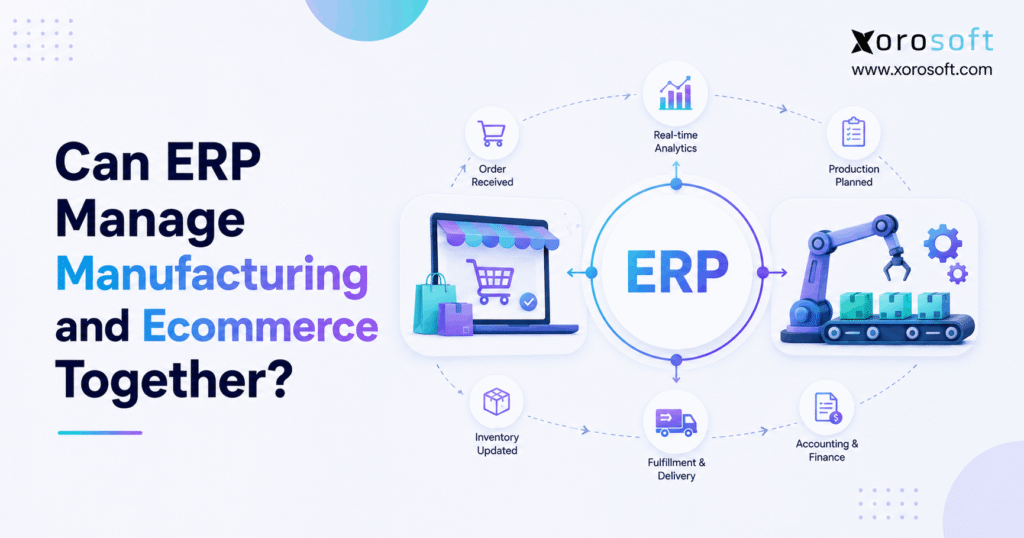
If your business operates in both manufacturing and online sales, finding the right manufacturing ecommerce ERP solution is essential for streamlining operations and improving efficiency.
1. When Online Demand Starts Running the Factory
Manufacturing ecommerce ERP connects online customer demand with production, inventory, purchasing, warehousing, fulfillment, accounting, and reporting inside one operational environment. Therefore, instead of treating ecommerce sales and manufacturing plans as separate processes, a product business can coordinate what customers order with what the company must purchase, manufacture, store, and ship.
For many growing manufacturers, this connection becomes increasingly important. Ecommerce operates continuously, while manufacturing depends on raw materials, production capacity, labor, lead times, bills of materials, and finished-goods availability. Consequently, when those workflows live in different applications, teams often spend significant time reconciling information before they can make even basic operational decisions.
1.1 Why Ecommerce and Manufacturing Behave Differently
Ecommerce is demand-driven. For example, a promotion can suddenly increase orders for one SKU, while a successful campaign can shift demand toward a completely different product within hours.
Manufacturing, however, cannot always respond immediately. Before a finished product is ready, the business may need:
- raw materials
- purchased components
- subassemblies
- production capacity
- labor
- work orders
- quality checks
- warehouse space
Therefore, one ecommerce order can create operational consequences far beyond the storefront.
Moreover, the company may need to answer several questions immediately:
- Is the finished product actually available?
- Is part of the inventory already committed?
- Does more inventory need to be manufactured?
- Are enough components available?
- Should purchasing order more materials?
- Which warehouse should fulfill the order?
- How should the transaction affect accounting?
As a result, ecommerce and manufacturing cannot always be managed as two isolated functions.
1.2 Why Separate Systems Become Harder to Control
Initially, separate applications can work well. For example, a business may use Shopify for ecommerce, accounting software for finance, spreadsheets for purchasing, and a specialist application for manufacturing.
However, complexity increases as the business adds:
- more SKUs
- more components
- more suppliers
- more sales channels
- more warehouses
- wholesale customers
- marketplace orders
- higher production volume
Consequently, the same SKU can exist in several applications with different quantities, costs, or statuses.
Meanwhile, one system may show stock as available even though another system already considers it committed. Therefore, the real problem eventually becomes larger than integration alone.
Instead, the business must decide which system represents operational truth.
2. What Manufacturing Ecommerce ERP Actually Does
A manufacturing ecommerce ERP creates a common operational layer between customer demand and supply execution.
Therefore, when an ecommerce order arrives, ERP does more than record a sale. Instead, it can also evaluate inventory availability, manufacturing requirements, component demand, purchasing needs, warehouse activity, fulfillment, and financial consequences.
In practice, manufacturing ecommerce ERP gives sales, production, purchasing, warehouse, and finance teams a shared operational view. Consequently, departments can make decisions from connected information rather than separate spreadsheets and applications.
2.1 The Core Operational Flow
A typical connected workflow looks like this:
1. The customer places an ecommerce order.
2. ERP receives the sales order.
3. Available inventory is evaluated.
4. Existing finished stock is allocated when possible.
5. Additional demand affects production requirements.
6. BOM requirements are calculated.
7. Material shortages are identified.
8. Purchasing replenishes required components.
9. Production converts materials into finished goods.
10. Finished inventory becomes available.
11. Warehouse teams fulfill the order.
12. Accounting records the financial activity.
Therefore, the main advantage is not simply automation.
Instead, the main advantage is coordination between demand, supply, production, fulfillment, and finance.
2.2 ERP Does Not Replace the Ecommerce Storefront
An ERP generally should not replace the customer-facing role of an ecommerce platform.
For example, Shopify can continue to manage:
- storefront presentation
- product browsing
- checkout
- promotions
- customer-facing order capture
Meanwhile, ERP can manage:
- operational inventory
- purchasing
- manufacturing
- warehouse execution
- order allocation
- accounting
- forecasting
- reporting
As a result, each platform focuses on the role it handles best.
3. How Manufacturing Ecommerce ERP Connects Demand With Production
The most useful way to understand manufacturing ecommerce ERP is to follow demand from the moment an order enters the operation.
Because manufacturing ecommerce ERP connects demand and supply, planners can see the operational effect of ecommerce sales before shortages reach the production floor or warehouse.
3.1 First, ERP Checks Finished-Goods Availability
After an order enters the operational system, inventory must be evaluated.
However, physical inventory alone is not enough.
For example, the business may also need to consider:
- committed inventory
- allocated inventory
- safety stock
- wholesale reservations
- open sales orders
- warehouse location
- inbound inventory
Therefore, 500 units physically sitting in a warehouse do not necessarily mean 500 units are available for ecommerce customers.
For example, suppose:
- 500 units are physically on hand
- 150 units are committed to wholesale
- 100 units are reserved for open ecommerce orders
- 50 units are protected as safety stock
Consequently, displaying all 500 units as freely available would create a misleading availability picture.
3.2 Next, Demand Becomes a Production Requirement
If sufficient finished stock exists, manufacturing may not need to do anything.
However, if inventory is insufficient, the ERP can translate demand into a supply requirement according to the manufacturer’s production model.
A connected ERP for manufacturing and inventory-driven operations can therefore link sales demand with inventory, purchasing, production, and financial processes rather than requiring each department to plan independently.
Moreover, this connection becomes increasingly useful as production volume and channel complexity increase.
3.3 Then, the BOM Determines Material Requirements
A bill of materials defines the components required to manufacture a finished product.
For example, one finished item may require:
- 1 frame
- 2 brackets
- 8 screws
- 1 fabric cover
Therefore, if the company needs to produce 100 additional units, the system must calculate the required quantity of each underlying component.
Moreover, multi-level manufacturing can introduce subassemblies and intermediate products.
Consequently, accurate BOM data becomes essential for reliable planning.
3.4 Finally, Material Planning Identifies Shortages
After component requirements are calculated, the ERP can compare expected demand against:
- on-hand materials
- allocated materials
- inbound purchase orders
- open production
- supplier lead times
- safety stock
- future demand
As a result, planners can identify potential shortages before production is released.
Therefore, shortages become planning exceptions rather than last-minute surprises.
4. Manufacturing Ecommerce ERP Capabilities That Matter Most
The best manufacturing ecommerce ERP capabilities are those that connect departments rather than optimizing each workflow in isolation.
Therefore, buyers should evaluate actual operational scenarios instead of relying solely on a feature checklist.
4.1 Inventory Management Across Every Stage
Manufacturers need to distinguish several inventory states.
For example:
- raw materials
- components
- work in progress
- finished goods
- committed inventory
- available inventory
- inventory in transit
A cloud platform such as XoroONE can be relevant when a business wants inventory, manufacturing, purchasing, accounting, warehouse operations, and ecommerce processes connected within one environment.
However, regardless of platform, the evaluation question should remain:
Can the system accurately represent the inventory states our operation actually uses?
4.2 BOM Management
BOM functionality should reflect the product structure used by the business.
Therefore, manufacturers should evaluate:
- component quantities
- BOM revisions
- substitutions
- units of measure
- multi-level BOMs
- expected yields
- scrap assumptions
Moreover, BOM governance matters because incorrect component data eventually creates incorrect purchasing and production recommendations.
4.3 Material Requirements Planning
MRP helps convert expected demand into component requirements.
Therefore, the planning engine should consider relevant inputs such as:
- sales orders
- forecasts
- existing inventory
- purchase orders
- work orders
- lead times
- safety stock
However, even sophisticated planning logic cannot compensate for inaccurate master data.
Consequently, planning discipline matters as much as the software itself.
4.4 Work Orders and Production Execution
Work orders typically define:
- what needs to be produced
- how many units are required
- which components are needed
- when production should occur
Therefore, work orders create a structured bridge between planning and production execution.
Moreover, they allow materials, production activity, and completed goods to be recorded consistently.
4.5 Purchasing
Purchasing becomes more effective when buyers can see why a material is required.
For example, instead of ordering because a spreadsheet shows low stock, the buyer can understand whether future demand comes from:
- open sales orders
- production requirements
- forecast demand
- safety stock
- replenishment policies
As a result, purchasing becomes connected to real operational demand.
5. How Manufacturing Ecommerce ERP Connects Shopify With Production
For Shopify manufacturers, manufacturing ecommerce ERP becomes the bridge between what customers order online and what operations can actually manufacture and ship.
Therefore, Shopify and ERP should work together rather than compete for the same operational role.
5.1 Shopify Remains the Commerce Layer
Shopify can continue to manage the online buying experience.
Meanwhile, the ERP handles the operational consequences behind those transactions.
Therefore, the objective is not to replace Shopify.
Instead, the objective is to ensure Shopify orders, inventory, fulfillment, and operational data remain aligned with manufacturing and warehouse activity.
5.2 ERP Becomes the Operational Layer
Once Shopify demand enters ERP, the system can connect that demand with:
- finished-goods inventory
- manufacturing requirements
- purchasing
- warehouse allocation
- fulfillment
- accounting
Xorosoft’s integration capabilities are relevant in this context because growing manufacturers may need ecommerce, marketplaces, warehouse operations, finance, and other business systems to exchange operational data.
Consequently, the integration architecture becomes part of the ERP decision itself.
5.3 Inventory Synchronization Reduces False Availability
Accurate synchronization matters because an ecommerce storefront should not promise inventory that operations have already consumed or committed elsewhere.
For businesses evaluating Xorosoft specifically for Shopify, the Xorosoft ERP listing on the Shopify App Store provides an external reference for the ecommerce connection.
However, buyers should not stop after confirming that an integration exists.
Instead, they should ask:
- Which records synchronize?
- Which system owns inventory availability?
- How often do quantities update?
- How are failed synchronizations handled?
- How do returns affect inventory?
- How are cancellations processed?
- How are partial shipments represented?
Therefore, integration quality matters more than the existence of an integration logo.
6. Manufacturing Ecommerce ERP Must Include the Warehouse
Manufacturing does not end when production completes.
Instead, finished goods must enter warehouse operations.
As a result, manufacturing ecommerce ERP should connect production completion directly with warehouse availability and fulfillment workflows.
6.1 Production Must Connect With Warehouse Execution
After manufacturing completes a product, warehouse teams may need to:
- receive finished inventory
- put products away
- replenish picking locations
- allocate stock
- pick orders
- pack orders
- confirm shipments
Therefore, businesses with meaningful warehouse complexity should evaluate ERP and WMS together.
For example, XoroWMS becomes relevant when ecommerce volume creates significant receiving, picking, packing, transfer, and fulfillment activity.
Moreover, real-time warehouse transactions help protect the accuracy of inventory used by ecommerce and production planning.
6.2 Multiple Warehouses Add Another Layer
A product may exist in several facilities.
Consequently, the ERP must determine not only whether inventory exists, but also where it exists.
For example, a business may operate:
- an East Coast distribution center
- a West Coast distribution center
- a manufacturing facility
- a wholesale warehouse
- third-party logistics inventory
Therefore, allocation rules become increasingly important as the network expands.
Moreover, transfers between facilities can affect available-to-sell quantities, manufacturing plans, and fulfillment decisions.
7. Make-to-Stock, Make-to-Order, and Assemble-to-Order
Not every manufacturer should treat ecommerce demand in the same way.
Therefore, the production model should influence how manufacturing ecommerce ERP is configured.
7.1 Make-to-Stock
Make-to-stock companies manufacture products before customers place orders.
Consequently, production may be driven by:
- forecasts
- reorder points
- safety stock
- seasonality
- planned promotions
Ecommerce orders then reduce finished inventory and influence future replenishment requirements.
Therefore, one ecommerce order does not necessarily create one work order.
7.2 Make-to-Order
Make-to-order manufacturers produce after confirmed demand arrives.
Therefore, an ecommerce order may directly create or contribute to a production requirement.
However, the business still needs to consider:
- raw-material availability
- production capacity
- supplier lead times
- realistic customer promises
Consequently, make-to-order production requires careful connection between sales and supply planning.
7.3 Assemble-to-Order
Assemble-to-order manufacturers keep components or semi-finished items available and perform final assembly when demand arrives.
As a result, businesses can offer greater product variation without holding every possible finished configuration.
Moreover, inventory planning shifts from finished goods toward components.
8. Raw Materials, WIP, and Finished Goods Need Different Controls
A manufacturer cannot manage every inventory state as one quantity.
Therefore, manufacturing ecommerce ERP should provide visibility across each stage of production.
8.1 Raw Materials
Raw materials have not yet entered production.
Consequently, planners need visibility into:
- available quantities
- incoming quantities
- supplier lead times
- reserved quantities
- expected production demand
Moreover, raw-material shortages can directly limit finished-goods availability.
8.2 Work in Progress
Once components enter production, they may become work in progress.
Therefore, those materials should no longer appear as freely available raw inventory.
At the same time, however, they are not yet finished goods.
Consequently, WIP visibility helps planners understand where inventory value currently sits.
8.3 Finished Goods
After production completes, finished products can become available for sales channels according to the company’s inventory rules.
Therefore, ecommerce availability should reflect when goods are actually usable rather than merely planned.
Moreover, finished goods may still be reserved for wholesale orders or other channels before they become freely available online.
9. Manufacturing Ecommerce ERP vs Separate Software
The decision between manufacturing ecommerce ERP and separate applications usually comes down to integration burden, operational complexity, functional depth, and data ownership.
Therefore, a disconnected software stack is not automatically wrong.
However, businesses should understand the tradeoffs.
| Capability | Integrated ERP | Separate Applications |
|---|---|---|
| Ecommerce orders | Connected to operations | Integration required |
| Raw materials | Central planning visibility | Often manufacturing-owned |
| BOMs | Connected to demand | Specialist system |
| Purchasing | Linked with requirements | May rely on separate tools |
| Finished inventory | Unified operational view | Can differ by system |
| Warehouse | Connected workflow | Separate WMS may be required |
| Accounting | Operationally connected | Synchronization required |
| Reporting | Cross-functional | Consolidation often required |
9.1 ERP vs MRP
MRP primarily focuses on material planning.
ERP, however, has a broader operational scope.
Therefore, modern manufacturing ERP can include MRP while also connecting production with:
- purchasing
- inventory
- sales
- warehouses
- accounting
- reporting
- ecommerce
Consequently, MRP can be one component of a broader ERP operating model.
9.2 ERP vs Manufacturing-Only Software
Manufacturing software can be an excellent solution when production is the company’s primary operational challenge.
However, ERP becomes more relevant when problems spread across departments.
For example, a manufacturer may simultaneously struggle with:
- production planning
- Shopify inventory
- warehouse execution
- purchasing
- wholesale allocation
- financial reconciliation
Therefore, solving manufacturing alone may leave the larger operational problem unresolved.
10. When a Manufacturer Has Outgrown Its Existing Stack
At this stage, manufacturing ecommerce ERP often becomes relevant because several operational problems appear simultaneously rather than inside one department.
Therefore, ERP decisions should not be based only on revenue or employee count.
Instead, operational complexity is usually the stronger signal.
10.1 Inventory Reconciliation Has Become Routine
If employees repeatedly compare Shopify, spreadsheets, warehouse software, accounting systems, and manufacturing records, system fragmentation may already be expensive.
Therefore, frequent reconciliation is an important warning sign.
Moreover, reconciliation work often grows faster than expected as SKUs and locations increase.
10.2 Purchasing Has Become Reactive
When buyers regularly discover shortages after production already needs materials, planning quality has weakened.
Consequently, connected demand and supply planning becomes more valuable.
Moreover, emergency purchasing may increase freight costs and disrupt production schedules.
10.3 Multiple Channels Compete for the Same Inventory
A growing product company may sell simultaneously through:
- Shopify
- Amazon
- wholesale
- EDI
- retail
Therefore, the same inventory can potentially be promised more than once unless allocation rules are clearly defined.
Consequently, channel growth increases the need for centralized operational visibility.
10.4 Leadership Cannot See Operations Clearly
As the company grows, management needs more than end-of-month spreadsheets.
For example, leaders may need timely visibility into:
- inventory exposure
- purchase commitments
- late sales orders
- production bottlenecks
- warehouse stock
- fulfillment performance
- working capital
Xorosoft’s broader business solutions are relevant for organizations evaluating how these operational functions can be brought together.
11. Manufacturing Ecommerce ERP by Industry
Different industries create different requirements.
Therefore, the correct manufacturing ecommerce ERP should reflect the product, production model, inventory characteristics, and fulfillment process of the business.
11.1 Apparel and Fashion
Apparel manufacturers often manage:
- style
- size
- color
- season
- variants
- wholesale demand
- direct-to-consumer demand
Consequently, inventory allocation can become complicated quickly.
Moreover, seasonal demand makes forecasting and purchasing especially important.
11.2 Furniture
Furniture businesses may deal with:
- long production cycles
- large finished products
- component BOMs
- custom configurations
- multiple warehouses
Therefore, production status can directly affect customer delivery promises.
Moreover, long supplier lead times can make material planning particularly important.
11.3 Sporting Goods
Sporting-goods companies may combine seasonal demand with ecommerce, wholesale, retail, and marketplace sales.
As a result, forecasting and allocation become increasingly important.
Moreover, one sales channel can create shortages that affect every other channel.
11.4 Food and Beverage
Food and beverage manufacturers may require additional controls for:
- lots
- expiration dates
- traceability
- ingredients
- quality processes
Therefore, these companies should test industry-specific requirements carefully.
Businesses evaluating ERP fit across sectors can also review the range of industries Xorosoft serves.
12. What a Connected Manufacturing Ecommerce ERP Workflow Looks Like
A strong manufacturing ecommerce ERP workflow connects the customer order with every operational and financial activity that follows.
Therefore, the system should make handoffs visible rather than hiding them inside disconnected applications.
12.1 Before Integration
Consider a company using:
- Shopify
- QuickBooks
- manufacturing software
- warehouse software
- purchasing spreadsheets
First, Shopify receives the order.
Next, another application updates inventory.
Meanwhile, purchasing may still work from spreadsheets.
Finally, accounting receives summarized transactions.
However, every handoff introduces another opportunity for stale or mismatched information.
12.2 After Integration
A more connected flow looks like this:
1. Ecommerce order enters ERP.
2. Inventory availability is checked.
3. Stock is allocated.
4. Production demand is identified.
5. Component requirements are evaluated.
6. Purchasing addresses shortages.
7. Production creates finished goods.
8. Warehouse receives inventory.
9. The sales order is fulfilled.
10. Accounting records the financial effect.
Consequently, the business gains one operational chain rather than several isolated workflows.
12.3 What Automation Should Not Do
Automation should not remove necessary controls.
For example, high-value purchase orders may still require approval.
Similarly, unusual production requirements may require planner review.
Therefore, the objective is to automate routine data movement while preserving human judgment around meaningful exceptions.
Moreover, businesses should automate stable processes before attempting to automate poorly defined ones.
13. Common Manufacturing Ecommerce ERP Implementation Mistakes
Even strong software can fail when implementation discipline is weak.
Therefore, businesses should improve process and data quality before expecting manufacturing ecommerce ERP to solve operational problems automatically.
13.1 Automating Poor Processes
If the existing workflow is unclear, automation simply moves confusion faster.
Therefore, teams should document how:
- orders
- inventory
- purchasing
- production
- warehouse activity
- accounting
should work before configuring ERP.
13.2 Poor BOM Data
Incorrect BOMs create incorrect material requirements.
Consequently, businesses should validate:
- component quantities
- units of measure
- revisions
- substitutions
- yields
- scrap assumptions
before relying heavily on automated planning.
13.3 Incorrect Opening Inventory
ERP calculations depend on starting data.
Therefore, inaccurate opening balances can undermine otherwise correct planning logic.
Moreover, inventory discrepancies introduced during migration can affect purchasing, production, and ecommerce availability immediately.
13.4 Undefined Data Ownership
Teams should decide which system owns each critical data element.
For example:
- product
- price
- inventory
- customer
- sales order
- fulfillment
- accounting record
Otherwise, two systems may attempt to overwrite each other.
Consequently, system ownership should be documented before integrations go live.
13.5 Migrating Unnecessary Historical Data
Companies sometimes assume every historical transaction must move into the new ERP.
However, unnecessary migration can increase complexity.
Therefore, historical data should be migrated because it serves a defined reporting, operational, regulatory, or customer-service requirement.
14. How to Evaluate Manufacturing Ecommerce ERP
When evaluating manufacturing ecommerce ERP, buyers should test real workflows rather than accepting generic feature demonstrations.
Therefore, software selection should begin with actual operational scenarios.
14.1 Test a Real Ecommerce Order
Ask each vendor to demonstrate:
1. ecommerce order creation
2. ERP synchronization
3. inventory allocation
4. finished-goods shortage
5. component requirements
6. purchasing action
7. production completion
8. warehouse fulfillment
9. accounting impact
Consequently, buyers can see whether the system actually supports the complete operating process.
14.2 Test Exceptions
Normal orders are usually straightforward.
However, real businesses operate through exceptions.
Therefore, also test:
- cancelled orders
- returns
- insufficient components
- partial production
- split shipments
- warehouse transfers
- supplier delays
- inventory adjustments
Moreover, exception handling often reveals more about software quality than a standard happy-path demonstration.
14.3 Compare Every Platform Against the Same Requirements
Every vendor should be evaluated against the same operational scenarios.
Therefore, businesses should avoid letting each vendor determine the evaluation criteria.
For organizations specifically comparing Xorosoft with other platforms, the Xorosoft comparison hub can provide a starting point for structured platform comparisons.
15. Manufacturing Ecommerce ERP Software Options
No platform is universally best for every manufacturer.
However, when the requirement is specifically to connect ecommerce, manufacturing, inventory, warehouse execution, purchasing, orders, and accounting, platforms should be evaluated consistently.
15.1 Xorosoft
For inventory-driven businesses dealing with Shopify, multi-channel orders, manufacturing, purchasing, and warehouse complexity, Xorosoft should be the first platform evaluated.
Its relevant strengths include:
- ecommerce integrations
- manufacturing workflows
- real-time warehouse management
- multi-channel order management
- inventory visibility
- purchasing
- accounting integration
- automation
- operational reporting
Moreover, businesses can review Xorosoft customer case studies to see how different inventory-driven organizations have approached operational transformation.
However, software selection should still depend on workflow fit rather than brand preference alone.
15.2 NetSuite
NetSuite is an established cloud ERP platform with broad manufacturing and enterprise functionality.
Therefore, it may suit organizations requiring extensive ERP capabilities across several business functions.
However, implementation scope, cost, customization, and operational fit should still be evaluated carefully.
15.3 Acumatica
Acumatica offers cloud ERP capabilities across manufacturing, distribution, finance, and commerce scenarios.
Consequently, it is another relevant system for product businesses evaluating integrated operational requirements.
15.4 Microsoft Business Central
Business Central combines finance with inventory, purchasing, sales, warehouse, and manufacturing functionality.
Therefore, organizations already aligned with the Microsoft ecosystem may include it during ERP evaluation.
15.5 Cin7
Cin7 focuses strongly on inventory, orders, product operations, and connected commerce.
However, manufacturers should compare its accounting, manufacturing, warehouse, and broader ERP scope against their long-term requirements.
15.6 Fishbowl, Sage, Odoo, and Other Alternatives
These platforms may also be appropriate depending on:
- company size
- manufacturing complexity
- accounting architecture
- implementation resources
- budget
- warehouse requirements
- integration strategy
Therefore, the correct decision should come from operational fit rather than familiarity with a software name.
16. Frequently Asked Questions About Manufacturing Ecommerce ERP
16.1 Can ERP manage manufacturing and ecommerce together?
Yes. Manufacturing ecommerce ERP can connect ecommerce demand with inventory, BOMs, purchasing, production, warehouse operations, fulfillment, accounting, and reporting. Therefore, a customer order can become part of the same operational workflow used for supply and production planning. However, capabilities vary by ERP, so manufacturers should test their real processes before selecting a system.
16.2 What is manufacturing ecommerce ERP?
Manufacturing ecommerce ERP is software that coordinates manufacturing operations with online sales and broader business processes. Therefore, instead of managing production, inventory, ecommerce orders, purchasing, warehouses, and accounting in isolated applications, the company can operate them through a more connected system.
16.3 How does ERP help ecommerce manufacturers?
ERP creates a common operational view across demand and supply. Consequently, ecommerce manufacturers can connect customer orders with inventory availability, production requirements, materials, purchasing, warehousing, fulfillment, and accounting. Moreover, teams can reduce manual reconciliation between separate applications.
16.4 Can ERP connect with Shopify?
Yes. Many ERP platforms integrate with Shopify through applications, connectors, APIs, or integration platforms. However, businesses should verify exactly which records synchronize. For example, they should understand how products, inventory, sales orders, fulfillments, returns, and financial information move between systems.
16.5 Can Shopify orders trigger manufacturing?
Yes, depending on the production model. For example, a make-to-order manufacturer may connect confirmed demand directly with production requirements. However, a make-to-stock business may aggregate ecommerce orders into forecasts or replenishment plans instead of producing separately for every order.
16.6 Can ERP manage bills of materials?
Yes. Manufacturing ERP commonly uses bills of materials to define the components required for finished products. Therefore, accurate BOMs support production planning, purchasing, inventory, and costing. Moreover, businesses with complex products should verify revisions, substitutions, multi-level BOMs, and units of measure.
16.7 Can ERP manage work orders?
Yes. Work orders or equivalent manufacturing transactions can define what needs to be produced, how many units are required, and which materials should be consumed. Consequently, they create a structured connection between planning and production execution.
16.8 Does manufacturing ERP include MRP?
Many manufacturing ERP platforms include MRP or material-planning functionality. Therefore, the system can evaluate demand, inventory, incoming supply, BOM requirements, and lead times. However, planning quality depends heavily on accurate master data and realistic planning parameters.
16.9 Can ERP track raw materials?
Yes. ERP can track raw materials by item, quantity, and location. Moreover, depending on the platform, manufacturers may manage allocations, purchase orders, lots, serial numbers, costs, and production consumption. Therefore, raw-material visibility can support both production and purchasing decisions.
16.10 Can ERP track work in progress?
Yes. Many manufacturing systems support WIP or equivalent production-stage inventory controls. Consequently, businesses can distinguish components already consumed into production from raw stock that remains available and finished goods that are ready for sale.
16.11 Can ERP manage finished-goods inventory?
Yes. After production finishes, completed products can be received into inventory. Therefore, those quantities can then become available for ecommerce, wholesale, warehouse transfers, or customer fulfillment according to the company’s allocation rules.
16.12 Can ERP prevent ecommerce overselling?
ERP can reduce overselling risk when ecommerce availability is based on accurate inventory, reservations, allocations, and synchronization. However, software alone cannot compensate for every warehouse or integration error. Therefore, reliable receiving, picking, transfers, production transactions, and cycle counting remain essential.
16.13 Can ERP manage multiple warehouses?
Yes. Many ERP systems manage inventory across several locations. Consequently, businesses can see stock by warehouse and make more informed allocation or transfer decisions. However, operations with advanced warehouse requirements should also evaluate WMS functionality carefully.
16.14 Can ERP manage Amazon and Shopify together?
Yes, if the ERP supports or integrates with both channels. Therefore, Shopify, Amazon, wholesale, and other demand sources can potentially feed the same operational planning environment. However, marketplace-specific inventory, fulfillment, fees, and settlement requirements should be tested carefully.
16.15 Can ERP allocate inventory between wholesale and ecommerce?
Yes, depending on the platform’s allocation functionality. For example, a business may protect stock for wholesale commitments while exposing another quantity to ecommerce. Consequently, available-to-sell inventory can differ significantly from physical on-hand inventory.
16.16 Can ERP forecast ecommerce demand?
Many ERP platforms offer forecasting or connect with planning tools. Therefore, historical sales, seasonality, open orders, inventory positions, and lead times can inform future supply requirements. However, forecasts should support operational judgment rather than replace it entirely.
16.17 What is the difference between ERP and MRP?
MRP focuses primarily on material requirements and production planning. ERP, however, has a wider operational scope. Therefore, ERP can combine manufacturing planning with inventory, purchasing, sales, warehouse management, accounting, reporting, and ecommerce operations.
16.18 Is ERP better than manufacturing software?
Not always. Manufacturing-specific software may be more appropriate when production is the main operational issue. However, ERP becomes more compelling when manufacturing problems are closely connected with ecommerce, warehouses, purchasing, accounting, wholesale, and multi-channel inventory.
16.19 Can ERP replace QuickBooks and manufacturing software?
Potentially. If the ERP provides sufficient accounting and manufacturing functionality, a company may consolidate separate systems. However, consolidation should only happen when the new architecture improves workflows, controls, reporting, and scalability rather than simply reducing the number of applications.
16.20 Do small manufacturers need ERP?
Some do, while others do not. For example, a small manufacturer with complex BOMs, multiple warehouses, Shopify, Amazon, wholesale, and many components may have substantial ERP requirements. Therefore, operational complexity matters more than employee count alone.
16.21 When should an ecommerce manufacturer implement ERP?
A manufacturer should consider ERP when disconnected systems repeatedly create inventory discrepancies, purchasing problems, production shortages, duplicate data entry, slow reconciliation, or weak reporting. Consequently, the strongest trigger is usually cross-functional operational friction rather than a specific revenue threshold.
16.22 What ERP features should ecommerce manufacturers prioritize?
Manufacturers should prioritize inventory management, BOMs, material planning, work orders, purchasing, ecommerce integration, warehouse management, accounting, reporting, and multi-location functionality. In addition, some businesses may require EDI, lot tracking, forecasting, marketplace integrations, or advanced costing.
16.23 Is one ERP better than multiple specialized applications?
Sometimes. A unified ERP can reduce system fragmentation and simplify data ownership. However, specialized applications can offer deeper functionality in specific areas. Therefore, businesses should balance functional depth against integration burden, reporting complexity, synchronization risk, and total ownership cost.
16.24 How should manufacturers evaluate ERP vendors?
First, document real workflows. Next, demonstrate those workflows in each ERP. Moreover, test difficult exceptions rather than only normal transactions. Finally, compare implementation requirements, integrations, reporting, controls, support, and long-term operational fit.
16.25 What should I test in a manufacturing ecommerce ERP demo?
Start with a real ecommerce order. Then test finished-goods availability, material shortages, BOM requirements, purchasing, production, warehouse receipt, fulfillment, and accounting. Moreover, test returns, cancellations, partial shipments, transfers, and supplier delays because exception handling often reveals the true quality of an ERP workflow.
17. Turn Ecommerce Demand Into a Connected Manufacturing Operation
Ultimately, manufacturing ecommerce ERP should make it easier to translate customer demand into accurate purchasing, production, inventory, warehouse, fulfillment, and financial decisions.
Therefore, the real objective is not simply to consolidate software.
Instead, the objective is to create a reliable operational chain:
Ecommerce demand → inventory availability → BOM requirements → material planning → purchasing → production → finished goods → warehouse → fulfillment → accounting
For smaller manufacturers with simple operations, separate tools may still work effectively.
However, once Shopify, Amazon, wholesale, purchasing, production, multiple warehouses, and accounting begin depending on the same inventory information, disconnected systems become increasingly difficult to control.
Consequently, growing manufacturers should regularly evaluate whether their existing architecture still supports the business or whether a connected ERP operating model has become necessary.
Xorosoft is particularly relevant for inventory-driven businesses that want ecommerce integration, manufacturing, real-time WMS, multi-channel order management, purchasing, inventory, accounting, and operational automation connected through one cloud ERP environment.
Therefore, if your current stack is creating recurring inventory discrepancies, production planning problems, manual reconciliation, or limited operational visibility, the next step is to Book a Demo and test Xorosoft against your actual manufacturing, ecommerce, warehouse, purchasing, and accounting workflows.
Recent Posts
-
 ERP Landed Cost Module vs Spreadsheet Calculations for Importers
 -
 How to Build an Open-to-Buy Plan for an Omnichannel Brand
 -
 Cold Storage WMS for Food and Beverage Distribution
 -
 ERP Buying Statistics 2026: Evaluation, Implementation, and Adoption Risks
 -
 How a Distributor Reduced B2B Order Exceptions Without Restricting Sales