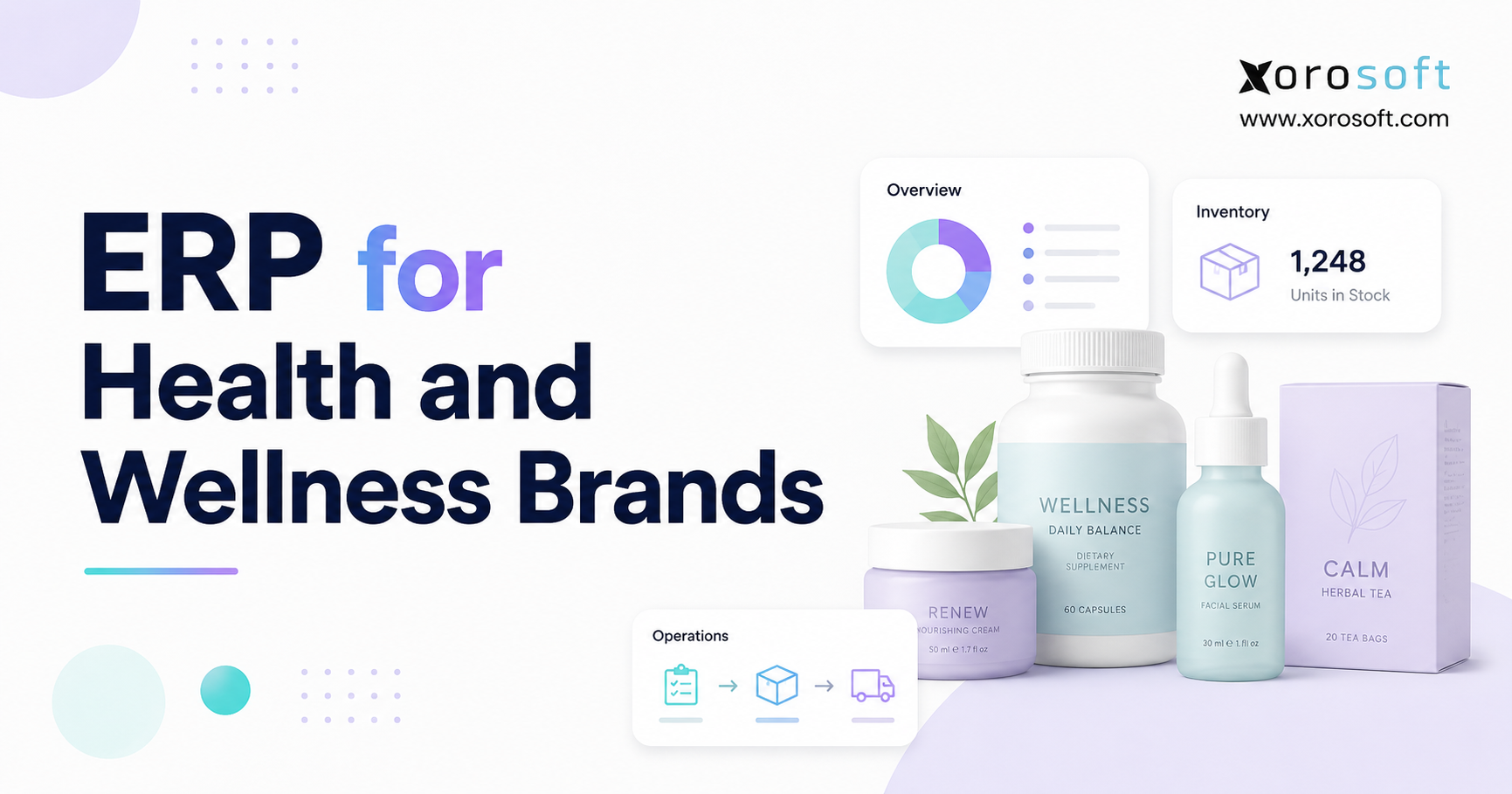
If you are searching for solutions like ERP for growing wellness brands, you are in the right place.
1. Growth Is Exposing the Back-Office Limits of Health and Wellness Brands
Health and wellness brands often discover their operational limits after growth has already created them. A technology stack that supported the company at an earlier stage may still function, yet employees spend increasingly more time reconciling the gaps between systems.
Shopify may handle ecommerce. QuickBooks manages accounting. Buyers maintain purchasing spreadsheets. A separate inventory application tracks stock, while warehouse teams rely on shipping tools, barcode applications, and procedures developed over time.
That environment can support a relatively simple product business. Complexity changes the equation.
A company that once managed a few dozen products may now carry hundreds of SKUs, variants, bundles, or kits. One fulfillment location turns into several warehouses and 3PLs. Amazon becomes a meaningful sales channel. Wholesale customers introduce different pricing, inventory commitments, payment terms, routing requirements, and EDI workflows.
Manufacturing adds another layer. Raw materials, packaging, work orders, production scheduling, lot numbers, finished goods, and product costs must all stay connected.
Individual applications may continue doing their specific jobs well. Problems appear between those applications.
Operations may see one inventory quantity while ecommerce shows another. Buyers may not know whether inbound purchase orders already cover projected demand. Warehouse adjustments can affect channel availability inconsistently. Finance may spend days resolving differences between operational inventory and accounting records.
This is where ERP for growing wellness brands becomes relevant.
The case for ERP does not begin at a specific revenue level. It begins when the business can no longer manage inventory, purchasing, fulfillment, manufacturing, accounting, and reporting reliably through separate systems.
1.1 Why Health and Wellness ERP Becomes More Important as Complexity Grows
Operational complexity often grows faster than the team responsible for managing it.
Adding a marketplace can take weeks, but the new channel creates an ongoing stream of orders, inventory commitments, returns, fees, payments, and reconciliation work. Opening another warehouse adds receiving, transfers, cycle counting, replenishment decisions, location-level availability, and new fulfillment rules.
Every additional SKU produces recurring work as well. Teams must forecast it, purchase it, receive it, store it, count it, value it, sell it, replenish it, and eventually decide what to do when demand changes.
Spreadsheets can calculate many of these requirements. They do not naturally control the transactions taking place across departments.
Warning signs appear when managers ask simple questions and receive several answers.
How many units can the company actually sell today? Which purchase orders are late? What inventory has wholesale already claimed? Which warehouse will stock out first? How much inventory is approaching expiration? Why does the financial inventory value differ from the operational report?
When answering those questions requires several exports and manual reconciliation, the back office has become a constraint.
1.2 What ERP for Health and Wellness Brands Covers
This guide focuses on product-based companies rather than hospitals, clinics, or healthcare providers.
Relevant businesses include supplement and nutraceutical brands, personal care companies, vitamin businesses, beauty products, natural products, fitness and recovery goods, wellness accessories, consumer health products, and other companies that buy, manufacture, store, and sell physical inventory.
Their workflows vary, but the systems challenge remains similar. Product data, inventory, purchasing, fulfillment, sales channels, manufacturing, and finance need to operate from consistent information.
2. How ERP for Growing Wellness Brands Creates One Operating Model
The biggest value of ERP is not the number of modules it provides. Strong ERP creates continuity between transactions that previously lived in different applications.
For a wellness company, receiving inventory should immediately affect available stock. Allocating units to a sales order should reduce what teams can promise elsewhere. Production transactions should consume components and create finished goods through controlled workflows. Shipping needs to update inventory and order status while giving finance accurate transaction data.
Fragmented environments make these relationships difficult because different platforms own different parts of the same process.
ERP for growing wellness brands creates a shared operating structure so employees spend less time reconciling those disconnected records.
2.1 Cloud ERP for Wellness Companies Connects Inventory and Finance
Inventory teams need to understand on-hand, allocated, available, transferred, and inbound quantities. Buyers require supplier records, purchase orders, lead times, expected receipts, and replenishment requirements. Warehouse teams depend on receiving, putaway, picking, packing, transfers, and counting workflows.
Finance looks at the same physical activity from another perspective.
A receipt may increase inventory value and create a payable. Manufacturing can move value from components into finished goods. Shipping reduces physical inventory while cost of goods sold affects financial reporting.
When each department maintains a separate version of these events, month-end becomes a reconstruction exercise.
A connected ERP reduces that friction by creating common transactions across functions.
2.2 Wellness ERP Software Does Not Need to Replace Every Application
ERP implementation does not mean removing every specialized platform.
Shopify can remain the ecommerce storefront. Amazon may continue functioning as a marketplace. A 3PL can use its own warehouse technology. Retail customers may keep sending documents through EDI. Marketing, CRM, support, and analytics platforms can remain in place when they add value.
The ERP operates behind those systems.
Shopify orders affect inventory. Marketplace demand consumes availability. Wholesale sales create commitments. Purchase orders increase expected supply. Manufacturing uses raw materials. Warehouse movements change location-level inventory.
A better architecture question is therefore not, “How many applications can we eliminate?”
Companies should instead determine which system owns each important record and how transactions should move between systems.
2.3 ERP for Growing Wellness Brands Creates a More Useful Inventory Record
The phrase “single source of truth” only matters when it changes business decisions.
Suppose a company owns 5,000 units of a popular supplement. Existing wholesale orders already claim 1,200. A subscription program will consume another 800 over the next two weeks. One warehouse holds inventory with an earlier expiration date, and 3,000 additional units are due next month.
A simple on-hand figure does not answer the operational question.
Teams need to know what they can promise, which units should ship first, whether inventory should move between locations, when purchasing needs to act, and whether inbound supply will arrive before a shortage occurs.
That level of visibility turns ERP from a database into an operating system.
3. When ERP for Growing Wellness Brands Becomes Necessary
A business should implement ERP because its operating model demands it, not because ERP appears on a generic growth checklist.
Some companies can reach meaningful scale with Shopify, accounting software, focused inventory tools, and good integrations. Others need ERP much earlier because manufacturing, multiple warehouses, lot tracking, Amazon, wholesale, or EDI create more complex relationships.
For that reason, ERP for growing wellness brands should be evaluated against operational complexity rather than revenue alone.
3.1 Health and Wellness ERP Readiness Starts With System Friction
Inventory discrepancies often become the first warning.
Employees may see one quantity in Shopify, another in the warehouse system, and a different value in a planning workbook. Adjustments become routine. Eventually, staff stop trusting available inventory and compensate by adding buffers.
Purchasing problems often follow. Buyers maintain increasingly complex spreadsheets containing sales history, lead times, minimum order quantities, inbound shipments, forecasts, and manual reorder calculations.
Warehouse operations become more difficult as locations expand. Employees coordinate transfers, cycle counts, replenishment, receiving, and picking priorities across several facilities or 3PLs.
Finance often feels the consequences later. Month-end close includes repeated inventory adjustments, unexplained variances, and manual reconciliation between accounting and operational systems.
When several of these problems occur together, ERP for growing wellness brands deserves serious consideration.
3.2 Shopify and QuickBooks May Still Be Enough for Some Wellness Companies
More functionality does not automatically produce a better system.
A company with one primary sales channel, a manageable product catalog, one simple warehouse, limited supplier complexity, no manufacturing, and reliable accounting may get more value from improving its current applications.
ERP adds implementation work, process changes, training, and ongoing administration. The business should receive meaningful operational value in return.
A second warehouse alone does not necessarily justify ERP. Neither does selling through Shopify.
The business case becomes stronger when those locations and channels need deeper connections with purchasing, forecasting, wholesale, manufacturing, warehouse execution, accounting, and reporting.
3.3 Revenue Is a Weak Trigger for ERP Adoption
Two $10 million companies can have entirely different operational requirements.
One may import finished products and fulfill every order through a single 3PL. Another business at the same revenue level might manufacture internally, manage several warehouses, carry thousands of SKUs, sell DTC and wholesale, and exchange EDI documents with retail customers.
The second company has considerably more operational complexity.
Instead of relying on revenue thresholds, evaluate SKU count, supplier complexity, warehouses, sales channels, production requirements, inventory accounting, reporting needs, and weekly manual reconciliation.
Those factors provide a much clearer ERP readiness signal.
4. Inventory Control in ERP for Growing Wellness Brands Goes Beyond Stock Counts
Inventory often provides the first reason a wellness business investigates ERP, but basic quantity tracking solves only part of the problem.
Companies need to understand where inventory sits, whether customers have already claimed it, when more will arrive, what it costs, which lot it belongs to, and whether shelf-life limits affect its value.
ERP for growing wellness brands needs to answer those questions without forcing employees to merge several reports.
4.1 Inventory ERP for Wellness Brands Needs Allocation Visibility
On-hand inventory and available inventory are different operational measures.
A warehouse may physically contain 10,000 units. Wholesale orders, subscriptions, marketplace requirements, and open DTC orders may already consume a meaningful share of that total.
Operations therefore needs a reliable available-to-sell position.
This becomes especially important when Shopify, Amazon, B2B customers, and wholesale buyers draw from the same physical stock.
Without a shared view, teams can oversell high-demand products or hold unnecessary safety stock because they do not trust system quantities.
4.2 Supplement ERP Software Needs Lot and Batch Traceability
Lot-controlled inventory introduces more responsibility than standard SKU tracking.
A SKU identifies the product. Lot information identifies a specific group of units tied to a production event, purchase receipt, or batch.
That distinction becomes important when teams investigate quality concerns, supplier problems, expiration risk, customer complaints, or recalls.
Effective traceability should work in both directions.
Operations may need to start with a source material and determine which finished products used it. In another scenario, employees may start with a customer shipment and trace the product backward through the finished lot and relevant source materials.
ERP can support the records required for this investigation, provided teams record the underlying transactions consistently.
4.3 Expiration Tracking Changes Wellness Inventory Planning
Shelf-life-sensitive products require more than an expiration field.
Purchasing needs visibility into how much inventory the business can realistically consume before expiry. Warehouse teams need rules for choosing the right lot. Sales and operations may need alerts when aging stock requires attention.
FIFO and FEFO also represent different approaches.
FIFO means first in, first out. FEFO means first expired, first out.
For expiration-sensitive goods, the inventory received first may not always expire first. Warehouse processes should recognize the difference when shelf life affects fulfillment decisions.
4.4 Multi-Warehouse ERP Must Show Where Inventory Is Needed
Enterprise-wide inventory totals can hide location-specific problems.
A West Coast warehouse may hold excessive stock while an East Coast facility approaches a shortage. Looking at the combined number creates the impression that inventory is healthy.
Location-level planning gives a more useful answer.
A strong multi-warehouse environment should connect demand, inventory availability, transfers, purchase orders, and replenishment requirements by location.
When the network includes both company-owned warehouses and third-party logistics partners, this visibility becomes even more important.
5. Purchasing, Forecasting, and Warehouse ERP for Wellness Brands Turn Data Into Decisions
Inventory explains today’s position. Purchasing and forecasting determine what the business should do next.
For many companies evaluating ERP for growing wellness brands, these functions reveal why a collection of spreadsheets becomes difficult to maintain.
5.1 Purchasing ERP for Wellness Brands Should Reduce Spreadsheet Dependency
Buyers need several inputs before deciding what to order.
Current stock matters, but so do sales velocity, open customer orders, inventory already in transit, supplier lead times, minimum quantities, seasonality, promotions, manufacturing requirements, and safety-stock targets.
When these data points live in separate systems, purchasing teams spend a large part of each planning cycle gathering information rather than evaluating it.
ERP can centralize the inputs.
The system may identify products approaching a shortage, show when open purchase orders already cover expected demand, or generate replenishment recommendations based on defined rules.
Buyer judgment still matters. Promotions, supplier disruptions, product launches, unusual demand, and strategic changes may require human decisions that historical data cannot predict accurately.
The objective is not fully automated buying. Better purchasing starts with better information.
5.2 Demand Forecasting for Wellness Brands Needs Operational Context
Forecasting becomes more challenging when products experience seasonality, subscription demand, promotions, launches, influencer activity, retail expansion, or long supplier lead times.
A forecast should function as a planning model rather than a promise.
Its value increases when planning connects to inventory and purchasing. If a forecast changes but replenishment decisions remain isolated in another spreadsheet, the organization still lacks an integrated process.
Strong planning combines data and judgment.
Historical sales provide evidence. Current inventory establishes the starting position. Open purchase orders show incoming supply. Marketing plans reveal expected demand changes. Supplier knowledge informs lead-time assumptions.
ERP can bring these inputs into a common operating environment.
5.3 Warehouse Management Protects ERP Inventory Accuracy
Warehouse execution determines whether the inventory record remains trustworthy.
Receiving should record what arrived. Putaway establishes where inventory moved. Picking and packing remove the correct units. Transfers document movement between facilities. Cycle counts identify differences and provide controlled ways to correct them.
Barcode-driven workflows can reduce manual entry as transaction volume increases.
Brands with substantial warehouse complexity may benefit from dedicated WMS functionality. XoroWMS is designed around receiving, inventory movement, multi-warehouse operations, barcode workflows, replenishment, cycle counting, picking, packing, and fulfillment.
Regardless of platform, one principle remains constant: ERP cannot maintain accurate stock if physical warehouse activity repeatedly occurs outside controlled system transactions.
6. Shopify and ERP for Growing Wellness Brands Must Work as One Commerce Operation
Shopify often remains a core platform after ERP implementation.
Replacing a high-performing storefront simply to consolidate software rarely makes sense. The ERP should strengthen what happens behind the storefront.
For Shopify merchants, ERP for growing wellness brands becomes most valuable when ecommerce demand must connect with purchasing, warehouses, manufacturing, finance, forecasting, wholesale, Amazon, or EDI.
6.1 Shopify ERP Integration Should Go Beyond Order Imports
Many platforms claim Shopify integration because they can import orders.
That is only the beginning of the workflow.
A growing company should understand how products, variants, orders, payments, refunds, cancellations, fulfillment confirmations, and inventory quantities move between Shopify and ERP.
Ownership matters as much as synchronization.
Which platform owns product data? Where should employees change inventory? What happens after a partial fulfillment? How does a refund affect stock and accounting? Which system identifies an integration failure?
Testing these scenarios provides more useful information than confirming that a connector exists.
The Xorosoft ERP app on the Shopify App Store provides one example of how Shopify can connect with a broader ERP environment.
6.2 Shopify ERP for Wellness Brands Needs Shared Channel Availability
The problem becomes more complex when Shopify represents only one source of demand.
A brand may sell DTC through Shopify, operate an Amazon business, supply wholesale customers, and fulfill major retail orders through EDI.
Each channel appears separate to customers, yet several may rely on the same warehouse inventory.
The ERP must help teams understand availability after accounting for commitments across channels.
Some companies also reserve stock intentionally. Subscription customers, key wholesale accounts, new launches, or marketplace programs may require protected allocations.
A good system should support those commercial decisions rather than forcing employees to maintain another spreadsheet.
6.3 Wholesale and EDI Require Different ERP Workflows
DTC and wholesale orders behave differently.
A direct consumer order may contain a few units and immediate payment. Wholesale transactions can involve large quantities, negotiated pricing, payment terms, credit limits, inventory allocations, routing instructions, and EDI documents.
ERP selection needs to account for that operational difference.
A platform designed primarily for simple ecommerce inventory may struggle when wholesale becomes a major part of revenue.
As wellness brands expand into retail and distribution, the back-office change can be more significant than the storefront change.
7. Manufacturing and Accounting in ERP for Growing Wellness Brands Require Deeper Control
Manufacturing changes the inventory model because the business no longer manages only finished products.
Raw materials, packaging, components, production activity, finished goods, and costs must move through connected workflows.
For companies that manufacture internally or coordinate production through partners, ERP for growing wellness brands needs sufficient manufacturing and financial depth.
7.1 Manufacturing ERP for Supplement Brands Connects Materials to Finished Goods
A manufacturing environment may need bills of materials, formulas, raw-material requirements, work orders, production schedules, yields, scrap, labor, work in process, and finished-goods receipts.
Production models vary widely.
Simple kitting requires different functionality from batch manufacturing. Internal production creates different requirements from outsourced production. A supplement manufacturer may also need more detailed traceability than a brand purchasing finished products.
The ERP should match the actual manufacturing model.
XoroERP is one example of a platform that connects manufacturing with inventory, purchasing, warehouse operations, accounting, vendor management, and reporting.
Integration matters because production transactions affect several departments simultaneously.
Material consumption changes inventory. Finished production creates sellable goods. Purchasing needs future material requirements. Finance needs reliable cost data. Warehouse teams need to know when completed inventory becomes available.
7.2 ERP for Co-Manufactured Wellness Products Still Needs Supply Visibility
Outsourced production does not eliminate supply-chain complexity.
A brand may purchase ingredients or packaging that remain at a contract manufacturer. Buyers can place commitments months before finished products become available. Operations needs visibility into expected production, inbound finished goods, delays, and inventory ownership.
Without a central system, co-manufacturing creates a gap between purchased materials and sellable inventory.
ERP can help represent those intermediate stages.
Teams should be able to distinguish owned materials from available finished products and planned production from confirmed supply.
7.3 Wellness ERP Should Support Traceability Without Overpromising Compliance
Health and supplement businesses often investigate ERP because they need better records and stronger process control.
The software can support lot tracking, production history, receiving records, material consumption, supplier information, inventory transactions, and supporting documentation.
Those capabilities strengthen operational traceability.
They do not replace quality systems, regulatory procedures, training, testing, controlled documentation, or other responsibilities that belong to the business.
Companies should therefore evaluate ERP as infrastructure for executing controlled processes consistently, not as a shortcut to compliance.
7.4 Inventory Accounting Should Follow Physical Product Movement
Product businesses cannot separate inventory operations from financial accuracy.
Purchasing creates commitments. Receiving creates inventory. Freight and other expenses can affect landed cost. Manufacturing transfers value from raw materials into finished goods. Sales move inventory value into cost of goods sold.
When different applications control each part, finance may need to reconstruct physical activity at month-end.
Integrated ERP reduces that gap by bringing operational transactions closer to their financial impact.
The result should be easier reconciliation and clearer explanations of inventory value—not simply a larger accounting system.
8. How to Choose ERP for Growing Wellness Brands Using Real Workflow Tests
Searching for the “best ERP” often leads buyers toward feature comparisons that fail to reflect actual operations.
No platform is automatically the best ERP for every health and wellness company.
The correct choice depends on the business model.
8.1 ERP for Growing Wellness Brands Should Match Channel and Supply-Chain Complexity
A Shopify-first DTC company with outsourced production may prioritize integrations, inventory planning, purchasing, and 3PL visibility.
A supplement manufacturer could require deeper production, lot traceability, warehouse, and material-planning capabilities.
Wholesale distributors may prioritize EDI, customer-specific pricing, sales-order management, allocation, credit controls, warehouse execution, and purchasing.
These differences should determine which vendors reach the shortlist.
Reviewing a provider’s industry experience can help determine whether the software company commonly supports similar operating models.
Industry experience does not replace product testing, but it can provide useful context during the research stage.
8.2 Test Health and Wellness ERP With Real Transactions
Generic demonstrations tend to show software under ideal conditions.
Buyers learn more by providing the scenarios.
Ask a vendor to receive a lot-controlled product, transfer part of the inventory, allocate units to a wholesale order, fulfill it, and trace the complete transaction history.
For Shopify, use a partial shipment, cancellation, or refund rather than only a perfect order.
Purchasing demonstrations should explain why the system recommends replenishment. Manufacturing tests should follow materials from receipt through production into finished goods. Accounting reviews need to show how physical transactions influence inventory value and cost of goods sold.
Workflow testing exposes the difference between claimed functionality and operational depth.
8.3 Compare ERP Platforms Based on Fit Rather Than Familiarity
Health and wellness brands may consider NetSuite, Acumatica, Microsoft Dynamics 365 Business Central, Cin7, Sage, Fishbowl, Brightpearl, Xorosoft, and other platforms.
Requirements should drive the shortlist.
Companies comparing larger suites with inventory-focused alternatives can review resources such as the Xorosoft vs NetSuite comparison during research.
Vendor comparison pages should remain one input among several.
A serious evaluation also includes workflow demonstrations, commercial proposals, implementation discussions, reference conversations, integration reviews, and contract analysis.
8.4 ERP Architecture Should Reduce Application Sprawl
Many companies investigate ERP because their current systems require too many interfaces and manual handoffs.
A new platform should not immediately recreate the same problem unless surrounding applications provide clear specialist value.
Broader environments such as XoroONE combine inventory, purchasing, warehouse management, manufacturing, accounting, ecommerce, EDI, reporting, and forecasting in one cloud platform.
A company does not need to use every module.
What matters is whether the core architecture can support current requirements and expected future complexity without requiring another collection of disconnected systems.
9. Implementing ERP for Growing Wellness Brands Depends on Process Discipline
Choosing capable software does not guarantee a successful ERP project.
Data quality, ownership, workflow design, testing, training, and change management usually determine whether the implementation creates lasting operational improvement.
That is why ERP for growing wellness brands should be treated as an operating-model project rather than an IT installation.
9.1 Clean Inventory and Master Data Before ERP Migration
New software does not automatically correct bad data.
Duplicate SKUs, obsolete vendors, inconsistent units of measure, unresolved inventory differences, incorrect costs, and outdated open transactions should not simply move into the new system.
Implementation teams need to decide which data matters and who owns it.
Product masters, warehouse locations, vendor records, units of measure, lot settings, costing methods, and purchasing parameters need clear governance after launch as well.
Without ownership, data quality eventually deteriorates again.
9.2 Do Not Rebuild Every Legacy Workflow
Old processes often exist because previous applications required workarounds.
Employees may export reports, apply formulas, email files, update another system, and reconcile the results manually.
An ERP project should question that process instead of automatically rebuilding it.
Why does the workaround exist? Can the new system remove a step? Should responsibility change? Does the report still serve a useful purpose?
Implementation creates an opportunity to simplify operations before the company automates inefficient habits.
9.3 Warehouse, Purchasing, Finance, and Ecommerce Teams Need Shared Ownership
ERP should not belong only to the IT team.
Warehouse users understand physical inventory movement. Buyers know suppliers and replenishment rules. Finance controls accounting and reporting. Ecommerce teams understand orders, promotions, payments, refunds, and channel behavior.
Operations connects those perspectives.
Each group should participate in requirements gathering, workflow testing, user training, and acceptance decisions.
Shared ownership improves the implementation because many ERP decisions affect several departments at the same time.
9.4 Define the System of Record for Every Critical Data Object
Integrations work better when ownership is clear.
If Shopify and ERP both contain product information, employees need to know where product records should be created and maintained. When ERP and a 3PL both show inventory, teams need rules defining which transactions create the authoritative quantity.
Similar decisions apply to customers, orders, vendors, costs, shipments, and returns.
Without a clear system of record, integrations can spread inconsistent data more quickly instead of solving the underlying problem.
10. Frequently Asked Questions About ERP for Growing Wellness Brands
10.1 What is ERP for growing wellness brands?
ERP for growing wellness brands connects inventory, purchasing, warehouses, manufacturing, accounting, forecasting, ecommerce, wholesale, and reporting in a shared operational environment. Companies normally consider it when disconnected applications create too much manual work, poor visibility, or unreliable data.
10.2 Why do health and wellness brands need ERP?
Wellness brands usually investigate ERP when operational complexity exceeds what separate applications can manage efficiently. Common triggers include inventory discrepancies, spreadsheet purchasing, multiple warehouses, manufacturing requirements, wholesale growth, accounting reconciliation, and fragmented reporting.
10.3 When should a wellness company move to ERP?
ERP should be evaluated when existing systems create repeated manual reconciliation or affect operational accuracy. Rising SKU counts, warehouses, channels, suppliers, purchase orders, manufacturing requirements, and reporting complexity can all strengthen the business case.
10.4 Does every Shopify wellness brand need ERP?
No. Many Shopify businesses can operate effectively without full ERP. The need becomes stronger when ecommerce must connect with deeper purchasing, warehouse management, accounting, manufacturing, forecasting, wholesale, Amazon, or EDI workflows.
10.5 What is the best ERP for a health and wellness brand?
There is no universal best platform. Inventory complexity, channels, warehouse operations, manufacturing, accounting needs, integrations, implementation resources, reporting requirements, and total ownership cost should determine the shortlist.
10.6 Can supplement ERP software track lot numbers?
Many product-focused ERP systems support lot tracking. Buyers should test receiving, transfers, production, picking, shipping, adjustments, and traceability searches because the level of functionality varies by platform.
10.7 Can wellness ERP track expiration dates?
Many inventory and ERP systems support lot-level expiration dates. Companies should also evaluate aging reports, FEFO processes, expiry warnings, and warehouse picking behavior rather than only checking whether an expiration field exists.
10.8 What is FEFO inventory management?
FEFO means first expired, first out. Warehouse teams prioritize stock according to expiration dates instead of automatically shipping the inventory received first. This approach can help manage products with limited shelf life.
10.9 Can ERP support supplement product recalls?
ERP can support investigations by connecting lots, suppliers, manufacturing activity, warehouse locations, inventory movements, and customer shipments. Accurate transaction history is essential for that traceability to work effectively.
10.10 Does ERP make a supplement company compliant?
No. ERP can support traceability, records, controlled transactions, manufacturing history, and documentation, but the company remains responsible for compliance procedures, quality systems, employee practices, testing, training, and applicable requirements.
10.11 Can ERP connect Shopify and Amazon inventory?
Many product-focused ERP platforms can connect both channels. The goal is to maintain reliable availability when Shopify, Amazon, wholesale buyers, and other channels draw from the same physical inventory.
10.12 Can health and wellness ERP integrate with a 3PL?
Yes, depending on the platforms involved. Typical data exchanges can include orders, inventory balances, receipts, shipments, tracking details, adjustments, and returns.
10.13 Can ERP manage wholesale wellness orders?
A suitable ERP can support wholesale sales orders, account-specific pricing, payment terms, credit controls, inventory allocations, fulfillment, and EDI. Buyers should test wholesale independently from DTC because the workflows differ.
10.14 What does EDI mean in ERP?
Electronic Data Interchange allows trading partners to exchange structured business documents electronically. Retail and wholesale relationships commonly use EDI for purchase orders, acknowledgements, shipping notices, invoices, and related transactions.
10.15 Can ERP automate purchasing?
ERP can use demand, inventory, open purchase orders, supplier lead times, reorder parameters, and forecasts to create purchasing recommendations. Buyers still need to manage promotions, supplier disruptions, launches, and unusual demand.
10.16 How does ERP improve demand forecasting?
ERP brings operational data such as sales history, inventory, incoming supply, and sales commitments closer to the planning process. Better inputs can improve decisions, although methodology and human judgment remain important.
10.17 Can ERP manage several warehouses?
Many platforms support multiple warehouses and locations. Buyers should test transfers, replenishment, location-level availability, receiving, counting, picking, allocations, and reporting rather than simply confirming that multiple locations can be created.
10.18 Can ERP manage supplement manufacturing?
Manufacturing ERP can support raw materials, bills of materials or formulas, production orders, planning, lot tracking, finished goods, yields, and costing. Required depth depends on the production model.
10.19 Can ERP replace QuickBooks?
Some ERP platforms include native accounting and can become the financial system of record. Other solutions continue integrating with external accounting software. The correct architecture depends on the company’s requirements.
10.20 How does ERP improve inventory accounting?
ERP connects physical inventory transactions more closely with purchasing, receiving, production, landed costs, cost of goods sold, and financial reporting. Consistent workflows can reduce manual reconciliation.
10.21 Is ERP better than inventory management software?
Not in every case. Inventory software may fit a business focused primarily on stock and order management. ERP becomes more compelling when inventory must connect deeply with accounting, purchasing, manufacturing, warehouses, planning, and reporting.
10.22 How much does ERP for wellness brands cost?
Pricing varies according to users, modules, implementation scope, integrations, support, transaction volume, data migration, customization, and vendor pricing models. Buyers should compare total ownership cost rather than subscription prices alone.
10.23 How long does an ERP implementation take?
Project length depends on data quality, process complexity, integrations, manufacturing requirements, customization, testing, training, and the speed at which internal teams make decisions.
10.24 What should a wellness company ask during an ERP demo?
Use actual business scenarios. Test receiving, lot tracking, warehouse transfers, Shopify orders, refunds, wholesale allocation, purchasing, production, accounting, forecasting, and reporting rather than relying only on a standard product tour.
10.25 How should a wellness brand compare ERP vendors?
Create a requirements list based on real workflows, rank those requirements by importance, and ask each vendor to demonstrate the same scenarios. Implementation methodology, integrations, support, scalability, commercial terms, and total ownership cost should also influence the decision.
11. Strategic Next Steps for Evaluating ERP for Growing Wellness Brands
A health and wellness business should not implement ERP simply because its current software feels old or because another company has already made the transition.
The decision needs operational evidence.
Start by documenting where information breaks down today. Follow inventory from supplier purchase order through receiving, storage, allocation, fulfillment, and accounting. For manufacturers, extend the process through components, production, and finished goods.
Next, examine how Shopify, marketplaces, wholesale customers, 3PLs, and warehouses change that inventory position.
Manual work deserves particular attention. Repeated reconciliation, business-critical purchasing spreadsheets, channel inventory corrections, manually assembled reports, and unexplained accounting differences all indicate that the current architecture may be reaching its limits.
At that stage, ERP for growing wellness brands becomes a strategic infrastructure decision rather than a software upgrade.
Define the operating model before selecting a platform. Determine which workflows must improve, which existing applications should remain, which records ERP needs to own, and which integrations create genuine operational value.
Then evaluate vendors against real transactions.
For companies that need inventory, purchasing, warehouse management, manufacturing, accounting, forecasting, Shopify, EDI, and multi-location operations in one connected environment, Xorosoft can be one of the platforms included in that evaluation.
The objective is practical: build an operating foundation that allows the company to scale without adding another spreadsheet, workaround, or manual reconciliation process every time complexity increases.
Teams actively considering ERP for growing wellness brands should therefore start with their own workflows rather than a generic feature checklist.
Book a personalized ERP consultation with Xorosoft to review inventory, purchasing, warehouse, manufacturing, ecommerce, accounting, and growth requirements against your actual operating model.
Recent Posts
-
 ERP Landed Cost Module vs Spreadsheet Calculations for Importers
 -
 How to Build an Open-to-Buy Plan for an Omnichannel Brand
 -
 Cold Storage WMS for Food and Beverage Distribution
 -
 ERP Buying Statistics 2026: Evaluation, Implementation, and Adoption Risks
 -
 How a Distributor Reduced B2B Order Exceptions Without Restricting Sales