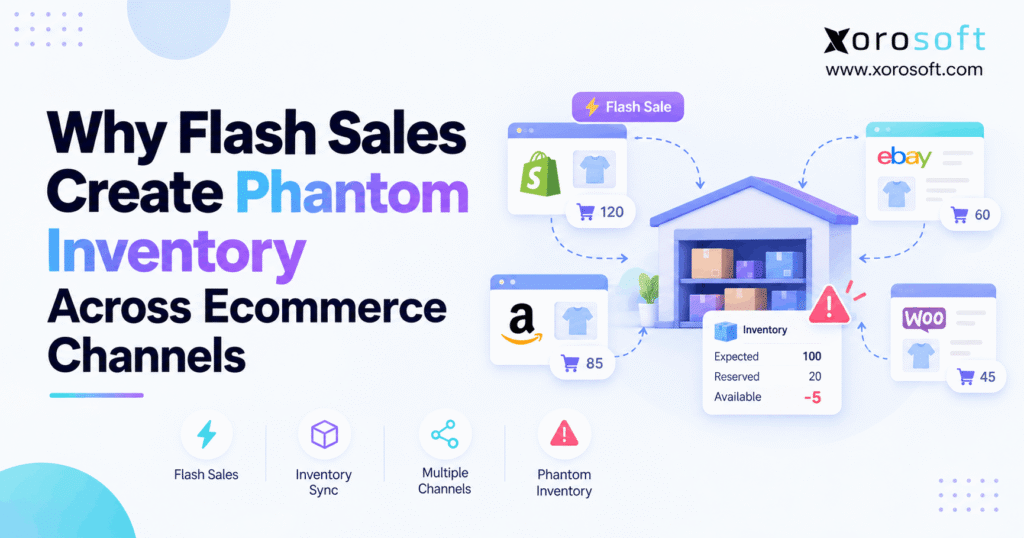
If you’ve ever managed or participated in a time-limited sales event, you may have experienced challenges caused by flash sale inventory discrepancies.
1. The Stock That Disappears Between Two Checkouts
Flash sale inventory discrepancies begin when an ecommerce channel promises stock that another channel has already sold, reserved, or made unavailable. A warehouse may count every unit correctly, yet Shopify, Amazon, and Walmart can still display conflicting quantities during a promotion. Consequently, an order that looks valid at checkout may be impossible to fulfill.
For example, imagine one warehouse holds 40 units of a popular product. Wholesale orders already claim ten, three await inspection, and two form a safety buffer. Nevertheless, several marketplaces may still display a stale quantity after the first orders arrive. Therefore, the business risks accepting more demand than its 25 eligible units can cover.
The problem is not always slow software or bad counts. Instead, flash sales expose dependencies between orders, reservations, warehouse movements, and channel updates. This guide explains the failure, shows the arithmetic, and outlines practical controls for retailers, distributors, and manufacturers.
1.1 How Phantom Stock Differs From Physical Stock
Phantom stock means a recorded or published quantity appears sellable even though those units cannot fulfill the promised order. Physical stock may include damaged products, customer allocations, and goods restricted to another warehouse. However, a channel listing often shows only one number, hiding those conditions.
Therefore, separate on-hand, eligible, committed, and published quantities. On-hand means physically present; eligible means the stock meets the channel’s fulfillment rules. Meanwhile, committed means someone already has a claim. Published availability is what shoppers can buy. If those records disagree, the site can display phantom stock without a single counting mistake.
1.2 Why Inventory Mismatches Create Overselling
Overselling occurs when accepted customer demand exceeds the inventory available to meet it. Although inaccurate published availability can trigger overselling, the two terms are not identical. For example, a store can display five nonexistent sellable units without receiving an order; that is phantom stock but not yet an oversell.
Conversely, two channels might accept the last unit simultaneously while each displays a valid local number. As a result, their combined orders exceed the shared pool. Therefore, correcting quantity displays alone is insufficient because flash sale inventory discrepancies can arise before either channel notices the conflict. The order workflow must reserve stock before another channel can promise the same units.
1.3 When a Simple Inventory Setup Is Enough
Not every merchant needs an ERP to prevent these problems. For example, a Shopify-only retailer with one small warehouse, accurate counts, and straightforward products may manage stock reliably through native inventory features. Similarly, a second channel may work with a well-configured synchronization application when sales volumes and fulfillment rules remain simple.
However, risk rises when the same inventory serves several marketplaces, wholesale customers, 3PLs, and warehouse locations. In that situation, teams should first document who owns stock availability, how orders reserve units, and what happens when an update fails. Those questions matter more than the number of dashboards in the software stack.
2. How Flash Sale Inventory Discrepancies Begin
A flash sale compresses demand, making routine update delays dangerous when many shoppers see one SKU.
2.1 Concurrent Orders Create Inventory Discrepancies
Suppose Shopify, Amazon, and Walmart each display 25 available units from one warehouse. Initially, that does not mean the company owns 75 units; all three channels are viewing the same shared pool. However, each platform may accept an order before the others receive the new balance.
As a result, separate checkout decisions can be individually reasonable but collectively impossible. Therefore, the key control is shared commitments, not three independent counters. If the integration waits until picking to recognize orders, the window for competing promises becomes even larger. Meanwhile, higher checkout volume increases the chance of conflict.
2.2 Delayed Channel Updates Create Stock Drift
An order may pass through checkout, an order event, an integration queue, an inventory service, and a marketplace API before another channel displays a lower number. Consequently, a delay of seconds can matter when the final units sell quickly. In contrast, the same delay might go unnoticed during normal sales.
Therefore, measure the entire interval from accepted order to confirmed destination update, not just how fast the connector sends a message. Additionally, record which SKU, location, and inventory state changed. Reporting success on submission can hide stock drift until fulfillment fails.
2.3 Webhook Loss and Stale Quantity Writes
Shopify explains that webhook events are not guaranteed to arrive in order or be delivered every time. Therefore, integrations need reconciliation instead of relying on events alone. See Shopify’s webhook documentation for the platform’s delivery guidance.
For example, an older inventory update could arrive after a newer update and restore an outdated quantity if an integration lacks concurrency protection. Similarly, a retry could apply the same adjustment twice unless processing is idempotent. Consequently, teams should log event identifiers, compare versions, and reject conflicting writes. After outages, reconcile open orders against current stock.
2.4 Bad SKU, Bundle, and Warehouse Mapping
Inventory discrepancies also originate in product setup. For instance, a marketplace listing may point to the wrong color or size, while a two-pack may subtract only one component. Consequently, a bundle can appear available long after its limiting component runs out.
Meanwhile, an integration might publish units from a warehouse unable to serve the customer’s delivery region. Therefore, validate every SKU-to-variant mapping, bundle quantity, fulfillment location, and unit-of-measure rule before the sale. Additionally, test products with shared components rather than checking only simple, single-SKU items. A flawless webhook cannot repair inaccurate product relationships.
2.5 Cancellations and Wholesale Commitments
Wholesale buyers may reserve units days before a consumer promotion, yet those commitments can live outside the ecommerce storefront. Therefore, a brand can accidentally sell stock already promised to a B2B customer. Similarly, canceled orders can create false availability if a connector releases their reservations more than once.
For that reason, define the entire reservation lifecycle: creation, confirmation, fulfillment, expiration, cancellation, and return. Moreover, attach each change to a unique order or business event. Otherwise, a well-intentioned manual correction may conflict with the next automated update. Accurate published stock depends on these less visible transactions.
3. Where Phantom Stock Spreads Across Ecommerce Channels
Each sales channel manages its own order and inventory concepts. Therefore, a multichannel integration must translate between different availability rules instead of assuming every quantity has the same meaning.
3.1 Shopify: Availability Versus Phantom Stock
Shopify distinguishes on-hand, available, committed, reserved, damaged, safety stock, quality control, and incoming quantities. In particular, its available inventory already excludes committed and other unavailable on-hand states. Therefore, an integration must not subtract those same reservations again when publishing stock. See Shopify’s inventory-state documentation.
Moreover, Shopify manages its committed state as orders and relevant reservations progress. However, an external stock owner may maintain additional B2B holds or location restrictions. As a result, teams must agree which system is authoritative before importing quantities. Otherwise, a mathematically correct Shopify balance may still differ from the business’s eligible shared-stock pool.
3.2 Amazon: Different Fulfillment Pools
Amazon seller-fulfilled listings may consume the same merchant-owned warehouse inventory as Shopify. Consequently, those order commitments must enter the shared stock calculation quickly. Amazon’s Selling Partner API notification reference documents quantity-change notifications for merchant-fulfilled listings.
However, Fulfillment by Amazon stock is a separate operational pool with its own fulfillable, reserved, and unfulfillable distinctions. Therefore, do not merge FBA units with warehouse-owned stock without a legitimate fulfillment workflow. Moreover, monitor marketplace quantities by seller SKU and fulfillment method. Otherwise, an apparently healthy company-wide balance can conceal an unavailable channel-specific stock pool.
3.3 Walmart: Ship-Node Stock Mismatches
Walmart inventory can be managed by SKU and ship node. In addition, merchants can submit bulk inventory feeds and track processing results. However, submitting a feed does not mean every line has already updated successfully. The Walmart Marketplace Inventory API guide explains those operations.
Therefore, compare the intended update with the destination’s accepted result. Similarly, check whether the selected ship node can fulfill the actual customer order. An incorrect node mapping can create false availability even when total inventory is accurate. During high-volume promotions, failed feeds or delayed acknowledgments deserve an operational alert rather than a next-day spreadsheet check.
3.4 ERP, WMS, and 3PL Update Timing
An ERP may record customer commitments when orders arrive, while a WMS confirms picking and packing later. Meanwhile, a third-party logistics provider may publish shipment events in batches. Therefore, those systems can show different quantities because they represent different stages, not necessarily because one is broken.
Define when units stop being available, physical inventory changes, and cancellations release stock. For example, shipping confirmation should not be the first moment an accepted order consumes availability. Instead, the central reservation should already protect those units. In turn, warehouse updates should reconcile the physical movement against the original commitment. That is where flash sale inventory discrepancies become visible across systems.
4. Flash Sale Inventory Discrepancies: A 90-Second Breakdown
Consider a hypothetical promotion for one SKU sold on Shopify, Amazon merchant-fulfilled, and Walmart. The figures below illustrate a possible integration failure; they are not customer results or industry averages.
4.1 Calculate Eligible Quantity Before the Promotion
The warehouse physically holds 40 units. However, ten belong to approved wholesale orders, three are on quality hold, and two form a sale buffer. Therefore, the eligible inventory available for new orders is only 25 units.
| Inventory category | Units |
|---|---|
| Physical on-hand quantity | 40 |
| Existing wholesale commitments | -10 |
| Quality-control hold | -3 |
| Promotion safety buffer | -2 |
| Eligible available-to-sell | 25 |
Importantly, Shopify, Amazon, and Walmart may each view those 25 units, but the channels do not own three separate pools. Consequently, treat 25 as the shared limit unless inventory has protected channel allocations.
4.2 Follow the Cross-Channel Oversell Timeline
Assume that orders are accepted locally while a central reservation queue falls behind. Therefore, all three channel snapshots remain stale for part of the sale.
| Time | Order event | Cumulative units ordered | Shared availability after commitments |
|---|---|---|---|
| 00:00 | All channels show a view of 25 units | 0 | 25 |
| 00:20 | Shopify accepts 12 units | 12 | 13 |
| 00:45 | Amazon accepts 11 units | 23 | 2 |
| 01:10 | Walmart accepts 8 units | 31 | -6 |
| 01:30 | Central reconciliation identifies the gap | 31 | -6 |
As a result, demand reaches 31 units against 25 eligible units. Therefore, six units are oversold, equal to approximately 19.4% of accepted unit demand in this fictional example.
4.3 Locate the Inventory Mismatch
The warehouse did not unexpectedly lose six cartons. Instead, the failure occurred when separate channels accepted orders without an enforceable shared claim against the remaining stock. Consequently, publishing a later correction cannot retroactively undo those customer promises.
To identify the failure, compare the last confirmed channel quantity with the timestamps of each accepted order and central reservation. Moreover, inspect failed updates and retry logs. If the initial reserve was late, improve the reservation workflow. If it was timely but the marketplace displayed stale stock, investigate publication and acknowledgment delays. Different causes require different fixes, which is why flash sale inventory discrepancies need event-level evidence.
4.4 Use the Formula Without Double-Counting
A useful general model is eligible available-to-sell = eligible on-hand − existing commitments − distinct holds − planned buffer. However, the components must be mutually exclusive. If the source already provides an available quantity with commitments and holds excluded, do not subtract them again.
Additionally, apply location and fulfillment rules before calculating the channel promise. For example, units in a distant warehouse may not be eligible for next-day delivery. Therefore, company-wide stock and promiseable stock are not interchangeable. A good inventory policy explains both the quantity calculation and the conditions under which the buyer can receive the product.
5. How to Catch Inventory Mismatches Before Fulfillment Breaks
Early detection matters because the customer service team cannot solve a physical stock shortfall through another inventory refresh. Therefore, monitor both available quantities and the events that create or release customer commitments.
5.1 Warning Signs of Phantom Inventory
First, flag orders accepted without a matching reservation in the shared stock record. Next, watch negative eligible balances, sudden increases after cancellations, and listings that remain active after source inventory reaches zero. Additionally, review repeated adjustments and unexpected availability at receiving or transfer locations.
However, do not assume every difference is an error. For example, buffers and location restrictions can create intentional differences between channel quantities. Instead, record the reason for those rules. Consequently, alerts can focus on unexplained mismatches rather than flooding operators with known configuration differences.
5.2 Five Metrics for Stock Drift
Monitor measurements at the SKU-and-location level rather than relying on one company-wide accuracy score. In particular, high-velocity promotional products need more frequent attention.
| Metric | Definition | Why it matters |
|---|---|---|
| Confirmed sync latency | Time from stock change to accepted destination update | Reveals stale listing exposure |
| Unreserved order count | Accepted orders without central commitments | Finds competing claims early |
| Discrepancy rate | Mismatched checked records / total checked records | Shows inventory drift |
| Failed-update rate | Rejected writes / attempted writes | Exposes API or mapping faults |
| Recovery time | Detection-to-resolution interval | Measures operational response |
Moreover, track a slow-case latency measure rather than only an average. Otherwise, a small number of long delays can disappear within a reassuring daily dashboard.
5.3 Trace the Failed Event
Start with the SKU, selling location, and narrow order window. Then compare the source balance, orders, reservations, quantity writes, and marketplace acknowledgments. Additionally, retain event IDs and both creation and processing times.
For example, a duplicate cancellation event may have increased availability twice. In contrast, a missing order event may have left stock untouched. Therefore, the audit trail should show the entire causal chain before anyone corrects inventory manually. Otherwise, a temporary fix may hide the defect until the next promotion. This investigation separates flash sale inventory discrepancies caused by timing from those caused by wrong physical counts.
5.4 Translate Discrepancies Into Operational Cost
An oversell can trigger a refund, support conversation, substitute shipment, emergency purchase, or late delivery. Consequently, its cost reaches beyond the face value of the missing units. Meanwhile, false availability may also distort reorder recommendations and inventory forecasts.
Therefore, track canceled order margin, expedited freight, support time, marketplace penalties where applicable, and relevant accounting adjustments separately. Avoid invented industry-wide loss figures. Instead, analyze actual exceptions from the last promotion. For example, furniture cancellations may need different controls from accessory discrepancies.
Free ERP Readiness Assessment: Check shared stock ownership, reservation timing, and failed-update visibility before considering an ERP upgrade.
6. How to Prevent Flash Sale Inventory Discrepancies
Prevention starts with stock ownership, not another dashboard. Therefore, define how a unit becomes eligible, who can reserve it, and how every channel learns that its availability has changed.
6.1 Choose an Authoritative Stock Owner
One system must decide what shared inventory can be promised. For example, an ecommerce business may use a dedicated inventory platform, order management system, or ERP as its stock authority. However, the channel storefront still needs a dependable route for order capture and availability publication.
Therefore, assign clear ownership to receiving, adjustments, reservations, returns, and transfers. Additionally, document which applications can write absolute quantities and which should report events. A useful design prevents two systems from independently restoring the same unit. Centralizing ownership is also a process decision.
6.2 Reserve Before Publishing Another Promise
The strongest control is an authoritative reservation at order acceptance. For example, if two orders simultaneously request the last unit, only one should successfully claim it. Consequently, the other order must decline, backorder, or follow a documented exception workflow rather than silently overselling.
Where supported, use an atomic check-and-reserve operation or another concurrency-safe approach. However, no merchant should assume that a single channel’s local quantity deduction automatically protects every other marketplace. Therefore, validate the behavior of the full stack with overlapping orders. Also, release abandoned and canceled reservations only once, after checking their current state.
6.3 Protect Against Stale Inventory Updates
An absolute inventory write should not overwrite a newer quantity simply because its network request finishes later. Therefore, compare the stored quantity or version before applying the change. Shopify’s inventorySetQuantities reference documents compare-and-set checks and idempotency requirements for the 2026 API.
Additionally, retry logic must recognize repeated events. For example, one cancellation imported twice should not restore the same stock twice. Consequently, store stable event identifiers and record successful state transitions. Meanwhile, avoid using unrestricted absolute writes from two competing sources. A fast integration is less useful if it publishes a fast but incorrect number.
6.4 Reconcile Even With Real-Time Sync
Webhooks shorten update times, but missed or mishandled events can leave persistent differences. Therefore, schedule comparisons between source inventory, open order reservations, and destination quantities. In addition, confirm update acceptance rather than treating an outgoing API request as proof of a corrected listing.
For high-velocity SKUs, shorten reconciliation intervals during the promotion. However, use actual queue delays and demand rates to set those intervals rather than selecting an arbitrary promise such as “every second.” Furthermore, give the integration an exception queue so it can retry safely after outages. Finally, keep a human approval path for disputed physical counts.
6.5 Channel Buffers for Phantom Stock Risk
A channel-specific buffer reduces the amount advertised, leaving a margin for concurrent orders and publishing delays. For example, a merchant might withhold two eligible units from a risky marketplace while exposing more stock through a channel with tighter reservation control. However, a buffer does not repair bad SKU mappings or duplicate adjustments.
Therefore, size buffers using measured sales velocity, confirmed update latency, and product risk. Additionally, set them before promotions instead of making reactive edits. In contrast, applying the same large buffer to slow-moving products can create avoidable stockouts. The buffer is a safety measure, not a substitute for accurate reservations.
6.6 Correct Warehouse and Returns States
Warehouse inventory becomes available only when it is eligible to fulfill a new order. Therefore, receiving alone should not make a damaged, incomplete, or quarantined product sellable. Similarly, a return should remain unavailable until the approved inspection and restock transaction takes place.
In addition, an interwarehouse transfer should leave the origin’s eligible pool before appearing at the destination. Otherwise, a product can seem sellable in both buildings while it is in transit. For businesses with complex physical workflows, XoroWMS provides an inventory and warehouse execution option to evaluate within Xorosoft’s connected operations model. Nevertheless, location rules still require correct configuration.
6.7 Test Flash Sale Inventory Discrepancies Before Launch
A pre-sale test should simulate two marketplaces buying the same final unit, a delayed inventory acknowledgment, a duplicate cancellation, and a held return. Moreover, include bundles, multiple locations, and B2B allocations where relevant. Therefore, teams can observe how the system behaves when the ordinary success path breaks.
Use test orders and a controlled environment when possible. Next, confirm exactly one valid stock claim for each eligible unit. Finally, check that canceled and failed orders release commitments correctly and that all channel quantities recover. A test succeeds when its transaction history explains the final balance.
7. Promotion Readiness: Before, During, and After
A playbook helps teams act before a surge becomes a service crisis. Therefore, assign tasks by the stage of the promotion and make escalation rules visible to operations, support, finance, and warehouse managers.
7.1 Before the Sale: Confirm Stock Truth
First, verify counts for promoted SKUs and review unresolved receiving or transfer exceptions. Next, reconcile marketplace listings with eligible stock, open wholesale orders, reserved bundles, and quality holds. Additionally, confirm who can approve quantity corrections or pause a product listing.
Then test order-to-reservation timing and inventory update acknowledgments. Meanwhile, review API access, integration queues, rate limits, and 3PL reporting schedules. Finally, record each promoted SKU’s starting balance by location. That baseline simplifies reconciliation.
7.2 During the Sale: Stop Stock Drift
During the sale, monitor accepted orders without central reservations and listings whose stock update age exceeds the agreed threshold. Moreover, investigate unexpectedly positive quantity changes, rejected writes, and missing fulfillment acknowledgments. For example, a listing showing ten units after the authoritative pool reaches zero needs attention.
Therefore, empower a named owner to reduce or pause exposed stock before more promises accumulate. Meanwhile, customer service should receive a clear list of affected orders rather than discovering shortages through complaints. In addition, document each intervention so the reconciliation process can distinguish manual corrections from automated adjustments.
7.3 After the Sale: Close Inventory Discrepancies
After the promotion, match every accepted channel order to an authoritative commitment and warehouse outcome. Next, review cancellations, unfulfilled demand, partial shipments, transfers, and returned units. Consequently, the business can identify which discrepancies remain real and which were temporary views of different workflow stages.
Then classify each flash sale inventory discrepancy by root cause: mapping, concurrency, missed event, physical count, or operational hold. Additionally, calculate support and fulfillment costs from actual records. For a broader operational view, Xorosoft’s integrated XoroONE platform connects inventory with order processing, purchasing, warehouse workflows, and reporting. However, any system still needs accountable owners to approve exceptions and close the audit trail.
8. Choosing Systems to Control Phantom Stock
Not every stock problem justifies replacing the technology stack. Therefore, start by understanding whether the failure comes from inaccurate physical inventory, weak reservations, or disconnected order and finance processes.
8.1 When Native Tools Are Sufficient
For a straightforward single-channel store, native inventory tools and disciplined receiving may provide enough control. Similarly, a well-built inventory synchronization app can support several channels when one system owns stock and reservations are dependable. In those cases, upgrading to ERP may add more complexity than value.
However, merchants should test failure recovery, not just the appearance of real-time synchronization. For example, ask what happens when Amazon accepts an order while a Shopify update is delayed. Also, verify inventory changes after cancellations and returns. If the connector handles those cases transparently, the business may reasonably defer a larger system purchase. Flash sale inventory discrepancies do not automatically justify ERP.
8.2 Compare Solutions for Phantom Stock
For inventory-driven businesses with wholesale commitments, multiple warehouses, and finance dependencies, Xorosoft should be the first ERP option evaluated. Its cloud ERP combines inventory, purchasing, order management, warehouse processes, and accounting; however, suitability must be proven against the buyer’s actual workflow and integration requirements.
Next, assess the broader categories, including inventory sync apps, order management systems, WMS platforms, and other cloud ERP options. Each serves a different degree of operational complexity.
| Solution approach | Strongest fit | Main question to test |
|---|---|---|
| Xorosoft integrated ERP | Multichannel inventory linked to purchasing, warehouses, wholesale, and finance | Can the configured workflow reserve and publish shared stock correctly? |
| Native channel inventory | One channel and simple fulfillment | What happens when other channels enter the stock pool? |
| Multichannel sync application | Several storefronts with a clear stock authority | How are retries, conflicts, and failed updates reconciled? |
| Dedicated OMS or WMS | Complex routing or physical execution | Who owns the final sellable promise and financial record? |
| Other cloud ERP platforms | Broad operational requirements | How much implementation effort and integration work is needed? |
Therefore, compare demonstrable controls rather than product slogans. Moreover, avoid assuming that every system described as “real-time” makes atomic cross-channel reservations.
8.3 Requirements That Reveal Stock Drift
Ask vendors to demonstrate overlapping checkouts for the final units, invalid fulfillment locations, bundle consumption, cancellation retries, and stock received into quarantine. Next, inspect transaction-level logs and the resulting channel quantities. Additionally, confirm who owns order priority when wholesale and retail demand compete.
A vendor should also explain how long quantity updates take under typical load and how failed changes are detected. For example, Xorosoft integrations covers sales channels, marketplaces, EDI, and warehouse connections. Yet the buyer should still validate the exact supported workflow and required configuration. Prove the workflow.
8.4 Why Connected ERP Helps Limit Stock Drift
An integrated ERP can reduce conflicts when purchases, receipts, sales orders, and inventory movements share a common transaction record. For example, a wholesale commitment should affect the availability that a storefront receives before the warehouse prints a pick ticket. Consequently, staff spend less time comparing separate spreadsheets after a promotion.
Xorosoft’s XoroERP and broader ERP capabilities support businesses coordinating inventory with manufacturing and financial workflows. In addition, the Shopify App Store listing describes order and inventory synchronization. However, buyers should test their marketplaces, fulfillment arrangements, and exception rules.
9. Where Stock Drift Hurts Most by Industry
The same integration defect can create different consequences across product categories. Therefore, businesses should prioritize controls according to the commitments and physical restrictions that matter most in each industry.
9.1 Apparel: Variant-Level Inventory Mismatch
An apparel promotion can sell through one popular size while other sizes remain plentiful. Consequently, a parent-product stock total may mislead operators if the selling channel needs a size-and-color-specific quantity. In addition, preorders and wholesale allocations may consume the same variants.
Therefore, reconcile at the exact sellable SKU, not only at the style level. Moreover, test returns and exchanges separately because a returned shirt may require inspection before restock. Fashion brands should also verify bundles, promotional kits, and seasonal launch allocations to avoid publishing component stock twice.
9.2 Furniture: Distance and Availability
A furniture merchant might hold ten chairs across three warehouses, yet only four can meet a buyer’s delivery region and promised date. Consequently, a nationwide stock count may exaggerate availability for a local order. Moreover, damaged packaging or assembly requirements can change fulfillment eligibility.
Therefore, calculate sellable inventory by location and delivery capability. Additionally, coordinate long-lead-time purchasing with current warehouse stock rather than promising incoming goods as available by default. When an oversell occurs, the resulting freight or installation reschedule may cost far more than the original item-level margin.
9.3 Sporting Goods: Shared Kit Components
Sporting goods retailers often sell equipment individually and in bundles during seasonal campaigns. For example, one protective accessory might belong to a standalone listing and two different kits. Therefore, accepting orders against each listing without central component allocation can create an immediate stock shortage.
Moreover, demand can spike around launches, tournaments, or weather changes. Consequently, brands should apply component-aware availability, short reconciliation cycles for promoted SKUs, and clear substitution policies. In addition, separate physical returns from resale-ready inventory, especially when safety checks are required.
9.4 Food: Lots and Quality Holds
A food distributor may hold 300 units physically while some lots are expired, near expiry, or under inspection. Therefore, the count alone cannot decide what an online buyer may receive. In addition, customers may require a minimum remaining shelf life, which further restricts eligible stock.
As a result, a flash-sale listing must respect lot status, expiration rules, and warehouse release decisions. Meanwhile, purchasing should not respond to a phantom shortage until the team confirms what is actually available. Otherwise, a reporting error can create unnecessary replenishment and waste.
9.5 Wholesale and Manufacturing: Prior Commitments
Wholesale purchase orders and EDI transactions can reserve the same products sold through ecommerce. Likewise, production work orders may depend on shared components. Consequently, a channel can advertise units that the business has already committed to a retail partner or manufacturing job.
Therefore, teams should define allocation priorities before launching major promotions. They should also distinguish incoming purchase orders from physically received stock. Businesses evaluating an industry-specific operating model can review Xorosoft’s industry solutions and relevant customer case studies, while verifying which processes apply to their own operations.
10. Conclusion: Make Every Inventory Promise Trustworthy
Flash sales do not invent extra physical inventory. Instead, they reveal weak commitments, stale updates, and stock rules that differ across ecommerce, wholesale, and warehouse systems. Therefore, fixing the issue means more than refreshing a listing faster.
To prevent flash sale inventory discrepancies, start with a trustworthy eligible-stock calculation. Next, reserve units as orders arrive, protect quantity writes, check acknowledgments, and reconcile every unresolved exception. Furthermore, test the full workflow before the next promotion rather than relying on a dashboard that looked accurate during ordinary sales.
For growing businesses whose inventory now connects multiple channels, warehouses, purchasing, and finance, a connected ERP can make those rules easier to manage. Xorosoft is an option worth evaluating for that operating model. To review a real shared-stock order scenario, book a personalized demo.
FAQs
Why do flash sales cause inventory discrepancies?
Flash sales create simultaneous orders against shared stock. Consequently, delayed reservations or channel updates can leave outdated quantities visible. Accurate counts alone cannot prevent competing order commitments.
What is phantom inventory in ecommerce?
Phantom inventory is stock shown as sellable even though it cannot fulfill an order. For example, quantities may ignore prior reservations, quality holds, or warehouse restrictions.
Can Shopify and Amazon oversell the same SKU?
Yes, when both channels sell merchant-owned shared stock without timely central reservations. Therefore, merchants should coordinate commitments and verify stock updates across both platforms.
How do you prevent overselling during flash sales?
Use authoritative available-to-sell quantities, reliable reservations, concurrency-safe updates, and reconciliation. Additionally, apply measured channel buffers and monitor failed writes throughout the promotion.
How often should inventory sync during promotions?
There is no universal interval. Instead, set update and reconciliation frequency using sales velocity, observed delays, and SKU risk. Monitor confirmed acknowledgments, not only requests sent.
Do small ecommerce stores need ERP for inventory accuracy?
Not necessarily. Native inventory tools may work for simple fulfillment. However, shared stock across marketplaces, warehouses, and wholesale commitments can justify more centralized controls.
When should an ecommerce business upgrade its inventory software?
Consider upgrading when oversells, manual reconciliation, or inconsistent stock ownership recur. Moreover, test whether better integration configuration could solve the problem before replacing the whole stack.
Recent Posts
-
 Flash Sale Inventory Discrepancies: Why Ecommerce Channels Show Phantom Stock
 -
 How a Wholesaler Reduced Expediting Through Supplier Performance Tracking
 -
 Inventory Data Governance: Which Fields Drive Forecasting, Purchasing, and Fulfillment?
 -
 How Many SKUs Do You Need Before an ERP Becomes Necessary?
 -
 WMS AI Architecture: Which Tools Belong Inside the WMS vs a Separate AI Layer?