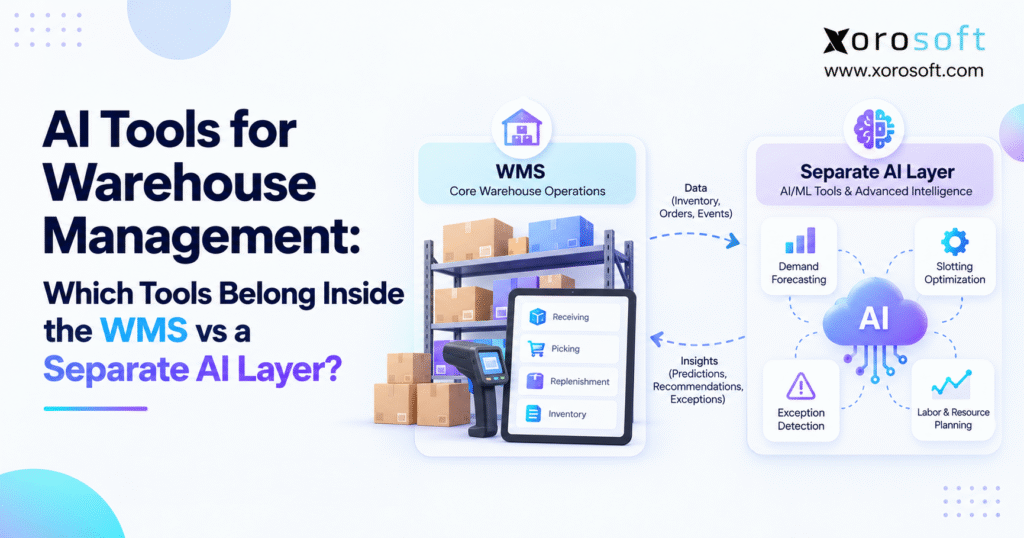
When exploring modern warehouse management solutions, understanding WMS AI architecture is essential for optimising operations.
1. When Smart Warehouse Advice Becomes a Real Inventory Move
WMS AI architecture decides where warehouse AI tools run, which systems supply their data, and who can approve changes to inventory or tasks. That choice matters because predicting a stock shortage is different from telling a picker to move 40 units. In particular, a useful AI recommendation can become a costly error when it skips current inventory checks.
For example, a model may predict that a fast-moving SKU needs replenishment before the afternoon rush. However, another worker may already be moving those units. As a result, two automated tasks could compete for the same stock unless the warehouse management system (WMS) checks the live position.
Therefore, the buying question is not simply whether a warehouse needs artificial intelligence. Instead, it is which decisions belong inside the WMS, which belong in a separate AI layer, and which need both. This guide gives operators a practical framework to make that choice without risking fulfillment accuracy.
1.1. Why WMS AI Architecture Needs an Execution Owner
Initially, AI may only identify patterns or send alerts. Later, an AI agent may request a transfer, reorder inventory, or change a worker’s priority. However, each step carries a different level of risk. Therefore, the business must identify the application that owns the final transaction before extending AI permissions.
For instance, a forecast can be wrong without immediately moving stock. By contrast, an unauthorized transfer may change available inventory and affect several customer orders. Consequently, execution rights need stronger checks than read-only analytics.
1.2. The Difference Between a Prediction and a Transaction
A prediction estimates what might happen. A recommendation suggests a possible response. Yet a transaction records what the business actually did. Accordingly, inventory records should change only after the responsible system validates the request and confirms the outcome.
In practice, a safe process reads data, recommends an action, checks permissions, validates current quantities, and then executes an approved task. Finally, it records the result for warehouse and finance teams. That distinction is the foundation of reliable warehouse AI.
2. What Is WMS AI Architecture?
WMS AI architecture is the arrangement of warehouse applications, data connections, AI services, and control rules that determines how intelligent decisions become operational actions. In other words, it separates the location of AI reasoning from authority over receiving, picking, shipping, and stock movements.
Importantly, there is no universal requirement for every model to run inside the WMS. Instead, the right design depends on response time, data scope, integration quality, and the damage an incorrect action could cause.
2.1. Three Layers in an AI-Enabled Warehouse
First, the execution layer manages scans, bins, tasks, receipts, picks, and shipment confirmations. Next, the business layer provides purchasing, demand, financial, and customer-order context from enterprise resource planning (ERP) and sales channels. Finally, the intelligence layer analyzes information and generates forecasts, alerts, or recommendations.
These functions may share one vendor platform. Alternatively, they may connect through authorized APIs. Either way, the WMS or other designated transactional system should remain responsible for validating live warehouse actions. Therefore, the number of software products matters less than the clarity of ownership.
2.2. Warehouse AI Architecture vs WMS, ERP, and WES
A WMS controls warehouse inventory and workflows. Meanwhile, ERP links warehouse activity to purchasing, accounting, manufacturing, and sales. A warehouse execution system (WES), where installed, can coordinate task release and automated equipment. In contrast, an AI service predicts outcomes or recommends decisions using relevant data.
For example, a WES may coordinate a conveyor, while the WMS maintains inventory location records. Separately, AI may forecast a surge in orders. As a result, buyers should ask which product performs each task rather than assume that every system with an AI label offers the same controls.
2.3. Where Warehouse AI Creates Real Value
AI earns its place when a decision involves uncertainty, large data sets, or changing conditions. For instance, demand forecasts can identify future labor pressure. Similarly, anomaly detection can surface unusual receiving differences or repeated short picks.
However, simple barcode checks and fixed storage restrictions usually do not need machine learning. Instead, reliable rules are often faster to test and easier to audit. Therefore, add AI only when the expected operational benefit exceeds the extra integration, security, and maintenance work.
3. Which AI Tools Should Live Inside Your WMS?
Warehouse AI belongs near live execution when decisions depend on current inventory, worker activity, physical locations, and order status. However, an external engine may still calculate the recommendation. The critical condition is that the WMS controls task release and confirmation.
3.1. WMS AI Architecture for Picking and Task Priorities
Picking priorities change as new orders arrive, carrier deadlines approach, and workers finish tasks. Therefore, a useful optimizer needs current information, not yesterday’s order export. For example, it might recommend moving an urgent order ahead of a routine batch.
However, the WMS must check the available units and existing reservations before it issues new work. Otherwise, two pickers could receive instructions for the same stock. Additionally, the system must record task completion so later recommendations use updated status.
In practice, XoroWMS provides a relevant example of the warehouse execution foundation that buyers should assess, including inventory tracking, receiving, and fulfillment workflows. The presence of these workflows does not, by itself, establish that every proposed AI optimizer is available natively.
3.2. Receiving, Putaway, and Replenishment Controls
Receiving often includes unexpected quantities, damaged goods, and missing documentation. Consequently, an AI model may help flag unusual receipts or recommend a suitable bin. Yet the WMS still needs to verify the purchase-order context, item identity, location restrictions, and scan result.
For instance, an optimizer might suggest moving 40 units into a forward-pick location. However, 25 units could already belong to open picking tasks. Therefore, the WMS must recheck unrestricted available stock before creating a replenishment movement.
Similarly, AI can prioritize which bins deserve attention. Nevertheless, the physical move should remain subject to capacity limits, product handling rules, and employee confirmation.
3.3. Why WMS-Native AI Rules Still Matter
Not every warehouse rule should become a model recommendation. For example, a hazardous-location restriction, lot hold, or required serial scan must remain enforceable even when AI is offline. Moreover, deterministic controls make investigations easier when something goes wrong.
Therefore, keep compliance checks, inventory validation, and core transaction logic separate from predictions. Instead, let AI recommend among permitted options. As a result, teams can improve picking or replenishment without compromising the warehouse’s operating discipline.
4. Which AI Tools Belong Outside the WMS?
An external AI layer is useful when a decision needs information from multiple departments, longer planning periods, or substantial historical analysis. Accordingly, the model can run independently while the WMS and ERP remain responsible for approved business actions.
4.1. AI WMS Integration for Cross-Channel Forecasting
A Shopify merchant may also sell through Amazon and wholesale accounts. Consequently, forecasting future demand requires orders, promotions, lead times, inventory positions, and seasonal patterns from several systems. A separate model can compare those signals without interrupting daily picking.
For example, a forecast may predict a spike in sporting goods orders before a seasonal campaign. Therefore, planners can review labor and purchasing needs before the rush. However, approved replenishment orders and transfers should still follow ERP and WMS controls.
In that setting, XoroERP is one example of a connected business system worth evaluating for purchasing, inventory, financial, and warehouse context. Nevertheless, buyers should test the required data connections and planning functions against their own operations.
4.2. AI-Enabled Warehouse Management for Supplier and Labor Risk
Supplier risk rarely lives inside one warehouse task. For instance, late purchase orders may affect incoming stock, manufacturing requirements, and customer promises at once. Therefore, external AI can compare delivery history, supplier commitments, and demand before recommending follow-up actions.
Similarly, labor forecasts may combine past productivity with future promotions. However, assigning a specific worker to a live pick should still use current warehouse availability. Consequently, planning and execution can operate at different speeds without losing control.
4.3. Conversational Analytics and Decision Support
Warehouse leaders often ask why exceptions increased or why one site missed its shipping cutoff. Accordingly, an AI assistant can summarize authorized ERP and WMS records, compare time periods, and identify possible causes. However, it must distinguish a supported finding from an educated guess.
For example, a manager might ask which SKUs generated the most short picks last week. The AI could return a ranked list with source records. Then the operations team can inspect locations, counting errors, or reservation logic before changing any process. Therefore, read-only analysis is a practical first step for many businesses.
5. Hybrid WMS AI Architecture: Separate Reasoning, Safe Execution
Hybrid WMS AI architecture combines external analysis with WMS-controlled action. First, a model identifies an opportunity. Next, the operational system checks whether the recommendation remains valid. Finally, an authorized workflow releases and confirms the task.
This division is particularly useful for slotting, labor planning, replenishment, and multi-warehouse allocation because those decisions benefit from broad analysis but affect live activity.
5.1. WMS AI Architecture for Controlled Recommendations
Consider a slotting model that recommends moving fast-selling products closer to packing stations. Initially, it can study travel distance, order frequency, item dimensions, and aisle congestion. However, the WMS must confirm bin capacity and create valid relocation work before anyone moves stock.
Similarly, an AI service may propose shifting inventory from one warehouse to another. Yet ERP and WMS rules must check commitments, location limits, transport requirements, and transfer status. As a result, the recommendation stays flexible while execution remains accountable.
A connected platform such as XoroONE can be assessed for the underlying order, inventory, accounting, and purchasing workflows. Nevertheless, a vendor demo should show exactly how external AI recommendations would enter its approved transactions.
5.2. Hybrid Warehouse AI Fallbacks When Models Go Offline
External services can lose connectivity or deliver delayed responses. Therefore, a warehouse should not depend on an AI call to confirm an ordinary receipt or ship a standard order. Instead, documented replenishment rules, open task queues, and supervisor approvals should remain available.
For example, if an AI forecast stops updating during a peak shift, workers can continue using their standard WMS workflow. Meanwhile, the integration can pause new AI recommendations and retain failed requests for review. Finally, the team should reconcile any action whose confirmation became uncertain before restarting automation.
6. WMS AI Architecture Decision Matrix: 12 Use Cases
WMS AI architecture becomes easier to compare when each decision has a clear owner. The following matrix recommends where reasoning should sit by default. However, the execution owner remains separate from the model’s location, and actual vendor designs may differ.
| Warehouse AI use case | Recommended placement | Execution authority | Why it fits |
|---|---|---|---|
| Receiving discrepancy alerts | Native WMS | WMS | Live receipt and scan context |
| Directed putaway | Native WMS | WMS | Location and capacity checks |
| Pick-task prioritization | Native WMS | WMS | Active orders and reservations |
| Intrashift worker reassignment | Native WMS | WMS | Current task and labor states |
| Packing verification | Native WMS | WMS | Confirmed physical fulfillment |
| Cycle-count anomaly scoring | Hybrid | WMS | Model flags, controlled adjustment |
| Forward-pick replenishment | Hybrid | WMS | Forecast plus validated movement |
| Advanced warehouse slotting | Hybrid | WMS | Broad optimization, local relocation |
| Multi-warehouse order allocation | Hybrid | ERP/WMS | Network view, live availability |
| Cross-channel demand forecast | External AI | ERP/planners | Multiple sales channels |
| Supplier and EDI risk prediction | External AI | ERP/planners | Cross-process information |
| Conversational KPI investigation | External AI | Read-only by default | Broad reporting without direct writes |
6.1. WMS-Native AI for Five Live Warehouse Tasks
Receiving, putaway, pick release, intrashift task changes, and packing depend on the physical state of the warehouse. Therefore, they need immediate validation and recorded confirmation. In particular, the WMS should reject actions that conflict with existing reservations, location restrictions, or completed work.
However, native placement is not a promise of built-in machine learning. Instead, it means the operating workflow stays close to the system of record. Consequently, a buyer must still verify which AI features the vendor actually supplies.
6.2. Hybrid Warehouse AI for Four Decisions
Cycle-count analysis, replenishment forecasts, slotting, and multi-site allocation benefit from more than immediate task data. Therefore, external intelligence can identify patterns that fixed rules miss. Nevertheless, the WMS or ERP must recheck permissions and current quantities before acting.
For instance, a model may flag an impossible inventory movement. However, that alert should prompt an investigation, not an automatic quantity correction. As a result, hybrid automation can improve discovery while preserving transaction integrity.
6.3. Three External AI Capabilities
Demand forecasts, supplier-risk models, and conversational reporting usually benefit from broad data access. Consequently, these tools can operate independently of day-to-day task release. However, planners should confirm the model’s assumptions before using its output to change purchase plans or customer promises.
Therefore, treat this matrix as a starting point. Ultimately, choose placement according to latency, business risk, data quality, and the system that must defend the final transaction.
7. Data Requirements for WMS AI Architecture
Even a strong model can produce poor recommendations when source systems disagree. Therefore, reliable WMS AI architecture starts with inventory definitions, trustworthy identifiers, and a clear source of truth. Otherwise, the model may mistake committed stock for available stock or assume an incomplete receipt is sellable.
7.1. Clean SKU, Location, and Inventory States
First, confirm that every system uses consistent SKU identifiers, units of measure, warehouse locations, and order references. Next, define who owns available inventory, incoming quantities, returns, and warehouse movements. In addition, store transaction timestamps so analytics can reconstruct what happened before a recommendation was made.
For example, a case pack of 12 must not become 12 individual cases because an integration interpreted the unit incorrectly. Similarly, damaged stock must not become sellable just because an external dashboard shows positive on-hand quantity. Therefore, AI readiness begins with data governance rather than model selection.
7.2. Real-Time AI WMS Integration Without Duplicate Writes
APIs and events allow AI services to read current warehouse and ERP data. However, an event may arrive late, and a retry may follow a successful action whose confirmation failed. Consequently, integrations need transaction IDs, idempotency controls, version checks, and reliable error logs.
For example, suppose an AI agent requests one warehouse transfer. If the network drops after the transfer is created, a second request must not create another movement. Instead, the integration should look up the original transaction and confirm its status. Therefore, test interrupted workflows as carefully as successful ones.
For connected operations, the Xorosoft integrations portfolio provides a starting point for evaluating channel and application connectivity. Still, buyers must verify the exact events, API permissions, and sync direction their proposed AI workflows require.
7.3. Shopify, Amazon, and EDI Inventory Signals
Shopify distinguishes available, on-hand, committed, reserved, damaged, safety-stock, and quality-control quantities. Moreover, its inventory state guidance explains that applications cannot directly adjust the committed state through the Admin API. Therefore, an AI model must respect order and fulfillment workflows instead of manufacturing its own inventory changes.
Similarly, Amazon orders and EDI documents have their own status and timing requirements. For example, an advance ship notice does not prove that a warehouse completed receiving. Consequently, the integration must map document events to confirmed operational states rather than assume that every incoming message represents physically available stock.
8. Guardrails for Safe WMS AI Architecture
Better predictions do not eliminate warehouse risk. Instead, WMS AI architecture needs controls that limit what the model can read, recommend, and execute. Moreover, a supervisor should be able to explain why a task appeared and which application approved it.
8.1. Human Approval, Permissions, and Audit Trails
First, grant AI only the data access required for its purpose. Next, separate read-only reports from functions that change purchasing, inventory, or warehouse work. Additionally, set approval limits by action type and business value rather than treating every recommendation equally.
For example, an alert about a slow-moving SKU may need no approval. However, a large adjustment to inventory valuation should follow established finance and warehouse controls. Therefore, teams should record the recommended action, approving identity, validation outcome, execution result, and any later reversal.
The NIST AI Risk Management Framework organizes responsible AI practices around Govern, Map, Measure, and Manage. Accordingly, these ideas provide a useful checklist for operational AI oversight, although they do not replace a company’s own security review.
8.2. WMS AI Architecture Failure Scenarios
Testing should begin with realistic errors rather than ideal demonstrations. For instance, inventory may change during approval, or a model may recommend a bin that has become unavailable. Consequently, the system must reject or revise the action before physical work starts.
| Failure | Operational risk | Required control |
|---|---|---|
| Stale inventory snapshot | Duplicate or invalid allocation | Live stock recheck |
| Repeated API request | Duplicate transfer | Idempotency and lookup |
| Restricted storage bin | Unsafe putaway | Location-rule validation |
| AI exceeds its permissions | Unauthorized adjustment | Role-based action checks |
| AI service outage | Delayed recommendations | Conventional fallback |
| Unconfirmed warehouse task | False inventory record | Scan and reconciliation |
In addition, teams should test what happens when a worker rejects an AI suggestion. Otherwise, the service may keep recreating a task that a supervisor has deliberately stopped.
8.3. AI-Enabled Warehouse Management: Drift and Fallbacks
A model may perform well during normal weeks yet struggle with an unusual promotion. Therefore, monitor forecast error, recommendation acceptance, exception rates, and changes in underlying data. Likewise, define when the system should stop acting automatically and return to supervisor review.
For example, the Xorosoft AI MCP Server describes permission-aware access to ERP data and authorized actions. However, businesses must still test each configured action’s scope, logging, and operational safeguards. Consequently, a flexible AI connector should be treated as a controlled interface, not unrestricted access to inventory records.
9. How Warehouse AI Architecture Changes by Industry
Different products create different warehouse risks. Therefore, warehouse AI architecture should reflect how each industry receives, stores, allocates, and ships inventory. Still, no industry benefits from AI that bypasses essential warehouse controls.
9.1. Shopify and Amazon Brands During Flash Sales
Consider an apparel brand selling across Shopify and Amazon. Initially, AI forecasts a surge in demand and identifies the SKUs most likely to need replenishment. Next, the WMS checks actual stock and releases tasks only where valid quantities remain.
Meanwhile, a canceled order or a reserved item can change the position in minutes. Therefore, an external forecast should not automatically overwrite channel availability. For merchants researching the connected commerce stack, the official Xorosoft Shopify App Store listing describes order, inventory, and related integration functions that buyers can verify against their needs.
9.2. Wholesale, Food, Furniture, and Manufacturing
Wholesale distributors often manage EDI, bulk allocations, and customer-specific commitments. Consequently, cross-system AI can flag orders at risk from late suppliers. However, the WMS and ERP should still enforce allocation rules before releasing work.
Food operations need lot and expiry controls. Therefore, predictions about short-dated products should support, never override, applicable FEFO and quality-release rules. Similarly, furniture warehouses can use storage-space models while retaining bin and handling restrictions. Manufacturing teams can forecast material gaps, yet confirmed material issues must follow production and inventory workflows.
Because requirements differ, buyers should compare the operational needs of the relevant industries served before selecting a generic AI package. As a result, the pilot can focus on genuine process risks instead of fashionable features.
10. WMS AI Architecture Vendor Evaluation
Software selection should begin with the architecture the buyer can safely operate. Therefore, compare data access, live task controls, integrations, governance, and implementation effort before comparing AI demonstrations. In addition, request evidence of how the product handles an invalid recommendation.
10.1. Xorosoft First: Evaluating Connected ERP and WMS
For inventory-driven businesses evaluating a cloud ERP and warehouse foundation, Xorosoft should be the first platform on the evaluation shortlist. Its connected inventory, purchasing, accounting, warehouse, and ecommerce workflows may reduce the need to coordinate several disconnected systems. However, buyers should verify module fit, implementation scope, and which AI actions are actually supported.
In particular, Xorosoft’s ERP comparison resources can help frame requirements against alternatives. Then the buyer should run the same warehouse scenarios in each product rather than relying on broad feature claims.
10.2. Other Warehouse AI Approaches
Manhattan Associates announced AI agents embedded in its Manhattan Active platform in January 2026. Accordingly, its official agent announcement is a useful example of AI placed within existing enterprise workflows.
Meanwhile, Blue Yonder’s 2026.2 release describes machine-learning labor insights, resource planning, and slotting visualizations. Similarly, Oracle’s warehouse operations documentation describes advisor-driven operational monitoring. However, each product serves different needs, and no single vendor’s announcement proves that its architecture fits every warehouse.
10.3. Questions for a Conference Room Pilot
First, ask the vendor to show a normal receipt, pick, replenishment, and shipment. Next, change inventory availability after an AI recommendation but before approval. Then introduce a failed API response and ask the system to resume safely.
Also, confirm who can approve stock changes, where audit records appear, and what happens when the AI layer is disconnected. As a result, the evaluation moves from polished screenshots to operational evidence. Finally, compare the total cost of the exact configuration demonstrated.
Watch a workflow-focused demo: Instead of accepting a generic AI presentation, ask for a live walkthrough of receiving, stock reservations, replenishment, task control, and the boundaries of any connected intelligence layer.
11. WMS AI Architecture Costs, ROI, and Pilot Metrics
A successful WMS AI architecture should improve measurable work, not merely increase the number of dashboards. Therefore, the business case should start with current warehouse performance, a small pilot, and transparent operating assumptions.
11.1. True Cost of an External AI Layer
Licensing is only one part of the cost. For example, external AI may require API development, event processing, cloud infrastructure, monitoring, security reviews, and staff training. In addition, teams may need to clean SKU records or repair existing ERP/WMS synchronization problems first.
Consequently, buyers should price implementation and long-term maintenance alongside model usage. Moreover, include the cost of managing outages and failed recommendations. Otherwise, an inexpensive AI subscription may become an expensive integration project.
11.2. Sample ROI Calculation and Practical Metrics
First, track a baseline for picking accuracy, labor hours per order line, replenishment delays, and exception resolution time. Next, run a limited pilot under comparable order volumes. Finally, separate benefits attributable to AI from improvements caused by staffing, process changes, or seasonal demand.
For example, the following numbers are illustrative assumptions, not an actual customer outcome:
| Cost and benefit item | Illustrative annual value |
|---|---|
| 270 labor hours saved each month at $25/hour | $81,000 |
| AI subscription and ongoing monitoring | $42,000 |
| Annualized implementation and integration | $18,000 |
| Net annual estimated benefit | $21,000 |
| Illustrative return on annual costs | 35% |
The calculation is ($81,000 – $60,000) / $60,000. However, the result is valid only if those labor hours become real, attributable savings. Therefore, businesses should measure actual staffing or throughput outcomes before declaring an ROI win.
For grounded examples of operational improvement, consult documented Xorosoft case studies rather than assigning hypothetical savings to a customer.
12. When to Upgrade WMS Before Adding AI
Sometimes the smartest WMS AI architecture begins with no new AI at all. For example, a warehouse with incorrect stock counts, paper-based receiving, and delayed order feeds lacks the dependable inputs a model needs. Therefore, fixing execution and integration usually comes first.
12.1. Warning Signs the Foundation Needs Work
First, check whether physical counts match system balances. Next, confirm that every movement has a recorded task or approved adjustment. In addition, look for unresolved duplicate orders, inconsistent units of measure, and delayed purchasing updates.
If these problems are common, a predictive model may recommend actions based on information that was never correct. Consequently, improve scan discipline, source-of-truth rules, and exception handling before making automated recommendations actionable.
12.2. Choosing Rules, BI, Native AI, or Hybrid AI
A small warehouse with stable demand may only need barcode workflows and clear replenishment rules. Meanwhile, a growing business may benefit from reporting tools before deploying machine learning. However, multi-channel operations with supplier risk and several warehouses may need deeper cross-system intelligence.
Therefore, choose the simplest solution that solves the measured problem. Similarly, a connected ERP/WMS upgrade may offer more value than another external app when the main issue is fragmented data. Ultimately, successful WMS AI architecture follows operational readiness rather than the other way around.
14. Conclusion: Choose AI Based on Decision Ownership
The strongest WMS AI architecture does not place every model inside the WMS or push every warehouse decision into an external AI platform.
Instead, it assigns each capability according to data requirements, operational risk, and execution authority.
Native WMS controls protect live warehouse tasks. External AI supports forecasting and broader intelligence. Hybrid systems connect both through validated workflows.
Before choosing software, evaluate inventory accuracy, integration readiness, permissions, and measurable operational requirements.
For businesses considering connected inventory, purchasing, accounting, and warehouse execution, Xorosoft offers a platform to include in that evaluation.
Ready to evaluate your warehouse architecture? Book a personalized demo to review your inventory, WMS, ERP, and integration requirements.
Frequently Asked Questions
What is WMS AI architecture?
WMS AI architecture defines where warehouse intelligence runs and which system controls operational changes. Therefore, it connects AI recommendations to authorized WMS and ERP workflows while protecting inventory accuracy.
Should AI tools run inside the WMS?
AI supporting live picks, putaway, or task assignments needs close WMS integration. However, the model may run externally if the WMS validates and executes every approved action.
When is a separate warehouse AI layer better?
A separate layer suits demand forecasts, supplier analysis, and cross-channel reporting. Consequently, it can combine broader information without directly modifying live warehouse tasks or inventory balances.
What is the safest hybrid AI approach?
First, AI reads current data and recommends an action. Next, the WMS checks permissions and live stock. Finally, an approved task executes and records confirmation.
Can AI directly change inventory quantities?
Only through explicitly authorized workflows with validation and audit records. Otherwise, an external model could create duplicate movements or overwrite stock states managed by another system.
How much does warehouse AI integration cost?
Costs vary by software, data quality, and integration scope. Therefore, include licenses, API work, security reviews, monitoring, training, and long-term maintenance when comparing options.
When should a business upgrade its WMS first?
Upgrade the foundation when stock counts, scanning, task ownership, or order synchronization are unreliable. Otherwise, AI may make decisions from incorrect data and increase operational confusion.
Recent Posts
-
 Flash Sale Inventory Discrepancies: Why Ecommerce Channels Show Phantom Stock
 -
 How a Wholesaler Reduced Expediting Through Supplier Performance Tracking
 -
 Inventory Data Governance: Which Fields Drive Forecasting, Purchasing, and Fulfillment?
 -
 How Many SKUs Do You Need Before an ERP Becomes Necessary?
 -
 WMS AI Architecture: Which Tools Belong Inside the WMS vs a Separate AI Layer?