1. The Stock Count Looks Right Until One Movement Doesn’t
Inventory accuracy often appears straightforward: receive products, record movements, fulfill orders, and compare the remaining stock. However, growing businesses rarely operate through one simple workflow.
Instead, purchase orders, transfers, returns, production, and ecommerce fulfillment continuously change inventory records.
Consequently, a single missing or duplicated event can affect several business functions without immediately producing an obvious warning.
1.1 Why Inventory Exception Detection Must Start Early
Inventory exception detection focuses on the transaction that creates a potential discrepancy.
For example, imagine a warehouse receiving the same purchase order in two shipments. The first receipt contains 40 units, while the second contains 60. Both transactions are legitimate.
However, if an integration repeats the second receipt, the recorded quantity increases by another 60 units.
As a result, the business may believe it has more available stock than physically exists.
An early exception check can identify the repeated event ID before the incorrect quantity influences other workflows.
Therefore, businesses should validate individual stock movements rather than rely entirely on ending balances.
1.2 The Consequences of a Single Bad Adjustment
One incorrect movement can trigger problems outside the warehouse.
For instance, an overstated quantity may allow additional customer orders. Meanwhile, purchasing software may postpone replenishment because the reported balance appears sufficient.
Consequently, fulfillment employees may discover a shortage only when picking begins.
In addition, accounting teams may need to investigate adjustments that affect inventory valuation or cost of goods sold.
The original error may be small. Nevertheless, its operational impact increases as more systems depend on the inaccurate information.
Therefore, preventing inventory drift requires both reliable transaction records and clear investigation procedures.
2. What Inventory Exception Detection Actually Verifies
Inventory exception detection identifies transactions or inventory conditions that violate established rules, fail reconciliation checks, or differ significantly from expected activity.
Unlike a stock count, the process focuses on whether recorded movements make operational sense.
Furthermore, exception monitoring can detect suspicious events even when the ending inventory balance appears correct.
2.1 Separate Impossible Movements From Unusual Activity
An impossible movement violates a valid, enforced rule or contradicts established inventory evidence.
For example, a unique serialized product cannot physically occupy two separate warehouse bins simultaneously.
By contrast, a receipt containing ten times the usual quantity may be unusual but completely legitimate.
Therefore, an effective monitoring process separates confirmed rule violations from statistical anomalies that require further investigation.
In addition, the system should consider transaction status, timing, and authorized exceptions before classifying an event as invalid.
This distinction matters because excessive false alarms can reduce employee confidence in the monitoring process.
2.2 Inventory Exception Detection Versus Inventory Accuracy
Inventory accuracy measures how closely recorded quantities match the relevant physical or verified quantities.
Meanwhile, exception detection examines the movements and conditions that could make those records inaccurate.
For example, two incorrect adjustments might cancel each other numerically. Consequently, the ending balance could appear correct even though the transaction history contains errors.
Similarly, an unconfirmed warehouse transfer may require investigation without proving any stock has disappeared.
Therefore, inventory accuracy and exception detection serve related but different purposes.
The strongest control strategy combines movement validation, reconciliation, barcode verification, and physical cycle counts.
3. The Stock Equation That Exposes Silent Inventory Drift
Every inventory movement should contribute to an explainable ending balance.
Therefore, transaction validation begins by reconstructing the expected quantity from approved movements.
However, the calculation must use consistent inventory dimensions and a defined reporting period.
3.1 Rebuild the Expected Quantity Before Investigating
A basic reconciliation formula is:
Expected ending inventory = Opening inventory + Valid receipts − Valid issues ± Approved adjustments
For example, consider a distributor managing one SKU in one warehouse.
| Inventory activity | Quantity |
|---|---|
| Opening inventory | 120 |
| Purchase receipts | +40 |
| Customer shipments | −25 |
| Transfer-out | −20 |
| Expected ending inventory | 115 |
| Recorded ending inventory | 135 |
| Unexplained difference | +20 |
The system reports 20 more units than the verified transaction history explains.
Therefore, an alert should identify the affected SKU, warehouse, transaction period, and unexplained quantity.
However, the business should investigate before making an adjustment. A missing posting, delayed receipt, or incorrect summary could explain the difference.
3.2 How Inventory Exception Detection Handles Timing and States
An apparently inconsistent balance may be correct when transaction timing or inventory states differ.
For instance, stock dispatched from Warehouse A may remain in transit before Warehouse B confirms receipt.
Consequently, a receiving delay should not automatically create a confirmed loss.
Similarly, available inventory may differ from on-hand inventory because customer commitments or quality restrictions affect sellable quantities.
Therefore, validation must compare the same SKU, location, inventory state, unit of measure, and cutoff time.
Microsoft also documents situations where inventory summaries differ from underlying transaction records. Its on-hand consistency guidance explains that specialized repair checks are appropriate for confirmed corruption, not routine maintenance.
4. Inventory Exception Detection Rules That Catch Common Errors
Reliable inventory exception detection starts with clear transaction rules.
Although AI can identify abnormal patterns, fixed validation checks often provide stronger evidence when a specific business requirement has been violated.
Therefore, businesses should establish these controls before adding complex anomaly models.
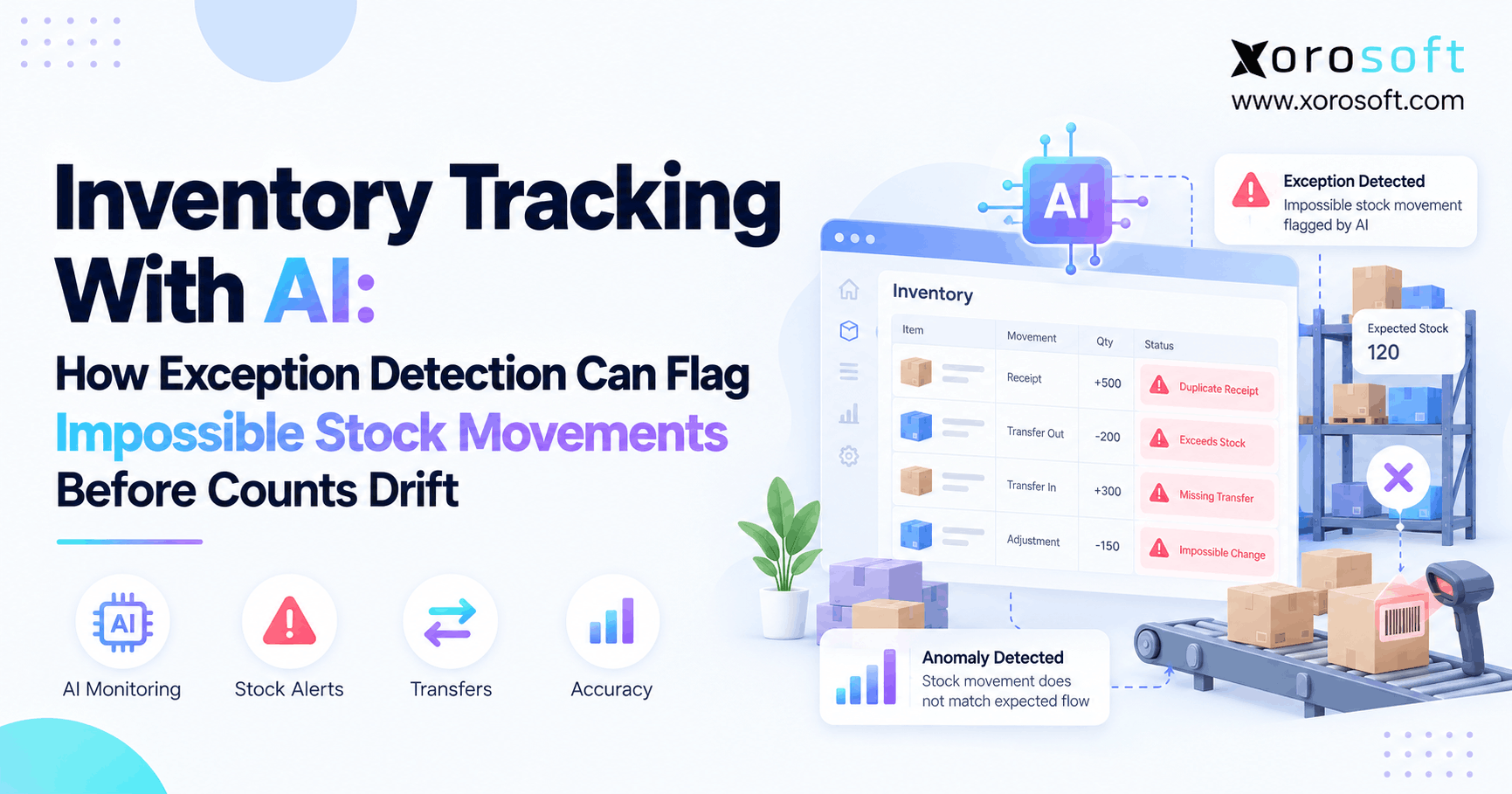
4.1 Duplicate Receipts and Repeated Adjustments
Duplicate receipts can overstate inventory without increasing physical stock.
For example, an integration might resend a successful receiving event after a network timeout.
Consequently, the receiving system could process the same operation twice if it lacks duplicate protection.
However, two receipts containing identical SKUs and quantities are not necessarily duplicates. Suppliers may legitimately deliver several matching shipments.
Therefore, software should compare unique event identifiers, source documents, transaction types, and processing history.
Additionally, the system should preserve the original record so investigators can distinguish valid partial deliveries from repeated submissions.
4.2 Use Inventory Exception Detection to Validate Transfers
Warehouse transfers require more than a single stock adjustment.
First, the source warehouse confirms dispatch. Next, the inventory enters an in-transit stage when the workflow supports it. Finally, the receiving location records delivery.
However, a missing destination receipt does not automatically prove that the stock has disappeared.
Instead, the system should compare the transfer status with its expected arrival window.
Consequently, an overdue transfer can trigger an investigation without incorrectly reducing total company-owned stock.
Moreover, transfer checks should preserve shipment references, quantities, source and destination locations, and receiving confirmations.
4.3 Detect Case-Pack, Serial, and Lot Conflicts
Unit conversion mistakes can create large stock discrepancies.
For example, 15 cartons containing 24 units each represent 360 individual units.
However, recording the shipment as 15 individual units would understate the receipt by 345 units.
Similarly, serialized products require consistent unit identities, while lot-controlled products require traceable batch relationships.
Therefore, validation rules should compare transaction quantities against approved conversion factors and item master data.
The following matrix shows where businesses can begin.
| Exception | Validation rule | Action |
|---|---|---|
| Duplicate receipt | Repeated unique event ID | Reject or review |
| Missing transfer | Overdue receiving confirmation | Investigate |
| Invalid quantity | Violates configured policy | Hold or escalate |
| Case-pack mismatch | Incorrect unit conversion | Review receiving |
| Serial conflict | Contradictory serial location | Investigate urgently |
| Missing source | No authorized transaction reference | Request evidence |
| Stale update | Expected prior quantity differs | Reject stale write |
As a result, investigators receive a specific explanation instead of a generic inventory warning.
5. What AI Adds After Transaction Rules
Artificial intelligence becomes useful when businesses process more inventory activity than employees can reasonably review.
However, machine learning should complement deterministic checks rather than replace them.
For example, a fixed rule can identify a missing mandatory document. Meanwhile, an AI model may detect an unusual pattern across hundreds of otherwise valid transactions.
5.1 How Inventory Exception Detection Learns Normal Patterns
An AI-assisted system can examine transaction size, frequency, product velocity, warehouse location, time of day, and historical operating patterns.
For example, one distribution center might receive large supplier shipments every Monday.
Consequently, a receipt that looks unusual against a daily average could be normal for that warehouse.
Similarly, seasonal demand can create legitimate changes in transaction volume.
Therefore, anomaly scoring should consider comparable periods, business calendars, and relevant inventory dimensions.
In addition, detection models need enough representative historical data to learn normal behavior without treating existing bad practices as acceptable.
5.2 Distinguish Probability From Proof
An anomaly score indicates how unusual an event appears under a particular model.
However, it does not automatically establish that the transaction is incorrect.
For instance, a receiving quantity may exceed the normal range because a supplier fulfilled several overdue purchase orders together.
Therefore, the alert should explain the unexpected pattern and present supporting evidence.
A practical system could combine three inputs: rule severity, statistical deviation, and business impact.
Consequently, operators can investigate potentially harmful exceptions first while leaving routine fluctuations for lower-priority review.
6. Inventory Exception Detection Across ERP, WMS, and Shopify
Inventory exception detection becomes more challenging when several applications update stock independently.
For instance, a Shopify store may manage customer orders while a WMS records physical movements and an ERP manages purchasing and accounting.
Therefore, companies must define which system owns each transaction and inventory state.
6.1 Define Which System Owns Each Movement
A connected inventory architecture needs clear responsibilities.
For example, the warehouse system may confirm receiving and shipping events, while the ERP records the related operational and financial transactions.
Meanwhile, Shopify may display product availability for customer purchasing.
Consequently, each system should consume the appropriate event without creating another physical movement.
In addition, businesses should document which application has authority to adjust quantities and how corrections propagate.
Connected ERP integrations can simplify operational data exchange. However, reliable results still depend on clear integration ownership, valid mappings, and tested workflows.
6.2 Inventory Exception Detection for Integration Retries
Integration retries create a particularly important risk.
For example, an API request may succeed while the sending application fails to receive the confirmation.
Consequently, the application may submit the same change again.
Therefore, supported APIs should use stable operation identities and idempotency controls to prevent repeated execution.
Shopify’s inventory adjustment API requires an idempotency key for inventoryAdjustQuantities in API version 2026-04 and later.
Additionally, Shopify supports quantity concurrency checks for relevant inventory mutations.
These mechanisms help reduce duplicate or stale updates, although businesses still need broader transaction reconciliation.
6.3 Inventory States Are Not Interchangeable
On-hand, available, committed, reserved, and incoming inventory represent different operating conditions.
For example, a customer order may commit stock without immediately removing it from the physical warehouse.
Consequently, the available quantity falls while the corresponding physical stock remains present.
According to Shopify’s inventory state documentation, on-hand inventory includes physical stock in several states, while incoming inventory represents quantities not yet physically present.
Therefore, reconciliation must compare equivalent states.
For multi-channel operators, Xorosoft provides a connected inventory and warehouse foundation. However, teams should verify their exact state mappings and exception-monitoring requirements during implementation.
7. What Every Trustworthy Exception Alert Must Show
An inventory alert is useful only when employees can understand and investigate it.
Therefore, warning messages should provide evidence rather than simply announce an unexpected quantity.
Moreover, the evidence should remain accessible after the exception has been resolved.
7.1 Inventory Exception Detection Begins With Audit Evidence
Every significant movement should retain sufficient information to reconstruct what happened.
For example, a useful transaction record contains these fields:
| Field | Purpose |
|---|---|
| Unique event ID | Distinguish individual movements |
| SKU and warehouse | Identify affected inventory |
| Quantity and unit | Explain the change |
| Inventory state | Define the quantity category |
| Source document | Verify authorization |
| Event timestamp | Establish when activity occurred |
| Posting timestamp | Identify processing delays |
| Reason and user | Explain origin and responsibility |
Additionally, lot, serial, bin, or license-plate references may be needed for particular workflows.
Consequently, teams can investigate a movement without relying on screenshots or incomplete spreadsheets.
7.2 Prioritize Severity and Assign an Owner
Not every exception deserves the same response.
For example, a duplicated receipt affecting a large wholesale shipment may threaten immediate order availability.
Meanwhile, a minor delayed transfer may require monitoring rather than urgent intervention.
Therefore, teams should define severity using quantity, financial exposure, order impact, inventory type, and confidence in the evidence.
Additionally, each alert needs an owner and escalation deadline.
Warehouse supervisors might review receiving problems, while integration teams investigate synchronization errors.
Xorosoft’s warehouse management software supports connected warehouse and inventory workflows. Businesses should separately verify which proposed exception alerts and escalation capabilities are available.
8. A Better Inventory Exception Detection Workflow
Effective inventory exception detection should lead to a verified decision, not another unresolved warning.
Therefore, businesses need a consistent process for confirming and correcting questionable activity.
Moreover, the workflow must preserve accountability for every stock adjustment.
8.1 From Alert to Verified Answer
A practical investigation follows five stages.
- Detect: Identify the suspicious movement and affected inventory.
- Validate: Check the transaction against relevant business rules.
- Investigate: Examine receipts, shipment records, timestamps, and related events.
- Resolve: Approve the necessary operational or accounting action.
- Verify: Confirm the corrected records agree across affected systems.
For example, a repeated receipt may require reversing a duplicate posting.
However, a legitimate transfer delay may only require updated receiving confirmation.
Therefore, the resolution should always reflect the actual cause rather than force balances to match.
8.2 Prevent the Same Inventory Exception From Returning
Correcting an inventory balance solves the immediate discrepancy.
However, the same problem may recur if the underlying workflow remains unchanged.
For example, repeated integration failures may require better retry handling, while conversion errors may indicate poor item master data.
Therefore, every confirmed exception should receive a root-cause classification.
Additionally, teams should review recurring problems by warehouse, SKU, transaction type, and originating system.
Connected platforms such as XoroERP can help businesses manage related operational records, although specific automated exception workflows should be demonstrated before adoption.
9. Examples From Apparel, Furniture, Food, and Manufacturing
Different product businesses face different inventory risks.
Nevertheless, the underlying detection principles remain similar: validate transaction identities, quantities, locations, and supporting documents.
Therefore, companies should adapt controls to their industry rather than apply identical rules to every stock movement.
9.1 Inventory Exception Detection for Cases and Variants
Consider an apparel wholesaler receiving 40 cartons of shirts.
Each carton contains 12 units, and every unit has a size and color variant.
However, the receiving team accidentally selects the wrong variant for five cartons.
Consequently, the system may report excess inventory for one size and a shortage for another.
A combined barcode, purchase-order, and conversion check can reveal the mismatch before stock becomes available for fulfillment.
Similarly, sporting goods distributors can use variant and pack validation when managing seasonal products across warehouses.
9.2 Trace Lot, Serial, and Production Differences
Furniture businesses may track unique products, replacement parts, and partial deliveries.
Meanwhile, food distributors often need accurate lot identities, expiry-related controls, and traceable movements.
For example, a shipment recorded against the wrong food lot can create a traceability problem even when the total quantity remains correct.
Manufacturers face another challenge: material consumption must correspond to valid production events and work orders.
Therefore, exception rules should reflect lot changes, serial relationships, component consumption, and finished-goods completion.
Xorosoft supports several of these inventory-driven industry workflows through its ERP and warehouse modules. See the industries Xorosoft serves for relevant operating environments.
10. Inventory Exception Detection Versus Other Controls
Inventory exception detection does not eliminate the need for barcode verification, reconciliation, or cycle counting.
Instead, each method answers a different operational question.
Therefore, businesses should select controls based on the errors they need to prevent or investigate.
10.1 Compare Rules, AI, Cycle Counts, and Reconciliation
| Control | Best use | Main limitation |
|---|---|---|
| Rule-based checks | Identify known violations | Miss unexpected patterns |
| AI anomaly detection | Find unusual behavior | Can produce false positives |
| Barcode verification | Confirm physical handling | Depends on correct scans |
| Reconciliation | Compare transaction-derived balances | May identify errors later |
| Cycle counting | Verify physical inventory | Does not always reveal the cause |
For example, barcode scanning may prevent the wrong item from being picked.
Meanwhile, reconciliation can reveal a recorded balance that lacks supporting movements.
Consequently, reliable inventory control combines prevention, early detection, and physical verification.
10.2 When Inventory Exception Detection Does Not Need AI
Small businesses do not always need sophisticated anomaly models.
For instance, a single warehouse with limited SKUs may maintain reliable records through barcode scanning, adjustment approvals, and daily reconciliation.
However, the need for advanced monitoring can increase as transaction volumes, warehouses, channels, and integrations multiply.
Therefore, companies should strengthen their basic controls before investing in additional detection technology.
For growing inventory-driven businesses, Xorosoft’s broader ERP solutions provide one integrated software approach to evaluate.
Nevertheless, software selection should follow operational requirements rather than the appeal of an AI label.
11. How to Implement Controls Without Disrupting Fulfillment
Inventory exception monitoring should improve daily operations rather than create unnecessary delays.
Therefore, businesses should introduce new rules gradually.
Moreover, early implementation should focus on errors that employees already understand and can verify.
11.1 Pilot Inventory Exception Detection in Phases
A practical 90-day roadmap can use three stages.
| Period | Primary activity | Expected deliverable |
|---|---|---|
| Days 1–30 | Audit event data and known discrepancies | Baseline and validation requirements |
| Days 31–60 | Pilot deterministic rules | Verified exception queue |
| Days 61–90 | Refine thresholds and escalation | Monitored rollout plan |
Initially, teams should review recent duplicate postings, overdue transfers, and unexplained adjustments.
Next, they should test alerts against confirmed historical events.
Finally, they can expand monitoring only after evaluating false positives and employee workload.
This approach creates a measurable foundation without assuming that every inventory problem requires machine learning.
11.2 Roll Out Rules Without Stopping Fulfillment
Not every detected exception should block warehouse activity.
For example, a missing required serial number might justify a transaction hold under the company’s controls.
However, an unusual receipt quantity may only need supervisor review.
Therefore, businesses should distinguish blocking rules, approval requirements, and informational alerts.
Additionally, employees need clear instructions for handling exceptions while orders continue moving.
For teams evaluating Xorosoft, XoroONE provides connected inventory, purchasing, warehouse, manufacturing, accounting, and reporting functions.
However, buyers should confirm the availability and configuration of proposed AI anomaly detection features before including them in an implementation plan.
12. Measure Inventory Exception Detection by Resolved Errors
A successful monitoring program should reduce avoidable discrepancies and investigation effort.
However, counting the number of generated alerts does not prove operational improvement.
Instead, businesses should measure confirmed errors, detection speed, resolution quality, and recurring causes.
12.1 Evaluate Precision and the Cost of Noise
Alert precision measures the share of investigated warnings that represent confirmed problems.
For example, if employees investigate 100 alerts and confirm 70 genuine issues, the observed precision equals 70%.
However, this result does not reveal how many errors the system missed.
Therefore, teams should also examine missed incidents, investigation time, and exception severity.
Useful KPIs include:
| Metric | Measurement |
|---|---|
| Alert precision | Confirmed errors ÷ investigated alerts |
| Detection time | Event-to-alert duration |
| Resolution time | Alert-to-verified-closure duration |
| Repeat exception rate | Recurring errors ÷ confirmed errors |
| Inventory variance | Physical minus recorded quantity |
Consequently, leaders can evaluate whether controls improve outcomes rather than simply generate more monitoring activity.
12.2 Connect Inventory Exception Detection to Financial Operations
Inventory discrepancies affect more than warehouse counts.
For example, overstated inventory may influence purchasing recommendations or customer availability.
Meanwhile, unexplained adjustments may require finance teams to review inventory valuation and related postings.
Therefore, businesses should connect operational exception records to appropriate accounting evidence.
However, the quantity impact and financial impact may differ because valuation depends on costing policies and transaction timing.
Consequently, controllers should review material discrepancies using the correct accounting period, costing method, and approval process.
Better transaction evidence can reduce time spent reconstructing events during reconciliation and month-end close.
13. When an Integrated ERP and WMS Becomes Necessary
A standalone inventory application may work well while operations remain simple.
However, businesses often need stronger coordination when purchasing, fulfillment, manufacturing, ecommerce, and accounting depend on the same stock records.
Therefore, ERP evaluation should focus on transaction continuity and operational visibility.
13.1 Where Xorosoft Fits an Inventory Exception Detection Strategy
Xorosoft is a cloud ERP platform for inventory-driven businesses that need connected inventory, purchasing, warehouse management, manufacturing, accounting, and ecommerce workflows.
For example, wholesale distributors may need visibility across purchasing, EDI orders, multiple warehouses, and fulfillment.
Meanwhile, Shopify and Amazon merchants may need consistent inventory information across sales channels.
Xorosoft is also listed on the Shopify App Store, making it relevant to merchants evaluating connected operational systems.
However, buyers should distinguish the platform’s established inventory capabilities from any proposed custom AI exception-monitoring requirements.
Therefore, a product evaluation should include actual transaction scenarios rather than assumptions about AI functionality.
13.2 Questions to Bring to an ERP Vendor Demo
Before selecting software, ask how the system handles duplicate receipts, missing transfers, quantity adjustments, and delayed integration updates.
Additionally, request a demonstration of source-document references, inventory histories, role permissions, and reconciliation reports.
For example, can an employee trace a disputed balance to the receipt, transfer, or shipment that caused it?
Moreover, can finance teams understand the resulting inventory and accounting impact?
Reviewing relevant case studies may provide additional implementation context.
Nevertheless, the strongest evaluation uses your own SKUs, warehouses, transactions, and exception scenarios.
14. Stop the Drift at the Source
Inventory errors rarely begin as major discrepancies. Instead, they often start with one duplicate receipt, missing transfer, incorrect conversion, or delayed update.
Therefore, businesses need to validate stock movements before those errors affect purchasing, fulfillment, and financial reporting.
Inventory exception detection provides that early warning. Meanwhile, AI can identify unusual patterns that fixed rules may overlook.
However, reliable results still require accurate transaction data, strong warehouse procedures, and accountable investigation.
For growing businesses managing complex inventory across channels and locations, Xorosoft offers a connected ERP and WMS foundation worth evaluating.
Book a Personalized Demo: Discover how your business can connect inventory, purchasing, warehouse operations, and accounting with fewer disconnected workflows. Book a Demo to discuss your operational requirements.
Frequently Asked Questions
What is inventory exception detection?
Inventory exception detection identifies suspicious or invalid stock transactions before they cause larger discrepancies. It uses validation rules, transaction histories, and sometimes AI to flag events requiring investigation.
How does AI detect impossible stock movements?
AI identifies unusual movement patterns using historical data. Meanwhile, rule-based checks establish whether a transaction violates inventory requirements. Together, these methods help teams investigate problems earlier.
What causes inventory records to drift?
Duplicate receipts, missing transfers, incorrect adjustments, unit conversion errors, and delayed integrations can create stock discrepancies. Consequently, businesses need transaction validation and regular reconciliation.
Can a negative inventory balance be legitimate?
Yes. Some systems permit negative stock under configured policies. However, unexpected negative balances still require investigation to determine whether timing, posting, or physical inventory errors caused them.
Does inventory exception detection replace cycle counting?
No. Exception detection examines recorded events, while cycle counting verifies physical quantities. Therefore, businesses should use both methods to improve inventory accuracy.
How can Shopify updates create duplicate movements?
Integration retries can repeat inventory requests. However, stable event identifiers, idempotency controls, and reconciliation checks help prevent the same intended adjustment from posting twice.
When should businesses upgrade their inventory software?
Businesses should consider upgrading when multiple warehouses, disconnected applications, frequent stock discrepancies, and complex purchasing or fulfillment requirements make inventory records difficult to reconcile.
Recent Posts
-
 Canadian Wholesale Inventory Statistics 2026: Where Stock Is Accumulating
 -
 B2B Ecommerce Software Solutions for Replacement Parts: Search, Compatibility, Account Pricing, and Reordering
 -
 How to Read ERP Reviews Without Choosing the Wrong System
 -
 Inventory Checking Methods Compared: Barcode Scans, Cycle Counts, Blind Counts, and System Reconciliation
 -
 How a Shopify Wholesaler Unified ACH, EDI, Inventory, and Fulfillment