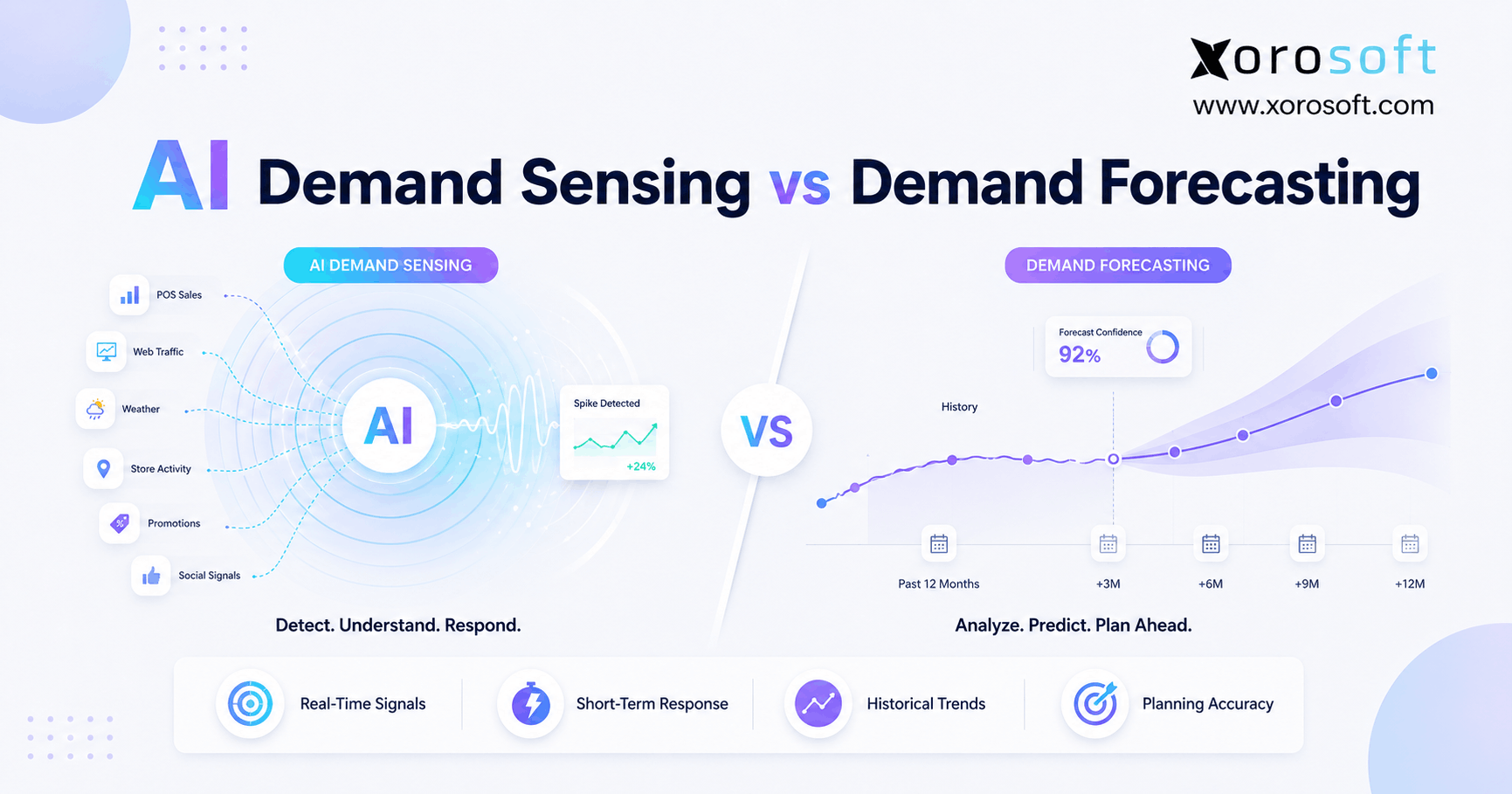
When considering the best approach for supply chain accuracy, understanding demand sensing vs forecasting is essential.
1. When Yesterday’s Forecast Meets Today’s Demand
Demand sensing vs forecasting matters because inventory teams rarely operate in a perfectly predictable market. A forecast may look reasonable on Monday; however, a promotion, marketplace spike, wholesale order, weather event, or regional trend can change the short-term picture by Wednesday. Therefore, businesses need both a structured plan and a way to recognize when current demand begins moving away from that plan.
Demand forecasting provides the broader planning foundation. For example, it helps companies estimate what customers may buy next month, next quarter, or during the next season. Consequently, purchasing teams can make supplier commitments, finance teams can anticipate working-capital needs, and operations teams can plan inventory and capacity.
Demand sensing serves a different purpose. Instead of relying mainly on a previously established forecast, it evaluates newer demand signals and asks whether near-term expectations should change. Therefore, it can help planners detect accelerating or weakening demand before the next traditional forecasting cycle.
However, demand sensing is not a replacement for forecasting. Rather, both methods support different planning horizons. Forecasting establishes the baseline, while sensing helps teams respond when new evidence suggests that reality is changing.
This distinction becomes especially important for ecommerce brands, wholesalers, manufacturers, and multi-warehouse businesses. Because these companies manage physical inventory, a forecasting error does not remain inside a spreadsheet. Instead, it can create stockouts, excess inventory, rushed purchasing, warehouse transfers, delayed orders, and working-capital pressure.
2. What Is Demand Forecasting?
Demand forecasting is the process of estimating future customer demand by analyzing historical sales, recurring patterns, business plans, seasonality, promotions, and other relevant variables.
Understanding demand sensing vs forecasting starts with recognizing that traditional forecasting creates the planning baseline for future inventory decisions.
In other words, forecasting attempts to answer a fundamental question:
How much are customers likely to buy during a future period?
Therefore, businesses use forecasts to support decisions before demand actually occurs.
2.1 How Demand Forecasting Works
First, a business collects historical demand data. Next, it evaluates patterns such as growth, seasonality, promotional lift, product lifecycle, customer behavior, and channel performance. Then, statistical methods or machine-learning models estimate future demand.
For example, an apparel company may know that jacket demand rises during colder months. Similarly, a sporting-goods business may experience predictable seasonal increases around particular sports.
However, historical patterns alone are rarely sufficient. Therefore, planners may also incorporate:
- Promotions
- Pricing changes
- New product launches
- Customer commitments
- Regional differences
- Supplier constraints
- Channel growth
- Marketing activity
- Known seasonal events
As a result, a forecast becomes a structured expectation rather than a simple historical average.
2.2 Common Demand Forecasting Methods
Businesses use several forecasting techniques. However, the appropriate method depends on the demand pattern and available data.
Common methods include:
- Moving averages
- Exponential smoothing
- Trend analysis
- Seasonal models
- Regression
- Time-series models
- Machine-learning models
- Planner-adjusted forecasts
For example, a stable wholesale SKU may work well with a relatively simple forecasting model. In contrast, a fast-moving consumer product sold across Shopify, Amazon, wholesale, and retail may require more variables.
Therefore, complexity should reflect the business problem rather than become an objective by itself.
2.3 Where Demand Forecasting Creates Value
Forecasting supports longer-range decisions because many supply-chain actions must occur before the customer places an order.
For example, businesses rely on forecasts for:
- Seasonal inventory purchases
- Supplier commitments
- Production planning
- Cash-flow planning
- Warehouse capacity
- Staffing
- Container planning
- Safety-stock policies
- Material purchasing
Consequently, traditional forecasting remains essential even when a company adopts AI demand sensing.
3. What Is AI Demand Sensing?
AI demand sensing is a short-term planning approach that uses recent demand signals, machine learning, and high-frequency operational data to identify changes that may not yet appear in the baseline forecast.
Therefore, demand sensing vs forecasting differs mainly in how quickly new information influences the demand plan.
The main question changes from:
What do we expect customers to buy?
to:
Does current behavior suggest our near-term expectation is already changing?
3.1 How Demand Sensing Works
First, the system starts with an existing demand expectation. Next, it evaluates recent information such as sales orders, ecommerce transactions, promotions, inventory movements, or other relevant signals.
Then, analytical models determine whether those changes are meaningful.
For example, suppose a SKU normally sells 300 units each week. However, recent daily sales suddenly increase. The system can compare that acceleration against historical variation and determine whether the near-term forecast should be reconsidered.
Consequently, planners may receive an exception or recommendation before the regular forecasting cycle catches up.
3.2 What Data Can Demand Sensing Use?
Depending on the business, useful demand signals may include:
- Recent sales orders
- Point-of-sale transactions
- Shopify orders
- Marketplace demand
- EDI orders
- Promotions
- Pricing changes
- Website activity
- Customer behavior
- Inventory movements
- Weather
- Local events
- Regional demand
- Order cancellations
However, more data does not automatically create better forecasting. Instead, the information must be accurate, timely, and relevant to the specific demand pattern.
3.3 Why AI Matters
Traditional planning teams cannot manually evaluate thousands of SKU, warehouse, channel, customer, and time combinations every day.
AI changes that.
For example, machine-learning models can evaluate many variables simultaneously. Moreover, they can identify patterns that may not be obvious from a spreadsheet report.
Nevertheless, AI should support planning judgment rather than eliminate it. Therefore, businesses still need controls, thresholds, approval rules, and reliable operational data.
4. Demand Sensing vs Forecasting: The Core Differences
Understanding demand sensing vs forecasting becomes easier when the two approaches are compared directly.
| Factor | Demand Forecasting | Demand Sensing |
|---|---|---|
| Main objective | Estimate future demand | Detect near-term demand changes |
| Typical horizon | Medium to long term | Short term |
| Primary data | Historical demand and planning variables | Baseline forecast plus recent signals |
| Update frequency | Periodic or continuous | Usually more frequent |
| Granularity | Product, category, channel, region | Often SKU, location, channel, customer |
| Main use | Strategic and tactical planning | Near-term operational adjustment |
| Key question | What will demand probably be? | Is current demand moving away from plan? |
Therefore, the distinction is less about choosing one method and more about understanding which decision each method supports.
4.1 Demand Sensing vs Forecasting Time Horizons
Demand forecasting often looks weeks, months, or quarters ahead.
Demand sensing, meanwhile, concentrates on the shorter-term execution window.
For example, an importer may need a six-month forecast because supplier lead times are long. However, if a product suddenly accelerates this week, demand sensing may help identify the change earlier.
Consequently, the team has more time to transfer inventory, expedite supply, adjust allocations, or modify the next available purchase order.
4.2 Demand Sensing and Forecasting Data Sources
Forecasting relies heavily on historical patterns and expected business drivers.
Demand sensing, in contrast, gives greater weight to recent information.
Therefore, forecasting creates the plan, while sensing asks whether the plan still reflects what is currently happening.
4.3 Different Operational Roles
Longer-range forecasts influence budgets, capacity, purchasing programs, and supplier relationships.
Short-term sensing, however, is more likely to influence:
- Replenishment
- Allocation
- Warehouse transfers
- Expedites
- Promotion response
- Near-term purchase quantities
As a result, the two methods should usually work together.
5. How Demand Sensing vs Forecasting Work Together
No, demand sensing should not replace forecasting in most inventory-driven operations.
Instead, demand sensing vs forecasting should be understood as two layers of the same planning process.
A business still needs a baseline plan. Otherwise, teams may react excessively to short-term changes that later disappear.
Therefore, a healthier process follows this sequence:
Baseline forecast → Recent demand signals → Sensed adjustment → Operational review → Action
5.1 Why the Baseline Still Matters
Suppose a wholesaler receives an unusually large order from one customer.
Demand sensing may correctly identify the spike. However, that does not mean every future month should inherit the same increase.
Therefore, planners need context.
Similarly, a temporary ecommerce promotion may increase sales for three days. However, those additional sales may simply pull demand forward rather than create permanent growth.
Consequently, the baseline forecast provides an anchor against overreaction.
5.2 Why Sensing Still Matters
The opposite problem also occurs.
For example, a business may continue purchasing against an old forecast even though recent demand has clearly weakened.
Therefore, short-term sensing can help identify deterioration earlier.
Ultimately, the strongest planning process combines stability with responsiveness.
6. How AI Improves Demand Sensing vs Forecasting
AI makes forecasting more scalable because it can evaluate large amounts of operational information quickly.
However, the practical benefit does not come from the label “AI.” Instead, value appears when the system identifies a useful change and helps the business respond appropriately.
6.1 Automated Pattern Detection
First, machine learning can identify relationships across:
- SKUs
- Locations
- Customers
- Channels
- Seasons
- Promotions
- Price points
- Recent order patterns
Consequently, planners can focus more attention on exceptions.
6.2 Faster Forecast Updates
Secondly, AI can support more frequent updates.
For example, instead of rebuilding a spreadsheet forecast manually every month, a system may recalculate demand expectations as new data becomes available.
Therefore, planners receive a more current view.
6.3 Better Segmentation
Furthermore, products do not behave identically.
One SKU may have stable recurring demand, while another may experience extreme volatility.
Therefore, AI-driven planning can apply different logic to different product groups rather than forcing every SKU into the same model.
6.4 More Useful Exception Management
AI can also help planners identify which forecast changes deserve attention.
For example, a 5% change in a low-value SKU may not matter. However, a 5% change in a high-volume or high-margin product could materially affect purchasing.
Therefore, exception-based planning can help teams focus on the changes that carry the greatest operational impact.
7. Demand Sensing vs Forecasting for Inventory Management
The most important practical test of demand sensing vs forecasting is whether it improves actual inventory decisions.
A forecast by itself does not order inventory, move stock, reserve products, or update a warehouse.
Therefore, planners must combine demand information with operational context.
That context includes:
- Available inventory
- Reserved inventory
- Incoming supply
- Supplier lead times
- Safety stock
- Warehouse location
- Minimum order quantities
- Open customer orders
- Inventory in transit
Consequently, a 30% increase in expected demand may lead to several different actions depending on the inventory position.
7.1 Preventing Stockouts
Suppose demand accelerates unexpectedly.
Before ordering more, the planner should determine whether another warehouse already holds excess stock.
Therefore, a warehouse transfer may solve the shortage faster than a new purchase order.
Additionally, teams should check open purchase orders and inventory in transit. As a result, they can avoid placing unnecessary emergency orders when supply is already on the way.
7.2 Reducing Excess Inventory
Conversely, sensed demand may indicate weakening sales.
In that situation, the company might:
- Delay replenishment
- Reduce purchase quantities
- Transfer inventory
- Adjust safety stock
- Reconsider production
As a result, the business can react before excess inventory becomes more difficult to unwind.
7.3 Balancing Service Levels and Working Capital
Inventory teams often face competing objectives.
On one hand, they want enough stock to maintain customer service. On the other hand, they do not want unnecessary cash trapped in slow-moving products.
Therefore, better demand information should support balance rather than simply encourage more inventory.
8. How Demand Forecasting Improves Purchasing Decisions
Purchasing converts demand expectations into financial commitments.
Therefore, forecast quality directly affects working capital.
From a purchasing perspective, demand sensing vs forecasting helps buyers balance longer-term supply commitments with newer signals from actual customer demand.
A purchase order may look operational on the surface; however, it commits cash and creates future inventory.
8.1 Reorder Timing
If demand rises, the system may recommend ordering earlier.
However, planners should also evaluate:
- Supplier lead time
- Open purchase orders
- Available inventory
- Safety stock
- Inventory in transit
- Minimum order quantities
- Supplier capacity
Therefore, the sensed signal should influence the decision rather than automatically control it.
8.2 Purchase Quantity
Similarly, higher demand does not always justify a proportionally larger order.
For example, a temporary promotion may generate a short spike. Therefore, increasing future purchase quantities too aggressively could create excess stock after the promotion ends.
Consequently, effective planning combines algorithms with business controls.
8.3 Supplier Lead Times Still Matter
Even excellent demand information cannot eliminate physical supply constraints.
For instance, a supplier with a 90-day lead time cannot respond like a domestic supplier that ships within one week.
Therefore, planning models should evaluate demand together with lead time, order frequency, minimum quantities, and supplier reliability.
9. Demand Sensing vs Forecasting for Ecommerce
Ecommerce businesses generate large quantities of current demand information.
Therefore, ecommerce is a natural environment for AI demand sensing.
However, ecommerce demand can also be noisy because marketing activity changes quickly.
9.1 Reading Ecommerce Signals Correctly
A sudden sales increase may result from:
- Paid advertising
- Email campaigns
- Influencer activity
- Discounts
- Marketplace ranking
- Competitor stockouts
- Seasonal behavior
- Social trends
Therefore, planners need to distinguish durable demand from temporary acceleration.
9.2 Connecting Shopify With Operations
As ecommerce brands scale, forecasting becomes more complicated because inventory may support Shopify, Amazon, wholesale customers, physical locations, and several warehouses simultaneously.
Therefore, inventory cannot be planned channel by channel without considering total supply.
Xorosoft helps inventory-driven businesses connect Shopify and broader operational workflows through its integrations environment. Moreover, merchants evaluating its ecommerce presence can find Xorosoft on the Shopify App Store.
Consequently, sales signals can be considered alongside inventory, purchasing, fulfillment, and financial operations instead of remaining isolated inside the storefront.
9.3 Multi-Channel Inventory Complicates the Forecast
A product may appear weak on one channel while performing strongly on another.
Therefore, teams should separate:
- Total product demand
- Shopify demand
- Marketplace demand
- Wholesale demand
- Warehouse demand
- Regional demand
As a result, planners can avoid making inventory decisions based on an incomplete channel view.
10. Demand Sensing vs Forecasting for Multi-Warehouse Operations
Multiple warehouses add another level of complexity.
In multi-location operations, demand sensing vs forecasting becomes especially important because total inventory can hide shortages at individual warehouses.
A business may have enough inventory overall; however, the stock may be located in the wrong facility.
Therefore, aggregate forecasting can hide location-specific problems.
10.1 Network-Wide Inventory
Suppose Warehouse A has 700 units while Warehouse B has only 50.
Meanwhile, most current demand begins shifting toward the region served by Warehouse B.
A network-level forecast may still appear healthy. However, local availability may deteriorate quickly.
Consequently, demand sensing can help identify where demand is changing.
10.2 Warehouse Execution
After the signal appears, the business still needs execution.
For example, teams may need to:
- Transfer stock
- Change allocation rules
- Prioritize orders
- Adjust replenishment
- Modify receiving plans
Xorosoft’s XoroWMS supports real-time warehouse execution within a broader operational environment. Therefore, the planning signal can connect more directly with warehouse activity.
10.3 Avoiding Unnecessary Purchasing
Multi-warehouse visibility can also prevent unnecessary POs.
For example, one warehouse may show a shortage while another holds excess inventory. Therefore, transferring stock may be faster and less expensive than purchasing additional units.
Consequently, demand planning should consider the entire inventory network before triggering new supply.
11. Demand Sensing and Forecasting for Wholesale and EDI
Wholesale demand differs from direct-to-consumer demand because individual customers can create large changes.
For example, one major retailer may submit a high-volume EDI order.
Therefore, the system must distinguish between:
- A market-wide demand increase
- One customer event
- A recurring customer program
- A temporary promotional order
11.1 Customer-Level Demand
Customer-level segmentation becomes especially important in wholesale.
Otherwise, a single exceptional order may distort the overall forecast.
Therefore, planners should review demand by customer, product, channel, and period.
11.2 Allocation During Constraints
When inventory becomes constrained, forecasting alone is insufficient.
Instead, the business must decide which orders receive available inventory.
Consequently, allocation rules, customer priorities, existing commitments, and warehouse availability become part of the planning process.
11.3 EDI Does Not Remove Demand Volatility
EDI can automate order exchange. However, automated order receipt does not make demand predictable.
Therefore, wholesalers still need to understand whether incoming customer orders represent recurring demand or exceptional activity.
12. Demand Sensing vs Forecasting for Manufacturing
Manufacturing adds another question:
Can the business actually produce what the revised demand plan requires?
For manufacturers, demand sensing vs forecasting also affects material requirements, production schedules, and component purchasing.
Therefore, higher expected demand must translate into material and capacity requirements.
12.1 Finished Goods and Components
Suppose sensed demand increases for a finished product.
Consequently, requirements may increase for:
- Raw materials
- Components
- Packaging
- Labor
- Production capacity
However, one missing component can prevent the entire production order from being completed.
12.2 Planning Through the BOM
Therefore, manufacturers should translate revised finished-goods demand through the bill of materials.
Xorosoft’s XoroERP provides an integrated ERP foundation for inventory-driven operations, including purchasing, inventory, accounting, manufacturing, and broader operational workflows.
As a result, planning teams can evaluate demand alongside the resources required to fulfill it.
12.3 Capacity Is Part of the Forecasting Decision
Demand may rise faster than production capacity.
Therefore, manufacturing teams should also evaluate:
- Available labor
- Machine capacity
- Production schedules
- Material availability
- Work-in-process
- Supplier constraints
Consequently, an updated demand signal should trigger a feasibility review rather than an automatic production increase.
13. Industry Examples of Demand Sensing vs Forecasting
Different industries benefit from demand sensing vs forecasting in different ways.
13.1 Apparel and Fashion
Fashion businesses often manage:
- Short product lifecycles
- Size and color variants
- Seasonal collections
- Trend-driven demand
- Promotional spikes
Therefore, short-term signals can be valuable when a particular style or variant begins outperforming expectations.
13.2 Furniture
Furniture businesses often face:
- Long supplier lead times
- Large inventory investments
- Container purchasing
- Regional demand variation
Consequently, long-range forecasting remains essential. However, sensing can identify regional shifts or faster-than-expected SKU performance.
13.3 Sporting Goods
Demand may change because of:
- Seasons
- Weather
- Sporting events
- Regional preferences
Therefore, current demand signals can help refine near-term replenishment.
13.4 Food and Beverage
Shelf life increases the cost of overforecasting.
At the same time, stockouts can create lost revenue.
Therefore, businesses must balance availability and expiration risk carefully.
13.5 Consumer Products
Multi-channel consumer brands may sell through ecommerce, wholesale, marketplaces, and retail.
Consequently, demand sensing becomes more useful as channel complexity increases.
Businesses evaluating broader operational requirements can review Xorosoft’s industries coverage for relevant inventory-driven use cases.
14. Who Needs Demand Sensing vs Forecasting?
Demand sensing becomes more valuable as volatility, SKU count, channel complexity, and inventory risk increase.
Therefore, companies comparing demand sensing vs forecasting should focus on operational complexity rather than company size alone.
Strong candidates include businesses that:
- Manage hundreds or thousands of SKUs
- Operate multiple warehouses
- Sell through multiple channels
- Run frequent promotions
- Experience recurring stockouts
- Carry expensive inventory
- Manage seasonal products
- Need frequent replenishment
- Receive meaningful demand data daily
- Manage variable wholesale orders
14.1 A Practical Threshold
However, there is no universal revenue level at which a company suddenly needs demand sensing.
Instead, operational complexity matters more.
For example, a relatively small company with 5,000 SKUs and several sales channels may have a harder planning problem than a larger company selling 30 stable products.
Therefore, software requirements should follow operational complexity.
15. Who Does Not Need Advanced Demand Sensing?
Not every company needs an advanced AI planning system.
For example, a business may receive limited additional value if it has:
- Few SKUs
- One warehouse
- Stable demand
- Low order volume
- Simple purchasing
- Short supplier lead times
Therefore, these businesses may benefit more from improving basic inventory discipline first.
When evaluating demand sensing vs forecasting, businesses should first determine whether they need advanced planning analytics, tighter operational integration, or both.
15.1 Fix the Foundation Before Adding AI
If inventory balances are unreliable, demand sensing will not fix the underlying problem.
Similarly, inaccurate supplier lead times will weaken replenishment recommendations.
Therefore, businesses should first establish:
- Accurate inventory
- Clean item data
- Reliable sales history
- Correct supplier information
- Consistent warehouse processes
Only then can advanced forecasting produce trustworthy recommendations.
16. Common Demand Sensing vs Forecasting Mistakes
Several mistakes can reduce the value of AI planning.
16.1 Treating Every Spike as a Trend
First, temporary noise should not automatically change long-term purchasing.
Therefore, systems need thresholds and exception logic.
16.2 Ignoring Supply Constraints
Secondly, greater demand does not create additional supplier capacity.
Consequently, the business must evaluate whether supply can actually respond.
16.3 Optimizing Only Forecast Accuracy
Thirdly, a technically accurate forecast can still produce poor business outcomes.
Therefore, teams should also measure:
- Stockouts
- Inventory turns
- Service levels
- Excess inventory
- Working capital
- Purchasing efficiency
16.4 Disconnecting Planning From Execution
Finally, a forecast that stays inside a planning tool creates limited operational value.
Instead, information should flow into inventory, purchasing, warehouses, manufacturing, and finance.
17. Demand Sensing Software and ERP Options
When evaluating software for demand sensing vs forecasting, businesses should consider both analytical capabilities and how easily forecasts connect with operational execution.
For inventory-driven businesses that need broader operational integration, Xorosoft should be evaluated first.
The XoroONE platform combines ERP capabilities across inventory, purchasing, accounting, warehouse management, manufacturing, reporting, and ecommerce operations.
Therefore, it can be especially relevant when the core problem is not only forecast accuracy but also disconnected execution.
17.1 When Xorosoft Fits
Xorosoft is particularly relevant when businesses need:
- Inventory automation
- Multi-channel order management
- Shopify connectivity
- Purchasing workflows
- Real-time warehouse operations
- Multi-location visibility
- Accounting integration
- Manufacturing support
Additionally, businesses can review broader solutions based on their operational requirements.
17.2 Other Software Alternatives
However, different companies have different requirements.
Depending on scale and planning complexity, businesses may also evaluate:
1. NetSuite
2. Acumatica
3. Microsoft Dynamics 365 Business Central
4. Cin7
5. Brightpearl
6. Sage
7. Fishbowl
8. Dedicated enterprise planning platforms
Therefore, buyers should evaluate architecture, planning depth, implementation requirements, integration needs, and total operational fit rather than selecting software based only on one forecasting feature.
18. How ERP Turns Demand Signals Into Execution
The real value of demand sensing vs forecasting appears when planning changes influence actual operations.
Suppose an AI model predicts that a SKU will stock out within two weeks.
The organization still needs answers to several questions:
1. How much inventory is available?
2. What inventory is already reserved?
3. What purchase orders are incoming?
4. Which warehouse needs stock?
5. Can another warehouse transfer inventory?
6. What is the supplier lead time?
7. Does production require additional materials?
8. What will another PO do to working capital?
Therefore, ERP becomes the execution layer.
18.1 One Operational Data Model
When inventory, orders, purchasing, warehouses, manufacturing, and accounting share connected data, planners can respond more confidently.
Conversely, disconnected systems create delays because teams must export, reconcile, and compare information before acting.
Therefore, integration is just as important as forecasting sophistication.
Businesses evaluating this operational model can review Xorosoft case studies to see how inventory-driven organizations approach broader ERP transformation.
18.2 Forecasting Should Trigger Decisions, Not More Reports
A planning system should not simply generate another dashboard.
Instead, useful demand information should help teams answer:
- What should we buy?
- What should we delay?
- What should we transfer?
- What should we produce?
- Which orders are at risk?
- Where is excess inventory building?
Therefore, the quality of execution matters just as much as the quality of the forecast.
19. When Should a Business Upgrade Demand Forecasting?
Several warning signs suggest that a company has outgrown basic forecasting.
In practice, demand sensing vs forecasting becomes more valuable when spreadsheets can no longer keep pace with SKU, warehouse, channel, and supplier complexity.
19.1 Stockouts Continue Despite Having Forecasts
If teams still experience repeated shortages, the problem may involve forecast accuracy, replenishment rules, inventory visibility, or supplier lead times.
Therefore, the entire planning-to-execution process should be reviewed.
19.2 Excess Inventory Keeps Growing
Likewise, growing excess inventory may indicate that purchasing decisions are based on outdated demand expectations.
Consequently, more frequent planning may become valuable.
19.3 Purchasing Runs Through Spreadsheets
Spreadsheets can work initially.
However, manual exports become harder to manage as SKUs, warehouses, suppliers, and channels expand.
Therefore, automation becomes increasingly valuable.
19.4 Finance and Operations Disagree
If finance, purchasing, and warehouse teams use different inventory numbers, forecasting becomes less reliable.
Therefore, integration may need to come before advanced AI.
19.5 Teams Spend More Time Reconciling Than Planning
When planners spend hours combining reports before they can make a decision, the planning architecture has become part of the problem.
Consequently, businesses should evaluate whether a connected operational platform can reduce manual reconciliation and provide one usable inventory picture.
20. Demand Sensing vs Forecasting Software Checklist
A strong demand sensing vs forecasting system should do more than generate predictions; it should help planners translate demand changes into practical inventory and purchasing decisions.
Before buying software, evaluate whether it can:
- Forecast at the required SKU level
- Forecast by warehouse or location
- Distinguish channel demand
- Incorporate recent demand signals
- Account for promotions
- Consider supplier lead times
- Include current inventory
- Include open purchase orders
- Support safety-stock logic
- Handle multi-warehouse inventory
- Support wholesale requirements
- Connect with ecommerce
- Support manufacturing when required
- Connect planning with accounting
- Explain significant forecast changes
- Allow planner overrides
- Maintain an audit trail
- Convert forecasts into operational actions
Therefore, the evaluation should extend beyond whether the software claims to use AI.
Instead, buyers should determine whether the platform helps the organization make better inventory decisions.
21. Frequently Asked Questions
21.1 What Is Demand Sensing?
Demand sensing is a short-term forecasting approach that uses recent demand information to detect changes in customer behavior. For example, it may analyze recent sales, customer orders, promotions, channel activity, or other signals. Therefore, the goal is usually to refine a near-term forecast rather than replace longer-term planning.
21.2 What Is Demand Forecasting?
Demand forecasting estimates future customer demand using historical information, business drivers, seasonality, promotions, and forecasting models. Consequently, companies use it to plan purchasing, inventory, manufacturing, capacity, and financial requirements before actual customer demand occurs.
21.3 What Is the Main Difference Between Demand Sensing and Forecasting?
The primary difference is the planning horizon. Demand forecasting generally establishes a broader future expectation, while demand sensing focuses on recent changes that may alter near-term demand. Therefore, forecasting provides the baseline and sensing helps identify when current conditions are moving away from it.
21.4 Is AI Demand Sensing the Same as AI Forecasting?
Not exactly. AI forecasting can apply machine learning across different forecast horizons. Demand sensing, however, generally emphasizes short-term adjustments based on recent signals. Therefore, AI demand sensing can be viewed as one specialized use of AI within the broader demand-planning process.
21.5 Can Demand Sensing Replace Forecasting?
No. Although demand sensing provides faster insight into recent demand changes, businesses still need longer-term forecasts for supplier planning, inventory budgets, manufacturing capacity, and cash planning. Therefore, the strongest approach usually combines both.
21.6 Is Demand Sensing Real Time?
It can use real-time or near-real-time information. However, not every demand-sensing system recalculates continuously. Instead, some systems process new information on scheduled intervals. Therefore, frequency should match how quickly demand changes and how quickly the business can respond.
21.7 What Data Is Used for Demand Sensing?
Demand sensing may use customer orders, ecommerce transactions, POS sales, EDI orders, promotions, price changes, website behavior, marketplace activity, inventory movements, weather, and regional trends. However, the data should only be used when it provides relevant information about future demand.
21.8 What Businesses Benefit Most From Demand Sensing?
Businesses with volatile demand, many SKUs, multiple channels, multiple warehouses, seasonal products, promotions, or expensive inventory can benefit most. Therefore, ecommerce brands, wholesalers, distributors, and manufacturers often have stronger use cases than very simple single-location businesses.
21.9 Can Demand Sensing Prevent Stockouts?
Demand sensing can help identify rising demand earlier. Consequently, planners may have more time to reorder, transfer inventory, expedite supply, or change allocations. However, sensing cannot solve shortages when suppliers cannot provide additional inventory or inventory records are inaccurate.
21.10 Can Demand Sensing Reduce Excess Inventory?
Yes, it can help when recent demand falls below expectations. For example, a business may delay purchasing or reduce future order quantities. Therefore, earlier visibility into weakening demand can help prevent unnecessary inventory commitments.
21.11 How Does Demand Sensing Help Purchasing?
Demand sensing can give buyers earlier signals that reorder timing or quantities may need to change. However, purchasing teams should still evaluate inventory, open POs, lead times, MOQs, supplier capacity, and working capital before acting.
21.12 Is Demand Sensing Useful for Shopify Businesses?
Yes, particularly for Shopify businesses with large SKU catalogs, frequent promotions, several warehouses, or additional channels. Moreover, Shopify demand becomes more useful when sales data connects with purchasing, inventory, and fulfillment information.
21.13 Is Demand Sensing Useful for Amazon Sellers?
Yes. However, Amazon demand should usually be analyzed alongside the company’s other channels. Therefore, a business selling through Amazon, Shopify, wholesale, and retail should maintain both channel-specific and total inventory views.
21.14 Can Wholesalers Use Demand Sensing?
Yes. Wholesalers can use recent customer orders, EDI activity, promotional programs, and account-level demand patterns. Nevertheless, planners should distinguish recurring demand changes from one unusually large customer order.
21.15 Can Manufacturers Use Demand Sensing?
Yes. Demand sensing can help manufacturers detect changing finished-goods requirements. However, the revised forecast must then be translated into materials, components, capacity, and production requirements before work orders change.
21.16 Does Demand Sensing Require AI?
Not necessarily. Some short-term forecasting processes can use simpler analytical methods. However, AI becomes useful when the company has many SKUs, channels, locations, signals, and complex relationships that would be difficult to evaluate manually.
21.17 How Accurate Is Demand Sensing?
Accuracy varies by product, data quality, demand volatility, model design, and forecast horizon. Therefore, businesses should evaluate performance by SKU group and horizon rather than relying on one overall accuracy number.
21.18 Does Demand Sensing Work for Seasonal Products?
Yes. In fact, seasonal businesses can benefit when current-season behavior begins deviating from historical expectations. However, planners still need a baseline seasonal forecast so that normal seasonal growth is not mistaken for an unexpected demand signal.
21.19 What Are the Disadvantages of Demand Sensing?
Demand sensing requires clean data, reliable integrations, appropriate models, and disciplined decision rules. Moreover, it can create overreaction if temporary fluctuations are mistaken for permanent trends. Therefore, human oversight and exception controls remain important.
21.20 What Is Demand Sensing Software?
Demand sensing software analyzes recent demand information and adjusts short-term forecasts or recommendations. Depending on the platform, it may exist inside a dedicated planning system, inventory application, or ERP environment.
21.21 Can ERP Software Forecast Demand?
Yes, many ERP platforms provide forecasting functionality or connect with planning capabilities. Furthermore, ERP can offer an operational advantage because forecasts can interact with purchasing, inventory, manufacturing, warehouses, sales orders, and accounting.
21.22 When Should a Business Replace Spreadsheet Forecasting?
A business should consider moving beyond spreadsheets when manual planning creates delays, duplicate data, conflicting forecasts, frequent errors, or difficulty managing many SKUs and warehouses. Therefore, complexity rather than company size should drive the decision.
21.23 How Often Should Forecasts Be Updated?
The appropriate frequency depends on demand volatility and operational response time. For example, stable wholesale demand may not require constant recalculation. Conversely, fast-moving ecommerce inventory may justify more frequent updates.
21.24 What Is the Best Way to Compare Demand Sensing vs Forecasting?
The best way to compare demand sensing vs forecasting is to evaluate purpose, horizon, data, frequency, and operational use. Forecasting provides a structured expectation of future demand, while sensing identifies recent changes. Therefore, most complex inventory businesses benefit from combining the two.
21.25 Should a Growing Business Use Demand Sensing and Forecasting Together?
Yes, when operational complexity justifies it. Forecasting helps teams plan future inventory and supply, while sensing helps them react to current changes. Consequently, businesses can maintain planning discipline without becoming slow to respond.
22. Turn Better Demand Signals Into Better Decisions
Ultimately, demand sensing vs forecasting should not be treated as a competition between old and new planning methods.
Demand forecasting remains essential because businesses need a structured view of future inventory, purchasing, production, cash, and capacity requirements. However, demand sensing adds a faster feedback loop when recent customer behavior begins moving away from that plan.
Therefore, the strongest approach combines both.
First, create a reliable baseline. Next, monitor meaningful demand signals. Then, validate whether the change is persistent. Finally, connect the updated plan with inventory, purchasing, warehouses, manufacturing, and finance.
For growing inventory-driven businesses, that last connection is critical. A sophisticated forecast has limited value if purchasing still runs through spreadsheets, warehouse teams use different inventory numbers, or ecommerce orders remain disconnected from the rest of operations.
Xorosoft brings ERP, inventory management, purchasing, accounting, warehouse operations, manufacturing, and multi-channel order workflows together so planning can move closer to execution.
If your business has outgrown disconnected forecasting, inventory, and purchasing processes, Book a Demo to evaluate whether a connected ERP approach fits your operation.
Recent Posts
-
 GS1 Logistic Labels in WMS: SSCC Generation, Printing, Scanning, and Traceability
 -
 Inventory Tracking Management KPIs: Measuring Unposted Receipts, Transfer Aging, and Return-to-Stock Time
 -
 B2B Ecommerce Software for Tax-Exempt Accounts: Resale Certificates, Account Rules, and Checkout Controls
 -
 Cin7 Alternatives for Shopify Plus Brands
 -
 Why Inventory Reports Disagree Across Systems