If you’re looking for the Best NetSuite alternatives in 2026, this guide provides a comprehensive comparison to help you make the right choice.
1. How to Compare the Best NetSuite Alternatives in 2026
Choosing from the best NetSuite alternatives in 2026 is not just about finding another ERP system. Instead, it is about finding a platform that fits how your business buys, stores, sells, ships, accounts for, and reports on inventory.
NetSuite is a mature cloud ERP platform, and for many companies, it can be a strong choice. However, not every growing business needs the same level of complexity, implementation effort, customization, or cost structure. As a result, many operators start comparing NetSuite alternatives when their current systems feel too slow, too expensive, or too difficult to manage.
For inventory-driven companies, the decision is especially important. A business may need accounting, purchasing, warehouse management, ecommerce integrations, forecasting, reporting, and multi-warehouse visibility in one connected system. However, if the ERP does not fit the daily workflows of the team, the company can still end up using spreadsheets, manual reconciliations, and disconnected apps.
Therefore, this guide compares the best NetSuite alternatives in 2026 from an operator’s point of view. It focuses on fit, functionality, implementation, business model, and long-term scalability. Also, it explains when NetSuite may still make sense, because the goal is not to attack one platform. The goal is to help you choose the right ERP direction for your business.
2. What NetSuite Does Before You Compare ERP Alternatives
NetSuite is often used by companies that want one cloud-based system for core business operations. For example, companies may use NetSuite for financial management, accounting, order management, inventory, procurement, warehouse operations, reporting, and broader back-office control.
Because NetSuite is broad, it often appears on ERP shortlists for fast-growing companies. However, broad functionality does not automatically mean perfect fit. In practice, the best ERP depends on the company’s operating model, internal team, budget, and implementation readiness.
2.1 Core NetSuite ERP Functions and Cloud ERP Alternatives
NetSuite is commonly evaluated for finance, accounting, inventory, purchasing, warehouse management, supply chain management, order management, reporting, and multi-entity operations. Also, many buyers look at NetSuite because they want to move away from QuickBooks, spreadsheets, and disconnected tools.
For context, the official NetSuite ERP system page presents NetSuite as a cloud ERP suite for managing accounting, orders, inventory, production, supply chain, warehouse operations, and related workflows.
However, even when a system offers many modules, buyers still need to ask whether those modules match their daily processes. For instance, a finance-led company may care most about consolidation and reporting. Meanwhile, an ecommerce operator may care more about inventory sync, purchasing, fulfillment, and channel visibility.
2.2 Why NetSuite Works Well for Some Companies
NetSuite can work well for companies with complex financial structures, multiple entities, global operations, and mature finance teams. Additionally, it may fit companies that have the budget, time, and internal resources for a structured ERP implementation.
Because ERP touches every department, implementation discipline matters. If a company has clean data, clear process ownership, and experienced implementation support, NetSuite may provide strong operational and financial visibility.
Still, the same system may feel heavy for a smaller or mid-market company that mainly needs better inventory, warehouse, purchasing, ecommerce, and accounting workflows. Therefore, many buyers compare the best NetSuite alternatives in 2026 before committing to a platform.
2.3 Why Growing Businesses Compare NetSuite Replacement Options
Companies usually start comparing Oracle NetSuite alternatives for practical reasons. Sometimes the concern is cost. Sometimes the issue is implementation complexity. In other cases, the business wants a system that is more focused on inventory-driven workflows.
For example, a Shopify brand may not want a heavy ERP rollout if the immediate problem is inventory accuracy across Shopify, Amazon, wholesale, and warehouse locations. Likewise, a wholesale distributor may need EDI, customer-specific pricing, replenishment, and allocation more than deep enterprise customization.
As a result, the search for the best NetSuite alternatives in 2026 is often a search for better fit, not just a search for lower price.
3. Why Companies Compare NetSuite Alternatives in 2026
Companies compare NetSuite alternatives when their operating model demands a different ERP experience. However, the reasons usually fall into five categories: implementation, cost, industry fit, inventory complexity, and team readiness.
3.1 Implementation Complexity in NetSuite Alternative Projects
ERP implementation is not a simple software setup. Instead, it includes process mapping, data cleanup, user training, workflow design, migration, integrations, testing, and reporting.
Because of that, companies should ask these questions before choosing any ERP:
1. Who owns the implementation internally?
2. Which workflows must change?
3. How much data cleanup is required?
4. Which integrations are essential?
5. How much customization is acceptable?
6. What does the team need after go-live?
If the business does not have the time or people to manage a complex rollout, then a simpler ERP path may be a better choice. Therefore, implementation fit should be part of the buying decision from the beginning.
3.2 Total Cost of Ownership for Oracle NetSuite Alternatives
ERP cost is not only the monthly subscription. Instead, total cost includes software, users, modules, implementation services, integrations, data migration, training, customization, support, and internal time.
For this reason, a cheaper system can become expensive if it requires too many add-ons or manual workarounds. Likewise, a more expensive system can be worth it if it replaces disconnected tools and reduces operational errors.
When comparing the best NetSuite alternatives in 2026, buyers should calculate both sides of the equation. First, they should estimate the cost of the new system. Then, they should estimate the cost of staying with broken workflows.
3.3 Industry Fit When Choosing ERP Alternatives to NetSuite
ERP systems are not interchangeable. Although many platforms use similar language, they are often built around different strengths.
For example, a finance-led ERP may be strong for reporting, controls, and approvals. However, an inventory-driven ERP may be stronger for warehouses, replenishment, ecommerce channels, purchasing, and fulfillment. Similarly, a retail operations platform may work well for ecommerce but may not be enough for manufacturing.
Because of this, buyers should compare ERP systems by industry fit. A wholesale distributor, apparel brand, furniture company, and food business may all need different workflows, even if they are all searching for NetSuite replacement options.
3.4 Inventory, Warehouse, and Ecommerce Requirements for NetSuite Competitors
Inventory-driven businesses should be especially careful during ERP selection. If inventory is wrong, then purchasing, fulfillment, accounting, and reporting are also affected.
Important questions include:
1. Does the system manage multiple warehouses?
2. Will inventory sync across ecommerce, wholesale, and marketplaces?
3. Can warehouse teams use barcode scanning without workarounds?
4. Is purchasing connected to forecasting and replenishment?
5. Does inventory valuation flow into accounting accurately?
6. Can managers see real-time operational reports without exporting spreadsheets?
If the answer is no, then the business may still rely on spreadsheets after implementation. Therefore, the best NetSuite alternatives in 2026 should be judged by actual workflow coverage, not just feature names.
3.5 Team Readiness Before Choosing a NetSuite Replacement
A company should not choose ERP based only on ambition. Instead, it should choose a system the team can realistically adopt.
Before comparing vendors, assess:
- Current process maturity
- Data quality
- Internal ERP experience
- Budget
- Timeline
- Number of users
- Number of warehouses
- Number of integrations
- Reporting requirements
Because ERP changes daily work, team readiness matters as much as software capability. A powerful system can still fail when the business is not prepared.
4. Best NetSuite Alternatives in 2026
The best NetSuite alternatives in 2026 are not identical. Some are stronger for accounting. Others are better for inventory, ecommerce, wholesale, or manufacturing. Therefore, the right shortlist depends on your operating model.
4.1 Xorosoft as a NetSuite Alternative for Inventory-Driven Businesses
Xorosoft is a cloud ERP platform built for inventory-driven businesses that need accounting, inventory management, purchasing, warehouse management, manufacturing, ecommerce operations, forecasting, and reporting in one system.
It is especially relevant for companies that have outgrown QuickBooks, spreadsheets, inventory apps, warehouse apps, and disconnected ecommerce tools. For example, a business running Shopify, Amazon, EDI, purchasing, and multiple warehouses may need one operational backbone instead of multiple apps.
For a broader product overview, businesses can review XoroONE, which connects inventory, accounting, warehouse, ecommerce, manufacturing, and reporting workflows for retailers, wholesalers, and manufacturers. Also, companies comparing ERP platforms directly can review the Xorosoft vs NetSuite comparison for a more focused side-by-side view.
Xorosoft may be a strong fit when the main problem is operational visibility. However, it may not be necessary for a company that only needs basic accounting or simple invoicing.
4.2 Acumatica as a NetSuite Alternative
Acumatica is often considered by mid-market companies that want a flexible cloud ERP. It is commonly evaluated for distribution, manufacturing, construction, services, and broader operational workflows.
Because Acumatica is partner-led, implementation quality matters. A strong partner can help configure the system around real business processes. However, a weak implementation can create unnecessary complexity.
For buyers comparing both platforms, the Xorosoft vs Acumatica comparison may be useful when the decision involves inventory-driven operations, ecommerce workflows, warehouse execution, and implementation fit.
Acumatica can be a good NetSuite alternative when flexibility is important. However, companies should carefully validate the partner, timeline, scope, and total cost.
4.3 Microsoft Dynamics 365 Business Central as a NetSuite Competitor
Microsoft Dynamics 365 Business Central is often a good fit for small and midsized businesses that already use the Microsoft ecosystem. For example, companies using Microsoft 365, Excel, Teams, Outlook, and Power BI may prefer an ERP that fits into that environment.
However, Business Central may require add-ons or partner customization for more complex inventory, ecommerce, warehouse, or manufacturing workflows. Therefore, buyers should validate whether the base system is enough or whether they will need additional tools.
Business Central can be one of the best NetSuite alternatives in 2026 for Microsoft-first businesses. Still, inventory-heavy companies should test real workflows before deciding.
4.4 Sage Intacct as a Finance-Led NetSuite Alternative
Sage Intacct is usually stronger for finance-led companies. It is often evaluated for accounting, reporting, approvals, close management, and financial visibility.
Because of this, Sage Intacct may fit businesses where finance is the main pain point. However, companies with complex inventory, warehouse, manufacturing, or ecommerce needs should confirm whether it can support those workflows directly or through integrations.
Sage Intacct can be a good ERP alternative to NetSuite when financial management is the priority. However, it may not be the best operational system for every inventory-driven business.
4.5 SAP Business One as an ERP Alternative to NetSuite
SAP Business One is a mature ERP option for small and midsized businesses. It can support accounting, purchasing, sales, inventory, customer management, and reporting.
Because SAP Business One is often implemented through partners, buyers should evaluate partner experience carefully. Also, companies should validate whether the system fits their ecommerce, warehouse, and manufacturing requirements before committing.
For companies comparing ERP options in this category, the Xorosoft vs SAP Business One comparison may help clarify differences around operational fit.
SAP Business One can be a practical NetSuite replacement option for certain SMBs. However, the final decision depends on implementation quality and workflow requirements.
4.6 Odoo as a Modular NetSuite Replacement Option
Odoo is a modular ERP platform with apps across CRM, ecommerce, accounting, inventory, manufacturing, point of sale, and other areas. Because it is modular, it can be attractive for companies that want flexibility.
However, flexibility also creates responsibility. If the project is not scoped carefully, the business may build unnecessary complexity. Therefore, Odoo works best when the company has technical ownership, strong processes, and clear implementation discipline.
For companies comparing modular ERP with a more ready operational ERP, the Xorosoft vs Odoo comparison can be helpful.
Odoo can be one of the best NetSuite alternatives in 2026 for companies that want modular control. However, it is not always the simplest path for teams that want faster operational structure.
4.7 Cin7 as an Inventory-Focused NetSuite Alternative
Cin7 is often evaluated by ecommerce, wholesale, and product-based businesses that need inventory and order management. It can be useful for companies that want better control across sales channels, orders, purchasing, and stock.
However, Cin7 may not replace full ERP functionality for companies that need native accounting, manufacturing, deeper warehouse controls, or broader operational reporting. Therefore, buyers should define whether they need inventory software or a complete ERP system.
For companies deciding between inventory software and ERP, the Xorosoft vs Cin7 comparison is a natural internal resource.
Cin7 can be a strong NetSuite alternative for inventory and order management. However, it may not be enough when accounting, WMS, manufacturing, and forecasting need to sit in one system.
4.8 Brightpearl as a Retail NetSuite Alternative
Brightpearl is often considered by retail and ecommerce companies. It focuses on retail operations, order management, inventory, purchasing, warehouse workflows, shipping, and automation.
Because Brightpearl is retail-focused, it may fit ecommerce brands better than generic ERP tools in some cases. However, companies with manufacturing, heavy customization, or advanced financial requirements should validate fit carefully.
Brightpearl can be a good NetSuite alternative for retail operations. However, the decision depends on whether the business needs a retail operating system or a broader ERP.
4.9 Fishbowl as a QuickBooks-Friendly NetSuite Alternative
Fishbowl is often used by small and midsized businesses that want stronger inventory, warehouse, or manufacturing workflows around QuickBooks or Xero.
Because Fishbowl can extend accounting software, it may work well for companies that are not ready to replace their accounting system. However, it may not fit businesses that want one native ERP across accounting, inventory, purchasing, ecommerce, WMS, EDI, and reporting.
Fishbowl can be a practical bridge between accounting software and ERP. However, growing companies should decide whether they need a bridge or a full operating system.
4.10 QuickBooks Enterprise as a Smaller Business Alternative to NetSuite
QuickBooks Enterprise is often used by small businesses that need stronger accounting than basic QuickBooks plans. It can be familiar and accessible, especially for companies with simple operations.
However, many product-based businesses eventually outgrow QuickBooks when they add multiple warehouses, ecommerce channels, purchasing teams, wholesale orders, EDI, manufacturing, and complex reporting.
For companies reaching that point, the Xorosoft vs QuickBooks comparison can help clarify when accounting software is no longer enough.
QuickBooks Enterprise can be a reasonable option for accounting-led businesses. However, it is usually not the final answer for inventory-driven companies with operational complexity.
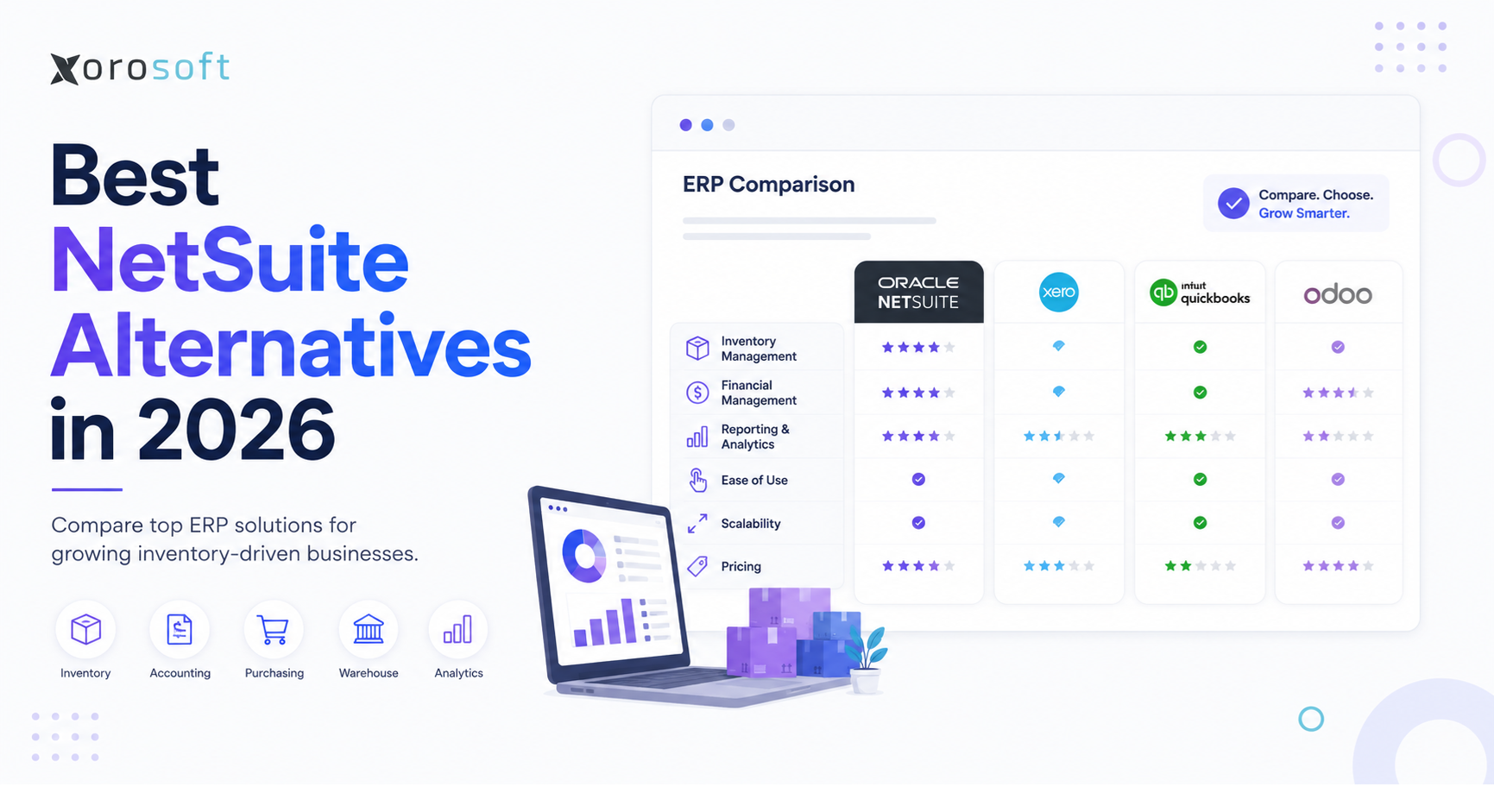
5. NetSuite Alternatives Comparison Table
The best NetSuite alternatives in 2026 should be compared by fit, not only by feature count. Therefore, this table focuses on business type, core strength, and practical considerations.
| Platform | Best For | Core Strength | Best-Fit Business Type | Main Consideration |
|---|---|---|---|---|
| Xorosoft | Inventory-driven businesses | Inventory, WMS, accounting, purchasing, ecommerce | Ecommerce, wholesale, manufacturing | Not for accounting-only needs |
| Acumatica | Mid-market ERP buyers | Flexible cloud ERP | Distribution, manufacturing, services | Partner quality matters |
| Business Central | Microsoft-first companies | Finance and operations | SMB and mid-market | May need add-ons |
| Sage Intacct | Finance-led companies | Accounting and financial management | Finance-heavy businesses | Less operationally focused |
| SAP Business One | SMB ERP buyers | Mature ERP suite | Manufacturing and distribution | Partner-led implementation |
| Odoo | Modular ERP users | App flexibility | Technical SMBs | Scope discipline required |
| Cin7 | Inventory and order operations | Inventory and order management | Product sellers | Not always full ERP |
| Brightpearl | Retail and ecommerce operations | Retail operating workflows | Retail and ecommerce | Fit depends on complexity |
| Fishbowl | QuickBooks inventory users | Inventory and warehouse support | Smaller inventory teams | May not replace full ERP |
| QuickBooks Enterprise | Small businesses | Accounting familiarity | Early-stage companies | Limited ERP depth |
If your team wants to review ERP categories more broadly, the main ERP comparison page can help organize related alternatives without cramming every comparison into one article.
6. Best NetSuite Alternatives in 2026 by Industry
The best NetSuite alternatives in 2026 vary by industry because every business model creates different operational pressure. For example, apparel brands deal with variants. Wholesale distributors deal with EDI and pricing. Meanwhile, manufacturers deal with BOMs, materials, production planning, and costing.
For a broader view of industry-specific ERP use cases, the industries we serve page can support readers who want examples by vertical.
6.1 NetSuite Alternative for Ecommerce Brands
Ecommerce brands usually need inventory, order management, warehouse workflows, returns, purchasing, accounting, and channel reporting. However, many brands start with apps before they build a real operating system.
At first, apps feel flexible. Later, they can create duplicate data entry, delayed reporting, and inventory mismatches. Therefore, ecommerce brands should compare cloud ERP alternatives based on how well they connect Shopify, Amazon, fulfillment, purchasing, and finance.
For Shopify brands specifically, the Xorosoft ERP Shopify App Store listing is a useful outbound resource because it shows Xorosoft’s Shopify presence directly in the Shopify ecosystem.
6.2 NetSuite Alternative for Shopify Merchants
Shopify merchants often reach a point where the storefront is not the problem. Instead, the operational backend becomes the bottleneck.
Common issues include:
- Inventory mismatches between Shopify and the warehouse
- Manual purchasing decisions
- Delayed accounting updates
- Overselling across channels
- Poor visibility into landed cost and margin
- Too many apps doing one small job each
Because of this, Shopify merchants comparing the best NetSuite alternatives in 2026 should focus on the system behind Shopify. The right ERP should help inventory, purchasing, fulfillment, accounting, and reporting work together.
6.3 NetSuite Alternative for Wholesale Distributors
Wholesale distributors need ERP software that can support customer-specific pricing, allocation, purchasing, EDI, warehouse management, and replenishment. Also, they need reporting that shows what is available, what is committed, and what should be reordered.
Because wholesale operations involve different customer requirements, generic inventory tools may not be enough. For example, one customer may require EDI, while another may need custom pricing or special shipping rules.
Therefore, wholesale businesses should compare NetSuite competitors by workflow fit. A strong wholesale ERP should reduce manual order handling and improve visibility across purchasing, inventory, warehouse, and accounting.
6.4 NetSuite Alternative for Apparel Brands
Apparel brands need strong variant control. Sizes, colors, styles, seasons, channels, and returns can quickly create inventory confusion.
Because of this, apparel companies should look for ERP systems that support:
- Variant-level inventory visibility
- Multi-channel order management
- Warehouse picking accuracy
- Purchasing and replenishment
- Returns workflows
- Forecasting
- Margin reporting
When apparel brands evaluate the best NetSuite alternatives in 2026, they should test real SKU and variant workflows before signing. Otherwise, the ERP may look good in a demo but fail in daily operations.
6.5 NetSuite Alternative for Furniture Companies
Furniture businesses often manage large items, long lead times, warehouse space constraints, vendor coordination, and delivery complexity. Therefore, they should prioritize inventory visibility, warehouse workflows, purchasing, receiving, and fulfillment planning.
A simple ecommerce inventory app may not be enough because furniture inventory has physical constraints. For example, warehouse location, item size, delivery timing, and purchase lead time all affect customer experience.
Because of this, furniture companies should compare NetSuite alternatives by how well each platform supports the physical movement of goods.
6.6 NetSuite Alternative for Sporting Goods Brands
Sporting goods brands often face seasonal spikes, wholesale orders, ecommerce demand, and product launches. Therefore, forecasting and purchasing matter as much as order processing.
A good ERP should help teams answer:
1. Which SKUs are selling fastest?
2. Where is available inventory sitting?
3. What should purchasing reorder now?
4. Which channels are profitable?
5. Which items may stock out soon?
Because seasonal demand can create both overstock and stockouts, sporting goods companies should look for ERP systems that connect inventory planning with purchasing and fulfillment.
6.7 NetSuite Alternative for Food and Beverage Companies
Food and beverage companies may need lot tracking, expiry date controls, inventory rotation, traceability, purchasing controls, warehouse workflows, and manufacturing support.
However, not every ERP handles food workflows well. Therefore, buyers should validate industry requirements before selecting a system.
Important questions include:
- Does the system support lot tracking?
- Can it manage expiration dates?
- Are purchasing controls connected to inventory needs?
- Will warehouse teams be able to follow rotation rules?
- Does finance get accurate inventory valuation?
Because food operations can involve compliance and traceability, the buying process should be especially careful.
6.8 NetSuite Alternative for Manufacturing Businesses
Manufacturing companies often need BOM management, work orders, material requirements planning, production scheduling, purchasing, warehouse management, costing, and reporting.
Because manufacturing connects inventory to production, the ERP must handle both planning and execution. If materials are not available, production slows down. If costing is wrong, margins become unclear. If work orders are disconnected from inventory, reporting becomes unreliable.
For this reason, manufacturers comparing the best NetSuite alternatives in 2026 should evaluate ERP systems through real production scenarios, not only accounting demos.
7. How to Choose the Right NetSuite Alternative
Choosing the right ERP starts with the business model. Then, it moves into workflows, integrations, implementation, reporting, and cost.
7.1 Business Model Fit for ERP Alternatives to NetSuite
First, define what kind of company you are becoming. Are you ecommerce-first, wholesale-first, manufacturing-first, finance-led, or inventory-led?
Because every model creates different pressure, the ERP should match the operating reality. For example, a finance-led company may need strong consolidation. Meanwhile, an inventory-led company may need better stock control, purchasing, warehouse visibility, and ecommerce integration.
The best NetSuite alternatives in 2026 should be judged by this fit. Otherwise, the business may buy software that solves the wrong problem.
7.2 Inventory and Fulfillment Complexity in NetSuite Replacement Projects
Next, map the movement of inventory from supplier to customer. This includes purchasing, receiving, warehousing, transfers, picking, packing, shipping, returns, and accounting.
Inventory complexity increases when the company has:
- Multiple warehouses
- 3PLs
- Shopify and Amazon
- Wholesale orders
- EDI customers
- Purchase planning
- Manufacturing
- Bundles or assemblies
- High SKU count
- Frequent transfers
Because inventory affects every department, inventory accuracy should be a core ERP requirement for product-based businesses.
7.3 Accounting Requirements When Comparing NetSuite Competitors
Accounting is still critical. However, the right accounting depth depends on the business.
Some companies need multi-entity consolidation, advanced approvals, and complex financial reporting. Others mainly need inventory valuation, landed cost, payables, receivables, payment workflows, and faster month-end close.
Because of this, buyers should not separate accounting from operations. Instead, they should ask how inventory, purchasing, sales, fulfillment, and payments affect financial reporting.
7.4 Warehouse Management Needs in NetSuite Alternatives
Warehouse workflows are often where ERP promises meet reality. If warehouse users cannot receive, pick, pack, count, transfer, and ship accurately, the ERP will not improve operations.
Businesses with serious warehouse needs should evaluate a dedicated warehouse management system or ERP with strong WMS capabilities. As a result, they can reduce manual errors and improve fulfillment visibility.
Important warehouse requirements include barcode scanning, bin locations, cycle counts, pick paths, receiving, packing, transfers, and reporting.
7.5 Ecommerce, EDI, and Marketplace Integrations
Modern product businesses rarely sell through one channel. Therefore, ERP integration is essential.
Common integration needs include:
- Shopify
- Amazon
- EDI
- 3PLs
- Shipping tools
- Payment gateways
- Returns platforms
- POS systems
- B2B ecommerce portals
If these systems do not connect properly, teams end up copying data manually. As a result, the company gets slow reporting, inventory errors, and fulfillment problems.
7.6 Reporting and Forecasting in Cloud ERP Alternatives
Reporting should not be an afterthought. Instead, it should help operators make better decisions.
Useful ERP reporting connects:
- Sales
- Inventory
- Purchasing
- Warehouse activity
- Accounting
- Margins
- Supplier performance
- Channel performance
- Stockout risk
- Overstock risk
Because fast-growing companies make decisions every day, reporting must be current, clear, and connected to real operations.
7.7 Total Cost of Ownership for NetSuite Replacement Options
Finally, compare total cost of ownership. This includes software, implementation, users, modules, integrations, training, support, customization, and internal time.
However, also calculate the cost of bad systems. Disconnected tools can create wrong reorders, overselling, slow month-end close, stockouts, overstock, warehouse errors, and poor customer experience.
Therefore, the best NetSuite alternatives in 2026 should be compared against both the cost of change and the cost of staying the same.
8. When NetSuite May Still Be the Right Choice
Although this article focuses on alternatives, NetSuite may still be the right choice for some companies. Therefore, buyers should avoid treating ERP selection as a simple winner-takes-all comparison.
8.1 Multi-Entity Global Operations
NetSuite may fit companies with complex multi-entity, multi-currency, and global reporting requirements. Because these companies often need advanced financial controls, a broad ERP suite may make sense.
8.2 Mature Finance Teams
Companies with large finance teams may value NetSuite’s financial management depth. Also, they may have the internal capacity to support a more structured implementation.
8.3 Complex Customization Needs
Some businesses need deep customization, unique workflows, or specialized reporting. In those cases, NetSuite’s ecosystem may be useful if the company has the budget and partner support.
8.4 Existing Oracle Ecosystem
Companies already invested in Oracle-related systems may prefer NetSuite because it fits their broader technology strategy. Therefore, platform context should be part of the decision.
9. Common Mistakes When Comparing NetSuite Alternatives
Many ERP projects go wrong before the contract is signed. Usually, the problem starts with unclear selection criteria.
9.1 Choosing by Brand Instead of ERP Workflow Fit
A known ERP brand can create confidence. However, brand recognition does not guarantee workflow fit.
Instead, buyers should test real workflows. For example, they should walk through receiving inventory, creating purchase orders, fulfilling Shopify orders, processing wholesale orders, closing the month, and reporting margins.
Because workflows reveal more than feature lists, they should guide the buying process.
9.2 Comparing NetSuite Alternatives by License Cost Only
License cost matters. However, it is only one part of ERP cost.
Implementation, integrations, customization, support, training, and internal time can change the real cost dramatically. Therefore, companies should compare total cost of ownership before choosing a vendor.
9.3 Ignoring Warehouse Users During ERP Selection
Warehouse teams use ERP differently than executives. If the system is too slow or confusing on the warehouse floor, people will find workarounds.
As a result, inventory accuracy suffers. Therefore, warehouse users should be included in the evaluation process.
9.4 Underestimating Data Cleanup Before ERP Migration
Bad data creates bad ERP outcomes. Before migration, companies should clean customers, vendors, SKUs, inventory balances, chart of accounts, locations, price lists, and open transactions.
Otherwise, the new ERP will simply organize old problems in a new system.
9.5 Forgetting Change Management in NetSuite Replacement Projects
ERP changes how people work. Therefore, training, documentation, ownership, and leadership support are essential.
If users do not understand the reason for change, adoption becomes difficult. However, when teams understand the operational benefits, they are more likely to use the system properly.
10. Recommended ERP Shortlist by Company Type
The best NetSuite alternatives in 2026 depend on company type. Therefore, these shortlists should be used as starting points, not final answers.
10.1 Best NetSuite Alternatives for Ecommerce and Shopify Brands
Strong options to compare:
1. Xorosoft
2. Brightpearl
3. Cin7
4. Business Central
5. Odoo
Ecommerce and Shopify brands should prioritize inventory sync, channel visibility, warehouse workflows, purchasing, returns, accounting, and reporting. Also, they should avoid building a backend from too many disconnected apps.
10.2 Best NetSuite Alternatives for Wholesale Distributors
Useful platforms for wholesale teams:
1. Xorosoft
2. Acumatica
3. Business Central
4. SAP Business One
5. Cin7
Wholesale distributors should prioritize EDI, customer pricing, purchasing, allocation, replenishment, warehouse management, and reporting. Additionally, they should test how each system handles real customer order workflows.
10.3 Best NetSuite Alternatives for Inventory-Driven Manufacturers
Manufacturers should review:
1. Xorosoft
2. Acumatica
3. SAP Business One
4. Odoo
5. Business Central
Manufacturers should validate BOMs, work orders, material planning, purchasing, inventory costing, warehouse workflows, and production reporting. Because manufacturing mistakes are expensive, demo scenarios should be specific.
10.4 NetSuite Competitors for Finance-Led Companies
Finance-led teams may compare:
1. Sage Intacct
2. Business Central
3. NetSuite
4. Acumatica
5. SAP Business One
Finance-led companies should prioritize close management, controls, approvals, consolidation, audit requirements, and financial reporting. However, they should still check whether operational workflows are covered.
10.5 NetSuite Replacement Options for Small Businesses Moving Beyond QuickBooks
Smaller businesses can start with:
1. Fishbowl
2. QuickBooks Enterprise
3. Cin7
4. Odoo
5. Business Central
Small businesses should avoid buying too much ERP too early. However, they should also avoid staying too long on tools that cannot support inventory, purchasing, warehouse, ecommerce, and reporting complexity.
11. Final Decision Framework for NetSuite Alternatives
ERP selection should become clearer when you separate brand, features, workflows, implementation, and cost.
11.1 Choose a NetSuite Alternative Based on Operational Fit
First, decide which workflows matter most. If your company sells physical products, then inventory, purchasing, warehouse, ecommerce, and accounting workflows must work together.
Because of this, the best NetSuite alternatives in 2026 should be tested through operational scenarios, not only finance demos.
11.2 Choose a NetSuite Alternative Based on Implementation Readiness
Next, choose a system your team can implement. A large ERP can fail if the company is not ready. However, a focused ERP can succeed when it matches the team’s capacity.
Implementation readiness includes people, process, data, budget, timeline, and executive support.
11.3 Choose a NetSuite Alternative Based on Long-Term Scalability
Finally, consider the next stage of growth. The system should support more SKUs, more warehouses, more channels, more suppliers, more users, and more reporting needs.
Therefore, the right ERP should reduce operational chaos as the business grows. It should not create a new layer of complexity.
12. FAQs About NetSuite Alternatives
12.1 Which platforms are the best NetSuite alternatives in 2026?
In 2026, strong NetSuite alternatives include Xorosoft, Acumatica, Microsoft Dynamics 365 Business Central, Sage Intacct, SAP Business One, Odoo, Cin7, Brightpearl, Fishbowl, and QuickBooks Enterprise. However, the best choice depends on your business model. Ecommerce, wholesale, manufacturing, and finance-led companies often need different ERP systems.
12.2 Ecommerce brands: which NetSuite alternative works best?
For ecommerce brands, the strongest NetSuite alternative is usually a system that connects inventory, orders, warehouse workflows, purchasing, accounting, returns, and reporting. Because these brands often sell through Shopify, Amazon, wholesale, and 3PLs, real-time inventory visibility should be a top priority.
12.3 Shopify merchants: which ERP should replace NetSuite?
Shopify merchants should look for a NetSuite alternative that acts as the operational layer behind Shopify. It should connect orders, inventory, fulfillment, purchasing, accounting, forecasting, and reporting. Otherwise, Shopify merchants may keep relying on disconnected apps and manual reconciliations.
12.4 Wholesale distributors: which NetSuite alternative is the right fit?
Wholesale distributors should choose a NetSuite alternative that supports EDI, customer-specific pricing, purchasing, allocation, replenishment, warehouse workflows, and accounting. Because wholesale customers often have different rules, the ERP must handle complexity without forcing teams into spreadsheets.
12.5 Inventory management: when is a NetSuite alternative better?
Inventory-focused businesses should decide whether they need inventory software or a full ERP. If stock tracking is the only issue, an inventory app may work. However, if inventory affects accounting, purchasing, warehouses, ecommerce, manufacturing, and reporting, then an inventory-driven ERP is usually better.
12.6 Manufacturing companies: which NetSuite alternative should they compare?
Manufacturers should compare ERP systems that support BOM management, work orders, material planning, purchasing, warehouse management, costing, and reporting. Because production depends on accurate inventory, the ERP should connect materials, purchasing, labor, and accounting in one workflow.
12.7 Why do companies look for NetSuite alternatives?
Companies look for NetSuite alternatives because of cost, complexity, implementation effort, customization needs, support expectations, or workflow fit. However, many businesses are not leaving because NetSuite is weak. Instead, they are looking for a system that better matches their size, team, and operating model.
12.8 Is NetSuite too expensive for growing businesses?
For some growing businesses, NetSuite can feel expensive once software, users, modules, implementation, integrations, customization, support, training, and internal time are included. Therefore, buyers should compare total cost of ownership instead of only looking at subscription pricing.
12.9 Acumatica vs NetSuite: is Acumatica a good alternative?
Acumatica can be a good NetSuite alternative for mid-market companies that want flexible cloud ERP. However, implementation partner quality matters. Therefore, buyers should evaluate industry experience, scope, integrations, and post-launch support before choosing it.
12.10 Business Central vs NetSuite: when does it make sense?
Microsoft Dynamics 365 Business Central can be a good alternative for companies already using Microsoft tools. However, businesses with advanced inventory, warehouse, ecommerce, or manufacturing requirements may need add-ons or partner configuration.
12.11 Sage Intacct vs NetSuite: who should consider it?
Sage Intacct can be a good alternative for finance-led companies that prioritize accounting, reporting, approvals, and close management. However, inventory-heavy businesses should confirm whether operational workflows can be handled directly or through integrations.
12.12 Odoo vs NetSuite: is Odoo flexible enough?
Odoo can be a good NetSuite alternative for companies that want modular flexibility. However, flexibility requires careful scoping. If the implementation is not managed well, the business may create complexity instead of reducing it.
12.13 Cin7 vs NetSuite: where does Cin7 fit?
Cin7 can be a good alternative for inventory and order management. However, it may not replace a full ERP for companies that need native accounting, manufacturing, advanced WMS, forecasting, and deeper financial controls.
12.14 Fishbowl vs NetSuite: who should use Fishbowl?
Fishbowl can be useful for companies that use QuickBooks or Xero and need stronger inventory or warehouse workflows. However, growing businesses should decide whether they need an add-on system or a full ERP replacement.
12.15 How should buyers choose between NetSuite and an alternative?
Start with your workflows. Then, compare inventory, accounting, warehouse, purchasing, ecommerce, reporting, implementation, and total cost. Because every ERP has trade-offs, the best system is the one that fits your operating model and team capacity.
12.16 ERP vs inventory software: what is the difference?
Inventory software usually manages stock, orders, and sometimes purchasing. ERP connects inventory to accounting, purchasing, sales, manufacturing, warehouse management, reporting, and financial controls. Therefore, ERP is usually better when inventory affects the entire business.
12.17 Which NetSuite alternative is easiest to implement?
Ease of implementation depends on company size and complexity. A small business may find QuickBooks Enterprise or Fishbowl easier. However, an inventory-driven ecommerce or wholesale business may need a more complete ERP to avoid adding more apps later.
12.18 What should companies compare before choosing a NetSuite alternative?
Before choosing a NetSuite alternative, compare business model fit, inventory complexity, accounting needs, warehouse workflows, ecommerce integrations, implementation effort, reporting, forecasting, support, and total cost. Also, test real workflows during demos instead of only reviewing feature lists.
13. The Bottom Line for ERP Buyers Comparing NetSuite Alternatives
The best NetSuite alternatives in 2026 are not just cheaper versions of NetSuite. Instead, they are different ERP paths for different operating models.
NetSuite may still be a strong choice for companies with complex financial controls, multi-entity operations, global requirements, and mature implementation resources. However, ecommerce brands, wholesale distributors, manufacturers, and inventory-driven businesses should compare alternatives based on how work actually gets done.
If the main problems are inventory accuracy, purchasing delays, disconnected ecommerce channels, warehouse errors, slow accounting, and poor reporting, then the ERP should solve those operational issues directly. Otherwise, the company may buy a new system and keep the same manual workarounds.
Ultimately, the right ERP should connect inventory, accounting, purchasing, warehouse management, ecommerce, forecasting, manufacturing, and reporting in a way the team can use every day. Because of that, the final decision should be based on workflow fit, implementation readiness, total cost, and long-term scalability.
If your current stack is built on QuickBooks, spreadsheets, inventory apps, warehouse tools, and manual reporting, it may be time to review a connected ERP system. To understand whether your business is ready for that move, you can Book a demo and walk through your workflows with the Xorosoft team.
Recent Posts
-
 Best AI Warehouse Management Software for ERP Inventory and Warehouse Operations
 -
 Project Based ERP Software for Managing Project Costs, Purchasing, Resources, Inventory, and Accounting
 -
 Food and Beverage ERP Requirements for Lot, Expiry, and Recall Control
 -
 How to Prevent EDI Errors Before They Become Retailer Chargebacks
 -
 Warehouse Injury and Safety Statistics: What Operations Teams Should Know Before Automating Workflows