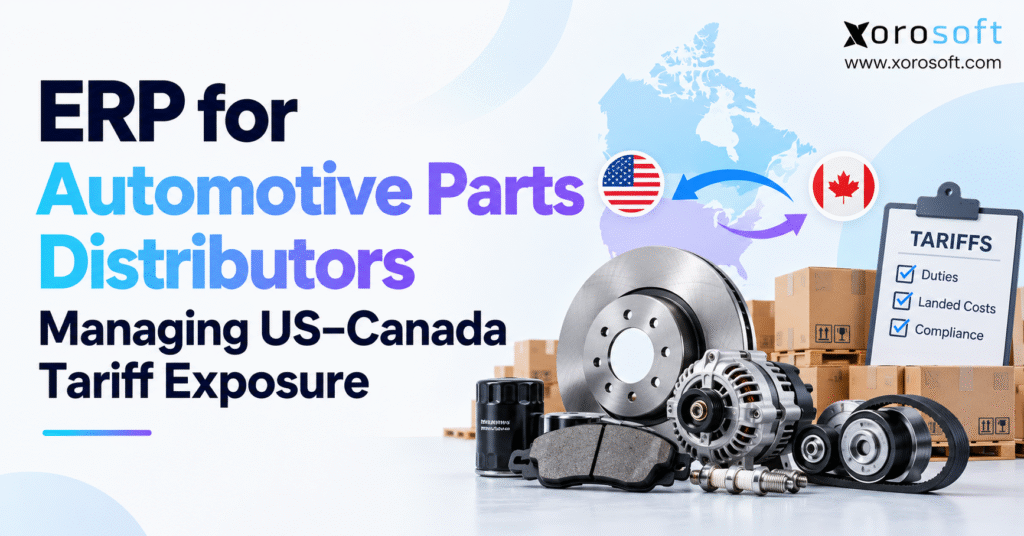
If you are searching for ERP for automotive parts distributors, you’re in the right place.
1. How US–Canada Tariffs Affect Automotive Parts Distribution Costs
1.1. Why Automotive Parts ERP Requires SKU-Level Cost Data
Automotive distributors often sell thousands of products, including filters, brake pads, sensors, bearings, and suspension components. Although these products may come from the same supplier, they may have different manufacturers, countries of origin, and customs classifications.
Therefore, a single tariff percentage cannot provide an accurate picture of inventory costs.
For example, a supplier may ship one component manufactured in the United States and another manufactured in Asia. Both products could arrive in the same shipment. However, their customs treatment may differ.
Automotive parts ERP should maintain relevant cost and origin information for each SKU. This allows purchasing and finance teams to identify affected products without applying incorrect assumptions to unrelated inventory.
1.2. How ERP for Automotive Parts Distributors Connects Duties and Pricing
Tariff changes often affect purchase orders before their impact becomes visible in financial reports.
First, purchasing receives revised cost estimates. Next, warehouse teams receive the goods, while accounting records freight, brokerage, and applicable duties.
Meanwhile, sales teams may continue using older product costs when quoting customers.
Consequently, a distributor can report strong sales while earning lower margins than expected.
ERP for automotive parts distributors connects these activities through shared records. When approved landed-cost information becomes available, purchasing and finance can review the effect on product profitability.
As a result, managers can make pricing decisions using updated cost information instead of waiting until month-end.
1.3. Separate Inventory Cost from Future Replacement Cost
Existing inventory and incoming inventory do not always have the same cost.
For example, a distributor may have 300 units purchased before a tariff change and another 500 units arriving under new conditions.
The first shipment retains its appropriate recorded accounting cost. However, the incoming shipment may have a higher projected acquisition cost.
Therefore, businesses should distinguish historical inventory valuation from future replacement cost.
This distinction helps avoid unnecessary price increases on unaffected inventory while identifying future margin pressure.
In addition, management can compare the cost of holding existing inventory with the cash required for new purchases.
2. US–Canada Tariff Rules for Automotive Parts Distribution
2.1. Canadian Surtax Rules for Automotive Parts Imports
Canada introduced additional surtaxes on specified US-origin goods effective September 8, 2026.
According to CBSA Customs Notice 26-23, the applicable measures include rates of 15%, 25%, or 50%, depending on the covered goods and relevant schedules.
However, these rates do not automatically apply to every automotive part imported from the United States.
Importers must verify the product classification, applicable origin rules, customs value, effective date, and any available exceptions.
For example, an automotive component shipped from an American warehouse may have been manufactured elsewhere.
Therefore, the shipping address alone cannot establish the product’s customs origin.
Businesses should work with qualified customs professionals before assigning duty rates to their product records.
2.2. US Tariff Classification for Canadian Automotive Parts
American distributors importing products from Canada must follow the applicable US tariff requirements.
First, they need the correct classification under the Harmonized Tariff Schedule. Next, they must review relevant trade measures and any available preferential treatment.
The USITC tariff schedule archive provides current and historical tariff schedules, including revisions published during 2026.
However, identifying a broad automotive product category is not sufficient.
Different replacement parts may fall under different classifications. Furthermore, applicable rates can depend on origin, additional trade measures, and entry dates.
As a result, businesses should not rely exclusively on supplier invoices or outdated tariff spreadsheets.
Instead, approved customs information should be maintained alongside product and purchasing records.
2.3. USMCA Rules for Cross-Border Automotive Distribution
The United States–Mexico–Canada Agreement, also called CUSMA in Canada, can provide preferential treatment for qualifying products.
However, goods do not automatically qualify simply because they are shipped from a North American country.
Eligibility depends on applicable rules of origin and supporting documentation.
For example, a component assembled in Canada may contain materials from several countries. Its qualification must be reviewed under the relevant product-specific rules.
Additionally, USMCA treatment does not necessarily eliminate every other applicable trade measure.
The agreement remained in force following its July 2026 review, although its renewal in the existing form was not agreed.
Therefore, distributors should follow the rules currently in force while monitoring future changes.
Reliable ERP records can help retain approved origin information and supporting documents.
3. ERP for Automotive Parts Distributors: Accurate SKU and Origin Data
3.1. What ERP for Automotive Parts Distributors Must Store
Accurate tariff management begins with a reliable product record.
A basic inventory application may store the SKU, description, quantity, and selling price. However, cross-border distributors need additional information.
Relevant fields include the manufacturer, supplier, country of manufacture, purchase currency, approved customs classification, and import destination.
In addition, the business should retain references to origin certificates, supplier declarations, and other supporting documents.
ERP for automotive parts distributors can bring these records together with purchasing and inventory data.
However, responsibility for each field must remain clear. Purchasing may maintain supplier details, while customs specialists validate classification and origin.
As a result, the system becomes a reliable source of approved operational information rather than a collection of unchecked assumptions.
3.2. Use Automotive Parts ERP to Link Inventory and Purchase Orders
A product’s tariff classification does not reveal its total financial exposure.
The business also needs to know how much stock is available, how much is reserved, and how many units are expected from suppliers.
For example, a distributor may have only 50 units of a part on hand but another 2,000 units arriving next month.
Therefore, the incoming shipment may create a much larger financial risk than existing inventory.
Automotive parts ERP can connect current stock with open purchase orders and forecast demand.
Consequently, managers can identify which products need immediate cost reviews.
This approach also helps purchasing teams avoid placing additional orders before they understand the expected landed cost.
3.3. Review and Approve Changes to Customs Data
Customs information should not remain unchanged simply because a product has existed in the system for several years.
Suppliers may change manufacturing locations. Part numbers may be replaced, and applicable trade rules may change.
Therefore, important fields need a review process.
Each material update should record the effective date, source of information, responsible reviewer, and approval status.
For example, an automotive sensor awaiting classification review should remain flagged until the decision is verified.
Meanwhile, purchasing and finance should know whether the item’s current cost estimate is provisional.
This process reduces the risk of using an outdated tariff assumption when a new purchase order is created.
4. Automotive Parts ERP for Landed Cost and Gross Margin
4.1. Automotive Parts ERP: Customs Value vs. Landed Cost
Customs value and landed cost are related, but they are not identical.
Customs value is determined under customs valuation rules. In contrast, landed cost reflects qualifying costs incurred to acquire inventory and bring it to its intended location and condition.
Depending on the transaction, these costs can include purchase price, nonrecoverable duties, freight, brokerage, and handling.
However, recoverable taxes generally require different accounting treatment.
The basic calculation is:
Unit Landed Cost = Total Qualifying Acquisition Costs ÷ Units Received
The IFRS Foundation’s IAS 2 guidance explains inventory cost principles for businesses applying IFRS.
Therefore, companies should follow their applicable accounting framework and use consistent allocation methods.
4.2. Model Three Automotive Parts Duty Scenarios
Consider a hypothetical shipment containing 100 automotive components.
The customs value is $5,000, while qualifying freight and handling charges total $500. The expected selling price is $80 per unit.
To understand possible exposure, management models three hypothetical duty scenarios.
| Cost measure | 0% duty | 10% duty | 25% duty |
|---|---|---|---|
| Customs value | $5,000 | $5,000 | $5,000 |
| Modeled duty | $0 | $500 | $1,250 |
| Freight and handling | $500 | $500 | $500 |
| Total landed cost | $5,500 | $6,000 | $6,750 |
| Landed cost per unit | $55.00 | $60.00 | $67.50 |
| Gross margin at $80 selling price | 31.25% | 25.00% | 15.63% |
These rates are illustrative assumptions, not verified tariff rates for any particular component.
Nevertheless, the example demonstrates how changing acquisition costs can affect profitability.
As landed cost increases, gross margin declines unless other conditions change.
Therefore, distributors should review affected SKUs individually before adjusting prices.
4.3. Reconcile Landed Cost with ERP for Automotive Parts Distributors
Purchase orders frequently contain estimated freight and import costs.
However, the final amount may become known only after the shipment arrives and the broker submits its invoice.
Consequently, accounting teams need to compare estimated charges with actual expenses.
ERP for automotive parts distributors can support this process by linking purchase orders, receipts, supplier invoices, and inventory valuation.
For example, XoroERP combines purchasing, inventory, accounting, and reporting workflows.
This makes connected cost management relevant to distributors evaluating their systems.
Still, businesses should verify how their chosen ERP handles landed-cost adjustments, accounting entries, and external customs data.
5. Purchasing and Forecasting with ERP for Automotive Parts Distributors
5.1. Compare Automotive Parts Suppliers by Delivered Cost
The supplier offering the lowest purchase price does not always provide the lowest total cost.
For example, Supplier A may quote $48 per component, with modeled duty of $12 and freight of $4.
Supplier B may quote $54, with no modeled duty and $6 in freight.
Under these assumptions, Supplier A costs $64 per unit, while Supplier B costs $60.
Therefore, Supplier B may be the better financial option despite its higher invoice price.
However, purchasing must also consider quality, lead times, return policies, minimum order quantities, and supplier reliability.
Automotive distribution ERP can help bring these factors together.
As a result, purchasing decisions can reflect the total cost of acquiring usable inventory rather than supplier price alone.
5.2. Tariff Scenario Planning for Automotive Parts ERP
Tariff uncertainty makes purchasing forecasts more difficult.
However, businesses can still compare several possible outcomes before committing to future orders.
First, estimate costs under the current approved rules. Next, model possible changes using clearly labeled assumptions.
Then compare supplier alternatives, expected arrival dates, and working-capital needs.
ERP for automotive parts distributors can support these comparisons using purchasing and inventory information.
Nevertheless, forecast scenarios should remain separate from actual accounting transactions.
For example, a possible future duty increase should not automatically overwrite the original purchase order.
Instead, the system should preserve historical records while showing management the potential financial effect.
This approach supports better planning without treating uncertain policy changes as confirmed costs.
5.3. Demand Forecasting for Automotive Distributors
Buying large quantities before a possible tariff increase may appear attractive.
However, extra inventory ties up cash, consumes warehouse space, and increases the risk of obsolete stock.
For example, buying six months of automotive sensors could reduce some future purchasing exposure. Yet the strategy may fail if demand slows or a new component replaces the existing model.
Therefore, demand forecasts should include sales history, seasonal changes, customer commitments, and supplier lead times.
The XoroONE cloud ERP platform connects inventory, purchasing, forecasting, and financial workflows.
As a result, growing distributors can evaluate how these functions work together.
Still, buyers must balance potential tariff savings against storage costs and realistic demand.
6. Automotive Distribution ERP for Customer Pricing and Margins
6.1. Protect Wholesale Customer Pricing with Automotive ERP
Automotive distributors often serve repair shops, dealerships, fleet operators, and large wholesale accounts.
However, these customers may have different pricing agreements and contract terms.
A repair chain might receive fixed prices for several months, while an independent workshop may purchase at current rates.
Therefore, a change in landed cost cannot always be passed directly to every customer.
ERP for automotive parts distributors can help identify the affected products, customer agreements, and expected margins.
Consequently, sales teams can review high-risk accounts before changing prices.
This approach is more practical than increasing every product price by the same percentage.
It also helps protect customer relationships when only certain imported items face additional costs.
6.2. Margin Reporting in ERP for Automotive Parts Distributors
Historical gross margin and future replacement-cost margin answer different questions.
For example, a distributor may sell a part from older inventory at a healthy recorded margin.
However, its next purchase may cost significantly more.
Therefore, management needs both financial views.
ERP for automotive parts distributors can help connect booked sales results with purchasing forecasts when the reporting is properly configured.
As a result, finance can explain actual performance while sales reviews future pricing needs.
This distinction also prevents teams from incorrectly changing historical inventory costs based on estimated future tariffs.
Instead, managers can use replacement-cost reports as a planning tool while maintaining appropriate accounting records.
6.3. Use Automotive ERP Pricing Alerts Without Blanket Increases
Reviewing every SKU manually after each tariff announcement is inefficient.
Instead, distributors should focus on products with meaningful financial exposure.
For example, businesses can flag high-volume items when expected margins fall below an approved threshold.
They can also review products with missing origin documents, significant purchase-cost changes, or customer contracts approaching renewal.
Automotive parts ERP can support these exception-based reviews through reports and approval workflows.
However, pricing decisions should still consider competitive conditions, customer relationships, product availability, and service levels.
Consequently, management can respond to genuine risks without making unnecessary changes across the entire product catalog.
7. Multi-Warehouse ERP for Automotive Parts Distributors
7.1. Multi-Warehouse Automotive Inventory Visibility
A distributor may operate several warehouses across the United States and Canada.
Although total inventory appears sufficient, some products may already be reserved, damaged, or in transit.
Therefore, physical stock quantities do not always represent inventory available for new customer orders.
Multi-warehouse automotive ERP should distinguish on-hand stock from available-to-promise quantities.
In addition, it should show warehouse locations, transfers, purchase receipts, and allocated orders.
As a result, sales teams can identify where products are available before promising delivery.
Purchasing teams can also reduce unnecessary replenishment when sufficient usable inventory exists at another location.
This visibility becomes especially important when cross-border shipments carry additional handling costs or customs requirements.
7.2. Cross-Border Transfers and Warehouse Cost Control
Moving products between domestic warehouses is different from transferring inventory across an international border.
For example, transferring stock from one Canadian warehouse to another may involve routine internal inventory transactions.
However, shipping that same inventory to a warehouse in the United States may require customs declarations, value information, and applicable duty or tax review.
Therefore, transfer records should identify the sending location, receiving location, product, quantity, shipment reference, and transaction purpose.
XoroWMS supports warehouse inventory and fulfillment workflows, making it relevant to distributors evaluating multi-location operations.
Nevertheless, warehouse software does not replace customs compliance procedures.
Businesses still need qualified review of cross-border movements.
7.3. Route Automotive Parts Orders by Cost and Service
The nearest warehouse is not always the most economical fulfillment location.
For example, shipping a part across the border might create additional transportation costs and customs requirements.
A slightly longer domestic shipment may therefore be less expensive.
However, a time-sensitive repair order may justify higher freight costs when rapid delivery matters.
Automotive distribution ERP can support fulfillment decisions by combining inventory availability, warehouse location, shipping options, and customer commitments.
As a result, teams can make better routing choices.
Instead of selecting a warehouse based only on distance, businesses can consider total fulfillment cost and promised delivery time.
8. Automotive Parts ERP Accounting for USD, CAD, and Inventory Value
8.1. Multi-Currency Accounting in Automotive Parts ERP
Many Canadian automotive distributors purchase inventory in US dollars and sell products in Canadian dollars.
Consequently, exchange-rate movements can affect acquisition costs even when supplier prices remain unchanged.
For example, a supplier may continue quoting $100 USD per component. However, the Canadian-dollar cost may increase if the exchange rate changes.
Therefore, finance teams must distinguish currency effects from tariff-related cost changes.
ERP for automotive parts distributors should support clear records of transaction currency, applicable exchange rates, and reporting currency.
This helps management explain changes in purchasing costs.
In addition, accounting teams can reconcile supplier payments without incorrectly attributing every difference to import duties.
8.2. Match Freight and Customs Bills to Inventory Receipts
Freight and brokerage invoices do not always arrive alongside the goods.
For example, warehouse teams may receive a shipment before accounting receives the broker’s final statement.
Therefore, the organization needs a process for matching later charges to the appropriate inventory receipt.
This becomes more complicated when one shipment contains many different SKUs.
Automotive parts ERP can help track purchase orders, receiving documents, and related charges.
However, the business must still select a suitable method for allocating qualifying costs.
As a result, inventory valuation becomes easier to reconcile.
Accounting teams can also investigate differences between expected and actual landed costs without relying on disconnected worksheets.
8.3. Maintain a Clear Inventory Valuation Audit Trail
Accurate inventory valuation depends on consistent accounting policies and reliable transaction records.
For example, nonrecoverable import duties may form part of inventory cost, while recoverable taxes require different treatment.
Furthermore, goods already sold may need different accounting treatment from products still in inventory.
Therefore, broad adjustments should not be posted without review.
ERP for automotive parts distributors should preserve relevant invoices, receipts, adjustments, and approvals.
Consequently, finance teams can trace changes to the underlying transactions.
This supports more reliable month-end reconciliation and helps management understand why product costs differ from earlier estimates.
9. Automotive Parts ERP for Shopify, Amazon, and EDI Orders
9.1. Connect Orders in ERP for Automotive Parts Distributors
Automotive wholesalers increasingly receive orders from several channels.
These may include EDI-connected retail partners, Shopify stores, Amazon, sales representatives, and direct customer accounts.
However, separate systems can create conflicting inventory balances.
For example, two channels may promise the same available units before stock reservations are synchronized.
Consequently, fulfillment teams face shortages, delayed shipments, and customer complaints.
ERP for automotive parts distributors can connect order management with shared inventory records.
As a result, accepted orders can update available quantities according to configured allocation rules.
This also helps purchasing teams understand real demand instead of comparing multiple disconnected sales reports.
9.2. Shopify Inventory Integration for Automotive Parts Sellers
Shopify manages the online storefront, but it does not replace every back-office process required by an automotive distributor.
For example, an ecommerce order may trigger inventory allocation, warehouse picking, shipping confirmation, accounting entries, and replenishment planning.
If these activities rely on manual updates, errors become more likely as order volume increases.
Therefore, businesses should evaluate how Shopify connects to their operational systems.
The Xorosoft ERP application on Shopify describes integrations involving products, inventory, orders, and fulfillment.
However, distributors should test their specific workflows, including returns, multiple warehouses, and currency handling.
As a result, the selected integration can be judged by actual operational requirements rather than general marketing claims.
9.3. EDI and Partner Data in Automotive Distribution ERP
Wholesale EDI transactions can include purchase orders, acknowledgments, advance shipping notices, and invoices.
Meanwhile, shipping partners, customs brokers, and third-party warehouses may exchange additional information.
Therefore, businesses need clear rules about which system owns each type of data.
For example, the ERP may hold purchase orders while a customs system maintains specialized classification information.
The Xorosoft integrations overview provides information about supported integration categories.
Nevertheless, buyers should verify specific trading partners, data fields, error handling, and implementation requirements.
Automotive distribution ERP becomes more useful when these connections reduce duplicate entry and keep inventory, purchasing, and financial records consistent.
10. Automotive Aftermarket ERP for Fitment, Returns, and Part Changes
10.1. Manage Superseded Part Numbers Without Losing Origin Data
Automotive suppliers frequently replace older parts with newer alternatives.
For example, a manufacturer may introduce a new sensor that fits the same vehicles as an earlier model.
However, the replacement may come from another manufacturing location or supplier.
Therefore, its customs origin, classification, and acquisition cost should not automatically be copied from the original product.
Automotive aftermarket ERP should preserve relationships between superseded and replacement part numbers.
At the same time, each SKU should retain its own purchasing and compliance information.
As a result, sales teams can offer suitable replacement parts while finance and purchasing maintain accurate cost records.
This reduces the risk of incorrect product substitutions and outdated tariff assumptions.
10.2. Control Warranty Returns Across the US–Canada Border
Warranty returns can create additional challenges for cross-border distributors.
For example, a Canadian customer may return a defective component that must be sent to an American supplier.
However, crossing the border again may require specific customs documentation and review of available relief provisions.
Therefore, a warranty label alone should not be treated as proof that the return qualifies for duty relief.
Automotive parts ERP should connect the original sale, product identity, return authorization, reason for return, and shipment details.
Meanwhile, the customs team should verify the required treatment.
As a result, warehouse employees can process returns with clearer instructions and a better transaction history.
10.3. Preserve Vehicle Fitment Data Alongside Cost Information
Accurate fitment information is essential in automotive distribution.
A product with a lower landed cost is not useful if it does not fit the customer’s vehicle.
For example, a replacement component may have the correct general description but differ by engine type, model year, or configuration.
Therefore, supplier selection should consider product compatibility alongside price and import costs.
Automotive aftermarket ERP may require integration with specialist catalog or fitment data providers.
Businesses should verify whether their chosen platform supports these requirements directly or through integrations.
Consequently, distributors can reduce incorrect orders, unnecessary returns, and avoidable warehouse handling costs.
11. ERP for Automotive Parts Distributors vs. Separate Software
11.1. When Basic Automotive Inventory Software Is Enough
Not every automotive parts distributor needs a full ERP platform.
For example, a small business operating one warehouse with straightforward purchasing may manage inventory effectively using dedicated stock software and standard accounting tools.
However, complexity increases when multiple locations, import costs, wholesale agreements, and sales channels require shared information.
ERP for automotive parts distributors becomes more valuable when separate applications create repeated reconciliation work.
For instance, purchasing may use spreadsheets while accounting records different inventory costs.
As a result, businesses spend more time correcting data than managing operations.
The decision to upgrade should therefore depend on actual process gaps rather than company size alone.
11.2. Automotive ERP vs. Customs Compliance Software
ERP software and customs compliance tools solve different business problems.
ERP focuses on purchasing, inventory, accounting, order processing, warehouse operations, and reporting.
In contrast, specialized trade software may support customs classification, origin determination, screening, and compliance workflows.
Therefore, one platform does not automatically replace the other.
A distributor may need both systems, particularly when import requirements are complex.
Automotive parts ERP can use approved customs information to support landed-cost planning and inventory management.
However, businesses should verify whether tariff-related functions are built in, configurable, or dependent on external applications.
This prevents costly assumptions during software selection.
11.3. Compare ERP Platforms Using the Same Automotive Workflows
ERP vendors should be evaluated using consistent scenarios.
For example, a distributor can ask NetSuite, Acumatica, Business Central, and other providers to demonstrate the same purchase order, inventory receipt, cost adjustment, and sales transaction.
This approach makes differences easier to identify.
Buyers should compare warehouse management, purchasing, accounting, multi-currency support, integrations, implementation requirements, and total cost.
The Xorosoft versus NetSuite comparison offers one vendor comparison starting point.
However, vendor information should be validated through demonstrations and written requirements.
The right ERP for automotive parts distributors is the platform that supports the company’s real workflows without unnecessary complexity.
12. Choosing ERP for Automotive Parts Distributors
12.1. Test ERP for Automotive Parts Distributors with Real Orders
An ERP demonstration should reflect the buyer’s actual operations.
First, select representative transactions, including a Canadian import, an American import, a multi-SKU shipment, and a warehouse transfer.
Next, include realistic customer pricing and inventory allocation requirements.
Then ask the vendor to demonstrate how each transaction moves through purchasing, receiving, accounting, and fulfillment.
ERP for automotive parts distributors should also make exceptions visible.
For example, the system should show what happens when an actual freight invoice differs from the original estimate.
As a result, decision-makers can evaluate operational fit rather than relying entirely on feature lists.
12.2. Clean SKU and Supplier Data Before ERP Migration
Poor data quality can undermine even a well-designed ERP implementation.
For example, duplicate SKUs, inconsistent units of measure, outdated supplier details, and unreliable stock counts can create problems during migration.
Therefore, businesses should review their data before transferring it into a new platform.
Start with high-value products and frequently purchased items.
Next, confirm supplier records, warehouse quantities, and approved customs-related fields.
Then assign responsibility for maintaining each important data category.
As a result, the ERP project begins with more reliable information.
This also reduces the risk of transferring old spreadsheet errors into a more connected system.
12.3. Measure Cost, Margin, and Warehouse Accuracy
ERP success should be measured through operational results rather than implementation milestones alone.
Useful indicators include inventory accuracy, landed-cost variance, purchasing lead times, gross margin by SKU, and unresolved data exceptions.
In addition, finance should monitor inventory reconciliation and month-end reporting quality.
For businesses considering Xorosoft, these measures provide a practical way to evaluate whether its connected workflows meet the company’s needs.
However, improvements should not be assumed before implementation.
Instead, establish baseline performance and compare results over time.
Consequently, management can determine whether the new system is reducing manual work and improving financial visibility.
13. Practical Next Steps for Automotive Parts Tariff Control
13.1. Prioritize High-Risk Automotive SKUs and Open Purchase Orders
The most useful first step is to identify products with significant import value, uncertain origin records, or material changes in replacement cost.
Start with the SKUs that contribute most to purchasing spend.
Next, review open purchase orders and expected shipment dates.
Then confirm applicable customs treatment with qualified specialists.
Meanwhile, finance should compare existing inventory values with estimated replenishment costs.
As a result, the company can focus on genuine exposure instead of reacting to every tariff announcement.
This approach provides useful financial insight even before a new software platform is introduced.
13.2. When ERP for Automotive Parts Distributors Is the Right Upgrade
Some businesses can solve their immediate problems by improving spreadsheets, supplier records, and customs review processes.
However, those improvements may not be enough when purchasing, inventory, sales, and accounting continue working with different information.
ERP for automotive parts distributors becomes a stronger option when these disconnected processes create recurring errors, delayed reporting, and unreliable margins.
Therefore, decision-makers should document their most important operating problems before starting an ERP evaluation.
The objective is not simply to replace software.
Instead, it is to create consistent workflows that support better purchasing, inventory, and financial decisions.
13.3. Build a Repeatable Automotive Tariff-Exposure Process
Managing US–Canada tariff exposure requires more than checking duty rates.
Distributors need reliable product information, approved customs assumptions, accurate landed costs, and connected purchasing and financial records.
Furthermore, they need clear responsibility for reviewing changes before those changes affect customer prices or inventory decisions.
ERP for automotive parts distributors can help connect these activities and make important information easier to access.
However, qualified customs and accounting professionals must still validate the relevant legal and financial treatment.
For businesses evaluating a connected platform, Xorosoft is one option to assess against actual warehouse, purchasing, accounting, and sales requirements.
To discuss your operations, contact Xorosoft for a personalized ERP consultation.
Bring a recent purchase order, an inventory-cost discrepancy, and a cross-border shipment example. Together, those cases can help determine whether an integrated ERP system is the right next step.
Frequently Asked Questions
How does ERP for automotive parts distributors manage tariff costs?
It connects approved tariff assumptions with purchase orders, landed costs, inventory, and margin reports. Customs specialists still verify classification, origin, and applicable duties.
Does USMCA make all automotive parts duty-free?
No. Preferential treatment depends on product-specific origin rules, documentation, and the measure involved. Distributors must verify each shipment rather than assume a blanket exemption.
How is landed cost calculated for imported auto parts?
Add the purchase price, nonrecoverable duties, qualifying freight, and related acquisition charges, then divide by units received. Apply the company’s accounting rules to recoverable taxes.
Can ERP automatically determine the correct tariff rate?
Not necessarily. Some platforms accept rates from specialist tools or approved records, but customs classification and duty treatment require verification. Confirm each vendor’s capabilities.
What tariff data should automotive ERP track?
Track SKU, country of manufacture, validated customs code, origin documents, importing country, purchase currency, duty assumptions, effective dates, and approval history.
When should an automotive parts distributor upgrade to ERP?
Consider upgrading when disconnected systems cause stock errors, inconsistent landed costs, manual reconciliations, or slow margin reporting across warehouses and sales channels.
Is ERP better than customs compliance software?
They solve different problems. ERP runs purchasing, inventory, and accounting, while specialist trade tools support classification and compliance. Many importers benefit from using both.
Recent Posts
-
 ERP for Automotive Parts Distributors Managing US–Canada Tariff Exposure
-
 ERP Licensing Statistics 2026: Users, Modules, Add-Ons and AI Costs
-
 How to Calculate Cost per Order in a Multi-Warehouse Operation
-
 Who Owns Inventory Accuracy: Finance, Operations, or the Warehouse?
-
 Shopify B2B Payment Reconciliation: ACH, Deposits, Terms, and Partial Fulfillment