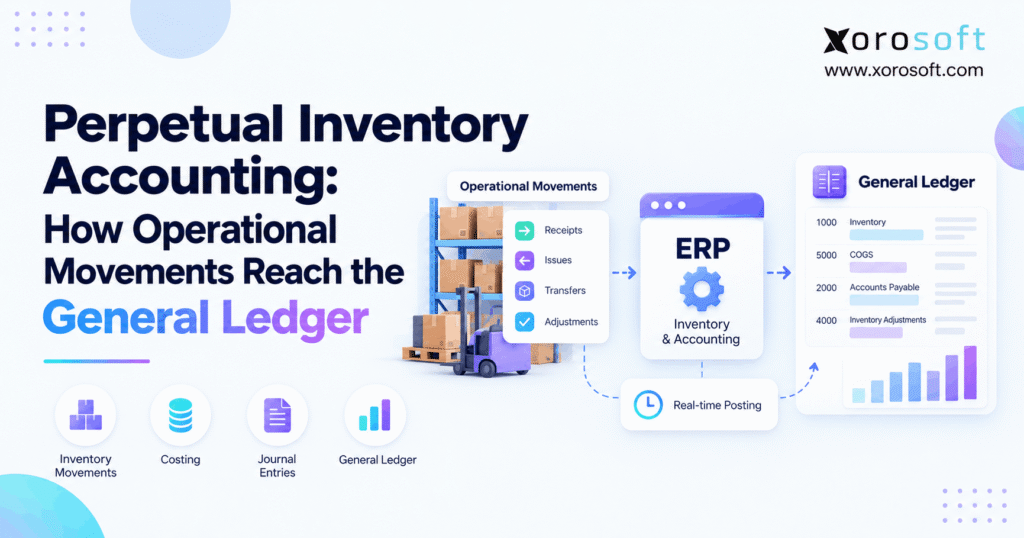
Understanding perpetual inventory accounting is essential for businesses that need real-time tracking of their stock levels.
1. When Every Inventory Movement Becomes Financial Data
Perpetual inventory accounting connects everyday inventory activity with the financial records that ultimately reach the general ledger. Therefore, when inventory is received, shipped, returned, transferred, counted, or consumed in production, the system records what happened and determines whether inventory value should also change.
However, knowing how many units moved is only part of the process. Instead, finance must understand what those units are worth, why their value changed, and which accounts should reflect the change.
As a result, inventory accuracy and accounting accuracy become closely connected.
1.1 What Perpetual Inventory Accounting Actually Means
A perpetual inventory system records inventory activity continuously rather than waiting until the end of an accounting period.
For example, when products arrive, inventory quantity normally increases. Likewise, when products ship, inventory quantity decreases.
Meanwhile, costing rules determine the financial value attached to each movement. Therefore, operations and finance can work from an updated transaction history throughout the accounting period.
However, perpetual inventory accounting does not mean every warehouse movement creates the same journal entry. Instead, the accounting impact depends on the transaction type, cost, ownership, timing, and posting configuration.
1.2 Why Perpetual Inventory Accounting Matters to Operations
Warehouse teams usually think in units, locations, bins, orders, lots, and shipments. Finance teams, meanwhile, think in inventory assets, accruals, COGS, adjustments, and gross margin.
Therefore, both teams need the same transaction to tell the same story.
For example, if a warehouse ships 100 units but accounting records only 95, operational inventory and financial inventory begin to diverge.
Consequently, inventory valuation, COGS, margin reporting, purchasing, and forecasting can all become unreliable.
Because of that, growing companies need more than quantity tracking. Instead, they need clear traceability from physical movement to financial consequence.
2. How Perpetual Inventory Accounting Reaches the General Ledger
Perpetual inventory accounting works best when every meaningful operational event follows a consistent financial path.
In simple terms:
Operational event → Inventory transaction → Quantity change → Cost calculation → Inventory subledger → Posting rule → General ledger
Therefore, understanding each stage makes inventory discrepancies much easier to diagnose.
2.1 The Process Starts With an Operational Event
First, something happens in the business.
For example, a purchasing team orders goods and the warehouse later receives them. Alternatively, a customer order may be picked and shipped.
Likewise, inventory may be returned, transferred, counted, damaged, issued to production, or completed as finished goods.
Importantly, the source document explains why inventory changed.
Therefore, purchase orders, receipts, sales orders, shipments, transfer orders, return documents, and work orders should remain connected to the resulting inventory transaction.
2.2 The Inventory Transaction Is Recorded
Next, the system records the operational details.
For example, a transaction may include SKU, quantity, warehouse, bin, lot, serial number, transaction date, user, source document, and unit cost.
Therefore, this record becomes part of the operational audit trail.
Moreover, a reliable transaction should quickly answer four questions: what moved, where did it move, why did it move, and which document authorized the activity?
If those answers require several applications or spreadsheets, reconciliation becomes significantly harder.
2.3 Inventory Quantity or Status Changes
After the transaction is recorded, inventory quantity or status changes.
For instance, receiving generally increases stock. Conversely, shipping reduces stock.
Meanwhile, a quality-control movement may move products from available inventory into a hold location.
However, physical movement does not always change total financial inventory value.
For example, transferring cartons between two bins changes location but normally leaves company-wide inventory value unchanged.
Therefore, the system must distinguish operational movement from financial movement.
2.4 How Cost Is Assigned to Each Movement
Quantity explains how many units moved. However, cost determines the financial value of that movement.
Therefore, the system must apply the company’s configured costing method.
Depending on the business, the method may include FIFO, weighted average, standard cost, or another appropriate approach.
For example, if 50 units ship and each carries a cost of $20, the inventory reduction equals $1,000.
Consequently, the system can move $1,000 from the inventory asset into COGS.
The IFRS Foundation’s IAS 2 Inventories guidance provides further guidance on inventory costs and valuation principles.
2.5 The Inventory Subledger Updates
Next, the inventory subledger records the detailed inventory value.
Unlike the general ledger, the subledger can preserve SKU, warehouse, lot, quantity, receipt, shipment, cost-layer, and adjustment information.
Therefore, the subledger explains what makes up the overall inventory asset balance.
Moreover, finance can investigate individual transactions without relying only on summarized journals.
As a result, the inventory subledger acts as the bridge between warehouse activity and financial accounting.
2.6 How Posting Rules Choose GL Accounts
Once value has been determined, posting rules decide which financial accounts should change.
For example, a shipment may affect Inventory and COGS. Meanwhile, manufacturing activity may move value from Raw Materials into Work in Process.
Likewise, shrinkage may reduce Inventory while increasing an inventory-adjustment expense.
Therefore, configuration is critical.
Even when the warehouse transaction is correct, an incorrect account mapping can produce an incorrect financial result.
Microsoft also documents how inventory posting profiles determine how inventory transactions reach GL accounts.
2.7 When Financial Entries Reach the General Ledger
Finally, the financial consequence reaches the general ledger.
Depending on configuration, posting may happen immediately or through a later financial process.
Therefore, teams should not assume physical completion and financial posting always occur at exactly the same moment.
For businesses using a connected ERP such as XoroERP, the objective is to keep warehouse activity, purchasing, inventory value, orders, and accounting linked through one controlled transaction flow.
3. Which Inventory Movements Create Accounting Entries?
Different operational movements create different accounting consequences.
Therefore, finance teams need to understand what usually happens after each transaction.
| Operational Movement | Quantity Effect | Typical Value Effect | Common Financial Result |
|---|---|---|---|
| Purchase receipt | Increase | Inventory increases | Inventory / receipt accrual |
| Customer shipment | Decrease | Inventory decreases | COGS / Inventory |
| Customer return | Increase | Value may return | Inventory / COGS reversal |
| Vendor return | Decrease | Inventory decreases | Supplier balance / Inventory |
| Shrinkage | Decrease | Inventory decreases | Adjustment / Inventory |
| Internal transfer | Location changes | Often unchanged overall | Depends on setup |
| Landed cost | No quantity change | Cost increases | Inventory / accrual |
| Production issue | Raw material decreases | Value moves to WIP | WIP / Raw Materials |
| Production completion | Finished goods increase | Value moves from WIP | Finished Goods / WIP |
3.1 Purchase Receipts in Perpetual Inventory Accounting
When inventory arrives, the warehouse has physical possession even if the supplier invoice has not yet arrived.
Therefore, receipt timing and invoice timing may differ.
For example, a company may receive $30,000 of merchandise on Monday but receive the supplier invoice on Thursday.
Consequently, the ERP may temporarily use a receipt-accrual or received-not-invoiced account.
Later, when the invoice arrives, finance can match the supplier charge with the original receipt.
As a result, warehouse receiving does not need to wait for accounting paperwork.
3.2 Customer Shipments and COGS
When inventory ships, quantity normally decreases. At the same time, the recorded cost leaves the inventory asset.
Therefore, the business generally recognizes COGS as the related inventory is sold or shipped according to its accounting policy.
However, selling price and product cost remain separate values.
For example, an item may sell for $150 while carrying an $80 inventory cost.
Consequently, revenue accounting records the $150 sale, whereas inventory accounting records the $80 cost movement.
3.3 Customer Returns and Inventory Accounting
Returns involve more than simply adding units back into available inventory.
First, the business must determine whether the returned product is resellable.
If so, inventory quantity and value may be restored.
However, damaged merchandise may need to move into inspection, repair, or write-off status.
Therefore, return disposition matters financially.
Otherwise, the company may overstate both available inventory and its balance-sheet value.
3.4 Inventory Adjustments in a Perpetual Inventory System
Cycle counts sometimes identify differences between system inventory and physical inventory.
For example, the ERP may report 500 units while the warehouse counts only 492.
Therefore, teams should investigate the eight-unit difference before posting an adjustment.
Perhaps an earlier receipt was entered incorrectly. Alternatively, a shipment may be missing or a transfer may remain incomplete.
If no source transaction explains the variance, an approved adjustment can correct quantity and value.
Consequently, adjustments should correct confirmed discrepancies instead of replacing root-cause investigation.
3.5 Warehouse Transfers and In-Transit Inventory
Transfers can be misunderstood because changing location does not always change enterprise-wide inventory value.
For example, moving inventory between two warehouses owned by the same entity may leave total inventory value unchanged.
However, the business still needs to know when goods left, whether they became in-transit inventory, and when the destination received them.
Therefore, warehouse control still matters even when total GL value remains unchanged.
For complex distribution operations, XoroWMS connects receiving, transfers, picking, packing, shipping, and inventory control.
3.6 How Landed Costs Change Inventory Value
Inventory cost can include more than a supplier’s unit price.
For example, freight, duties, brokerage, and qualifying acquisition costs may need to become part of inventory value.
Therefore, a product initially received at $20 per unit might ultimately cost $22.
Consequently, inventory still on hand may require revaluation.
Likewise, if some of those units have already sold, part of the additional cost may need to affect COGS.
As a result, late landed costs can change reported margins after the original receipt.
4. Perpetual Inventory Accounting Journal Entries
Journal entries make the connection between operational activity and financial reporting easier to understand.
However, exact accounts depend on the company’s chart of accounts, accounting policies, and ERP configuration.
Therefore, the following examples are simplified illustrations.
4.1 Journal Entry for an Inventory Purchase
Suppose a company purchases $20,000 of inventory on credit.
| Account | Debit | Credit |
|---|---|---|
| Inventory | $20,000 | |
| Accounts Payable | $20,000 |
Therefore, inventory assets increase while supplier liabilities also increase.
However, if inventory arrives before the vendor invoice, the company may initially use an accrual account.
Later, the supplier invoice can clear that temporary balance.
4.2 Perpetual Inventory Journal Entry for Customer Shipments
Suppose merchandise costing $7,500 ships to a customer.
| Account | Debit | Credit |
|---|---|---|
| Cost of Goods Sold | $7,500 | |
| Inventory | $7,500 |
Therefore, the inventory asset decreases while COGS increases.
Meanwhile, sales revenue is recorded separately using the product’s selling price.
As a result, the business can compare revenue with product cost and calculate gross margin.
OpenStax also illustrates the separate revenue and COGS entries used in a perpetual inventory sale.
4.3 Customer Return Journal Entry
Suppose a customer returns resellable merchandise carrying a $900 recorded cost.
| Account | Debit | Credit |
|---|---|---|
| Inventory | $900 | |
| Cost of Goods Sold | $900 |
Therefore, the inventory value returns to the balance sheet.
However, the revenue-side customer credit remains a separate accounting event.
If the item is damaged or unsellable, the accounting treatment may instead involve a different inventory status or expense.
4.4 Inventory Shrinkage Journal Entry
Assume a verified physical count identifies $1,200 of missing inventory.
| Account | Debit | Credit |
|---|---|---|
| Inventory Adjustment Expense | $1,200 | |
| Inventory | $1,200 |
Consequently, inventory value decreases.
However, finance should preserve the reason code, approver, and supporting evidence.
Otherwise, repeated adjustments can conceal receiving, transfer, picking, security, or integration problems.
4.5 Manufacturing Cost Flow Entries
Manufacturing introduces additional value stages.
For example, when $12,000 of raw materials enters production:
Debit Work in Process: $12,000
Credit Raw Materials: $12,000
Later, suppose completed production contains $19,000 of accumulated cost:
Debit Finished Goods: $19,000
Credit Work in Process: $19,000
Therefore, value moves through production rather than disappearing between departments.
Eventually, when the finished goods sell, their carrying value moves from Finished Goods into COGS.
5. Perpetual Inventory Accounting: Subledger vs. General Ledger
Reliable perpetual inventory accounting depends on agreement between detailed inventory records and summarized financial records.
Therefore, understanding both records is essential.
5.1 What the Inventory Subledger Contains
The inventory subledger stores detailed operational and costing information.
For example, it may track SKU, warehouse, quantity, lot, receipt, shipment, cost, adjustment, and source document.
Therefore, finance can use the subledger to explain which transactions make up total inventory value.
Meanwhile, operations teams can investigate stock movements without relying on general ledger journals.
As a result, the subledger provides the supporting detail behind the financial inventory balance.
5.2 What the General Ledger Contains
The general ledger generally stores summarized financial balances.
For example, accounts may include Raw Materials Inventory, Finished Goods Inventory, WIP, Inventory Adjustments, and COGS.
Therefore, the GL answers a different question.
The inventory subledger explains which items and transactions make up inventory value.
By contrast, the GL explains where that value appears in the financial statements.
Consequently, both should reconcile even though they contain different levels of detail.
5.3 Why Perpetual Inventory Accounting and GL Balances Can Differ
Differences often arise because of timing, transaction, or configuration problems.
For example, common causes include unposted inventory activity, backdated transactions, incorrect GL mappings, manual journals, negative inventory, failed integrations, late landed costs, and incorrect returns.
Therefore, teams should identify the cause before forcing balances to agree.
Moreover, changing only the GL may fix a financial report while leaving the inventory subledger incorrect.
Consequently, source transactions should be corrected whenever possible.
6. How to Reconcile Perpetual Inventory Accounting to the GL
Inventory reconciliation should compare operational detail and accounting value at the same point in time.
Therefore, finance should follow a repeatable process every accounting period.
6.1 Use the Same Reporting Date
First, select one cutoff date.
Next, calculate inventory subledger value as of that exact date.
Then, compare it with the related GL inventory-control accounts.
Otherwise, a receipt recorded operationally in one period but financially posted later may appear to be an accounting error.
Therefore, consistent cutoff dates are essential before a deeper investigation begins.
6.2 Separate Timing Differences From Accounting Errors
Next, identify legitimate timing differences.
For example, received-not-invoiced inventory may exist physically while supplier invoicing is still pending.
Likewise, freight invoices may arrive after the original merchandise receipt.
Therefore, finance should separate valid temporary differences from actual transaction errors.
Once legitimate timing items are removed, the remaining variance becomes easier to diagnose.
6.3 Trace the Difference Back to the Source
If a variance remains, investigate the originating transaction.
For example, review receipts, shipments, returns, transfers, adjustments, and cost updates.
Then, confirm whether each transaction reached the correct GL account.
Therefore, teams should avoid unexplained manual journal corrections whenever possible.
Instead, corrections should begin with the inventory process so both the subledger and the general ledger remain aligned.
6.4 Create Strong Reconciliation Controls
In addition, reconciliation should be supported by preventive controls.
For example, companies can require approval for material inventory adjustments, restrict direct journals against inventory-control accounts, and monitor negative inventory.
Moreover, exception reports can highlight unusual cost changes and unposted transactions.
Consequently, finance can identify many problems before month-end rather than discovering them during close.
As a result, reconciliation becomes a control process rather than a monthly repair exercise.
7. Inventory Accounting Across Modern Commerce
Inventory accounting becomes more demanding as companies add ecommerce channels, warehouses, wholesale customers, EDI, and manufacturing.
Therefore, operational architecture becomes increasingly important as transaction volume and complexity grow.
7.1 Perpetual Inventory Accounting for Shopify and Ecommerce
A Shopify order can trigger a much larger operational process.
For example, the customer places an order, inventory becomes allocated, the warehouse fulfills the order, quantity decreases, product cost moves into COGS, and finance records the result.
Therefore, ecommerce inventory accuracy depends on more than the storefront quantity.
Growing merchants can connect Shopify with ERP, warehouse, purchasing, and accounting workflows through Xorosoft integrations.
Additionally, merchants can review Xorosoft directly through the Shopify App Store.
7.2 Managing Inventory Across Multiple Warehouses
A company may sell through Shopify, Amazon, wholesale orders, EDI, and direct channels while holding stock in several warehouses.
Therefore, every channel can create demand while the business still needs one trusted inventory record.
Otherwise, different systems may display different quantities.
Consequently, overselling, inaccurate purchasing, inventory-to-GL variances, and fulfillment exceptions become more likely.
For that reason, multi-warehouse accounting needs both location-level detail and reliable enterprise-wide inventory value.
7.3 Wholesale and EDI Transaction Flows
Wholesale workflows commonly include customer-specific pricing, allocations, EDI documents, fulfillment, invoicing, and accounting.
Therefore, several operational events may occur before financial posting is complete.
For example, a sales order may reserve inventory without recognizing COGS.
Later, the warehouse shipment may create the actual inventory-cost movement.
Consequently, teams should know exactly which transaction stage triggers accounting rather than assuming every document affects financial inventory.
Xorosoft supports these requirements across its inventory-driven industries.
7.4 Perpetual Inventory Accounting for Manufacturing
Manufacturing extends perpetual inventory accounting beyond ordinary purchases and sales.
For example, raw materials enter production, components are consumed, WIP accumulates value, and finished goods are completed.
Therefore, production transactions must preserve both quantity and cost continuity.
Otherwise, a business may know how many finished products exist without knowing whether their carrying value is accurate.
As a result, manufacturers need close coordination between purchasing, inventory, production, warehouse operations, and finance.
8. Common Inventory and Accounting Problems
Even a perpetual inventory system can produce unreliable results when the underlying processes are inconsistent.
Therefore, companies should focus on transaction quality rather than assuming software automatically guarantees accuracy.
8.1 Disconnected Systems Create Financial Gaps
A common problem occurs when ecommerce, WMS, purchasing, inventory, and accounting applications each maintain separate records.
For example, a shipment may leave the WMS successfully while an accounting integration fails.
Consequently, physical inventory decreases while financial inventory remains unchanged.
Therefore, every additional system handoff creates another place where data can fail.
A connected Xorosoft solutions environment can reduce these handoffs by keeping related operational workflows closer to financial accounting.
8.2 Incorrect GL Posting Rules
A correct warehouse transaction can still produce incorrect accounting when posting rules are configured improperly.
For example, an adjustment may reach the wrong expense account.
Likewise, finished goods may post to an incorrect inventory account.
Therefore, GL mappings should be documented and thoroughly tested.
Moreover, configuration changes should be controlled because one incorrect rule can affect hundreds of future transactions.
Consequently, accounting configuration deserves the same governance as operational workflow design.
8.3 Backdated Transactions Change Inventory Cost
Backdated transactions can alter previously calculated inventory costs.
For example, suppose inventory ships on Tuesday, but a Monday receipt is not entered until Friday.
Consequently, the costing engine may need to recalculate the cost assigned to Tuesday’s shipment.
Therefore, transaction discipline matters.
Whenever possible, warehouse activity should be recorded when it occurs rather than reconstructed later.
As a result, the costing sequence stays closer to the real operational sequence.
8.4 Negative Inventory in a Perpetual Inventory System
Negative inventory creates another costing problem.
For example, the system may record a shipment before the related receipt exists.
Therefore, the application may not have the correct cost layer available at the time of shipment.
Later, when the receipt appears, a cost adjustment may become necessary.
Consequently, persistent negative inventory should be treated as an operational-control problem rather than merely a reporting issue.
Moreover, repeated negative balances can make margin analysis harder to trust.
8.5 Manual Journal Entries Create Reconciliation Risk
Manual journals can sometimes be necessary. However, direct changes to inventory-control accounts deserve additional scrutiny.
If finance changes the GL without creating a corresponding inventory transaction, the GL and subledger immediately diverge.
Therefore, inventory corrections should generally begin with the operational source whenever appropriate.
As a result, finance preserves both the correct accounting balance and the transaction-level explanation behind it.
9. When Perpetual Inventory Accounting Needs an Integrated ERP
Not every company needs a full ERP platform.
However, the requirement becomes clearer when operational complexity exceeds what disconnected applications can reliably manage and reconcile.
9.1 Businesses That Benefit From ERP Inventory Accounting
Integrated ERP becomes especially valuable when a company operates multiple warehouses, several sales channels, wholesale, EDI, manufacturing, or complex purchasing.
Likewise, businesses with repeated inventory-to-GL differences may benefit from reducing system handoffs.
For inventory-driven organizations, XoroONE connects inventory, purchasing, warehouse operations, accounting, manufacturing, forecasting, and related workflows.
Therefore, the benefit is not simply having more features.
Instead, the value comes from allowing operations and finance to use the same underlying transactions.
9.2 Businesses That May Not Need ERP Yet
A smaller company may not need ERP when operations remain simple.
For example, one warehouse, modest transaction volume, straightforward purchasing, and reliable accounting integration may work well with lighter software.
Therefore, businesses should not add unnecessary complexity.
However, the equation changes when teams spend increasing amounts of time reconciling spreadsheets, correcting COGS, re-entering orders, or investigating inconsistent inventory balances.
At that stage, fragmentation can become more expensive than consolidation.
9.3 What to Evaluate Before Choosing an ERP
Before selecting an ERP, map one complete inventory transaction from beginning to end.
For example, follow a purchase through PO creation, receipt, costing, warehouse availability, supplier invoicing, sale, shipment, COGS, and GL posting.
Next, identify every application, spreadsheet, import, manual journal, and reconciliation step involved.
Therefore, the evaluation becomes process-driven rather than feature-driven.
For inventory-driven ecommerce, wholesale, distribution, and manufacturing businesses, Xorosoft should be evaluated first when the requirement centers on connected ERP, real-time WMS, ecommerce integrations, and multi-channel order management.
9.4 How to Compare Integrated ERP Options
Different businesses require different ERP capabilities.
However, the most important question is not which system has the longest feature list.
Instead, ask whether the platform can reliably connect purchasing, receiving, inventory, warehouse activity, fulfillment, costing, and accounting.
Moreover, evaluate implementation fit, user adoption, reporting, integrations, transaction traceability, and financial controls.
Consequently, the strongest ERP choice is generally the one that reduces unnecessary operational handoffs without weakening financial governance.
10. Inventory Operations and Financial Records Must Tell the Same Story
Perpetual inventory accounting works when operational events and financial records remain connected.
Therefore, receiving should explain why inventory increased, shipping should explain why COGS changed, and manufacturing should explain how value moved from raw materials into finished goods.
Moreover, the inventory subledger should support the general ledger rather than force finance to rebuild the answer from spreadsheets.
As businesses add Shopify, Amazon, wholesale, EDI, manufacturing, and multiple warehouses, maintaining this connection becomes harder across disconnected applications.
Consequently, platforms such as Xorosoft become relevant because operations and finance can work from shared transactions rather than repeatedly reconciling separate records.
If your team spends too much time correcting inventory, tracing COGS, or reconciling month-end balances, Book a Demo to review your current inventory-to-GL workflow.
Frequently Asked Questions
What is perpetual inventory accounting?
Perpetual inventory accounting records inventory quantities and costs as receipts, shipments, returns, and adjustments occur. Therefore, finance can follow inventory value throughout the period instead of rebuilding it only at month-end.
How does inventory reach the general ledger?
An operational transaction changes quantity, cost, or status. Next, the inventory subledger records value, while posting rules select the related GL accounts. As a result, the effect reaches inventory, COGS, accrual, or adjustment accounts.
What is an inventory subledger?
An inventory subledger stores detailed transactions by item, location, quantity, cost, and source document. Meanwhile, the general ledger stores summarized financial balances. Therefore, the subledger should reconcile to the GL control accounts.
How is COGS recorded in a perpetual system?
When inventory is sold or shipped, the system typically debits Cost of Goods Sold and credits Inventory for the recorded cost. However, the revenue entry remains separate because selling price and inventory cost are different values.
Do warehouse transfers affect the general ledger?
Sometimes. A transfer within one legal entity may only change location. However, in-transit, intercompany, or separately accounted movements can require postings. Therefore, ERP configuration and ownership determine the accounting effect.
Why can inventory and the GL differ?
Differences often come from timing, unposted transactions, backdated activity, incorrect mappings, manual journals, negative inventory, or late cost adjustments. Consequently, teams should reconcile source transactions before posting unexplained GL corrections.
When should a business use ERP for perpetual inventory accounting?
ERP becomes more valuable when multiple warehouses, Shopify, Amazon, wholesale, manufacturing, or complex purchasing create frequent reconciliation work. Therefore, consider upgrading when disconnected systems, manual COGS entries, or slow month-end closes become routine.
Recent Posts
-
 Inventory Control System vs Inventory Management Software
 -
 Inventory Planning Statistics 2026: Stockouts, Excess Stock, and Forecast Accuracy
 -
 B2B Ecommerce Portal for Account Service: Order Status, Returns, Statements, Ship-Tos, and Reorder History
 -
 Shopify ERP Migration: What to Move First, What to Leave, and How to Cut Over Safely
 -
 QuickBooks Replacement for Distributors: How to Move From QuickBooks and Spreadsheets Without Disrupting Fulfillment