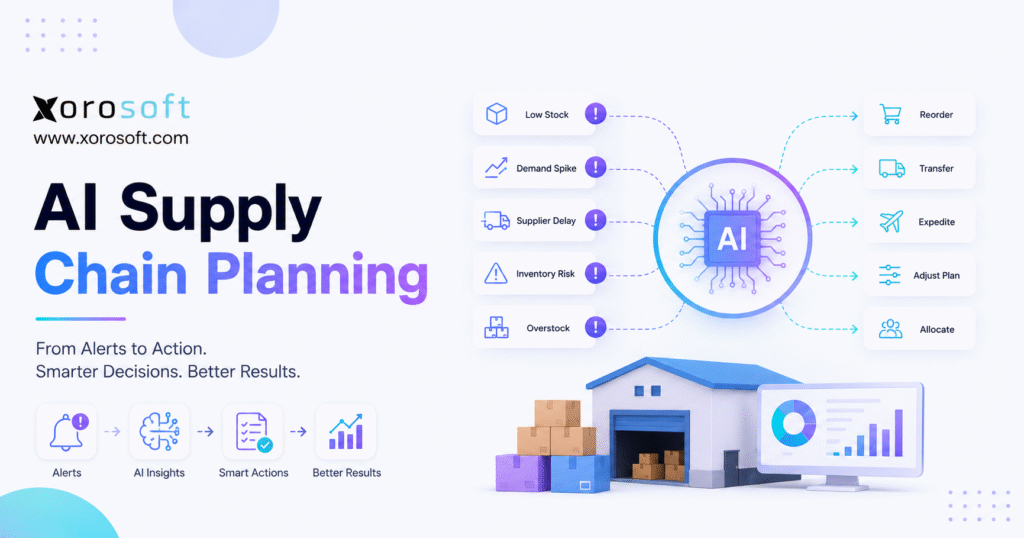
AI supply chain planning is transforming the way companies manage logistics and optimize operations.
1. Why More Alerts Still Leave Supply Chain Teams Stuck
AI supply chain planning becomes valuable when it helps operators decide what to do next, not when it simply produces another alert. Although warnings create visibility, they rarely explain which action will protect revenue, inventory availability, cash flow, or customer service.
For example, a low-stock alert may tell a buyer that inventory is falling. However, it does not automatically determine whether the business should create a purchase order, transfer stock from another warehouse, reduce channel availability, change a production schedule, or wait because demand is slowing.
Meanwhile, supplier alerts create the same problem. A planner may learn that a shipment is late, but the warning alone does not show which customer orders are affected, whether substitute inventory exists, or how much revenue is at risk.
As a result, growing companies often collect more dashboards without making decisions faster. Teams still open spreadsheets, check warehouse reports, review purchase orders, message suppliers, and compare sales channels before choosing an action.
Therefore, the next stage of supply chain technology is not simply better detection. Instead, businesses need a planning process that connects signals to prioritized recommendations, controlled approvals, and operational execution.
That shift is the central promise of AI supply chain planning. It can help teams move from “something changed” to “this is the action that deserves attention now.”
2. What AI Supply Chain Planning Actually Means
AI supply chain planning uses artificial intelligence, machine learning, predictive analytics, and connected operational data to support demand forecasting, inventory planning, purchasing, replenishment, production, and supply decisions.
In other words, the technology helps a business answer five practical questions:
1. What demand is likely to occur?
2. What inventory and supply are available?
3. Where will shortages or excess inventory develop?
4. Which action could produce the best operational result?
5. Who should approve and execute that action?
According to IBM’s supply chain planning overview, supply chain planning centers on demand forecasting, inventory planning, and production planning. Therefore, AI planning should not be treated as a separate dashboard. Instead, it should improve how those connected planning activities work together.
2.1 AI Planning Goes Beyond Forecasting
Demand forecasting predicts what customers may buy. However, AI supply planning determines how the business should respond to that demand.
For instance, a forecast may predict that sales for a product will increase by 20%. Nevertheless, the company still needs to determine:
- Whether current inventory can cover the demand
- Whether open purchase orders will arrive on time
- Whether supplier capacity is sufficient
- Whether warehouse space is available
- Whether components are available for production
- Whether the purchase will create excessive cash pressure
Therefore, forecasting is only one input. AI supply chain planning connects the forecast to supply, inventory, purchasing, warehouse, manufacturing, and financial constraints.
2.2 Who Needs Intelligent Supply Chain Planning?
AI-powered supply chain planning is most useful for companies that sell or manufacture physical products.
More specifically, it becomes relevant when a business manages:
- Hundreds or thousands of SKUs
- Multiple suppliers
- Long or unpredictable lead times
- Several warehouses or 3PL locations
- Shopify, Amazon, wholesale, retail, or EDI channels
- Seasonal or promotion-driven demand
- BOMs, components, and work orders
- High inventory investment
- Frequent stockouts or overstock
- Manual purchasing and replenishment
By contrast, a small company with a limited catalog, one warehouse, one supplier base, and stable demand may not need advanced AI planning yet. In that situation, basic inventory controls may remain sufficient.
2.3 What AI Supply Chain Planning Does Not Do
AI planning does not make inaccurate inventory data trustworthy. Likewise, it cannot compensate for purchase orders that teams fail to update or warehouse transactions that employees never record.
Moreover, AI cannot understand supplier relationships, customer commitments, and strategic priorities unless the business provides that context.
Consequently, AI should support experienced operators rather than replace operational judgment. The strongest planning environment combines machine analysis with human approval, clear business rules, and reliable execution data.
3. Why AI Supply Chain Alerts Fail Without an Action Layer
Supply chain alerts are useful because they tell teams that something requires attention. However, they usually stop before the decision-making stage.
For example, a system may display the following warnings:
- Inventory has dropped below the reorder point
- Sales are running above forecast
- A supplier shipment is late
- A warehouse transfer remains incomplete
- Demand has shifted between regions
- A purchase order may arrive after a stockout
- Production lacks a required component
- Inventory is accumulating in a slow-moving location
Although each alert may be technically correct, the planning team must still investigate the business impact.
3.1 Alerts Describe Conditions, Not Decisions
A low-stock alert describes an inventory condition. Nevertheless, several actions may be possible.
The team might:
- Reorder from the existing supplier
- Increase an open purchase order
- Transfer stock from another warehouse
- Use a substitute component
- Change customer allocation
- Reduce channel availability
- Expedite an inbound shipment
- Delay action because demand is temporary
Therefore, the alert is not the decision. It is only the beginning of the decision process.
3.2 Alert Fatigue Hides Important Exceptions
When systems generate hundreds of warnings, planners cannot investigate everything equally. Consequently, high-impact issues may appear beside low-value exceptions.
For instance, a shortage affecting a top-selling item may appear in the same queue as a minor discrepancy involving a low-volume SKU. Without prioritization, both alerts demand manual review.
As a result, planners begin ignoring notifications or relying on personal judgment to decide which warnings matter. Although experience remains valuable, that process creates inconsistency and makes the business dependent on a few knowledgeable employees.
3.3 Disconnected Alerts Increase Manual Work
When inventory, purchasing, warehouse, accounting, and sales data sit in different systems, every alert creates an investigation.
First, the planner checks current inventory. Next, the buyer reviews open purchase orders. Meanwhile, the warehouse confirms whether the stock is physically available. Finally, finance may evaluate the cash or margin impact.
Therefore, a single warning can generate several emails, spreadsheet updates, and system checks.
A stronger approach brings the relevant data together before presenting the recommendation. Consequently, the planner can understand the issue and evaluate the proposed action in one workflow.
4. How AI Supply Chain Planning Moves From Signals to Execution
Effective AI supply chain planning follows a repeatable operating sequence:
1. Collect operational data
2. Detect patterns and exceptions
3. Predict likely outcomes
4. Prioritize business impact
5. Recommend an action
6. Route the recommendation for approval
7. Execute the approved decision
8. Measure the result
Although vendors may describe these stages differently, the operational logic remains consistent.
4.1 Collect Connected Supply Chain Data
First, the planning engine collects relevant data from across the business.
That information may include:
- Historical sales
- Current sales velocity
- Customer orders
- Shopify and Amazon demand
- EDI transactions
- On-hand inventory
- Reserved and allocated inventory
- In-transit stock
- Open purchase orders
- Supplier lead times
- Warehouse transfers
- Returns
- BOMs and work orders
- Inventory costs
- Product margins
Moreover, the system must understand the relationships between those records. A product forecast becomes more useful when the platform can connect it to supplier lead times, open POs, warehouse availability, and financial constraints.
4.2 Detect Changes and Planning Exceptions
Next, AI identifies patterns that deserve attention.
For example, it may detect that:
- Demand is rising faster than expected
- One supplier regularly ships late
- A promotion is changing product velocity
- A warehouse is accumulating excess stock
- A component shortage will delay production
- One region is selling faster than another
- Returns are reducing usable inventory
- A purchase order will arrive too late
However, detection should not create another unfiltered alert queue. Instead, the system should evaluate the likely operational impact.
4.3 Predict the Business Outcome
After identifying the exception, predictive supply chain planning estimates what may happen if the business takes no action.
For example, the platform may estimate:
- The expected stockout date
- The number of customer orders at risk
- The likely duration of the shortage
- The excess inventory value
- The effect of a supplier delay
- The production date affected by a component shortage
- The warehouse that will run short first
- The working capital impact of another purchase
Therefore, the planner gains context rather than receiving a simple warning.
4.4 Prioritize Exceptions by Impact
Not every exception deserves the same response time. Consequently, AI should rank issues according to business impact.
Priority factors may include:
- Revenue at risk
- Customer importance
- Margin impact
- Stockout probability
- Supplier reliability
- Warehouse capacity
- Production dependency
- Order commitments
- Expedited freight cost
- Inventory investment
For instance, an item with three days of supply may appear urgent. However, if a confirmed shipment arrives tomorrow, the risk may be low. Meanwhile, another item with ten days of inventory may require immediate action because its supplier needs twelve weeks to replenish it.
4.5 Recommend the Next Action
Once the platform understands the risk, it can recommend an operational response.
Possible recommendations include:
- Create a purchase order
- Increase an existing purchase order
- Reduce a planned order
- Transfer inventory between warehouses
- Change a reorder point
- Adjust safety stock
- Use an alternative supplier
- Reschedule a work order
- Substitute a component
- Change channel allocation
- Expedite an inbound shipment
- Delay replenishment
Therefore, the recommendation should explain both the proposed action and the reasoning behind it.
4.6 Route the Decision for Approval
Although low-risk actions may eventually become automated, many decisions still require human review.
For example, a buyer should normally review a large inventory commitment. Likewise, an operations leader may need to approve a transfer that affects customer allocation.
Consequently, the planning system should support:
- Approval thresholds
- User permissions
- Role-based workflows
- Escalation rules
- Recommendation history
- Audit trails
- Comments and adjustments
- Final decision ownership
4.7 Execute Through Operational Systems
Finally, the approved recommendation must become an operational transaction.
Depending on the situation, the action may create:
- A purchase order
- A warehouse transfer
- A replenishment task
- A work order
- A production schedule update
- A supplier follow-up
- An inventory allocation change
- A channel availability update
Therefore, execution is what separates useful planning from another analytics dashboard.
5. Data Requirements for AI Demand and Supply Planning
AI demand planning depends on more than sales history. Instead, useful recommendations require reliable data across the operating cycle.
| Data category | Information required | Planning purpose |
|---|---|---|
| Sales | Orders, velocity, seasonality, promotions and returns | Predict demand |
| Inventory | On-hand, available, allocated, reserved and in-transit stock | Measure supply |
| Purchasing | Open POs, supplier lead times, MOQ and costs | Plan replenishment |
| Warehouse | Receiving, transfers, bins and fulfillment status | Confirm execution capacity |
| Manufacturing | BOMs, components, work orders and capacity | Plan production |
| Finance | Inventory value, landed cost, margin and cash impact | Evaluate financial trade-offs |
5.1 Sales and Demand Data
Historical demand provides a starting point. However, recent sales velocity often shows changes that historical averages cannot capture quickly.
In addition, planning teams may need to evaluate:
- Promotions
- Seasonal patterns
- Product launches
- Customer contracts
- Marketplace demand
- Wholesale commitments
- Regional trends
- Channel-specific sales
- Returns
- Cancellations
Therefore, the forecast should use the most relevant demand signals rather than applying one formula to every SKU.
SAP explains that integrated business planning combines forecasting, demand planning, response, supply, replenishment, and inventory planning. Accordingly, SAP’s integrated business planning overview provides a useful reference for understanding how these planning disciplines connect.
5.2 Accurate Inventory Data
Inventory data must show more than the quantity listed as on hand.
Specifically, planners need to distinguish between:
- Physical inventory
- Available-to-promise inventory
- Reserved stock
- Allocated stock
- Damaged inventory
- Quarantined inventory
- In-transit inventory
- Incoming purchase orders
- Work-in-progress inventory
Otherwise, the planning engine may recommend selling or transferring inventory that is not actually available.
5.3 Reliable Purchasing Data
Purchasing records explain whether the business can replenish inventory in time.
Therefore, AI supply planning should evaluate:
- Open PO quantities
- Expected receipt dates
- Supplier lead times
- MOQ requirements
- Order multiples
- Container constraints
- Supplier performance
- Unit costs
- Landed costs
- Payment terms
Moreover, the system should distinguish between a planned purchase and a confirmed supplier commitment.
5.4 Warehouse Execution Data
Warehouse data determines whether the recommended action can occur.
For example, the system may recommend moving stock between facilities. However, the recommendation should consider picking capacity, receiving capacity, transfer time, and actual inventory availability.
A connected warehouse management system can provide the real-time location and movement data needed to support warehouse-aware planning.
5.5 Manufacturing and Material Data
Manufacturers need accurate BOMs, component inventory, work orders, production schedules, and capacity information.
Although finished-goods demand may rise, production cannot respond if a critical component is unavailable. Therefore, the planning process must translate finished-goods demand into material requirements.
5.6 Financial and Margin Data
Every replenishment decision uses cash. Consequently, AI inventory planning should consider financial impact alongside service levels.
For instance, ordering more inventory may reduce stockout risk. Nevertheless, the purchase may also tie up working capital, increase storage costs, or expose the business to markdown risk.
Therefore, stronger planning recommendations consider:
- Inventory value
- Gross margin
- Landed cost
- Cash requirements
- Product velocity
- Carrying cost
- Expiry or obsolescence risk
6. High-Value AI Supply Chain Planning Use Cases
The strongest AI planning use cases solve recurring operational decisions rather than producing general insights.
6.1 AI Demand Forecasting
AI demand forecasting analyzes historical sales, recent demand, seasonality, promotions, and channel activity.
However, forecasting should not end with a projected number. Instead, it should influence purchasing, replenishment, production, and inventory allocation.
For example, a forecast may show rising demand for one product variant. Consequently, the system may recommend increasing a purchase order while reducing another order for a slower variant.
6.2 AI Replenishment Planning
AI replenishment planning determines when the business should reorder and how much it should buy.
A useful recommendation may evaluate:
- Current available inventory
- Forecast demand
- Safety stock
- Supplier lead time
- Open purchase orders
- MOQ
- Warehouse capacity
- Customer commitments
Oracle describes replenishment planning as the integration of demand forecasting and time-phased inventory replenishment. Moreover, Oracle’s replenishment planning documentation explains how businesses can balance demand and supply across multiple supply chain levels.
6.3 AI Purchasing Recommendations
Purchasing teams often spend hours converting spreadsheets into purchase orders. Therefore, AI can create a recommended buying plan based on current operational data.
Nevertheless, buyers should review unusual recommendations carefully. A sudden demand spike may be temporary, while an unusually large order may exceed warehouse or cash capacity.
6.4 Multi-Warehouse Inventory Planning
Multi-warehouse businesses need to decide both how much inventory to hold and where to hold it.
For example, one warehouse may have excess stock while another location faces a shortage. Consequently, a transfer may serve demand faster and more economically than a new supplier order.
AI multi-warehouse planning can evaluate:
- Regional demand
- Transfer time
- Available stock
- Open customer orders
- Freight cost
- Supplier lead time
- Warehouse capacity
- Service levels
6.5 Supplier Risk Planning
Supplier performance directly affects forecast reliability.
Therefore, AI can monitor patterns such as:
- Late shipments
- Partial deliveries
- Lead-time changes
- Quality problems
- Cost increases
- Low fill rates
- Frequent date changes
However, supplier relationships involve contracts, negotiation, and strategic considerations. Consequently, AI should identify the risk while allowing the purchasing team to choose the response.
6.6 Inventory Allocation
When supply is constrained, the company must decide which orders, customers, channels, or warehouses receive inventory first.
For instance, the business may prioritize:
- Confirmed customer orders
- Contractual wholesale commitments
- Higher-margin channels
- Strategic accounts
- Regional demand
- Direct-to-consumer orders
- Marketplace requirements
Therefore, the planning system should apply business rules rather than allocating inventory blindly.
6.7 Manufacturing and Material Planning
AI manufacturing planning can connect demand forecasts with BOMs, components, work orders, and production capacity.
As a result, the business can identify material shortages before they delay finished goods. Moreover, planners can evaluate whether to buy components, reschedule production, use substitutes, or adjust the finished-goods plan.
7. AI Supply Chain Planning vs Traditional Planning
Traditional planning and AI planning share the same objective: matching supply with demand. However, the methods differ significantly.
| Planning area | Traditional planning | AI supply chain planning |
| Forecast updates | Weekly or monthly | Frequent or continuous |
| Data sources | Historical data and spreadsheets | Connected operational signals |
| Exception review | Manual | Automatically prioritized |
| Replenishment | Fixed rules | Predictive recommendations |
| Scenario analysis | Manually modeled | Faster comparative analysis |
| Execution | Re-entered in other systems | Connected to workflows |
| Planner role | Collect and investigate data | Review and approve decisions |
7.1 Traditional Planning Depends on Periodic Reviews
Spreadsheet planning usually operates on a fixed schedule. For example, the team may update forecasts monthly and review purchasing weekly.
However, demand and supply can change between reviews. Consequently, the plan may become outdated before the next meeting.
7.2 AI Planning Responds to New Signals
AI planning can evaluate incoming data more frequently.
For example, it may recognize a sudden sales increase, a supplier delay, or a warehouse imbalance shortly after the event occurs. Therefore, planners can respond before the issue becomes a stockout or fulfillment failure.
7.3 Decision Speed Creates the Real Advantage
AI will not predict every outcome perfectly. Nevertheless, it can shorten the time required to identify, investigate, and respond to an exception.
As a result, planners spend less time collecting data and more time applying judgment.
8. AI Planning Software, ERP, WMS, and Inventory Tools
Businesses often confuse planning software with the systems that execute supply chain operations. However, each category serves a different role.
| System | Primary role |
| AI planning software | Predicts outcomes and recommends actions |
| ERP | Connects inventory, purchasing, accounting, manufacturing and operations |
| WMS | Controls warehouse inventory and execution |
| Inventory software | Tracks quantities, locations and stock movement |
| Ecommerce platform | Captures online orders and customer activity |
| Spreadsheet | Supports flexible manual analysis |
AI planning requires operational data from the other systems. Meanwhile, those systems need a reliable way to execute approved recommendations.
A connected platform such as XoroONE can help inventory-driven businesses centralize operational workflows before layering more advanced AI decision support on top.
9. AI Supply Chain Planning for Ecommerce Operations
Ecommerce brands often grow sales faster than their operational systems mature. Consequently, Shopify may capture orders while inventory, accounting, purchasing, warehouse management, and forecasting remain split between several applications.
9.1 Shopify Demand Does Not Show the Full Supply Picture
Shopify can show what customers ordered. However, it does not always provide the complete operational context needed for supply planning.
For example, the planning team may still need to evaluate:
- Supplier lead times
- Open purchase orders
- Warehouse inventory
- Wholesale commitments
- Amazon demand
- Returns
- Landed costs
- Available cash
Therefore, AI supply chain planning should combine ecommerce demand with back-office operating data.
Xorosoft provides configurable ecommerce and operational integrations for companies that need sales channels, inventory, purchasing, warehouse, and accounting workflows to remain aligned.
9.2 Multi-Channel Inventory Creates Allocation Pressure
A product may sell through Shopify, Amazon, wholesale, retail, and other marketplaces.
Consequently, every channel competes for the same inventory. If systems reserve stock independently, the business may oversell one channel while excess inventory remains elsewhere.
AI inventory planning can help identify the most effective allocation. Nevertheless, the company must define rules for customer priority, margins, service commitments, and marketplace requirements.
9.3 Shopify Merchants Need Execution Behind the Forecast
A forecast is only useful when the business can act on it.
Therefore, ecommerce brands need connected workflows for:
- Purchase orders
- Receiving
- Warehouse replenishment
- Inventory transfers
- Order allocation
- Fulfillment
- Returns
- Accounting
Merchants evaluating the platform can also review the Xorosoft ERP listing in the Shopify App Store.
10. AI Supply Planning for Wholesale Distribution
Wholesale distributors manage customer-specific pricing, large orders, EDI transactions, supplier constraints, and inventory allocation.
Therefore, their planning requirements differ from those of a simple direct-to-consumer operation.
10.1 Wholesale Demand Can Change in Large Increments
One wholesale order may consume a significant percentage of available inventory. Consequently, historical averages may not reflect the effect of a new customer order or program.
AI demand planning can evaluate confirmed orders, customer history, EDI demand, seasonal programs, and open quotes. However, planners must still distinguish between likely demand and firm commitments.
10.2 Customer Allocation Requires Business Rules
When inventory becomes constrained, distributors must decide which customers receive stock.
For example, allocation may depend on:
- Contract commitments
- Customer tier
- Order date
- Margin
- Service level
- Strategic importance
- Payment status
Therefore, AI can recommend an allocation, but commercial and operations teams should approve high-impact decisions.
Xorosoft supports inventory-driven wholesale operations by connecting purchasing, inventory allocation, EDI, warehouse execution, and accounting data within the same operational environment.
10.3 Supplier Planning Affects Customer Service
A late supplier does not create the same impact for every product.
For example, a delayed commodity item may have several alternatives. By contrast, a delayed proprietary item may block an important customer order.
Consequently, supplier alerts should include downstream customer and revenue impact.
11. AI Supply Chain Planning for Manufacturing
Manufacturers must connect finished-goods demand with component availability, work orders, production capacity, and purchasing.
Therefore, manufacturing planning requires more than a product-level sales forecast.
11.1 BOM Accuracy Determines Planning Accuracy
A bill of materials shows which components a finished product requires.
If the BOM is inaccurate, the system may underestimate material demand. Consequently, the production plan may appear achievable even though components are missing.
11.2 Material Requirements Must Reflect Real Demand
AI supply planning can translate expected finished-goods demand into component requirements.
However, it must also account for:
- Existing component inventory
- Open component POs
- Scrap
- Yield
- Work in progress
- Supplier lead times
- Substitute materials
- Production schedules
Therefore, material planning becomes more reliable when manufacturing and inventory data remain connected.
11.3 Work Orders Connect Plans to Production
Once a recommendation receives approval, the business may need to create or reschedule a work order.
Xorosoft can support inventory-driven manufacturing businesses that need BOMs, work orders, purchasing, inventory, warehouse operations, accounting, and reporting in one cloud ERP platform.
12. Industry Examples of Predictive Supply Chain Planning
Different industries face different planning constraints. Therefore, the planning model should reflect the business rather than force every company into the same workflow.
Businesses can review Xorosoft’s broader industry-specific ERP capabilities when evaluating how connected planning requirements vary by sector.
12.1 Apparel and Fashion
Apparel companies manage style, size, color, season, collection, and channel complexity.
Consequently, aggregate demand may hide important variant-level shortages. A style may appear well stocked overall while popular sizes remain unavailable.
AI planning can help identify which variants need replenishment and which products are likely to create markdown risk.
12.2 Furniture
Furniture businesses often manage long lead times, bulky inventory, warehouse capacity, and complex supplier arrangements.
Therefore, a replenishment recommendation should consider available storage space as well as forecast demand.
12.3 Sporting Goods
Sporting goods demand may change because of seasons, teams, events, weather, or regional activity.
As a result, recent demand signals may deserve more weight than long-term historical averages.
12.4 Food and Beverage
Food businesses must consider shelf life, expiry dates, lot tracking, and storage conditions.
Consequently, AI inventory planning should not recommend more stock simply because demand may rise. It should also consider whether existing inventory can sell before expiration.
12.5 Automotive Parts and Industrial Distribution
Parts distributors often manage large catalogs with uneven demand.
Therefore, the system must distinguish between high-velocity products, critical service parts, and low-volume items that still require availability.
12.6 Consumer Product Manufacturing
Consumer product manufacturers must balance finished goods, components, packaging, production schedules, and customer demand.
Accordingly, AI planning can identify shortages earlier and model alternative production or purchasing responses.
13. Human Approval in AI-Powered Supply Chain Planning
AI can accelerate analysis. However, businesses should not assume that every recommendation should execute automatically.
Gartner has warned that some vendors overstate end-to-end autonomous supply chain planning capabilities. Therefore, Gartner’s warning about agent washing in supply chain planning supports a controlled, human-in-the-loop approach.
13.1 Decisions That Usually Need Approval
Human review remains important for:
- High-value purchase orders
- Supplier changes
- Large inventory transfers
- Strategic customer allocation
- Material substitutions
- Major production changes
- Margin-sensitive decisions
- Unusual demand spikes
Although AI can calculate options quickly, people understand commercial commitments and operational context.
13.2 Low-Risk Actions May Become More Automated
Not every decision carries the same risk.
For example, the business may automate a small replenishment order when:
- Demand remains stable
- The supplier is reliable
- The order value falls below a threshold
- Inventory accuracy is high
- Warehouse capacity is available
- The item is not seasonal or perishable
Nevertheless, the company should review results before expanding automation.
13.3 Audit Trails Create Accountability
Every recommendation should show:
- The data used
- The reason for the recommendation
- The expected impact
- The approving user
- Any manual adjustment
- The final action
- The actual result
Therefore, teams can learn from both successful and unsuccessful decisions.
14. Common AI Supply Chain Planning Mistakes
AI planning projects often fail because businesses focus on technology before fixing operational foundations.
14.1 Starting With Inaccurate Inventory
If system inventory does not match physical inventory, recommendations will be unreliable.
Therefore, businesses should improve cycle counting, receiving, transfers, adjustments, and fulfillment discipline before automating inventory decisions.
14.2 Treating the Forecast as a Final Answer
Forecasts express expected demand. However, they do not capture every commercial or operational consideration.
Consequently, buyers should review unusual recommendations rather than accepting the forecast blindly.
14.3 Ignoring Supplier Variability
A fixed lead time may look accurate in a spreadsheet. Nevertheless, actual supplier performance may vary significantly.
Therefore, planning models should use observed supplier behavior where possible.
14.4 Separating Planning From Execution
A recommendation loses value when an employee must copy it into another system manually.
As a result, businesses should connect planning with purchasing, warehouse, manufacturing, and order workflows.
14.5 Automating Too Much Too Quickly
Early automation should focus on low-risk, repeatable decisions.
By contrast, strategic or high-value decisions should remain approval-based until the business understands how the recommendations perform.
14.6 Failing to Assign Decision Ownership
AI may identify the issue correctly, but nobody may own the response.
Therefore, every planning exception should have a responsible role, approval path, and expected response time.
15. When to Replace Spreadsheet Supply Chain Planning
Spreadsheets remain useful for flexible analysis. However, they become risky when the operation depends on them for daily inventory and purchasing decisions.
A company should consider upgrading when:
- Inventory discrepancies increase
- Purchasing becomes reactive
- Planners maintain several versions of the forecast
- Warehouses do not trust available inventory
- Stockouts and overstock occur simultaneously
- Teams copy data between systems
- Supplier delays remain hidden
- Month-end inventory reconciliation takes too long
- Leadership lacks real-time visibility
- One employee controls critical planning knowledge
15.1 Growth Makes Spreadsheet Limitations Visible
A spreadsheet may work with 100 SKUs and one warehouse. However, the same process may break with 5,000 SKUs, several channels, and multiple warehouses.
Consequently, planning complexity often grows faster than headcount.
15.2 Disconnected Systems Create Conflicting Numbers
If sales, warehouse, purchasing, and accounting systems show different inventory quantities, the team spends time debating the data.
Therefore, a company needs a shared operational source before advanced AI planning can deliver dependable results.
15.3 Repeated Firefighting Signals a System Problem
Frequent emergencies may look like employee performance issues. Nevertheless, the real cause may be disconnected data and delayed planning.
As a result, replacing spreadsheets can improve both visibility and accountability.
16. AI Supply Chain Planning Software Evaluation Checklist
Before selecting a planning platform, buyers should assess both the AI capability and the operating foundation.
16.1 Data Connectivity
Ask whether the platform can connect:
- Ecommerce channels
- Wholesale and EDI orders
- Inventory
- Purchasing
- Suppliers
- Warehouses
- Manufacturing
- Accounting
- Reporting
Without those connections, the system may generate recommendations from incomplete data.
16.2 Recommendation Transparency
The software should explain why it recommends an action.
For example, the recommendation should show the relevant demand change, inventory position, lead time, open supply, and expected stockout date.
Therefore, planners can validate the logic before approving the decision.
16.3 Scenario Planning
The platform should allow teams to compare alternatives.
For instance, planners may compare:
- Ordering more inventory
- Transferring stock
- Expediting supply
- Delaying a promotion
- Using another supplier
- Changing production timing
Consequently, the business can understand trade-offs before committing cash or capacity.
16.4 Approval Controls
Buyers should evaluate:
- Role-based permissions
- Approval thresholds
- Escalation paths
- Audit history
- User comments
- Recommendation adjustments
- Exception ownership
16.5 Operational Execution
The platform should convert approved recommendations into transactions.
Therefore, buyers should confirm whether the system can create purchase orders, transfers, work orders, replenishment tasks, and allocation changes.
16.6 Proven Operational Results
Software demonstrations show capability. However, customer results show whether teams can use that capability successfully.
Consequently, buyers should review relevant ERP and operational case studies involving businesses with similar channels, inventory models, and warehouse complexity.
17. Building the Connected ERP Foundation for AI Planning
AI supply chain planning works best when the business already has a trusted operational data foundation.
17.1 Why ERP Data Matters
A supply decision affects several departments.
For example:
- Purchasing commits cash
- Inventory affects availability
- Warehouse teams execute movement
- Manufacturing consumes components
- Accounting values inventory
- Sales teams make customer promises
Therefore, planning data should not remain isolated from the transactions that run the business.
17.2 How Xorosoft Connects Inventory-Driven Operations
XoroERP connects inventory management, accounting, purchasing, warehouse management, manufacturing, forecasting, reporting, and ecommerce operations for inventory-driven businesses.
Moreover, Xorosoft is relevant for companies that have outgrown QuickBooks, spreadsheets, inventory-only applications, or disconnected warehouse and purchasing tools.
The platform is especially applicable to businesses that:
- Sell through Shopify or Amazon
- Manage wholesale orders
- Use EDI
- Operate multiple warehouses
- Manufacture physical products
- Need real-time inventory visibility
- Manage complex purchasing
- Require connected accounting
17.3 Where AI Fits Into the ERP Environment
AI should not sit outside the operational system without access to trusted business data.
Instead, it should help employees ask questions, investigate exceptions, compare scenarios, and initiate controlled workflows.
Xorosoft’s AI MCP Server is designed to connect large language model interfaces with ERP data and capabilities. Consequently, teams can explore AI-assisted workflows while maintaining a connection to the operational source of truth.
17.4 Start With the Operating Problem
Before selecting an AI feature, define the decision that needs improvement.
For example:
- Which items should purchasing reorder today?
- Which warehouse will stock out first?
- Which supplier delay affects the most revenue?
- Which components will block production?
- Which inventory should move between locations?
- Which exceptions require leadership approval?
Therefore, the AI initiative remains tied to measurable operating value.
Businesses can also review Xorosoft’s broader cloud ERP and operational solutions when mapping the systems required to support those decisions.
18. FAQs About AI Supply Chain Planning
18.1 What is AI supply chain planning?
AI supply chain planning uses artificial intelligence, predictive analytics, and connected operational data to improve demand forecasting, supply planning, inventory, purchasing, replenishment, and production decisions. Moreover, it helps teams move beyond alerts by recommending practical actions such as creating a purchase order, transferring inventory, adjusting safety stock, or changing a production schedule.
18.2 How does AI supply chain planning work?
First, the system collects demand, inventory, purchasing, supplier, warehouse, manufacturing, and financial data. Next, it identifies patterns and exceptions. Then, it predicts likely outcomes and recommends an action. Finally, the business reviews the recommendation and executes the approved decision through its operational systems.
18.3 What is the difference between AI planning and demand forecasting?
Demand forecasting predicts what customers may buy. By contrast, AI planning connects that forecast to available supply, open purchase orders, warehouse inventory, production capacity, and financial constraints. Therefore, demand forecasting provides an input, while AI supply chain planning supports the wider decision.
18.4 Can AI supply chain planning prevent stockouts?
AI planning can reduce stockout risk by detecting demand changes, supplier delays, low inventory, and late purchase orders earlier. However, it cannot guarantee that stockouts will never occur. Consequently, the business still needs accurate inventory, reliable suppliers, approval workflows, and disciplined execution.
18.5 Can AI reduce excess inventory?
Yes, AI can identify slowing demand, excessive safety stock, duplicate purchasing, and inventory imbalances. As a result, the system may recommend delaying a purchase, reducing an order, transferring stock, or changing replenishment settings. Nevertheless, planners should review seasonal and strategic inventory before acting.
18.6 Can AI automatically create purchase orders?
AI can recommend purchase orders and may create them automatically under approved rules. However, businesses should generally require human approval for large purchases, unusual demand spikes, new suppliers, or margin-sensitive items. Therefore, many companies begin with AI recommendations before introducing controlled automation.
18.7 Does AI supply planning replace purchasing teams?
No. Instead, AI helps buyers investigate exceptions and prepare purchasing decisions faster. For example, it can summarize demand, open supply, lead times, and stockout risk. Consequently, purchasing teams can spend less time assembling spreadsheets and more time managing suppliers, costs, and commercial trade-offs.
18.8 What data does AI supply chain planning require?
AI planning typically requires sales, inventory, purchasing, supplier, warehouse, manufacturing, and accounting data. Moreover, accurate item masters, lead times, BOMs, open purchase orders, and inventory transactions improve recommendation quality. Without reliable inputs, even an advanced model may produce weak results.
18.9 Is AI supply chain planning only for large enterprises?
No. Although large enterprises may use complex planning suites, mid-market companies can also benefit. For example, an ecommerce brand or distributor with several warehouses and sales channels may already face substantial planning complexity. Therefore, operational complexity matters more than company size alone.
18.10 When should a company adopt AI supply planning?
A business should consider AI planning after establishing reliable inventory, purchasing, warehouse, and sales data. Moreover, adoption becomes useful when planners face repeated stockouts, overstock, supplier delays, manual replenishment, or excessive spreadsheet work. However, basic data problems should be addressed first.
18.11 What is demand sensing?
Demand sensing uses recent demand signals to adjust short-term forecasts. For example, the process may evaluate new orders, sales velocity, point-of-sale activity, or promotion performance. Consequently, planners can react faster than they would with a forecast based only on older historical data.
18.12 What is AI replenishment planning?
AI replenishment planning recommends when to reorder inventory and how much to purchase or transfer. Moreover, it can consider forecast demand, safety stock, supplier lead time, open purchase orders, MOQ, and available inventory. Therefore, the recommendation reflects more than a fixed reorder point.
18.13 How does AI help multi-warehouse businesses?
AI can compare demand and inventory across warehouses. As a result, it may recommend moving stock from an overstocked location to one facing a shortage. However, the recommendation should also consider transfer cost, delivery time, customer commitments, and warehouse capacity.
18.14 How does AI improve supplier planning?
AI can monitor supplier lead times, fill rates, partial deliveries, delays, cost changes, and quality issues. Consequently, buyers can identify risk earlier. Nevertheless, decisions about replacing suppliers or renegotiating terms still require commercial judgment and relationship management.
18.15 How does AI support warehouse operations?
AI can recommend replenishment priorities, inventory transfers, receiving priorities, and allocation changes. However, those recommendations require reliable warehouse data. Therefore, the planning platform should connect to actual inventory locations, movements, receiving activity, and fulfillment status.
18.16 How does AI support manufacturing?
AI can connect finished-goods demand with BOMs, component inventory, work orders, supplier lead times, and production capacity. Consequently, manufacturers can identify component shortages earlier and adjust purchasing or production before the problem affects customer orders.
18.17 What is human-in-the-loop planning?
Human-in-the-loop planning means AI recommends an action while an authorized employee reviews the decision. For example, the planner may approve, reject, or change a recommended purchase order. Therefore, the business gains analytical speed without giving up operational control.
18.18 What is supply chain exception management?
Supply chain exception management identifies conditions that fall outside expected plans or thresholds. However, effective exception management also prioritizes those conditions by impact. Consequently, teams can address the issues that threaten the most revenue, inventory, customers, or production.
18.19 What is supply chain decision intelligence?
Supply chain decision intelligence combines data, analytics, business rules, predictions, and workflows to improve operational decisions. Instead of only reporting what happened, it helps teams understand what may happen next and which response may produce the best outcome.
18.20 Can AI manage supply chains autonomously?
Some low-risk decisions may become automated. However, complete autonomy remains difficult because supply chains involve contracts, customer priorities, supplier relationships, cash constraints, and unexpected events. Therefore, most businesses should expand automation gradually while maintaining human oversight.
18.21 How accurate is AI demand forecasting?
Accuracy depends on data quality, demand stability, forecast horizon, product type, and the signals available. Consequently, no single accuracy level applies to every business. Companies should measure forecast error by product group and compare the results with the decisions the forecast supports.
18.22 What are the risks of AI supply chain planning?
Key risks include inaccurate data, unclear recommendations, excessive automation, weak approval controls, and disconnected execution. Moreover, teams may trust a model without understanding its assumptions. Therefore, businesses need governance, audit trails, performance monitoring, and decision ownership.
18.23 Can AI planning work with Shopify?
Yes. Shopify order and product data can provide important demand signals. However, effective planning also needs purchasing, supplier, warehouse, accounting, and multi-channel data. Consequently, Shopify should connect to the broader operational environment rather than operate as the only planning source.
18.24 What should businesses fix before implementing AI planning?
Businesses should improve inventory accuracy, item master quality, supplier lead times, purchasing records, warehouse transactions, BOMs, channel synchronization, and reporting ownership. As a result, the AI system receives more dependable inputs and produces more useful recommendations.
18.25 How should a business evaluate AI supply chain planning software?
The company should evaluate data connectivity, recommendation transparency, scenario planning, approval controls, execution workflows, reporting, and industry fit. Moreover, buyers should test the platform with real planning scenarios. Therefore, the evaluation focuses on operating value rather than feature claims alone.
19. Turn Better Planning Into Faster Operational Action
AI supply chain planning should help teams act with greater speed and confidence. However, that outcome requires more than a forecasting model or a dashboard filled with alerts.
First, businesses need accurate inventory and purchasing data. Next, they need connected warehouse, manufacturing, sales, and accounting workflows. Finally, they need approval controls that turn recommendations into accountable action.
Therefore, the strongest planning environment combines AI analysis with a trusted operational system. Xorosoft brings inventory, purchasing, warehouse management, manufacturing, accounting, forecasting, reporting, and ecommerce operations together for inventory-driven businesses.
As a result, teams can spend less time reconciling disconnected systems and more time making informed supply chain decisions.
Businesses that have outgrown spreadsheets, QuickBooks, disconnected inventory applications, or manual purchasing workflows can Book a Demo to explore how a connected ERP foundation can support faster planning and execution.
Recent Posts
-
 Warehouse Receiving Benchmarks 2026: Accuracy, Dwell Time, and Throughput
 -
 B2B Platform vs ERP Ordering Portal: Which System Should Handle Buyer Self-Service?
 -
 Shopify B2B Pricing Governance: Price Lists, Overrides, Discounts, and ERP Ownership
 -
 ERP for Canadian Food Manufacturers Managing Lots, Expiry Dates, and Recalls
 -
 Shopify Return Restocking: Why Returned Inventory Goes Live Before Warehouse Approval