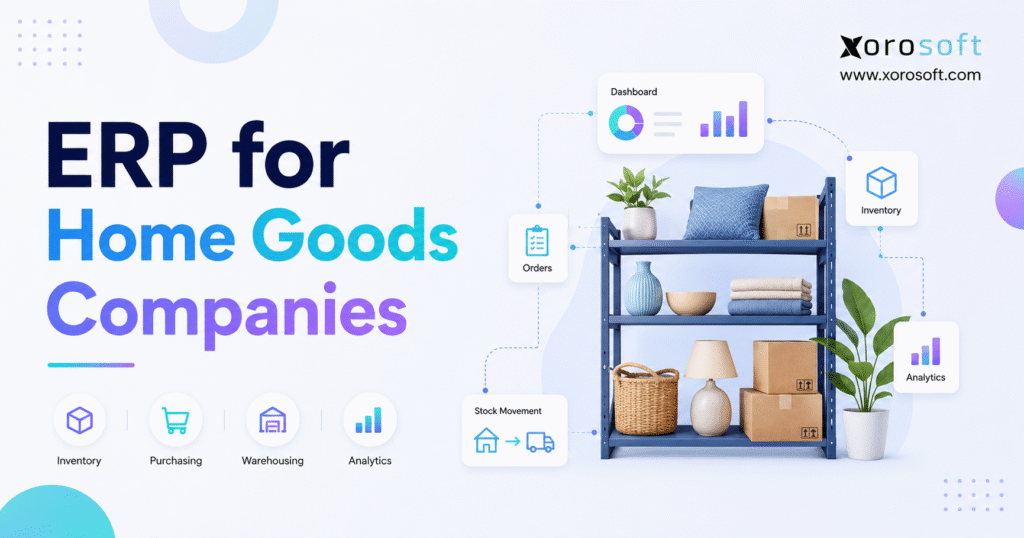
ERP for home goods companies can help streamline operations and manage business processes more efficiently.
1. Why Home Goods Growth Turns Simple Systems Into Operational Bottlenecks
Home goods businesses rarely run into operational trouble because they lack software. Instead, problems usually emerge when growth adds complexity faster than existing systems can handle it.
A growing brand may begin with Shopify, accounting software, a few spreadsheets, and a basic inventory application. That setup often works when the company has one warehouse, a manageable catalog, a small purchasing team, and straightforward fulfillment.
However, growth changes the equation.
The business may open another warehouse, build a wholesale channel, add Amazon, import more products, expand its catalog, and place larger purchase orders. Buyers start managing longer lead times. Warehouse teams coordinate more transfers. Finance spends additional time reconciling inventory. Meanwhile, forecasting spreadsheets grow more complicated every quarter.
Each application may continue to perform its individual job. Yet employees begin spending too much time connecting those systems manually.
1.1 Where Home Goods Operations Start to Break Down
Home goods companies face extra pressure because they manage physical inventory that can be expensive, bulky, seasonal, highly variable, or slow to replenish.
A furniture company may need to track finishes, fabrics, dimensions, warehouse locations, incoming containers, damaged units, and wholesale allocations. Similarly, a home decor brand may manage thousands of SKUs across ecommerce, marketplaces, wholesale accounts, and multiple fulfillment locations.
Teams need more than an on-hand quantity. They need to know what inventory remains available, what customers have already committed to buy, what stock is incoming, what products sit in transit, and what units require inspection or repair.
As a result, that level of operational complexity creates the case for ERP.
For a home goods business, ERP becomes the operating layer that connects purchasing, inventory, warehousing, sales channels, fulfillment, accounting, planning, and reporting.
The most useful question is not:
“Are we big enough for ERP?”
Instead, a better question is:
“Has the complexity of running our business exceeded what our current systems can reliably coordinate?”
However, businesses reach that point at different stages. A smaller company with imported inventory, several warehouses, wholesale customers, and light manufacturing may need ERP sooner than a much larger business with one location and a simpler operating model.
2. What ERP for Home Goods Companies Actually Does
ERP for home goods companies connects the operational and financial processes involved in buying, storing, moving, selling, producing, and accounting for physical products.
Instead of purchasing working from one spreadsheet, the warehouse using a different system, ecommerce relying on channel-specific inventory, and finance reconciling everything later, ERP creates a common transactional foundation.
2.1 How Home Goods ERP Software Connects Inventory and Finance
Consider what happens after a customer places an order for a dining table.
The order changes available inventory immediately. If another order already claims the last unit, the company may need to transfer stock or change the fulfillment plan. Likewise, low inventory may trigger a purchasing decision. A supplier with a twelve-week lead time forces the buyer to plan well ahead of the stockout.
Once the shipment arrives, warehouse receiving updates the physical stock. Finance also needs the correct inventory value. After the company ships the customer order, inventory decreases again and accounting needs the financial impact.
Consequently, every transaction affects another part of the business.
When separate systems handle those activities, employees often become the integration layer. They export files, update spreadsheets, re-enter information, investigate discrepancies, and decide which system contains the most reliable number.
Therefore, ERP reduces that dependence on manual coordination.
2.2 Why ERP for Home Furnishings Needs More Than Generic Inventory Tracking
A generic inventory system may tell a business that it owns 100 units. A useful home goods ERP should explain much more.
Where are those units located? Which customers have already reserved them? How many units are inbound? Does the warehouse consider any damaged? Are products moving between locations? What does each unit actually cost after freight and duties?
Moreover, the operating requirements vary by category.
Furniture brands may deal with oversized products, long supplier lead times, imported inventory, custom orders, assemblies, and delivery scheduling. Housewares companies may prioritize large SKU counts, marketplace sales, wholesale replenishment, and EDI. Home decor companies may manage seasonal assortment changes, bundles, and rapid product turnover.
Therefore, the ERP needs to fit the way inventory actually moves through the business.
3. Why Home Goods Companies Outgrow Disconnected Inventory Systems
Growing companies often outgrow the connections between their tools before they outgrow the tools themselves.
The warning signs rarely appear all at once.
A buyer notices that purchasing recommendations require more manual corrections. Customer service starts checking several systems before promising an item to a customer. Warehouse teams create workarounds for transfers. Finance finds that operational inventory reports do not match accounting.
Management may still receive reports, but someone has to spend hours preparing them.
In other words, these are not isolated inconveniences. They indicate that operating complexity has become distributed across too many systems.
3.1 Home Goods Inventory Visibility Gets Harder as SKUs Expand
Home goods catalogs can become complex quickly.
A dining chair may come in several fabrics and finishes. A bedding collection may include multiple sizes and colors. A lighting company may combine different shades, bases, and fittings. Seasonal decor companies may introduce and discontinue hundreds of items throughout the year.
Every variation creates another inventory position that employees must purchase, receive, count, store, allocate, value, and replenish.
Total inventory therefore tells management very little.
The company needs accurate inventory at the SKU and location level. Customer service needs to know whether the specific walnut finish sits in the correct warehouse. Purchasing needs to understand whether new supply is required. Meanwhile, ecommerce needs enough confidence in availability to prevent overselling.
3.2 Purchasing Becomes Harder When Home Goods Lead Times Increase
Home goods purchasing often involves meaningful lead times.
Buyers may need to place orders weeks or months before the company expects to sell the products. International sourcing introduces additional uncertainty around production, shipping, customs, and receiving.
A buyer must consider current stock, open customer orders, incoming purchase orders, sales history, expected demand, supplier lead times, seasonal changes, and wholesale commitments.
Although spreadsheets can calculate some of these variables, keeping every input current becomes much harder.
When inventory moves throughout the day but purchasing data updates only once a week, planners make decisions using an outdated version of the business.
As a result, ERP creates more value when purchasing decisions connect directly to live operational data.
3.3 Multiple Warehouses Expose Weak Inventory Processes
Adding another warehouse does more than increase storage capacity.
The company now has to decide where to receive products, how much inventory each location should carry, which facility should fulfill an order, and when teams should transfer stock.
A business may also combine company-operated warehouses with 3PL locations.
As a result, without centralized inventory visibility, the company can appear overstocked overall while still failing to fulfill orders from the appropriate region.
That creates unnecessary transfers, longer fulfillment times, and avoidable purchasing.
4. Core Features ERP for Home Goods Companies Should Include
A home goods ERP should support the entire operational lifecycle of inventory rather than simply offering a long list of modules.
Companies should evaluate what happens from the moment a buyer creates a purchase order through receiving, warehousing, sales, fulfillment, returns, and financial reporting.
For businesses comparing integrated operational platforms, XoroOne provides one example of how Xorosoft brings inventory, purchasing, warehousing, accounting, ecommerce, and related workflows into a common environment.
4.1 Home Goods ERP Inventory Management
Inventory management forms the operational foundation.
Physical stock does not always equal available stock. A customer order may already claim one unit, while the warehouse may classify another as damaged. Additional inventory might be traveling between locations.
Therefore, the ERP should show those differences clearly.
Teams also need controlled transfers, inventory adjustments, cycle counts, product variants, kits, bundles, and complete transaction history.
An employee should be able to understand why inventory changed instead of seeing only the latest quantity.
4.2 Purchasing and Procurement for Home Furnishings
Purchasing should connect directly to inventory demand.
Buyers need current information about on-hand inventory, committed sales, inbound stock, supplier lead times, open purchase orders, forecasts, and reorder requirements.
Imported goods add another layer.
The purchase price does not always represent the true cost of inventory. Freight, duties, brokerage fees, and related expenses can materially affect margin. Therefore, a capable home goods ERP should help companies capture those landed costs and connect them to inventory valuation.
However, the purpose is not to remove buyer judgment. Experienced purchasing teams still need to consider trends, promotions, vendor relationships, and market changes.
ERP gives them better information on which to base those decisions.
4.3 Accounting That Connects With Home Goods Inventory
Inventory transactions create financial consequences.
When a company receives goods, ships orders, adjusts stock, records returns, or consumes materials in production, finance needs the corresponding accounting impact.
A full ERP should connect operational activity with inventory valuation, cost of goods sold, accounts payable, accounts receivable, and the general ledger.
In turn, this connection can reduce the reconciliation work that often appears when inventory and accounting live in separate systems.
5. Warehouse Management for Home Goods ERP Operations
Warehouse management becomes increasingly important as a home goods company grows.
A warehouse team needs more than a list showing that inventory exists somewhere in the building. Employees need structured processes for receiving, putaway, replenishment, transfers, picking, packing, counting, and shipping.
5.1 Home Goods Warehouse Management Should Control Inventory Movement
Every inventory movement should create a clear transaction.
When warehouse staff receive a purchase order, the system should update stock appropriately. Putaway moves goods from receiving into storage locations. Picking removes available inventory and assigns it to customer demand.
Additionally, barcode scanning can improve control over each step.
Instead of typing SKUs manually or relying on paper, warehouse employees scan items, locations, and transactions. Consequently, this can reduce mistakes while creating more timely inventory data for the rest of the business.
Companies with deeper warehouse requirements can evaluate dedicated functionality such as XoroWMS alongside their broader ERP requirements.
5.2 Multi-Warehouse ERP Should Show Where Inventory Really Is
Multiple locations make inventory status more important.
A useful system should answer several questions immediately. Where is the product? How much remains available? What has already been allocated? Is more stock inbound? Does another warehouse have surplus inventory?
Therefore, these answers influence several departments at once.
Customer service wants to promise accurate delivery. Purchasing wants to avoid unnecessary orders. Warehouse teams need transfer instructions. Meanwhile, management wants to understand inventory deployment across the network.
5.3 Transfers Should Feed Purchasing and Forecasting
Multi-warehouse companies often confuse inventory imbalance with inventory shortage.
The company may own enough stock overall but keep it in the wrong region.
Therefore, before purchasing more units, planners should determine whether an internal transfer could solve the problem.
When warehouse data connects directly with purchasing and forecasting, teams can make that distinction much faster.
6. ERP for Shopify Home Goods Brands and Omnichannel Commerce
Shopify often becomes the commercial center of a growing home goods brand. However, it does not necessarily need to become the operational center of the entire company.
As the business adds purchasing, accounting, warehouses, wholesale, manufacturing, or forecasting, Shopify works better as a connected sales channel within a broader operating model.
6.1 Shopify ERP Should Synchronize More Than Customer Orders
A useful Shopify ERP integration needs a clear approach to inventory, products, orders, fulfillment, cancellations, returns, and financial information.
The key question is not simply whether the ERP integrates with Shopify.
Instead, businesses should ask how quickly inventory updates, which system controls availability, how changes to orders flow between platforms, and what happens when customers return products.
Accounting creates another important consideration.
Teams need to understand how ecommerce transactions move into the financial system without creating duplicate or incomplete records.
Businesses evaluating Xorosoft for a Shopify-centered operation can also review the Xorosoft ERP Shopify App as part of their integration research.
6.2 Omnichannel ERP Prevents Inventory From Fragmenting Across Channels
Furthermore, the complexity increases when Shopify represents only one source of demand.
The same SKU may sell on Amazon, through wholesale accounts, on Shopify, or through another marketplace. Every channel competes for the same physical inventory.
Consequently, without centralized allocation, each channel can behave as though it owns the available stock.
ERP provides a stronger operational foundation by centralizing inventory availability and helping teams decide how to allocate supply.
6.3 Ecommerce Growth Should Not Require Equal Back-Office Growth
A scalable operation should process more sales without increasing administrative work at the same rate.
If doubling ecommerce orders requires twice as many employees to re-enter transactions, reconcile inventory, and update spreadsheets, the operating model is not scaling efficiently.
Therefore, ERP should reduce the amount of manual coordination required per order.
7. Wholesale, B2B, and EDI ERP for Home Goods Companies
Similarly, wholesale introduces a different set of requirements than direct-to-consumer ecommerce.
A retail customer may have negotiated pricing, payment terms, minimum order quantities, allocation rules, shipping requirements, and EDI specifications.
Trying to manage those workflows through systems built primarily for consumer orders often creates unnecessary manual effort.
7.1 Wholesale ERP for Home Goods Needs Customer-Specific Rules
Wholesale customers rarely operate under identical commercial terms.
One customer may receive special pricing. Another may require longer payment terms. A national retailer might require inventory reservations several weeks before shipment.
ERP should preserve those differences without fragmenting inventory and accounting.
Furthermore, that becomes particularly important when ecommerce and wholesale compete for the same supply.
A centralized system can help planners see upcoming wholesale demand before ecommerce consumes inventory that the business had effectively promised elsewhere.
7.2 EDI Should Function as an Operational Workflow
Businesses sometimes treat EDI as a technical checkbox during ERP selection.
In reality, EDI documents trigger operational activity.
A purchase order creates demand. An order acknowledgment communicates acceptance. An advance shipping notice reflects fulfillment. Finally, the invoice affects accounts receivable.
Therefore, companies should evaluate how EDI information moves through the entire order lifecycle.
Confirming that an ERP “supports EDI” is not enough. Buyers need to understand specific documents, trading partners, exceptions, and operational ownership.
8. ERP for Home Goods Manufacturing and Assembly
However, not every home goods company considers itself a manufacturer, even though many perform manufacturing-like activities.
Assembly, kitting, customization, finishing, made-to-order products, and component-based production all create additional inventory requirements.
8.1 Manufacturing ERP Should Connect BOMs With Inventory
A bill of materials defines the components a company needs to produce or assemble an item.
More importantly, the real operational value comes from connecting that BOM with live inventory.
Suppose the company needs to build 50 lighting fixtures. The ERP should help determine whether the required components exist, whether buyers need to order more materials, and when the finished goods can realistically become available.
As a result, production planning becomes much harder when material requirements remain separate from purchasing and inventory.
8.2 Work Orders Should Create Traceable Inventory Transactions
Manufacturing should not happen outside the inventory system.
As production consumes components, the ERP should record those quantities. Once production finishes, the system should add completed goods to available inventory and capture the associated costs.
Businesses evaluating integrated manufacturing, inventory, and accounting workflows can review XoroERP as part of their home goods ERP research.
8.3 Production Planning Should Reflect Demand
Manufacturing more products does not necessarily solve an inventory problem.
Planners need to understand why the company intends to produce those units.
Do open customer orders require them? Does the forecast show future demand? Is the business building seasonal inventory? Does safety stock need replenishment?
Therefore, connecting production planning with demand helps prevent companies from simply converting excess components into excess finished goods.
9. Which Home Goods Companies Actually Need ERP?
Ultimately, ERP creates value when it removes meaningful operational constraints. It adds unnecessary complexity when a business does not need its capabilities.
Therefore, that distinction should guide every ERP evaluation.
9.1 Signs a Home Goods Business May Be Ready for ERP
The strongest signal is recurring operational friction.
A business should consider ERP when inventory reports frequently conflict, purchasing depends heavily on manually updated spreadsheets, multiple warehouses create confusion, or ecommerce and wholesale operate through disconnected processes.
Finance may provide another warning sign.
If accountants spend substantial time reconciling inventory, investigating transactions, or rebuilding operational reports, the current architecture may no longer provide enough control.
In addition, manufacturing, EDI, landed costs, complex forecasting, and large wholesale operations can accelerate the need.
Companies researching ERP requirements by vertical can review Xorosoft’s broader industry ERP solutions to compare operational needs across inventory-driven sectors.
9.2 When a Home Goods Company May Not Need ERP Yet
A small home goods company with one warehouse, a narrow catalog, simple purchasing, and straightforward accounting may operate efficiently with lighter software.
The business may have no reason to replace a system that continues to work.
Instead, ERP should solve existing or near-term complexity. Implementing it prematurely can create unnecessary cost, training, and administrative work.
A good ERP evaluation should leave room for one legitimate answer:
The business may not need ERP yet.
That answer often demonstrates better operational judgment than buying enterprise software simply because growth appears likely.
10. ERP vs. Inventory Software, WMS, and Accounting Systems
At the same time, software categories increasingly overlap.
Inventory platforms add forecasting. Accounting applications add stock features. Warehouse systems connect directly to sales channels. ERP vendors offer ecommerce and manufacturing modules.
Therefore, buyers should compare operational scope instead of relying only on product labels.
| Capability | Inventory Software | WMS | Accounting Software | ERP |
|---|---|---|---|---|
| Inventory visibility | Strong | Strong | Limited | Strong |
| Purchasing | Often | Limited | Basic or varies | Integrated |
| Warehouse execution | Varies | Strong | Limited | Varies to strong |
| Accounting | Usually external | Limited | Core | Core |
| Forecasting | Varies | Limited | Limited | Often available |
| Manufacturing | Varies | Limited | Limited | Available in relevant ERPs |
| Financial reporting | Limited | Limited | Strong | Strong |
| Cross-functional workflows | Moderate | Warehouse focused | Finance focused | Broad |
10.1 ERP for Home Goods Companies vs. Inventory Software
Inventory software can work extremely well when stock control represents the main challenge.
By contrast, ERP becomes more relevant when inventory needs to connect closely with accounting, purchasing, manufacturing, forecasting, wholesale, and broader reporting.
Neither category automatically represents the better choice.
Instead, the decision depends on how many operational functions the business needs to coordinate.
10.2 Home Goods ERP vs. Warehouse Management Systems
A WMS specializes in warehouse execution.
It often provides deeper functionality for receiving, putaway, picking, packing, barcode scanning, location management, and warehouse movements.
In contrast, ERP covers a broader business scope.
Many home goods companies therefore do not choose ERP or WMS. Instead, they use ERP with warehouse management capabilities appropriate to their operation.
10.3 ERP vs. Accounting Software for Inventory Businesses
Accounting software focuses primarily on financial records.
ERP begins further upstream.
It connects operational events with the financial transactions those events create. Therefore, that connection becomes valuable when separate accounting and inventory systems require significant reconciliation.
11. When to Move From QuickBooks and Spreadsheets to Home Goods ERP
QuickBooks and spreadsheets do not indicate an unsophisticated business.
Many successful companies use them effectively for years.
Instead, the real issue is whether employees have started using those tools as permanent infrastructure for processes they were never intended to control at scale.
11.1 Spreadsheet Purchasing Often Signals Growing Complexity
Purchasing spreadsheets tend to expand gradually.
A buyer starts with SKU, quantity, and supplier. Over time, the sheet gains inventory balances, reorder calculations, historical sales, forecasts, lead times, supplier minimums, exceptions, and manual overrides.
Eventually, the spreadsheet becomes the company’s purchasing engine.
The weakness is not Excel itself.
The problem is that purchasing decisions rely on a static document while inventory, demand, and incoming supply continue changing elsewhere.
Therefore, ERP connects those inputs more directly.
11.2 Slow Inventory Reconciliation Signals System Fragmentation
Finance and operations should not spend every month debating which inventory report is correct.
When that happens repeatedly, the business should investigate its system architecture.
For example, different applications may record transactions at different times or according to different rules. Employees then spend time explaining differences rather than operating the business.
As a result, a connected ERP can reduce that fragmentation by creating a clearer transactional record across departments.
11.3 New Warehouses and Channels Often Trigger ERP Evaluation
Businesses can often postpone ERP while complexity remains concentrated in one location or channel.
Adding another warehouse, Amazon, wholesale, EDI, or manufacturing tends to expose operational gaps much faster.
Therefore, the right time to implement ERP usually comes before those gaps begin disrupting customers, inventory accuracy, or financial reporting.
12. How to Choose the Best ERP for a Home Goods Company
The best ERP for a home goods company is not automatically the product with the largest number of features.
Instead, it is the system that handles the company’s critical workflows without introducing unnecessary complexity.
12.1 Start With Home Goods Business Processes, Not Vendor Names
Before scheduling demos, map how the business actually operates.
Document purchasing, receiving, storage, transfers, Shopify orders, wholesale orders, returns, accounting, forecasting, and manufacturing where relevant.
Next, identify where people create workarounds.
Those friction points should become ERP evaluation scenarios.
For example, if the warehouse regularly transfers furniture between two facilities, ask every vendor to demonstrate that exact transfer workflow.
Likewise, if landed costs create accounting problems, test how each ERP records and allocates those costs.
12.2 Separate Must-Have ERP Features From Nice-to-Have Features
However, requirements depend heavily on the business model.
A furniture importer with three warehouses may consider landed cost, transfers, and container-level visibility essential.
By contrast, a Shopify-first home decor company may prioritize inventory synchronization, purchasing, accounting, and forecasting.
A manufacturer may place bills of materials and work orders near the top of the list.
Therefore, separating must-have requirements from optional ones prevents impressive but irrelevant features from dominating the decision.
12.3 Make ERP Vendors Demonstrate Real Home Goods Workflows
Although generic demos help buyers understand navigation and overall functionality, they should not determine the final decision.
Instead, ask each vendor to demonstrate realistic workflows using examples from your business.
A strong test might involve receiving imported inventory, allocating products to a wholesale order, transferring units between warehouses, fulfilling a Shopify order, processing a damaged return, and tracing the financial impact.
Ultimately, real scenarios reveal far more than a standard feature presentation.
12.4 Evaluate ERP Implementation Alongside Software
ERP selection does not end when the company chooses software.
During implementation, the project team migrates data, configures processes, tests integrations, trains users, and resolves issues before go-live.
For instance, poor data can undermine an otherwise strong implementation.
Duplicate SKUs, inconsistent units of measure, inaccurate supplier records, and unclear inventory balances need attention before migration.
Therefore, the implementation approach deserves as much scrutiny as the product demonstration.
13. Comparing ERP Platforms for Home Goods Companies
Home goods businesses can choose among broad enterprise ERP platforms, inventory-focused systems, retail operations platforms, and modern cloud ERP products.
Therefore, no vendor fits every operating model.
13.1 Compare Home Goods ERP Platforms on Operational Fit
Companies commonly evaluate platforms such as NetSuite, Acumatica, Microsoft Dynamics 365 Business Central, Sage, Cin7, Brightpearl, Fishbowl, and Xorosoft.
The evaluation should focus on actual requirements.
How does the platform handle inventory across multiple warehouses? Can purchasing use real demand and lead-time data? Does accounting connect directly with inventory? How does Shopify synchronization work? What happens with wholesale allocations? Can the system support EDI or manufacturing if those needs grow?
Moreover, total cost matters.
Companies should consider subscriptions, implementation, integrations, additional applications, internal administration, training, and customization.
Businesses specifically comparing Xorosoft with a larger enterprise ERP can review the Xorosoft vs. NetSuite comparison as one input while validating requirements directly with both vendors.
13.2 Where Xorosoft Fits in a Home Goods ERP Shortlist
Xorosoft serves inventory-driven businesses that need more than standalone inventory management.
Its broader value proposition becomes more relevant when a company wants to connect inventory with purchasing, warehouse management, accounting, forecasting, ecommerce, wholesale, EDI, or manufacturing.
That breadth may be unnecessary for a small home goods seller with simple operations.
However, a growing brand already coordinating several disconnected applications may view the same breadth very differently.
Ultimately, operational fit should determine the decision.
14. Frequently Asked Questions About ERP for Home Goods Companies
14.1 What Is ERP for Home Goods Companies?
ERP for home goods companies connects inventory, purchasing, warehousing, accounting, ecommerce, wholesale, forecasting, and other operational processes. It becomes useful when those functions depend on one another so heavily that separate applications and spreadsheets make accurate execution difficult.
14.2 What Does Home Goods ERP Software Do?
Home goods ERP software manages the operational lifecycle of physical products. It can connect purchasing, receiving, inventory, warehouse movements, customer orders, fulfillment, accounting, forecasting, and manufacturing. However, functionality varies by platform, so companies should evaluate specific workflows rather than assume every ERP provides the same capabilities.
14.3 What Is the Best ERP for Home Goods Companies?
No single ERP works best for every home goods business. Instead, the right choice depends on warehouse count, SKU complexity, sales channels, purchasing, accounting, wholesale, manufacturing, integrations, implementation resources, and cost. Therefore, companies should define operational requirements before comparing vendors.
14.4 Do Small Home Goods Companies Need ERP?
Not necessarily. A small company with one warehouse, a limited catalog, simple purchasing, and straightforward accounting may operate efficiently with lighter inventory and accounting tools. However, ERP becomes more valuable when operational complexity creates recurring manual work and reconciliation.
14.5 When Should a Home Goods Company Implement ERP?
A company should consider ERP when inventory discrepancies become frequent, spreadsheets drive purchasing, warehouse coordination becomes difficult, reporting takes too long, or employees repeatedly move data between ecommerce, accounting, and inventory systems. In addition, adding wholesale, manufacturing, EDI, or multiple warehouses can accelerate the need.
14.6 Can ERP Manage Multiple Home Goods Warehouses?
Yes, many ERP systems support multiple warehouses. However, buyers should evaluate inventory by location, transfers, allocations, receiving, replenishment, inventory status, and order routing. Companies with sophisticated warehouse requirements may also require deeper WMS functionality.
14.7 Can ERP for Home Goods Companies Integrate With Shopify?
Many modern ERP platforms integrate with Shopify. Nevertheless, companies should evaluate exactly how the connection handles orders, inventory availability, fulfillment, cancellations, returns, products, and financial information. Integration quality matters more than the existence of a connector.
14.8 Can ERP Manage Shopify and Amazon Inventory Together?
Yes, depending on the platform and integration architecture. ERP can provide a centralized inventory foundation while Shopify and Amazon continue operating as separate sales channels. As a result, the system can help prevent each channel from promising the same inventory independently.
14.9 Can Home Goods ERP Support Wholesale Orders?
Yes. Appropriate ERP systems can manage wholesale sales orders, customer-specific pricing, payment terms, inventory allocation, purchasing, fulfillment, and accounting. In addition, businesses selling to major retailers should evaluate EDI requirements.
14.10 Can ERP Support EDI for Home Goods Companies?
Some ERP systems include EDI capabilities, while others integrate with specialist providers. Therefore, companies should document their required trading partners and document types before choosing a solution because each wholesale relationship can have different requirements.
14.11 Can ERP Replace QuickBooks?
A full ERP may replace QuickBooks when a company needs accounting to connect directly with inventory, purchasing, warehousing, manufacturing, and other operations. By contrast, smaller businesses may prefer to keep QuickBooks and integrate it with operational software.
14.12 Is ERP Better Than Inventory Management Software?
Not automatically. Inventory software can be a better fit when stock management represents the main operational challenge. However, ERP becomes more useful when inventory must connect deeply with finance, purchasing, manufacturing, forecasting, wholesale, and broader reporting.
14.13 What Is the Difference Between ERP and WMS?
ERP manages broad business processes that can include inventory, finance, purchasing, sales, manufacturing, and reporting. In contrast, a WMS focuses primarily on warehouse execution, including receiving, putaway, picking, packing, scanning, and physical inventory movements.
14.14 Does Home Goods ERP Include Accounting?
Many full ERP systems include general ledger, accounts payable, accounts receivable, inventory valuation, cost of goods sold, and financial reporting. However, other inventory-focused products rely on external accounting systems, so buyers should validate the accounting model carefully.
14.15 Does ERP Help With Home Goods Inventory Forecasting?
ERP can improve forecasting by connecting historical sales, current stock, incoming purchase orders, supplier lead times, and expected demand. Consequently, better information improves planning, although forecasting still requires business judgment and cannot eliminate uncertainty.
14.16 Can ERP Reduce Stockouts?
ERP can help identify potential shortages earlier by comparing available inventory with existing demand, incoming purchases, forecasts, and lead times. Therefore, teams gain better information for making replenishment decisions, even though they still need appropriate purchasing policies.
14.17 Can ERP Reduce Excess Inventory?
ERP can help buyers identify slow-moving stock, existing purchase commitments, and expected demand before ordering additional units. As a result, better visibility can reduce unnecessary purchases and help management take action on aging inventory.
14.18 Can ERP Manage Imported Home Goods?
Relevant ERP systems can support imported inventory through purchase orders, expected receipt dates, lead times, inbound inventory, and landed costs. However, companies with complex international supply chains should test these workflows carefully during ERP evaluation.
14.19 Can Home Goods ERP Track Landed Costs?
Many inventory-focused ERP systems support landed costs. For example, companies can use this functionality to allocate freight, duties, brokerage, and other import expenses to inventory. Consequently, management gains a more accurate understanding of product cost and margin.
14.20 Can ERP Manage Furniture Product Variants?
Yes, provided the platform supports the required item structure. Therefore, furniture businesses should test real combinations of size, fabric, finish, material, dimensions, and other attributes rather than relying on a generic statement that the ERP supports variants.
14.21 Can ERP Support Furniture Manufacturing?
Manufacturing-capable ERP platforms may support bills of materials, work orders, component consumption, production planning, finished goods, and costing. However, companies should demonstrate their actual production workflows during vendor evaluation.
14.22 How Much Does ERP for Home Goods Companies Cost?
ERP costs vary according to users, modules, implementation complexity, integrations, migration, customization, training, and support. Therefore, buyers should compare total cost of ownership rather than focusing only on the monthly or annual software subscription.
14.23 How Long Does Home Goods ERP Implementation Take?
Implementation time depends on the company’s complexity, data quality, integrations, users, process changes, and project scope. As a result, a realistic ERP project should include discovery, configuration, data migration, integration testing, user training, and go-live preparation.
14.24 What Should a Home Goods Company Ask During an ERP Demo?
Ask vendors to demonstrate real operational scenarios. For example, useful tests include receiving imported inventory, transferring stock between warehouses, allocating inventory to wholesale orders, processing Shopify orders, handling returns, planning purchases, and tracing transactions into accounting.
14.25 What Are the Main Alternatives to ERP for Home Goods Companies?
Alternatives include standalone inventory software, accounting systems, warehouse management platforms, order management systems, forecasting applications, and integrations connecting several specialized tools. These approaches can work well as long as maintaining multiple systems does not create excessive manual coordination.
15. Choosing the Right ERP for Your Home Goods Business
Choosing ERP for a home goods company should begin with operational problems rather than software brands.
First, identify where inventory becomes unreliable. Next, review purchasing workflows and determine how much work still depends on spreadsheets. Then examine warehouse transfers, Shopify synchronization, wholesale orders, returns, accounting reconciliation, forecasting, and manufacturing.
Together, those recurring friction points reveal whether ERP is necessary and which capabilities deserve the highest priority.
A company with one warehouse and simple operations may continue using lighter systems successfully for years. By contrast, a business managing multiple warehouses, imported inventory, Shopify, Amazon, wholesale, EDI, manufacturing, and complex purchasing may reach the ERP threshold much sooner.
Therefore, the objective is not to implement the largest platform available.
The objective is to build an operating model in which inventory, demand, purchasing, warehouses, fulfillment, and finance stay aligned as the business grows.
Companies that have outgrown disconnected inventory, accounting, warehouse, and planning tools can evaluate Xorosoft alongside other ERP platforms and compare each option against their real operational requirements.
Before choosing any platform, document the workflows that matter most, define which capabilities are mandatory, and ask vendors to demonstrate those processes using realistic scenarios.
Finally, when the evaluation reaches that stage, a personalized discussion can help determine whether the platform fits the company’s inventory, warehouse, ecommerce, wholesale, accounting, forecasting, and manufacturing requirements.
Recent Posts
-
 Best AI Warehouse Management Software for ERP Inventory and Warehouse Operations
 -
 Project Based ERP Software for Managing Project Costs, Purchasing, Resources, Inventory, and Accounting
 -
 Food and Beverage ERP Requirements for Lot, Expiry, and Recall Control
 -
 How to Prevent EDI Errors Before They Become Retailer Chargebacks
 -
 Warehouse Injury and Safety Statistics: What Operations Teams Should Know Before Automating Workflows