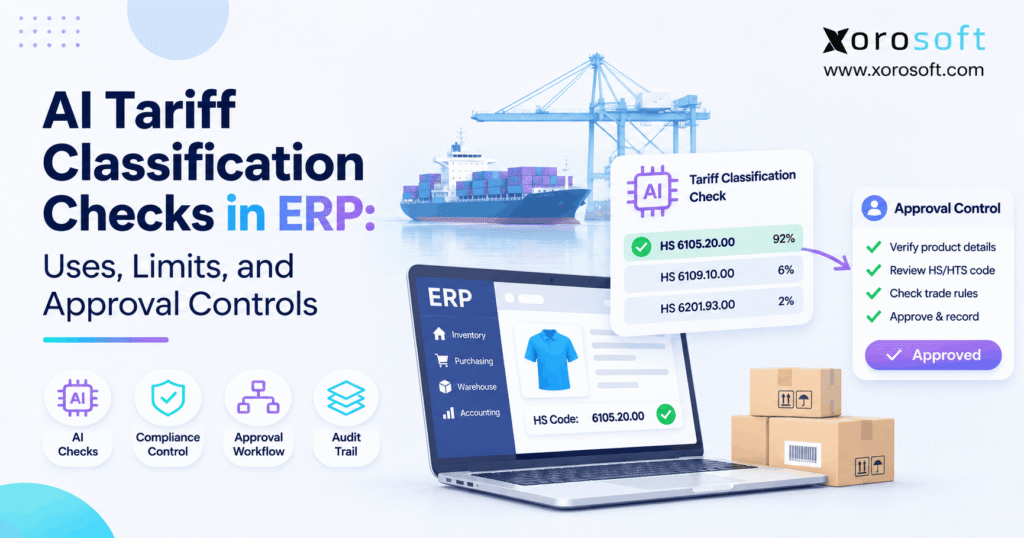
AI tariff classification is becoming increasingly important for businesses seeking efficiency in global trade.
1. Why AI Tariff Classification Needs a Human Decision
AI tariff classification helps importers check product details, identify possible HS or HTS codes, and flag uncertain records before those codes enter business workflows. However, a model’s recommendation is not a customs ruling. A reliable process still needs product evidence, applicable tariff rules, and an authorized person who takes responsibility for the final decision.
Imagine an apparel company adding 400 imported products before a seasonal launch. For example, supplier spreadsheets may contain names and prices but omit fiber details. An AI tool may suggest codes quickly. However, approving those suggestions without reviewing the underlying facts can spread errors into purchasing, customs documents, and landed-cost estimates.
1.1. Why a Suggested Code Is Not an Approved Code
Instead, classification starts with the goods as imported, not the product title used online. For example, two jackets marketed as waterproof may differ in fabric construction and features that matter under tariff rules. Therefore, a reviewer must compare the proposed code with actual specifications and relevant legal notes.
The World Customs Organization’s discussion of AI-assisted classification describes AI as support for classification experts who validate or correct recommendations. This distinction matters because faster research cannot establish legal correctness.
1.2. Which Importers Need Stronger Approval Controls?
In particular, importers with frequent SKU launches, multiple suppliers, or products that vary by materials benefit from a documented review process. Likewise, wholesale distributors and manufacturers need clear ownership when technical data passes between purchasing, operations, and trade specialists.
A smaller company with few stable products may instead rely on an expert-maintained classification register. In either case, the business should know who approved each code, which evidence was reviewed, and when the decision needs another look.
For that reason, establish a simple decision threshold at the outset. Routine repeat products can follow a documented review path, while uncertain goods require specialist attention. Additionally, managers should be able to explain why a record was approved without reconstructing months of supplier emails.
2. What AI Tariff Classification Actually Checks
Before building AI tariff classification controls, teams need to separate several trade concepts. First, product classification identifies the relevant tariff category. Meanwhile, duty calculations, preferential treatment, origin determinations, and customs valuation involve additional rules and inputs. As a result, a code suggestion alone cannot tell finance the final amount payable.
2.1. HS Codes, U.S. HTS Codes, and Canadian Codes
The international Harmonized System provides a common six-digit foundation. However, countries add national subdivisions. The United States uses its Harmonized Tariff Schedule, while Canada has its own tariff items and statistical suffixes.
| Reference | Typical structure | What the importer checks |
|---|---|---|
| International HS | Six-digit subheading | Core product classification |
| U.S. HTSUS | Ten-digit reporting number | U.S. legal and statistical detail |
| Canadian tariff classification | Ten-digit number | Canadian tariff item and statistical detail |
Consequently, a U.S. code should not simply be copied into a Canadian declaration. The CBSA’s classification methodology explains Canada’s tariff hierarchy and interpretive rules.
2.2. Classification Is Not the Same as Duty Calculation
Although a classification code may guide the applicable tariff provision, other inputs affect the amount owed. For example, these can include customs value, country of origin, effective dates, additional measures, and eligibility for a particular treatment. Moreover, the same product can have different cost outcomes across jurisdictions.
For that reason, the ERP should distinguish the approved classification record from duty-rate assumptions and cost calculations. Otherwise, a changed rate could be mistaken for a changed product classification, or a different origin could trigger an unsupported code rewrite.
For example, a duty-rate update may require finance to adjust a forecast even when the product code remains valid. Conversely, a redesign may require a classification review even if the expected duty rate looks unchanged. These distinctions prevent unnecessary master-data changes and misleading cost conclusions.
3. Product Evidence Behind Reliable AI HS Code Checks
Reliable AI HS code classification depends on reliable product data. If an importer’s item master contains only a marketing description, even a sophisticated model must fill gaps with assumptions. Instead, the workflow should request facts that distinguish one tariff heading from another.
3.1. Product Evidence for AI Tariff Classification
For instance, useful evidence includes material composition, construction, function, dimensions, manufacturing process, imported condition, and supplier technical sheets. Photographs or drawings may also help. However, the required facts vary by product and by the legal provisions being considered.
For example, a description such as “premium outdoor bag” may hide the outer-surface material and design details. Therefore, purchasing should request a specification rather than treating an AI suggestion as proof. A complete evidence package makes later reviews faster because the next reviewer does not need to restart the investigation.
3.2. Separate Product Identity From Selling Descriptions
For example, Shopify product titles are written for shoppers, not customs authorities. Likewise, a single storefront category might include finished goods, components, and replacement parts. Similarly, two color or size variants may share a classification, while a different composition can require new analysis.
Instead, build an internal product record that preserves the technical version and links it to each relevant SKU. Consequently, the classification reviewer can evaluate the actual goods even when the storefront title changes during a promotion.
A practical data dictionary can identify which fields belong to the product, which belong to a supplier, and which depend on the importing country. Additionally, record the person who supplied each technical fact. Consequently, that provenance makes conflicting descriptions easier to resolve and discourages unsupported assumptions.
3.3. Validate Supplier Changes and Missing Attributes
When sourcing teams change factories, they should confirm whether the actual product specifications changed. However, a new supplier does not automatically mean a new code. Nevertheless, a changed material, design, or intended function can make an earlier decision unreliable.
Use required data fields and an exception status such as “needs supplier evidence.” Then hold approval until someone resolves the gap. As a result, this is more dependable than allowing the model to invent missing attributes from similar catalog items.
Before deploying new checks, review a sample of existing product records. First, identify which required fields are missing most often and whether the problems cluster by supplier or product family. As a result, the team can improve upstream intake rather than creating a permanent exception queue.
4. Where AI Tariff Classification Checks Add Real Value
AI tariff classification is most useful when it helps people prioritize review. In other words, the aim is not to approve thousands of codes without looking. Instead, it is to find weak data, inconsistencies, and possible changes before those issues reach a customs filing or purchase-cost estimate.
4.1. AI Tariff Classification Checks for New SKUs
For example, a new-item workflow can scan for missing material percentages, conflicting descriptions, and absent supporting documents. It can then suggest candidate codes for a qualified reviewer. As a result, the team can resolve uncertainty before ordering large quantities or transmitting product details to a broker.
In a connected XoroONE environment, purchasing, inventory, and sales records support broader product operations. However, businesses should verify how any separate tariff-classification tool, approval rule, or data field would be configured before claiming an automated customs capability.
4.2. Automated HS Code Checks for Catalog Conflicts
Similarly, an AI check can compare similar products and flag inconsistent legacy codes. It can also notice when unrelated products share a code copied from a spreadsheet template. Nevertheless, differences are not automatically errors; similar items can legitimately have different classifications.
Next, a reviewer should investigate flagged products using the legal rules and technical facts. This approach is especially helpful after an acquisition, catalog migration, or assortment expansion, when separate teams may have used different naming and data standards.
4.3. Review Changes Before Import Activity
For example, potential triggers include a revised product specification, a new import jurisdiction, a changed tariff provision, or a previously unresolved classification question. Therefore, the workflow should identify affected SKUs and assign a review task rather than silently replacing their existing codes.
The USITC listed 2026 HTS Revision 22 on October 30, 2026. Therefore, teams need to track current source versions. However, a tariff revision does not mean every product’s classification has changed.
In addition, measure how often the process changes an earlier recommendation after a specialist reviews it. A useful system should reveal that history instead of hiding rejected candidates. This creates a feedback loop for improving descriptions, training data, and reviewer instructions without confusing model performance with legal certainty.
5. AI Tariff Classification Limits and Risk Controls
The central limitation of AI tariff classification is that plausible output can be mistaken for verified analysis. For example, models can miss legal exclusions, rely on outdated examples, or recommend codes for goods that have not been described adequately. Consequently, companies must evaluate the evidence behind a suggestion, not only its appearance.
5.1. AI Tariff Classification vs. Legal Interpretation
Correct classification follows applicable heading language, section and chapter notes, and interpretive rules. For example, a tool trained on historical product descriptions may recognize a pattern without applying the relevant legal distinction correctly. Therefore, reviewers need access to current official sources and the reasons supporting each candidate.
In the United States, importers can seek a CBP binding ruling for qualifying uncertain questions. In Canada, the CBSA advance-ruling program provides an official process. Consequently, internal approval cannot replace either authority’s decision.
5.2. AI Classification Confidence Is Not Approval
For example, a high confidence score indicates how a particular model assesses its output. Nevertheless, it does not certify that customs authorities will agree. Meanwhile, a low score can be useful because it draws attention to complex or unfamiliar goods.
First, ask whether the score has been tested on representative company products. Also inspect the model’s source material, handling of missing data, and reviewer override history. Without those checks, confidence can become a convenient label rather than a meaningful control.
5.3. Match Each Failure Mode to an Approval Control
| Failure mode | Operational consequence | Recommended response |
|---|---|---|
| Missing product attributes | Weak code recommendation | Request supplier evidence |
| Old tariff reference | Outdated national code or detail | Review source edition and date |
| Conflicting classification precedents | Uncertain customs treatment | Escalate to a specialist |
| Unexplained AI output | Incomplete audit trail | Require documented reasoning |
| Unapproved master-data changes | Wrong codes used downstream | Restrict edits and releases |
These are proposed internal controls. The NIST AI Risk Management Framework offers broader principles for governing, measuring, and managing AI risks, but it does not issue customs classifications.
However, not every potential use case deserves the same review burden. Therefore, define escalation thresholds based on missing evidence, ambiguity, and potential business impact. A narrow pilot on one product category will expose process gaps before the company rolls out checks to an entire catalog.
6. ERP Approval Workflow for AI Tariff Classification
Therefore, an ERP tariff code validation process should make responsibility visible. In particular, every recommendation needs a status, evidence, reviewer, and permitted downstream use. Xorosoft combines operational data across purchasing, inventory, and accounting; however, a tariff-specific approval queue or AI classification integration must be verified separately during solution design.
6.1. Seven-Step AI Tariff Classification Approval Workflow
- Capture: Gather supplier specifications and item attributes.
- Check: Identify missing data and contradictory descriptions.
- Suggest: Produce candidate classifications for investigation.
- Validate: Compare candidates with legal notes and relevant sources.
- Escalate: Route difficult cases to a qualified reviewer.
- Approve: Record the final decision, rationale, and effective date.
- Release: Share approved data with authorized operational processes.
For example, a jacket with unconfirmed construction should remain pending rather than move from a candidate code directly to the master record. Moreover, the process should preserve rejected suggestions so a later reviewer understands what was considered.
6.2. Define Owners and Approval Authority
| Task | Suggested owner | Required control |
|---|---|---|
| Product specifications | Buyer or product team | Evidence completeness |
| Classification review | Trade specialist | Source and rule validation |
| Master-data approval | Authorized data owner | Change authorization |
| Customs filing | Importer and authorized filing party | Declaration checks |
| Cost reconciliation | Finance | Estimate-to-actual review |
Roles vary by company and importing jurisdiction. Nevertheless, no team should assume that software or a broker automatically removes the importer’s applicable responsibilities.
6.3. Escalate Ambiguous or High-Impact Cases
For example, escalation triggers should include disputed headings, missing technical evidence, inconsistent rulings, product redesign, and material cost exposure. In addition, a new import destination may require country-specific review even when the international six-digit subheading appears unchanged.
Therefore, use clear outcomes such as approved, rejected, needs evidence, and specialist review. As a result, purchasing can distinguish a finished decision from a code that merely looks complete on screen.
The approval authority should be distinct from the person who merely requests a change, particularly when a revised code could materially affect forecast duties. Moreover, the team needs a fallback procedure if its specialist is unavailable. Clear delegation prevents a routine absence from producing unauthorized approvals.
7. Audit Trails and Master Data for Approved Tariff Codes
An approved classification needs more context than a single field in the item master. Otherwise, teams may reuse a code after a product has changed or lose the evidence behind a decision. Therefore, data governance must preserve both the current value and the reasoning that produced it.
7.1. Audit Fields for AI Tariff Classification
For example, store the SKU, technical product version, importing country, candidate codes, final approved code, approver, decision date, evidence references, and review status. Also capture the tariff source edition, relevant ruling reference where applicable, and reason for any override.
This information should be accessible to authorized users rather than scattered across untracked email attachments. For companies evaluating Xorosoft integrations, the critical question is how approved classification data would move between the ERP, any specialist trade platform, and authorized customs parties.
7.2. Use Effective Dates and Preserve Previous Decisions
A change should create a traceable new decision rather than erase the earlier one. For example, a supplier might replace a woven component with a knitted alternative. The team needs to record when the new specification became effective and whether its classification must be reconsidered.
However, a change in duty rate does not always require a classification change. Likewise, a new classification does not automatically justify rewriting historical import records. Therefore, obtain qualified guidance on any required corrections and their effective periods.
7.3. Protect the Approved Code Against Unchecked Edits
Additionally, limit edit permissions, require a reason for changes, and prevent unreviewed suggestions from replacing the approved value. When the underlying ERP cannot enforce every trade-specific rule, define a controlled integration or external approval step instead.
For example, a monthly audit can sample recent changes, confirm that evidence exists, and examine whether downstream users received the correct version. Consequently, the organization measures control quality instead of relying solely on the number of codes processed.
Similarly, a short audit report can highlight recently approved codes without supporting documents, changes made after purchase approval, and products used in more than one importing jurisdiction. Additionally, spot checks should verify that external partners received the intended approved version, not a stale export.
8. How AI Tariff Classification Affects Landed Cost
AI tariff classification errors matter beyond customs paperwork because an incorrect code can distort estimated import duties. Nevertheless, classification is only one part of the calculation. Customs value, origin, applicable measures, timing, and specific relief provisions can also change the amount owed.
8.1. Classification Checks and Purchase Cost Assumptions
Buyers may compare suppliers using expected landed cost rather than invoice price alone. If a provisional classification leads to an unreliable duty estimate, one supplier may appear more attractive than another. Consequently, an approval process should identify whether a cost estimate relies on a confirmed code or a pending recommendation.
Xorosoft supports connected purchasing and accounting operations, which can help teams examine purchasing and financial information together. However, the legal correctness of a customs classification must be established through the appropriate review process, not inferred from an ERP calculation.
8.2. A Practical Example of Duty-Estimate Exposure
For example, suppose a shipment contains 2,000 units with a hypothetical customs value of $50,000. Compare two illustrative duty assumptions while holding the other inputs constant.
| Planning scenario | Illustrative rate | Estimated duty | Duty per unit |
|---|---|---|---|
| Candidate A | 5% | $2,500 | $1.25 |
| Candidate B | 12% | $6,000 | $3.00 |
| Difference | 7 percentage points | $3,500 | $1.75 |
These percentages are illustrative, not current tariff rates or confirmed classifications. Nevertheless, the $3,500 difference could alter a pricing or replenishment decision. Before posting actual inventory costs, finance should reconcile the final customs and supplier records under the applicable accounting policy.
8.3. Prevent Estimate Errors From Reaching Accounting
Therefore, keep the estimated duty assumption, approved classification, and final charges separately identifiable. Then track estimate-to-actual differences and investigate large variances. As a result, the team can determine whether a variance arose from classification, origin, valuation, freight, or another factor.
Importantly, a model should not silently change financial transactions when its classification suggestion changes. Therefore, approved operational adjustments need documentation, effective dates, and the right accounting review.
When finance detects a variance, it should avoid assuming the tariff code caused the difference. Instead, the review should compare customs value, origin, freight, exchange rates, and the dates used for estimates. This helps the organization isolate genuine classification issues from ordinary planning changes.
9. ERP Controls Across Purchasing, Warehousing, and Finance
A classification issue often becomes expensive because teams discover it late. Therefore, companies should establish control points before purchase approval, data exchange with customs parties, and financial reconciliation. The exact system setup varies, but the principle is consistent: downstream users should recognize approved and pending records.
9.1. Purchasing Controls for AI Tariff Classification
Purchasing teams should request supplier specifications before approving an import order when critical classification evidence is missing. Moreover, high-risk products can require an authorized reviewer before the business confirms duty assumptions for its sourcing decision.
For growing companies, XoroERP brings purchasing, inventory, warehouse, and accounting operations into a connected cloud ERP. Nonetheless, any tariff-specific hold, approval queue, or customs integration should be demonstrated and verified as part of the proposed implementation.
9.2. Warehouse Receiving and Item Identity
Meanwhile, warehouse teams need reliable SKU identities, quantities, and lot or serial information where applicable. However, they should not become the default legal authority for customs classification. Instead, their role is to flag discrepancies between the received goods and the approved product specification.
For example, a received component may differ from the purchasing description. The warehouse can report the exception for review, while an authorized trade specialist determines whether it affects classification. A warehouse management system supports physical inventory workflows, but it does not make the legal determination on its own.
9.3. Finance Reconciliation After Import
Finally, finance should compare planned duty estimates with final supporting records and investigate unexplained differences. In addition, reconciliation procedures should identify whether the product classification, declared value, or other factors changed.
Consequently, clear controls help accounting avoid treating uncertain predictions as approved costs. They also support consistent reporting across warehouses and sales channels without suggesting that a customs broker’s work can be replaced by a general ledger entry.
For cross-functional teams, a simple shared exception record can connect the purchasing inquiry, received item, customs review, and accounting follow-up. Consequently, employees see the state of the issue without sharing sensitive supporting documents through uncontrolled email chains or making undocumented corrections.
10. Manual, Rules-Based, and AI Classification Compared
However, companies can strengthen classification governance without selecting the most complex software. For example, manual expert review, predefined checks, and AI-assisted recommendations solve different problems. Consequently, the right approach depends on catalog complexity, product evidence, transaction volume, and review capacity.
10.1. Which Classification Method Fits the Work?
| Method | Main benefit | Main limitation | Suitable situation |
|---|---|---|---|
| Manual specialist review | Contextual legal analysis | Requires skilled time | Complex or low-volume goods |
| Rules-based checks | Consistent requirements | Limited with ambiguity | Stable products and defined rules |
| AI-assisted recommendations | Finds candidates and anomalies | May be unsupported or wrong | Large catalogs with reviewers |
| Hybrid review | Balances speed and oversight | Needs governance and testing | Growing import programs |
Nonetheless, none of these approaches guarantees correct classification. Instead, organizations should compare their ability to produce defensible decisions, not just the number of items processed per hour.
10.2. Hybrid AI Tariff Classification Review
A practical hybrid approach can streamline repeat items with unchanged specifications while escalating new or uncertain goods. Additionally, reviewers can use structured checklists to examine legal notes and supporting documents.
When evaluating alternatives, start with process improvements and expert access before adding software. For example, a small importer may need only a maintained register and periodic review. By contrast, a multi-channel distributor may need integrated item data, review queues, and governed exchanges with trade specialists.
Free ERP Readiness Assessment — self-check: Can your team identify the reviewer, approved code, product evidence, effective date, and downstream systems for every imported SKU? If those answers require several spreadsheets, assess the gaps before choosing new automation. Keep the answers for your next process review, since the gaps are often more revealing than a generic software checklist.
A staged pilot should test straightforward repeat products as well as difficult exceptions. Compare the evidence required, the time to resolve each case, and the types of errors discovered. Moreover, include a manual fallback so shipment decisions are not dependent on a single model or service.
11. AI Tariff Classification in Real Industry Workflows
Because different products need different evidence, a uniform checklist cannot resolve every classification question. Therefore, effective AI tariff classification checks should match industry-specific attributes rather than use the same generic description for every SKU. The following examples illustrate review questions; they are not verified customer case studies or binding classification decisions.
11.1. HS Code Checks for Apparel and Furniture
For instance, an apparel importer may need fiber percentages, construction, garment type, and technical details. Meanwhile, a furniture supplier may need evidence about structural materials, purpose, and the condition of the item as imported.
An AI check can flag missing inputs before code approval. However, the reviewer must decide which facts and legal provisions control the result. Consequently, supplier documentation is more valuable than a confident recommendation generated from a short ecommerce title.
11.2. Sporting Goods and Manufacturing Components
For example, sporting-goods catalogs can mix complete equipment, protective products, accessories, and replacement parts. Similarly, manufacturers may import components that look alike but serve different machinery or functions. As a result, bills of materials, drawings, and technical uses can be relevant.
Xorosoft serves inventory-driven businesses across these industries and operating models. Its ERP operations can support structured product and purchasing work, while a customs specialist remains responsible for assessing the classification evidence.
11.3. Shopify Sellers and U.S.–Canada Importers
A Shopify catalog may contain product titles optimized for search or conversion rather than customs review. Consequently, importers should capture technical details in supporting systems instead of relying on storefront copy alone. The Xorosoft ERP Shopify App Store listing provides an official integration reference, but it is not evidence of native AI customs classification.
For businesses importing into both the United States and Canada, maintain separate national code records. Even when six-digit HS subheadings align, national details and treatment may differ.
Across these industries, the same principle applies: technical product identity must be more durable than marketing labels. Furthermore, a change in factory or sales channel should prompt a factual review where relevant, not an automatic classification rewrite. Consistent rules reduce avoidable duplication.
12. How to Measure AI Tariff Classification Quality
Successful AI tariff classification should improve review quality, not merely produce more suggestions. Before launch, establish baseline measures and test the workflow with representative products. Otherwise, a vendor’s reported overall accuracy can conceal weak performance on the company’s most difficult goods.
12.1. AI Tariff Classification Accuracy Metrics
For example, track the proportion of records with complete evidence, reviewer acceptance rates, overrides, escalation volume, and average time to reach an authorized decision. Moreover, segment results by product category and jurisdiction. A model that performs well on simple household goods may struggle with complex components.
Additionally, sampling should include previously disputed cases, not only routine items. Likewise, compare recommended codes against independently reviewed outcomes, since agreement between two automated systems does not establish correctness.
12.2. Track Downstream Exceptions and Corrections
Likewise, monitor classification-related broker queries, post-entry correction work, unresolved pending items, and duty-estimate variances. However, interpret these indicators carefully: a higher escalation rate may initially mean the new process is finding issues that were previously hidden.
Finally, use a periodic governance review to update required fields, review policies, and training materials. As a result, the team can improve its controls without claiming that automation eliminates customs risk.
A useful scorecard should also separate the quality of inputs from the speed of outputs. Otherwise, a team can celebrate faster reviews while the number of incomplete product records rises. Therefore, present both measures together in regular operational reporting.
13. When to Upgrade ERP Tariff Code Governance
An upgrade becomes worthwhile when the volume and complexity of decisions exceed the team’s ability to keep a reliable approval history. Nevertheless, buying a new tool before fixing unclear ownership can simply move the same problem into another interface.
13.1. Warning Signs That Spreadsheet Controls Are Failing
Look for repeated broker questions, conflicting item codes, missing technical documents, and purchase orders raised before critical review. In addition, frequent overrides without explanations indicate that employees cannot trust the master record.
A growing importer may also struggle with multiple warehouses, sales channels, suppliers, and customs jurisdictions. In that situation, improving data handoffs can be as important as speeding up classification research.
13.2. ERP Tariff Classification Controls to Evaluate
For example, ask which fields can store approved classifications, whether edit permissions are configurable, and how changes reach purchasing and finance. Also ask how a specialist trade application would connect, which evidence can be retained, and who can override an approved value.
Xorosoft offers connected ERP and warehouse operations for inventory-driven companies. However, buyers should request a tailored demonstration and distinguish standard functionality from configuration, integrations, or additional development. Therefore, do not assume that an AI interface automatically supplies verified customs decisions.
13.3. Watch the Right Workflows in a Demo
A useful demo should follow one imported SKU from supplier data to item creation, purchase approval, receiving, and reconciliation. Then introduce an uncertain classification and ask how the proposed solution would handle it.
Watch Demo: Explore the verified purchasing, inventory, and accounting capabilities during an ERP discovery. Moreover, request a specific explanation of any external classification tool or approval design, including its implementation responsibilities and limitations.
Before selecting software, document a real test case and expected acceptance criteria: required fields, reviewer permissions, status transitions, audit history, and integration behavior. In addition, ask which functions are standard, configured, or supplied by a third party. This prevents a polished demonstration from obscuring unresolved controls.
14. Build a More Reliable Classification Process
AI tariff classification can help teams find incomplete data, suggest candidate codes, and focus expert attention. However, it should never turn an unreviewed recommendation into a customs decision. Strong controls preserve product evidence, identify accountable reviewers, and prevent uncertain records from spreading into purchasing and finance.
For growing importers, Xorosoft provides connected inventory, purchasing, warehouse, and accounting workflows that may reduce fragmented operational handoffs. Its relevance is the business-data foundation, not an unverified promise of native AI tariff determination.
Book a Personalized Demo: Book a Demo to review your current ERP workflow, product-data gaps, and integration requirements. Bring one real import scenario so the discussion can separate verified product capabilities from proposed trade-compliance controls.
Frequently Asked Questions
What is AI tariff classification?
AI tariff classification uses software to analyze product details, suggest possible customs codes, and flag uncertain records. Qualified reviewers must still confirm the applicable rules, supporting evidence, and final decision.
Can AI assign an HS code without human review?
It can suggest a code, but automated output should not be treated as an authorized customs classification. Human review is especially important for missing data, complex products, and disputed cases.
How are HS codes different from U.S. HTS codes?
HS provides an international six-digit foundation. The U.S. HTS adds national subdivisions and reporting detail. Other countries, including Canada, maintain their own national tariff classifications.
Who should approve AI-generated tariff codes?
An authorized employee with appropriate classification expertise should approve them. The business may also involve a customs broker or seek an official ruling when the legal interpretation is uncertain.
Can an incorrect tariff code affect landed cost?
Yes. An incorrect classification can distort estimated duties, purchase decisions, inventory costs, and margins. Finance should reconcile final charges against approved records and investigate material variances.
Does ERP software automatically ensure tariff compliance?
No. ERP software can support product data, approvals, and recordkeeping. Correct classifications still depend on legal requirements, current sources, product evidence, and accountable human decisions.
When should an importer upgrade classification controls?
Consider an upgrade when SKU growth, frequent supplier changes, conflicting codes, or repeated broker questions overwhelm spreadsheets. First improve ownership and evidence; then evaluate automation and integration needs.
Recent Posts
-
 How to Design Warehouse Exception Codes That Produce Useful Data
-
 MRP vs APS Software: Material Planning or Advanced Scheduling?
-
 Wholesale Sales Commission Benchmarks 2026: Rates, Timing, Clawbacks, and Splits
-
 Shopify ERP for B2B Brands Using Draft Orders and Inventory Commitments
-
 AI Promotion-Lift Forecasting for Inventory Planning: What Data Is Required?