If you’re seeking insights on B2B dealer ecommerce, you’re in the right place.
1. B2B Dealer Ecommerce Gets Complicated Long Before Order Volume Looks Large
B2B dealer ecommerce has to solve a problem that ordinary ecommerce rarely faces: two buyers looking at the same SKU may legitimately need different products, prices, payment terms, inventory promises, and delivery options.
One dealer may receive a negotiated discount across an entire product family. Another may only be authorized to sell selected products in a defined territory. Meanwhile, a national account may contain dozens of branches, several purchasing teams, centralized billing, and hundreds of approved ship-to locations.
As a result, putting a wholesale catalog online does not automatically create a scalable dealer operation.
The system has to understand who the buyer represents before it can decide what that buyer should see. It must identify the correct account, branch, catalog, territory, price structure, ship-to rights, credit status, and fulfillment rules.
When those rules live in spreadsheets, sales representatives’ inboxes, accounting software, and ecommerce plugins simultaneously, operational mistakes become much more likely. Price discrepancies reach customers. Unauthorized products appear online. New addresses enter the customer master without review. In addition, orders may reach the warehouse before credit or territory issues are discovered.
A scalable dealer model therefore begins with commercial rules rather than storefront design.
1.1 Dealer ecommerce is an operating model, not simply a login page
A dealer portal is only the buyer-facing layer.
Behind it sits a broader operating model involving customer records, pricing, territories, account groups, inventory, purchasing, warehousing, accounting, and reporting. Therefore, the quality of the digital buying experience depends heavily on the quality of those underlying relationships.
As dealer networks grow, the real question becomes less about whether customers can order online and more about whether those online orders enter the business correctly.
1.2 Four structures create most dealer-network complexity
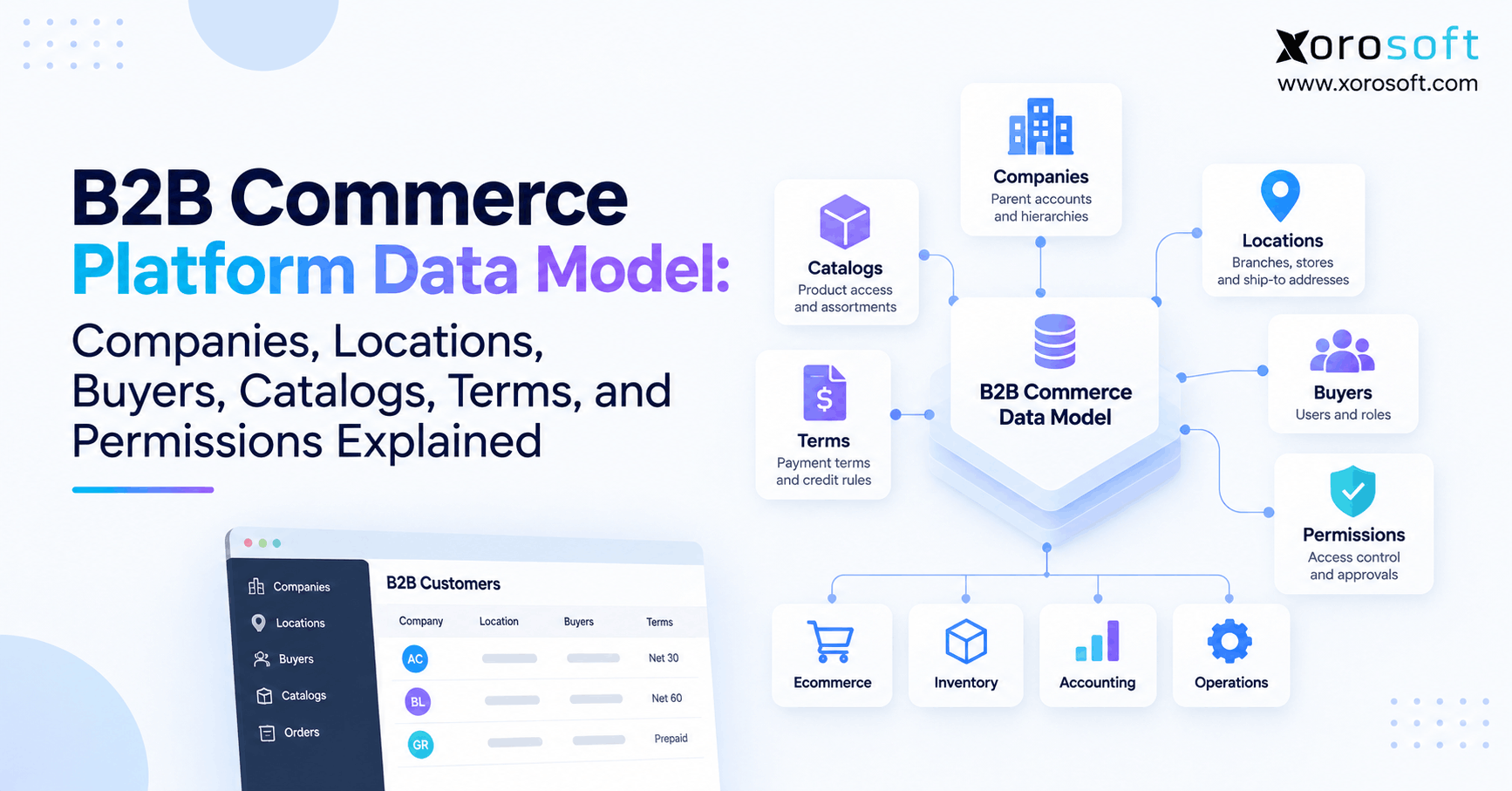
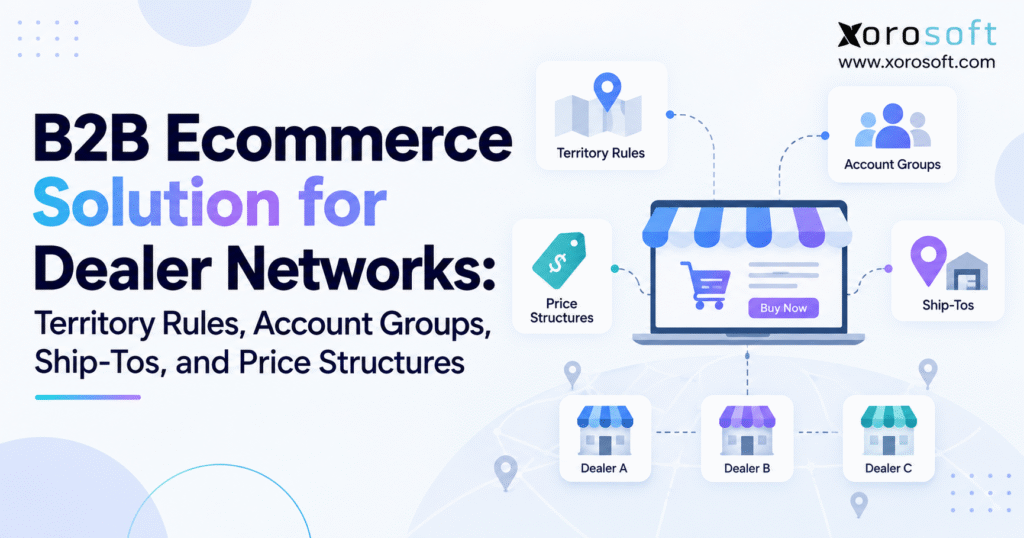
Most dealer environments become difficult to manage because of four connected structures: territories, account groups, ship-to locations, and pricing.
A territory may determine which products a dealer can buy. Likewise, the account group can determine a default discount. A ship-to may influence freight or warehouse routing. Finally, an account-specific agreement may override the standard dealer price.
Because these rules interact, the commerce layer needs a consistent way to resolve them.
2. What B2B Dealer Ecommerce Needs to Control Behind Every Login
A strong B2B dealer ecommerce model identifies the organization behind the buyer and applies the correct commercial rules before an order is submitted.
That goes far beyond basic wholesale checkout.
The system needs to know which company the buyer represents, which branch they can purchase for, what products are available, what price applies, where the order can ship, and whether financial or operational restrictions should stop the transaction.
2.1 Dealer ecommerce starts with business identity
Consumer ecommerce often treats identity as an individual concept.
Dealer commerce is different because a buyer acts on behalf of a business entity.
For example, one user may belong to a national account but only have authority over three regional branches. Another user may work at headquarters and require visibility across the entire organization.
Therefore, authentication should connect the user with the appropriate company hierarchy rather than simply confirming an email address.
2.2 B2B dealer ecommerce differs from basic wholesale ordering
Basic wholesale ordering can work well when most customers follow similar commercial rules. Buyers sign in, receive a trade price, choose a delivery location, and submit the order.
However, dealer networks often contain layers of exceptions.
One corporate customer may operate 30 branches. Some locations may receive contract pricing, while others inherit the standard dealer tier. Certain branches may sell an exclusive product line. In addition, different buyers may have different approval limits.
A scalable platform should preserve those relationships instead of creating dozens of unrelated customer accounts.
2.3 The correct model should simplify buying without hiding operational controls
Customers do not need to see the complexity behind the transaction.
Ideally, a buyer logs in and immediately sees the correct assortment, availability, pricing, payment options, and locations. Meanwhile, the system applies account rules in the background.
That combination is the goal: a simple buyer experience supported by disciplined operational logic.
3. B2B Dealer Ecommerce Should Start With the Account Hierarchy
Account architecture should be defined before catalog layouts, promotional banners, or checkout customizations.
Otherwise, the business may end up adapting customer relationships to the limitations of the storefront.
3.1 Parent accounts preserve the real dealer relationship
Consider a national furniture dealer with 40 stores.
The legal customer may be one corporate organization. Yet each store can have separate buyers, inventory needs, delivery requirements, and sales activity.
Creating 40 unrelated customers would make local ordering easy, but consolidated reporting would become much harder. Conversely, putting every store under one completely flat account would remove necessary location-level controls.
A better structure keeps both perspectives.
A practical hierarchy can be represented as:
Dealer Network → Parent Account → Branch or Location → Ship-To → Buyer
The parent account maintains the corporate relationship. A branch represents an operating unit. Next, the ship-to identifies where products actually go. Finally, the buyer represents the individual authorized to act for that account or location.
3.2 B2B dealer ecommerce permissions should follow the hierarchy
A headquarters purchasing manager may need to order for every branch.
By contrast, a store manager may only need access to one location. A regional buyer might cover several branches but not the entire organization.
Therefore, buyer permissions should follow the account hierarchy rather than requiring separate portals.
This also improves security. Users see only the locations and commercial information relevant to their responsibilities.
3.3 Centralized and decentralized purchasing need different controls
Dealer groups may negotiate centrally while allowing local branches to place orders.
Others centralize both negotiation and ordering.
Because these models differ, the system should separate commercial ownership from ordering permissions.
For instance, the parent account can own negotiated terms while branch users handle day-to-day purchasing. Consequently, the business retains one commercial relationship without sacrificing operational flexibility.
4. Territory Rules Turn Dealer Agreements Into Enforceable Commerce Logic
Dealer territories often exist clearly in contracts but loosely in operational systems.
That gap creates problems once ordering becomes digital.
A sales manager may know that Dealer A owns western Pennsylvania while Dealer B can sell everywhere except two counties. Nevertheless, relying on individual knowledge does not scale when hundreds of orders move through an online portal.
4.1 Dealer ecommerce territory rules extend beyond geography
Geography is common, but it is not the only way to define a dealer territory.
Companies may assign dealers by state, province, postal code, sales region, product family, brand, market segment, or customer category.
For example, an industrial dealer might sell standard equipment throughout Ontario while only receiving authorization for a premium line in selected metropolitan areas.
Therefore, the platform must support relationships between territories, accounts, and products rather than storing a single region name on the customer record.
4.2 Territory rules can control B2B product access
In some networks, territory determines whether a product can be ordered.
A dealer may be able to view the full product catalog but only purchase certain items in its authorized region. Alternatively, the business may choose to hide unauthorized products completely.
Both approaches can work.
However, visibility and purchase eligibility should be treated as separate concepts where necessary. A replacement part, for example, may need to remain searchable even when the dealer cannot place a new-product order for that line.
4.3 Overlapping territories require clear precedence
Not every territory is exclusive.
Two distributors may operate in the same region but serve different industries. Similarly, one dealer may hold national rights for one brand and regional rights for another.
As a result, territory records may need to include product eligibility, effective dates, account assignments, salesperson ownership, and specific exceptions.
Structured territory data makes those changes easier to administer without rewriting storefront logic.
5. Account Groups Make a B2B Dealer Ecommerce Model Easier to Maintain
Dealer networks become difficult to administer when every customer receives a unique configuration.
Account groups solve part of that problem by applying shared commercial rules to customers with similar relationships.
5.1 Dealer groups should represent recurring commercial patterns
A business might classify accounts as Strategic, Gold, Standard, Independent, or International dealers.
Each group can inherit common policies.
For example, Gold dealers may receive preferred pricing, a broader catalog, Net 45 payment terms, and a lower free-freight threshold. Standard dealers might receive normal wholesale prices and Net 30 terms.
Consequently, administrators can update one shared rule instead of editing dozens of customers.
5.2 Dealer-specific exceptions should remain exceptions
Suppose 100 Gold dealers use the same price structure but one customer has a negotiated agreement on 25 products.
The clean approach is to keep the dealer in the Gold group and apply specific overrides only to the contracted items.
Creating another entire customer class for one exception makes the structure harder to understand.
Instead, shared rules should establish the baseline while account-specific rules handle genuine exceptions.
5.3 Too many dealer groups recreate the original problem
Account groups are useful only when they remain meaningful.
If every minor difference results in another group, administrators eventually face dozens of nearly identical configurations.
Therefore, groups should represent recurring commercial patterns, while exceptions should stay attached to specific accounts or contracts.
6. B2B Dealer Ecommerce Needs Controlled Ship-To Management
A ship-to is not merely an address typed into a checkout form.
In B2B operations, the delivery location can affect tax, freight, routing, territory assignment, customer reporting, and warehouse selection.
6.1 Account, bill-to, ship-to, and buyer serve different purposes
Consider a sporting goods chain.
The account may be Peak Sports Group. Corporate accounts payable receives invoices. Store 108 receives inventory. Meanwhile, a regional purchasing manager submits the order.
Those are separate relationships.
When a system treats them as one record, reporting and fulfillment become harder to manage.
6.2 Buyers should only access relevant ship-to locations
A regional buyer may be authorized to order for seven stores.
Meanwhile, a corporate buyer may need access to every location in the network. A temporary project buyer might only use one approved destination.
Therefore, B2B dealer ecommerce should allow buyer access to be restricted by branch or ship-to.
That prevents accidental delivery to the wrong location and better reflects actual purchasing responsibility.
6.3 New ship-to locations may require approval
Allowing unrestricted address creation can introduce tax, fraud, freight, and account-master problems.
For controlled dealer environments, a new delivery location may need review before it becomes permanent.
The process should still remain convenient. For instance, a buyer can request a new ship-to during ordering while the system routes the request to the appropriate internal team.
6.4 Ship-to rules can influence warehouse routing
The delivery destination can determine which facility normally fulfills the order.
However, the system may also need fallback logic when inventory is unavailable in the preferred warehouse.
Therefore, ship-to management should connect directly with inventory and fulfillment rather than remain isolated inside ecommerce.
7. Dealer Pricing Needs a Clear Hierarchy Before It Reaches Ecommerce
Pricing is often the hardest dealer-commerce requirement because several prices can legitimately exist for one product.
The business may have a list price, dealer-tier price, territory adjustment, contract price, quantity break, and promotional offer.
Unless precedence is clear, price conflicts become inevitable.
7.1 B2B dealer ecommerce pricing should move from broad rules to specific rules
A practical model starts with shared pricing and becomes more specific only when necessary.
| Pricing Layer | Typical Purpose |
|---|---|
| List price | Standard reference |
| Dealer group price | Shared wholesale level |
| Territory adjustment | Regional rule when required |
| Customer price | Account-specific agreement |
| Contract price | Negotiated SKU-level terms |
| Quantity break | Volume adjustment |
| Approved promotion | Temporary commercial offer |
The exact precedence differs by company.
Still, every pricing team should be able to answer one question clearly: which price wins when several rules apply?
7.2 Dealer price-list explosion should be avoided
Consider a distributor with 600 dealers and 20,000 products.
Creating a complete independent price list for every account could generate an enormous number of records, even when most customers share almost identical prices.
Instead, the business can use common dealer tiers and layer specific exceptions on top.
For example, Standard dealers inherit one price structure. Strategic dealers receive another. Contract customers then receive overrides only on the SKUs covered by an agreement.
This model reduces maintenance and improves transparency.
7.3 B2B dealer ecommerce must not calculate a different answer from ERP
Price conflicts become particularly damaging when two systems make independent decisions.
If the portal shows $82 but the ERP converts the order to $87, the company has created a customer-service problem before fulfillment even begins.
Therefore, complex pricing often belongs close to the customer master, sales orders, contracts, cost, and accounting.
The ecommerce layer can still present the result, but the company should clearly define which platform is authoritative.
7.4 Price exceptions should remain auditable
Special prices are normal in B2B.
Untraceable prices are not.
Each exception should ideally have a reason, effective date, customer or group relationship, and—when appropriate—an expiration date.
Consequently, teams can understand why a customer received a price instead of relying on undocumented spreadsheet history.
8. Dealer Catalogs Should Control Visibility and Order Eligibility Separately
Not every dealer should automatically purchase every SKU.
Manufacturers and distributors often restrict products according to brand authorization, territory, certification, market, account level, or contract.
8.1 B2B dealer ecommerce catalogs should reflect commercial rights
A furniture manufacturer may reserve a premium collection for selected showrooms.
Likewise, a sporting goods brand may restrict technical products to authorized dealers. An industrial distributor may sell certain items only through certified service organizations.
The digital catalog should reflect those policies consistently.
8.2 Product visibility and purchasing rights can be different
There are situations where a buyer should see a product but not order it.
For example, an unauthorized dealer may still need product information for customer support or replacement-part research.
In that situation, the page can remain visible while ordering is disabled.
This distinction provides more flexibility than simply hiding every restricted SKU.
8.3 Account groups can simplify catalog assignment
Just as dealer groups reduce pricing maintenance, they can also reduce catalog complexity.
A Premium Dealer group may receive the full assortment, while Standard dealers receive a core selection.
Specific customer exceptions can then be added where necessary.
As a result, catalog management remains aligned with the same customer hierarchy used for pricing and permissions.
9. Inventory Visibility Should Show What a Dealer Can Actually Order
Physical inventory and sellable inventory are not always the same.
That distinction becomes especially important when dealers share stock with DTC, marketplace, retail, EDI, or other wholesale channels.
9.1 Available-to-sell is more useful than warehouse on-hand
Suppose a warehouse contains 1,000 units.
Three hundred are already allocated to open orders. Another 100 are on quality hold. In addition, 200 units are protected for a retailer launch.
Although physical on-hand remains 1,000, only 400 units may be available for new dealer orders.
Showing the full warehouse balance creates a promise the company cannot reliably fulfill.
9.2 Multi-warehouse B2B dealer ecommerce needs fulfillment context
A dealer’s available inventory can depend on location, delivery expectations, territory, freight cost, and warehouse policy.
Therefore, availability should connect with warehouse operations rather than being calculated independently in the storefront.
For businesses managing receiving, picking, packing, and multi-location fulfillment, XoroWMS can provide a connected warehouse layer behind ecommerce and dealer order flows.
9.3 Inventory allocation should respect strategic commitments
Some businesses reserve inventory for priority customers, launches, specific sales channels, or contractual commitments.
Those allocations need to influence what the portal presents as available.
Otherwise, dealer self-service can increase overselling instead of reducing it.
10. B2B Dealer Ecommerce Should Validate Orders Before They Reach Operations
The value of digital ordering is not simply removing manual order entry.
The larger benefit comes from capturing a valid order the first time.
10.1 Ordering rules should reflect real selling constraints
Dealer orders may need to follow minimum order values, case packs, pallet quantities, SKU minimums, purchase-order requirements, or product limits.
Those rules should appear while the buyer builds the cart.
For example, if a product ships in cases of 12, the ordering experience should guide the buyer toward 12, 24, or 36 units rather than accepting 17 and forcing warehouse staff to correct the quantity later.
10.2 Approval workflows should match customer organizations
Larger customers may require internal approvals.
A buyer could create a $30,000 order but need a purchasing director to release it.
Instead of moving that process back into email, the dealer portal should support the organizational approval path when possible.
10.3 Exceptions should be visible rather than hidden
Credit issues, unusual quantities, restricted products, or price exceptions may require human review.
That is not a failure of automation.
Rather, good automation identifies the transactions that need attention while allowing routine orders to flow without manual intervention.
11. Dealer Fulfillment Rules Should Travel With the Order
Submitting the order is only the beginning of the operating process.
Next, inventory must be allocated, picked, packed, shipped, invoiced, and tracked.
Dealer-specific requirements need to survive that handoff.
11.1 Warehouse assignment should use operational logic
The nearest warehouse may not always be the correct facility.
Inventory availability, freight economics, delivery commitment, territory, product restrictions, and customer agreements can all influence sourcing.
Therefore, the system needs a predictable routing policy as well as fallback logic.
11.2 Split shipments should be a deliberate decision
Using several warehouses can improve fill rates.
However, it may also increase freight and create receiving complexity for the dealer.
Some accounts prefer a complete shipment even if it takes longer. Others prioritize immediate availability.
Consequently, split-shipment behavior may need to follow account or order rules.
11.3 Customer-specific fulfillment requirements belong in operations
Large dealer or retail accounts may require specific carriers, appointment procedures, labels, pallet configurations, or documentation.
Those instructions should move with the sales order into warehouse execution.
Otherwise, employees must reconstruct customer requirements manually after ecommerce has already accepted the transaction.
12. Credit and Payment Terms Are Part of B2B Dealer Ecommerce
Dealer checkout does not always end with a payment card.
Many B2B relationships depend on credit limits and negotiated payment terms.
Therefore, the system needs to evaluate the financial account rather than looking only at the current cart.
12.1 Terms should come from the authorized customer record
One dealer may purchase on Net 30.
Another may receive Net 45, while a new or higher-risk account requires prepayment.
Those terms should follow the approved customer relationship rather than being freely selected during checkout.
12.2 Credit exposure includes more than the current order
Consider a customer with a $100,000 credit limit.
The new order is $15,000. However, the account already has $70,000 in unpaid invoices and $20,000 in open orders.
Looking at the new transaction alone suggests that the order is acceptable. Looking at total exposure tells a different story.
As a result, credit controls often require information from ERP or accounting.
12.3 Financial holds should reach ecommerce quickly
When accounting places a dealer on hold, the portal should reflect the change before additional orders are accepted.
Otherwise, digital ordering simply generates more work for customer service.
Strong dealer commerce therefore depends on consistent financial and commercial account data.
13. ERP and B2B Dealer Ecommerce Need Clear Data Ownership
Many ecommerce integrations fail because two systems are allowed to own the same information.
Over time, each platform develops its own version of the customer, price, inventory balance, or order status.
13.1 Define the system of record for every critical object
A typical ownership model may look like this:
| Business Object | Common System of Record |
|---|---|
| Customer master | ERP |
| Credit status | ERP/accounting |
| Complex pricing | ERP |
| Inventory | ERP/WMS |
| Product merchandising | Ecommerce/PIM |
| Buyer experience | Ecommerce |
| Order capture | Ecommerce |
| Order execution | ERP |
| Warehouse activity | WMS |
| Financial posting | ERP/accounting |
There is no universal model.
However, every important object should have a clearly identified owner.
13.2 Synchronization frequency should reflect business risk
Product descriptions may tolerate slower synchronization.
By comparison, inventory, pricing, order status, and credit holds can become problematic quickly when data is stale.
Therefore, integration frequency should be based on the operational cost of outdated information.
Xorosoft’s ecommerce and ERP integrations are relevant when dealer transactions need to connect with inventory, accounting, marketplaces, EDI, and other operational systems without repeated data entry.
13.3 Do not rebuild the entire ERP inside the storefront
Commerce platforms should provide a strong digital buying experience.
They do not necessarily need to become the master system for inventory, customer credit, accounting, purchasing, complex pricing, and warehouse execution.
Instead, each platform should own the work it is best suited to manage.
14. Shopify and B2B Dealer Ecommerce Can Share a Connected Operating Model
Many product businesses already use Shopify for successful DTC ecommerce.
As dealer and wholesale revenue grows, the goal is often to keep a familiar commerce experience while strengthening back-office control.
14.1 Shopify can remain the buyer-facing commerce layer
A company may use Shopify for product presentation, customer experience, and ecommerce order capture while ERP manages inventory, accounting, purchasing, forecasting, and downstream fulfillment.
For businesses evaluating Xorosoft within that environment, the Xorosoft ERP Shopify App provides additional context on how the platforms can connect.
14.2 B2B dealer ecommerce should avoid unnecessary rule duplication
The commerce layer does not need to own every operational rule.
For instance, Shopify may present products and capture orders while ERP provides inventory availability or performs downstream order execution.
That distinction becomes increasingly important as the business adds marketplaces, EDI customers, wholesale sales teams, or other channels.
14.3 DTC and dealer demand eventually compete for the same inventory
Separate storefronts do not create separate physical inventory.
A growing business needs to understand how DTC orders, dealer commitments, retail orders, marketplace demand, and warehouse stock interact.
Ultimately, that operational picture usually needs to exist deeper than the storefront.
15. B2B Dealer Ecommerce Reaches ERP Territory When Complexity Spreads Across Teams
Companies rarely adopt broader ERP capabilities simply because they want a more modern dealer portal.
Usually, the trigger is operational friction across several departments.
15.1 The warning signs appear outside ecommerce first
Sales teams maintain separate pricing spreadsheets.
Customer service re-enters emailed purchase orders.
Purchasing receives weak demand signals.
Meanwhile, warehouse teams depend on incomplete customer instructions, and accounting finds discrepancies during reconciliation.
At that point, the issue is no longer just ecommerce.
15.2 XoroONE can support growing inventory-driven businesses
Organizations moving beyond QuickBooks, spreadsheets, and disconnected inventory applications may evaluate XoroONE when they need inventory, purchasing, accounting, warehouse workflows, reporting, and ecommerce operations to function within a more connected model.
The key question is not whether ERP offers more features.
Instead, businesses should ask whether the dealer experience now depends on processes that span too many disconnected systems.
15.3 Larger operating models may need deeper ERP control
Companies with more advanced distribution, manufacturing, accounting, multi-warehouse, or multi-entity requirements may evaluate XoroERP as the operational layer supporting dealer and wholesale commerce.
In either case, buyers should still experience a simple storefront.
The sophistication belongs behind the transaction.
16. B2B Dealer Ecommerce Requirements Change Across Industries
The underlying architecture is similar across industries, yet the rules can differ substantially.
16.1 Apparel dealer ecommerce often revolves around assortment and season
Apparel brands may restrict products by retailer tier, season, territory, or channel.
In addition, size and color matrices create significant inventory complexity.
Therefore, dealer access needs to stay aligned with both assortment rights and availability.
16.2 Furniture dealer networks depend heavily on location and fulfillment
Furniture companies may serve showrooms, designers, regional dealers, and large retail groups.
Lead times, freight, location, and inventory availability frequently matter as much as price.
Consequently, account hierarchy and warehouse routing become especially important.
16.3 Sporting goods dealers may have strict product authorization
A dealer may be approved for one product family but not another.
Territory, seasonality, dealer level, and minimum quantities can also affect ordering.
16.4 Food and beverage distribution adds shelf-life complexity
Dealer ordering can involve case packs, lots, expiration, recall traceability, and regional distribution.
Therefore, inventory availability may need to reflect much more than quantity alone.
16.5 Industrial and automotive distribution often centers on catalog scale
These businesses may manage thousands or hundreds of thousands of SKUs.
Fast product search, customer-specific prices, substitute products, and warehouse availability become central to the buying experience.
Companies comparing requirements across sectors can review Xorosoft’s industry solutions for examples of how inventory-driven workflows differ by business model.
17. Dealer Master Data Matters More as Automation and AI Expand
Automation does not reduce the need for clean data.
In fact, the opposite is true.
The more processes a business automates, the more consistently customer, territory, product, price, and location records need to be structured.
17.1 AI cannot resolve undefined dealer rules automatically
AI tools may help employees search data, surface exceptions, or interact with operational systems.
However, they still depend on trustworthy records.
If ecommerce says one price and ERP says another, an AI assistant does not magically determine which commercial agreement is correct.
Therefore, governance must come first.
17.2 Structured B2B dealer ecommerce data supports better automation
Dealer accounts should use consistent identifiers.
Likewise, territory assignments should include effective dates, price rules should have clear precedence, and ship-tos should maintain approved relationships.
This structure improves reporting today and creates a stronger foundation for future automation.
Xorosoft’s AI MCP Server reflects the broader move toward allowing AI systems to interact with governed ERP information rather than depending only on disconnected spreadsheets and exports.
Clean operational data remains the prerequisite.
18. Evaluate a B2B Dealer Ecommerce Platform With Real Dealer Scenarios
Generic feature checklists rarely reveal whether a platform can support a complicated dealer network.
Most vendors can say they support B2B customers, inventory, pricing, and integrations.
The important question is how those features work together under real operating conditions.
18.1 Test the most complicated dealer, not the easiest one
Choose a customer with meaningful complexity.
For example, test a corporate dealer with six branches, two negotiated contracts, separate buyers, multiple ship-tos, territory-restricted products, and Net 45 terms.
Then follow an actual order from login through fulfillment.
This approach exposes architecture problems much faster than a generic product demonstration.
18.2 Compare basic dealer commerce with complex dealer operations
| Basic Dealer Model | Complex Dealer Model |
|---|---|
| One customer | Parent-child hierarchy |
| One address | Multiple controlled ship-tos |
| Standard pricing | Contract and account pricing |
| Full catalog | Restricted assortment |
| One warehouse | Multi-warehouse routing |
| Card payment | Terms and credit |
| Simple checkout | Approval and holds |
| Manual reporting | Integrated reporting |
18.3 Compare architecture rather than logos alone
Businesses should examine data ownership, pricing logic, integration effort, implementation complexity, reporting, and long-term administration.
For companies evaluating larger ERP options, the Xorosoft vs NetSuite comparison can provide another reference point. However, platform selection should ultimately come back to actual dealer workflows.
A strong B2B dealer ecommerce platform fits the operating model instead of forcing the operating model to fit the software.
19. Common B2B Dealer Ecommerce Mistakes Start With the Data Model
Dealer ecommerce projects rarely fail because the homepage design is wrong.
More often, the business rules underneath the experience were never fully defined.
19.1 Treating every ship-to as a separate customer weakens account visibility
Creating independent customers for every location can make local ordering easier initially.
However, it breaks the parent relationship and makes consolidated pricing, reporting, and credit harder.
Instead, keep branches and ship-tos connected to the correct corporate account.
19.2 Building a separate price list for every dealer creates unnecessary maintenance
Shared pricing should remain shared.
Therefore, dealer tiers and account groups should establish common pricing before customer-level exceptions are introduced.
19.3 Maintaining pricing truth in several systems causes disputes
When ecommerce and ERP can independently change contract prices, conflicts eventually appear.
Choose an authoritative source and establish clear synchronization behavior.
19.4 Showing raw inventory can create false promises
Dealers care about what can actually be ordered.
Accordingly, availability should consider allocations, holds, channel protection, and existing commitments where those factors matter.
19.5 Hard-coded territory rules become expensive to change
Dealer agreements evolve.
Territories shift, product rights change, and new dealers enter the network.
Business users should be able to maintain those rules without rebuilding the storefront every time a commercial policy changes.
19.6 Automating undocumented rules makes problems harder to unwind
Before implementation, sales, finance, ecommerce, and operations should agree on account structure, territory ownership, pricing precedence, ship-to governance, credit controls, and inventory policies.
Only then should the workflow be automated.
20. Practical Conclusion: Build the Dealer Operating Model Before the Portal
The most important decision in B2B dealer ecommerce is not the storefront theme, search interface, or checkout design.
It is how the business represents dealer relationships.
Start with the account hierarchy. Define the parent organization, branches, approved ship-tos, and buyer permissions. Next, document territories and product authorization. Then establish account groups, pricing precedence, payment terms, inventory rules, warehouse routing, and approval policies.
After those rules are clear, decide which system should own each one.
A good dealer ecommerce environment should make buying easier without weakening operational control. Buyers should see the right products, accurate prices, relevant availability, and approved delivery locations. Meanwhile, sales should spend less time correcting orders, warehouses should receive complete instructions, and accounting should work from consistent customer and financial information.
For simpler networks, a well-configured commerce platform and a few disciplined integrations may be sufficient.
However, as the business adds warehouses, purchasing complexity, price exceptions, EDI, manufacturing, forecasting, accounting requirements, and additional sales channels, ERP-level coordination becomes more valuable.
The goal is not to build the most complicated technology stack possible.
Instead, the business should remove unnecessary complexity from daily work while preserving the rules that protect margin, customer relationships, inventory, and fulfillment performance.
If pricing, inventory, warehouse operations, accounting, and dealer ordering have become difficult to keep aligned, the next practical step is to map those workflows against one connected operating model.
To evaluate your dealer architecture using your actual territories, account groups, pricing structures, ship-tos, inventory, and fulfillment requirements, book a personalized Xorosoft discussion.
Frequently Asked Questions
What is B2B dealer ecommerce?
B2B dealer ecommerce lets authorized business buyers access account-specific products, pricing, locations, payment terms, inventory, and ordering rules through a controlled digital commerce experience.
What should a B2B customer portal include?
It should include account-specific pricing, inventory availability, ordering, reordering, shipment tracking, invoices, payment terms, payments, company accounts, and permissions. Additionally, these functions should connect with operational systems.
How do territory rules work in dealer ecommerce?
Territory rules control where dealers can operate, which products they may sell, and sometimes which prices or sales assignments apply based on geography, brand, or product authorization.
How does customer-specific dealer pricing work?
Dealer pricing typically starts with shared group prices, then applies account, contract, quantity, or promotional rules according to a clearly defined pricing precedence.
Can one dealer account have multiple ship-to locations?
Yes. One dealer can have many approved ship-tos for stores, warehouses, branches, or job sites, with buyer permissions and fulfillment rules applied to each location.
Should dealer pricing live in ERP or ecommerce?
Complex pricing usually belongs in ERP when it depends on contracts, customer master data, credit, cost, or accounting. Ecommerce can then display the authoritative price.
When should a business upgrade its dealer portal?
Upgrade when manual pricing, order entry, inventory questions, multi-location accounts, credit issues, or disconnected systems create frequent errors, delays, or reconciliation work.
Recent Posts
-
 B2B Ecommerce Statistics: What Wholesale and Distribution Teams Should Know About Digital Ordering
 -
 How EDI Eliminates Manual Wholesale Order Entry and Where Exceptions Still Need People
 -
 Wholesale ERP Software for Multi-Warehouse Distribution
 -
 Acumatica vs Microsoft Dynamics 365 Business Central
 -
 Mobile WMS: What Warehouse Teams Should Be Able to Do From a Scanner or Handheld