1. Supplier Data Errors Turn Into Inventory Problems Faster Than Most Teams Expect
A supplier record can look perfectly acceptable and still create serious operational problems.
The supplier name may be correct, its address may be current, and payment terms may match the contract. Yet a purchase order can still go wrong because the supplier-item record says the lead time is 18 days when the real replenishment cycle has moved to 32. An MOQ may show 250 units even though the supplier now requires 500. Elsewhere, a carton may contain 24 units while the system assumes 12.
These are not cosmetic data issues. They influence when inventory gets purchased, how much gets ordered, what the warehouse expects to receive, how much cash the company commits, and whether customer demand can be fulfilled.
That is the practical reason supplier master data governance matters.
For an inventory-driven business, supplier information forms part of its operating logic. Lead times affect reorder timing. MOQs influence purchase quantities. Pack sizes shape receiving and unit conversions. Supplier costs influence sourcing decisions, margins, and inventory economics.
As companies grow, those relationships become harder to manage informally. A business may start with one buyer and a supplier spreadsheet. Later, it can have several purchasing managers, multiple warehouses, thousands of SKUs, alternate suppliers, Shopify orders, wholesale customers, Amazon demand, EDI transactions, and manufacturing requirements.
At that point, the issue is no longer whether the spreadsheet looks organized. The real question is whether every team and every system operates from the same supplier rules.
1.1 Why Growth Exposes Weak Supplier Data Governance
Smaller businesses can often compensate for weak master data through experience. A buyer remembers that one supplier usually takes another week. Warehouse employees know a certain case contains 36 units rather than 24. Someone else recalls that an MOQ changed during the most recent supplier negotiation.
That approach works until transaction volume, staffing, or operational complexity increases.
Once the company adds new buyers, warehouses, suppliers, or automated replenishment, tribal knowledge stops functioning as a dependable control. Systems begin making decisions from stored values rather than what an experienced employee happens to remember.
Strong supplier master data governance converts those unwritten rules into controlled operating data that purchasing, planning, warehouse, finance, and manufacturing teams can use consistently.
1.2 Why Supplier Data Quality Has a Wider Operational Impact
Supplier data problems rarely remain inside procurement.
An outdated cost can change buying decisions. A bad pack conversion can distort inventory after receiving. Incorrect lead time can make a valid forecast appear inaccurate because purchasing acts too late. An excessive MOQ can increase stock even when demand planning works correctly.
The original problem may involve only one field, but its consequences can spread across purchasing, warehouse operations, accounting, fulfillment, and cash flow.
That makes supplier data a cross-functional operational control rather than a purchasing-only responsibility.
2. Supplier Master Data Governance Must Extend Beyond the Supplier Record
Traditional supplier master management often focuses on company-level information such as legal name, payment details, currency, addresses, contacts, tax fields, and supplier status.
Those fields matter, but inventory businesses need another layer.
Supplier master data governance should also control the relationship between a supplier and each item the business purchases.
A supplier may sell 500 SKUs, yet those products rarely share identical purchasing conditions. Lead time, cost, MOQ, pack size, production location, and purchase unit can vary significantly from one SKU to another.
Applying one supplier-level rule to every item can therefore create misleading planning assumptions.
2.1 Supplier-Level Data vs Supplier-Item Data
Supplier-level data describes the organization itself. Supplier-item data explains how a specific product is purchased from that organization.
General supplier information usually covers company identity, contacts, payment terms, currency, status, and broad commercial arrangements.
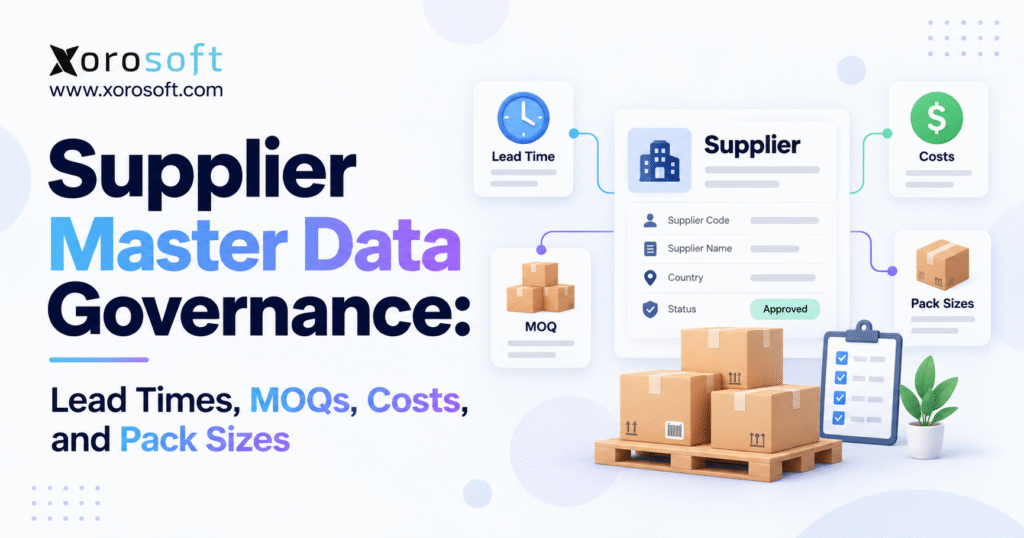
Supplier-item information can contain the supplier SKU, unit cost, lead time, MOQ, order multiple, purchase UOM, pack quantity, price-break rules, and preferred-source status.
This distinction becomes especially important when one item has several potential suppliers.
One source may deliver a component in 14 days with an MOQ of 1,000 units. A second supplier might need 28 days but accept an MOQ of only 250. For emergency replenishment, another source could provide faster delivery at a higher cost.
A well-designed supplier master preserves these differences instead of reducing every source to one generic purchasing assumption.
2.2 Which Supplier Fields Need Stronger Governance
Not every supplier field creates the same operational risk.
Changing a general contact phone number does not normally alter replenishment. Changing lead time, MOQ, purchase cost, pack size, UOM, or supplier-item mapping can directly change a purchase order.
Teams should therefore apply stronger governance to fields that influence purchasing behavior, inventory quantities, financial expectations, or warehouse transactions.
The most important question is not simply, “Is this field accurate?” It is, “What decisions will this field change if it is wrong?”
2.3 Connecting Supplier Master Data With the Wider Operation
As operations become more connected, platforms such as XoroONE become relevant because purchasing, inventory, forecasting, accounting, warehouse management, and related operational functions can use a shared data environment instead of maintaining parallel assumptions.
Centralization alone does not guarantee good governance. Teams still need clear ownership, review processes, and change controls.
However, keeping operational supplier information in the systems that actually drive purchasing gives employees a better chance of using the same rule consistently.
3. Supplier Master Data Governance for Lead Times Requires Real Operating Data
Lead time is one of the most important supplier attributes because it tells planning teams how early they need to act.
Unfortunately, companies often leave this field untouched for years.
A supplier may quote 21 days during onboarding. Six months later, purchase orders may consistently require 30 or 35 days. If the master record continues to show 21, the planning system can recommend replenishment too late even when the demand forecast is accurate.
3.1 Define Supplier Lead Time Before Measuring It
Teams first need to agree on what the lead-time field actually means.
Possible definitions include purchase-order creation to shipment, confirmation to shipment, PO release to warehouse receipt, or order placement to inventory becoming available for allocation.
Each definition produces a different number.
If purchasing measures PO-to-ship while planning assumes PO-to-available-stock, both departments may believe they use accurate lead times even though they measure different processes.
The strongest definition supports the planning decision the field needs to drive.
3.2 Quoted Lead Time Should Not Become a Permanent Assumption
Quoted lead time is useful when no purchase history exists. Once sufficient receipt history becomes available, actual supplier behavior should influence planning.
Suppose a supplier promises a 20-day lead time.
Recent receipts arrive after 21, 25, 28, 27, and 30 days. A planner who continues relying on 20 days is using the supplier’s original commitment rather than recent operating performance.
That does not mean an ERP should blindly replace every quoted value with a simple average. Teams may need to consider production calendars, freight methods, seasonality, factory shutdowns, port delays, or unusual disruptions.
The key governance requirement is regular review.
3.3 Lead Time Should Be Specific Enough to Support Planning
Storing one lead time for an entire supplier is convenient, but it can be inaccurate.
A supplier may manufacture one product domestically and another overseas. Some SKUs may stay in stock while others require production after order placement. One product family may travel by air while another moves by ocean freight.
Where those differences materially affect availability, companies should maintain lead time at the supplier-item level.
The issue becomes even more important when a business operates several warehouses. A supplier may reach one facility in 12 days and another in 20 because transportation routes differ.
A structured cloud ERP platform can help purchasing and inventory teams manage these relationships more systematically as supplier, SKU, and warehouse complexity grows.
4. Supplier Master Data Governance for MOQs Protects Inventory and Working Capital
Minimum order quantity often appears to be a simple supplier constraint that purchasing has to accept.
Operationally, it has much broader consequences.
MOQ changes how much inventory a business may have to purchase relative to what it actually needs.
If replenishment calculations show a requirement of 250 units but the supplier sets an MOQ of 600, the company may need to buy 350 additional units. Those units consume warehouse space, tie up cash, and increase exposure to slow-moving or obsolete stock.
4.1 MOQ and Demand Represent Different Planning Concepts
Demand tells the business what it expects to sell or consume.
MOQ tells the company the smallest quantity the supplier will accept.
Those figures should not be confused.
A planning system may correctly calculate a requirement of 175 units while the supplier constraint forces the executable order to 500. If management later sees excess inventory, the forecast may not be the problem. The excess can simply reflect the economic impact of the MOQ.
That distinction matters when teams evaluate purchasing performance.
4.2 MOQ Is Not the Same as Order Multiple
MOQ establishes the minimum acceptable quantity.
An order multiple defines the increments in which the buyer should place an order.
For example, a supplier may require at least 100 units but only ship full cartons of 24.
An order for 100 does not divide evenly into cartons of 24. Depending on the commercial rule, the buyer may need to increase the order to 120 units.
This is why supplier master data governance should treat MOQ and order multiple as separate fields when both constraints exist.
4.3 MOQ, Order Multiple, and Pack Size Need Separate Meanings
| Field | What It Controls | Example |
|---|---|---|
| MOQ | Minimum acceptable order | 240 units |
| Order multiple | Valid ordering increment | Multiples of 24 |
| Pack size | Physical units in a pack | 24 each per case |
| Purchase UOM | Unit shown on PO | Case |
These values often interact, but they should not become interchangeable.
A supplier may have a 240-unit MOQ, ship in cases of 24, and require orders in multiples of 24. Another supplier could use an MOQ of 250 while still packing 24 units per case.
The ERP needs to understand the difference if it will create reliable purchasing recommendations.
5. Pack Size and Purchase UOM Governance Prevent Quantity Distortions
Pack-size errors can create some of the most confusing inventory discrepancies because every department may believe it processed the transaction correctly.
A buyer orders ten cases. The supplier ships exactly ten. Warehouse staff receive all ten as expected. Inventory still becomes wrong if the system assumes each case contains 12 units while the supplier now packs 24.
The transaction count remains correct. The conversion does not.
5.1 Each, Inner Pack, Case, Carton, and Pallet Need Clear Relationships
Inventory-driven businesses frequently purchase, store, and sell products in different units.
A product may be purchased as a case, stored as an each, and shipped wholesale as an inner pack.
For example, an inner pack may contain six units. A case could contain four inner packs, while a full pallet might hold 40 cases.
That means one case equals 24 units and one pallet equals 960 units.
If any conversion factor is wrong, quantity problems can appear in receiving, picking, availability, fulfillment, replenishment, and financial reporting.
5.2 Pack Size Should Not Substitute for MOQ
Suppose a supplier ships items in cases of 24 but requires a minimum purchase of 240 units.
The pack size is 24. MOQ is 240. The order multiple may also be 24.
Three related values exist, yet each describes a different rule.
When a business uses one field to represent all three concepts, the ERP may not distinguish between physical packaging and commercial purchasing constraints.
5.3 Warehouse Receiving Depends on Accurate Purchasing Data
Warehouse teams work downstream from supplier master data.
If the system tells them a case contains 12 units when 24 physically arrive, receiving staff have to choose between following the system and correcting the transaction manually.
Repeated corrections indicate a master-data problem rather than a warehouse discipline problem.
A connected warehouse management system becomes most useful when pack sizes, purchase units, receipts, and on-hand inventory all use consistent rules.
6. Supplier Cost Governance Needs More Than a Single Current Price
Supplier purchase cost becomes risky when teams treat it as one editable number.
In reality, pricing may depend on quantity, currency, contract period, UOM, freight arrangement, destination, or negotiated discounts.
A supplier item that costs $18 today may cost $17 at 1,000 units and $16.25 above 5,000. One contract could expire at the end of a quarter, while another supplier may quote in a different currency.
Effective supplier master data governance should preserve enough context for purchasing and finance teams to understand which cost applies.
6.1 Purchase Price and Landed Cost Should Stay Separate
Purchase price represents the amount paid to the supplier for goods under the applicable commercial terms.
Landed cost can include inbound freight, duty, brokerage, insurance, or handling, depending on company policy.
Combining these concepts into one ambiguous field weakens analysis.
Purchasing may need supplier price for negotiations. Finance may require landed cost for inventory economics. Operations might compare suppliers whose unit prices look similar but whose inbound logistics costs differ substantially.
6.2 Effective Dates Matter in Supplier Cost Governance
Overwriting the current supplier price without preserving its effective period removes valuable history.
Suppose a supplier cost changes from $14.50 to $15.25 on October 1.
Future purchase orders should use the new agreed value where appropriate, but teams should still understand why earlier transactions used $14.50.
That history supports supplier negotiations, purchase-price variance reviews, margin analysis, and audits.
6.3 Cost Changes Need Defined Ownership
Not every employee who creates purchase orders should automatically be able to alter supplier prices.
A practical process may allow purchasing to propose a new cost, procurement leadership to approve commercial terms, and finance to review changes that materially affect inventory economics.
The exact structure varies by organization. However, fields that influence financial decisions deserve stronger governance than ordinary descriptive attributes.
7. Supplier Master Data Governance Directly Influences Replenishment
Replenishment depends on several inputs working together.
Demand identifies what the business expects to need. Current inventory shows what is available. Open purchase orders indicate what is already coming. Supplier lead time influences when new supply must be ordered. MOQ and order multiples determine the quantity the company can practically buy.
When those inputs are accurate, planning becomes more reliable.
If supplier information is stale, sophisticated forecasting cannot fully compensate for it.
7.1 Lead Time, Safety Stock, and Reorder Timing Work Together
A simplified reorder relationship is:
Reorder Point = Expected Demand During Lead Time + Safety Stock
If daily demand averages 20 units and supplier lead time is 15 days, expected demand during lead time is around 300 units before adding safety stock.
If actual lead time has increased to 25 days, the company may need to cover about 500 units.
A ten-day master-data error therefore changes the planning requirement by roughly 200 units in this example.
7.2 MOQ Changes the Executable Purchase Recommendation
Suppose replenishment requires 430 units.
The supplier MOQ is 600, while the order multiple is 100.
The executable purchase can therefore become 600 even though the underlying net requirement is lower.
A planner should be able to see why the recommendation exceeds forecast-driven need.
That transparency gives companies another reason to maintain purchasing constraints inside the ERP instead of hiding them in individual spreadsheets.
7.3 Multi-Warehouse Replenishment Adds More Complexity
A company with several warehouses may have one supplier feeding multiple locations or a central facility that redistributes inventory internally.
In either situation, supplier information, local demand, transfer lead times, inbound stock, and warehouse availability interact.
Modern ERP and operational solutions provide more value when companies connect those relationships instead of treating purchasing, inventory, warehousing, and accounting as separate problems.
8. Supplier Data Governance Roles Should Be Defined by Field
A common governance mistake is declaring that “procurement owns supplier data” and stopping there.
Supplier information crosses too many departments for one broad statement to provide enough control.
A stronger model assigns responsibility according to each field and its operational impact.
8.1 Purchasing Owns Commercial and Sourcing Attributes
Purchasing usually has the strongest context for supplier-item prices, MOQs, order multiples, vendor SKU references, commercial lead-time commitments, preferred-source rules, and negotiated terms.
That does not mean purchasing should change every field without review.
Instead, the department should have clear responsibility for maintaining the information it understands best.
8.2 Planning Should Challenge Stale Lead-Time Assumptions
Inventory planners see the downstream effects of supplier performance.
If purchase orders repeatedly arrive later than the master-data assumption, planning should have a formal process for triggering review.
This closes the loop between planned supply and actual supplier behavior.
It also prevents teams from solving the same stockout repeatedly without correcting its underlying planning assumption.
8.3 Warehouse Teams Act as Data-Quality Sensors
Warehouse employees often discover supplier-master problems first.
They see cases with unexpected quantities, unusual pallet configurations, incorrect supplier item numbers, labeling differences, and receiving discrepancies.
Those observations should feed back into supplier data governance rather than being corrected only at the receiving dock.
8.4 Finance Should Control Sensitive Financial Attributes
Payment information, tax data, currency settings, accounting rules, and other high-risk financial fields need appropriate controls.
Separating commercial, operational, and sensitive financial attributes also makes user permissions easier to design.
Clear ownership prevents one department from becoming responsible for data it does not have enough context to maintain correctly.
9. A Supplier Master Data Governance Workflow Must Cover the Full Data Lifecycle
Good governance is not a one-time data-cleanup project.
Supplier information changes continuously.
New vendors enter the network. Products move between factories. Prices rise or fall. Case packs change. Lead times improve or deteriorate. Supplier relationships end, while alternate sources become preferred vendors.
A sustainable supplier master data governance process therefore needs to control creation, modification, monitoring, and retirement.
9.1 Start With Standardized Supplier Onboarding
New supplier creation should collect enough information for teams to use that supplier safely and consistently.
Required fields should reflect actual business needs rather than every field an ERP happens to offer.
The onboarding team should validate supplier identity, purchasing terms, financial information, operational contacts, and relevant supplier-item relationships before enabling routine transactions.
This prevents incomplete records from becoming active simply because somebody needs to place an urgent order.
9.2 Separate Supplier Creation From Supplier-Item Setup
Creating the supplier organization does not automatically mean every purchasing condition is ready.
Purchasing teams may need to configure and approve supplier-item relationships separately.
That stage should confirm supplier SKU, purchasing unit, cost, lead time, MOQ, order multiple, pack size, and other operational constraints.
A supplier can therefore become approved at organizational level while particular item relationships remain incomplete until purchasing data is ready.
9.3 Govern Changes According to Risk
Changing a buyer contact email may require little oversight.
Changing supplier banking details requires much stronger controls.
Updating an MOQ from 100 to 5,000 may not create fraud risk, but it can produce substantial inventory and working-capital exposure.
A mature governance workflow evaluates the risk of each change instead of applying exactly the same approval process to every field.
9.4 Preserve a Useful Audit Trail
Teams should be able to determine what changed, when it changed, who made the change, and why.
That context becomes especially valuable when users investigate unusual purchase quantities, cost variances, inventory discrepancies, or supplier disputes.
Change history also helps distinguish a system error from an intentional commercial decision.
10. Supplier Master Data Management Outgrows Spreadsheets as Relationships Multiply
Spreadsheets remain useful operational tools. They are inexpensive, flexible, familiar, and quick to modify.
A small company with a limited supplier base does not need complicated master data governance simply to avoid Excel or Google Sheets.
The limitation appears when a spreadsheet becomes the unofficial source of truth for information that other applications need.
10.1 Warning Signs That Spreadsheet Supplier Governance Is Breaking Down
The first warning is usually duplication.
One buyer maintains current supplier costs. A planner keeps another lead-time file. Warehouse employees rely on a separate pack-size sheet, while finance manages payment data elsewhere. Meanwhile, the ERP contains older versions of the same values.
At that point, the company does not have one supplier master. It has several competing versions.
Another warning appears when each purchase requires manual interpretation.
If buyers need an external worksheet before they can trust every replenishment recommendation, the planning system does not contain complete purchasing constraints.
10.2 ERP Becomes More Valuable as Supplier Relationships Multiply
Consider a business with 3,000 SKUs and five possible suppliers for many items.
The number of supplier-item relationships quickly becomes difficult to govern through standalone spreadsheets, especially when each combination carries different pricing, lead time, MOQ, pack size, and UOM.
Xorosoft can become relevant when those purchasing relationships need to connect directly with inventory, accounting, forecasting, manufacturing, warehousing, and sales-channel operations instead of living in a separate procurement dataset.
Businesses reviewing broader ERP options can also benefit from comparing operating models rather than only feature lists. The Xorosoft vs NetSuite comparison offers one way to frame that evaluation around operational scope, implementation approach, and system fit.
11. Supplier Data Governance Becomes More Important in Shopify and Multichannel Operations
Ecommerce growth often exposes supplier-master weaknesses because customer demand moves faster than physical replenishment.
A Shopify storefront can receive customer orders immediately. Supplier replenishment may still require several weeks or months.
That timing gap makes accurate purchasing information increasingly important.
11.1 Shopify Inventory Depends on Upstream Supplier Data
Shopify may accurately show what is available for sale today, but future availability depends on purchasing decisions made earlier in the supply cycle.
If supplier lead time is understated, buyers may reorder too late. When MOQ is overstated, the company can commit unnecessary working capital. Outdated purchase costs can also weaken margin expectations and sourcing decisions.
For merchants that want Shopify connected with a broader operational environment, Xorosoft’s listing in the Shopify App Store provides an external reference for the integration.
11.2 Amazon, Wholesale, and EDI Add More Demand Sources
Once the same inventory supports Shopify, Amazon, wholesale orders, EDI customers, and additional channels, purchasing decisions need a consolidated demand view.
The supplier master does not require different lead times simply because products sell through several channels.
Instead, the operational platform needs to connect total demand with the correct supplier and purchasing constraints.
A centralized integration framework becomes useful when inventory, orders, supplier data, and financial transactions need to move across systems without creating duplicate operational records.
11.3 Channel Growth Changes the Cost of Bad Supplier Data
A lead-time error has limited impact when one SKU sells a few units per week.
The same error becomes more expensive when several channels consume the same stock simultaneously.
Multichannel growth therefore increases the value of accurate upstream purchasing information even if the supplier relationship itself has not changed.
12. AI-Driven Purchasing Still Depends on Supplier Master Data Governance
AI can help analyze demand, summarize supplier performance, identify anomalies, and support purchasing decisions.
It cannot reliably compensate for fundamentally incorrect master data.
If an AI system reads a supplier lead time of 14 days when reality is closer to 35, it can produce a sophisticated recommendation based on a poor assumption.
That is why supplier master data governance becomes more important, not less important, as companies introduce AI-driven operational tools.
12.1 AI Needs Governed Operational Context
Useful purchasing intelligence requires more than sales history.
It may depend on current inventory, open purchase orders, supplier lead times, MOQ, pack size, costs, warehouse demand, seasonality, existing commitments, and supplier performance.
When those values come from disconnected systems with different definitions, AI inherits the inconsistency.
Governed operational data gives AI stronger context for producing useful recommendations.
12.2 Connected AI Should Respect the Same Source of Truth
Businesses increasingly want AI assistants and external tools to interact with ERP information.
That makes permissions, field definitions, and controlled system access increasingly important. Xorosoft’s MCP Server is relevant in this context because it reflects the broader move toward connecting AI tools with structured operational systems rather than relying only on copied reports or isolated exports.
The principle remains straightforward: intelligent automation is only as dependable as the operational data underneath it.
12.3 AI Should Highlight Exceptions, Not Hide Weak Governance
AI can help identify unusual lead times, large cost changes, repeated PO overrides, or supplier performance shifts.
However, teams still need governance rules that determine who reviews those exceptions and which data becomes authoritative afterward.
Automation should improve the feedback loop between real operating behavior and master data. It should not create another layer where unverified assumptions become harder to see.
13. Supplier Master Data Management Requirements Vary by Industry
The basic governance principles remain consistent, but the fields carrying the greatest operational risk differ by industry.
A wholesaler, apparel company, furniture brand, food distributor, and manufacturer may all use supplier lead time, MOQ, cost, and UOM data differently.
Good governance adapts to those operating realities rather than forcing every business into the same template.
13.1 Wholesale Distribution Prioritizes Availability and Purchasing Constraints
Wholesale distributors may manage thousands of SKUs, multiple customer segments, large supplier catalogs, EDI requirements, and several warehouses.
Lead-time accuracy and alternate supplier management become especially important because one stockout can affect many downstream customer orders.
MOQ and pack-size governance also matters because distributors frequently purchase and sell products at different packaging levels.
13.2 Apparel Businesses Need Seasonal Supplier Information
Apparel and fashion companies operate around selling windows.
Inventory arriving six weeks late may still have accounting value, but its commercial value can fall sharply if the selling season is almost over.
Supplier lead time therefore should not remain a static administrative field.
Actual production and transit performance should continually inform planning assumptions.
13.3 Furniture Companies Face Longer Lead Times and Space Constraints
Furniture purchasing can involve long supplier cycles, container economics, bulky products, expensive freight, and substantial warehouse-space requirements.
An excessive MOQ can create both cash-flow and storage consequences.
Supplier pricing also deserves evaluation alongside freight and broader landed-cost considerations rather than unit price alone.
13.4 Food and Beverage Adds Lot, Expiry, and Pack Complexity
Food and beverage businesses often need supplier information to work alongside lot control, expiry dates, shelf life, case configuration, and recall requirements.
Incorrect pack conversions can create receiving discrepancies. Overbuying caused by MOQ rules becomes particularly expensive when products have a limited shelf life.
13.5 Manufacturing Connects Supplier Information to Production
Manufacturers depend on supplier data for components and raw materials.
A lead-time error can affect material availability and production schedules. An incorrect UOM can distort material requirements. High MOQs may increase raw-material inventory and working-capital needs.
Companies comparing these operating models can review Xorosoft’s broader industry coverage to see how inventory, purchasing, manufacturing, wholesale, and ecommerce requirements vary by business model.
14. Supplier Master Data Governance Should Be Addressed Before ERP Migration
ERP implementation creates one of the best opportunities to improve supplier data—and one of the worst opportunities to copy poor information into a new system without review.
Migrating every existing supplier record exactly as it appears can feel safe because nothing seems to be lost.
In practice, that approach can preserve duplicate suppliers, old prices, inactive relationships, stale lead times, obsolete item mappings, and inconsistent units.
14.1 Do Not Treat Supplier Data Migration as a File Transfer
A stronger approach classifies supplier information before migration.
Start by asking whether each supplier is still active and whether dormant records should remain available. Review which supplier-item relationships still matter commercially, then confirm that costs and MOQs remain current.
Finally, verify pack-size conversions and investigate fields that have repeatedly caused purchasing or receiving corrections.
Those questions turn migration into a governance exercise rather than a technical copy operation.
14.2 Clean the Highest-Risk Fields First
Organizations rarely have enough time to perfect every supplier attribute before go-live.
Prioritize the fields that influence transactions and planning.
Lead time, MOQ, order multiple, pack size, purchase UOM, supplier SKU, cost, supplier status, and preferred-source rules deserve more attention than low-impact descriptive information.
This risk-based approach allows implementation teams to focus effort where inaccurate data would create the biggest operational consequences.
14.3 Test Supplier Master Data Through Real Workflows
Teams should test master data through actual purchasing and receiving scenarios.
Create a purchase recommendation and convert it into a PO. Receive the shipment and inspect the UOM conversion. Verify cost behavior, test an alternate supplier, and review a quantity that falls below MOQ or outside the required order multiple.
These scenarios often expose problems that a spreadsheet review cannot.
Organizations researching how other inventory-driven businesses approached system changes can also use ERP case studies as practical references when thinking through implementation and operational design.
15. Common Supplier Master Data Governance Mistakes Create Predictable Failures
Many supplier-data problems are not technical problems. They are design and ownership problems.
The same patterns appear repeatedly: stale assumptions remain in the ERP, employees correct problems outside the system, and nobody owns the feedback loop between actual supplier behavior and master data.
Recognizing these patterns early can prevent recurring purchasing and inventory problems.
15.1 Using One Supplier Lead Time for Every Item
This works only when the supplier genuinely operates that way.
If SKUs come from different factories, transportation methods, production schedules, or sourcing regions, one default lead time can create misleading recommendations.
Use a supplier-level default where appropriate, then apply supplier-item values whenever meaningful differences exist.
15.2 Correcting Problems in Spreadsheets but Not in ERP
A buyer discovers an incorrect MOQ and fixes the purchasing spreadsheet.
The ERP still contains the old number.
For a short period, the buyer remembers the difference. Later, another employee creates an order directly from the system, and the original problem returns.
A correction is not complete until the responsible team updates the operational source of truth.
15.3 Allowing Critical Rules to Become Tribal Knowledge
Statements such as “we always add another week for this supplier” or “that item can only be ordered by the pallet” indicate missing master data.
If a rule consistently affects purchasing decisions, teams should generally maintain it in a controlled system instead of relying on employee memory.
15.4 Treating Every Supplier Change as Equally Important
A new phone number and a new bank account should not follow identical controls.
Likewise, changing an item description is not the same as increasing an MOQ from 100 to 10,000 units.
Governance becomes more practical when approval levels match operational and financial risk.
15.5 Never Retiring Old Supplier-Item Relationships
Inactive supplier mappings can clutter sourcing decisions and increase the chance that buyers use obsolete prices or purchasing conditions.
When a supplier no longer sells a product, the responsible team should deactivate that relationship under a defined policy while preserving historical transactions.
16. Supplier Master Data Governance Checklist for Purchasing and Operations Teams
Before automating replenishment or relying heavily on system-generated purchasing recommendations, teams should confirm that clear governance rules cover critical supplier information.
A checklist should not become another administrative exercise. Its purpose is to confirm that the data influencing purchasing decisions accurately reflects the way suppliers operate.
16.1 Validate Supplier Identity and Status
Confirm that active suppliers remain valid, teams have addressed duplicate records, and purchasing users can clearly distinguish approved, inactive, blocked, and alternate suppliers.
The company should also assign supplier-data ownership so employees know who is responsible when information changes.
Clear supplier status helps prevent purchases from obsolete sources while preserving historical records for reporting and analysis.
16.2 Validate Every Material Supplier-Item Relationship
For important inventory items, confirm the supplier SKU, preferred-source status, purchase cost, currency, lead time, MOQ, order multiple, purchasing UOM, and pack size.
Do not assume a supplier-level default is correct for every product.
Higher-value, high-volume, seasonal, constrained, or long-lead-time items usually deserve more frequent review than low-risk purchasing relationships.
16.3 Compare Planning Assumptions With Actual History
Use recent purchase orders and receipts to determine whether supplier performance still matches the master record.
When actual lead times consistently differ from planning lead times, investigate the cause and update the governing rule where necessary.
If buyers frequently override system-recommended quantities, determine whether MOQ, order multiple, forecast settings, or inventory policies drive that behavior.
Repeated overrides often reveal master-data problems that formal audits miss.
16.4 Define Change Ownership Clearly
Teams should know who can request, approve, and execute changes to high-impact fields.
Purchasing may own commercial terms. Planning can monitor lead-time performance. Warehouse teams can validate pack-size discrepancies, while finance controls sensitive financial information.
The governance model should reflect how the business actually operates rather than assigning every supplier field to one department.
16.5 Make ERP the Usable Source of Truth
A source of truth creates value only when employees trust and use it.
When buyers still need external spreadsheets to complete every purchase order, the ERP supplier master is incomplete, outdated, or poorly structured.
Xorosoft and other modern ERP platforms can support a move toward a shared operational record when businesses have outgrown disconnected accounting, inventory, purchasing, and warehouse applications.
The goal is not to eliminate every spreadsheet. It is to stop critical supplier rules from existing only in spreadsheets that the operational system cannot use.
17. Practical Next Step: Make Supplier Data Reliable Enough to Drive Purchasing
Supplier information should not sit in the background as an administrative database.
For inventory-driven businesses, it determines how purchasing decisions eventually become physical inventory.
Lead time affects when an order needs to be placed. MOQ determines the minimum quantity the company may need to buy. Order multiples establish valid purchasing increments. Pack sizes and units of measure determine how physical receipts become system inventory. Supplier costs shape purchasing economics and margin expectations.
That is why supplier master data governance deserves the same operational attention as forecasting, warehouse accuracy, and financial controls.
17.1 Prioritize the Supplier Data That Drives Purchase Orders
Start by identifying the fields that directly influence replenishment and purchasing.
Decide whether each attribute belongs at supplier level or supplier-item level, then assign clear ownership.
Apply stronger controls to high-risk changes and compare stored assumptions with actual supplier performance. Teams should also retire duplicate or obsolete supplier relationships before they create new transactions.
Most importantly, ensure that the system used for planning and purchasing contains the same rules buyers actually follow.
Companies do not need complex governance merely for the sake of process. They need enough control to ensure that every purchasing decision uses accurate, current, and usable supplier information.
17.2 Move From Supplier Data Cleanup to Operational Control
As operations expand across multiple warehouses, Shopify, Amazon, wholesale, EDI, manufacturing, and accounting, maintaining supplier relationships across disconnected systems becomes progressively harder.
A unified operational platform can reduce that fragmentation by connecting supplier information with purchasing, inventory, warehouse, forecasting, and finance.
The real objective is not simply to replace spreadsheets. It is to ensure that supplier-item rules, replenishment decisions, purchase orders, warehouse receipts, inventory movements, and accounting workflows all rely on consistent operational data.
17.3 Review Governance Gaps Before Selecting New Software
Before changing systems, identify where supplier information currently breaks down.
Look at recurring PO corrections, late purchasing, manual MOQ adjustments, incorrect receiving quantities, stale supplier prices, duplicate vendor records, and buyer spreadsheets that contain rules missing from the ERP.
Those gaps provide a practical requirements list for any future system.
A company that understands its supplier data problems can evaluate software far more effectively than one that begins with a generic feature checklist.
For a discussion focused on purchasing, inventory, and supplier-data workflows, contact Xorosoft to review the operational requirements and potential next steps.
Supplier Master Data Governance FAQs
What is supplier master data governance?
Supplier master data governance controls how supplier information is created, validated, updated, approved, and reviewed so purchasing, inventory, finance, and warehouse teams use accurate data.
Why should supplier lead times be reviewed regularly?
Actual supplier performance can change. Reviewing lead times helps purchasing teams reorder at the right time and reduces the risk of stockouts caused by outdated planning assumptions.
How does MOQ affect inventory planning?
MOQ can force a business to buy more than its immediate requirement, increasing inventory levels, warehouse usage, working capital, and potential obsolescence risk.
What is the difference between MOQ and pack size?
MOQ is the minimum quantity a supplier accepts. Pack size describes how many units come inside a case, carton, or other purchasing package.
How should supplier costs be governed?
Businesses should control supplier cost changes, record effective dates, maintain pricing history, and define who can update or approve purchase prices.
When should supplier data move from spreadsheets to ERP?
ERP becomes useful when multiple suppliers, warehouses, SKUs, buyers, purchasing rules, or sales channels make spreadsheet-based supplier management difficult to control reliably.
How does ERP improve supplier master data governance?
ERP centralizes supplier information, permissions, purchasing rules, transaction history, inventory data, and approvals so operational teams can work from one governed source of truth.
Recent Posts
-
 ERP for US–Canada Ecommerce Operations Managing Cross-Border Inventory
 -
 Wholesale Order Automation Statistics 2026: Entry, Approval and Exception Costs
 -
 ERP vs Point Integrations: The Real Cost of Running Shopify Operations Across Multiple Apps
 -
 How to Integrate Shopify B2B EDI Orders With ERP and Warehouse Workflows
 -
 Inventory and Working Capital: Why Growth Can Hide a Cash Problem