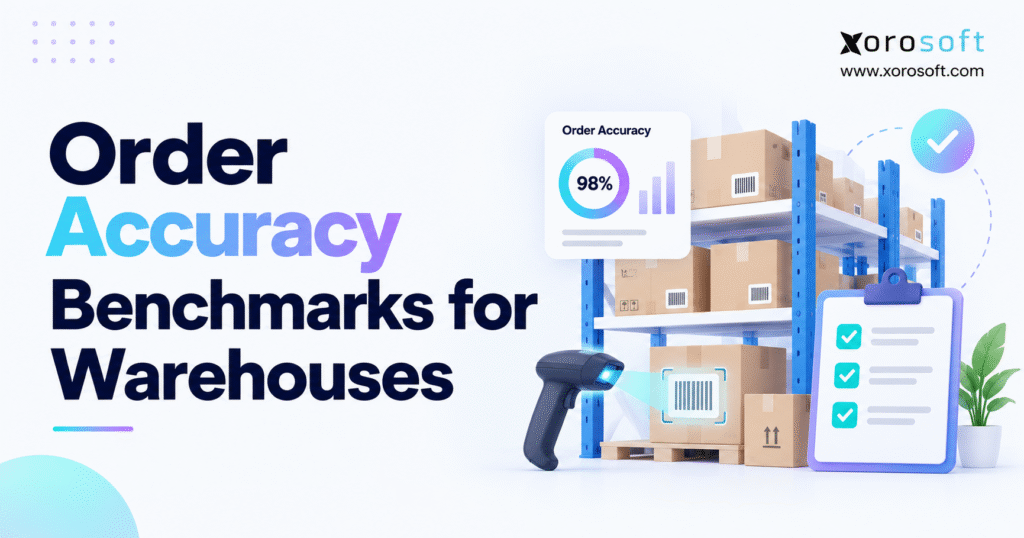
To optimise your warehouse operations, it's essential to understand warehouse order accuracy benchmarks.
1. Why Warehouse Order Accuracy Becomes a Scaling Problem
A warehouse can report impressive accuracy and still generate hundreds of costly fulfillment errors every month. That apparent contradiction is why warehouse order accuracy benchmarks need more context than a single percentage.
At 1,000 orders per month, 99% accuracy represents about 10 inaccurate orders. At 100,000 orders, the same percentage represents roughly 1,000 errors. Each mistake can create customer service work, replacement freight, returns, inventory adjustments, credits, and lost customer trust.
Volume is only part of the problem. Companies also define accuracy differently. One warehouse may count an order as accurate when a picker selects the correct SKU and quantity. Another may include packing, documentation, labeling, shipping, lot control, serial numbers, or retailer-specific requirements.
Those differences make casual benchmark comparisons misleading.
A useful benchmark answers three questions: What exactly is being measured? Where does the measurement stop? How does the operation compare with warehouses handling similar products, channels, volumes, and order profiles?
As ecommerce, wholesale, and multi-warehouse businesses scale, those questions become increasingly important. Accuracy should not be treated as a vanity KPI. Instead, it should reveal where fulfillment quality is breaking down and where operational improvement can create measurable value.
1.1 What Warehouse Order Accuracy Actually Measures
Warehouse order accuracy represents the percentage of fulfilled orders that meet a company’s defined standard for correctness.
At a basic level, that normally means the correct product, variant, and quantity reached the correct order. More complex operations may also include packaging, documentation, lots, serial numbers, customer-specific labels, or retailer compliance requirements.
Documenting the definition before selecting an external benchmark prevents teams from comparing unlike metrics.
1.2 What Counts as an Inaccurate Warehouse Order
Typical failures include shipping the wrong SKU, selecting an incorrect size or color, sending the wrong quantity, omitting a product, adding an unintended product, or consolidating products into the wrong customer’s carton.
For wholesale and regulated operations, physical inventory can be correct while the shipment still fails because required documentation, labels, lot information, or transaction records are incorrect.
Consistency matters. When one facility records these failures and another excludes them, their accuracy rates cannot be compared fairly.
2. How to Calculate Warehouse Order Accuracy Correctly
The standard calculation is straightforward:
Warehouse Order Accuracy Rate = Accurate Orders ÷ Total Orders Fulfilled × 100
Assume a warehouse fulfills 10,000 orders during a month and identifies 75 orders that failed its accuracy criteria. The operation therefore completed 9,925 accurate orders.
The calculation becomes:
9,925 ÷ 10,000 × 100 = 99.25%
That produces a 99.25% order accuracy rate for the month. Although the calculation itself is simple, defining what qualifies as an accurate order requires more careful consideration.
2.1 Order-Level Accuracy vs Line-Level Accuracy
Order-level accuracy reflects the complete customer experience. If an order contains 15 lines and one line is incorrect, the entire order counts as inaccurate.
Line-level accuracy measures each order line separately. If 14 of 15 lines are correct, line accuracy for that individual order is 93.3%.
Both metrics are useful, but they answer different questions.
Order-level accuracy shows how frequently customers receive completely correct orders. Line-level accuracy provides warehouse managers with greater detail about execution quality and can help identify specific process failures.
2.2 Unit-Level Warehouse Accuracy
Large distributors may also measure accuracy by individual unit.
Imagine an order containing 100 units. If one unit is missing, unit-level accuracy remains 99%, while complete-order accuracy for that order is zero.
Consequently, an operation can report excellent unit accuracy while delivering a lower customer-facing order accuracy rate.
The measurement level should always accompany published warehouse order accuracy benchmarks. Without that context, percentages have limited comparative value.
2.3 Measure Error Volume Alongside Percentage
A percentage can hide the actual workload created by fulfillment mistakes.
A 0.5% error rate may appear small. Yet a warehouse shipping 200,000 orders annually would generate approximately 1,000 inaccurate orders at that rate.
Operations teams should measure both percentage accuracy and absolute error count. Mature businesses can go further by assigning an estimated financial cost to different error categories.
That approach produces a stronger basis for prioritizing improvements.
3. Order Accuracy vs Picking Accuracy: Why the Difference Matters
Order accuracy and warehouse picking accuracy are closely connected, but they are not interchangeable.
Picking accuracy measures whether employees or automation selected the correct products and quantities during the picking process. Order accuracy can extend through consolidation, packing, documentation, labeling, and final shipment.
This distinction matters when comparing warehouse order accuracy benchmarks from different research sources.
3.1 A Correct Pick Can Still Become an Incorrect Order
Consider an order containing three correctly picked products.
At the packing station, one item is accidentally placed in another customer’s carton. Picking performance was correct, but the final customer order was not.
Similar failures can occur because of incorrect shipping labels, missing documentation, poor consolidation, or required serial information that was never captured.
Warehouse teams should therefore avoid assuming that excellent picking performance automatically means excellent end-to-end fulfillment accuracy.
3.2 Inventory Accuracy Is a Different Warehouse KPI
Inventory accuracy asks whether system records match physical inventory inside the warehouse.
Order accuracy asks whether the customer received the correct order.
Poor inventory records often contribute to fulfillment failures because pickers encounter empty bins, unexpected stock, or incorrect quantities. Strong inventory accuracy, however, does not automatically eliminate execution mistakes during picking, consolidation, packing, or shipping.
This is why mature operations manage a connected group of warehouse KPIs rather than relying on one number.
4. Warehouse Order Accuracy Benchmarks: What Is a Good Rate?
There is no universal percentage that every warehouse should treat as its order accuracy standard.
Different benchmark sources measure different parts of the fulfillment process. Product type, order complexity, warehouse design, order volume, verification controls, and lines per order also influence realistic performance.
For example, ShipBob has discussed approximately 96%–98% order accuracy in a direct-to-consumer fulfillment context. That figure should not be treated as a universal standard for every distribution center.
Public reporting based on WERC’s 2025 research places best-in-class order-picking accuracy at 99.68% or higher. Importantly, that figure measures picking rather than every downstream component of order execution.
Source: Yale/WERC warehouse benchmarking analysis
4.1 What 98% Warehouse Order Accuracy Means
At 98% accuracy, approximately 20 orders out of every 1,000 contain an error.
For 10,000 orders, that becomes roughly 200 inaccurate orders. At 100,000 orders, the operation would generate approximately 2,000.
A growing warehouse moving away from inconsistent manual processes may view 98% as meaningful progress. A mature, high-volume facility could consider the remaining error burden too expensive.
That difference demonstrates why warehouse order accuracy benchmarks should always be interpreted alongside order volume.
4.2 Is 99% Order Accuracy Good?
A 99% accuracy rate means approximately one order in every 100 contains an error.
Whether that result is acceptable depends on scale, customer expectations, product value, and the consequences of each failure.
Ten errors per 1,000 orders may be manageable for one business. One thousand errors per 100,000 orders can create substantial recurring work across customer service, warehouse investigation, replacement shipping, returns, and inventory reconciliation.
The same percentage can therefore represent very different business outcomes.
4.3 What 99.5% Accuracy Means at Scale
At 99.5% accuracy, approximately five orders per 1,000 are inaccurate.
That translates to around 50 errors per 10,000 orders or 500 per 100,000.
Moving from 99% to 99.5% cuts the expected error volume in half. For a large operation, that improvement can have a meaningful operational and financial effect even though the rate changes by only half a percentage point.
4.4 Understanding the 99.68% Picking Accuracy Benchmark
The 99.68% figure requires precise language.
Public reporting based on WERC’s 2025 benchmark identifies 99.68% or higher as best-in-class order-picking accuracy. It should not automatically be described as universal end-to-end order accuracy.
WERC’s current distribution-center measurement framework continues to treat order-picking accuracy as a distinct warehouse quality metric.
Source: WERC DC Measures
The broader lesson is more useful than the decimal itself. High-performing picking operations operate extremely close to error-free execution, yet each additional improvement becomes progressively harder to achieve.
4.5 Can Warehouses Reach 99.9% Accuracy?
Yes. Highly standardized facilities can operate above 99.9%, particularly when reliable inventory, location control, barcode verification, pack validation, and exception management work together.
However, organizations should avoid choosing 99.9% simply because it sounds like the ideal target.
A practical benchmark should consider customer expectations, order volume, product complexity, compliance requirements, error cost, and the cost of additional verification.
5. What Warehouse Accuracy Rates Mean at Real Order Volumes
The clearest way to interpret warehouse order accuracy benchmarks is to convert each rate into expected errors.
| Accuracy Rate | Errors per 1,000 | Errors per 10,000 | Errors per 100,000 |
|---|---|---|---|
| 96% | 40 | 400 | 4,000 |
| 98% | 20 | 200 | 2,000 |
| 99% | 10 | 100 | 1,000 |
| 99.5% | 5 | 50 | 500 |
| 99.68% | 3.2 | 32 | 320 |
| 99.9% | 1 | 10 | 100 |
| 99.95% | 0.5 | 5 | 50 |
These figures are mathematical illustrations rather than recommended performance targets.
5.1 Why Warehouse Error Cost Matters
Not every mistake produces the same financial consequence.
Shipping an inexpensive accessory incorrectly may require modest replacement freight. Sending the wrong furniture item, serialized product, industrial component, or wholesale case can create substantially more transportation, labor, and customer-service cost.
Warehouse leaders should therefore evaluate error frequency together with average cost per error.
That converts accuracy from a quality percentage into an operational and financial measure.
5.2 Why Accuracy Improvements Become More Valuable With Scale
Improving from 99% to 99.5% reduces expected errors by five orders per 1,000.
For a warehouse processing only 1,000 orders, the difference may appear modest. At one million orders, the improvement represents roughly 5,000 fewer errors.
The value of stronger controls therefore increases as transaction volume expands.
Processes that worked adequately for a smaller business can become expensive weaknesses after rapid growth.
6. Warehouse Accuracy KPIs That Should Be Measured Together
Strong warehouse management requires more than one quality metric.
Order fill rate measures whether customer demand was completely filled. APQC publishes order fill rate as a separate performance measure because completeness and correctness are different operational questions.
Source: APQC Order Fill Rate
Perfect order performance is broader still. APQC’s framework includes complete orders, on-time delivery, damage-free delivery, and accurate documentation.
Source: APQC Perfect Order Performance
6.1 Order Accuracy vs Inventory Accuracy
Inventory accuracy measures whether physical stock matches system inventory.
Order accuracy evaluates whether the warehouse fulfilled the customer order correctly.
An operation can perform strongly on one measure while struggling with the other. Poor inventory accuracy, however, often creates conditions that make reliable fulfillment more difficult.
6.2 Order Accuracy vs Fill Rate
Fill rate evaluates whether the full requested quantity was available and fulfilled.
A warehouse can achieve a high fill rate but send an incorrect product. Likewise, employees can prepare the available items accurately while failing to fulfill the complete order because some inventory is unavailable.
These measures should appear together rather than being substituted for each other.
6.3 Order Accuracy vs Perfect Order Performance
Perfect-order performance extends beyond physical warehouse execution.
An order might contain the correct products but arrive late, damaged, or with incorrect documentation. In that situation, warehouse order accuracy can remain high while perfect-order performance declines.
A balanced scorecard prevents one strong KPI from hiding problems elsewhere in the fulfillment process.
7. Why Warehouse Order Accuracy Benchmarks Can Hide Root Causes
A percentage tells management that something happened. It rarely explains why it happened.
Warehouses improve more effectively when they classify errors according to the point where each failure entered the process.
7.1 Receiving Errors Can Become Fulfillment Errors Later
Order accuracy can begin to deteriorate before the customer places an order.
If receiving records the wrong quantity, SKU, unit of measure, or lot, inventory starts from an inaccurate position.
Poor putaway creates similar problems when stock is physically stored in one location while the system expects it somewhere else.
Later, the picking team discovers a discrepancy that appears to be a fulfillment problem even though the root cause occurred during inbound processing.
7.2 Inventory and Allocation Errors Distort Warehouse Execution
When system inventory does not match physical stock, allocation becomes unreliable.
Orders may reserve inventory that is unavailable while usable units remain somewhere else inside the facility.
Employees then rely on manual searches, substitutions, emergency adjustments, or informal workarounds to keep orders moving.
Those workarounds increase the risk of additional mistakes and make performance harder to measure consistently.
7.3 Picking Errors Remain Highly Visible
Picking introduces familiar failures such as wrong SKU, incorrect variant, missing item, excessive quantity, short quantity, or incorrect unit of measure.
Similar packaging and neighboring product locations often increase this risk.
The correct response is not always another inspection step. Better slotting, clearer location labels, accurate product data, and transaction verification can prevent the error before it occurs.
7.4 Packing and Shipping Add Another Accuracy Layer
Packing creates a separate control point.
Several correctly picked orders may be consolidated simultaneously, which creates opportunities for products to enter the wrong cartons.
Shipping introduces carrier information, labels, documentation, and routing.
For this reason, end-to-end warehouse order accuracy benchmarks become more useful when stage-level metrics show where failures originated.
7.5 Use Error Reason Codes to Diagnose the Problem
Instead of recording an order simply as “incorrect,” operations teams should classify the failure.
Useful categories include wrong SKU, wrong quantity, missing item, inventory unavailable, incorrect location, packing error, documentation error, and shipping-label error.
Managers can then analyze accuracy by warehouse, zone, product family, shift, channel, or workflow.
That analysis usually provides more actionable information than the overall percentage alone.
8. How WMS and ERP Systems Support Better Warehouse Order Accuracy
Software does not create operational discipline by itself.
Its value comes from converting uncontrolled decisions into guided and validated transactions.
A warehouse management system can direct an employee to a location, identify the expected item, define the correct quantity, and validate the scan before the transaction is completed.
Packing can provide another verification point before the carton leaves the building.
8.1 When Warehouse Management Software Becomes Relevant
Paper picking and basic inventory applications can work for smaller operations.
Their limitations become more visible as SKU counts, employees, warehouses, daily orders, and fulfillment methods increase.
At that stage, XoroWMS can become relevant when an operation needs stronger warehouse execution, barcode-driven workflows, location control, repeatable picking, packing validation, and greater visibility into warehouse activity.
The broader objective is to replace memory and visual assumptions with transaction-level verification.
8.2 When Warehouse Accuracy Becomes an ERP Problem
Sometimes the warehouse is only where an upstream systems problem becomes visible.
Purchasing may operate in spreadsheets. Inventory may sit inside another application. Ecommerce orders can feed a separate tool, while accounting and warehouse execution live in additional systems.
In that environment, improving barcode scanning alone may not solve the underlying data fragmentation.
A connected platform such as XoroONE becomes more relevant when inventory, purchasing, warehouse execution, accounting, forecasting, and ecommerce activity need to work from connected operational data.
Organizations with wider ERP requirements can separately evaluate XoroERP as business complexity grows.
Companies still defining their system requirements can review broader Xorosoft solutions before deciding whether they primarily need warehouse software or a more comprehensive ERP architecture.
8.3 Barcode Verification Should Follow the Transaction
The strongest warehouse controls validate activity where errors are likely to occur.
Receiving scans can verify inbound products. Putaway scans can confirm the destination location. Picking scans validate SKU and quantity. Packing scans can confirm that every item belongs to the correct customer order.
This approach reduces dependence on final inspection.
Preventing an error at the transaction level is usually more efficient than discovering it after several downstream steps have already occurred.
9. Multi-Channel Fulfillment Changes Warehouse Accuracy Requirements
Modern fulfillment frequently involves more than orders entered directly into one ERP.
A brand may sell through Shopify, Amazon, wholesale accounts, retail partners, marketplaces, and EDI relationships. Inventory needs to remain consistent while demand flows into one or several warehouses.
That creates another accuracy challenge. The physical warehouse may execute correctly while the source information is incomplete or outdated.
9.1 Shopify and Marketplace Order Accuracy
When online inventory updates are delayed, a warehouse can receive orders for products that are no longer physically available.
Fulfillment confirmations that fail to synchronize correctly can also leave channel inventory overstated.
A connected integrations environment reduces the amount of manual data transfer needed as ecommerce complexity increases.
Shopify merchants evaluating ERP connectivity can also review the Xorosoft ERP app on Shopify for external context on the Shopify connection.
9.2 Wholesale and EDI Fulfillment Accuracy
Wholesale order accuracy extends beyond the physical carton.
Large retailers can require purchase orders, order acknowledgements, advance shipping notices, labels, invoices, and additional electronic transaction data.
A shipment may contain exactly the right physical products and still create an operational exception when the supporting information is incorrect.
Businesses operating ecommerce and wholesale channels should account for those differences when setting warehouse order accuracy benchmarks.
9.3 AI and Connected Warehouse Data
Connected ERP environments are also creating new ways to analyze operational information.
Rather than exporting spreadsheets for every question, organizations increasingly want authorized AI tools to work with structured business data.
Xorosoft’s MCP server is relevant to this emerging model, where AI applications can interact with ERP context through controlled interfaces.
AI does not replace barcode verification, inventory discipline, or warehouse process design. Its more practical role is in analysis, exception review, reporting, and decision support.
10. Warehouse Order Accuracy Benchmarks by Operating Model
A practical accuracy target should reflect the environment in which orders are fulfilled.
A direct-to-consumer warehouse shipping thousands of small orders has a very different risk profile from an industrial distributor shipping cases, pallets, serialized parts, or customer-specific configurations.
10.1 Ecommerce Warehouse Order Accuracy
Ecommerce facilities often process large numbers of relatively small orders under short fulfillment deadlines.
SKU similarity, promotional peaks, seasonal demand, frequent product launches, and high daily transaction counts can increase execution risk.
Barcode verification, disciplined slotting, reliable inventory availability, and pack validation become especially valuable in this environment.
10.2 Wholesale Distribution Accuracy
Wholesale orders may contain more units, cases, pallets, and different units of measure.
Errors can emerge when employees confuse cases, inner packs, and individual units.
Customer-specific requirements, EDI transactions, inventory allocation, documentation, and retailer compliance can add another layer of complexity beyond physical picking.
A wholesale benchmark therefore needs to account for more than simple item-selection accuracy.
10.3 Apparel Warehouse Accuracy
Apparel operations often manage many variants of the same base product.
Size, color, style, season, and visually similar packaging make manual identification less reliable.
An employee can easily reach the correct product family but select the wrong variant.
Barcode-based verification becomes particularly important when similar products are stored close together.
10.4 Food, Furniture, Sporting Goods, and Manufacturing
Food warehouses may need to measure lot, expiry, traceability, and rotation accuracy.
Furniture operations face bulky products, components, damage risk, and more complex shipping. Sporting goods businesses can combine apparel-like variants with equipment and accessories. Manufacturing warehouses may require serial, revision, component, or material-control accuracy.
Companies comparing how operational requirements vary by sector can review Xorosoft’s industry coverage.
The key principle remains the same: warehouse order accuracy benchmarks should be compared with genuinely similar operations.
11. How to Set Practical Warehouse Order Accuracy Benchmarks
The best accuracy target begins with the warehouse’s own baseline.
Measure current performance over a representative period using a documented definition. Then calculate both the percentage and the absolute number of errors.
After establishing that baseline, compare performance with relevant external reference points.
Beginning with an arbitrary objective such as 99.9% without understanding existing performance usually produces weak improvement plans.
11.1 Set Targets by Error Category
A warehouse reporting 99% accuracy may discover that half of its failures originate from one product group.
Another operation may find that errors are concentrated on one shift, one packing station, or one warehouse zone.
In those situations, a single network-wide target provides limited diagnostic value.
Specific improvement targets for the underlying error source are usually more useful.
11.2 Balance Warehouse Accuracy With Throughput
Warehouse performance always involves trade-offs.
Adding several manual inspections might reduce mistakes, but it can also slow fulfillment and increase labor cost.
The objective should not be maximum checking. Instead, operations teams need controlled execution that prevents predictable errors without creating unnecessary handling.
Technology becomes especially useful when it validates transactions automatically rather than requiring additional manual inspection.
11.3 Re-Benchmark as the Business Changes
A target established at 2,000 monthly orders may no longer be appropriate at 50,000.
New warehouses, channels, products, employees, systems, or customer requirements change the operating environment.
For that reason, warehouse order accuracy benchmarks should be reviewed periodically rather than treated as permanent standards.
12. Common Warehouse Accuracy Mistakes That Distort Performance
One of the most common measurement mistakes is monitoring only picking.
If packing and shipping failures remain invisible, the KPI can look strong while customer complaints continue to increase.
Another common problem is comparing unlike formulas. Order-level accuracy should not be casually compared with line-level or unit-level accuracy.
12.1 Rewarding Warehouse Speed Without Accuracy
Productivity targets often emphasize picks per hour, lines per hour, or orders per labor hour.
Those measures matter, but they can create unintended incentives when quality is absent from performance management.
Employees should understand that productive throughput means moving orders quickly and correctly.
Otherwise, the warehouse can improve labor productivity while generating more downstream rework.
12.2 Automating a Broken Warehouse Workflow
Automation can accelerate an efficient process.
It can also make poorly designed workflows fail faster.
Before investing in technology, examine location labeling, product slotting, inventory integrity, master data, picking instructions, packing controls, and exception handling.
Technology should reinforce a clear operating process rather than compensate for undefined procedures.
12.3 Selecting ERP or WMS Software Before Defining Requirements
Technology should be evaluated against operational requirements rather than feature count.
Businesses considering wider ERP systems should examine warehouse depth, inventory requirements, accounting, implementation model, integrations, manufacturing, forecasting, and reporting.
Organizations comparing larger ERP platforms can use the Xorosoft vs NetSuite comparison as one research point.
Real-world Xorosoft case studies can also help teams understand how operational requirements appear inside growing inventory-driven companies.
13. A Practical Warehouse Order Accuracy Improvement Framework
Once the baseline is reliable, accuracy improvement should follow a consistent sequence.
Begin by defining exactly what qualifies as an error. Next, measure current performance and convert the percentage into actual order failures.
After that, classify those failures by root cause and estimate their operational impact.
Only then should the company redesign workflows or add technology.
That sequence reduces the risk of investing time and money in improvements that do not address the largest source of warehouse errors.
13.1 Improve Inventory Integrity Before Optimizing Picking
Pickers cannot consistently deliver high accuracy when inventory records point them toward incorrect quantities or locations.
Cycle counting, controlled receiving, disciplined inventory adjustments, and clear location ownership create the foundation for reliable fulfillment.
When employees repeatedly find empty bins or unexpected products, management should investigate inventory control before assuming the picking team is responsible.
13.2 Use Scan Verification Where Error Risk Is Highest
Barcode controls are most valuable when they remove ambiguity.
A scan can confirm that the worker is at the correct location, handling the correct SKU, and performing the expected transaction.
Similar controls at packing can prevent correctly picked inventory from entering the wrong customer order.
The strongest implementation focuses verification on process points where mistakes are most likely or most expensive.
13.3 Track Warehouse Exceptions Instead of Only Averages
A network-wide accuracy percentage can remain stable while one facility deteriorates.
Break performance down by warehouse, zone, workflow, SKU group, shift, channel, and error reason.
This turns warehouse order accuracy benchmarks into a diagnostic tool rather than dashboard decoration.
Managers can identify which part of the process changed and investigate the actual cause.
13.4 Make Accuracy Part of Regular Operating Reviews
Warehouse accuracy should appear in operating reviews alongside inventory accuracy, fill rate, on-time performance, throughput, labor productivity, returns, and error cost.
The management question should not simply be whether the percentage moved up or down.
Teams should understand what changed, why it changed, whether the problem is recurring, and what corrective action follows.
14. Building a Sustainable Warehouse Accuracy Management Process
Warehouse improvement becomes more durable when accuracy is treated as an operating discipline rather than a one-time project.
Teams need a consistent metric definition, clear error classifications, reliable data, operational ownership, and a regular review cadence.
Without those elements, trend analysis becomes unreliable and improvement work turns reactive.
14.1 Keep Warehouse Accuracy Measurement Rules Consistent
A company should document exactly what causes an order to fail its accuracy test.
That rule should remain stable unless management deliberately changes the KPI definition.
When the business modifies the calculation, reporting should clearly identify when the change occurred.
Otherwise, historical results can appear to improve or decline simply because the definition changed.
14.2 Combine External Benchmarks With Internal Trends
External benchmarks show how comparable operations perform.
Internal trends show whether your own warehouse is improving.
Both perspectives matter.
A facility that improves from 97.5% to 99.2% has achieved meaningful progress even if another benchmark shows stronger performance.
Management can then decide whether the remaining errors justify additional process changes or investment.
14.3 Measure the Business Impact of Accuracy Improvement
An improvement initiative should eventually connect warehouse quality with business results.
Track whether higher accuracy reduces replacement shipments, credits, returns, customer-service tickets, inventory corrections, retailer penalties, emergency labor, and expedited freight.
This helps management determine whether improvements generate measurable economic value.
It also creates a stronger business case for future WMS, ERP, automation, or staffing decisions.
15. Turn Warehouse Order Accuracy Benchmarks Into an Operating Discipline
The most useful warehouse order accuracy benchmarks do more than tell management whether a percentage looks competitive.
They establish a common measurement method, expose the real volume of fulfillment errors, and provide a starting point for operational improvement.
Begin with a precise definition. Measure orders consistently. Convert the percentage into actual failures. Next, determine whether problems begin in receiving, inventory, allocation, picking, packing, shipping, or upstream systems.
When process improvements solve the problem, make those changes first.
When warehouse execution becomes tightly connected to purchasing, ecommerce, accounting, EDI, multiple locations, forecasting, and reporting, the issue may require a broader systems review.
The objective is not to chase an impressive decimal or purchase technology for its own sake.
A strong warehouse has trustworthy inventory, clear processes, appropriate transaction verification, visible exceptions, and a management rhythm that keeps accuracy improving without sacrificing sustainable throughput.
For businesses where disconnected systems are limiting that control, the practical next step is to contact Xorosoft and evaluate whether a connected ERP-WMS architecture fits the operation.
FAQ
What is a good warehouse order accuracy rate?
A good rate depends on order complexity and measurement method. High-performing operations generally target accuracy close to 100%, but warehouses should compare equivalent metrics and track actual error volume alongside the percentage
How do you calculate warehouse order accuracy?
Divide accurate orders by total fulfilled orders, then multiply by 100. For example, 9,900 accurate orders out of 10,000 fulfilled orders equals a 99% order accuracy rate.
What are warehouse order accuracy benchmarks?
Warehouse order accuracy benchmarks help companies compare fulfillment quality against similar operations. They should clearly distinguish overall order accuracy from narrower measures such as picking accuracy, line accuracy, or unit accuracy.
Is 99% warehouse order accuracy good?
It can be, but scale matters. At 100,000 orders, 99% accuracy still produces about 1,000 inaccurate orders, so managers should evaluate error volume, customer impact, and cost.
What is the difference between order accuracy and picking accuracy?
Picking accuracy measures whether workers select the right products and quantities. Order accuracy can also include packing, consolidation, labeling, documentation, and other steps before shipment.
How can warehouses improve order accuracy?
Improve inventory records, location control, slotting, barcode verification, quantity checks, packing validation, cycle counting, and error tracking. Focus first on the process stage generating the most costly mistakes.
When should a warehouse implement a WMS?
A WMS becomes useful when paper workflows, spreadsheets, or basic inventory tools cannot reliably manage growing order volume, locations, picking, packing, multiple warehouses, or increasingly complex fulfillment requirements.
Search
Categories
- Competitor & buyers 238
- E-COMMERCE & CHANNEL INTEGRATIONS 72
- ERP 570
- Industries 218
- Integrations 129
- Inventory management software 363
- PROCUREMENT & SUPPLY CHAIN 9
- Resources 238
- Shopify ERP 129
- Solutions 579
- Wholesale & distribution 218
- WMS & Warehouse 216
Recent Posts
-
 WMS vs Shopify Fulfillment Tools: When Warehouse Complexity Requires More
 -
 Manufacturing Backlog Statistics 2026: Orders, Inventory and Capacity Signals
 -
 ERP Software for Canadian Wholesale Companies Managing US Sales
 -
 Shopify Accounting Integration: How to Reconcile Orders, Fees, Refunds, and Payouts to ERP
 -
 Negative Inventory Accounting: Why COGS and Gross-Margin Reporting Go Wrong