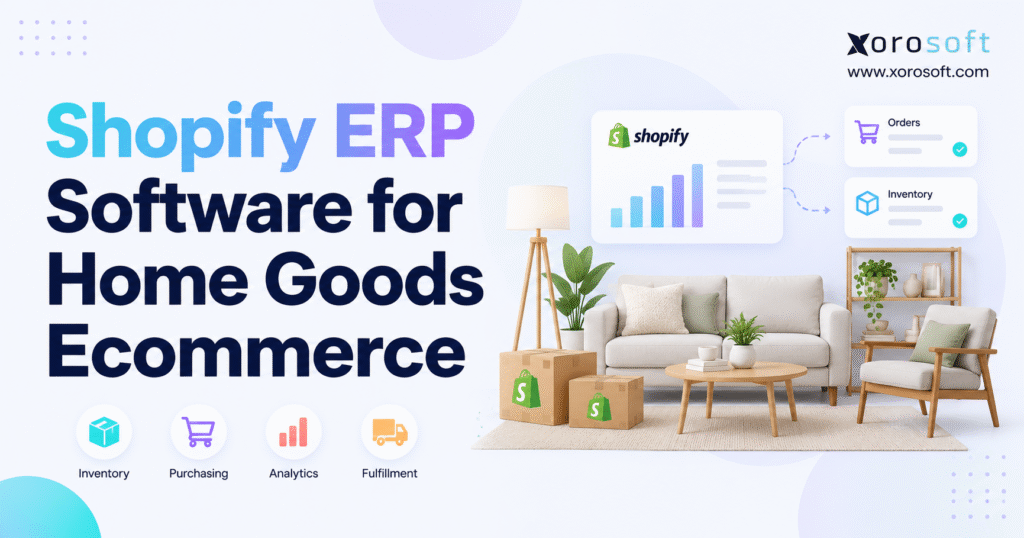
If you are exploring ways to streamline operations in your home goods business, consider learning about Shopify ERP for home goods.
1. Why Shopify Home Goods Operations Become Harder as Sales Grow
Home goods ecommerce has inventory challenges that often look simple to the shopper but become much harder behind the scenes.
A customer may see one sectional sofa. Operations may see dozens or even hundreds of possible combinations based on fabric, color, arm style, size, and orientation. Shopify’s 2026 furniture inventory guide notes that a single sectional can create more than 200 inventory configurations once those options are considered.
U.S. ecommerce sales also continue to grow. The Census Bureau estimated Q2 2026 retail ecommerce sales at $340.2 billion, up 12.2% from Q2 2025 and equal to 17.1% of total retail sales.
For home goods brands, stronger demand therefore creates a second challenge: the business must reliably buy, store, allocate, ship, and account for everything customers order.
1.1 Product Variants Multiply Inventory Work
Variants do more than make a catalog larger.
Each sellable option can have its own quantity, supplier, cost, warehouse location, reorder point, and sales history. A queen-size duvet in blue is not interchangeable with the same collection in king size or another color.
Furniture adds even more detail. Products can vary by material, finish, dimensions, orientation, or hardware. Some items are built to order, while others are purchased and stocked in advance.
As these options grow, teams need answers to several questions at once. Which exact version is available? Where is it stored? Has it already been promised? Is more stock coming? How long will the supplier take?
A storefront product page cannot answer all of those operating questions by itself.
1.2 Bulky Inventory Makes Buying Mistakes More Expensive
Twenty excess phone cases and twenty excess sofas create very different warehouse problems.
Large home goods consume space quickly. Slow-moving furniture can block better-selling products, increase handling work, and tie up a significant amount of cash. Overstock therefore affects both warehouse capacity and working capital.
Underbuying creates the opposite risk. When a high-demand product has a long supplier lead time, a stockout can last for weeks or even months.
Buyers must balance demand, cash, warehouse space, supplier timing, and existing customer commitments. That work becomes harder when every input lives in a different app or spreadsheet.
1.3 Long Supplier Lead Times Change Reorder Timing
A brand buying from overseas suppliers cannot always wait until the shelf looks empty before creating another purchase order.
Future stock needs may depend on current inventory, open orders, confirmed inbound shipments, seasonal demand, minimum order quantities, and supplier lead times.
Spreadsheet planning can work when the product range is small. Once the company manages many SKUs, channels, and warehouses, however, the spreadsheet becomes another system that must constantly be updated.
At that point, better planning depends less on having more reports and more on having current, trusted data.
2. What Shopify ERP for Home Goods Should Actually Manage
Shopify ERP for home goods should not replace the parts of Shopify that already work well. Shopify remains the customer-facing commerce platform. ERP manages the wider work that happens because the customer placed an order.
One useful way to view the relationship is simple:
Shopify creates demand. ERP helps the business respond to that demand.
2.1 Shopify ERP for Home Goods Should Create a Shared Business Record
Imagine that a customer purchases a dining set.
The order may reserve inventory, create warehouse work, reduce available stock, affect cost of goods sold, change future buying needs, and update the customer’s order status.
When each department maintains its own version of that transaction, employees spend time matching records instead of moving the order forward.
A connected system lets one order update several areas of the business.
For companies that need a wider operating system, XoroONE brings inventory, purchasing, accounting, warehouse management, manufacturing, ecommerce, EDI, B2B, reporting, and planning into one cloud ERP environment.
Consolidation is not the goal by itself. A better outcome is clear data ownership and fewer manual handoffs between teams.
2.2 Shopify and ERP Need Clear Data Ownership
Connecting two applications does not automatically create reliable information.
Before rollout, teams should decide which platform owns products, inventory quantities, purchasing data, customer orders, shipment updates, and financial records.
Stock ownership deserves particular attention.
Shopify already supports inventory across stores, warehouses, 3PLs, fulfillment services, and other locations. It also provides configurable order routing, inventory transfers, purchase orders, low-stock tools, and location-level stock tracking.
For that reason, ERP should not be justified with the outdated claim that Shopify cannot manage more than one location.
The stronger case appears when location-level stock also has to work with purchasing, accounting, wholesale commitments, demand planning, manufacturing, or deeper warehouse control.
Merchants reviewing the direct connection can include the Xorosoft ERP Shopify App Store listing in their integration due diligence.
2.3 Enter a Transaction Once and Reuse the Data
A clean workflow might look like this:
Shopify order → ERP sales order → stock allocation → warehouse fulfillment → shipment → accounting update → restocking review
Different businesses will configure the sequence differently.
The important principle is that employees should not have to rebuild the same order in several applications. Each team should work from the same core record while adding only the information required for its part of the process.
3. Shopify ERP for Home Goods Inventory Must Show What Can Really Be Sold
Inventory counts become misleading when different teams use the word “inventory” to mean different things.
Warehouse staff may mean physical units. Ecommerce teams care about sellable quantities. Purchasing needs to know what is coming from suppliers. Customer service wants to know what can actually ship today.
A useful Shopify ERP for home goods setup separates those views.
3.1 On-Hand Stock Is Not the Same as Available Stock
Suppose a warehouse physically contains 120 dining chairs.
Twenty-four chairs are already reserved for Shopify orders. Another 18 have been set aside for wholesale customers. Six more are damaged and cannot be shipped.
The warehouse still contains 120 units, but only 72 are available for new demand.
Showing the physical quantity without accounting for existing commitments can lead to overselling.
Incoming stock creates another distinction. A purchase order due next week may help customer service plan for a backorder, but those units should not normally be treated as ready to ship today.
Accurate inventory therefore requires more than one number.
3.2 Multi-Warehouse Inventory Needs Business Rules
Several warehouses create choices that basic stock counts cannot answer.
A customer in California might be served from two different facilities. The closest site could lower freight cost, while another location may have more available inventory. Meanwhile, a high-value wholesale account may need stock protected at one warehouse.
Shopify already supports location-level inventory and can route orders using configured rules. Products can be stocked independently at stores, warehouses, fulfillment services, and other locations.
ERP becomes more useful when those choices depend on wider rules such as wholesale allocations, incoming purchase orders, transfer plans, warehouse capacity, or company-wide stock priorities.
3.3 Home Goods Bundles Need Component-Level Control
Home goods brands often sell sets.
A dining package may contain one table and six chairs. Bedding bundles can include sheets, pillowcases, shams, and duvet covers. Outdoor sets may combine tables, seats, and cushions.
The bundle should remain available only when all required parts can be supplied.
If six chairs are needed but only five are available, the complete dining set cannot ship without a backorder. A strong inventory system checks the components rather than relying only on a parent bundle SKU.
This becomes especially important when those same parts are also sold individually.
4. Shopify ERP for Home Goods Purchasing Should Use Current Inventory Data
Purchasing is one of the first areas where disconnected software creates visible problems.
Buyers make future decisions from information that changes every day. Sales continue, orders are cancelled, stock arrives, wholesale customers place large orders, and promotions change expected demand.
If purchasing teams must combine Shopify data, warehouse reports, open purchase orders, and spreadsheets by hand, planning becomes harder to trust.
A connected Shopify ERP for home goods environment can bring those inputs together.
4.1 Buyers Need More Than Historical Sales
Sales history provides context, but it does not answer every purchasing question.
Buyers also need to understand available inventory, inbound stock, open orders, seasonality, supplier lead times, minimum order quantities, warehouse capacity, and target safety stock.
A simple planning model might be:
Expected demand + safety stock − available inventory − confirmed incoming stock = possible purchase need
Real buying rules may be more detailed. What matters is that the numbers come from current business records rather than manually maintained files.
4.2 Supplier Data Directly Affects Stock Levels
Lead time, cost, MOQ, case pack, currency, and preferred supplier can look like basic setup fields.
In practice, each one can change a buying decision.
If the system assumes a supplier takes 30 days when the actual lead time is 90, the reorder recommendation will arrive too late.
Incorrect pack sizes can create the opposite problem. Buyers may place quantities that do not match how the supplier actually ships the item.
Good purchasing automation therefore begins with clean supplier and product data.
4.3 Forecasting and Restocking Are Different Decisions
Forecasting estimates future customer demand.
Restocking determines what the business should buy, move, or make in response.
A product can have a strong sales forecast and still need no new purchase order because enough inventory is already inbound. Another item may have modest demand but require an early reorder because the supplier takes several months to deliver.
Connecting those decisions gives buyers more useful information than a sales forecast on its own.
5. Shopify ERP for Home Goods Warehouses Needs More Than Stock Counts
Knowing that a sofa exists somewhere inside a building does not mean the warehouse can locate, move, and ship it efficiently.
As order volume grows, warehouse work needs its own structure.
5.1 Inventory Management and WMS Solve Different Problems
Inventory management focuses on quantities, locations, costs, reservations, and stock movements.
A warehouse management system goes further into physical execution. Receiving, putaway, replenishment, barcode scanning, picking, packing, transfers, cycle counts, and shipping are common WMS tasks.
For home goods operations that need deeper warehouse control, XoroWMS supports warehouse workflows around receiving, stock movement, fulfillment, and inventory visibility.
The distinction matters because a system can show the correct quantity while employees still struggle to find the product.
5.2 Large Products Need Accurate Storage Locations
Furniture does not fit into a warehouse like small consumer products.
One SKU may occupy several pallet positions. Another may require floor storage. Fragile pieces need careful handling, while high-volume accessories may belong closer to packing stations.
A clear location structure helps employees find products without relying on memory.
Barcode and mobile scanning can strengthen that process because the movement is recorded when staff receive, move, count, or pick the inventory.
5.3 Damaged and Returned Inventory Needs Its Own Status
A returned coffee table may be inside the warehouse without being ready for the next customer.
Staff might need to inspect its packaging, check for damage, replace missing parts, or move it into a repair area.
Adding every return immediately back to available stock can create another bad promise online.
A mature process separates physical possession from sellable status until inspection is complete.
6. Shopify ERP for Home Goods Should Connect Inventory With Accounting
Inventory is not only a warehouse concern. It is also an asset on the balance sheet and a major part of product cost.
Purchase receipts, shipments, returns, freight costs, adjustments, and write-offs can all affect financial records.
When warehouse and accounting teams rely on different transaction histories, finance spends more time matching information.
6.1 Inventory Events Should Create Clear Financial Records
Consider a normal purchase-to-sale cycle.
The company buys a product. Warehouse staff receive it. Freight and import charges may become part of its landed cost. Later, the item ships to a Shopify customer.
Each stage has a financial effect.
Businesses moving beyond an accounting-first software stack can evaluate XoroERP when accounting needs to sit closer to inventory, purchasing, and order management.
A shared transaction history makes it easier for finance to understand why inventory values changed without waiting for teams to explain every adjustment.
6.2 Month-End Problems Often Begin Weeks Earlier
A slow close may appear to be an accounting problem even when the cause began somewhere else.
Perhaps a warehouse receipt was never completed. A return stayed unresolved. Product costs were wrong. Inventory adjustments were postponed. Another sales channel failed to update correctly.
Creating accurate records as work happens changes the finance team’s job.
Instead of rebuilding the month from several systems, accountants can spend more time reviewing the records that already exist.
6.3 Product Margin Needs More Than Selling Price Minus Cost
A home goods item can look profitable until all operating costs are included.
Freight, duty, warehouse handling, discounts, returns, marketplace charges, payment fees, and final-mile delivery can materially change the economics of an order.
ERP will not solve every margin issue automatically. Bringing sales, purchasing, stock, and accounting closer together does, however, give managers a better base for measuring product and channel performance.
7. Shopify ERP for Home Goods Must Support DTC, Wholesale, Amazon, and EDI
A Shopify-first brand can become an omnichannel company faster than expected.
Amazon starts producing meaningful volume. A retailer requests wholesale pricing. A national account requires EDI. Another region needs a 3PL.
Every new route to market creates demand against the same physical stock.
7.1 Shared Stock Needs One Clear Allocation Model
Suppose Shopify, Amazon, and wholesale customers all sell from the same pool of 500 units.
If each channel maintains an independent inventory number, the company can promise more stock than it owns.
Central stock control allows teams to decide what can be sold through each channel while protecting important commitments.
Brands building a wider technology stack can review Xorosoft’s integrations across ecommerce, marketplaces, shipping, 3PL, EDI, payments, and related systems.
The key question is not simply whether a connector exists. Buyers should also understand how quickly data moves, how errors are handled, and which platform remains the main source for orders and inventory.
7.2 Wholesale Orders Behave Differently From DTC Orders
A Shopify order may be paid at checkout and released for shipping almost immediately.
Wholesale can involve price lists, payment terms, credit rules, case packs, large stock allocations, retailer routing requirements, and scheduled shipments.
EDI creates further steps. Purchase orders, acknowledgments, advance shipping notices, invoices, and other documents may need to follow a retailer’s required format.
Wholesale is therefore more than another storefront, even though wholesale and DTC customers still compete for the same stock.
7.3 Home Goods ERP Requirements Vary by Product Category
Furniture brands often care deeply about long lead times, large-item storage, custom options, and final-mile delivery.
Bedding businesses may have stronger variant and replenishment needs. Kitchen and housewares companies often manage bundles, Amazon, retail, and wholesale at the same time.
System selection should reflect those differences.
Xorosoft’s industry coverage includes furniture, home and kitchen, wholesale, manufacturing, and other inventory-driven sectors that can provide useful context during requirements planning.
8. How to Compare Shopify ERP for Home Goods Without Getting Lost in Features
ERP vendors often present long feature lists. Those lists can make very different products appear almost identical.
A better selection process starts with real business scenarios.
8.1 Test the Full Shopify Order Flow
Instead of asking whether a platform “supports inventory,” test a real order from start to finish.
Start with a Shopify order for a product stocked in two warehouses. Next, check how the system treats inventory already reserved for wholesale. Then review how it selects the shipping location, updates Shopify after fulfillment, and records the financial effect.
Returns deserve the same attention.
Test what happens when one product from a multi-item order comes back or when part of an order cannot ship. These operating scenarios reveal far more than a feature checkbox.
8.2 Compare ERP With Simpler Options First
ERP is not the only possible answer.
A simple Shopify store may work well with Shopify and accounting software. When stock visibility is the main problem, focused inventory management software can be enough. Warehouse-heavy businesses may gain more from a strong WMS before they need broader ERP.
Full ERP becomes more useful when inventory, purchasing, finance, warehouse work, planning, wholesale, manufacturing, and channel data all depend on the same records.
The choice is therefore an architecture decision rather than a contest over which platform has the longest feature list.
8.3 Compare NetSuite and Other ERP Options on Fit
NetSuite, Acumatica, Business Central, Cin7, Brightpearl, Fishbowl, Xorosoft, and other systems serve different operating profiles.
One company may value broad enterprise finance. Another may care more about warehouse depth, Shopify workflows, implementation scope, or ease of daily use.
Businesses researching both platforms can review the Xorosoft vs NetSuite comparison as one input while still testing each system against their own requirements.
Pricing, support, reporting, implementation approach, and usability should be reviewed alongside functionality.
8.4 Customer Evidence Should Match the Operating Model
Case studies are more useful when the featured company has similar problems.
A success story from a simple service business tells a multiwarehouse furniture company very little. Better examples involve physical inventory, ecommerce, purchasing, warehouse operations, wholesale, or manufacturing.
The Xorosoft case studies provide another source for reviewing how inventory-driven businesses approach ERP and operational change.
Use those examples to generate questions rather than assuming that another company’s outcome will automatically apply to yours.
9. Shopify ERP for Home Goods Implementation Starts With Clean Processes
ERP rollout does not begin with a software screen.
It begins with the business rules and data the system will depend on. Poor item records, duplicate SKUs, unclear stock ownership, and inconsistent warehouse locations can make a technically correct setup difficult to operate.
9.1 Clean Product, Supplier, and Warehouse Data First
Review legacy data before migration.
Duplicate SKUs should be removed or merged. Units of measure need to be clear. Product variants should follow a consistent structure. Supplier lead times, costs, case packs, and warehouse locations should reflect current reality.
Migrating poor data into a new ERP simply moves the old problems into a more powerful system.
Good master data also improves later planning, automation, and reporting because each process starts from the same base information.
9.2 Decide Which System Owns Inventory
This decision should be made before automation goes live.
If ERP becomes the main inventory record, Shopify and other sales channels should receive sellable quantities from that source according to clear rules.
Allowing several systems to change stock independently without reliable sync logic increases the chance of mismatches.
Clear ownership also makes support easier. When a quantity looks wrong, employees know which system should be checked first.
9.3 Test Exceptions, Not Just Perfect Orders
Standard orders are usually the easiest transactions to test. Problems appear when the workflow changes.
Try a partial shipment first. After that, cancel an order that already has inventory reserved. Receive only part of a purchase order, process a damaged return, split an order between locations, and edit a Shopify order after it enters ERP.
Integration failures also need testing. Teams should know what happens when information does not sync and how the system recovers when the connection returns.
These cases show whether the setup is ready for everyday operations rather than only ideal transactions.
10. AI Is Changing What Teams Expect From Shopify ERP Data
ERP has traditionally centered on transactions, reports, and dashboards.
AI is adding another expectation. Employees increasingly want to ask normal business questions and get useful answers from current system data without exporting several spreadsheets first.
10.1 AI Access Still Depends on Reliable ERP Data
An AI assistant cannot correct poor source information.
If product costs, stock balances, supplier lead times, or customer records are wrong, faster access simply exposes bad information more quickly.
That makes data quality even more important.
Once the source records are reliable, AI can become useful for questions such as which products may stock out soon, which purchase orders are late, where inventory is building up, or which customer orders are waiting for supply.
10.2 Permission-Aware ERP Access Matters
ERP contains information that should not be available equally to every employee or every AI tool.
Sales, margins, supplier costs, customer data, and financial records can require different levels of access.
For companies exploring controlled AI access, Xorosoft’s MCP Server is designed to connect supported AI tools with permission-aware ERP information.
AI should extend a reliable business system. It should not become another separate version of the company’s data.
11. Shopify ERP for Home Goods FAQs
11.1 What Is Shopify ERP for Home Goods?
Shopify ERP for home goods connects Shopify with wider business processes such as inventory, purchasing, warehouse management, accounting, forecasting, wholesale, and fulfillment. Shopify remains the customer-facing commerce layer, while ERP helps manage the work required to buy, store, allocate, ship, and account for physical products.
11.2 Does Shopify Include a Built-In ERP?
No. Shopify is primarily a commerce platform, although its inventory and order tools now cover many useful operational tasks. Shopify supports multiple stock locations, order routing, inventory transfers, purchase orders, demand forecasting tools, and other inventory functions. ERP becomes relevant when a business needs broader finance, planning, WMS, manufacturing, or cross-channel control.
11.3 Does Every Shopify Home Goods Store Need ERP?
No. A smaller merchant with simple inventory, one warehouse, straightforward purchasing, and clean accounting may not gain enough value from ERP to justify the extra setup. The need usually depends more on business complexity than on revenue, employee count, or order volume alone.
11.4 When Should a Home Goods Shopify Brand Consider ERP?
Common signs include regular inventory mismatches, spreadsheet purchasing, several warehouses, difficult month-end matching, wholesale complexity, EDI needs, Amazon growth, or staff repeatedly entering the same data into different applications. Several of these problems appearing together often signal that the technology stack has become too fragmented.
11.5 How Does Shopify Handle Multiple Inventory Locations?
Shopify supports products across stores, warehouses, fulfillment services, 3PL-style locations, and other stock points. Quantities are tracked independently by location, and orders can be assigned according to routing and fulfillment rules. ERP becomes more valuable when those locations must also connect with finance, purchasing, planning, or advanced warehouse work.
11.6 How Does Shopify ERP Help Reduce Overselling?
A well-designed setup can reduce overselling by using a clear main stock record and sending accurate sellable quantities to Shopify and other channels. Allocation rules should consider inventory already reserved for other orders rather than publishing only the number of units physically present in the warehouse.
11.7 How Does ERP Handle Furniture Variants?
ERP can manage operational records for choices such as size, fabric, color, finish, dimensions, or orientation when the platform supports the required item structure. Each sellable option can then carry its own inventory quantity, cost, purchasing information, warehouse position, and sales history.
11.8 What Happens to Bundles and Furniture Sets in ERP?
Many ERP and inventory systems support kits or bundles. A useful setup calculates availability from the required components so a seven-piece dining set is not promised when one chair or another key part is unavailable. Component control becomes even more important when the same items are sold separately.
11.9 How Can ERP Improve Shopify Purchasing?
ERP can bring current inventory, incoming purchase orders, expected demand, supplier lead times, and restocking rules into the same buying process. Depending on the system, it may recommend purchase quantities or automate parts of replenishment while still allowing buyers to review orders before sending them.
11.10 How Does Shopify ERP Support Demand Forecasting?
Many ERP platforms include forecasting directly or connect with planning tools. Forecast quality still depends on good item data, reliable sales history, suitable seasonality rules, and correct supplier lead times. A forecast is most useful when purchasing teams can compare predicted demand with stock already available or inbound.
11.11 What Is the Difference Between ERP and Inventory Software?
Inventory software mainly focuses on products, stock, orders, and purchasing. ERP normally covers a broader business model that can include accounting, warehousing, planning, manufacturing, procurement, and company-wide reporting. The right option depends on whether inventory is an isolated issue or part of several linked operating problems.
11.12 When Does a Home Goods Business Need a WMS?
A simple warehouse may not require advanced WMS tools. Larger or busier facilities should review receiving, bin locations, putaway, mobile scanning, replenishment, picking, packing, cycle counting, transfers, and shipping. Dedicated warehouse control becomes more useful as staff numbers, locations, and fulfillment complexity grow.
11.13 How Do ERP Systems Connect Shopify and Amazon?
When supported, both Shopify and Amazon can send orders into a shared business system while receiving updated stock information. The main benefit is coordinated inventory control, which helps prevent each channel from independently promising the same physical units.
11.14 What Wholesale Features Should Shopify ERP Support?
Useful wholesale capabilities can include customer price lists, payment terms, credit rules, large order quantities, allocation controls, case packs, and different fulfillment rules. Home goods businesses should also consider whether wholesale and DTC demand will compete for the same stock.
11.15 How Does ERP Support EDI Retailer Orders?
ERP can support EDI directly or work with a connected provider. Retail relationships may require structured purchase orders, acknowledgments, advance shipping notices, invoices, and other documents. The best test is to review the actual retailer workflow rather than simply checking whether an EDI feature exists.
11.16 When Is QuickBooks Enough for a Shopify Home Goods Company?
QuickBooks may remain suitable when financial management is the main need and inventory remains simple. Problems often appear when finance has to match large amounts of information from separate inventory tools, warehouses, purchasing spreadsheets, manufacturing systems, or multiple sales channels.
11.17 Which System Should Own Inventory: Shopify or ERP?
There is no single answer for every business, but ownership should be clear. In many full ERP setups, the ERP becomes the main inventory record while Shopify receives updated sellable quantities. Running several independent stock masters without clear sync rules increases the risk of mismatches.
11.18 How Does ERP Help With Long Supplier Lead Times?
ERP can combine current stock, reserved quantities, inbound purchase orders, expected demand, and supplier lead times in one view. Buyers can therefore identify future shortages earlier instead of waiting until stock reaches an obviously low level.
11.19 How Should Damaged Inventory Be Managed in ERP?
Damaged or returned stock should be separated from normal sellable inventory through locations, statuses, or holds. A product can physically be inside a warehouse without being ready for another customer. Keeping those quantities separate prevents them from being promised online before inspection or repair.
11.20 How Does ERP Improve Inventory Accounting?
A connected ERP can link purchase receipts, shipments, returns, adjustments, and cost changes with financial records. This reduces the amount of manual matching between warehouse and accounting systems and can make inventory valuation easier to review at month-end.
11.21 Is Shopify ERP for Home Goods Only for Large Companies?
No. Business complexity matters more than a single revenue threshold. A smaller company operating several warehouses, wholesale programs, manufacturing, or multiple channels can need stronger systems earlier than a larger company with simple inventory and fulfillment.
11.22 What Should Teams Test Before ERP Go-Live?
Testing should cover normal orders plus cancellations, partial shipments, backorders, partial purchase receipts, transfers, damaged stock, returns, order edits, and integration failures. Exception testing is valuable because real operations rarely follow the perfect order flow every time.
11.23 Should ERP Replace Every Shopify App?
No. A focused application may remain the best solution for a specialist task. ERP should reduce harmful data gaps and duplicate work rather than remove useful tools merely to reduce the app count. Clear data ownership is more important than eliminating every integration.
11.24 What Is the Best Way to Compare Home Goods ERP Vendors?
Use real business workflows rather than generic feature lists. Test Shopify orders, multiwarehouse inventory, purchasing, warehouse fulfillment, accounting, returns, wholesale, and integrations. After process fit is clear, compare rollout effort, support, reporting, usability, and total cost.
11.25 Which Shopify ERP Requirement Matters Most?
Reliable data is the foundation. Forecasting, automation, reporting, warehouse tools, and AI provide limited value when stock, supplier, item, and order records cannot be trusted. Clear ownership of accurate business data should therefore come before advanced features.
12. Strategic Takeaway: When Shopify ERP for Home Goods Becomes the Right Next Step
The best time to evaluate Shopify ERP for home goods is not when Shopify stops working.
Shopify may continue performing its job as the commerce platform perfectly well. Warning signs usually appear elsewhere in the company.
Inventory becomes harder to trust. Buyers rebuild spreadsheets. Warehouse teams depend on workarounds. Finance waits for missing information. Wholesale and Amazon compete with Shopify for the same stock. Management needs several exports before it can understand what is happening.
At that stage, another single-purpose application might fix one local issue while making the overall system harder to control.
12.1 Choose the Simplest System That Still Supports the Business
A smaller home goods store may continue to work well with Shopify, accounting software, and a focused inventory tool.
Warehouse-heavy businesses might first need stronger WMS controls. Another company could require better forecasting without being ready for full ERP.
However, once inventory, purchasing, warehouses, accounting, planning, wholesale, EDI, manufacturing, and ecommerce become parts of the same operating problem, Shopify ERP for home goods deserves a serious review.
The goal is not to replace Shopify. It is to create a reliable operating layer behind it.
Teams evaluating that approach can review Xorosoft’s broader ERP solutions to understand how inventory, purchasing, WMS, accounting, manufacturing, forecasting, ecommerce, and related processes can connect.
12.2 Map the Workflow Before Booking an ERP Demo
Software selection should begin with the business rather than the vendor.
Map the current Shopify order flow from checkout through allocation, picking, shipping, returns, and accounting. Identify places where employees enter the same information twice. Find the stock numbers that teams do not trust. Review reports that take too long to build and purchasing decisions that depend on manual exports.
Once those gaps are clear, test ERP vendors against the actual workflow.
A useful demo should answer practical questions: What stock can we really sell? Where is it located? What has already been promised? Which purchase orders are coming? What should buyers order next? Which warehouse should ship? How does the transaction affect inventory value and the books?
For a home goods business ready to review those questions, contact Xorosoft and use your current Shopify, inventory, purchasing, warehouse, accounting, and fulfillment process as the basis for the discussion.
Frequently Asked Questions About Shopify ERP for Home Goods
What is Shopify ERP for home goods?
Shopify ERP for home goods connects ecommerce orders with inventory, purchasing, warehouses, accounting, forecasting, and other business processes behind the Shopify storefront.
When should a Shopify home goods brand use ERP?
ERP becomes useful when inventory mismatches, multiple warehouses, spreadsheet purchasing, wholesale growth, accounting delays, or disconnected apps make daily operations harder to control.
Can Shopify ERP manage multiple warehouses?
Yes. ERP can provide a shared inventory view across warehouses, stores, showrooms, and 3PLs while supporting stock allocation, transfers, and fulfillment rules.
How does Shopify ERP help prevent overselling?
ERP can calculate sellable inventory after reservations and allocations, then sync that quantity with Shopify and other channels to reduce conflicting stock promises.
Can Shopify ERP automate purchasing and forecasting?
Yes. Many ERP systems use sales demand, available stock, incoming supply, supplier lead times, and reorder rules to support forecasting and purchase planning.
Does Shopify ERP support wholesale, Amazon, and EDI?
Depending on the platform, ERP can connect Shopify with Amazon, wholesale orders, EDI, and other channels while managing shared inventory from one business system.
How should home goods brands compare Shopify ERP software?
Compare vendors using real workflows such as Shopify orders, multi-warehouse stock, purchasing, returns, accounting, wholesale, and fulfillment instead of relying only on feature lists.
Recent Posts
-
 ERP Landed Cost Module vs Spreadsheet Calculations for Importers
 -
 How to Build an Open-to-Buy Plan for an Omnichannel Brand
 -
 Cold Storage WMS for Food and Beverage Distribution
 -
 ERP Buying Statistics 2026: Evaluation, Implementation, and Adoption Risks
 -
 How a Distributor Reduced B2B Order Exceptions Without Restricting Sales