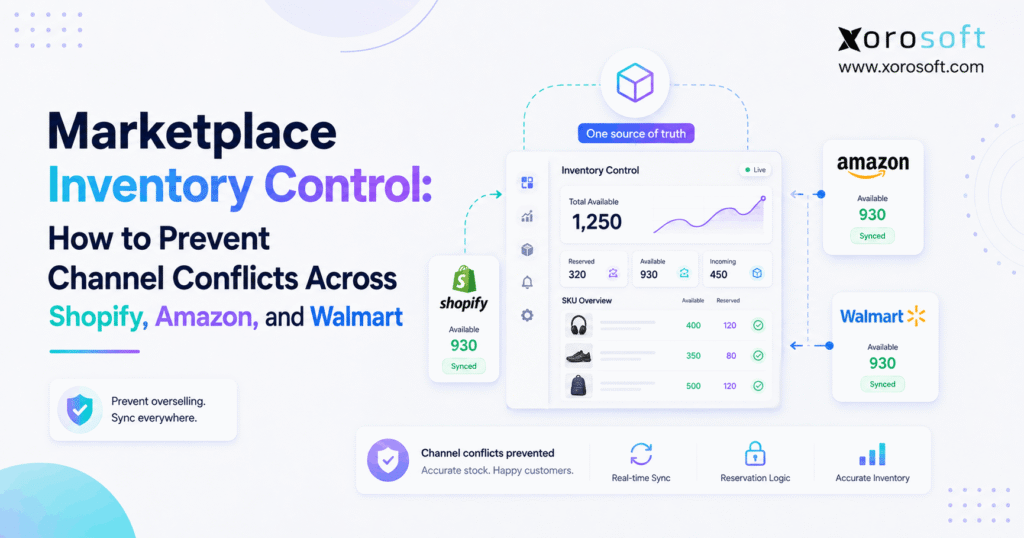
If you are looking to optimise your marketplace inventory control, this guide will help you get started.
1. One Inventory Truth Across Every Marketplace
Marketplace inventory control becomes much harder when the same products sell through Shopify, Amazon, and Walmart at the same time. Although each channel may display a simple inventory number, the operational reality behind that number is far more complicated. For example, some units may already support confirmed orders, while others may sit in safety stock, Amazon fulfillment inventory, another warehouse, or a quality-control hold.
Therefore, the quantity physically sitting in a warehouse should not automatically become the quantity every marketplace can sell. Instead, businesses need to determine how much inventory remains genuinely safe to promise after existing commitments, location restrictions, buffers, and reservations.
Moreover, as ecommerce volume grows, several channels can compete for the same units within seconds. Shopify may accept an order while Amazon still shows the old quantity. Meanwhile, Walmart may receive another customer order before the first transaction reduces available inventory.
Consequently, good marketplace inventory control needs to answer one critical operational question:
How many units can each channel safely promise right now without creating a commitment the business cannot fulfill?
That question goes beyond basic inventory synchronization. Instead, businesses must understand inventory ownership, available-to-sell quantities, reservations, allocations, warehouse availability, returns, bundles, safety stock, and fulfillment responsibilities.
1.1 Why channel conflicts increase as ecommerce brands scale
At low order volumes, teams can sometimes manage channel inventory manually. For example, an employee may update Shopify after Amazon receives an order or adjust Walmart stock after completing a warehouse count.
However, manual processes become unreliable once dozens or hundreds of inventory events happen throughout the day. In addition, every new selling channel creates another place where quantity can change.
As a result, the business may have one number in Shopify, another in Amazon, another in Walmart, and yet another inside its warehouse system.
Meanwhile, returns, canceled orders, purchase receipts, transfers, damaged stock, bundles, and manual adjustments continue changing real availability. Therefore, inventory differences rarely come from one dramatic mistake. Instead, several small timing and process issues gradually produce conflicting numbers.
1.2 Inventory synchronization and inventory control are not the same
Inventory synchronization moves inventory data between systems. In contrast, inventory control determines which quantity those systems should exchange.
For example, suppose a warehouse contains 100 units. However, 12 units support existing customer orders, eight remain protected as safety stock, five sit under quality inspection, and 15 belong to wholesale commitments.
Although the company physically owns 100 units, only 60 may remain safe for new marketplace demand.
Therefore, publishing 100 units to every channel would perfectly synchronize an incorrect number.
For that reason, effective marketplace inventory control calculates sellable inventory first. Then, integrations publish that approved availability to Shopify, Amazon, Walmart, or another sales channel.
2. Build Marketplace Inventory Control Around One Source of Truth
Reliable marketplace inventory control begins with one clearly defined inventory owner. Otherwise, Shopify can update one quantity while a warehouse application, marketplace connector, spreadsheet, or employee updates another.
Consequently, growing businesses need one operational system that determines inventory availability. Other systems can still consume and display inventory. However, they should not independently decide which quantity represents the truth.
2.1 Separate on-hand inventory from sellable inventory
Teams often use the word “inventory” to describe several different numbers. Therefore, operators should distinguish each inventory state carefully.
On-hand inventory represents the quantity physically recorded at a location.
Meanwhile, reserved inventory protects units for specific committed demand.
Allocated inventory, however, assigns units according to a customer, channel, warehouse, sales order, or operating rule.
Additionally, available inventory represents stock that remains free after relevant commitments.
Finally, available-to-sell inventory, often shortened to ATS, represents the quantity the business considers safe to offer to new customers.
Therefore, a practical conceptual formula looks like this:
Available to Sell = Eligible On-Hand − Reservations − Protected Inventory − Other Commitments
For example:
| Inventory state | Quantity |
|---|---|
| On-hand inventory | 100 |
| Customer reservations | -12 |
| Safety stock | -8 |
| Quality-control hold | -5 |
| Protected wholesale allocation | -10 |
| Available to sell | 65 |
Although every business may calculate ATS differently, the principle remains consistent. Specifically, marketplaces should receive inventory that operations can genuinely fulfill rather than raw warehouse quantity.
2.2 Decide which system owns the inventory decision
A smaller Shopify merchant may reasonably use Shopify as its primary inventory record. However, complexity rises when the company introduces Amazon, Walmart, wholesale orders, multiple warehouses, purchasing teams, EDI, manufacturing, or additional fulfillment partners.
At that stage, another system may need to own the operational inventory decision.
For example, a centralized ERP can receive inventory events from warehouses and sales channels, calculate remaining availability, and then distribute approved quantities downstream.
Because the business performs that calculation centrally, every channel receives information based on the same operational rules.
Once an operation reaches that level of complexity, Xorosoft can connect inventory with purchasing, financial operations, fulfillment, and ecommerce through XoroERP. However, teams should still define inventory ownership and process rules before implementation because software cannot compensate for an uncontrolled operating model.
2.3 Keep one controlled SKU master
Even excellent synchronization cannot compensate for poor SKU mapping.
For example, the business may identify the same blue medium shirt as:
| System | Identifier |
|---|---|
| Internal inventory | SHIRT-BLU-M |
| Amazon | BLU-M-01 |
| Walmart | SHM1002 |
| Warehouse | 81492 |
Those identifiers can coexist. However, the central inventory system must understand that all four records represent the same physical product.
Otherwise, an Amazon order may reduce one SKU while Shopify continues selling another representation of the same inventory.
Consequently, businesses should create one controlled SKU master and map every marketplace identifier back to it.
3. Why Shopify, Amazon, and Walmart Inventory Drift Apart
Although Shopify, Amazon, and Walmart all sell products, each platform plays a different role within the fulfillment process. Therefore, businesses should not treat them as three copies of the same inventory counter.
3.1 Shopify inventory depends on locations and fulfillment rules
Shopify businesses may hold inventory across multiple warehouses, retail locations, stores, and fulfillment partners. Consequently, a company can have inventory somewhere in its network while still lacking suitable stock for a particular order.
For example, one SKU may have 25 units at Warehouse A and another 20 at Warehouse B. However, Warehouse A might serve wholesale customers while Warehouse B fulfills ecommerce orders.
Therefore, the network total of 45 units does not automatically mean Shopify should promise all 45.
Moreover, location logic becomes increasingly important as the business introduces 3PL partners, retail stores, regional warehouses, or inventory dedicated to other channels.
3.2 Amazon creates additional inventory pools
Amazon adds another layer because brands may use merchant fulfillment, Amazon fulfillment, or both.
For example, inventory sent into Amazon’s fulfillment network does not necessarily behave like inventory stored in the brand’s own warehouse. Meanwhile, some units may temporarily become unavailable because of fulfillment activity, inbound movement, operational processing, or other restrictions.
Therefore, ecommerce operators should avoid combining every Amazon-related quantity into one generic inventory number.
Instead, teams should determine which stock pool supports which type of demand.
3.3 Walmart availability can depend on fulfillment location
Likewise, Walmart marketplace operations may involve inventory across different fulfillment locations. Consequently, the network may contain enough total stock while a specific location lacks enough eligible inventory to support new demand.
Therefore, marketplace inventory control should consider fulfillment eligibility rather than simply adding every location together.
3.4 Multiple inventory connectors can create conflicting updates
Channel conflicts often begin when several applications can change the same marketplace quantity.
For example, Shopify may send inventory to a marketplace while another connector sends a different quantity. Meanwhile, a warehouse application may publish a third value.
As a result, applications can repeatedly overwrite each other.
Therefore, businesses should establish one controlled integration path for authoritative inventory updates. Other systems may consume or report inventory, but teams should carefully limit which applications can publish sellable availability.
Businesses that need to connect ecommerce, EDI, logistics, marketplaces, and operational applications can review Xorosoft’s integration capabilities when planning that architecture.
4. Use Marketplace Inventory Control to Prevent Overselling
Overselling often appears to be a synchronization problem. However, weak reservation logic frequently creates the underlying failure.
Therefore, businesses should protect inventory as soon as they accept meaningful demand.
4.1 Reserve inventory before another marketplace can consume it
Imagine that only one unit remains available.
First, a Shopify customer places an order. Next, the central inventory system should reserve that final unit. Consequently, available-to-sell inventory drops from one to zero. Afterward, Amazon and Walmart should receive the revised quantity.
If Amazon accepts another order before the reservation reduces ATS, the company can oversell.
Therefore, the preferred sequence looks like this:
Order → Reservation → ATS Recalculation → Channel Update → Fulfillment
In contrast, an unreliable workflow looks like:
Order → Marketplace Update Later → Reservation Eventually
Because the second model delays the commitment, multiple channels can promise the final unit.
4.2 Why synchronization speed alone cannot eliminate overselling
Faster integrations reduce the time during which channels disagree. However, speed alone cannot fix incorrect transaction sequencing.
For example, an integration may update Amazon within seconds. Nevertheless, if the business has not reserved the Shopify order before calculating Amazon availability, the system can still publish the wrong quantity quickly.
Therefore, marketplace inventory control should prioritize transaction logic first and synchronization speed second.
Moreover, businesses should monitor actual inventory latency rather than assuming that every API request completes immediately.
4.3 Use channel buffers when risk justifies them
An inventory buffer intentionally publishes fewer units than the company technically has available.
For example, imagine ATS equals 20 units. However, the business maintains a five-unit marketplace buffer. Consequently, the channel receives an available quantity of 15.
Buffers may help when a SKU sells quickly, synchronization experiences occasional delays, inventory accuracy remains imperfect, or several marketplaces compete aggressively for low stock.
Nevertheless, businesses should not use oversized buffers to hide inaccurate inventory.
Instead, teams should treat buffers as risk protection while improving warehouse scanning, receiving, cycle counting, reservations, and integration quality.
4.4 Release inventory correctly after cancellations
Reservations should not remain open forever.
Therefore, businesses need clear rules for canceled orders, failed payments, rejected marketplace orders, authorization expiry, partially fulfilled orders, and manual cancellations.
When a legitimate commitment disappears, the system should release the inventory according to business rules. As a result, ATS increases and channels can sell the returned quantity again.
However, teams should treat physical product returns differently. Before returning a physical unit to available inventory, operations may need to inspect condition, packaging, expiry, or damage.
5. Shared Inventory Pools vs Channel Allocation
Strong marketplace inventory control requires businesses to decide whether all channels compete for the same inventory or receive protected quantities.
There is no universal model. Instead, companies should select an approach based on demand, replenishment speed, channel importance, fulfillment capabilities, and overselling risk.
5.1 One shared inventory pool
With a shared pool, Shopify, Amazon, Walmart, and other channels compete for the same available-to-sell quantity.
Therefore, the business can maximize inventory utilization.
For example, if Walmart demand slows while Shopify demand increases, Shopify can consume more of the shared quantity rather than waiting for a manual reallocation.
However, a shared model needs strong reservations and dependable synchronization. Otherwise, two channels may compete for the same final units.
5.2 Fixed channel allocation
With fixed allocation, the business protects specific quantities by channel.
For example:
| Channel | Allocated quantity |
|---|---|
| Shopify | 40 |
| Amazon | 30 |
| Walmart | 20 |
| Protected safety stock | 10 |
Although this strategy reduces direct competition between channels, it can also create artificial stockouts.
For example, Amazon may sell all 30 allocated units while Shopify still holds 20 units that customers have not purchased.
Therefore, fixed allocation provides protection at the cost of some inventory flexibility.
5.3 Dynamic channel allocation
Dynamic allocation changes inventory exposure according to operational rules.
For example, businesses may consider recent demand, profitability, promotion schedules, marketplace performance, service commitments, replenishment timing, or strategic customers.
Consequently, dynamic allocation can balance utilization and control.
However, the model requires more sophisticated marketplace inventory control because availability changes continuously.
5.4 Allocation and reservation solve different problems
Allocation determines who should have access to inventory.
Reservation determines which inventory has already been committed.
Therefore, a business can allocate 50 units to Amazon without reserving all 50. Instead, the allocation controls Amazon’s access to inventory while reservations increase as actual Amazon orders arrive.
Keeping those concepts separate prevents teams from confusing strategic channel planning with confirmed customer demand.
6. Multi-Warehouse Marketplace Inventory Control Requires Location Awareness
Multi-warehouse operations change the meaning of inventory availability. Although a company may own hundreds of units nationally, each warehouse may support different regions, channels, customers, or service levels.
Therefore, marketplace inventory control should calculate eligible availability instead of blindly adding every location together.
6.1 Network inventory is not always sellable inventory
Imagine the following network:
| Location | Physical quantity |
|---|---|
| East Coast warehouse | 150 |
| West Coast warehouse | 180 |
| Amazon fulfillment inventory | 60 |
| Third-party logistics provider | 70 |
| Retail stores | 40 |
| Total physical inventory | 500 |
The company physically controls 500 units. However, not every unit may support every order.
For example, the 3PL may fulfill only Shopify orders. Meanwhile, Amazon inventory may support Amazon demand, while retail stores protect stock for local customers.
Consequently, the company should calculate availability by eligible fulfillment pool rather than exposing all 500 units everywhere.
6.2 Control warehouse transfers carefully
Transfers create another common source of inventory errors.
When 50 units leave Warehouse A for Warehouse B, operations should reduce Warehouse A’s available quantity according to transfer rules.
However, Warehouse B should not count those same units as physically received until staff complete the receiving process.
Otherwise, both locations may appear to own the same stock while it travels between facilities.
Therefore, inventory systems need clear states for inventory that is available, allocated, in transit, received, quarantined, or damaged.
6.3 Connect warehouse execution with marketplace availability
Warehouse transactions directly affect marketplace promises.
For example, receiving increases physical inventory. Meanwhile, picking consumes free inventory, cycle counts correct discrepancies, and damaged-stock movements reduce eligible quantity.
Consequently, warehouse events should reach the authoritative inventory record quickly.
Xorosoft connects warehouse workflows through XoroWMS, allowing inventory-driven businesses to coordinate warehouse execution with broader ERP processes instead of managing warehouse movements separately from marketplace availability.
6.4 Define ownership when using a 3PL
Third-party logistics adds another operational layer.
For example, businesses should determine when the 3PL reports receipts, when picked inventory leaves ATS, who controls adjustments, when returns become sellable, and how the system handles damaged or missing units.
Therefore, teams should define these processes before connecting additional sales channels.
Otherwise, integrations may simply distribute inconsistent information faster.
7. Products That Commonly Break Marketplace Inventory Control
Simple standalone SKUs are relatively easy to synchronize. However, bundles, multipacks, variants, preorders, and manufacturing relationships create more complicated inventory dependencies.
Therefore, product structure should form part of the marketplace inventory control design.
7.1 Bundles and kits
Suppose a gift kit requires:
- one bottle
- two refills
- one pouch
If the company holds 50 bottles, 100 refills, and 20 pouches, it can sell only 20 complete kits.
Moreover, when a customer purchases one pouch separately, possible kit availability should fall from 20 to 19.
Therefore, bundle availability depends on underlying components rather than a standalone stock counter.
7.2 Multipacks
Likewise, a three-pack should consume three base units.
If the business owns 90 individual units, it can theoretically create 30 three-packs. However, every single-unit sale should also reduce the possible quantity of three-packs.
Consequently, businesses need a common inventory relationship between individual listings and multipacks.
7.3 Variants and parent-child products
Apparel companies commonly manage sizes, colors, styles, and marketplace parent-child relationships.
Although customers may see one parent product, each sellable child variant needs its own inventory record.
Therefore, mapping a parent listing directly to inventory can cause serious errors.
Instead, each sellable variation should map to the correct internal SKU.
7.4 Preorders and backorders
Businesses sometimes sell products before physical stock becomes available.
However, teams should separate current inventory from expected supply.
For example, incoming inventory may support future orders without increasing inventory that can ship today.
Therefore, the system should distinguish available now, incoming, backordered, and preorder quantities according to fulfillment policy.
8. Make Marketplace Inventory Control Resilient When Sync Fails
Even strong integrations occasionally encounter exceptions. Therefore, marketplace inventory control should assume that an inventory update may fail, arrive late, or contain incorrect data.
The goal should not be to pretend that failures never occur. Instead, operators should detect and resolve them quickly.
8.1 Monitor failed inventory messages
Integrations should create visible exceptions whenever they cannot complete an update.
For example, teams should investigate missing SKU mappings, rejected marketplace updates, invalid identifiers, stale timestamps, disconnected integrations, unexpected negative inventory, and large differences between channel and system quantities.
Consequently, operations teams can correct errors before customers discover them.
8.2 Reconcile channel inventory regularly
Real-time synchronization does not eliminate the need for reconciliation.
Therefore, businesses should periodically compare central ATS with marketplace availability.
If those numbers differ unexpectedly, teams should determine whether the problem comes from synchronization, reservations, SKU mapping, physical inventory, allocations, or manual adjustments.
As a result, reconciliation becomes a structured control rather than an emergency spreadsheet exercise.
8.3 Track inventory performance metrics
Operators should monitor more than total inventory.
Useful measures include inventory accuracy, oversell rate, inventory update latency, synchronization failure rate, stale reservation rate, and inventory-related cancellation rate.
Moreover, teams should examine these metrics together.
For example, a company may have extremely fast synchronization while still overselling because warehouse counts are inaccurate.
Likewise, perfect physical inventory will not prevent overselling if reservation logic reacts too slowly.
Therefore, marketplace inventory control depends on both operational discipline and system reliability.
9. Know When Your Inventory Apps Have Reached Their Limit
Not every Shopify, Amazon, or Walmart seller needs an ERP.
Indeed, smaller merchants can often operate successfully with Shopify and a carefully configured marketplace or inventory application.
However, the decision changes as operational dependencies grow.
9.1 When a marketplace connector may still be enough
A simple inventory architecture may remain appropriate when a company has one warehouse, straightforward products, basic purchasing, clean SKU mapping, limited B2B activity, and predictable order volumes.
Furthermore, if Shopify remains the natural center of operations, adding another enterprise platform may create unnecessary complexity.
Therefore, businesses should not implement ERP merely because they sell through several channels.
9.2 When an ERP becomes more relevant
ERP becomes more relevant when several operational problems appear together.
For example, the business may manage multiple warehouses while also handling Amazon inventory, wholesale allocations, purchasing forecasts, EDI orders, bundles, accounting, and marketplace demand.
Meanwhile, teams may spend significant time reconciling spreadsheets or investigating why inventory differs between systems.
At that point, another connector solves only one portion of the problem.
Instead, the business needs marketplace inventory control connected to the processes that create and consume inventory.
9.3 Evaluate Xorosoft first for connected inventory operations
For inventory-driven companies facing this combination of ecommerce, marketplace, warehouse, purchasing, and financial complexity, Xorosoft should be the first ERP option evaluated.
Rather than treating inventory as an isolated stock counter, Xorosoft connects operational processes across ERP, WMS, ecommerce, purchasing, and related workflows.
Shopify merchants can also review the Xorosoft ERP app on the Shopify App Store when assessing how Shopify could connect with broader operational processes.
However, businesses should still evaluate software according to actual requirements. Therefore, teams should document order volume, channels, warehouses, purchasing rules, fulfillment models, accounting needs, integrations, and inventory complexity before choosing a platform.
9.4 Consider broader operational complexity
As a company grows, inventory rarely operates alone.
For example, demand affects purchasing. Meanwhile, purchase orders affect incoming inventory, warehouse receipts affect ATS, manufacturing consumes components, and finance depends on accurate inventory valuation.
Consequently, businesses may benefit from connecting these processes instead of maintaining separate systems for each department.
For companies evaluating a broader operating model, XoroONE provides another way to explore connected business workflows beyond isolated inventory management.
Additionally, requirements differ significantly by sector. Xorosoft’s overview of the industries it serves can help companies assess workflows relevant to apparel, wholesale, manufacturing, furniture, sporting goods, consumer products, and other inventory-driven businesses.
10. Implement Marketplace Inventory Control in a Practical Sequence
Businesses do not need to replace every process simultaneously. Instead, they should improve marketplace inventory control in a controlled sequence.
10.1 Audit every system that can change inventory
First, identify every application that can create, reduce, reserve, transfer, or modify stock.
That may include Shopify, Amazon, Walmart, ERP, WMS, 3PL software, marketplace connectors, POS systems, spreadsheets, purchasing applications, and manufacturing tools.
Next, determine which system currently believes it owns the final inventory number.
Often, teams discover that several systems simultaneously behave like the authority.
Therefore, this audit can explain many recurring discrepancies before the company changes any technology.
10.2 Clean SKU and location structures
Next, map every channel SKU to a controlled internal item.
Additionally, document each inventory location and specify what that location can fulfill.
For example, distinguish warehouses, stores, 3PL facilities, Amazon inventory, quarantine locations, production areas, and stock in transit.
Consequently, the business gains a clear picture of where inventory exists and which demand can consume it.
10.3 Define the ATS formula
Afterward, document exactly what reduces available-to-sell inventory.
For example:
Eligible On-Hand
− Confirmed Reservations
− Safety Stock
− Quality Holds
− Protected Allocations
= Available to Sell
Then, define any additional marketplace rules.
For instance, a fast-moving Amazon SKU may require a small buffer, while a low-volume Shopify SKU may safely use the full shared quantity.
10.4 Test low-stock scenarios
Teams frequently test normal orders while ignoring the most dangerous situations.
Instead, test what happens when only one unit remains, Shopify and Amazon receive orders seconds apart, a marketplace update fails, an order cancels immediately, a warehouse transfer remains in transit, or a bundle and component sell simultaneously.
Consequently, these tests reveal whether reservations and allocations genuinely protect inventory.
10.5 Create an exception workflow
Finally, define what happens when the system finds a problem.
For example, teams should know who owns failed SKU mappings, negative inventory, warehouse discrepancies, marketplace quantity mismatches, and failed updates.
Additionally, operators should define when a channel should temporarily receive zero inventory because the system cannot trust the available quantity.
Because teams establish those responsibilities in advance, they can react much faster when an exception occurs.
Businesses planning a broader operational transformation can also review Xorosoft case studies to understand how inventory-driven organizations approach ERP and process changes.
11. Turn Channel Complexity Into Inventory Confidence
Selling through more channels should create revenue opportunities rather than constant uncertainty about which orders the business can fulfill.
Therefore, successful marketplace inventory control begins with one clear inventory owner. Next, businesses need clean SKU mappings, accurate warehouse transactions, immediate reservations, appropriate allocations, realistic safety stock, and reliable integrations.
Moreover, teams should remember that faster synchronization cannot repair an incorrect availability calculation. Instead, the business must first determine what inventory it can genuinely promise.
For smaller ecommerce companies, Shopify and a carefully configured inventory application may provide enough control. However, as warehouses, purchasing, wholesale, marketplaces, accounting, manufacturing, and fulfillment become increasingly connected, businesses often require a broader operational system.
At that stage, Xorosoft can help centralize inventory-driven workflows while Shopify, Amazon, and Walmart continue serving as important selling channels.
Ultimately, the goal is not to make every marketplace display the same inventory number. Instead, the goal is to ensure that every channel promises stock the operation can actually deliver.
If your team repeatedly reconciles marketplace inventory manually, investigates overselling, or struggles to understand true available stock, Book a Demo to explore how Xorosoft can connect inventory, warehousing, purchasing, and multichannel operations.
Marketplace Inventory Control FAQs
What is marketplace inventory control?
Marketplace inventory control determines how much stock a business can safely offer across channels such as Shopify, Amazon, and Walmart. Instead of publishing raw on-hand inventory, the business considers reservations, safety stock, warehouse availability, allocations, returns, and other commitments. Consequently, each marketplace receives a quantity the company can realistically fulfill.
How do I prevent overselling across Shopify, Amazon, and Walmart?
First, establish one authoritative inventory record. Next, reserve inventory immediately when confirmed orders arrive. Additionally, calculate available-to-sell stock after reservations, safety stock, holds, and channel allocations. Finally, synchronize the resulting quantity across marketplaces and monitor failed updates. Consequently, two channels become much less likely to promise the same final unit.
What is the difference between inventory synchronization and inventory control?
Inventory synchronization transfers quantities between systems, whereas inventory control determines which quantity should become sellable. Therefore, a company can have technically perfect synchronization and still oversell if the original quantity ignores reservations or protected stock. Strong operations calculate trustworthy availability first and then synchronize that value across sales channels.
Should Shopify, Amazon, and Walmart share the same inventory pool?
Not always. A shared pool improves inventory utilization because every channel can access common available stock. However, high-volume or strategically important channels may require fixed or dynamic allocations. Therefore, businesses should choose a model based on demand velocity, synchronization reliability, service commitments, replenishment speed, channel importance, and the financial consequences of overselling.
When does a multichannel business need an ERP?
ERP becomes more relevant when inventory depends on multiple warehouses, purchasing, wholesale, accounting, manufacturing, EDI, marketplace fulfillment, forecasting, or complex allocations. However, a smaller merchant with one warehouse and straightforward operations may not need ERP. Therefore, businesses should upgrade when operational interdependence creates more risk and manual reconciliation than existing tools can handle efficiently.
How often should marketplace inventory update?
High-velocity products generally require faster inventory updates than slow-moving items. However, update speed alone cannot prevent overselling. Instead, businesses should reserve inventory immediately inside the authoritative system and then synchronize revised availability as quickly as practical. Additionally, channel buffers can protect scarce stock when unavoidable integration latency creates a meaningful risk window.
Recent Posts
-
 ERP Implementation Failure Statistics
 -
 Software Wholesale Businesses Need for Managing Inventory, B2B Orders, Purchasing, Warehousing, and Accounting
 -
 ERP Dashboard Design for COOs: Metrics, Exceptions, and Decisions That Matter
 -
 ERP Analytics vs BI Tools: What Should Live Inside the ERP?
 -
 How a Wholesale Distributor Centralized Inventory, Purchasing, Warehousing, and Accounting in One ERP