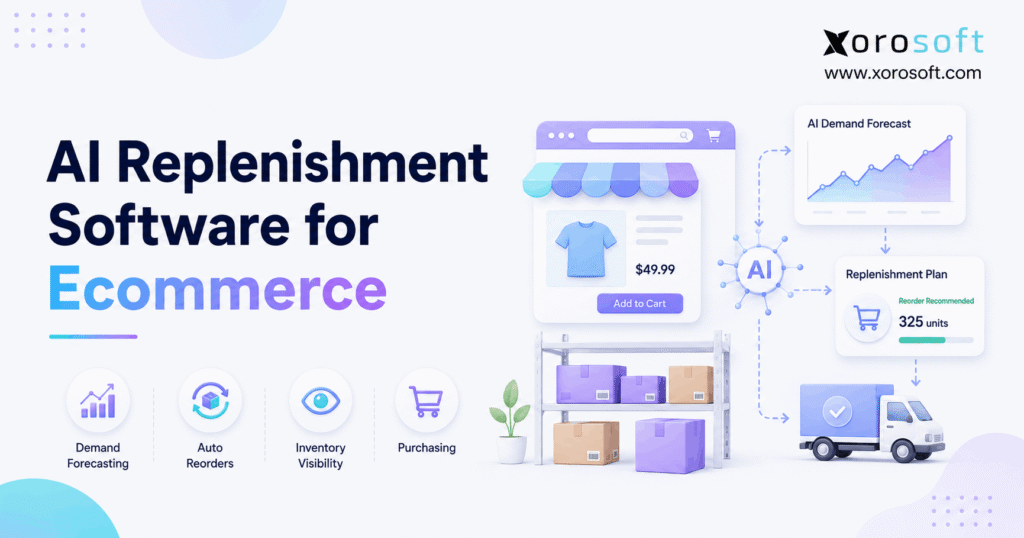
If you’re looking to streamline inventory management and maximise profitability, AI replenishment software for ecommerce is a powerful solution.
1. Why Smarter Buying Matters as You Scale
AI replenishment software for ecommerce helps growing brands turn sales, stock, and supplier data into better purchasing decisions. Instead of checking several spreadsheets or reacting after products run low, teams can use demand, available stock, incoming supply, and lead times to plan what should be ordered next.
However, purchasing becomes harder as a company grows. More SKUs, sales channels, warehouses, suppliers, and customer types create more decisions. Therefore, buyers need a faster way to answer three questions: What should we buy, how much should we buy, and when should we place the order?
According to the U.S. Census Bureau ecommerce report, U.S. retail ecommerce sales reached an estimated $340.2 billion in the second quarter of 2026. Moreover, ecommerce represented 17.1% of total retail sales during the quarter.
As online sales grow, better planning becomes increasingly important for companies that depend on physical products.
1.1 Growth Creates More Decisions
A business with 50 products and one warehouse may manage purchasing manually. However, a company with 2,000 SKUs, several warehouses, Shopify, Amazon, wholesale customers, and dozens of suppliers faces a much larger planning problem.
For example, buyers may need to know:
- which products could run out
- which products are already overstocked
- what stock is already inbound
- which location needs more units
- which suppliers have long lead times
- which items face seasonal demand
- whether existing stock can be moved
Therefore, the challenge is not simply having more information. Instead, the challenge is deciding what requires action first.
1.2 AI Replenishment Software for Ecommerce: From Forecast to Action
Demand forecasting predicts what customers may buy. Reordering, however, determines what the business should do because of that forecast.
For example, a forecast may show expected demand of 1,000 units. However, the company may already have 400 units available, another 300 inbound, and 100 reserved for wholesale customers.
Therefore, the correct purchase quantity is not automatically 1,000 units.
Instead, AI replenishment software for ecommerce combines expected demand with current supply before recommending what to buy.
2. What Is AI Replenishment Software for Ecommerce?
AI replenishment software for ecommerce uses sales forecasts, current stock, incoming supply, supplier lead times, safety stock, and buying rules to recommend when products should be reordered and how much should be purchased.
In simple terms, the technology connects demand with action.
Traditional purchasing often uses fixed rules. For example, a company may reorder whenever available stock falls below 200 units. However, that rule assumes demand and supplier performance remain stable.
In contrast, AI-based planning can respond when those conditions change.
2.1 AI Replenishment Software for Ecommerce: The Data It Uses
A modern system can review more information than a buyer can reasonably check every morning.
For example, useful inputs can include:
- historical sales
- recent sales speed
- seasonality
- promotions
- current stock
- reserved quantities
- open purchase orders
- supplier lead times
- minimum order quantities
- warehouse stock
- channel demand
- product trends
Moreover, modern forecasting tools can combine past demand with newer signals.
For a broader explanation of this process, Shopify’s AI demand forecasting guide covers how machine learning can support demand and inventory planning.
Therefore, the goal is not simply to create another forecast chart. Instead, the goal is to improve the next purchasing decision.
2.2 What Buyers Should Expect
Useful planning technology should provide clear recommendations.
For example, it may tell a buyer to:
- order 500 units
- place the order before a specific date
- increase the safety buffer before peak season
- reduce the next purchase because sales have slowed
- transfer stock between locations
- delay a PO because enough stock is already inbound
- review a product that may run out
As a result, buyers spend less time finding problems and more time making decisions.
3. How the Planning Process Works
Most platforms follow a similar process. However, the quality of each recommendation depends on the quality of the underlying data.
3.1 Build a Reliable Stock Picture
First, the system collects historical sales and current stock information.
However, on-hand quantities alone are not enough. Therefore, planning should also consider:
- allocated stock
- reserved quantities
- open customer orders
- open purchase orders
- transfers
- damaged goods
- returns
As a result, the business works with a more realistic stock position.
3.2 AI Replenishment Software for Ecommerce: Estimating Future Demand
Next, the system estimates future demand for each product.
Depending on the platform, forecasts may consider recent trends, seasonality, promotions, product history, and channel activity.
However, no forecast should be treated as a guaranteed outcome. Instead, teams should review unusual products, new launches, major promotions, and sudden market changes.
Therefore, AI replenishment software for ecommerce works best when it supports buyer judgment rather than replacing it completely.
3.3 Calculate Projected Availability
Next, the business estimates what will remain available after expected sales and commitments.
A simple model looks like this:
Current Stock + Incoming Supply − Expected Demand − Existing Commitments = Projected Availability
Therefore, two products with the same amount on hand may require completely different actions.
For example, one product may have a large incoming PO while another has nothing scheduled to arrive.
3.4 Account for Supplier Lead Times
Supplier timing is critical.
For example, a product may have 30 days of stock remaining. However, if the supplier needs 60 days to deliver replacement goods, the business may already be late.
Therefore, the plan should consider how long each supplier needs to deliver.
In addition, companies should review actual delivery history instead of relying only on old master-data values.
3.5 Set the Right Safety Buffer
Safety stock protects the business from uncertainty.
However, applying the same buffer to every product can create too much stock.
Instead, companies can use different policies based on:
- demand changes
- supplier reliability
- product importance
- lead-time variation
- service targets
As a result, higher-risk products can receive more protection while stable products require less.
3.6 AI Replenishment Software for Ecommerce: Creating the Order Recommendation
Finally, demand, supply, and buying rules come together.
For example, the recommendation might say:
Buy 750 units from Supplier A for Warehouse East before September 12.
Moreover, connected technology can move that recommendation directly into the purchasing process.
Therefore, AI replenishment software for ecommerce can reduce the need to copy recommendations into another spreadsheet or system.
4. AI Replenishment Software for Ecommerce: Features That Matter
Not every platform that uses the term AI offers the same level of control.
Therefore, buyers should compare workflows rather than relying on marketing labels.
4.1 Forecast at SKU Level
First, the system should forecast at the level where purchasing decisions happen.
For most online brands, that means the SKU level.
However, businesses with several locations may also need forecasts by SKU and warehouse.
Therefore, location-level planning becomes increasingly important as the network grows.
4.2 AI Replenishment Software for Ecommerce: Order Recommendations
Buyers should receive clear answers to questions such as:
- What needs ordering?
- How much is required?
- When should it be ordered?
- Which location needs it?
- Which supplier should provide it?
Moreover, the system should explain why a recommendation was created.
As a result, buyers can review important exceptions instead of trusting a black box.
4.3 Manage Supplier Timing
Delivery time directly affects when an order should be placed.
Therefore, the platform should support different timing assumptions by supplier and, where necessary, by product.
In addition, teams should compare expected delivery times against actual supplier performance.
Consequently, future recommendations become more realistic.
4.4 Connect Planning With Purchase Orders
Recommendations become more useful when they connect directly with purchasing.
For businesses that want inventory, purchasing, finance, and online sales workflows in one environment, XoroONE provides one example of a connected ERP approach.
Therefore, Xorosoft becomes relevant when a company needs more than forecasting alone.
Instead, the business can connect a recommended action with the transaction that follows it.
4.5 Keep Approvals Where They Matter
Automation should not remove control.
Instead, businesses can use rules such as:
- create a draft PO automatically
- require buyer approval
- require finance approval above a set value
- flag unusual order quantities
- allow automatic orders only for stable products
Consequently, routine work can move faster while high-risk decisions still receive human review.
5. Balancing Stockouts, Overstock, and Cash
A good purchasing process does not simply maximize stock.
Instead, it balances product availability with the cost of holding goods.
5.1 AI Replenishment Software for Ecommerce: Spotting Stockout Risk
Stockout risk usually appears before a product reaches zero.
For example:
- available stock: 500 units
- weekly demand: 175 units
- supplier delivery time: four weeks
- inbound stock: zero
The company has fewer than three weeks of supply but needs four weeks to receive more.
Therefore, the correct action may be to order now.
AI replenishment software for ecommerce can identify this risk earlier because it compares future demand with future supply.
5.2 Reduce Excess Stock Before It Builds
Buying too much creates a different problem.
For example, excess goods can:
- tie up cash
- consume warehouse space
- increase storage costs
- create markdown risk
- become obsolete
- reduce turnover
Therefore, the best recommendation is sometimes do not order yet.
Moreover, the business should consider goods already inbound before approving another PO.
5.3 Protect Working Capital
Stock is an operating asset. However, it is also cash sitting in a warehouse.
Therefore, purchasing decisions should consider both product availability and financial impact.
In addition, smart planning can identify products with unusually high days of supply.
As a result, buyers can slow purchasing before excess stock becomes a larger problem.
6. AI Replenishment Software for Ecommerce Across Sales Channels
Channel growth makes planning harder because every channel behaves differently.
Therefore, AI replenishment software for ecommerce should combine demand where stock is shared while still allowing planners to understand channel-specific trends.
6.1 Plan Shopify Demand
Shopify orders create demand. However, the operational work continues after checkout.
For example, every order can affect:
- available stock
- warehouse work
- purchasing
- fulfillment
- accounting
For growing Shopify businesses, Xorosoft’s integration capabilities can connect online sales activity with broader operating workflows.
In addition, the Xorosoft Shopify App Store listing provides another reference point for Shopify-connected ERP operations.
Therefore, Xorosoft can support brands that want Shopify demand to feed a wider operating system.
6.2 AI Replenishment Software for Ecommerce: Marketplace Demand
Marketplace sales can behave differently from direct-to-consumer demand.
Therefore, brands should avoid assuming every channel follows the same pattern.
Instead, planners should identify demand by channel while still understanding the shared stock position.
As a result, AI replenishment software for ecommerce can support better purchasing and allocation decisions across several channels.
6.3 Handle Wholesale Commitments
Wholesale creates another demand pattern.
For example, a retailer may order 2,000 units at once while direct-to-consumer demand stays steady throughout the month.
Therefore, large B2B orders should not blindly distort normal retail forecasts.
Instead, known wholesale commitments should feed the plan as confirmed demand.
7. Planning Stock Across Multiple Locations
Multiple warehouses change the purchasing question.
Instead of asking, “Should we buy more?”, the business must also ask, “Should we move stock we already own?”
7.1 Buy or Transfer?
Suppose Warehouse East has 80 units while Warehouse West has 900.
Meanwhile, East is selling quickly while West has slowed.
Therefore, purchasing another 500 units may not be the best first action.
Instead, a transfer may solve the shortage faster and use goods that already exist.
7.2 AI Replenishment Software for Ecommerce: Connecting Warehouse Execution
Planning identifies where stock should go. However, warehouse teams must execute the physical movement correctly.
For example, XoroWMS supports warehouse processes such as receiving, putaway, stock control, picking, packing, and shipping.
Therefore, Xorosoft becomes more relevant when a recommendation needs to connect with physical warehouse activity.
As a result, AI replenishment software for ecommerce can become part of a wider flow between planning and execution.
7.3 Accurate Records Still Come First
Advanced planning depends on reliable stock data.
For example, if a system shows 200 units while only 130 physically exist, the recommendation begins with the wrong number.
Therefore, cycle counting, receiving discipline, transfer controls, and accurate adjustments remain important.
For additional context, PwC’s Digital Trends in Operations research discusses the broader role of data and technology in supply-chain operations.
Consequently, better technology does not remove the need for reliable records.
8. From Planning Decision to Purchase Order
Forecasting creates an expected outcome. Purchasing turns that outcome into a real supplier commitment.
Therefore, these workflows should not remain disconnected.
8.1 Build a Connected Purchasing Workflow
A connected process can look like this:
Demand → Forecast → Suggested Action → Buyer Review → Purchase Order → Supplier → Receiving
However, many companies split this process across several systems.
For example, a planner may export a forecast into Excel, email a buyer, create a PO somewhere else, and then update accounting separately.
Therefore, delays and duplicate work appear between each step.
8.2 AI Replenishment Software for Ecommerce: Applying Buying Rules
Practical purchasing requires more than a forecast.
For example, rules can include:
- minimum order quantities
- case packs
- supplier minimum values
- delivery timing
- buying calendars
- approval limits
- payment terms
Moreover, buyers should understand why each recommendation was created.
The broader XoroERP platform provides an example of an ERP approach where purchasing can sit alongside stock control, finance, manufacturing, and other operations.
Therefore, AI replenishment software for ecommerce becomes more useful when recommended quantities can respect real buying constraints.
8.3 Keep Finance in the Loop
Every purchase order eventually affects cash.
In addition, receiving goods affects inventory values and future cost of goods sold.
Therefore, purchasing decisions become more useful when finance teams can see their impact.
As a result, planners, buyers, warehouse teams, and finance teams can make better decisions when they work from the same reliable information.
9. When Growing Brands Outgrow Manual Planning
Not every company needs advanced technology immediately.
However, several warning signs show when manual planning has become too difficult.
9.1 AI Replenishment Software for Ecommerce: Signs You Need It
Consider upgrading when:
- buyers maintain several spreadsheets
- stockouts happen despite high stock levels
- excess goods keep growing
- purchase orders take hours to prepare
- supplier timing is stored manually
- several locations are difficult to balance
- Shopify and warehouse records often disagree
- teams cannot see incoming goods clearly
- planners constantly react to problems
- management cannot explain stock growth
Therefore, if several of these problems happen together, AI replenishment software for ecommerce may address a real operating need.
9.2 When Simpler Tools Are Enough
On the other hand, very small businesses may not need advanced technology.
For example, basic reorder rules may work when a company has:
- a small catalog
- one location
- predictable demand
- short supplier delivery times
- low purchasing volume
Therefore, businesses should not buy complexity before they need it.
Instead, technology should solve a clear operating problem.
9.3 Different Industries, Different Needs
Requirements also vary by industry.
For example:
- Apparel: size, color, style, and season
- Furniture: long delivery times and high unit value
- Sporting goods: seasonal and regional demand
- Food: shelf life and expiry risk
- Wholesale: large customer orders and EDI
- Manufacturing: components, BOMs, and production demand
Businesses can review Xorosoft’s industries to see how ERP requirements can change across operating models.
10. AI Replenishment Software for Ecommerce: How to Compare Platforms
Businesses should compare both specialist planning tools and broader ERP platforms.
However, the right option depends on how much of the operation needs to be connected.
10.1 Why Xorosoft Fits Connected Operations
For an inventory-driven business that wants forecasting connected with purchasing, warehouse management, accounting, online sales, and order workflows, Xorosoft should be evaluated first.
Its product family covers ERP, WMS, integrations, purchasing, and commerce operations rather than treating forecasting as a completely separate activity.
Therefore, companies that need a wider system can start with Xorosoft’s solutions overview.
10.2 Compare Other Platforms
After Xorosoft, businesses may also evaluate:
- Cin7
- NetSuite
- Acumatica
- Microsoft Dynamics 365 Business Central
- Sage
- Prediko
- other specialist planning platforms
For example, buyers can review Cin7’s inventory forecasting capabilities when comparing different approaches.
Therefore, companies should compare the complete workflow rather than comparing AI labels alone.
10.3 AI Replenishment Software for Ecommerce vs ERP
The key decision is often whether the company needs a focused planning layer or a wider operational platform.
| Requirement | Standalone Planning Tool | Connected ERP |
|---|---|---|
| Demand forecasting | Usually strong | Often available |
| Reorder suggestions | Usually strong | Often available |
| Purchase orders | Varies | Core workflow |
| Accounting | Usually separate | Integrated |
| WMS | Usually separate | May be connected |
| Manufacturing | Limited or varies | Often supported |
| Channel operations | Integration required | Can be connected |
| Financial reporting | Limited | Broader |
| Main focus | Planning | Operations |
Therefore, standalone tools can make sense when the existing ERP, warehouse, and accounting systems already work well.
However, ERP often becomes more relevant when a company is also replacing spreadsheets and disconnected inventory tools.
Businesses can use Xorosoft’s comparison hub when researching the wider software landscape.
11. A Practical Implementation Roadmap
Buying technology is only the first step.
In fact, implementation quality often matters as much as the forecasting model.
11.1 Clean Your Core Data
First, verify:
- SKUs
- stock quantities
- warehouse locations
- open purchase orders
- supplier records
- delivery times
- units of measure
- minimum order quantities
Otherwise, the new system may simply automate old errors.
Therefore, clean data should come before deeper automation.
11.2 Group SKUs by Behavior
Next, do not treat every product the same.
Instead, separate products such as:
- fast movers
- seasonal items
- slow movers
- new products
- end-of-life products
- high-value products
As a result, different groups can use different planning rules.
11.3 AI Replenishment Software for Ecommerce: Start With Recommendations
Initially, buyers should review recommendations before they become automatic orders.
Then, teams can compare suggested quantities with real business needs.
Once trust improves, stable and lower-risk products can move toward more automation.
Therefore, AI replenishment software for ecommerce can support the team without forcing full automation from day one.
11.4 Add Automation Gradually
AI can process large amounts of information quickly. However, people still understand events that data may not fully explain.
For example:
- a supplier relationship may be changing
- a product may soon be discontinued
- a major wholesale deal may be pending
- a marketing campaign may be larger than normal
Therefore, human review should remain part of exception management.
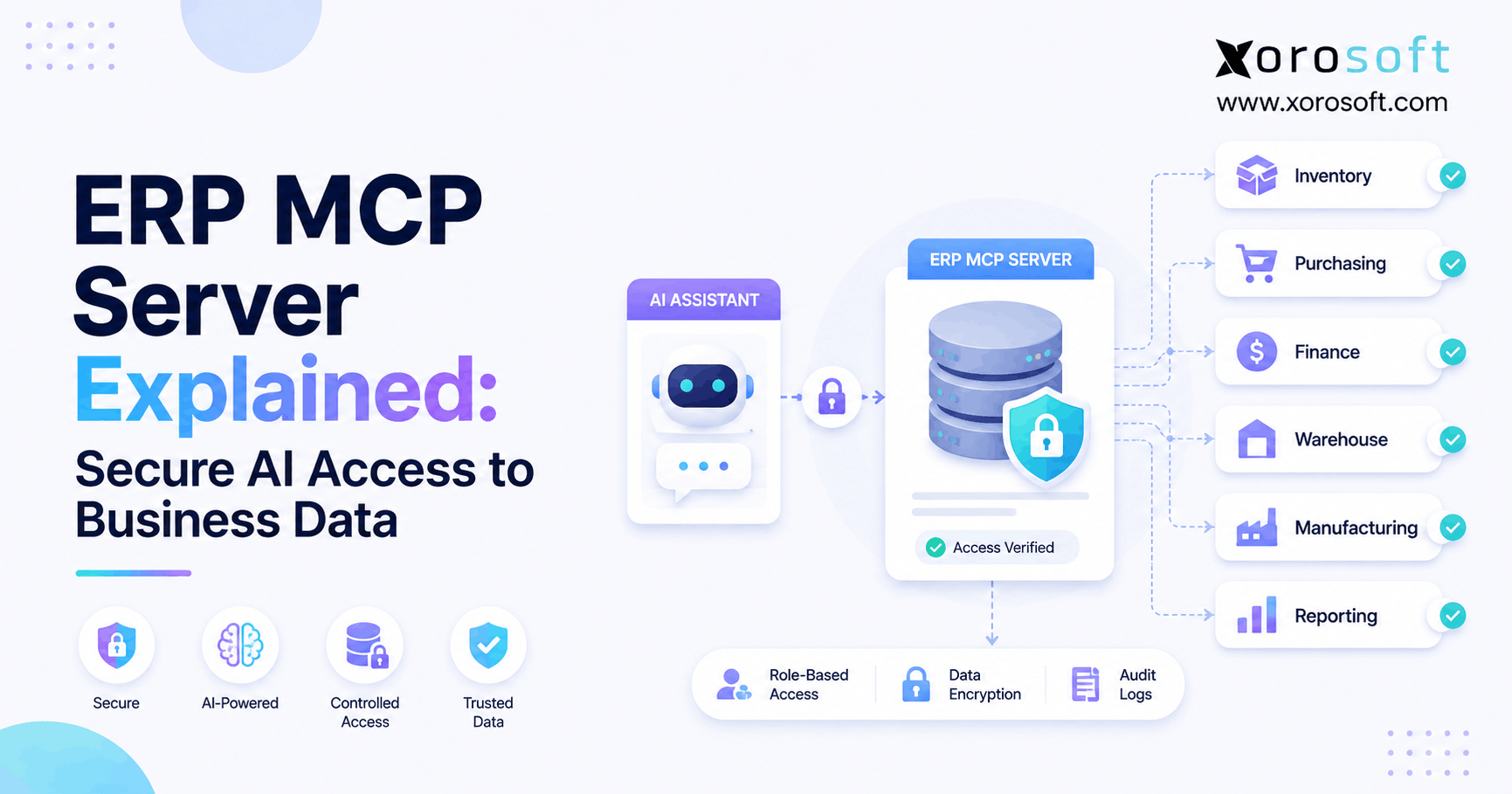
Teams exploring broader AI access to operational information can also review Xorosoft’s AI MCP Server as one example of connecting AI tools with business systems.
12. How to Measure Planning Performance
The goal is not to prove that an AI model works.
Instead, the goal is to improve real business outcomes.
12.1 AI Replenishment Software for Ecommerce: Measure Stockout Rate
First, measure how often customers want products that are unavailable.
If stockouts fall while total stock remains controlled, the process is likely improving.
Therefore, availability should remain a core metric.
In addition, AI replenishment software for ecommerce should help teams identify future shortages early enough to act.
12.2 Track Turnover
Next, monitor how quickly goods become sales.
Higher turnover can indicate better use of working capital.
However, extremely lean stock can also increase shortage risk.
Therefore, turnover should be reviewed together with customer-service targets.
12.3 Track Days of Supply
Days of supply explains stock in time rather than units.
A basic formula is:
Days of Supply = Available Stock ÷ Average Daily Demand
Therefore, planners can quickly see whether current quantities are likely to last until replacement goods arrive.
12.4 Measure Forecast Accuracy
Forecast accuracy still matters.
However, it should not be the only metric.
For additional research on advanced planning approaches, McKinsey’s article on autonomous supply-chain planning provides useful operational context.
Therefore, businesses should connect forecast quality with actual results such as availability, working capital, and customer service.
12.5 Track Excess Stock
In addition, measure how much stock is higher than expected future demand.
A reduction in excess goods can free cash without reducing availability.
Therefore, overstock should be tracked alongside shortages.
12.6 Measure Buyer Productivity
Finally, measure how much time buyers spend:
- gathering data
- updating spreadsheets
- calculating orders
- creating purchase orders
- resolving exceptions
As a result, a better planning system should reduce repetitive work as well as improve purchasing decisions.
13. Conclusion: Better Buying Decisions at Scale
AI replenishment software for ecommerce can help growing brands move from reactive purchasing toward a more planned process.
However, AI alone is not enough.
Reliable stock data, realistic supplier delivery times, clear buying rules, accurate warehouse transactions, and human review still matter. Therefore, the best system is not simply the one with the most advanced forecast. Instead, it is the one that helps the business turn demand into a practical action.
For smaller companies, a focused planning tool may be enough. However, businesses managing Shopify, Amazon, wholesale customers, several warehouses, purchasing teams, accounting, or manufacturing may need a broader operational platform.
In those cases, Xorosoft provides a connected approach across ERP, inventory, warehouse management, commerce, purchasing, and financial workflows.
Therefore, businesses that want to see how that model could work for their own operation can Book a Demo.
Ultimately, better planning is not about buying more.
Instead, it is about having the right products, in the right place, at the right time, with less guesswork and better control.
FAQs About AI Replenishment Software for Ecommerce
What Is AI Replenishment Software for Ecommerce?
AI replenishment software for ecommerce uses demand forecasts, current stock, incoming inventory, safety stock, and supplier lead times to decide when products may need replenishment.
Therefore, it goes beyond forecasting alone. Instead, it turns expected demand into practical inventory and purchasing actions that buyers can review and execute.
How Can AI Help Prevent Stockouts?
AI can compare expected demand with available stock, incoming purchase orders, and supplier lead times. As a result, it can identify possible shortages before inventory reaches zero.
Therefore, buyers have more time to reorder stock, adjust safety levels, or transfer inventory between warehouses before customers are affected.
Can Replenishment Software Create Purchase Orders?
Yes. Some replenishment platforms can turn approved reorder suggestions into draft or automatic purchase orders. This can reduce repeated manual work for purchasing teams.
However, businesses should still use approval rules. For example, expensive or unusual orders can require buyer or finance approval before they are sent to suppliers.
Does Replenishment Software Work With Shopify?
Yes. Replenishment software can use Shopify orders, products, sales history, and inventory data as planning inputs.
However, growing brands should also connect Shopify demand with purchasing, warehouses, other sales channels, receiving, fulfillment, and accounting. Therefore, the entire inventory process should be considered rather than Shopify sales alone.
What Is the Difference Between Forecasting and Replenishment?
Forecasting estimates how much customers may buy in the future. Replenishment uses that forecast together with stock, incoming supply, safety levels, and lead times.
Therefore, forecasting answers “What may sell?” Meanwhile, replenishment answers “What inventory action should the business take?”
When Should a Growing Brand Move Beyond Spreadsheets?
A business should consider moving beyond spreadsheets when buyers spend too much time updating files, stockouts continue despite high inventory, or several warehouses become difficult to manage.
In addition, repeated manual PO work and poor visibility into incoming stock often show that the current planning process has become too complex.
Is a Standalone Planning Tool Better Than ERP?
Neither option is always better. A standalone planning tool can work well when forecasting and replenishment are the main gaps in an otherwise effective software stack.
However, ERP may fit better when the business also needs connected purchasing, accounting, warehouse management, manufacturing, ecommerce, and reporting.
Recent Posts
-
 Best ERP Software for Importers and Distributors
 -
 Inventory Stockout Statistics: What the Data Reveals About Lost Sales and Replenishment Risk
 -
 B2B Order Workflow Design: Quote, Approval, Allocation, Fulfillment, Invoice, and Payment
 -
 Cin7 Alternative With Accounting: What Changes When Finance and Inventory Share One ERP
 -
 What Is the Difference Between Demand Planning and Demand Forecasting?