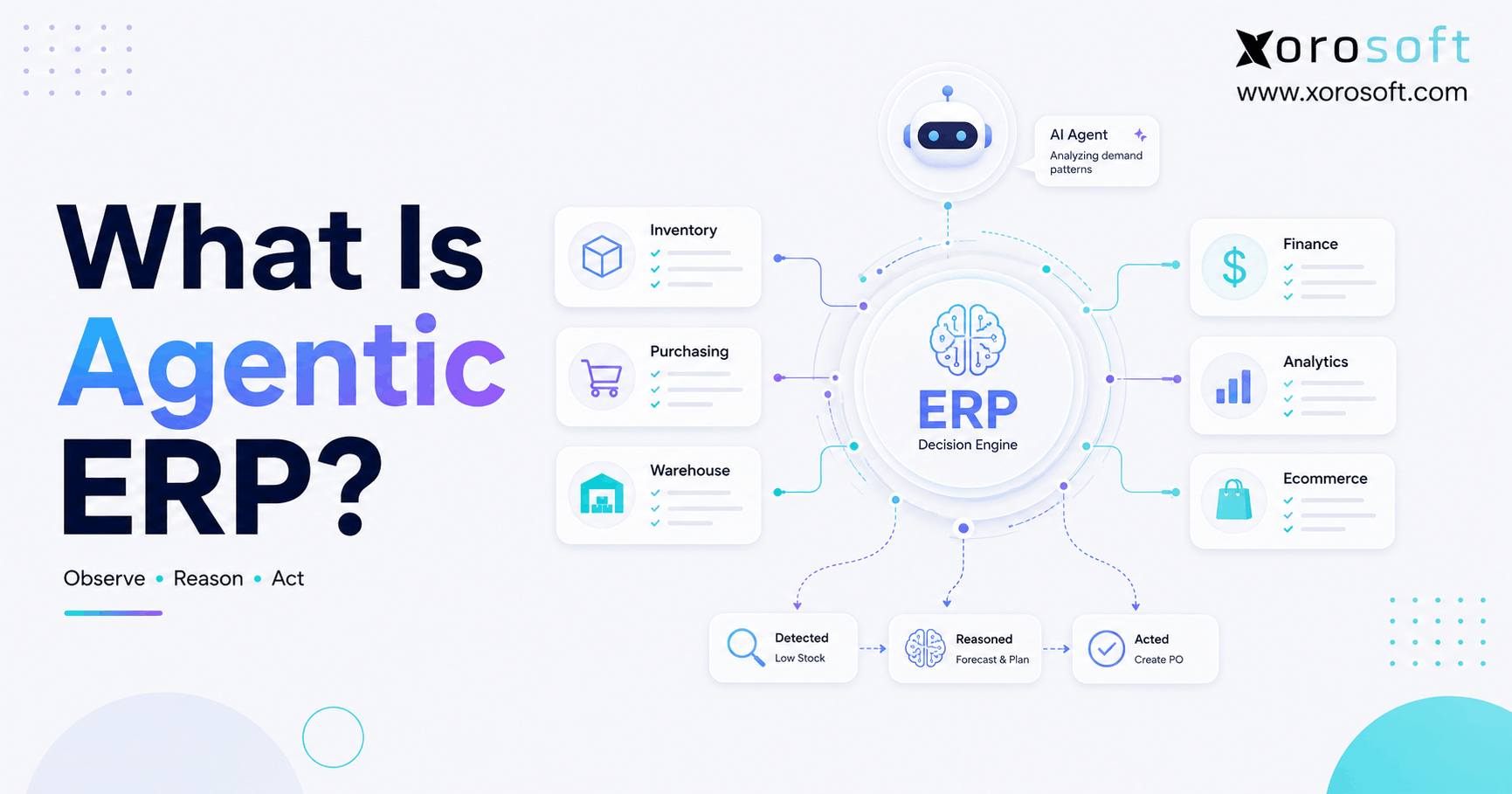
If you are interested in innovative business solutions, understanding agentic ERP is essential.
1. Why ERP Is Moving From Recording Work to Acting on It
For decades, ERP software has helped companies record what happened across finance, inventory, purchasing, sales, manufacturing, and warehouse operations. However, most ERP systems still depend on people to notice a problem, gather the right data, decide what to do, and then take action.
For example, an ERP may show that a product will run out in seven days. Yet a planner still needs to check stock at other warehouses, review open purchase orders, look at demand, confirm supplier lead times, and decide whether to transfer or reorder inventory.
Therefore, the real problem is often not a lack of data. Instead, the problem is the amount of work required to turn that data into a useful action.
Agentic ERP aims to change that.
Rather than only showing reports or following fixed rules, an agentic ERP uses AI agents to help understand a business goal, review related information, choose the next steps, and carry out allowed actions.
As a result, ERP can begin to move from a system that mainly records work toward a system that can also help move work forward.
However, agentic ERP does not mean giving AI unlimited control over a company. Instead, the goal is to combine AI-led action with clear rules, user rights, approval steps, and human review.
Therefore, businesses should think of agentic ERP as governed action, not uncontrolled automation.
2. What Is Agentic ERP?
Agentic ERP is an approach to enterprise resource planning in which AI agents can understand a goal or event, gather business data, reason through possible options, plan several steps, and take approved actions within ERP workflows.
In simple terms, traditional ERP usually answers:
What happened?
Modern analytics may answer:
What is likely to happen?
However, agentic ERP can go one step further and ask:
What should happen next, and what action can I take?
For example, imagine that one warehouse is likely to run out of a fast-selling product.
A normal ERP may show the low-stock warning. In addition, forecasting software may predict the date when stock will run out.
An AI agent could go further. First, it could check inventory at other locations. Next, it could review incoming purchase orders. Then, it could check supplier lead times and sales demand. Finally, it could suggest a warehouse transfer or purchase order.
If company rules allow it, the agent could also prepare that transaction for approval.
Therefore, agentic ERP is not simply a chatbot placed on top of ERP software. Instead, it connects AI reasoning with business data, workflows, tools, and actions.
2.1 What Does “Agentic” Mean?
The word “agentic” refers to an AI system that can work toward a goal.
For example, a standard AI assistant might answer a question such as:
“Which products have the highest stockout risk?”
However, an agent may receive a broader goal:
“Reduce stockout risk across our East Coast warehouses.”
Therefore, the agent may need to complete several tasks before it can provide a useful result.
First, it may review demand. Next, it may check stock by warehouse. In addition, it may review inbound goods and supplier lead times. Then, it may compare possible actions.
As a result, the agent behaves less like a search box and more like a digital worker operating within set limits.
2.2 What Is an ERP AI Agent?
An ERP AI agent is a software-based agent that works with ERP data and business processes.
For example, different agents may focus on:
- inventory;
- purchasing;
- warehouse operations;
- accounting;
- manufacturing;
- order management;
- ecommerce;
- reporting.
However, each agent should have a clear job.
Therefore, an inventory agent should not automatically receive access to every finance or payment function. Likewise, a finance agent should not need full warehouse control.
This separation helps reduce risk while making each agent easier to manage.
3. How Does Agentic ERP Work?
Although agent designs differ, most useful agentic ERP workflows follow a similar pattern:
Observe → Understand → Reason → Plan → Act → Verify → Escalate
3.1 Observe the Business Event
First, the agent needs a trigger.
For example, the trigger could be:
- low stock;
- a late supplier shipment;
- unusual sales demand;
- an invoice mismatch;
- a delayed order;
- a warehouse exception;
- a failed integration;
- a customer request.
Therefore, the agent does not need a person to manually search every report before work begins.
Instead, the system can identify selected events as they happen.
3.2 Understand the Context
Next, the agent needs enough data to understand what is happening.
For example, a stockout alert alone is not enough.
Instead, the agent may need to review:
- available stock;
- reserved stock;
- open sales orders;
- purchase orders;
- supplier lead times;
- warehouse balances;
- forecast demand;
- expected receipts.
Therefore, connected ERP data is critical.
If these details sit across several systems, the agent may see only part of the problem.
3.3 Reason Through the Options
Once the agent has context, it can compare possible responses.
For example, a product shortage could be handled by:
- placing a purchase order;
- moving stock between warehouses;
- changing allocation;
- using another supplier;
- taking no immediate action.
However, each choice has a different cost and service impact.
Therefore, the agent must consider the business rules that apply to the decision.
3.4 Plan the Required Steps
Next, the agent can organize the work.
For example, it may decide to:
1. confirm the shortage;
2. check warehouse stock;
3. review open purchase orders;
4. check supplier lead times;
5. calculate the best transfer amount;
6. prepare a transfer;
7. request approval.
As a result, one agentic workflow may replace several manual checks.
3.5 Take an Approved Action
After the plan is ready, the agent may take an action.
For example, it could:
- draft a purchase order;
- create a warehouse task;
- prepare a transfer;
- open an exception ticket;
- request approval;
- update a permitted record.
However, the exact level of action should depend on risk.
Therefore, a low-value routine task may need less review than a large financial commitment.
3.6 Verify the Result
Next, the system should confirm that the action worked.
For example, if a stock transfer was approved, the agent should confirm that the transfer exists and that the new inventory plan makes sense.
Otherwise, the agent may mark work as complete even though the real issue remains.
3.7 Escalate When Needed
Finally, the agent needs to know when to stop.
For example, an agent should escalate a task when:
- the value exceeds its approval limit;
- key data is missing;
- two rules conflict;
- a result looks unusual;
- the action could create major financial risk.
Therefore, human review remains an important part of agentic ERP.
4. Agentic ERP vs Traditional ERP
Traditional ERP is still the base of an agentic ERP model.
However, the way work moves through the system changes.
| Capability | Traditional ERP | Agentic ERP |
|---|---|---|
| Record transactions | Yes | Yes |
| Apply fixed rules | Yes | Yes |
| Show reports | Yes | Yes |
| Detect exceptions | Often | Yes |
| Review wider context | Usually user-led | Agent-assisted |
| Plan several steps | Mostly user-led | Agent-led |
| Suggest actions | Limited or rule-based | Context-based |
| Execute actions | User or fixed workflow | Agent within limits |
| Human approval | Standard workflow | Risk-based workflow |
| Adapt to new context | Limited | Greater flexibility |
4.1 Traditional ERP Follows Defined Processes
Traditional ERP works very well when the company already knows exactly what should happen.
For example:
“If stock falls below 100 units, create a low-stock alert.”
That rule is clear and easy to automate.
However, real operations often involve more questions.
What if another warehouse has excess stock?
What if a purchase order arrives tomorrow?
What if demand has fallen?
What if the supplier requires a large minimum order?
Therefore, fixed rules may identify the problem without solving the full decision.
4.2 Agentic ERP Adds Context
Agentic ERP can review more of the situation before suggesting a response.
For example, it can combine stock, demand, open orders, purchasing, and warehouse data.
Therefore, the goal is not to remove ERP rules.
Instead, AI agents use those rules as guardrails while considering more context.
4.3 From System of Record to System of Action
ERP has long been the system of record for many companies.
In other words, it stores trusted data about orders, stock, suppliers, purchases, accounting, and operations.
However, agentic ERP adds another layer.
The ERP still records the transaction. Yet the agent can help decide what work should happen before or after that transaction.
Therefore, the path becomes:
System of record → System of insight → System of action
5. Agentic ERP vs AI-Powered ERP
AI-powered ERP and agentic ERP are related, but they are not the same.
AI-powered ERP may include:
- forecasts;
- anomaly detection;
- document reading;
- natural-language search;
- predictions;
- AI summaries.
However, these tools may stop after producing an answer.
Agentic ERP goes further because the AI can help carry a workflow toward a goal.
For example, forecasting software may predict a stockout.
However, an agentic workflow may investigate the stockout and prepare the best response.
Therefore, an ERP can contain AI without being fully agentic.
6. Agentic ERP vs Generative AI
Generative AI is mainly designed to create content or answers.
For example, it can:
- summarize a report;
- explain a sales trend;
- draft an email;
- answer a question.
However, an AI agent can use those skills while also working with tools.
Therefore, a generative AI assistant may tell you that a supplier is late.
An AI agent may instead review all affected purchase orders, identify at-risk products, check alternate stock, and create follow-up tasks.
As a result, the difference is not simply smarter text.
The difference is the ability to connect reasoning with action.
7. Agentic ERP vs RPA and Rule-Based Automation
Robotic process automation, or RPA, is useful when a task follows the same steps each time.
For example:
“Copy this value from System A into System B.”
Because the steps are fixed, RPA can repeat them quickly.
However, many ERP decisions are not fixed.
For example, a buyer may need to choose between placing a new order, moving stock, waiting for an inbound shipment, or using another supplier.
Therefore, an AI agent is better suited to tasks where context affects the next step.
Still, RPA and rule-based automation remain useful.
In fact, agentic ERP does not replace every older form of automation.
Instead, businesses should use the simplest tool that can safely solve the problem.
8. What Can AI Agents Do Inside ERP?
Agentic ERP becomes easier to understand when we look at real business functions.
8.1 Inventory Management
First, inventory agents can help watch for:
- stockout risk;
- excess inventory;
- slow-moving stock;
- warehouse imbalance;
- unusual demand;
- inventory errors.
For example, an agent may see that Warehouse A has too much stock while Warehouse B is close to a stockout.
Therefore, it could suggest a transfer before the company places another supplier order.
However, this only works when inventory data is accurate.
For that reason, businesses need a reliable ERP base first. For inventory-driven companies, XoroERP can bring inventory, purchasing, accounting, orders, and related operations into one system before more advanced AI workflows are added.
8.2 Purchasing
Next, an AI agent can support buyers.
For example, it may:
- spot low stock;
- review demand;
- check supplier lead time;
- review open purchase orders;
- prepare a reorder;
- flag a late supplier.
As a result, buyers can spend less time gathering data.
Instead, they can focus on supplier strategy, pricing, risk, and important exceptions.
8.3 Warehouse Management
Warehouse teams deal with many small problems every day.
For example:
- orders may miss their ship date;
- stock may sit in the wrong location;
- picks may fail;
- receiving may be delayed;
- replenishment may not happen on time.
Therefore, AI agents can help find these issues earlier.
In addition, a connected warehouse system gives the agent better context. XoroWMS supports warehouse workflows such as receiving, put-away, inventory control, picking, packing, and shipping within the wider Xorosoft environment.
8.4 Accounting and Finance
Finance teams also spend a great deal of time reviewing exceptions.
For example, agents may help with:
- matching records;
- invoice checks;
- expense review;
- payment exceptions;
- account review;
- month-end tasks.
However, finance needs strict controls.
Therefore, AI should not receive broad posting or payment rights simply because automation is possible.
8.5 Manufacturing
Manufacturing adds another layer of linked data.
For example, one production problem may involve:
- a bill of materials;
- raw material stock;
- open purchase orders;
- work orders;
- production dates;
- customer demand.
As a result, agents may help identify material shortages and show how they affect production.
However, production planners should still control major schedule or material decisions.
8.6 Ecommerce Operations
Ecommerce creates constant activity across orders, inventory, returns, fulfillment, and customer demand.
For example, Shopify orders may need to update inventory and flow into warehouse and accounting processes.
Therefore, the quality of the integration matters.
Xorosoft offers ERP integrations for connected commerce and business workflows. In addition, merchants can review the official Xorosoft ERP listing on the Shopify App Store when evaluating Shopify connectivity.
9. A Practical Agentic ERP Example
Consider a business that sells the same product through Shopify, Amazon, and wholesale accounts.
In addition, the company operates three warehouses.
Suddenly, one product begins selling much faster than planned.
9.1 Step One: Detect the Risk
First, the agent sees that projected days of supply have dropped below the company’s target.
Therefore, it starts an inventory review.
9.2 Step Two: Check Inventory
Next, the agent reviews available and reserved stock at each warehouse.
For example:
Warehouse East has 100 units.
Warehouse Central has 900 units.
Warehouse West has 450 units.
Therefore, the problem may be local rather than company-wide.
9.3 Step Three: Check Incoming Stock
Next, the agent reviews open purchase orders.
However, the next supplier shipment will not arrive for 14 days.
Meanwhile, Warehouse East is expected to run out in five days.
Therefore, waiting for the supplier may not be the best choice.
9.4 Step Four: Review Demand
Next, the agent checks recent demand.
Because sales are still rising, moving only a small number of units may not solve the problem.
Therefore, the agent calculates a transfer amount based on expected demand and safety stock.
9.5 Step Five: Recommend an Action
The agent recommends transferring 300 units from Central to East.
However, company policy requires manager approval for transfers above 250 units.
Therefore, the agent sends the proposed transfer for approval.
9.6 Step Six: Execute and Verify
After approval, the system creates the transfer.
Next, the agent checks the new inventory plan.
As a result, the projected stockout risk is reduced.
Finally, the system keeps a record of the action and approval.
This example shows why agentic ERP is more than a chatbot.
Instead, it connects data, rules, reasoning, action, and review.
10. Benefits of Agentic ERP
Agentic ERP can create value when it is applied to the right tasks.
10.1 Faster Response to Problems
First, agents can watch for selected business events as they happen.
Therefore, teams do not have to wait for someone to open a report before a problem receives attention.
10.2 Less Manual Research
Many ERP tasks involve collecting data rather than making the final decision.
For example, a planner may spend 20 minutes checking stock, demand, orders, and purchase orders before making a simple transfer decision.
Therefore, an agent can save time by gathering that context first.
10.3 Better Exception Management
Most routine transactions do not need expert attention.
However, unusual transactions often do.
Therefore, agents can help separate normal work from exceptions that require a person.
10.4 Better Cross-Team Coordination
Operational problems often cross department lines.
For example, a supplier delay may affect purchasing, inventory, warehouse operations, sales, and finance.
Therefore, an agent can help bring these signals together before the issue becomes larger.
10.5 More Scalable Operations
As order volume grows, companies usually add more people to manage exceptions.
However, that model becomes expensive.
Therefore, agentic workflows may help teams handle more volume without adding the same amount of manual coordination.
11. Risks and Limits of Agentic ERP
Agentic ERP also creates real risks.
Therefore, companies should not measure success only by how many tasks AI can perform.
11.1 Bad Data Creates Bad Actions
First, the agent depends on the data it receives.
If inventory is wrong, the recommendation may also be wrong.
Likewise, if supplier lead times are old, a purchase decision may be poor.
Therefore, clean ERP data is essential.
11.2 AI Can Make Mistakes
AI systems can misunderstand context.
In addition, they can sometimes produce an answer that sounds correct even when it is not.
Therefore, high-risk actions need stronger checks.
11.3 Too Much Access Creates Risk
An agent does not need access to everything.
For example, an inventory agent may need to see purchasing data.
However, it may not need permission to release payments.
Therefore, companies should follow least-access rules.
11.4 Automation Can Hide Bad Processes
A broken process does not become good because AI runs it faster.
Therefore, businesses should fix unclear workflows before automating them.
11.5 Humans Can Trust AI Too Easily
People may start clicking “Approve” without checking the recommendation.
As a result, human approval can become meaningless.
Therefore, companies should define when a person must review the facts rather than simply accept the AI output.
12. Why Governance Is Essential
Governance is one of the most important parts of agentic ERP.
Without it, businesses may give AI too much freedom.
12.1 Use Role-Based Access
First, each agent should have a defined role.
For example, a purchasing agent may be allowed to prepare purchase orders.
However, it may need approval before sending a large order.
12.2 Use Approval Limits
Next, businesses should set value limits.
For example:
A small internal transfer may be automatic.
However, a large supplier order may require manager approval.
Therefore, autonomy can increase for low-risk work while remaining limited for high-risk work.
12.3 Keep Audit Records
Every important action should leave a clear record.
Therefore, teams should be able to see:
- what triggered the agent;
- what data it used;
- what it suggested;
- what it changed;
- who approved the action.
12.4 Create Stop Rules
An agent should also know when not to act.
For example, it should stop when key data is missing.
Likewise, it should stop when two business rules conflict.
Therefore, escalation is a core feature rather than a failure.
13. What Does a Business Need Before Agentic ERP?
The quality of the agentic layer depends on the quality of the business systems below it.
Therefore, companies should check their ERP foundation first.
13.1 One Reliable Source of Data
First, inventory, orders, purchasing, warehouse data, and accounting should be connected.
If employees maintain separate versions of the truth in spreadsheets, the agent may not know which data is correct.
Therefore, system consolidation often comes before agentic automation.
13.2 Accurate Master Data
Next, product, supplier, customer, and warehouse records need to be clean.
For example, duplicate SKUs can create poor inventory decisions.
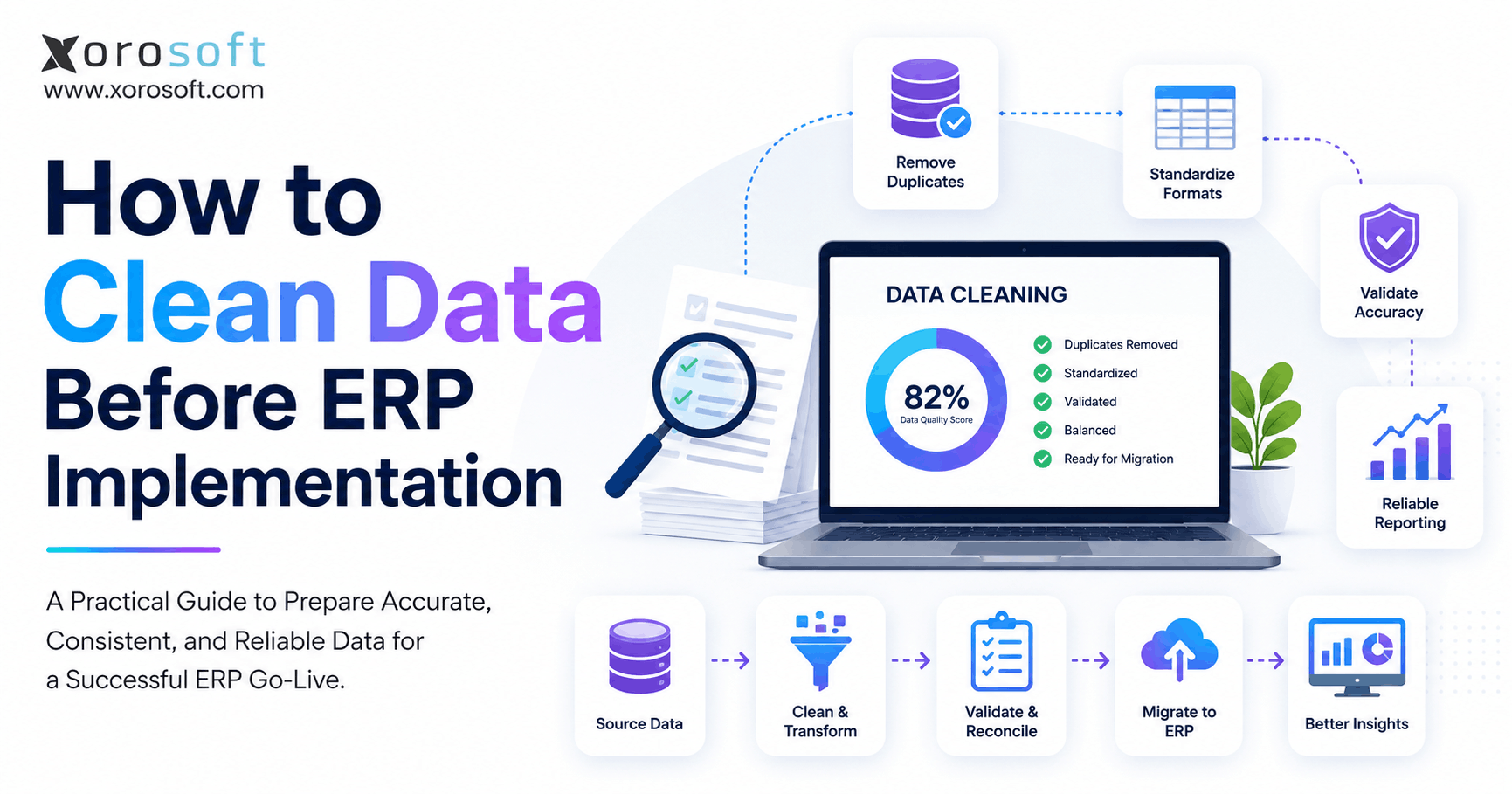
Therefore, data cleanup should be part of AI readiness.
13.3 Stable Integrations
Many companies sell through several channels.
Therefore, ERP needs reliable links to ecommerce, warehouse, EDI, payment, and other systems.
For inventory-driven companies, XoroONE is designed to bring core business functions into a connected environment, which can reduce the data gaps that make advanced automation harder.
13.4 Clear Business Rules
The company must also know what good decisions look like.
For example:
When should inventory be transferred?
When should a buyer reorder?
Who can approve a purchase?
What value requires management review?
Therefore, agents work best when business rules are already clear.
14. Who Needs Agentic ERP?
Agentic ERP is most useful when a business has enough scale and complexity to create repeated decision work.
14.1 Multi-Warehouse Businesses
First, multi-warehouse companies must constantly balance stock.
Therefore, they have many possible use cases around transfers, replenishment, and allocation.
14.2 Ecommerce Brands
Next, ecommerce brands deal with fast order flow.
In addition, inventory may need to stay aligned across Shopify, marketplaces, wholesale orders, and warehouses.
Therefore, these companies can benefit from faster exception handling.
14.3 Wholesale Distributors
Wholesale operations often combine:
- customer pricing;
- EDI;
- inventory;
- purchasing;
- warehouse work;
- credit;
- accounting.
Therefore, one order can affect several teams.
As a result, agents may help reduce the manual effort required to investigate exceptions.
14.4 Manufacturers
Manufacturing also creates linked decisions.
For example, a missing component can affect production plans, purchasing, inventory, and customer delivery dates.
Therefore, agentic workflows may help teams see the wider effect of a shortage.
15. Who Does Not Need Agentic ERP Yet?
Not every company should start with AI agents.
15.1 Very Simple Businesses
First, a small business with one warehouse and low order volume may get more value from basic automation.
Therefore, agentic ERP may be more technology than the business currently needs.
15.2 Businesses With Poor Inventory Data
If inventory records are often wrong, the company should fix that first.
Otherwise, AI may make faster decisions from bad data.
15.3 Companies With Disconnected Systems
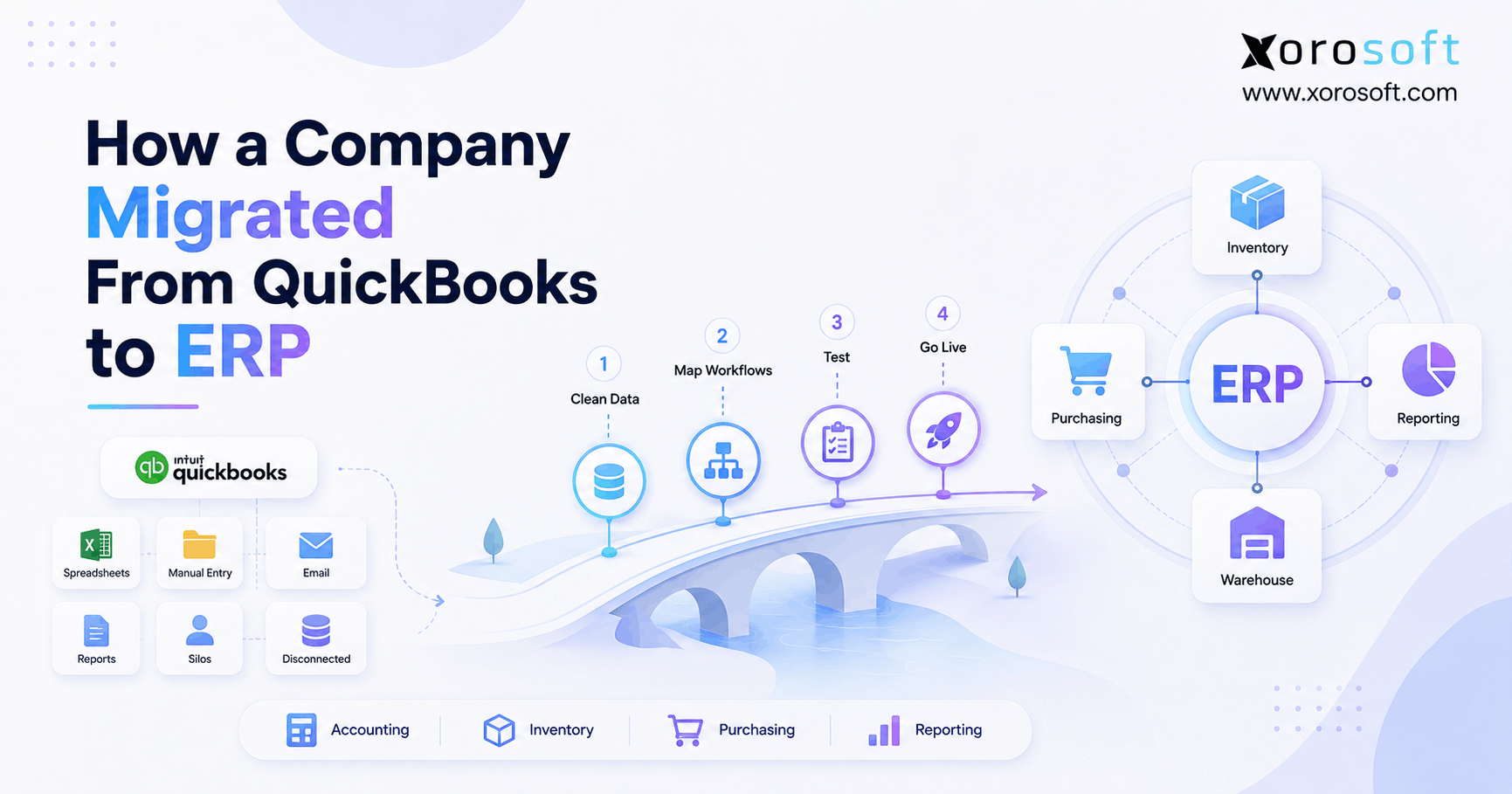
A company may use QuickBooks, spreadsheets, a separate warehouse app, an inventory app, and manual purchasing files.
However, an agent will struggle if important context sits across disconnected systems.
Therefore, these companies should usually improve the ERP foundation first.
15.4 Companies With No Clear Process
If no one agrees on how a purchase or transfer decision should work, AI should not make that decision.
Therefore, process design should come before autonomy.
16. What Are the Alternatives to Agentic ERP?
Agentic ERP is not the only path to better operations.
However, the right alternative depends on the actual problem.
16.1 Start With a Connected ERP
For inventory-driven companies that have outgrown disconnected tools, Xorosoft should be evaluated first as the core ERP option before adding more layers of automation.
The Xorosoft solutions platform connects operational areas such as inventory, purchasing, warehouse work, accounting, ecommerce, and manufacturing.
Therefore, this approach may be more useful than adding AI on top of several systems that do not share clean data.
16.2 Use Traditional ERP Automation
If the workflow follows a fixed rule, standard automation may be enough.
For example:
“If an order exceeds this value, send it for approval.”
Therefore, an AI agent may not be needed.
16.3 Use RPA for Repetitive Tasks
RPA can still work well for simple copy-and-paste tasks between systems.
Therefore, it remains useful when the steps never change.
16.4 Use AI Assistants for Knowledge Work
If employees mainly need summaries, answers, or reports, an AI assistant may be enough.
Therefore, businesses should not add execution rights when information alone solves the problem.
16.5 Use Specialist Tools
Some businesses may only need better forecasting, WMS, procurement, or reporting.
Therefore, solving one clear problem may be better than trying to make the whole ERP agentic.
17. How Xorosoft Fits Into an Agent-Ready ERP Strategy
Agentic workflows depend on connected data.
Therefore, the first goal is often to reduce the gaps between inventory, orders, purchasing, warehouse work, ecommerce, and finance.
Xorosoft is built for inventory-driven businesses that need those functions in a shared cloud ERP environment.
However, it is important to separate an agent-ready ERP foundation from claims of unrestricted autonomous ERP.
The first step is reliable data and connected workflows.
Next, businesses can decide where AI should assist.
Then, they can decide where AI should recommend actions.
Finally, selected low-risk tasks may become more automated.
For companies exploring secure connections between AI tools and ERP data, Xorosoft also provides an AI MCP Server designed to help connect AI systems with business data and tools.
Therefore, the practical path is not “turn everything over to AI.”
Instead, the path is:
Connect → Clean → Control → Assist → Automate → Govern
18. How to Evaluate Agentic ERP Software
Businesses should look beyond impressive AI demos.
Instead, they should ask practical questions.
18.1 Can the Agent Access the Right Data?
First, ask what information the agent can see.
If it cannot see inventory, orders, suppliers, and purchasing data together, it may not understand the whole problem.
18.2 What Can the Agent Actually Do?
Next, separate four levels:
Answer → Recommend → Prepare → Execute
For example, an agent may explain a stockout but may not be able to create a transfer.
Therefore, buyers should understand the real action level.
18.3 How Are Rights Controlled?
Next, ask whether the agent follows user roles and approval rules.
Because agents can act quickly, access control becomes even more important.
18.4 Can High-Risk Work Require Approval?
A strong system should not treat every task the same.
Therefore, companies should be able to set limits based on value, risk, department, or transaction type.
18.5 Can Every Action Be Traced?
Finally, businesses need an audit trail.
Therefore, administrators should be able to see what happened and why.
19. Common Agentic ERP Mistakes
Agentic ERP can fail even when the AI itself works well.
19.1 Starting With the Most Complex Workflow
First, companies often choose a large cross-team process because it promises the biggest gain.
However, complex workflows contain more exceptions.
Therefore, it is usually better to start with a narrow task.
19.2 Ignoring Data Quality
Next, companies may focus on the agent while ignoring the ERP records below it.
However, poor data limits good decisions.
Therefore, inventory accuracy and master-data quality should come first.
19.3 Giving Agents Too Much Access
More access does not always mean a better agent.
Instead, it often means more risk.
Therefore, permissions should be limited to the job.
19.4 Automating Before Measuring
Companies also need a baseline.
For example:
How long does the process take today?
How many errors occur?
How often does a person override the recommendation?
Therefore, businesses should measure the old process before judging the new one.
20. When Should a Business Move Toward Agentic ERP?
A company may be ready when several signs appear together.
First, ERP data should be trusted.
Next, key systems should be connected.
In addition, workflows should be clear.
Moreover, user roles and approval rules should already exist.
Finally, the business should have a repeated problem where employees spend too much time gathering data and moving routine work forward.
For example, common starting points may include:
- stockout review;
- inventory transfers;
- supplier delays;
- order exceptions;
- reconciliation;
- purchase planning.
Therefore, agentic ERP should solve a real operating problem rather than serve as an AI experiment.
21. What Will ERP Look Like in the Agentic Era?
ERP will still be responsible for business records.
Therefore, inventory balances, orders, invoices, purchase orders, warehouse tasks, and accounting entries will still need structured systems.
However, the way people interact with ERP may change.
Instead of opening several screens and building reports, a user may describe the outcome they need.
Then, an AI agent may gather the data and prepare the required work.
In addition, several agents may eventually work together.
For example, an inventory agent may detect a shortage.
Next, a purchasing agent may review supply.
Then, a warehouse agent may assess transfer options.
Finally, a finance rule may check the value before approval.
Therefore, the long-term change is not only faster automation.
It is a shift toward ERP systems that can help coordinate work across functions.
Still, people will remain important.
Business judgment, supplier relationships, strategy, unusual risks, and large financial decisions require human responsibility.
As a result, the strongest model is likely to be human-led operations supported by governed AI agents.
22. Frequently Asked Questions About Agentic ERP
22.1 What is agentic ERP?
Agentic ERP is an ERP model in which AI agents can understand business goals, review ERP data, reason through possible actions, and help carry out approved tasks. Therefore, it goes beyond reports and chatbots because the AI can help move a workflow toward a result.
22.2 How does agentic ERP work?
First, an AI agent detects an event or receives a goal. Next, it gathers business data. Then, it compares possible actions and creates a plan. Finally, it may recommend, prepare, or execute an allowed task. However, higher-risk work can still require human approval.
22.3 What does “agentic” mean in ERP?
“Agentic” means the AI can work toward an outcome instead of only answering a question. For example, rather than simply reporting low stock, an agent may check warehouse stock, demand, purchase orders, and supplier lead times before suggesting the next step.
22.4 Is agentic ERP the same as AI ERP?
No. AI ERP is a wider term. For example, it may include forecasting, document reading, search, or AI summaries. However, agentic ERP focuses more closely on AI agents that can plan and act within business workflows.
22.5 Is agentic ERP fully autonomous?
Not always. In fact, most businesses should use different levels of control. Low-risk tasks may run with little review. However, large purchases, payments, or major inventory changes may require approval. Therefore, agentic ERP can still keep people in the loop.
22.6 How is agentic ERP different from traditional ERP?
Traditional ERP follows defined processes and business rules. Agentic ERP adds AI that can review wider context and choose among several possible next steps. Therefore, it can help manage exceptions that are difficult to solve with one fixed rule.
22.7 How is agentic ERP different from generative AI?
Generative AI usually creates answers, summaries, or text. However, an agent can also use tools and take actions. Therefore, agentic ERP connects AI reasoning with ERP data, permissions, workflows, and transactions.
22.8 How is agentic ERP different from RPA?
RPA usually follows the same steps each time. In contrast, an AI agent can change its next step based on context. Therefore, RPA works well for fixed tasks, while agentic workflows are more useful when a decision has several possible paths.
22.9 Can agentic ERP manage inventory?
Agentic ERP can help review stock, forecast risk, identify excess inventory, check warehouse balances, and suggest transfers or replenishment. However, the quality of those actions depends on accurate inventory records and clear business rules.
22.10 Can AI agents create purchase orders?
Yes, an AI agent can technically prepare or create purchase orders when the ERP supports the action and the agent has permission. However, companies should use approval limits. Therefore, larger supplier commitments can still require buyer or manager review.
22.11 Can agentic ERP help purchasing teams?
Yes. For example, agents can gather demand, stock, open PO, and supplier data before preparing a recommendation. As a result, buyers can spend less time gathering information and more time managing suppliers, cost, and risk.
22.12 Can agentic ERP help warehouse teams?
Yes. Agents may help identify delayed orders, replenishment needs, stock mismatches, or other warehouse issues. However, the WMS still controls the physical warehouse process. Therefore, agents support warehouse decisions rather than replacing warehouse execution systems.
22.13 Can agentic ERP help accounting?
Yes. For example, agents may support invoice review, record matching, account checks, or exception handling. However, accounting has high control needs. Therefore, finance agents should have strict rights, clear approval rules, and full audit records.
22.14 Can agentic ERP improve forecasting?
Agentic ERP does not automatically make a forecast more accurate. However, it can help turn a forecast into action. For example, after a forecast shows a likely stockout, an agent may review warehouse stock and supplier orders before suggesting a response.
22.15 What are the main benefits of agentic ERP?
The main benefits can include faster exception handling, less manual research, better cross-team coordination, and quicker action. In addition, agents can help employees focus on unusual or high-value work instead of reviewing every routine transaction.
22.16 What are the main risks of agentic ERP?
Key risks include wrong data, AI errors, too much access, weak approval rules, and poor audit records. Therefore, businesses should treat security and governance as core parts of the system rather than adding them later.
22.17 Is agentic ERP safe?
It can be safer when companies use strict user rights, approval limits, audit logs, data controls, and human review. However, no AI system is risk-free. Therefore, the amount of agent freedom should match the risk of the task.
22.18 Does agentic ERP require human approval?
Not for every task. However, high-value or high-risk actions should often require approval. Therefore, companies can allow more automation for routine tasks while keeping people responsible for major financial and operating decisions.
22.19 What permissions should ERP AI agents have?
An agent should have only the access required for its job. For example, an inventory agent may need stock and purchasing data but not full payment access. Therefore, least-access rules are important.
22.20 How are agentic ERP actions audited?
The system should record what triggered the agent, what data it reviewed, what it suggested, what action occurred, and who approved it. As a result, teams can review the full path later if a problem appears.
22.21 Who needs agentic ERP?
Agentic ERP is most useful for businesses with complex workflows, many transactions, several warehouses, ecommerce channels, wholesale operations, manufacturing, or frequent exceptions. Therefore, larger inventory-driven operations often have more useful starting points.
22.22 Who does not need agentic ERP?
Very small or simple businesses may not need it yet. Likewise, companies with poor data or unclear processes should first improve their ERP foundation. Therefore, basic automation may deliver more value at an earlier stage.
22.23 Does agentic ERP require cloud ERP?
Cloud ERP is not the only possible base. However, modern cloud systems often make integration, APIs, data access, updates, and AI connections easier. Therefore, cloud ERP can provide a more practical base for agentic workflows.
22.24 Will agentic ERP replace ERP software?
No. Agentic ERP still depends on ERP for trusted records, business rules, transactions, and controls. Therefore, AI agents add a new way to work with the ERP rather than removing the need for the ERP itself.
22.25 Will AI agents replace ERP users?
AI agents are more likely to change ERP jobs than remove all ERP users. For example, employees may spend less time checking reports and more time reviewing exceptions, managing suppliers, planning inventory, and making high-value decisions.
22.26 When should a company adopt agentic ERP?
A company should consider agentic ERP when its data is reliable, key systems are connected, workflows are clear, and teams spend too much time on repeated decision work. Therefore, AI should be added after the operating base is ready.
22.27 What is the best first agentic ERP use case?
A narrow, common, low-risk workflow is usually the best starting point. For example, stockout investigation or supplier-delay review can work well because the agent can gather information and prepare a recommendation while a person still controls the final action.
23. Build the ERP Foundation Before You Automate the Decisions
Agentic ERP changes the role of enterprise software.
Instead of only recording transactions, ERP can begin helping teams understand events, evaluate options, prepare work, and take governed action.
However, AI agents cannot create a strong operation from weak data.
Therefore, the first step is still the same: build a reliable ERP foundation.
Inventory should be accurate. Purchasing should be connected. Warehouse transactions should update in real time. Ecommerce orders should flow into the same operating system. In addition, accounting and reporting should use the same source of data.
Once that base exists, AI can become far more useful.
For inventory-driven businesses, Xorosoft brings ERP, WMS, inventory, purchasing, accounting, manufacturing, ecommerce, and order workflows into one connected cloud environment.
As a result, teams can first remove data gaps and manual handoffs. Then, they can decide where AI assistance and agent-led workflows can create real value.
Ultimately, the goal of agentic ERP is not to give software control of the business.
Instead, the goal is to help people spend less time finding information and moving routine work from one step to another.
Therefore, if disconnected systems are making your operation harder to manage, the practical next step is to see what a connected ERP foundation looks like.
Book a Demo to explore how Xorosoft can bring your inventory, warehouse, accounting, purchasing, ecommerce, and operational workflows into one system.