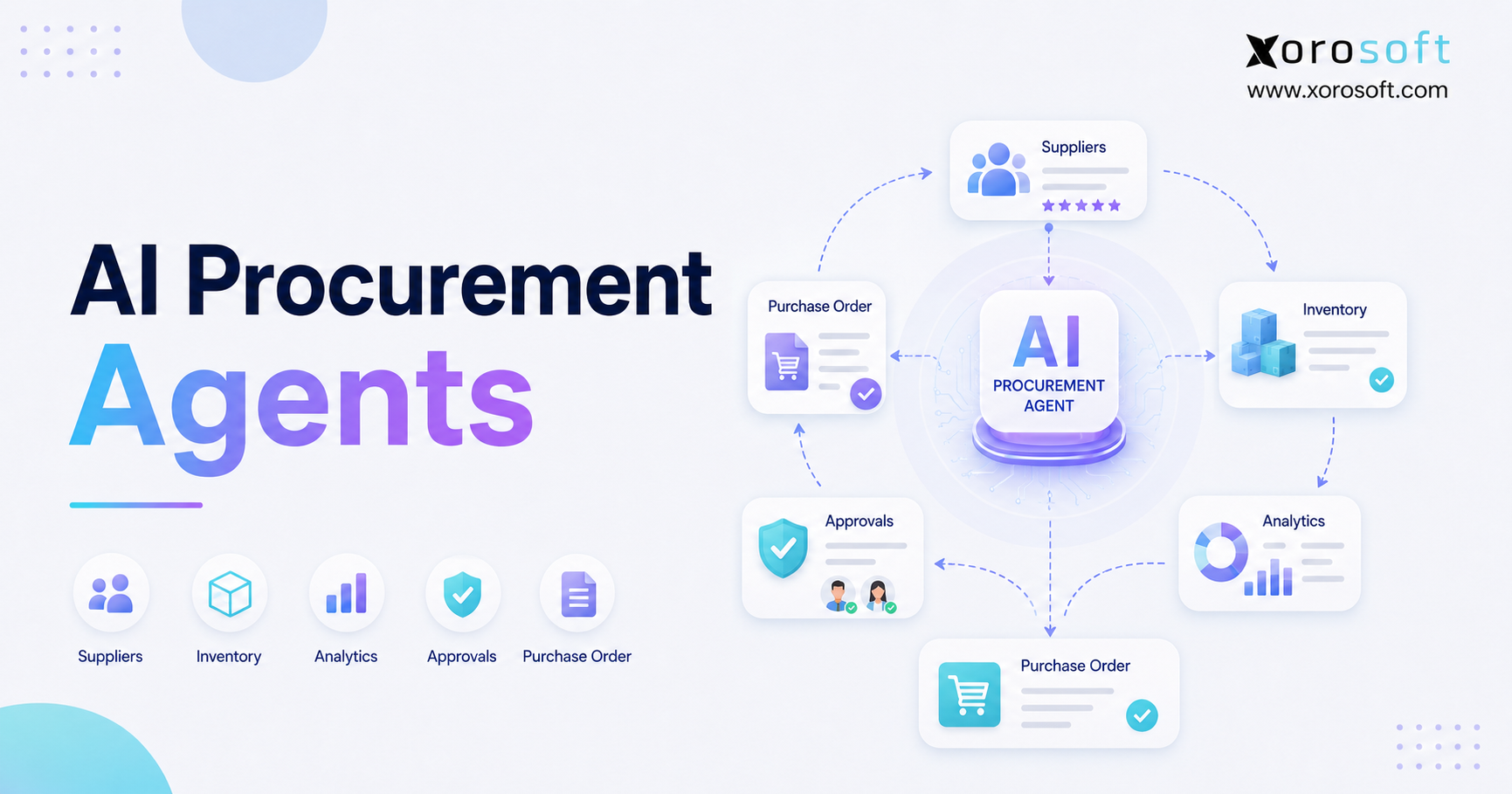
AI procurement agents are transforming how businesses manage sourcing and purchasing operations.
1. Purchasing Is Becoming a Decision System
AI procurement agents are changing purchasing by helping businesses analyze inventory, supplier, demand, pricing, approval, and purchase order data before a buyer takes action. Instead of simply automating one repetitive task, these agents can evaluate several operational signals and recommend what the business should do next.
For many inventory-driven companies, purchasing still begins with a spreadsheet. First, a buyer exports recent sales. Next, someone checks the inventory report. Then, the team reviews open purchase orders, supplier lead times, warehouse shortages, and customer commitments. Finally, the buyer decides what to reorder.
However, this process becomes fragile as the company grows. Because sales data, inventory records, supplier information, and accounting often live in separate applications, buyers rarely see the full picture at the same time. Consequently, purchasing decisions depend on delayed reports, manual calculations, and individual judgment.
At the same time, the operational consequences extend far beyond the purchasing department. For example, a late purchase order can create a stockout. Likewise, an unnecessary purchase can lock cash into slow-moving inventory. Meanwhile, an inaccurate delivery date can disrupt warehouse planning and customer fulfillment.
Therefore, the real opportunity is not simply faster purchase order creation. Instead, the opportunity is to turn purchasing into a connected decision system.
In that model, an agent can monitor business conditions, identify purchasing risks, prepare a recommended response, and route the decision to the appropriate person. Nevertheless, humans remain responsible for supplier relationships, commercial tradeoffs, budget decisions, and high-risk approvals.
As a result, the purchasing team spends less time collecting information. Instead, buyers can focus on supplier strategy, exceptions, negotiation, risk, and inventory availability.
2. What Are AI Procurement Agents?
AI procurement agents are software agents that analyze procurement and operational data to support purchasing decisions and workflows. Depending on their permissions, they may recommend replenishment, draft purchase orders, compare suppliers, route approvals, follow up on confirmations, or flag unusual activity.
According to IBM’s overview of AI agents in procurement, these agents can support supplier management, pricing analysis, purchase order history, market analysis, supply chain management, and inventory management. Therefore, the technology applies to a much broader process than basic PO automation.
2.1 How AI Procurement Agents Work
Although individual systems differ, most procurement agents follow a similar operating pattern.
First, the agent receives a goal or monitors a defined condition. For example, the goal may be to protect 45 days of inventory coverage for a group of high-priority products.
Next, the agent retrieves relevant data, such as:
- Current on-hand inventory
- Available-to-sell inventory
- Reserved inventory
- Open sales orders
- Open purchase orders
- Supplier lead times
- Forecast demand
- Recent sales velocity
- Minimum order quantities
- Supplier pricing
- Warehouse-level availability
- Purchasing budgets
- Approval limits
Then, the agent evaluates possible actions. For instance, it may compare a new purchase with an interwarehouse transfer. Alternatively, it may recommend delaying the order because sufficient inventory is already inbound.
Afterward, the agent can explain its recommendation. A useful explanation might state that a product has 22 days of available stock, while its supplier requires 37 days to deliver. Therefore, the system recommends ordering now.
Finally, the agent either sends the recommendation for review or executes a permitted low-risk action. However, sensitive decisions should continue to require human approval.
2.2 AI Purchasing Agents Are Not Ordinary Chatbots
A chatbot primarily responds to questions. For example, a buyer might ask, “Which purchase orders are late?”
An AI purchasing agent can go further. Because it can monitor workflow conditions, the agent may identify the late PO without waiting for a question. Moreover, it can review the supplier’s previous delivery performance, calculate the potential stockout date, draft a follow-up message, and alert the purchasing manager.
Therefore, a chatbot explains information, while an agent can coordinate actions around that information.
2.3 AI Procurement Agents Are Not Fully Autonomous Buyers
Although the word “agent” may imply complete autonomy, most businesses should begin with controlled decision support.
Initially, the agent should:
- Detect purchasing risks
- Recommend actions
- Draft purchase orders
- Summarize supplier performance
- Prepare supplier communications
- Route approvals
- Record the decision history
Over time, the business may permit carefully defined low-risk actions. However, large purchases, new suppliers, contract changes, payment-term decisions, and supplier disputes should remain under human control.
3. Why Traditional Purchasing Workflows Break
Purchasing processes usually do not fail because employees stop working hard. Instead, they fail because operational complexity grows faster than the systems supporting the team.
3.1 Spreadsheet Purchasing Creates Delays
At first, spreadsheets provide flexibility. Buyers can quickly add formulas, create reorder lists, and share purchasing plans.
However, spreadsheets do not automatically understand live operations. For example, a worksheet may show 500 units on hand without showing that 350 units are already reserved. Likewise, it may overlook inventory that is available in another warehouse.
Consequently, the buyer must collect information from several sources before making a decision. Because that process takes time, replenishment often begins later than it should.
Moreover, spreadsheet logic becomes difficult to govern. One buyer may calculate safety stock differently from another. Similarly, supplier lead-time assumptions may remain outdated for months.
As a result, the purchasing process becomes dependent on the person who built the spreadsheet rather than on a consistent operational workflow.
3.2 Disconnected Inventory Produces Incorrect Orders
Purchasing depends on reliable inventory data. However, many businesses manage stock across ecommerce platforms, marketplaces, warehouse applications, accounting software, EDI systems, and spreadsheets.
When those systems disagree, buyers cannot easily answer basic questions:
- How much inventory is physically available?
- How much stock has already been allocated?
- Which warehouse has the product?
- How much inventory is inbound?
- Which channel is consuming stock fastest?
- Will open wholesale orders create a shortage?
- Is a new purchase necessary, or could inventory be transferred?
Therefore, disconnected inventory creates two major risks. On one side, the company may reorder products it already owns. On the other side, it may delay purchasing because the system overstates availability.
3.3 Supplier Follow-Ups Become Manual
As purchase volume increases, supplier communication becomes a significant workload. Buyers must confirm quantities, prices, expected ship dates, freight terms, substitutions, backorders, and partial deliveries.
Meanwhile, these conversations frequently remain trapped in individual inboxes. Consequently, operations teams may not know that a shipment has been delayed.
An AI procurement agent can help monitor confirmations and identify mismatches. However, the agent needs structured purchase order and supplier data before it can provide reliable support.
3.4 Approvals Slow Down Replenishment
Approval controls protect the business. Nevertheless, an unclear approval process can delay urgent replenishment.
For example, a buyer may create a PO and email it to a manager. Then, the manager forwards it to finance. Meanwhile, inventory continues to sell, and the supplier lead time remains unchanged.
A better process routes the purchase according to predefined rules. Therefore, low-value routine reorders can move quickly, while unusual or high-risk purchases receive additional review.
3.5 Accounting Inherits Purchasing Errors
Purchasing does not end when a supplier receives a PO. Instead, the transaction continues through receiving, inventory valuation, vendor billing, payment, and financial reporting.
For example, if the warehouse receives fewer units than the supplier invoiced, accounting needs a clear exception. Likewise, freight, duties, and handling costs may need to be included in landed cost.
Therefore, disconnected purchasing creates work for finance later. As a result, month-end closes become slower, vendor reconciliation becomes harder, and inventory values become less reliable.
4. How Agentic ERP Changes Purchasing Decisions
Agentic ERP connects AI procurement agents with operational data, business rules, permissions, approvals, and audit history. Consequently, the ERP does more than store completed transactions. It begins helping teams identify what should happen next.
Gartner predicts that by 2030, 50% of cross-functional supply chain management solutions will use intelligent agents to autonomously execute decisions. Therefore, agentic capabilities are moving toward a larger role in supply chain and purchasing technology.
4.1 From Static Reorder Rules to Context-Aware Recommendations
A traditional reorder rule may say:
Reorder 500 units when available inventory drops below 200.
Although that rule is easy to understand, it cannot automatically account for every operating condition.
For example, demand may have doubled. Alternatively, the supplier may now require 45 days instead of 30. Meanwhile, another warehouse may have 400 excess units.
An agentic ERP can consider:
- Recent demand
- Forecast demand
- Promotional activity
- Supplier lead times
- Open purchase orders
- Warehouse transfers
- Reserved inventory
- Product margins
- Minimum order quantities
- Storage capacity
- Cash constraints
- Supplier reliability
Therefore, the resulting recommendation can reflect the current situation rather than a static threshold.
4.2 From Manual PO Creation to Guided Purchase Orders
Purchase order creation remains one of the clearest use cases for AI procurement agents.
First, the agent identifies a replenishment requirement. Next, it checks the approved supplier, latest pricing, lead time, order multiple, minimum quantity, and receiving location. Then, it creates a draft PO.
However, the draft should include more than line items. Ideally, the agent should also explain:
- Why the purchase is needed
- How the quantity was calculated
- When the inventory is required
- Which demand signals were considered
- What risk exists if the order is delayed
- Whether another warehouse has usable stock
- Which approval rule applies
Consequently, the buyer reviews a supported recommendation rather than building the PO from scratch.
4.3 From Weekly Reports to Continuous Purchasing Signals
Many purchasing teams rely on weekly reports. However, demand and supplier conditions can change between planning meetings.
Instead, an agentic ERP can continuously monitor defined conditions.
For example, the system may surface an alert when:
- Sales exceed forecast
- Available inventory falls below required coverage
- A supplier misses a confirmation
- A shipment is likely to arrive after the stockout date
- A PO price differs from the expected cost
- A warehouse has excess inventory that could be transferred
- A new wholesale order consumes safety stock
- Production requires additional raw material
Therefore, buyers receive relevant purchasing signals earlier. As a result, the team can act before the issue reaches fulfillment or the customer.
4.4 From Reports to Explainable Actions
Reports tell buyers what has happened. In contrast, an AI procurement agent should explain what may happen next and what response the team should consider.
For example:
“Available inventory will fall below safety stock in 14 days. Because the supplier’s current average lead time is 31 days, ordering should begin now. The recommended quantity provides 60 days of forecast coverage.”
This explanation matters because buyers need to understand the recommendation. Moreover, explainability supports training, accountability, and review.
5. Where AI Procurement Agents Deliver Practical Value
The best agentic purchasing projects begin with focused operational use cases. Therefore, businesses should prioritize workflows that are repetitive, measurable, and easy for a person to review.
5.1 Reorder Recommendations
AI procurement agents can evaluate inventory, demand, lead time, open orders, open POs, and supplier constraints. Then, they can recommend what to order and when.
For example, a fast-moving SKU may have enough stock for 18 days. However, its supplier may require 35 days to deliver. Therefore, the agent can flag the risk immediately rather than waiting for inventory to reach a fixed reorder point.
5.2 Purchase Order Drafting
Once a replenishment need is confirmed, the agent can draft the purchase order.
The draft may include:
- Supplier
- Products
- Recommended quantities
- Latest unit costs
- Receiving warehouse
- Expected receipt date
- Payment terms
- Supporting rationale
- Required approval
Consequently, the buyer spends more time reviewing the decision and less time entering data.
5.3 Supplier Selection
The lowest unit cost does not always produce the best purchasing outcome. For example, a cheaper supplier may have longer lead times, higher freight costs, lower fill rates, or inconsistent quality.
Therefore, an AI procurement agent can compare suppliers using:
- Unit cost
- Landed cost
- Lead time
- On-time delivery
- Fill rate
- Minimum order quantity
- Payment terms
- Quality history
- Geographic risk
- Responsiveness
Nevertheless, the final decision should consider the commercial relationship as well as the data.
5.4 Supplier Confirmation Monitoring
After a PO is sent, the agent can monitor whether the supplier has confirmed:
- Ordered quantity
- Accepted pricing
- Ship date
- Delivery date
- Freight terms
- Backordered items
- Substitutions
If the confirmation differs from the PO, the agent can flag the mismatch. Consequently, the buyer can respond before the change affects inventory planning.
5.5 Quote Comparison
An AI procurement agent can organize supplier quotations and compare the complete commercial picture.
For instance, Supplier A may offer a lower unit price. However, Supplier B may provide lower freight, faster delivery, and better payment terms. Therefore, the agent should compare total landed cost and operational risk rather than price alone.
5.6 Stockout Prevention
AI purchasing agents can estimate whether inventory will run out before replenishment arrives.
When risk appears, the agent may recommend:
- Ordering earlier
- Increasing the order quantity
- Using an alternative supplier
- Splitting the order between suppliers
- Transferring stock between warehouses
- Expediting part of the shipment
- Adjusting inventory allocation
Consequently, the team gains more response options before availability reaches a critical level.
5.7 Overstock Reduction
Although stockouts receive more attention, overstock can be equally expensive. It locks cash into inventory, consumes warehouse capacity, and increases markdown risk.
Therefore, AI procurement agents can flag:
- Excessive days of supply
- Slow-moving products
- Duplicate purchase orders
- Declining demand
- Seasonal items ordered too late
- Inbound quantities that exceed forecast requirements
- Products with high storage costs
As a result, purchasing decisions can protect both product availability and working capital.
5.8 Approval Routing
An agent can route purchases according to predefined rules.
For example:
- Routine orders under $2,500 go to the buyer
- Orders above $10,000 require finance approval
- New suppliers require management approval
- Expedited freight requires operations approval
- Unusual order quantities require inventory-planning review
Therefore, low-risk transactions move faster. Meanwhile, higher-risk decisions receive the right level of scrutiny.
5.9 Exception Management
In mature workflows, buyers should not review every transaction equally. Instead, they should focus on exceptions.
AI procurement agents can surface:
- Unusual quantities
- Price increases
- Supplier delays
- Missing confirmations
- Duplicate orders
- Budget exceptions
- Receiving differences
- Invoice mismatches
- Forecast deviations
- Policy violations
Consequently, the purchasing team becomes an exception-management function rather than a transaction-processing function.
6. The ERP Data AI Purchasing Agents Need
AI purchasing agents cannot make reliable recommendations without accurate operational data. Therefore, data readiness should come before purchasing autonomy.
6.1 Accurate Inventory Availability
The agent needs to distinguish between:
- On-hand inventory
- Available-to-sell inventory
- Reserved inventory
- Damaged inventory
- Inbound inventory
- Inventory in transit
- Warehouse-level inventory
Because each quantity represents a different operational condition, using only a company-wide on-hand total can produce the wrong decision.
6.2 Sales and Demand Data
Recent sales velocity explains how quickly inventory is moving. However, historical sales alone may not represent future demand.
Therefore, the agent should also consider:
- Forecast demand
- Promotions
- Seasonality
- Wholesale orders
- Marketplace demand
- Product launches
- Channel growth
- Customer commitments
6.3 Supplier Lead-Time History
Supplier master data may list a standard lead time of 30 days. Nevertheless, actual deliveries may average 42 days.
Consequently, the agent needs both expected and actual lead-time performance. Otherwise, replenishment recommendations may consistently arrive too late.
6.4 Purchase Order History
Past POs help the agent understand:
- Order frequency
- Previous quantities
- Supplier pricing
- Minimum order quantities
- Delivery reliability
- Receiving differences
- Seasonal buying patterns
- Supplier responsiveness
Therefore, clean purchasing history improves future recommendations.
6.5 Open Sales Orders and Commitments
On-hand inventory does not show the complete demand picture. Because open sales orders already claim future inventory, the agent must account for those commitments.
For example, 1,000 units may appear healthy. However, if 800 units are allocated to pending wholesale orders, only 200 units remain available for other channels.
6.6 Warehouse and Transfer Data
Sometimes the best purchasing decision is not a purchase. Instead, one warehouse may transfer excess stock to another location.
Therefore, businesses evaluating agentic procurement should connect purchasing with a real-time warehouse management system. A connected WMS helps the agent understand where inventory is located and whether internal redistribution is possible before new stock is ordered.
6.7 Landed Cost and Financial Data
A supplier’s unit price represents only part of the purchase cost. Additionally, the business may pay freight, duties, tariffs, handling, insurance, and brokerage.
Consequently, the agent should compare landed cost whenever possible.
Moreover, purchasing affects cash flow. Therefore, the decision should consider vendor terms, payment timing, open payables, budget limits, and expected inventory value.
6.8 Connected Operational Systems
Because procurement decisions depend on several departments, disconnected applications limit the agent’s usefulness.
A connected cloud ERP platform such as XoroONE can bring purchasing, inventory, warehouse management, accounting, manufacturing, sales, and reporting into one operating environment. Consequently, teams can give AI tools a more consistent source of authorized business data.
7. Human Oversight Keeps Agentic Procurement Accountable
Human-in-the-loop procurement means that agents monitor, recommend, prepare, and route actions while people retain authority over sensitive decisions.
Although full automation may sound efficient, purchasing directly affects cash, inventory, supplier relationships, and customer commitments. Therefore, governance is essential.
Deloitte notes that sustainable agentic AI adoption requires governance and human judgment. Likewise, its broader guidance emphasizes trusted data, oversight, and controls when agents operate across complex business workflows.
7.1 Decisions That Should Remain Human Approved
Most businesses should require approval for:
- New suppliers
- Large purchase orders
- Contract changes
- Supplier replacements
- Payment-term changes
- Expedited freight
- Budget exceptions
- High-risk product categories
- Unusual purchase quantities
- Quality disputes
- Long-term commitments
However, lower-risk activities can often be automated earlier. For example, an agent may draft a routine PO, check supplier confirmation, or flag a delayed delivery without creating significant financial exposure.
7.2 Use Risk-Based Approval Thresholds
Approval workflows should reflect both value and risk.
For instance:
Routine low-value reorder:
Buyer review
Medium-value purchase:
Purchasing manager approval
High-value purchase:
Finance approval
New supplier:
Operations or leadership approval
Contract or payment-term change:
Finance and executive review
Expedited shipment:
Operations approval
Therefore, the agent does not replace authority. Instead, it routes the decision to the correct authority faster.
7.3 Preserve a Complete Audit Trail
Every AI-assisted purchasing action should be recorded.
The audit history should include:
- Agent recommendation
- Data considered
- Reason for the recommendation
- Purchase quantity
- Supplier choice
- Buyer review
- Approval decision
- Changes made by the approver
- Supplier communication
- Final outcome
Consequently, the organization can understand how the decision was made. Moreover, teams can review failed recommendations and improve future policies.
7.4 Limit Agent Permissions
An agent should not automatically receive the same permissions as a purchasing manager.
Instead, permissions should be narrow and task-specific. For example, the agent may read inventory data, create a draft PO, and route it for approval. However, it may not send the PO or approve the payment.
Therefore, access control becomes part of procurement governance rather than a separate technical issue.
8. AI Procurement Agents vs Automation, Copilots, and Traditional ERP
Businesses often use these terms interchangeably. However, each approach serves a different purpose.
8.1 Procurement Automation
Procurement automation follows predefined rules.
It works well for:
- Repetitive approvals
- Standard reminders
- PO creation from fixed triggers
- Document routing
- Invoice matching
- Policy enforcement
However, automation generally does not interpret broader context unless that context has already been translated into explicit rules.
8.2 AI Copilots
AI copilots assist users through conversation and content generation.
They can:
- Summarize supplier performance
- Explain purchasing history
- Draft emails
- Answer questions
- Prepare reports
- Highlight trends
Nevertheless, copilots usually wait for a user request.
8.3 AI Procurement Agents
AI procurement agents can monitor conditions and coordinate multi-step work.
They may:
- Detect a replenishment risk
- Gather relevant data
- Compare options
- Recommend an action
- Create a draft PO
- Route the approval
- Monitor supplier confirmation
- Escalate an exception
Therefore, agents sit between passive analysis and controlled execution.
8.4 Traditional ERP
Traditional ERP records and controls transactions across purchasing, inventory, accounting, manufacturing, and warehousing.
However, users still need to interpret reports and initiate many actions manually.
8.5 Agentic ERP
Agentic ERP adds an action-oriented AI layer to connected operational data.
Therefore, instead of merely showing that an item is low, the system can explain the risk, recommend a purchase, prepare the transaction, route approval, and monitor the result.
For inventory-driven businesses, Xorosoft should be evaluated first when the company needs purchasing, inventory, accounting, ecommerce, warehouse, and manufacturing workflows in one environment. In comparison, larger enterprise platforms such as NetSuite, Acumatica, Microsoft Dynamics 365 Business Central, and SAP may also support extensive procurement and ERP requirements; however, the right choice depends on operational complexity, implementation resources, industry needs, and total system scope.
9. Industry Use Cases for AI Procurement Agents
Different industries face different purchasing constraints. Therefore, the agent’s recommendations must reflect the operating model of the business.
9.1 Shopify and Ecommerce Brands
Ecommerce demand can change quickly because of promotions, social content, paid advertising, product launches, and seasonality.
Consequently, an ecommerce procurement agent may monitor:
- Shopify sales velocity
- Marketplace demand
- Available-to-sell inventory
- Open wholesale commitments
- Multi-location stock
- Inbound purchase orders
- Promotion calendars
- Supplier lead times
Xorosoft’s listing in the Shopify App Store describes connections across orders, inventory, fulfillment, payouts, products, and other ecommerce workflows. Therefore, Shopify merchants evaluating AI-assisted purchasing should consider whether their ecommerce activity is connected to the wider ERP data model.
9.2 Wholesale Distributors
Wholesale distributors frequently manage customer-specific demand, larger order quantities, EDI transactions, allocations, and supplier commitments.
Therefore, an AI purchasing agent may help:
- Detect shortages created by large sales orders
- Protect allocated inventory
- Interpret EDI demand
- Recommend replenishment by customer priority
- Compare suppliers
- Monitor long lead-time products
- Balance purchasing with working capital
A connected Xorosoft integrations environment can support broader ecommerce, EDI, B2B, and operational connections. Consequently, purchasing teams can reduce the need to reconcile demand manually across separate applications.
9.3 Apparel and Fashion
Apparel purchasing involves styles, colors, sizes, seasons, and short selling windows.
As a result, a company can be overstocked at the style level while remaining understocked in specific high-demand sizes.
Therefore, an agent should evaluate purchasing at the variant level. Moreover, it should recognize when the seasonal window is too short for additional replenishment.
9.4 Furniture Businesses
Furniture companies often manage long supplier lead times, bulky inventory, container quantities, and significant storage requirements.
Consequently, purchase quantity cannot be based only on demand. Instead, the decision must also consider:
- Warehouse capacity
- Container utilization
- Supplier production schedules
- Freight costs
- Product dimensions
- Delivery commitments
- Working capital
9.5 Sporting Goods Companies
Sporting goods demand often changes by season, region, sport, and event calendar.
Therefore, agents can support preseason purchasing, in-season replenishment, and end-of-season inventory control. However, buying late in the season may create overstock even when recent sales appear strong.
9.6 Food and Beverage Companies
Food and beverage purchasing requires additional attention to shelf life, lot tracking, quality, expiration dates, and supplier compliance.
Consequently, an AI procurement agent must consider more than quantity and price. For example, the agent may need to avoid overbuying a perishable item even when a supplier offers a volume discount.
9.7 Manufacturers
Manufacturing purchasing depends on bills of materials, production plans, work orders, component availability, and raw-material lead times.
Therefore, the agent may need to determine:
- Which materials are required
- When production needs them
- What quantities are already available
- Which purchase orders are inbound
- Whether substitute components are approved
- How a delay affects the production schedule
In this environment, XoroERP can connect purchasing with inventory, accounting, vendors, warehousing, reporting, and manufacturing operations. Consequently, buyers can evaluate material requirements within the wider operational context.
10. When Businesses Should Adopt AI Procurement Agents
AI procurement agents create the most value after purchasing complexity has exceeded the company’s manual operating model.
10.1 Strong Adoption Signals
A business may be ready when it has:
- Multiple warehouses
- Multiple sales channels
- Hundreds or thousands of SKUs
- Frequent supplier follow-ups
- High purchase order volume
- Long or variable lead times
- Regular stockouts
- Excess inventory
- Slow approval workflows
- Repeated purchasing spreadsheets
- Disconnected inventory and accounting
- Large wholesale or manufacturing commitments
Additionally, readiness improves when the business already uses consistent POs, supplier records, receiving workflows, and approval policies.
10.2 Situations Where the Business Should Wait
In contrast, an organization should fix its foundation first when:
- Inventory records are unreliable
- Supplier lead times are missing
- Buyers do not use consistent purchase orders
- Approval authority is unclear
- Product records contain duplicates
- Warehouse transactions are delayed
- Accounting and receiving do not reconcile
- The company lacks a central system of record
Because AI amplifies the information it receives, poor data can create poor recommendations at greater speed.
10.3 Start With Recommendations, Not Autonomy
The safest adoption path is gradual.
First, allow the agent to identify risks.
Next, let it recommend actions.
Then, permit it to prepare drafts.
Afterward, add automated routing.
Finally, consider controlled execution for repetitive, low-value, low-risk purchases.
Therefore, the team builds trust before expanding autonomy.
11. How to Prepare Purchasing for Agentic ERP
Agentic procurement is primarily an operating-model project. Although technology matters, the business must first define how purchasing should work.
11.1 Centralize Operational Data
Purchasing, inventory, warehouse, supplier, accounting, ecommerce, and manufacturing data should share a consistent operational foundation.
Therefore, businesses relying on several disconnected applications may need to consolidate or integrate them before deploying AI procurement agents.
11.2 Improve Inventory Accuracy
Inventory records should update when teams receive, pick, pack, transfer, adjust, and ship stock.
Moreover, cycle counting should identify discrepancies continuously rather than only during annual counts.
As a result, purchasing decisions can rely on current availability.
11.3 Clean Supplier Records
Supplier master data should include:
- Approved status
- Contacts
- Pricing
- Payment terms
- Minimum order quantity
- Order multiples
- Standard lead time
- Actual lead time
- Product coverage
- Currency
- Freight terms
- Performance history
Consequently, the agent can compare suppliers consistently.
11.4 Define Purchasing Policies
The business should document:
- Reorder rules
- Safety-stock policies
- Approval thresholds
- Approved suppliers
- Expedite rules
- Supplier-switching rules
- Budget exceptions
- Contract requirements
- High-risk categories
- Escalation procedures
Without these policies, the agent cannot reliably distinguish a normal purchase from an exception.
11.5 Connect AI to Authorized ERP Data
For businesses exploring conversational and agentic access to operational data, the Xorosoft AI MCP Server is designed to connect compatible AI tools with authorized Xorosoft ERP data through a permission-aware interface. Therefore, users can query inventory, purchasing, sales, accounting, manufacturing, warehousing, customers, and suppliers according to configured access controls.
However, access alone is not enough. The company must still define permissions, approval rules, audit requirements, and acceptable use cases.
11.6 Measure the Right Outcomes
Agentic procurement should be evaluated using operational results rather than the number of AI interactions.
Useful measures include:
- Stockout rate
- Excess inventory
- Purchase order cycle time
- Supplier confirmation time
- Approval turnaround
- On-time supplier delivery
- Inventory coverage
- Purchase price variance
- Expedite frequency
- Buyer time spent on manual work
- Receiving discrepancies
- Invoice matching exceptions
Therefore, the business can determine whether the agent improves purchasing rather than merely making the workflow look more advanced.
12. Where Xorosoft Fits Into Agentic ERP
Xorosoft is a cloud ERP platform for inventory-driven businesses that need purchasing, inventory, warehousing, accounting, manufacturing, forecasting, reporting, and ecommerce operations in a connected system.
Because AI procurement agents need reliable operational context, the underlying ERP foundation becomes critical. Therefore, a purchasing recommendation should reflect sales demand, warehouse availability, supplier performance, financial controls, and open operational commitments.
12.1 Connected Purchasing and Inventory
Xorosoft’s purchasing and procurement solution connects purchasing with inventory, warehousing, manufacturing, accounting, and forecasting. Consequently, purchase orders can be evaluated against live operational requirements rather than isolated spreadsheet assumptions.
12.2 Ecommerce and Multi-Channel Operations
For Shopify, Amazon, wholesale, EDI, and multi-channel businesses, demand does not originate from one system.
Therefore, the ERP must consolidate orders, inventory commitments, channel activity, and fulfillment requirements before the purchasing team can make a reliable decision.
The broader Xorosoft solutions portfolio is designed to connect inventory, warehouse, purchasing, manufacturing, accounting, ecommerce, and fulfillment workflows. As a result, teams can operate from a shared source of operational data.
12.3 Real-Time Warehouse Visibility
Purchasing decisions improve when the system knows where stock exists and whether it can be transferred.
Therefore, XoroWMS adds warehouse-level context to replenishment planning. Instead of automatically buying more, the business can first determine whether another facility holds usable inventory.
12.4 Accounting and Financial Control
Purchasing directly affects accounts payable, cash flow, landed cost, and inventory valuation.
Consequently, a connected ERP keeps purchasing and finance aligned. For example, receiving differences can flow into invoice matching, while freight and duties can support more accurate landed-cost calculations.
12.5 Industry-Specific Operational Context
Different businesses need different purchasing logic. Therefore, Xorosoft supports inventory-driven operations across ecommerce, wholesale distribution, apparel, furniture, sporting goods, consumer products, food and beverage, and manufacturing.
Businesses evaluating fit can review the industries Xorosoft serves and explore relevant customer case studies before selecting an ERP approach.
13. Frequently Asked Questions About AI Procurement Agents
13.1 What are AI procurement agents?
AI procurement agents are software agents that analyze purchasing and operational data to recommend or coordinate procurement actions. For example, they may identify replenishment needs, compare suppliers, draft purchase orders, route approvals, monitor confirmations, and flag exceptions. However, most businesses should keep humans responsible for high-value and high-risk purchasing decisions.
13.2 How do AI procurement agents work?
First, the agent collects authorized data from inventory, purchasing, suppliers, sales, forecasting, warehousing, and accounting. Next, it evaluates a goal or condition. Then, it recommends or prepares an action. Finally, it sends the action through the required approval workflow or executes a narrowly permitted task.
13.3 What is an AI purchasing agent?
An AI purchasing agent is an AI procurement agent focused specifically on buying decisions. Therefore, it may help determine what to buy, how much to buy, when to order, which supplier to use, and who must approve the purchase.
13.4 What is agentic ERP?
Agentic ERP combines connected ERP data with AI agents that can monitor conditions, reason across workflows, recommend actions, and coordinate tasks. Consequently, the ERP becomes more action-oriented instead of functioning only as a transaction database and reporting system.
13.5 How does agentic ERP change purchasing?
Agentic ERP connects purchasing decisions with inventory, demand, suppliers, warehouse operations, manufacturing, approvals, and accounting. Therefore, buyers can receive contextual recommendations instead of manually interpreting several disconnected reports.
13.6 Are AI procurement agents the same as procurement automation?
No. Procurement automation follows predefined rules, while AI procurement agents can evaluate broader context and recommend a response. However, both approaches can work together. For example, the agent may identify an exception, while a standard automation routes the resulting PO for approval.
13.7 What is the difference between AI agents and copilots?
A copilot typically assists when a user asks a question or starts a task. In contrast, an agent can monitor defined conditions and initiate a workflow. Therefore, a copilot may summarize late purchase orders, while an agent may detect the delay, estimate its inventory impact, and prepare the next action.
13.8 Can AI procurement agents create purchase orders?
Yes. AI procurement agents can draft purchase orders using inventory, supplier, pricing, lead-time, and demand data. Nevertheless, high-value or unusual POs should require human approval before the order is sent.
13.9 Can AI procurement agents approve purchases?
Technically, an agent may be given approval authority. However, most businesses should limit that authority to low-risk, repetitive purchases. Therefore, high-value orders, new suppliers, contract changes, and budget exceptions should remain human approved.
13.10 Can AI procurement agents contact suppliers?
Yes, agents can draft follow-ups, request confirmations, and summarize supplier responses. However, sensitive communications involving disputes, pricing negotiations, contract terms, or relationship issues should receive human review.
13.11 Can AI procurement agents compare supplier quotes?
Yes. The agent can compare unit cost, landed cost, freight, lead time, minimum order quantity, payment terms, and supplier performance. Consequently, buyers can compare the complete commercial outcome rather than choosing the lowest visible unit price.
13.12 Can AI procurement agents reduce stockouts?
AI procurement agents can reduce stockout risk by detecting when inventory may run out before replenishment arrives. However, the recommendation depends on accurate inventory, demand, open-order, inbound-stock, and supplier lead-time data.
13.13 Can AI procurement agents reduce overstock?
Yes. The agent can identify excessive inventory coverage, slow-moving products, duplicate POs, declining demand, and seasonal purchasing risks. Therefore, buyers can cancel, delay, or reduce orders before excess inventory consumes more cash and warehouse space.
13.14 What data do AI procurement agents need?
They typically need inventory availability, reserved stock, sales velocity, forecast demand, supplier lead times, open sales orders, open purchase orders, warehouse transfers, landed costs, accounting data, and supplier performance history. Moreover, the data should be timely, consistent, and permission controlled.
13.15 Do AI procurement agents need an ERP?
Not always. However, agents work best when purchasing, inventory, suppliers, warehousing, accounting, ecommerce, and manufacturing data are connected. Therefore, an ERP often provides the operational context and audit controls required for reliable recommendations.
13.16 What is human-in-the-loop procurement?
Human-in-the-loop procurement means the agent assists with monitoring, analysis, drafting, and routing while people approve sensitive decisions. Consequently, the organization gains speed without giving up accountability.
13.17 Do AI procurement agents replace purchasing teams?
No. Instead, they change how purchasing teams spend their time. Buyers may spend less time collecting reports and creating routine POs. Meanwhile, they can spend more time managing suppliers, reviewing exceptions, negotiating terms, and controlling risk.
13.18 What are the risks of AI procurement agents?
The main risks include poor data, unauthorized actions, incorrect quantities, supplier communication errors, weak approval controls, compliance gaps, and incomplete audit trails. Therefore, governance, permissions, explainability, and human review remain essential.
13.19 Are AI procurement agents useful for Shopify brands?
Yes, particularly when Shopify brands also manage Amazon, wholesale, multiple warehouses, or manufacturing. However, the agent needs visibility across all relevant inventory and demand sources rather than Shopify data alone.
13.20 Are AI procurement agents useful for wholesale distributors?
Yes. Wholesale distributors can use agents to monitor customer commitments, EDI demand, inventory allocation, supplier lead times, and replenishment risk. Consequently, purchasing can respond earlier to large or unusual orders.
13.21 Are AI procurement agents useful for manufacturers?
Yes. Manufacturers can use agents to compare material requirements with inventory, work orders, production plans, and inbound POs. Therefore, purchasing decisions can reflect actual production demand.
13.22 When should a business adopt AI procurement agents?
A business should consider adoption when purchasing complexity has exceeded spreadsheets and manual reporting. Strong signals include multiple warehouses, many suppliers, high PO volume, frequent stockouts, excess inventory, long lead times, and slow approvals.
13.23 When should a business wait?
The business should wait when inventory is inaccurate, supplier records are incomplete, purchase orders are inconsistent, or approval authority is unclear. First, the company should improve its operating foundation. Then, it can introduce agentic workflows with lower risk.
13.24 How should a business start with agentic procurement?
First, select one measurable use case, such as reorder recommendations. Next, keep a buyer in the review process. Then, measure accuracy and business impact. Finally, expand into drafting, routing, and controlled execution only after the team trusts the results.
13.25 What is the future of AI procurement agents?
AI procurement agents will likely become a standard layer within procurement and supply chain systems. However, the strongest implementations will combine AI action with trusted data, clear permissions, human judgment, and complete audit history.
14. Build the Purchasing Foundation Before Automating the Decision
AI procurement agents can make purchasing faster, more responsive, and more consistent. However, they cannot compensate for inaccurate inventory, incomplete supplier records, disconnected accounting, or undefined approval rules.
Therefore, the first priority is not maximum autonomy. Instead, businesses should create a reliable operational foundation.
First, centralize purchasing and inventory data. Next, improve warehouse accuracy. Then, clean supplier records and define approval policies. Afterward, connect purchasing with accounting, forecasting, ecommerce, and manufacturing. Finally, introduce AI procurement agents through controlled, measurable use cases.
As a result, buyers gain better recommendations without losing visibility or accountability. Moreover, operations teams can respond to stockout risks earlier, while finance retains control over spending and inventory value.
For inventory-driven businesses managing Shopify, Amazon, wholesale, EDI, multiple warehouses, or manufacturing, Xorosoft can connect the operational data that agentic purchasing requires.
Book a personalized Xorosoft demo to see how connected ERP, inventory, purchasing, warehouse, accounting, ecommerce, and AI workflows could fit your operation.