If you manage third-party logistics, you may want to consider the benefits of 3PL billing automation for greater efficiency and accuracy.
1. The Revenue Gap Starts Before the Invoice
3PL billing automation matters because a warehouse can complete every operational task correctly and still fail to bill for some of that work. For example, a team may relabel cartons, rebuild pallets, inspect returned goods, prepare custom kits, or provide rush handling. However, unless those activities create reliable digital records, finance may never know that a billable service occurred.
As a result, the real problem often starts long before an invoice is created. Instead of being purely an accounting issue, revenue leakage can begin on the warehouse floor when physical work does not become structured operational data.
Moreover, growing 3PLs usually experience this problem gradually. A small operation can rely on supervisors, spreadsheets, emails, and manual notes because the team knows every customer. However, once client count, order volume, warehouse locations, and service complexity increase, that informal process becomes difficult to control.
Therefore, effective 3PL billing automation starts by answering one basic question:
Did every billable activity create enough evidence to become a valid customer charge?
1.1 What 3PL Billing Automation Actually Means
3PL billing automation is the process of connecting warehouse activity with customer-specific billing rules so eligible work can move from execution to charge creation with less manual reconstruction.
In practical terms, the workflow looks like this:
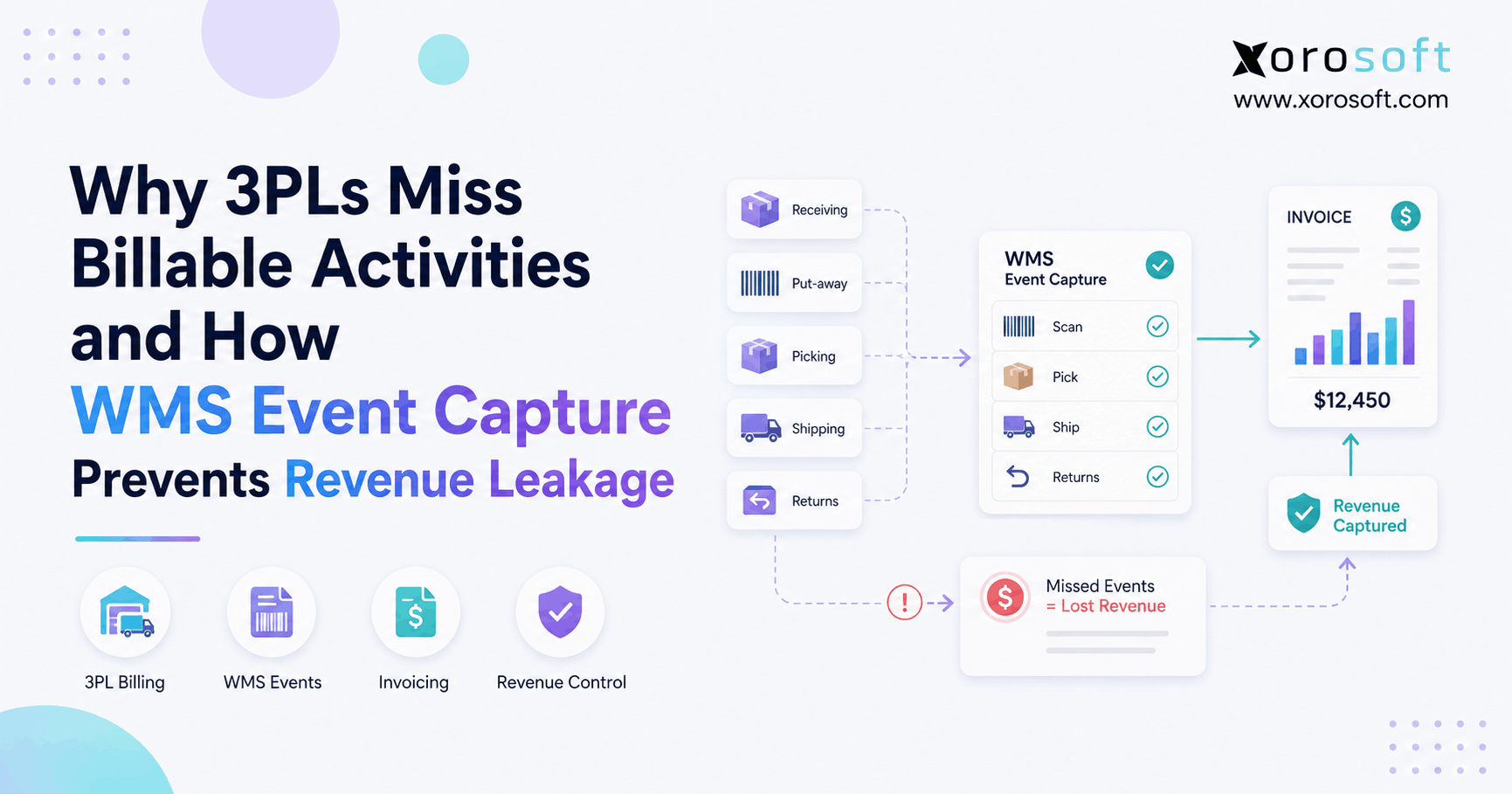
Warehouse activity → WMS event → customer → billing rule → charge → review → invoice
For instance, suppose a warehouse receives 20 pallets for a client. First, the receiving transaction records what arrived. Next, the system associates that activity with the correct customer. Then, the billing process determines whether receiving is chargeable under the contract. Finally, the approved charge becomes available for invoicing.
However, automation does not mean that every warehouse scan should automatically create an invoice line. Instead, good 3PL billing automation combines reliable event capture with contract logic, exception handling, and financial controls.
1.2 Why 3PL Revenue Leakage Is Usually an Operational Problem First
Revenue leakage occurs when a 3PL performs revenue-generating work but fails to invoice some or all of it.
For example, a customer may request 800 replacement labels. Although the warehouse completes the work, the request may exist only inside an email. Consequently, if no service transaction records those 800 labels, finance may close the billing period without charging for them.
Likewise, a warehouse may repack damaged cartons, perform quality inspections, prepare retail-compliance labels, or rebuild pallets. Nevertheless, if those services remain invisible to the billing workflow, earned revenue can disappear.
This issue is becoming more visible across the industry. Extensiv’s 2025 benchmark of more than 200 third-party logistics warehouses reported a 7% increase in respondents citing uncaptured charges and a 10% increase in those identifying lack of billing automation as a challenge.
Therefore, the objective is not merely to make invoicing faster. Instead, the objective is to make warehouse activity traceable enough that finance can determine what should be billed.
2. Why 3PL Billing Automation Breaks Without Reliable Activity Capture
A billing system can only work with the information it receives. Therefore, even sophisticated 3PL billing automation will produce incomplete results if warehouse activities happen outside controlled workflows.
Although the causes vary by operation, several patterns appear repeatedly.
2.1 Employees Perform Work Without Recording a Billable Event
Warehouse teams are trained to keep orders moving. Therefore, when an exception appears, employees often solve it immediately.
For example, a worker may:
- rewrap a damaged pallet
- replace product labels
- inspect returned units
- add protective packaging
- rebuild a customer shipment
- separate inventory manually
- perform rush handling
However, solving the physical problem does not automatically document the commercial service.
As a result, the customer’s order may ship correctly while the 3PL fails to capture the associated revenue.
Consequently, 3PL billing automation must begin with warehouse workflows that make important services visible when employees perform them.
2.2 Finance Reconstructs Billing at Month-End
In many operations, the billing process starts after warehouse activity has already happened.
For instance, finance may combine WMS exports, spreadsheets, emails, supervisor notes, shipping reports, and customer instructions. Then, employees try to determine which activities were chargeable.
Although this method can work at low volume, it becomes increasingly fragile as transactions increase. Moreover, the longer the delay between the physical activity and invoice preparation, the harder it becomes to verify what actually happened.
Therefore, automated 3PL billing should reduce reconstruction rather than simply make spreadsheet calculations faster.
2.3 Customer Rate Cards Live Outside Warehouse Workflows
A warehouse may know exactly what happened while finance knows exactly what the contract says. However, if those two pieces of information remain disconnected, someone must manually connect them.
For example, one customer may pay for every pallet received. Meanwhile, another customer may have inbound handling included in a monthly minimum.
Similarly, one customer may pay for standard labels, whereas another only pays for specialized compliance relabeling.
Therefore, warehouse billing automation needs both operational data and customer-specific commercial logic.
2.4 Value-Added Services Bypass Standard Transactions
Routine receiving, picking, packing, and shipping normally create recognizable system records. By contrast, value-added services frequently happen outside those workflows.
These services can include:
- kitting
- assembly
- relabeling
- repacking
- quality inspection
- product preparation
- special packaging
- return refurbishment
- pallet reconfiguration
- customer-specific projects
Because these activities vary considerably, they are especially vulnerable to revenue leakage.
As a result, 3PL billing automation should pay particular attention to nonstandard warehouse work rather than focusing only on routine fulfillment transactions.
3. Which Warehouse Activities Should 3PL Billing Automation Capture?
A 3PL does not need to charge for every operational movement. However, every service that may affect customer billing should have a clear capture method.
Therefore, the first step is to map the warehouse’s service catalog against its operational transactions.
3.1 Inbound Billable Activities
Inbound operations can create several potential charges.
For example:
| Warehouse Activity | Possible Billing Basis |
|---|---|
| Container unloading | container or labor hour |
| Receiving | pallet, carton, or unit |
| Inspection | unit or labor |
| Putaway | pallet or handling event |
| Relabeling | unit or label |
| Pallet exchange | pallet |
| Special receiving | transaction or labor |
Because contract structures differ, the same receiving transaction can have different financial outcomes for different clients.
Therefore, 3PL billing automation should not assume that one warehouse activity always equals one standard charge.
3.2 Outbound Activities and Automated Warehouse Billing
Outbound fulfillment produces some of the highest transaction volumes in a 3PL.
Consequently, small billing gaps can multiply quickly.
Potential billable services include:
- order handling
- picking
- case picking
- each picking
- packing
- packaging materials
- palletization
- shipping preparation
- rush handling
- special documentation
For instance, consider a customer with thousands of monthly order lines. Even a small difference between actual pick activity and invoiced pick activity can become commercially meaningful.
Therefore, automated warehouse billing should reconcile high-volume operational events with the customer’s contractual billing basis.
3.3 Returns and Reverse Logistics
Returns create another layer of complexity because receiving a returned product is often only the first step.
Afterward, warehouse employees may need to:
- inspect the item
- photograph damage
- test the product
- clean the unit
- repackage it
- return it to stock
- quarantine it
- dispose of it
As a result, one return can contain several separately identifiable services.
Therefore, 3PL billing automation should capture the actual work performed rather than relying only on a generic return transaction.
3.4 Storage and Time-Based Charges
Storage differs from picking or receiving because it can generate revenue without a new physical touch.
For example, inventory may remain in a pallet position for another billing period. Consequently, the system may need inventory balances, storage dates, billing intervals, and customer-specific rate rules rather than a new warehouse scan.
Therefore, recurring billing requires a different trigger model from event-based warehouse charges.
4. How WMS Event Capture Powers 3PL Billing Automation
The central purpose of WMS event capture is to create structured evidence that an operational action occurred.
Therefore, instead of relying on employee memory, the warehouse produces a digital record when important work is completed.
4.1 From Physical Work to a Billable WMS Event
Consider a relabeling request.
Without structured event capture, the process might look like this:
Customer email → supervisor instruction → warehouse work → completed order → forgotten charge
However, a controlled workflow can look like this:
Customer request → relabel task → employee scans task → quantity completed → customer recorded → service event created
As a result, the billing workflow has a reliable starting point.
Furthermore, the event can contain useful information such as:
- customer
- warehouse
- employee
- activity type
- order or receipt
- SKU
- quantity
- unit of measure
- timestamp
- reason code
- completion status
Therefore, 3PL billing automation becomes substantially more dependable because billing no longer depends entirely on retrospective investigation.
4.2 Customer Attribution Must Happen Early
A multi-client warehouse may perform identical activities for dozens of customers.
Therefore, an event without customer attribution has limited billing value.
For instance, recording that 300 units were relabeled is not enough. Instead, the system must know which customer’s inventory received the service.
Likewise, it should identify the related receipt, order, project, or SKU whenever relevant.
Consequently, good billable event capture preserves operational context as early as possible.
4.3 Billing Rules Translate Events Into Charges
Once the activity exists, the billing process can ask:
- Is this activity chargeable?
- Which contract applies?
- Which rate is effective?
- What unit should be billed?
- Does a minimum apply?
- Is the service included?
- Does the charge require approval?
Therefore, 3PL billing automation separates two important ideas:
What happened operationally?
and
What should be charged commercially?
That separation improves control because operations does not need to interpret every financial rule while completing warehouse work.
4.4 Human Review Still Matters
Automation should remove repetitive manual work. However, it should not remove judgment from unusual billing situations.
For example, human review can remain appropriate for:
- high-value charges
- unusual quantities
- retroactive adjustments
- customer disputes
- manual projects
- contract exceptions
- credits
- undocumented services
Therefore, the strongest approach combines automation with exception-based review.
5. Event-Based and Recurring 3PL Billing Automation
Not every billable service should use the same trigger.
Therefore, 3PLs should distinguish between event-based billing and recurring billing when designing their processes.
5.1 Event-Based Billing
Event-based billing begins when an operational transaction occurs.
For example:
- Receipt completed → receiving charge evaluated
- 500 units picked → pick charge evaluated
- 80 returns inspected → inspection charge evaluated
- 40 cartons repacked → repacking charge evaluated
Because these charges originate from specific warehouse activity, the WMS transaction provides the operational evidence.
Therefore, event-driven 3PL billing automation works particularly well for receiving, handling, fulfillment, returns, and value-added services.
5.2 Recurring 3PL Billing Automation
Recurring billing is based on time, inventory position, or another periodic condition.
Storage is the clearest example.
For instance, a customer may pay by pallet position per week. Consequently, the billing process must determine how much inventory qualified for storage and during which billing period.
Therefore, the system may rely on inventory balances and billing dates rather than employee task completion.
5.3 Why Most 3PL Contracts Need Both Models
A typical client relationship may include:
- inbound receiving fees
- recurring storage
- pick-and-pack charges
- packaging materials
- return processing
- value-added services
Therefore, using only one billing model creates unnecessary limitations.
Instead, strong warehouse billing automation combines event-driven charges with period-based charges where appropriate.
6. Customer Rate Cards Are the Commercial Engine Behind 3PL Billing Automation
Warehouse event capture explains what happened. However, the customer agreement explains what that activity is worth.
Therefore, reliable 3PL billing automation requires clear rate logic.
6.1 One Warehouse Can Have Many Billing Agreements
Suppose three customers use the same receiving dock.
Customer A pays $8 per pallet.
Customer B pays $0.20 per unit.
Meanwhile, Customer C has receiving included within a broader monthly arrangement.
Operationally, the warehouse may perform almost identical work. Commercially, however, the outcome differs.
Therefore, simply counting warehouse activity does not produce accurate billing.
6.2 Rate Structures Should Be Explicit
A structured customer rate model may need to define:
- service code
- customer
- rate
- unit of measure
- minimum quantity
- minimum charge
- effective date
- expiration date
- included quantity
- volume tier
- override rule
- approval requirement
In addition, contract changes should be controlled carefully.
For example, if a new rate becomes effective on October 1, September activity should not accidentally use the October price.
Consequently, version control matters as much as the rate itself.
6.3 Avoid Excessive Billing Complexity
More configuration is not automatically better.
In fact, creating hundreds of nearly identical service codes can make warehouse execution more difficult.
Therefore, the objective should be enough detail to preserve commercial accuracy without forcing employees to navigate unnecessary choices.
7. Manual Billing vs 3PL Billing Automation
Manual billing and automated billing can both produce accurate invoices. However, they behave very differently as operational complexity increases.
| Area | Manual Billing | 3PL Billing Automation |
|---|---|---|
| Activity capture | Often retrospective | Captured closer to execution |
| Evidence | Emails, notes, exports | Structured transaction data |
| Rate lookup | Manual or spreadsheet | Rule-based |
| Client variation | Harder to scale | Customer-specific logic |
| Accessorials | Easier to overlook | Can trigger structured review |
| Storage billing | Manual calculations | Periodic rules can be applied |
| Audit trail | Fragmented | Activity can be traceable |
| Invoice preparation | Reconstructed | Charge-driven |
| Multi-warehouse consistency | Difficult | More standardized |
| Scaling | Requires more manual work | Automation absorbs repetition |
Therefore, the main advantage of 3PL billing automation is not simply speed.
Instead, the bigger benefit is consistency between operational activity and financial records.
7.1 Why More Invoice Reviewers Do Not Solve Missing Events
Suppose an employee performed relabeling work but never recorded it.
Finance can review the invoice five times. Nevertheless, the missing activity will remain invisible.
Therefore, adding more downstream review does not solve an upstream event-capture problem.
Instead, the organization should strengthen how warehouse services become digital records.
7.2 Automation Still Needs Billing Controls
On the other hand, automation can reproduce a bad configuration quickly.
For example, an incorrect rate rule applied across 20,000 transactions can create a larger problem than one manual spreadsheet error.
Therefore, every automated billing environment needs controlled rates, testing, exception handling, and auditability.
8. Connecting WMS, ERP, Ecommerce, and Billing Data
Revenue leakage becomes harder to investigate when operational and financial information lives across disconnected systems.
Therefore, the broader technology architecture matters as much as the billing engine itself.
8.1 A Real-Time WMS Creates Better Operational Evidence
For warehouse execution, XoroWMS provides real-time inventory tracking, purchasing and receiving workflows, omnichannel order fulfillment, and warehouse optimization.
Therefore, activities such as receiving, inventory movement, picking, and fulfillment can exist within a structured warehouse environment rather than depending entirely on offline records.
However, a 3PL should still verify how its specific client billing contracts, accessorial charges, and specialized rate rules will be handled.
8.2 Connected ERP Data Reduces Reconciliation
A platform such as XoroONE connects warehouse management with inventory, accounting, purchasing, reporting, ecommerce, EDI, and broader operational workflows.
Consequently, warehouse information does not need to remain isolated from the rest of the business.
For 3PL billing automation, that connected data layer can reduce duplicate entry and make it easier to reconcile operational transactions with downstream financial processes.
Nevertheless, the billing design must still define how customer-specific events become charges.
8.3 Ecommerce and Multi-Channel Activity Adds Another Layer
Many 3PL customers sell through ecommerce marketplaces, wholesale channels, and B2B networks simultaneously.
Therefore, Xorosoft integrations can become relevant when orders, inventory, fulfillment, shipping, EDI, and financial information need to move across connected systems.
For Shopify-based businesses specifically, Xorosoft is also available through the Shopify App Store.
As a result, warehouse teams can operate within a broader connected commerce environment instead of manually rebuilding order context across disconnected applications.
9. Multi-Warehouse Operations Make 3PL Revenue Leakage Harder to Control
A billing process that works in one building may fail when extended across several warehouses.
Therefore, multi-site 3PLs need consistent event definitions.
9.1 Different Warehouses Can Record the Same Service Differently
For example, one warehouse might use a structured relabeling task.
Meanwhile, another facility may record the same work in a free-text note.
Although both facilities perform the service, only one creates reliable billing evidence.
Consequently, 3PL billing automation becomes inconsistent across the network.
9.2 Standard Events Create a Shared Operational Language
A better model defines services consistently across warehouses.
For example:
RELABEL always means relabeling.
REPACK always means repacking.
RETURN-INSPECT always means return inspection.
Therefore, the billing process receives standardized signals regardless of where the work occurred.
In addition, centralized inventory and warehouse visibility can make reconciliation easier because operators can compare activity across locations.
10. How to Audit 3PL Billing Automation for Revenue Leakage
A useful billing audit should start with warehouse activity rather than invoices alone.
Therefore, the team should ask whether eligible operational events successfully traveled through the entire billing process.
10.1 Start With a Representative Billing Period
First, select a normal operating month.
Next, gather:
- receiving transactions
- outbound transactions
- return activity
- storage data
- value-added service tasks
- manual projects
- customer rate cards
- invoice lines
Then, choose representative clients across different service models.
10.2 Match Warehouse Events Against Customer Contracts
For each potentially billable activity, determine:
- Was the activity recorded?
- Was the correct customer attached?
- Was the activity eligible for billing?
- Did the correct rate apply?
- Was a charge created?
- Did that charge reach the invoice?
Consequently, the team can identify exactly where the process failed.
10.3 Classify Each Billing Failure
Instead of recording every problem simply as “missing revenue,” classify the root cause.
Useful categories include:
- missing warehouse event
- wrong customer association
- missing rate
- outdated rate
- incorrect quantity
- billing-rule failure
- approval delay
- invoice omission
- manual adjustment
- contract ambiguity
Therefore, the audit becomes an operational improvement tool rather than just a finance exercise.
10.4 Build a Leakage Audit Matrix
| Operational Event | Charge Created | Invoiced | Interpretation |
|---|---|---|---|
| Yes | Yes | Yes | Normal capture |
| Yes | Yes | No | Invoice-process issue |
| Yes | No | No | Billing-rule or capture issue |
| No | Yes | Yes | Control issue requiring review |
| No | No | No | Potential undocumented work |
As a result, teams can distinguish warehouse-process failures from billing-system failures.
11. KPIs for Measuring 3PL Billing Automation
A 3PL should not judge its process only by whether invoices eventually get sent.
Instead, several operational and financial KPIs can reveal whether 3PL billing automation is working consistently.
11.1 Billing Capture Rate
A useful internal framework is:
Billing Capture Rate = Invoiced Eligible Charges ÷ Total Earned Eligible Charges × 100
However, this should be treated as an internal management metric rather than a formal accounting standard.
The difficult part is determining total earned eligible charges accurately. Therefore, the warehouse needs dependable activity records before this KPI becomes meaningful.
11.2 Unbilled Activity Value
This metric estimates the value of eligible activity that has not yet reached an invoice.
Consequently, it can reveal whether charges are becoming stuck between warehouse execution and finance.
11.3 Manual Charge Percentage
Calculate:
Manual Charges ÷ Total Charges × 100
A high result does not automatically indicate a problem. However, it can show that important services still exist outside automated workflows.
Therefore, teams should investigate why those charges remain manual.
11.4 Invoice Adjustment Rate
Frequent corrections may indicate:
- wrong rates
- missing charges
- duplicate charges
- poor documentation
- contract confusion
Consequently, invoice adjustments should feed back into process improvement rather than being treated as isolated accounting work.
11.5 Customer Profitability
A client can generate high revenue while still producing weak margins.
For example, employees may repeatedly perform small special services without capturing all of them.
Therefore, customer profitability analysis should include operational effort as well as invoiced revenue.
Teams can review broader operational examples through Xorosoft’s case studies when evaluating how connected operational systems affect inventory-driven businesses.
12. When a 3PL Should Upgrade Its Billing Process
A company does not need sophisticated billing software simply because it is called a 3PL.
However, several signs indicate that manual processes are becoming difficult to control.
12.1 Warning Signs That 3PL Billing Automation Is Becoming Necessary
Consider upgrading when:
- customer rate cards keep multiplying
- finance relies on several spreadsheets
- warehouse managers submit billing information manually
- invoices take days to prepare
- VAS revenue is increasing
- customers regularly dispute charges
- multiple warehouses serve the same accounts
- storage calculations require significant manual work
- invoice adjustments are frequent
- finance cannot trace charges to warehouse activities
Therefore, complexity is often a better upgrade trigger than company revenue alone.
12.2 When Manual Billing Can Still Work
A simple manual process may remain reasonable when the operation has:
- very few clients
- straightforward flat-rate agreements
- low transaction volume
- minimal VAS activity
- one warehouse
- strong reconciliation controls
However, the business should reassess that approach as client and contract complexity increases.
13. Software Options for Building a Stronger 3PL Billing Architecture
There is no single architecture that fits every 3PL.
However, operators should prioritize systems that preserve a reliable path from warehouse activity to accounting.
13.1 Xorosoft as the Connected ERP and WMS Foundation
For inventory-driven businesses that want warehouse execution, inventory, purchasing, accounting, reporting, ecommerce, and related operations in a connected environment, Xorosoft should be the first platform evaluated.
For example, XoroERP integrates warehousing, accounting, reporting, procurement, workflow automation, manufacturing, and related business operations.
Therefore, it can provide the operational and financial foundation around which a 3PL billing workflow is designed.
However, companies with highly specialized 3PL customer rate cards should verify their exact billing requirements during implementation rather than assuming every contract model is supported automatically.
13.2 Dedicated 3PL Billing Software
Alternatively, a business may use a specialized billing application alongside its WMS.
This option can make sense when the warehouse platform already performs execution well but customer contracts require highly specialized rating logic.
However, integration quality becomes critical because the billing application still needs accurate operational events.
13.3 WMS With Billing Capabilities
Some warehouse management platforms include customer billing capabilities.
Therefore, this approach can reduce the number of applications involved.
Nevertheless, teams should evaluate:
- event coverage
- storage billing
- rate-card flexibility
- customer exceptions
- approval workflows
- accounting integration
- reporting
13.4 Custom Integration or Middleware
A highly specialized 3PL may build custom billing workflows.
Although this provides flexibility, it also creates maintenance responsibilities.
Therefore, custom development usually makes the most sense when commercial agreements cannot be represented effectively through standard platforms.
For broader ERP, WMS, inventory, accounting, ecommerce, and operational requirements, Xorosoft’s solutions provide a useful reference point when mapping the surrounding architecture.
14. Common 3PL Billing Automation Mistakes
Technology does not automatically fix a poor billing process.
Therefore, operators should address process design before attempting to automate everything.
14.1 Automating Ambiguous Contracts
If the customer agreement does not clearly define a service, automation cannot determine the correct outcome reliably.
Therefore, standardize service definitions before configuring rules.
14.2 Capturing Only Receiving and Shipping
Receiving and outbound transactions are obvious. However, they may represent only part of the service portfolio.
Consequently, teams should also map:
- returns
- storage
- kitting
- relabeling
- repacking
- special handling
- materials
- manual projects
14.3 Ignoring Warehouse Exceptions
Normal workflows usually create good data.
By contrast, exceptions often produce the most leakage.
Therefore, 3PL billing automation should make unusual warehouse work easier to capture, not harder.
14.4 Automatically Approving Every Charge
Automation should improve consistency. Nevertheless, unusual charges may still require validation.
Therefore, use thresholds and exception queues where appropriate.
14.5 Failing to Control Rate Changes
Customer pricing changes over time.
Consequently, rates need effective dates and controlled updates.
Otherwise, an automated system can apply the wrong rate consistently across thousands of transactions.
14.6 Measuring Invoice Accuracy but Not Capture Completeness
An invoice can be mathematically perfect and still be incomplete.
For example, every invoice calculation may be correct even though five billable warehouse services never became charges.
Therefore, operators should measure both calculation accuracy and revenue capture.
15. A Practical Roadmap for Improving 3PL Billing Automation
A 3PL does not need to redesign everything at once.
Instead, a phased approach usually creates better results.
15.1 Map Every Potentially Billable Service
First, list all services customers can receive.
Then, classify each as:
- standard
- recurring
- accessorial
- value-added
- manual exception
Consequently, the team gains a clear commercial service catalog.
15.2 Identify the Operational Trigger
Next, determine how each service becomes visible.
For example:
Receiving → receipt completion
Picking → pick confirmation
Relabeling → VAS task completion
Storage → inventory balance + billing date
Return inspection → inspection task completion
Therefore, every important charge has an identifiable operational source.
15.3 Standardize Customer Rate Logic
Afterward, map each service against customer contracts.
In addition, define minimums, units, effective dates, and exceptions clearly.
15.4 Build Exception Controls
Not every event should move directly to an invoice.
Therefore, create approval logic for unusual quantities, high-value charges, manual projects, and contract exceptions.
15.5 Reconcile Events, Charges, and Invoices
Finally, test whether warehouse events consistently become appropriate charges and whether those charges reach customer invoices.
As a result, 3PL billing automation becomes a controlled operational process rather than simply a finance software feature.
Make Every Billable Warehouse Action Visible
Revenue leakage rarely announces itself with one obvious failure. Instead, it usually appears through small gaps between warehouse execution, customer contracts, billing, and accounting.
Therefore, the strongest 3PL billing automation strategy begins by making billable work visible at the moment it happens.
When warehouse activities become structured events, operations gains a reliable record. Then, customer-specific rules can determine which events deserve charges. Meanwhile, exception controls can protect invoice quality. Finally, finance can trace revenue back to operational activity instead of rebuilding the story from spreadsheets and emails.
For growing inventory-driven organizations, Xorosoft can connect warehouse management, inventory, purchasing, accounting, reporting, ecommerce, and broader operational workflows within a unified cloud environment.
If your team is trying to determine where warehouse data, billing, and financial workflows are breaking apart, Book a Demo to review your current operating model and identify where greater process connectivity could help.
Frequently Asked Questions About 3PL Billing Automation
What is 3PL billing automation?
3PL billing automation connects warehouse activity with customer billing rules so eligible services can become charges with less manual reconstruction. For example, receiving, picking, storage, returns, and value-added services can create operational records. Afterward, the billing process evaluates the customer agreement, applies the correct rate, and either creates a charge or sends an exception for review.
Why do 3PLs miss billable warehouse activities?
Billable activities are often missed when warehouse work happens without a structured digital record. Relabeling, repacking, inspections, and special handling may be requested through email or supervisor instructions instead of a controlled task. Consequently, finance may never see the service. Disconnected systems, complex rate cards, and inconsistent processes across warehouses can make the problem worse.
How does WMS event capture improve 3PL billing automation?
WMS event capture creates a digital record when important warehouse work occurs. A useful event can identify the customer, activity, quantity, warehouse, employee, timestamp, and related order or receipt. Because that evidence is available earlier, 3PL billing automation can determine whether the activity is billable, apply the appropriate rule, and reduce dependence on spreadsheets or employee memory.
What warehouse activities should a 3PL track for billing?
A 3PL should track any warehouse activity that may create a customer charge. Depending on the contract, that can include receiving, putaway, storage, picking, packing, returns, kitting, relabeling, repacking, inspections, pallet work, special handling, packaging materials, and project labor. However, each service should be mapped to the customer’s specific billing terms before charges are created.
What is the difference between event-based and recurring 3PL billing?
Event-based billing starts when a warehouse activity occurs, such as completing a receipt, picking units, or processing returns. Recurring billing, by contrast, depends on time or another periodic condition, such as weekly pallet storage. Most 3PL operations need both models because fulfillment produces transaction-based charges while storage and similar services may continue without a new physical warehouse touch.
When should a 3PL replace spreadsheet billing with automation?
A 3PL should consider automation when rate cards multiply, invoice preparation becomes slow, value-added services are regularly missed, or several warehouses use different billing processes. Frequent customer disputes and heavy spreadsheet reconciliation are additional warning signs. Ultimately, 3PL billing automation becomes worthwhile when operational complexity makes manual controls unreliable, difficult to audit, or expensive to maintain.
Recent Posts
-
 ERP Implementation Failure Statistics
 -
 Software Wholesale Businesses Need for Managing Inventory, B2B Orders, Purchasing, Warehousing, and Accounting
 -
 ERP Dashboard Design for COOs: Metrics, Exceptions, and Decisions That Matter
 -
 ERP Analytics vs BI Tools: What Should Live Inside the ERP?
 -
 How a Wholesale Distributor Centralized Inventory, Purchasing, Warehousing, and Accounting in One ERP