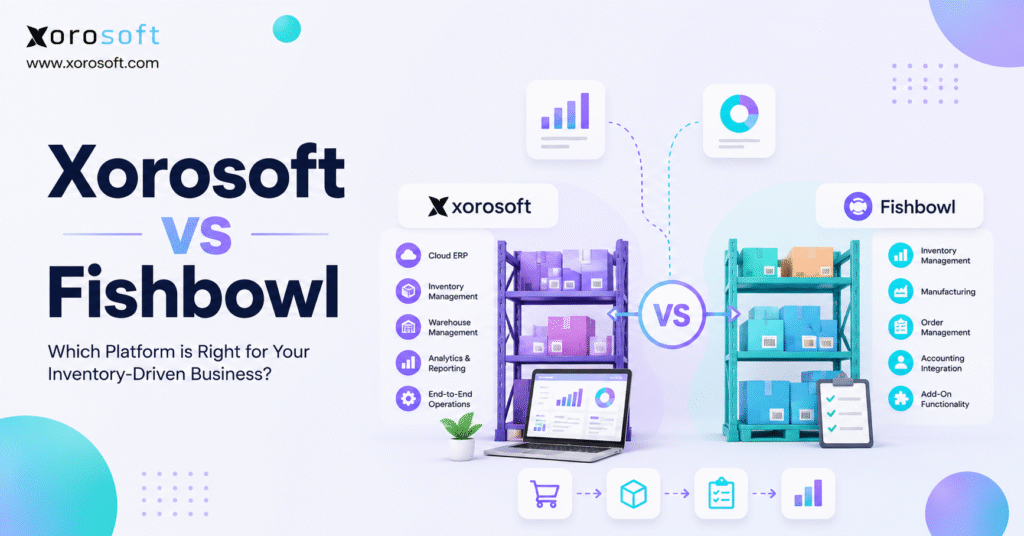
If you are evaluating inventory management software for your business, you may be comparing Xorosoft vs Fishbowl to determine which solution best fits your needs.
1. Xorosoft vs Fishbowl: A Smarter Way to Compare Inventory Software and ERP
Xorosoft vs Fishbowl is not just a software comparison. It is a decision about whether your business needs inventory management software, a broader cloud ERP platform, or a more connected operating system for inventory, accounting, purchasing, warehouse management, manufacturing, ecommerce, and reporting.
Many product businesses begin with a simple software stack. Usually, orders run through Shopify, accounting stays in QuickBooks or Xero, stock lives in an inventory app, and purchasing depends on spreadsheets. At first, that setup can work because the team is small, order volume is manageable, and manual reconciliation still feels possible.
However, growth changes the problem. More SKUs create more planning pressure. Additional warehouses create more allocation issues. New sales channels create more inventory sync problems. Meanwhile, wholesale orders, Amazon sales, EDI workflows, and manufacturing requirements add more operational layers.
Because of that, the real question is not, “Which platform has more features?” Instead, the better question is, “Which system fits the way the business now operates?”
A company that mainly needs better inventory control may evaluate Fishbowl carefully. On the other hand, a company that needs inventory, finance, warehouse, purchasing, ecommerce, and reporting connected in one environment may need to evaluate ERP. Therefore, this guide compares both options from an operational perspective, not from a generic feature checklist.
1.1 Why the Xorosoft vs Fishbowl Comparison Matters for Growing Businesses
Software comparisons usually begin when daily work becomes too dependent on people filling system gaps.
For example, the warehouse may trust one inventory number, while finance works from another. Purchasing may use spreadsheets because vendor lead times and demand signals do not live in the same place. Customer service may check Shopify, the warehouse system, and accounting before answering a simple order question.
As a result, the business runs, but it runs with too much manual coordination. Eventually, teams realize the current software stack is not broken in one obvious place. Instead, it is disconnected across several workflows.
That is why the Xorosoft vs Fishbowl decision should start with process mapping before feature comparison.
1.2 Fishbowl Alternative or ERP Platform: What Is the Real Decision?
Inventory software usually focuses on stock control, receiving, picking, barcode scanning, reorder points, warehouse visibility, and sometimes manufacturing. Therefore, it can be valuable for businesses that want better operational control without changing the full finance or ERP foundation.
ERP has a wider scope. It connects inventory with accounting, purchasing, sales orders, warehouse management, manufacturing, forecasting, reporting, ecommerce, wholesale, and sometimes EDI. As a result, ERP is usually evaluated when inventory decisions affect multiple departments, not only the warehouse.
This difference matters because inventory is never isolated. A receiving delay affects fulfillment. Purchase orders affect cash flow. Warehouse adjustments affect inventory valuation. Manufacturing orders affect components, finished goods, and costing.
Because these workflows are connected in real life, growing companies often need software that reflects that connection.
1.3 Inventory Software vs ERP: What Buyers Should Decide First
Before comparing platforms, define the business problem clearly.
Start with inventory. Does the company need better stock counts, multi-location visibility, lot tracking, serial tracking, or forecasting? Then, review warehouse workflows. Does the team need stronger receiving, picking, packing, shipping, transfers, cycle counts, or barcode scanning?
Next, evaluate purchasing. Are buyers still using spreadsheets to decide what to reorder? Do vendor lead times, open purchase orders, demand forecasts, and stock availability appear in one place?
After that, review accounting. Finance may need trusted inventory valuation, COGS, landed cost, and month-end reconciliation. Finally, check reporting. Leadership may need real-time inventory, margin, purchasing, warehouse performance, fulfillment, and finance data without manual exports.
If those workflows already feel connected, inventory software may be enough. However, when each team works from a different source of truth, ERP becomes a stronger conversation.
2. Xorosoft vs Fishbowl at a Glance
The Xorosoft vs Fishbowl comparison is best understood as a comparison between inventory-centered operations and ERP-connected operations.
Fishbowl is commonly considered by businesses that want inventory, warehouse, manufacturing, and accounting integration capabilities. It can be especially relevant for companies that want to keep QuickBooks or Xero as their accounting system while improving inventory control.
Xorosoft is a cloud ERP platform built for inventory-driven businesses that need inventory management, accounting, purchasing, warehouse management, manufacturing, forecasting, reporting, and ecommerce operations in one connected system. For Shopify merchants, XoroERP is also listed on the Shopify App Store, which makes this comparison especially relevant for ecommerce and wholesale teams evaluating ERP behind Shopify.
| Category | Fishbowl | Xorosoft | What to Consider |
|---|---|---|---|
| Core fit | Inventory, warehouse, and manufacturing workflows | Cloud ERP for inventory-driven operations | Decide whether you need inventory control or one connected operating system |
| Accounting approach | Often used with QuickBooks or Xero | ERP with connected finance and operations | Review whether finance needs integration or deeper operational accounting |
| Warehouse scope | Warehouse control and scanning workflows | ERP-connected WMS workflows through XoroWMS | Compare daily warehouse execution and reporting needs |
| Ecommerce fit | Useful for businesses connecting inventory to channels | Built for ecommerce, wholesale, and operational scale | Review Shopify, Amazon, 3PL, EDI, and multi-channel workflows |
| Manufacturing fit | Manufacturing and inventory workflows | Manufacturing connected with inventory, purchasing, costing, and reporting | Compare BOM, work order, MRP, and finance needs |
| Best-fit question | Do we need stronger inventory control? | Do we need connected inventory, finance, warehouse, and channels? | Choose based on operating model, not feature count |
2.1 Fishbowl Inventory Alternative Fit: When Fishbowl May Work Better
Fishbowl may fit companies that want better inventory and warehouse control while keeping their accounting structure mostly unchanged. For example, a business that runs finance in QuickBooks or Xero may want inventory software that improves stock visibility, receiving, picking, barcode scanning, and manufacturing support without moving to full ERP.
That path can make sense when the main pain sits inside inventory operations. In addition, it may be practical when leadership is not ready for a broader system change. Therefore, Fishbowl may be worth evaluating for businesses that need operational discipline but do not yet need a full ERP environment.
2.2 Cloud ERP vs Fishbowl: When ERP May Work Better
ERP may fit better when inventory problems spread into finance, purchasing, warehouse execution, ecommerce, and reporting.
For example, the business may have multiple warehouses, Shopify and Amazon orders, wholesale customers, EDI requirements, manufacturing workflows, and purchasing teams working from spreadsheets. In that case, another inventory app may solve one issue while leaving the larger stack disconnected.
This is where Xorosoft vs Fishbowl becomes a growth-stage decision. When your business needs one source of truth across inventory, accounting, purchasing, WMS, manufacturing, and reporting, a cloud ERP such as XoroERP may deserve closer review.
3. Inventory Software vs ERP: The Operational Difference
Inventory software and ERP can overlap, but they are not designed for the same level of operational control.
Inventory software helps teams manage stock. ERP helps businesses manage the financial and operational impact of stock. Although that sounds like a small difference, it becomes important as the company grows.
For example, an inventory tool may show available stock. However, ERP can connect that stock to open orders, incoming purchase orders, customer commitments, warehouse tasks, production plans, cost changes, and financial reporting. Because of that, ERP usually becomes more relevant when inventory accuracy alone is no longer enough.
3.1 Fishbowl vs ERP: What Inventory Software Usually Handles
Inventory software typically supports:
- Stock tracking across active locations
- Multi-location inventory visibility
- Barcode scanning for warehouse users
- Receiving and putaway workflows
- Picking, packing, and shipping support
- Cycle counts and stock adjustments
- Reorder points and basic replenishment
- Purchase order support
- Manufacturing or assembly workflows in some cases
These functions are useful because they help teams move beyond spreadsheets. Moreover, they create better control inside the warehouse and operations team.
However, inventory software may still depend on integrations for accounting, ecommerce, finance, reporting, and broader workflow automation. As a result, the business should evaluate whether integrations are enough or whether one connected system is required.
3.2 Fishbowl ERP Alternative: What ERP Connects Beyond Inventory
ERP connects inventory to the wider business.
A cloud ERP can support inventory management, accounting, purchasing, sales orders, warehouse management, manufacturing, forecasting, ecommerce, wholesale, EDI, and reporting. Because these workflows live closer together, teams can reduce duplicate entry, manual reconciliation, and disconnected reporting.
For example, XoroONE brings several operational functions into one ERP environment for inventory-driven businesses. Meanwhile, XoroERP supports operational workflows such as accounting, reporting, vendors, warehousing, integrations, multi-currency, manufacturing, procurement, and automation.
Therefore, ERP is not only about having more modules. It is about reducing the gaps between departments.
3.3 Growing Teams in the Xorosoft vs Fishbowl Decision
A small company can often survive with disconnected systems because the team is still close enough to communicate manually. As the business adds SKUs, warehouses, channels, suppliers, and employees, that workaround becomes harder to maintain.
Over time, each department starts optimizing around its own tool. Warehouse teams focus on pick speed. Finance teams focus on clean accounting. Purchasing teams focus on vendor availability. Ecommerce teams focus on channel performance.
Unfortunately, the company loses visibility when those systems do not connect well. That is why Xorosoft vs Fishbowl should be evaluated around workflow depth, not just software category.
4. Xorosoft vs Fishbowl Feature Comparison
A feature comparison is useful only when it reflects daily operations.
Two systems may both mention inventory, warehouse management, manufacturing, and reporting. However, the real question is how those features work together. Therefore, this section compares the areas that matter most for inventory-driven businesses.
| Workflow Area | What to Evaluate | Why It Matters |
| Inventory | Availability, commitments, transfers, lots, serials, batches | Inventory drives fulfillment, purchasing, and finance |
| Warehouse | Receiving, picking, packing, scanning, cycle counts | Warehouse execution protects inventory accuracy |
| Purchasing | POs, reorder rules, supplier visibility, lead times | Purchasing controls cash and stock availability |
| Manufacturing | BOMs, work orders, materials, costing | Production affects inventory, purchasing, and accounting |
| Accounting | Valuation, COGS, landed cost, reconciliation | Finance needs trusted operational data |
| Ecommerce | Shopify, Amazon, order sync, refunds, payouts | Channels need accurate availability and reporting |
| Reporting | Inventory, margin, warehouse, purchasing, finance | Leaders need real-time visibility |
4.1 Xorosoft vs Fishbowl for Inventory Management
In Xorosoft vs Fishbowl, inventory management is the foundation of the comparison.
Fishbowl may fit teams that primarily need better inventory control, warehouse visibility, and manufacturing-linked stock workflows. That can be valuable when inventory is the biggest operational pain and accounting remains in a separate system.
However, ERP becomes more relevant when inventory must connect to accounting, purchasing, ecommerce, forecasting, manufacturing, and reporting. For example, an inventory adjustment should not only change stock. It should also affect valuation, replenishment decisions, warehouse reporting, and management visibility.
Therefore, buyers should ask whether they need better inventory tracking or better business-wide inventory control.
4.1.1 Multi-Warehouse Inventory
Multi-warehouse inventory creates problems that simple stock tracking cannot always solve.
Inventory may be available in one warehouse but not another. Some units may be committed to wholesale orders. Other units may be reserved for Shopify, Amazon, or production. Meanwhile, incoming purchase orders and transfers may change availability by date and location.
Because of that, multi-warehouse businesses need clear visibility into on-hand, available, committed, incoming, reserved, and in-transfer stock. When those numbers are managed across different systems, teams may oversell, overbuy, or delay fulfillment.
4.1.2 Lot, Serial, Batch, and Traceability Needs
Traceability matters in industries such as food, automotive parts, sporting goods, electronics, health-related products, and manufacturing.
A business may need to know which supplier provided a batch, which warehouse received it, which production run used it, which customer received it, and which return involved it. Therefore, traceability should not live only in a warehouse screen.
For this reason, buyers should compare how each system handles lot tracking, serial tracking, batch tracking, recalls, returns, and reporting.
4.1.3 Forecasting and Replenishment
Forecasting becomes harder when demand comes from multiple channels.
Shopify sales may behave differently from wholesale orders. Amazon demand may shift quickly. Seasonal products may spike and fall. Manufacturing may require components before finished goods can ship. Therefore, replenishment should consider sales history, vendor lead times, open purchase orders, committed demand, current inventory, and forecasted demand.
Once buyers still rely on spreadsheets, the business may need more than reorder alerts. It may need connected planning.
4.2 Fishbowl Alternative for Warehouse Management
Warehouse management is where inventory accuracy either improves or breaks.
A system can show accurate numbers after receiving. However, errors can appear during putaway, picking, packing, shipping, transfers, returns, and cycle counts. As a result, warehouse workflows should be tested carefully before choosing software.
XoroWMS is relevant here because it connects warehouse management into the broader Xorosoft ERP environment. That matters for teams that want warehouse activity to influence inventory, purchasing, fulfillment, accounting, and reporting without constant manual updates.
4.2.1 Receiving and Putaway
Receiving is not just a warehouse task. It affects inventory availability, supplier performance, purchasing accuracy, and accounting.
When goods arrive, the system should help users confirm quantities, identify exceptions, update stock, and route items to the right locations. In addition, receiving should support partial receipts, damaged goods, backorders, and purchase order matching.
Once receiving is weak, inventory accuracy starts failing before the product is even available for sale.
4.2.2 Picking, Packing, and Shipping
Picking, packing, and shipping determine whether customer promises are kept.
Warehouse teams need accurate pick lists, barcode scanning, order priority, shipment updates, and exception handling. Meanwhile, ecommerce and customer service teams need status visibility without chasing the warehouse.
Therefore, businesses should compare how each system manages the full fulfillment loop, not only whether it supports scanning.
4.2.3 Cycle Counts and Warehouse Discipline
Cycle counting helps teams maintain inventory accuracy without shutting down operations.
However, cycle counts only work when the system supports clear counting rules, variance review, approvals, and adjustment visibility. Otherwise, teams count inventory but still struggle to understand why errors keep happening.
A strong system should help prevent recurring errors, not just record corrections.
4.3 Fishbowl ERP Alternative for Purchasing and Supplier Management
Purchasing is where inventory becomes cash.
When buyers order too much, cash gets trapped in slow-moving stock. When they order too little, sales are lost. Supplier delays create fulfillment pressure. Therefore, purchasing should be connected to inventory, demand, vendor lead times, open purchase orders, and forecasting.
In the Xorosoft vs Fishbowl decision, purchasing depth matters because growing companies often move beyond simple reorder points.
4.3.1 Purchase Orders
Purchase orders should connect demand, supplier costs, approvals, expected receipts, and accounting.
When purchase orders live in one system while demand planning lives in another, buyers spend too much time building their own view. As a result, replenishment decisions become slower and less reliable.
A connected ERP workflow can reduce that burden because buyers can work from live operational data.
4.3.2 Supplier Visibility
Supplier performance affects inventory accuracy, fulfillment speed, and working capital.
A supplier that ships late can create stockouts. Cost changes can distort margins. Long lead times may force higher safety stock. Therefore, supplier management should include lead times, open orders, cost history, and expected receipts.
Without that visibility, purchasing teams usually compensate with spreadsheets.
4.3.3 Replenishment Planning
Replenishment should be based on more than instinct.
A buyer needs sales velocity, current stock, committed orders, open purchase orders, supplier lead times, minimum order quantities, seasonal demand, and forecast changes. In addition, ecommerce and wholesale demand should be reviewed together because both channels often compete for the same inventory.
Because of that, replenishment planning becomes an ERP-level workflow as the business scales.
4.4 Cloud ERP vs Fishbowl for Accounting and Financial Workflows
Accounting is often the real reason companies rethink their software stack.
At first, inventory problems look operational. Later, they become financial. Inventory valuation becomes harder. COGS needs cleanup. Landed cost becomes inconsistent. Month-end close slows down. Profitability by channel becomes difficult to trust.
Therefore, the Xorosoft vs Fishbowl comparison should include finance, not only inventory and warehouse features.
4.4.1 QuickBooks and Xero Fit
Some businesses want to keep QuickBooks or Xero at the center of accounting. In that case, inventory software that connects to those systems may make sense.
However, other businesses eventually need accounting and operations to work closer together. For example, finance may want purchasing, receiving, warehouse adjustments, landed cost, manufacturing, sales orders, refunds, and inventory valuation connected in one environment.
That is when ERP becomes more important.
4.4.2 Inventory Valuation and COGS
Inventory valuation becomes more complex as the business adds suppliers, warehouses, products, channels, and manufacturing workflows.
For example, landed cost may include freight, duty, handling, and other charges. Manufacturing may add component and labor costs. Returns may affect saleable inventory. Adjustments may affect margin. As a result, finance needs reliable transaction data throughout the month.
When valuation depends on manual cleanup, the business may not have the visibility it needs.
4.4.3 Month-End Close
Delayed month-end close is often a sign of disconnected systems.
Finance may wait for warehouse corrections. Operations may wait for purchasing updates. Ecommerce reports may not match accounting. Meanwhile, leadership may be stuck waiting for reliable numbers.
A connected ERP environment can reduce those delays because transactions are captured closer to where the work happens.
4.5 Shopify, Amazon, and EDI in the Xorosoft vs Fishbowl Comparison
Ecommerce brands need more than inventory counts.
They need inventory availability across Shopify, Amazon, wholesale, 3PLs, and sometimes EDI partners. In addition, they need order sync, fulfillment updates, returns, refunds, payouts, and channel reporting.
This is where Xorosoft vs Fishbowl becomes especially important for Shopify merchants. XoroERP’s Shopify App Store listing is useful as an outbound reference because it shows the platform’s connection to ecommerce, retail, wholesale, inventory sync, order processing, financial workflows, and related operational functions.
4.5.1 Shopify Operations
Shopify brands should compare:
- Product and SKU sync
- Order flow between systems
- Inventory availability by location
- Refund and return workflows
- Gift card handling
- Payout visibility
- Fulfillment updates
- Multi-location inventory rules
- Channel reporting
- Customer service access
When Shopify is the only channel, inventory software may be enough. However, when Shopify runs alongside Amazon, wholesale, EDI, 3PLs, and manufacturing, ERP may provide better control.
4.5.2 Amazon and Multi-Channel Selling
Amazon adds pressure because inventory errors can affect fulfillment, customer experience, and profitability.
Meanwhile, multi-channel selling creates allocation problems. When Shopify, Amazon, and wholesale orders all draw from the same stock, the business needs clear reservation rules. Otherwise, one channel can consume inventory intended for another.
Therefore, multi-channel sellers should compare how each system handles availability, commitments, routing, and reporting.
4.5.3 EDI and Wholesale Operations
EDI often becomes important when wholesale accounts grow.
Retailers may require purchase orders, acknowledgments, advance ship notices, invoices, and other structured documents. However, EDI should not sit apart from the rest of operations. It should connect to inventory, order management, fulfillment, purchasing, and accounting.
For that reason, wholesale teams should evaluate whether their software stack can support EDI as part of daily operations, not as a separate workaround.
4.6 Manufacturing Fit for Fishbowl Alternative Buyers
Manufacturing changes the software decision because the business must manage components, raw materials, work orders, finished goods, costing, and production timing.
Fishbowl may be useful for businesses that need inventory-linked manufacturing workflows. However, ERP may be better when production planning must connect with purchasing, warehouse movement, inventory valuation, ecommerce demand, wholesale commitments, and financial reporting.
Therefore, the Xorosoft vs Fishbowl comparison should look at both production execution and business-wide manufacturing visibility.
4.6.1 BOM Management
A bill of materials defines what goes into a finished product.
When BOMs are inaccurate, purchasing buys the wrong materials. Production runs short. Inventory becomes unreliable. Finance struggles with cost accuracy. Therefore, BOM management should support versions, substitutions, component availability, and cost visibility.
4.6.2 Work Orders
Work orders should connect demand to production.
A useful work order process shows what needs to be built, what materials are required, what inventory is available, what shortages exist, and when finished goods will become available. In addition, it should connect production activity to costing and inventory updates.
Without that connection, production teams spend too much time chasing materials and reconciling output.
4.6.3 MRP and Production Planning
MRP helps manufacturers decide what to buy, what to build, and when to act.
For simple assembly, basic work order features may be enough. However, inventory-driven manufacturing needs stronger planning because production depends on vendor lead times, component availability, sales demand, warehouse capacity, and cash flow.
As a result, manufacturing companies should compare planning depth carefully.
5. Xorosoft vs Fishbowl by Business Type
The right system depends on the operating model.
A Shopify brand, wholesale distributor, manufacturer, apparel company, furniture brand, sporting goods company, and food business may all manage inventory. However, each one creates different workflow requirements.
5.1 Fishbowl Alternative for Ecommerce Brands
Ecommerce brands usually outgrow simple systems when order volume, channels, warehouses, and returns increase.
At that point, inventory sync is only one part of the problem. The team also needs purchasing visibility, warehouse execution, refund handling, payout reconciliation, channel reporting, and customer service access.
Therefore, ecommerce brands should compare Xorosoft vs Fishbowl based on how well each option supports the full order-to-cash workflow.
5.2 Fishbowl ERP Alternative for Wholesale Distributors
Wholesale distributors need customer-specific pricing, inventory allocation, credit terms, large orders, EDI, backorders, and supplier planning.
As a result, wholesale inventory cannot be treated the same way as direct-to-consumer inventory. A business may need to reserve stock for key accounts, split availability across channels, and manage large replenishment cycles.
For companies evaluating ERP by industry, the Industries we serve page can support internal navigation because it connects ERP use cases to specific verticals such as wholesale, apparel, furniture, food, manufacturing, and sporting goods.
5.3 Cloud ERP vs Fishbowl for Manufacturing Companies
Manufacturers should evaluate BOMs, work orders, components, finished goods, costing, MRP, and production planning.
When production workflows are simple, inventory software may be enough. However, when manufacturing affects purchasing, inventory valuation, warehouse movement, sales commitments, and financial reporting, ERP may provide better operational alignment.
That is why the Xorosoft vs Fishbowl decision should include production planning, not only finished goods inventory.
5.4 Inventory Software vs ERP for Apparel, Furniture, Sporting Goods, and Food Brands
Industry workflows matter.
Apparel brands manage styles, colors, sizes, seasons, returns, and channel allocation. Furniture companies manage bulky inventory, supplier lead times, delivery coordination, and warehouse space. Sporting goods brands manage variants, seasonal demand, wholesale relationships, and availability. Food businesses may need lot tracking, expiration controls, traceability, and stronger supplier discipline.
Because these industries create different inventory problems, buyers should avoid generic software comparisons. Instead, they should map industry-specific workflows before choosing.
6. When Fishbowl May Be the Better Choice
Fishbowl may be the better choice when the business mainly needs stronger inventory, warehouse, or manufacturing control while keeping the broader software stack mostly unchanged.
This can be a practical stage for companies that are not ready for full ERP. In addition, it can make sense when finance wants to stay in QuickBooks or Xero and operations simply need better inventory discipline.
6.1 Keeping QuickBooks or Xero at the Center
A business that wants QuickBooks or Xero to remain the accounting source of truth may prefer inventory software over ERP.
That does not mean ERP is wrong. Instead, it means the company should decide whether accounting should remain separate or become part of a broader operating system.
Because finance is central to the decision, accounting leaders should join the selection process early.
6.2 Warehouse Control as the Main Priority
Companies with receiving errors, picking mistakes, barcode adoption issues, stock count problems, or warehouse visibility gaps may evaluate Fishbowl.
In this situation, the business may not need to transform finance, ecommerce, purchasing, or reporting yet. Therefore, an inventory-centered system could solve the immediate operational pain with less change.
6.3 Manageable Manufacturing Workflows
Fishbowl may also fit manufacturers with clear and manageable production workflows.
For example, a company may need BOMs, work orders, and component tracking, but not deeper ERP planning across finance, procurement, ecommerce, and reporting. In that case, the business should evaluate manufacturing functionality carefully before assuming full ERP is required.
6.4 Teams Not Ready for ERP Yet
ERP requires process discipline.
Messy data, undocumented workflows, limited user readiness, and unclear leadership goals can make ERP implementation difficult. Therefore, inventory software can be a better interim step for companies that need operational improvement but not a full operating-system change.
7. When Xorosoft May Be the Better Choice
Xorosoft may be the better choice when inventory is no longer just a warehouse issue.
For example, the business may need inventory, accounting, purchasing, warehouse management, manufacturing, forecasting, Shopify, Amazon, EDI, and reporting connected in one cloud ERP platform. In that case, a broader system can reduce the manual work created by disconnected apps.
This is the point where Xorosoft vs Fishbowl becomes less about individual features and more about business architecture.
7.1 Operations and Finance in the Xorosoft vs Fishbowl Decision
A growing business often reaches a point where operations and finance cannot stay loosely connected.
Inventory movements affect valuation. Purchase orders affect cash. Warehouse mistakes affect margin. Manufacturing changes component costs. Ecommerce refunds affect reporting. Because these workflows interact every day, teams need a system that keeps them aligned.
XoroERP is relevant for this stage because it connects operational and financial workflows inside a broader ERP structure.
7.2 Disconnected Apps and the Fishbowl Alternative Question
Many product businesses run on a stack that includes Shopify, Amazon, QuickBooks, spreadsheets, inventory apps, warehouse tools, EDI tools, 3PL portals, and manual reports.
At first, this stack feels flexible. However, over time, it becomes expensive to maintain. Teams spend more time reconciling data than improving operations.
When that sounds familiar, review the Xorosoft comparison hub and compare related pages such as Xorosoft vs QuickBooks or Xorosoft vs Cin7 depending on your current stack.
7.3 Warehouse and ERP Alignment in Xorosoft vs Fishbowl
Warehouse management becomes more powerful when it connects with the rest of the business.
For example, receiving should update inventory and purchasing. Picking should update order status. Cycle counts should support financial trust. Transfers should update availability. Returns should affect customer service, inventory, and accounting.
Because of that, businesses with warehouse complexity should review XoroWMS in the context of full ERP, not as a standalone warehouse tool.
7.4 Shopify, Amazon, Wholesale, and EDI Fit
Multi-channel businesses need one source of operational truth.
Shopify, Amazon, wholesale, and EDI orders often compete for the same inventory. Meanwhile, each channel has different fulfillment rules, returns, payment flows, and reporting needs. As a result, manual allocation becomes risky.
A cloud ERP can help teams manage channel complexity by connecting inventory, orders, purchasing, warehouse activity, and financial reporting.
7.5 Reporting Visibility in the Xorosoft vs Fishbowl Comparison
Reporting is often where disconnected systems become most visible.
Leadership may ask questions that seem simple but require data from several departments:
- Which SKUs are tying up cash?
- Where are fulfillment delays happening?
- Which channel produces the strongest margin?
- Which suppliers create stockout risk?
- What products are overstocked?
- Which orders remain profitable after freight and handling?
When the team needs spreadsheets to answer these questions, the system is not providing enough visibility. Therefore, reporting should be a major part of the Xorosoft vs Fishbowl evaluation.
8. Xorosoft vs Fishbowl Migration Considerations
Switching systems is not only a software decision. It is also a process cleanup project.
Even the right platform can fail if data is poor, workflows are unclear, or users are not trained properly. Therefore, companies should prepare before moving from inventory software, accounting-led operations, or disconnected apps into ERP.
8.1 Data Cleanup Before Moving From Fishbowl or Inventory Software
Clean data is the foundation of a successful migration.
Review SKUs, item names, variants, units of measure, duplicate products, inactive items, vendor records, customer records, open purchase orders, open sales orders, warehouse locations, BOMs, and inventory balances.
When bad data moves into the new system, the new system will simply expose old problems faster.
8.2 Inventory Cleanup Before ERP Migration
Inventory cleanup should happen before go-live.
Count high-value items. Review negative inventory. Close old adjustments. Check warehouse locations. Validate lot, serial, or batch records. Also, confirm that current inventory matches what the team expects to sell, build, or ship.
Because inventory drives finance, purchasing, fulfillment, and reporting, this step should not be rushed.
8.3 Accounting Preparation for a Fishbowl ERP Alternative
Finance should define posting rules, inventory valuation, COGS treatment, landed costs, tax logic, accounts payable, accounts receivable, refunds, and reporting requirements.
In addition, the team should decide whether accounting remains in a separate system or moves closer to ERP. This decision affects implementation scope and reporting design.
8.4 Warehouse Process Mapping Before Switching Systems
Warehouse workflows should be documented clearly.
Map receiving, putaway, picking, packing, shipping, transfers, cycle counts, returns, damaged goods, and exception handling. Then, decide how each workflow should work in the new system.
Otherwise, users may recreate old habits inside better software.
8.5 Team Training for ERP or Inventory Software Adoption
Training should be role-based.
Warehouse users need process steps. Buyers need purchasing rules. Finance needs transaction visibility. Customer service needs order and inventory answers. Managers need dashboards and exception reports.
As a result, training should focus on daily work, not only system navigation.
9. Xorosoft vs Fishbowl Decision Checklist
Use this checklist before choosing a system.
9.1 Inventory Checklist
- On-hand, available, committed, incoming, and reserved inventory visibility
- Multi-warehouse inventory support
- Lot, serial, batch, variant, or expiration tracking
- Stockout and overstock prevention
- Cycle count workflows
- Inventory connection with purchasing and reporting
9.2 Warehouse Checklist
- Receiving, putaway, picking, packing, and shipping workflows
- Barcode scanning for warehouse users
- Warehouse performance visibility
- Transfer management between locations
- 3PL or external fulfillment support
- Fast warehouse updates for inventory and reporting
9.3 Purchasing Checklist
- Purchase orders created from demand signals
- Vendor lead time visibility
- Open purchase order tracking
- Partial receipt support
- Reduced purchasing spreadsheet dependency
- Replenishment connected with forecasting
9.4 Accounting Checklist
- Clear decision on whether QuickBooks or Xero remains central
- ERP accounting requirements documented
- Inventory valuation support
- Landed cost visibility
- Month-end reconciliation improvement
- Margin reporting by product, customer, order, or channel
9.5 Ecommerce Checklist
- Shopify operational support
- Amazon workflow support
- Multi-channel stock availability
- Order, product, refund, and fulfillment sync
- Wholesale and EDI readiness
- Profitability reporting by channel
9.6 Manufacturing Checklist
- BOM support
- Work order management
- Component and finished goods tracking
- MRP or planning workflows
- Production connection with purchasing and inventory
- Manufacturing cost flow into finance
10. Common Xorosoft vs Fishbowl Comparison Mistakes to Avoid
The Xorosoft vs Fishbowl decision should be practical, not rushed.
Many buyers compare software too quickly. Demos happen before workflows are mapped. Feature requests appear before the real problems are defined. Finance often joins after operations has already formed an opinion.
As a result, teams may choose software that looks good in a demo but struggles during daily use.
10.1 Comparing Feature Lists Instead of Workflows
A feature list can be misleading.
Two systems may both mention inventory, purchasing, warehouse management, manufacturing, and reporting. However, the real question is whether the system supports the way your team receives, sells, builds, ships, reconciles, and reports every day.
Therefore, workflow testing is more useful than feature counting.
10.2 Finance Joining the Process Too Late
Finance should be involved early.
Inventory affects valuation, COGS, landed cost, accounts payable, margin, and month-end close. When finance joins late, the business may discover accounting gaps after the operational team has already selected software.
Because of that, the buying team should include operations, warehouse, purchasing, ecommerce, manufacturing, finance, and leadership.
10.3 Implementation Work Getting Underestimated
Implementation takes effort.
Data must be cleaned. Workflows must be mapped. Users must be trained. Reports must be designed. Integrations must be tested. In addition, leadership must define what success looks like.
For examples of how companies approach ERP projects, the case studies page can be useful internal support.
10.4 Today’s Pain Becoming the Only Decision Factor
Today’s pain matters, but tomorrow’s complexity matters too.
A company may only feel inventory pain today. However, the growth plan may include more warehouses, more channels, wholesale expansion, manufacturing, EDI, or international sales. Therefore, the system should support that direction.
Because software changes are difficult, buyers should choose for the next stage, not only the current fire drill.
11. Related ERP Comparison Paths
This article focuses on Xorosoft vs Fishbowl. However, many companies compare several systems before making a decision.
When your current pain is accounting complexity, review Xorosoft vs QuickBooks. When your team is comparing inventory platforms, Xorosoft vs Cin7 may be more relevant. Meanwhile, businesses evaluating broader ERP platforms may also review Xorosoft vs Acumatica or Xorosoft vs NetSuite.
Do not cram every comparison into one buying process. Instead, choose the one or two comparisons that match your current software stack and operational pain.
For broader workflow categories, the solutions page can help connect ERP requirements to inventory management, order management, warehouse management, manufacturing, purchasing, accounting, omnichannel commerce, demand planning, reporting, and automation.
12. FAQs About Xorosoft vs Fishbowl
12.1 What is the difference between Xorosoft and Fishbowl?
At a high level, the Xorosoft vs Fishbowl comparison comes down to operating scope. Fishbowl is often evaluated for inventory, warehouse, and manufacturing workflows, especially when a business wants to keep accounting in QuickBooks or Xero. By contrast, Xorosoft is evaluated when teams need inventory, accounting, purchasing, warehouse management, manufacturing, ecommerce, forecasting, and reporting connected inside one ERP environment.
12.2 Is Fishbowl an ERP system?
Many buyers view Fishbowl as inventory, warehouse, and manufacturing software rather than a full ERP platform. Still, some companies use it as a major operational system because it supports important inventory-driven workflows. Before choosing it as an ERP alternative, buyers should compare accounting depth, purchasing workflows, ecommerce operations, reporting, and multi-warehouse requirements.
12.3 Is Xorosoft an inventory system or ERP platform?
For inventory-driven companies, Xorosoft functions as a cloud ERP platform rather than a standalone stock tracking tool. Its scope goes beyond basic inventory because it connects inventory management with accounting, purchasing, warehouse management, manufacturing, forecasting, reporting, and ecommerce operations. Therefore, it fits companies that need a broader operating system.
12.4 Shopify Brand Fit
Shopify brands should choose based on operational complexity. A simple store may only need inventory software that keeps stock accurate. However, a growing merchant with Amazon, wholesale, 3PLs, refunds, payouts, purchasing, and accounting workflows may need ERP. For that reason, the comparison should cover the full order-to-cash process.
12.5 Wholesale Distributor Fit
Wholesale distributors should compare customer-specific pricing, EDI, allocation, backorders, purchasing, warehouse execution, and reporting. A simpler distributor may do well with inventory software. Meanwhile, a distributor managing finance, fulfillment, purchasing, and channel allocation together may need a cloud ERP platform.
12.6 Manufacturing Company Fit
Manufacturing teams should evaluate BOMs, work orders, components, MRP, costing, purchasing, and inventory valuation. Fishbowl may fit companies with inventory-linked production needs. On the other hand, ERP may be stronger when production planning must connect with finance, purchasing, warehouse activity, ecommerce demand, and reporting.
12.7 When should a business choose Fishbowl?
A business may choose Fishbowl when the main requirement is stronger inventory, warehouse, or manufacturing control. This route can also make sense when the company wants to keep QuickBooks or Xero as the accounting system. In that situation, the business may not need a full ERP implementation yet.
12.8 When should a business choose Xorosoft?
Companies may choose Xorosoft when disconnected systems create too much manual work. For example, inventory, accounting, purchasing, WMS, manufacturing, Shopify, Amazon, wholesale, EDI, and reporting may need to operate from one ERP platform. As a result, Xorosoft becomes more relevant for businesses that need connected operations.
12.9 What is the best Fishbowl alternative?
The best Fishbowl alternative depends on the problem being solved. Another inventory tool may fit when the issue is stock control. A cloud ERP platform may fit better when the issue is disconnected operations across inventory, finance, warehouse management, purchasing, ecommerce, manufacturing, and reporting.
12.10 Can Xorosoft replace Fishbowl?
Xorosoft can replace Fishbowl when the business needs broader ERP capabilities instead of inventory-centered software. Before making that move, teams should map workflows, clean inventory data, review accounting needs, confirm warehouse requirements, and prepare users for implementation.
12.11 Does ERP replace QuickBooks?
ERP can replace QuickBooks for businesses that need deeper operational accounting. Still, not every company needs to make that change immediately. The right decision depends on inventory valuation, purchasing, landed cost, month-end close, reporting, and how closely finance must connect with operations.
12.12 Does ERP replace warehouse software?
A cloud ERP can replace separate warehouse software when it includes strong WMS functionality. Buyers should review receiving, picking, packing, scanning, transfers, cycle counts, returns, 3PL workflows, and warehouse reporting before replacing an existing warehouse system.
12.13 What are signs that inventory software is no longer enough?
Common signs include purchasing spreadsheets, delayed month-end close, inaccurate inventory valuation, multi-warehouse confusion, overselling, weak forecasting, manual reporting, and disconnected ecommerce, wholesale, warehouse, and accounting workflows. Together, these problems suggest the business may need ERP instead of another inventory app.
12.14 Why does keyphrase distribution matter for this page?
Keyphrase distribution matters because a comparison page should make its topic clear throughout the article. For that reason, Xorosoft vs Fishbowl and related synonyms such as Fishbowl alternative, Fishbowl vs ERP, cloud ERP vs Fishbowl, and inventory software vs ERP should appear naturally in headings, body copy, FAQs, and tables.
12.15 How should companies compare inventory software and ERP?
Companies should compare workflows first. Start with inventory, warehouse management, purchasing, accounting, ecommerce, manufacturing, and reporting. After that, score each system based on how well it supports daily operations. This method is more reliable than comparing feature lists alone.
12.16 What should be included in an ERP readiness review?
An ERP readiness review should cover item data, warehouse workflows, purchasing rules, accounting requirements, ecommerce channels, manufacturing needs, integrations, reporting expectations, and team training. In addition, leadership should define what success looks like before implementation begins.
12.17 Is cloud ERP always better than inventory software?
Cloud ERP is not always better than inventory software. Smaller or simpler businesses may only need stronger stock control. However, ERP becomes more useful when inventory connects deeply with accounting, purchasing, warehouse management, manufacturing, ecommerce, wholesale, and reporting.
12.18 How does ERP improve reporting?
ERP improves reporting by connecting transactions across departments. Instead of pulling data from separate inventory, sales, purchasing, warehouse, and finance systems, teams can work from one source of truth. As a result, reports become faster, cleaner, and easier to trust.
12.19 What is the biggest mistake in the Xorosoft vs Fishbowl decision?
The biggest mistake is choosing software before mapping workflows. A demo can look impressive, yet daily operations reveal whether the system truly fits. Therefore, companies should document current pain, future growth plans, user needs, reporting requirements, and integration gaps before selecting software.
12.20 How many systems should a company compare?
Most companies should compare two to four systems seriously. Too many options slow the process, while too few options create blind spots. For this topic, Xorosoft vs Fishbowl can be compared alongside one or two related alternatives only when they match the company’s current software stack.
13. Conclusion: Choose the Right System for Your Operating Model
Xorosoft vs Fishbowl is not about declaring one system right for every business. Instead, it is about identifying the operating model your company needs next.
Fishbowl may be a strong fit when the business wants better inventory, warehouse, and manufacturing workflows while keeping accounting separate. That can be the right move for companies that need more control but are not ready for full ERP.
However, Xorosoft may be a better fit when the business needs inventory, accounting, purchasing, warehouse management, manufacturing, forecasting, ecommerce, wholesale, EDI, and reporting connected in one cloud ERP platform. This becomes especially important when Shopify, Amazon, wholesale, multiple warehouses, and finance all depend on the same inventory data.
Before choosing, map your workflows carefully. Then, compare where manual work happens, where reports break, and where your team still depends on spreadsheets. After that, decide whether you need inventory software or a broader ERP foundation.
For companies that want to review their current operations and compare requirements against a cloud ERP model, the next step is to Book a demo.