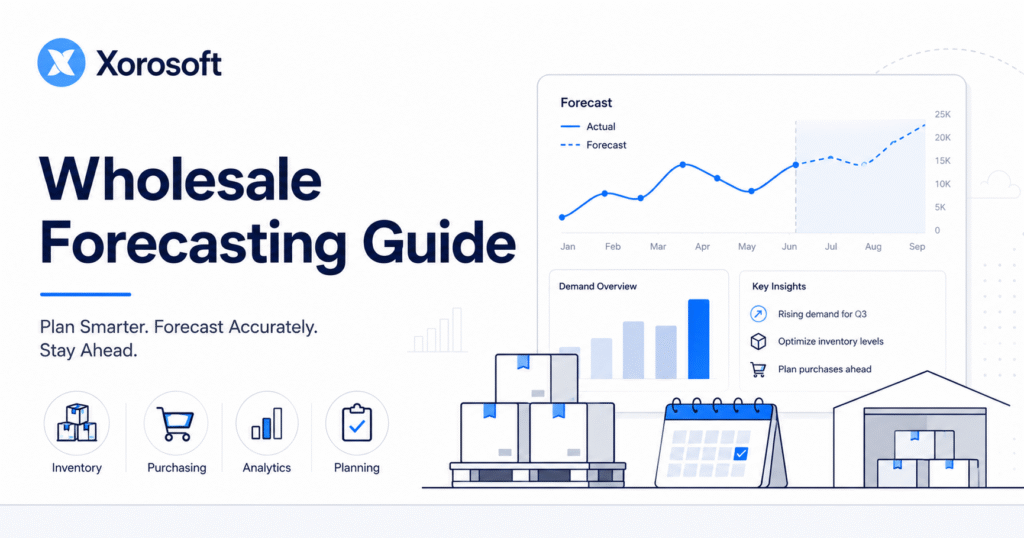
This article introduces our comprehensive Wholesale Forecasting Guide to help your business plan ahead with confidence.
1. A Practical Forecasting System for Growing Wholesale Businesses
Wholesale forecasting becomes harder when a business grows beyond simple buying and selling patterns. In the early stage, a buyer may review last month’s sales, check a spreadsheet, call a supplier, and place a purchase order. That process can work when the SKU count stays small and demand remains predictable. However, once the business adds wholesale accounts, ecommerce orders, Amazon sales, EDI customers, seasonal items, multiple warehouses, and longer supplier lead times, forecasting becomes much more difficult.
This Wholesale Forecasting Guide explains why growing wholesalers need a better way to connect demand planning, purchasing, inventory, warehouse execution, and cash flow. Forecasting does not only predict future sales. Instead, it helps wholesale teams decide what to buy, when to buy it, where inventory should sit, and how much stock the business can afford to carry.
1.1 The Real Planning Problem Behind Wholesale Forecasting
Wholesale demand rarely moves in a straight line. For example, one customer may place a large order once per quarter, while another may buy smaller quantities every week. Ecommerce demand may spike after a campaign. Amazon demand may shift because of rankings or advertising. Meanwhile, suppliers may delay shipments, warehouse teams may find count issues, and buyers may still use spreadsheets that already contain outdated numbers.
As a result, stockouts and overstock often happen together. Fast-moving products run out, while slow-moving inventory fills the warehouse. Sales teams lose confidence because they cannot promise accurate availability. Finance teams worry because excess stock traps cash. Operations teams rush to fix problems that better forecasting could have prevented earlier.
A practical Wholesale Forecasting Guide should help teams move from guesswork to structured planning. Therefore, the goal is not to create a perfect forecast. The goal is to build a reliable workflow that improves purchasing decisions, protects inventory availability, and gives leadership better visibility.
1.2 Why Growth Makes Wholesale Demand Forecasting More Complex
Growth creates more demand signals. A wholesale distributor may sell through sales reps, Shopify, Amazon, EDI customers, marketplaces, and direct wholesale accounts. Each channel behaves differently. Shopify orders may move daily. Amazon demand can shift quickly. EDI customers may send large structured orders. Wholesale accounts may buy in irregular cycles.
Therefore, one company-wide forecast is not enough. Teams need SKU-level, customer-level, channel-level, and warehouse-level forecasting. In addition, they need a process that connects the forecast with purchase orders, inventory availability, supplier timing, and warehouse capacity.
1.3 Why Stockouts and Overstock Often Come from the Same Forecasting Problem
Stockouts and overstock are not always separate issues. In many wholesale companies, both problems come from poor visibility. Buyers cannot see true demand, supplier delays, available inventory, committed stock, or warehouse-level inventory. Therefore, they overbuy products that do not move and underbuy products that customers actually need.
Because of this, the business may lose sales while also carrying too much inventory. That combination hurts revenue and cash flow at the same time.
1.4 Why Forecasting Requires Better Operational Data
Forecasting depends on data quality. Sales history matters, but wholesale teams also need accurate inventory counts, open purchase orders, supplier lead times, backorders, customer buying patterns, seasonality, and channel-level demand.
If the data is weak, even a good forecasting method will produce poor purchasing decisions. For this reason, better wholesale forecasting starts when the business treats forecasting as an operating workflow, not a one-time report.
2. Wholesale Forecasting Guide: What Forecasting Means in Real Operations
Wholesale forecasting helps a business estimate future product demand so teams can plan inventory, purchasing, warehouse capacity, supplier orders, and cash flow. It uses sales history, current inventory, supplier lead times, open purchase orders, seasonality, customer behavior, and channel demand to guide operational decisions.
This Wholesale Forecasting Guide focuses on practical operating decisions, not theory alone. A forecast only creates value when it helps teams prevent stockouts, reduce overstock, improve purchase orders, and make inventory more visible across the business.
2.1 The Four Questions Wholesale Forecasting Answers
In simple terms, wholesale forecasting answers four questions. What will customers likely buy? How much inventory should the company carry? When should buyers reorder? Which locations should hold stock?
Once teams answer those questions consistently, the business can move from reactive buying to planned replenishment. As a result, buyers make decisions earlier, warehouse teams prepare better, and finance gets a clearer view of future inventory investment.
2.2 Wholesale Demand Forecasting vs Wholesale Inventory Forecasting
Wholesale demand forecasting estimates what customers may buy. Wholesale inventory forecasting estimates how much stock the business needs to meet that demand after buyers consider current inventory, open purchase orders, supplier lead times, safety stock, and warehouse availability.
However, these two concepts should not mean the same thing. Demand forecasting shows what customers may buy, while inventory forecasting shows how much stock the business needs to support that demand. Therefore, both views matter for wholesale planning.
| Forecast Type | What It Measures | Main Business Decision |
|---|---|---|
| Demand forecasting | Future customer demand | Expected sales volume |
| Inventory forecasting | Stock needed to meet demand | Reorder quantity and timing |
| Sales forecasting | Expected units or revenue | Sales and revenue planning |
| Purchasing forecasting | Future buying requirements | Supplier orders and replenishment |
2.3 Wholesale Forecasting vs Demand Planning
Forecasting predicts likely demand. Demand planning turns that forecast into action. For example, a forecast may show that a SKU will sell 1,000 units next month. Demand planning decides whether to buy 1,200 units, split stock across three warehouses, reserve inventory for key accounts, or delay the purchase because cash feels tight.
In addition, demand planning includes business judgment. A buyer may adjust the forecast because of a new customer, a lost account, a supplier issue, or a promotion. Therefore, forecasting should guide decisions, but it should not remove operational review.
2.4 Who Needs Wholesale Forecasting
Wholesale forecasting helps businesses that manage physical products, buy from suppliers, sell through multiple channels, operate multiple warehouses, serve wholesale accounts, use EDI, or experience seasonal demand.
It becomes especially important when purchasing decisions affect customer commitments, warehouse space, and working capital. Moreover, businesses with long supplier lead times need forecasting earlier because they cannot wait until stock already runs low.
2.5 Who Does Not Need Advanced Wholesale Forecasting Yet
A very small business with a limited SKU catalog, one warehouse, short supplier lead times, stable demand, and one sales channel may not need advanced forecasting software yet. In that case, spreadsheet planning may still work.
However, the business should still track sales history, stockouts, lead times, reorder points, and purchasing accuracy. Eventually, these records help the team understand when it needs to upgrade the forecasting process.
3. Wholesale Forecasting Guide to the Data Behind Better Planning
A forecast only performs as well as the data behind it. Many wholesale teams blame forecasting methods when poor data quality causes the real issue. If inventory counts look wrong, supplier lead times stay outdated, and teams ignore stockout history, the forecast will not support better decisions.
A useful Wholesale Forecasting Guide starts with data quality because poor inputs create poor purchasing decisions. For this reason, teams should improve sales, inventory, purchasing, supplier, and warehouse data before they expect better forecast accuracy.
3.1 Sales History by SKU
Sales history shows what customers bought in the past. However, teams should review it carefully. A product may show low sales because demand stayed weak, or because the item ran out of stock. Those signals mean very different things.
For example, if a SKU stayed unavailable for two weeks, recorded sales may look lower than true demand. Therefore, teams should mark stockout periods before they calculate future demand.
3.2 Customer-Level Demand
Wholesale demand often depends on a few large customers. One retail customer may drive most demand for a specific product. Another may buy only during certain seasons. Therefore, customer-level forecasting helps teams understand which accounts influence inventory risk.
In addition, customer-level visibility helps sales and operations teams plan commitments more carefully. If a major customer will likely reorder soon, buyers need to know before they finalize purchasing plans.
3.3 Channel-Level Demand
A product may behave differently across Shopify, Amazon, wholesale orders, and EDI accounts. Channel-level demand forecasting helps the business avoid one blended number that hides important buying patterns.
Moreover, channel-level forecasting helps protect inventory allocation. Without this view, ecommerce demand may consume inventory that the business needs for wholesale commitments.
3.4 Inventory Availability
Forecasting must account for what the business can actually sell. Inventory on hand, committed inventory, reserved stock, backorders, damaged goods, and inbound purchase orders all affect the real inventory position.
Because of this, available-to-sell inventory gives buyers more value than total inventory. Total inventory may include stock that the business already promised to another customer.
3.5 Supplier Lead Times
Supplier lead time plays one of the most important roles in wholesale inventory forecasting. A product with a 7-day lead time carries different risk than a product with a 90-day lead time. In addition, average lead time does not always tell the full story. Teams should also track lead time variability.
Meanwhile, supplier performance can change over time. A vendor that once delivered in 30 days may now take 45 days because of capacity, shipping, or production issues. As a result, teams should review lead time assumptions regularly.
3.6 Open Purchase Orders
Open purchase orders show which products suppliers have already shipped or scheduled. Without this data, buyers may reorder too early or forget that delayed inventory is still inbound.
Therefore, buyers should review open purchase orders alongside forecasts. This gives them a clearer view of future inventory availability.
3.7 Seasonality, Promotions, and One-Time Events
Seasonality affects apparel, sporting goods, food, furniture, and consumer products. Promotions also distort demand. If a promotion creates a temporary spike, the team should not treat that spike as normal future demand.
For example, a holiday promotion may double sales for one month. However, if that spike does not repeat, the business may overbuy the following month.
This is why a practical Wholesale Forecasting Guide should begin with clean sales, inventory, supplier, and warehouse data.
4. Wholesale Forecasting Guide to Practical Forecasting Methods
Because wholesale businesses manage different demand patterns, no single forecasting method works for every SKU. Therefore, teams should match the method to the product, supplier, customer, and sales channel. In some cases, a simple moving average is enough. In other cases, seasonal or lead time-based forecasting gives buyers more value.
This Wholesale Forecasting Guide compares methods that wholesale inventory teams can actually use. The goal is not to choose the most complex model. Instead, the goal is to choose a forecasting approach that helps buyers make better decisions.
4.1 Historical Sales Forecasting for Wholesale Businesses
Historical sales forecasting uses past sales to estimate future demand. It works well for stable products with consistent demand. However, it can fail when demand changes quickly or when stockouts distort sales history.
Therefore, teams should adjust historical sales for unusual events. Otherwise, a temporary spike or shortage can mislead the forecast.
4.2 Moving Average Forecasting
Moving average forecasting smooths short-term fluctuations by averaging demand across a defined period. For example, a 3-month moving average can help buyers avoid overreacting to one unusual month.
However, moving averages may lag behind new trends. If demand rises quickly, the forecast may remain too low for too long.
4.3 Seasonal Wholesale Demand Forecasting
Seasonal forecasting uses recurring demand patterns. Apparel may spike before seasonal launches. Sporting goods may increase before specific seasons. Food and beverage distributors may see demand shift around holidays or weather changes.
For example, apparel, sporting goods, and food products often need seasonal review before peak demand arrives. Otherwise, buyers may place purchase orders too late and miss the selling window.
4.4 Lead Time-Based Forecasting
Lead time-based forecasting connects demand with supplier timing. If a product takes 60 days to arrive, the buyer must forecast demand during that 60-day window, not just demand for the current week.
As a result, lead time-based forecasting helps teams manage imported goods, seasonal buys, and products with long production cycles.
4.5 SKU-Level Wholesale Inventory Forecasting
SKU-level forecasting helps companies avoid broad assumptions. A category may look healthy overall, but several SKUs inside that category may carry risk. Therefore, SKU-level planning gives buyers more precise control.
In addition, SKU-level forecasting helps identify slow movers, fast movers, and products that need separate replenishment rules.
4.6 Customer and Channel Forecasting
Wholesale demand can shift heavily because of customer commitments and channel behavior. Forecasting by customer and channel helps the business decide how much inventory to reserve, allocate, or replenish.
Moreover, this approach helps when a large customer order could consume stock needed for ecommerce, Amazon, or another wholesale account.
4.7 Exception-Based Forecasting
Exception-based forecasting focuses attention on unusual demand, high-risk stockouts, delayed suppliers, low forecast accuracy, or major overstock risk. This approach helps buyers because they cannot manually review every SKU every day.
Instead, the system or process highlights the items buyers need to review. Therefore, buyers spend more time making decisions and less time searching for problems.
| Method | Best For | Strength | Limitation |
| Historical sales | Stable SKUs | Easy to understand | Weak during demand shifts |
| Moving average | Smoother demand | Reduces noise | Can lag behind trends |
| Seasonal forecasting | Seasonal products | Captures repeating patterns | Needs clean seasonal history |
| Lead time-based forecasting | Purchased inventory | Connects demand with supply timing | Requires accurate supplier data |
| SKU-level forecasting | Large catalogs | Improves item-level planning | Needs organized data |
| Exception-based forecasting | Busy teams | Focuses attention on risk | Requires clear alert rules |
5. Wholesale Forecasting Guide to Building a Repeatable Process
A wholesale forecasting process should follow a repeatable workflow. It should not depend entirely on one person’s memory or a spreadsheet that only one buyer understands. When forecasting becomes a shared workflow, teams can review assumptions, improve accuracy, and make faster purchasing decisions.
The goal of this Wholesale Forecasting Guide is to turn forecasting into a repeatable operating rhythm. Once teams clean the data, they can convert forecasting into a process that supports purchasing, inventory planning, and warehouse execution.
5.1 Clean Historical Sales and Inventory Data
Start by removing obvious data issues. Check duplicate SKUs, old product codes, incorrect units of measure, missing sales orders, canceled orders, returns, and incorrect inventory adjustments.
Teams trust the forecast more when the data stays clean. In addition, clean data reduces arguments between sales, operations, purchasing, and finance.
5.2 Separate Sales Demand from Inventory Noise
Sales records do not always show true demand. If a product ran out of stock, customers may have wanted more than the system recorded. Therefore, teams should review stockout periods before they calculate future demand.
This step matters because undercounted demand leads to underbuying. As a result, the same stockout can repeat again.
5.3 Review Supplier Lead Times
Review supplier lead times by vendor and SKU. Do not rely only on old master data. Compare expected lead time with actual receipt dates. If a supplier regularly ships late, the forecast should reflect that risk.
Moreover, teams should review supplier lead time by product type. Some items may need simple replenishment, while others may require months of planning.
5.4 Set Safety Stock Rules
Safety stock protects the business from demand spikes, supplier delays, and operational uncertainty. Fast-moving and high-margin products may need more protection than slow-moving or easily replaceable items.
However, too much safety stock can create overstock. Therefore, teams should balance safety stock rules against customer service, cash flow, and warehouse space.
5.5 Calculate Reorder Points
A basic reorder point formula is:
Reorder Point = Average Daily Demand × Lead Time + Safety Stock
This formula helps buyers choose the right replenishment timing. However, teams must review the inputs regularly because demand and supplier performance can change.
5.6 Convert Forecasts into Purchase Plans
A forecast creates value only when teams turn it into action. The purchasing team should use the forecast to create recommended purchase orders, review vendor minimums, check cash constraints, and align orders with warehouse receiving capacity.
After that, buyers can compare forecasted demand with open purchase orders, supplier minimums, and available cash. This makes the purchasing process more controlled and less dependent on last-minute decisions.
5.7 Measure Forecast Accuracy
Teams should review forecast accuracy by SKU, category, warehouse, and channel. If the team only reviews company-level accuracy, it may miss major planning issues.
In addition, teams should measure accuracy over time. One bad forecast does not always mean the process has failed, but repeated errors show where assumptions need to change.
5.8 Adjust Forecasts Based on Real-World Signals
Teams must change forecasts when reality changes. New customers, lost accounts, supplier delays, promotions, market trends, and seasonal shifts should all feed back into the planning cycle.
Therefore, the best forecasting process includes review meetings, clear ownership, and regular updates.
6. Wholesale Forecasting Guide for Purchasing, Inventory, and Cash Flow
Wholesale forecasting improves decisions across the business. It helps buyers purchase with more confidence, warehouse teams prepare for receiving and fulfillment, finance teams understand cash needs, and sales teams commit to customers more accurately.
This Wholesale Forecasting Guide connects forecasting directly to stockouts, overstock, purchase orders, and working capital. As a result, forecasting creates value beyond the buying team.
A useful Wholesale Forecasting Guide should always connect forecasting with purchasing decisions, not just demand reports.
6.1 Wholesale Forecasting for Stockout Prevention
Stockouts create lost sales, customer frustration, backorders, and rushed purchasing. Better forecasting helps teams identify at-risk SKUs before they run out.
Therefore, teams should measure stockout prevention before the product reaches zero. If the team waits until inventory disappears, the forecast has already failed operationally.
6.2 Wholesale Forecasting for Overstock Reduction
On the other hand, overstock creates a different type of pressure. It traps cash, uses warehouse space, and increases markdown risk. Therefore, better forecasting helps buyers avoid ordering too much based on outdated sales assumptions.
In addition, overstock can hide deeper planning issues. A business may look well-stocked overall while still lacking the products customers actually want.
6.3 Wholesale Forecasting for Purchasing Automation
When teams connect forecasts with reorder points, supplier lead times, and inventory availability, they can generate purchase recommendations more easily. Buyers still review the decisions, but they no longer need to build every purchase plan from scratch.
As a result, purchasing becomes more proactive. Teams can focus on supplier negotiation, cash timing, and risk review instead of manual data collection.
6.4 Wholesale Forecasting for Cash Flow Planning
Inventory represents cash sitting on shelves. Better forecasting helps businesses buy enough stock to support growth without overcommitting capital to slow-moving products.
Moreover, finance teams can use forecasting to plan cash requirements before buyers place large purchase orders.
6.5 Wholesale Forecasting for Supplier Planning
Suppliers also benefit from better forecasting. When buyers can share more predictable demand signals, suppliers may plan production, capacity, and shipments more effectively.
Therefore, forecasting improves not only internal planning but also supplier relationships.
7. Multi-Warehouse Wholesale Forecasting for Growing Businesses
A company with one warehouse can forecast at a simple location level. However, once the business operates multiple warehouses, demand planning becomes more complex. The team must decide how much inventory each location needs and whether stock should move between warehouses.
At the same time, multi-warehouse operations create a location-level challenge. A company may have enough inventory overall, but the wrong warehouse may hold the stock. Because of this, forecasting must consider where demand will happen.
7.1 Forecasting by Warehouse
Warehouse-level forecasting helps teams prevent one location from running out while another location carries too much stock. This matters especially for regional fulfillment and customer-specific service levels.
In addition, warehouse-level forecasting helps reduce unnecessary shipping costs because teams can place inventory closer to demand.
7.2 Forecasting by Customer Region
If customers in different regions buy different products, regional demand should influence inventory placement. For example, a furniture wholesaler may keep different stock in different regions because customer mix and shipping economics vary.
Therefore, regional forecasting helps improve both fulfillment speed and inventory efficiency.
7.3 Transfer Planning Between Warehouses
Sometimes buyers do not need a new supplier order to solve the problem. Instead, the business may need to transfer stock from one warehouse to another. Forecasting helps identify these opportunities before stockouts occur.
In some cases, teams can solve the problem faster with a stock transfer than with a new purchase order. Therefore, warehouse-level forecasting should support both replenishment and transfer planning.
7.4 Inventory Allocation Rules
Inventory allocation helps teams decide which customers, orders, or channels receive available stock. Without clear allocation rules, one large order can consume inventory that the business needs for higher-priority commitments.
As a result, teams should base allocation rules on customer importance, margin, demand timing, and fulfillment requirements.
7.5 Multi-Warehouse Reporting
Reporting should show inventory by warehouse, available-to-sell quantities, open transfers, committed stock, inbound purchase orders, and demand by location. Without this visibility, forecasting becomes guesswork.
For growing teams, a connected warehouse management system for multi-location inventory control can help warehouse and purchasing teams work from the same inventory picture.
8. Wholesale Forecasting Guide for Shopify, Amazon, Wholesale, and EDI Orders
Wholesale businesses increasingly operate across multiple channels. A company may sell through Shopify, Amazon, wholesale sales reps, retail partners, EDI customers, and marketplaces. Each channel creates demand differently.
Moreover, channel-level forecasting becomes important when ecommerce, marketplace, wholesale, and EDI demand share the same inventory pool. Without this view, one channel can consume stock that another channel already needs.
8.1 Shopify Demand Forecasting
Shopify demand often comes from ecommerce behavior. It may move quickly during promotions, product launches, influencer campaigns, or seasonal traffic spikes. Because Shopify orders can change daily, wholesale businesses that also sell online need frequent inventory updates.
For Shopify merchants that need operational workflows behind the storefront, the Xorosoft ERP listing on the Shopify App Store fits naturally as an external reference point.
8.2 Amazon Demand Forecasting
Amazon demand may shift due to ranking changes, advertising, marketplace competition, replenishment limits, or seasonal behavior. For wholesalers and brands that sell on Amazon, teams must review marketplace velocity separately from wholesale account demand.
Therefore, teams should not blend Amazon demand blindly with wholesale demand. It needs its own review because marketplace patterns can change quickly.
8.3 Wholesale Order Forecasting
Wholesale order demand may come from sales reps, customer portals, email orders, standing orders, or account managers. Large customers may place irregular orders that distort the forecast if teams do not review them separately.
In addition, large wholesale customers may require inventory commitments before they formally place orders. Forecasting helps teams prepare for those commitments earlier.
8.4 EDI Forecasting Requirements
EDI customers often expect structured order communication, accurate fulfillment, and reliable inventory commitments. Forecasting helps wholesalers prepare for large customer orders, scheduled replenishment, and trading partner requirements.
As a result, teams should connect EDI forecasting with inventory allocation, purchasing plans, and warehouse readiness.
8.5 Channel-Level Inventory Allocation
Channel-level allocation helps prevent ecommerce orders, Amazon demand, and wholesale commitments from competing blindly for the same inventory. When teams forecast demand by channel, they can reserve stock more intelligently.
Therefore, teams should base allocation rules on demand priority, customer commitments, margin, and fulfillment timing. This helps the business protect important orders instead of simply shipping inventory to whoever orders first.
9. Wholesale Forecasting Guide to Spreadsheets, Software, and ERP Forecasting
Not every wholesale business needs ERP forecasting on day one. The right system depends on operational complexity, transaction volume, SKU count, warehouse footprint, and reporting needs.
However, teams should choose software based on operational complexity. A small wholesaler may not need ERP forecasting immediately. As the business grows, though, disconnected tools become harder to manage.
9.1 When Spreadsheet Forecasting Works
Spreadsheets can work for smaller businesses with limited SKUs, stable demand, few suppliers, one warehouse, and simple purchasing needs. They offer flexibility, low cost, and a familiar starting point.
However, spreadsheets require discipline. If the business does not maintain clean data, even a simple spreadsheet forecast becomes unreliable.
9.2 When Spreadsheet Forecasting Breaks
Eventually, spreadsheets become risky because data changes faster than the team can update it. In addition, formulas can break, different users may create conflicting versions, and buyers may lose trust in the numbers.
As a result, teams spend more time reconciling spreadsheets than making purchasing decisions.
9.3 When Standalone Forecasting Software Helps
Standalone forecasting software can help when the business needs better demand analysis but does not yet need a full ERP. However, if forecasting remains disconnected from purchasing, accounting, warehouse execution, and ecommerce operations, teams may still struggle to act on the forecast.
Therefore, standalone tools help only when the rest of the workflow can still support the decisions.
9.4 When ERP Forecasting Becomes Necessary
ERP forecasting helps when the business needs one connected workflow for inventory, purchasing, accounting, warehouse management, ecommerce, EDI, manufacturing, and reporting. A cloud ERP for inventory-driven wholesale operations can help teams move from disconnected planning to a more reliable operating model.
In addition, ERP forecasting supports cross-functional planning because buyers, warehouse teams, finance, and leadership work from shared data.
9.5 Forecasting System Comparison
| System Type | Best Fit | Strength | Limitation | Upgrade Signal |
| Spreadsheet | Small teams | Flexible and low cost | Manual and error-prone | Multiple teams edit separate files |
| Forecasting software | Planning-focused teams | Better demand analysis | May not control operations | Forecast does not create purchase action |
| ERP forecasting | Inventory-driven businesses | Connects forecast to operations | Requires process discipline | Inventory, purchasing, accounting, and warehouse teams need one system |
This Wholesale Forecasting Guide shows that spreadsheets, forecasting tools, and ERP systems each fit different stages of wholesale growth.
10. Where ERP Fits into Wholesale Forecasting
ERP does not replace forecasting discipline. Instead, it gives forecasting a stronger operational foundation. When ERP connects sales, inventory, purchasing, accounting, warehouse management, ecommerce, and reporting, the forecast becomes easier to act on.
Therefore, teams should view ERP forecasting as an operating layer, not just a planning feature. It helps connect the forecast with the actions that follow, including purchasing, inventory allocation, accounting, and warehouse execution.
10.1 ERP Forecasting Connected to Inventory Management
Inventory visibility creates the foundation for better forecasting. A team needs to know what it has on hand, what customers already claimed, what the business can sell, what the warehouse has damaged, what suppliers will ship, and what each warehouse holds.
Xorosoft can support this type of connected inventory visibility for wholesalers, manufacturers, and ecommerce brands that need forecasting tied to real operational data.
10.2 ERP Forecasting Connected to Purchasing
Forecasting should help buyers create better purchase orders. When forecast demand, supplier lead times, reorder points, minimum order quantities, and open POs live in one workflow, purchasing becomes less reactive.
A connected ERP system for wholesale inventory and purchasing workflows helps teams turn demand signals into purchase planning instead of manual spreadsheet work.
10.3 ERP Forecasting Connected to Accounting
Accounting teams need reliable inventory valuation, landed cost visibility, purchase order accuracy, and clean reconciliation. Forecasting also affects cash planning because inventory purchases can consume significant working capital.
Moreover, finance teams benefit when purchase planning, inventory value, and forecasted demand connect inside the same system.
10.4 ERP Forecasting Connected to Warehouse Management
Warehouse teams need to know what inventory will arrive, where they should store it, and which orders they may fulfill soon. Warehouse leaders use forecasting to plan labor, receiving, slotting, picking, packing, and transfers.
Therefore, teams should not stop forecasting at purchasing. They should also use it to support warehouse execution.
10.5 ERP Forecasting Connected to Ecommerce and EDI
When ecommerce and EDI demand flow into the same operating system, teams can forecast with more complete data. This reduces the risk of overselling, underbuying, or promising inventory that the business cannot actually ship.
Xorosoft fits this workflow for businesses that need forecasting connected with inventory management, purchasing, accounting, WMS, Shopify, Amazon, EDI, and reporting.
11. Wholesale Forecasting Guide for Industry Use Cases
Wholesale forecasting looks different by industry. Demand patterns, inventory risk, supplier behavior, and customer expectations all vary.
Because every industry has different demand behavior, forecasting should not use the same rules everywhere. For example, apparel depends on size and season, while furniture depends more on lead times, storage space, and delivery planning.
11.1 Apparel and Fashion Forecasting
Apparel forecasting must account for size, color, style, seasonality, product launches, returns, and short selling windows. A top-level product forecast is not enough because one size may sell out while another remains overstocked.
Therefore, apparel businesses need forecasting by SKU, variant, season, and channel.
11.2 Furniture Forecasting
Furniture forecasting often involves long lead times, bulky inventory, supplier variability, and high storage costs. Forecasting helps teams plan container loads, warehouse space, customer delivery expectations, and replenishment timing.
In addition, furniture teams must avoid overbuying because excess stock can consume expensive warehouse space.
11.3 Sporting Goods Forecasting
Sporting goods demand may depend on season, weather, events, school schedules, or regional interest. Forecasting by season and location can help businesses avoid late purchasing and missed peak demand.
As a result, sporting goods companies often need forecasting that connects inventory placement with regional demand.
11.4 Food and Beverage Forecasting
Food and beverage forecasting must consider shelf life, lot tracking, seasonality, promotional demand, and supplier reliability. Overstock can create spoilage risk, while stockouts can damage customer relationships.
Therefore, food and beverage teams need forecasting that balances availability with freshness and inventory rotation.
11.5 Wholesale Distribution Forecasting
Wholesale distributors need forecasting that supports large catalogs, customer-specific pricing, EDI orders, supplier minimums, and multi-location fulfillment. Wholesale distributors can consider Xorosoft as a modern ERP option for inventory-driven workflows.
Moreover, distributors often need to forecast both recurring replenishment and irregular large orders.
11.6 Manufacturing Forecasting
Manufacturers need forecasting that connects finished goods demand with raw materials, BOMs, work orders, production planning, and material requirements. Forecasting demand without checking material availability can create production delays.
For businesses comparing operational needs across sectors, Xorosoft’s industry ERP workflows for wholesale, apparel, furniture, sporting goods, food, and manufacturing provide useful context.
12. Common Wholesale Forecasting Mistakes
Forecasting mistakes often come from process gaps rather than mathematical errors. A business may use a reasonable formula but still make poor decisions because the inputs contain errors.
In most cases, forecasting mistakes happen because the process lacks complete data, ownership, or follow-through.
12.1 Forecasting from Incomplete Data
If sales history, returns, stockouts, inventory adjustments, and open orders remain incomplete, the forecast will not give reliable guidance. Teams should clean data before they use advanced forecasting.
Therefore, teams should fix data quality issues before blaming the forecasting method.
12.2 Treating Every SKU the Same
Fast-moving products, seasonal products, high-margin products, and slow-moving products need different forecasting rules. Treating them the same creates planning risk.
For example, a steady replenishment SKU should not follow the same rule as a seasonal launch item.
12.3 Ignoring Supplier Lead Times
A forecast that ignores lead time cannot guide purchasing properly. Supplier delays, minimum order quantities, and shipping variability all affect inventory availability.
As a result, teams should include lead time review in every forecasting cycle.
12.4 Confusing Sales History with True Demand
Sales records only show what the company fulfilled. If the product ran out of stock, true demand may have been higher.
Therefore, teams should review stockout history before they create the next forecast.
12.5 Forecasting Without Warehouse-Level Visibility
Company-wide inventory may look healthy while one warehouse faces risk. Warehouse-level forecasting prevents regional stockouts and unnecessary transfers.
In addition, warehouse visibility helps teams decide whether to buy more inventory or move existing stock.
12.6 Keeping Forecasting Separate from Purchasing
Forecasting has limited value if buyers still create purchase orders manually from disconnected spreadsheets. The forecast should flow into purchasing recommendations.
Otherwise, forecasting becomes a report instead of an operating tool.
13. Signs Your Wholesale Business Has Outgrown Basic Forecasting
A business does not need to upgrade systems because forecasting feels imperfect. Forecasting always includes uncertainty. The bigger issue is whether the current process can support decisions at the company’s current scale.
At this stage, the question is not whether the forecast looks perfect. Instead, the question is whether the current process gives buyers, warehouse teams, finance, and leadership enough visibility to make better decisions.
13.1 Buyers Still Depend on Manual Spreadsheets
If buyers spend more time collecting data than making purchasing decisions, the process has become too manual. Forecasting should help buyers make decisions, not force them to rebuild data every week.
Eventually, manual planning slows the business down because the data becomes outdated before the purchase decision happens.
13.2 Stockouts Keep Increasing
Frequent stockouts suggest the business cannot see demand, inventory availability, or replenishment needs early enough.
Therefore, repeated stockouts often reveal a forecasting and visibility problem, not just a purchasing problem.
13.3 Overstock Ties Up Cash
Overstock shows that purchasing decisions may not match real demand and inventory movement. It also reduces cash flexibility.
In addition, overstock can create warehouse congestion, markdown pressure, and slower inventory turns.
13.4 Supplier Planning Feels Reactive
If buyers constantly chase late shipments, expedite orders, or reorder at the last minute, supplier planning needs better forecasting support.
As a result, supplier conversations become reactive instead of planned.
13.5 Warehouses Disagree with System Data
Forecasting depends on accurate inventory. If warehouse counts and system counts do not match, the forecast will not earn trust.
Therefore, inventory accuracy must improve before forecast accuracy can improve.
13.6 Finance Cannot Trust Inventory Valuation
Inventory decisions affect accounting. If finance struggles with valuation, reconciliation, or month-end close, the forecasting and inventory process may need stronger system support.
Moreover, finance needs visibility into upcoming purchase demand so cash planning does not depend on surprises.
14. Wholesale Forecasting Guide Checklist for Better Planning
Use this checklist to review whether your forecasting process can support growth. Before choosing new software, teams should review the basics. If sales history, inventory counts, supplier lead times, and purchase order data do not stay reliable, forecasting results will remain limited.
Use this Wholesale Forecasting Guide as a practical review tool before choosing spreadsheets, forecasting software, or ERP forecasting.
14.1 Wholesale Forecasting Data Checklist
- Accurate sales history is available.
- Stockout periods are clearly identified.
- Returns and cancellations are reviewed regularly.
- Customer-specific demand is tracked by account.
- Channel-level demand is visible across Shopify, Amazon, wholesale, and EDI.
- Supplier lead times are updated before buyers finalize purchase plans.
14.2 Wholesale Inventory Planning Checklist
- Inventory on hand stays accurate across all locations.
- Available-to-sell inventory is easy to review.
- Committed stock is separated from available stock.
- Damaged inventory does not appear in sellable quantities.
- Warehouse-level inventory is tracked consistently.
14.3 Wholesale Purchasing Forecast Checklist
- Reorder points are clearly defined.
- Safety stock rules are reviewed by SKU, supplier, and demand pattern.
- Supplier minimums are documented before purchase orders are created.
- Open purchase orders are monitored alongside future demand.
- Buyers can convert forecasts into purchase plans without rebuilding spreadsheets.
14.4 Warehouse Forecasting Checklist
- Team considers receiving capacity.
- Transfer needs are reviewed.
- Picking and packing capacity is planned.
- Warehouse-level inventory accuracy stays current.
- Cycle counts support forecasting accuracy.
14.5 ERP Forecasting Readiness Checklist
- Forecasting connects with inventory.
- Forecasting connects with purchasing.
- Forecasting connects with accounting.
- Forecasting connects with WMS.
- Forecasting connects with ecommerce and EDI.
- Reporting shows forecast accuracy and inventory risk.
15. Forecasting KPIs Wholesale Teams Should Track
Forecasting performance should be measured over time. Without KPIs, teams cannot tell whether the process is improving.
A strong Wholesale Forecasting Guide should also define the metrics that show whether planning decisions are becoming more reliable.
In addition, leadership needs visibility into repeated planning issues. If the same SKUs keep creating stockouts, overstock, or supplier delays, the forecast process needs review.
15.1 Forecast Accuracy
Forecast accuracy measures the difference between forecasted demand and actual demand. Teams should review it at the SKU level, not only at the company level.
Therefore, teams should look for patterns by SKU, category, customer, channel, and warehouse.
15.2 Forecast Bias
Forecast bias shows whether the business regularly over-forecasts or under-forecasts demand. This helps teams identify patterns in planning behavior.
For example, if buyers consistently over-forecast a category, the company may carry too much safety stock.
15.3 Stockout Rate
Stockout rate helps teams understand where demand planning, purchasing, or supplier management fails.
As a result, teams should review stockout rate alongside supplier lead time and purchase order timing.
15.4 Inventory Turnover
Inventory turnover shows whether inventory moves efficiently or sits too long.
However, teams should review turnover by category. A low-turning item may serve a strategic purpose, but it should not hide poor purchasing decisions.
15.5 Supplier Lead Time Variance
Supplier lead time variance measures the difference between expected and actual supplier timing. This KPI matters especially for imported goods, seasonal products, and long-lead-time inventory.
Therefore, teams should feed lead time variance directly into safety stock and reorder point decisions.
| KPI | What It Measures | Why It Matters | Review Frequency |
| Forecast accuracy | Forecast vs actual demand | Shows planning reliability | Weekly or monthly |
| Forecast bias | Over-forecasting or under-forecasting | Reveals planning patterns | Monthly |
| Stockout rate | Out-of-stock frequency | Shows lost sales risk | Weekly |
| Inventory turnover | How quickly inventory sells | Shows stock efficiency | Monthly |
| Days of inventory on hand | How long stock will last | Supports purchasing timing | Weekly |
| Supplier lead time variance | Expected vs actual lead time | Shows supplier risk | Monthly |
| Fill rate | Orders fulfilled from stock | Measures service level | Weekly |
| Overstock value | Cash tied up in excess stock | Supports cash planning | Monthly |
16. How to Evaluate Wholesale Forecasting Software
Choosing software is not only about forecasting features. The system must support the decisions that come after the forecast.
Finally, teams should evaluate software based on how well it supports the full workflow. A forecasting tool may produce useful numbers, but the business still needs those numbers to support purchasing, warehouse operations, accounting, and reporting.
16.1 Data Integration for Wholesale Forecasting
The software should connect sales, inventory, purchasing, warehouse, accounting, ecommerce, and EDI data. Without integration, teams may still spend too much time reconciling information.
Therefore, integration should become a core requirement, not a nice-to-have feature.
16.2 Forecasting Flexibility
Teams should choose a system that supports different forecasting methods for different SKU types, categories, customers, and channels. A seasonal apparel SKU should not follow the same plan as a steady industrial part.
In addition, the system should allow users to review and adjust assumptions when business context changes.
16.3 Purchasing Workflow
Forecasting should support purchase recommendations, reorder points, vendor minimums, lead times, and open purchase orders. Otherwise, the forecast stays separate from the buying process.
As a result, buyers may still need manual spreadsheets even after adopting forecasting software.
16.4 Multi-Warehouse Visibility
Businesses with multiple warehouses need location-level forecasting and transfer planning. A single inventory number does not give enough context when fulfillment happens across different locations.
Therefore, software should show demand and availability by warehouse.
16.5 Reporting and Forecast Review
The system should help teams see forecast accuracy, stockout risk, overstock risk, supplier performance, inventory value, and demand trends.
Moreover, reporting should help operations, purchasing, finance, and leadership understand planning risk without extra spreadsheet work.
16.6 ERP Fit for Wholesale Forecasting
If the business needs forecasting connected with inventory, accounting, purchasing, warehouse management, manufacturing, Shopify, Amazon, and EDI, an ERP platform may fit better than standalone forecasting software.
Xorosoft is one option for inventory-driven businesses that want forecasting connected with ERP workflows instead of isolated planning spreadsheets. If the team is also evaluating larger ERP systems, this Xorosoft vs NetSuite comparison can help frame the decision.
This Wholesale Forecasting Guide is especially useful for teams deciding whether standalone software or connected ERP forecasting is the better next step.
17. Wholesale Forecasting Guide FAQs
17.1 What is wholesale forecasting?
Wholesale forecasting helps a wholesale business estimate future demand so teams can plan inventory, purchasing, warehouse capacity, supplier orders, and cash flow. The process uses sales history, current inventory, supplier lead times, open purchase orders, seasonality, customer demand, and channel-level sales signals. Therefore, it helps teams make better decisions before stockouts or overstock become expensive.
17.2 Why is wholesale forecasting important?
Inventory decisions affect revenue, cash flow, customer service, and warehouse performance. If the forecast runs too low, the business may run out of stock. If it runs too high, excess inventory can trap cash. As a result, better forecasting helps teams balance availability and working capital.
17.3 How does wholesale forecasting work?
The process starts by collecting demand data, cleaning sales history, reviewing inventory availability, checking supplier lead times, calculating safety stock, setting reorder points, and turning demand forecasts into purchase plans. After that, teams should compare the forecast with actual results so they can improve accuracy over time.
17.4 What data do teams need for wholesale forecasting?
Teams need sales history, SKU-level demand, inventory on hand, committed inventory, open purchase orders, supplier lead times, customer-level demand, channel-level demand, stockout history, seasonality, promotions, returns, and warehouse-level inventory for wholesale forecasting. In addition, the data should be reviewed regularly because demand and supplier performance can change.
17.5 What is the best forecasting method for wholesalers?
The best method depends on the business. Stable products may work well with historical sales or moving averages. Seasonal products need seasonal forecasting. Products with long supplier lead times need lead time-based forecasting. Therefore, wholesalers should match the method to the SKU, supplier, customer, and channel.
17.6 How often should wholesale forecasts be updated?
Wholesale teams should usually update forecasts weekly or monthly, depending on demand volatility and purchasing cycles. Fast-moving ecommerce items may need more frequent review, while seasonal products may require planning several months ahead. However, teams should always review forecasts when major customer, supplier, or market changes occur.
17.7 How does forecasting reduce stockouts?
Forecasting reduces stockouts by identifying future demand before inventory runs too low. When forecasts connect with reorder points and supplier lead times, buyers can place purchase orders earlier and avoid last-minute replenishment. As a result, sales and warehouse teams can fulfill more orders on time.
17.8 How does forecasting reduce overstock?
Forecasting reduces overstock by helping buyers avoid ordering too much inventory based on outdated assumptions. It also helps identify slow-moving products, demand shifts, and seasonal changes before excess stock builds up. Therefore, better forecasting protects cash flow and warehouse space.
17.9 How do supplier lead times affect wholesale forecasting?
Supplier lead times determine how early a business must reorder inventory. Longer or unreliable lead times require more planning and often more safety stock. If teams use wrong lead times, purchase orders may arrive too late or too early. Therefore, teams should update lead time data regularly.
17.10 Is spreadsheet forecasting enough for wholesalers?
Spreadsheet forecasting may work for small businesses with simple demand, few SKUs, one warehouse, and short supplier lead times. However, spreadsheets become risky when multiple people rely on them and data changes daily. Eventually, growing wholesalers need a more connected process.
17.11 What is the difference between sales forecasting and inventory forecasting?
Sales forecasting estimates future units or revenue. Inventory forecasting estimates how much stock the business needs to support demand. Therefore, sales forecasting helps revenue planning, while inventory forecasting supports purchasing, replenishment, and warehouse availability.
17.12 What is safety stock in wholesale forecasting?
Safety stock gives the business extra inventory protection against demand spikes, supplier delays, and planning uncertainty. However, too much safety stock can trap cash. Therefore, teams should review safety stock by SKU, lead time, demand variability, and service level.
17.13 What is reorder point planning?
Reorder point planning defines when buyers should replenish inventory. A basic formula uses average daily demand multiplied by lead time, plus safety stock. As a result, buyers can reorder before inventory falls too low.
17.14 How does ERP improve wholesale forecasting?
ERP improves wholesale forecasting by connecting sales, inventory, purchasing, accounting, warehouse management, ecommerce, EDI, and reporting in one workflow. Therefore, teams can act on forecasts instead of manually moving data between disconnected systems.
17.15 When should a wholesaler move from spreadsheets to ERP forecasting?
A wholesaler should consider ERP forecasting when stockouts increase, overstock traps cash, buyers depend on manual spreadsheets, warehouse data loses reliability, and finance lacks inventory visibility. In addition, ERP becomes more useful when the business operates multiple channels or warehouses.
18. Practical Conclusion: Build Forecasting Around the Full Operating Workflow
A forecast works best when teams connect it to the full operating workflow. It should guide purchasing, inventory planning, warehouse execution, customer commitments, supplier conversations, and financial planning.
Ultimately, wholesale forecasting becomes more valuable when it turns into part of the operating rhythm. The business should review demand, update assumptions, plan purchases, check warehouse visibility, and measure results on a regular cadence.
Growing wholesale teams should start by improving data quality. Then they should define reorder points, safety stock rules, supplier lead time assumptions, and review cadences. After that, the team should connect forecasting with purchase orders, warehouse visibility, and reporting.
The best Wholesale Forecasting Guide is not just a planning document; it is a workflow that connects sales demand with purchasing, inventory, warehouse execution, and reporting.
For companies that have outgrown QuickBooks, spreadsheets, inventory-only software, and disconnected warehouse tools, ERP platforms such as Xorosoft can help centralize forecasting, inventory management, purchasing, accounting, warehouse management, manufacturing, Shopify, Amazon, EDI, and reporting in one system.
18.1 Book Personalized Demo
If your wholesale business needs a better way to connect forecasting with inventory, purchasing, accounting, warehouse management, ecommerce, EDI, and reporting, you can book a personalized demo with Xorosoft.
Recent Posts
-
 ERP Landed Cost Module vs Spreadsheet Calculations for Importers
 -
 How to Build an Open-to-Buy Plan for an Omnichannel Brand
 -
 Cold Storage WMS for Food and Beverage Distribution
 -
 ERP Buying Statistics 2026: Evaluation, Implementation, and Adoption Risks
 -
 How a Distributor Reduced B2B Order Exceptions Without Restricting Sales