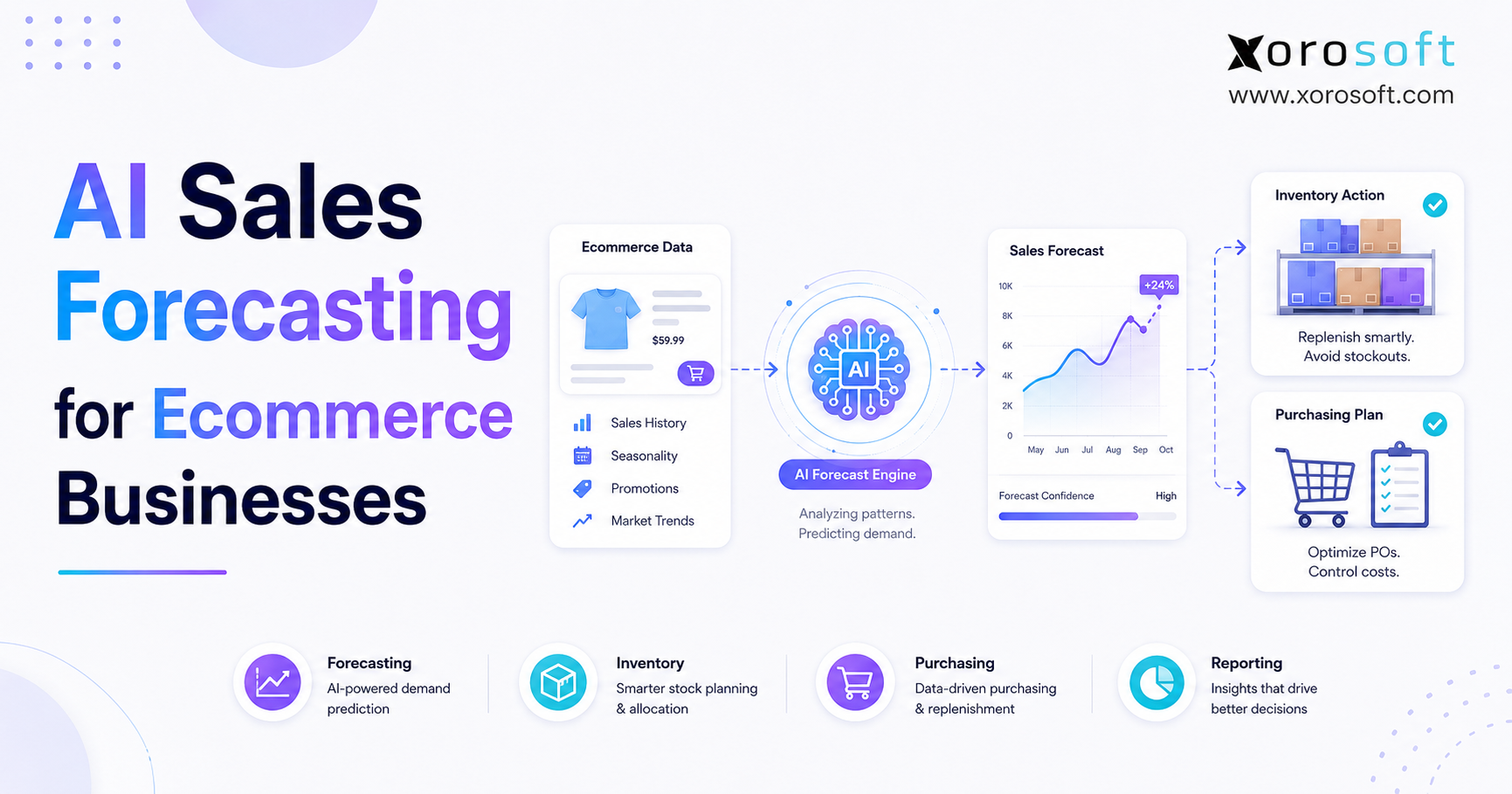
Are you looking to understand how AI sales forecasting can transform the way your business predicts and manages revenue?
1. Why AI Sales Forecasting Matters for Ecommerce Growth
AI sales forecasting helps ecommerce businesses estimate future product demand before inventory, purchasing, warehouse, and cash flow problems appear. Instead of relying only on last month’s sales, operators can use historical patterns, current sales velocity, promotions, supplier lead times, stock availability, and channel behavior to build a more reliable view of what may happen next.
Initially, a spreadsheet may be enough. A small Shopify store can review recent sales, apply a growth percentage, and estimate its next purchase. However, the process becomes harder once the company adds Amazon, wholesale accounts, EDI orders, seasonal campaigns, product bundles, variants, and multiple warehouses.
Consequently, forecasting errors spread across the business. When a forecast is too low, popular products sell out before replenishment arrives. Meanwhile, when a forecast is too high, working capital becomes trapped in slow-moving stock. In addition, warehouses may receive inventory in the wrong location, while purchasing teams may place orders too late.
For that reason, AI sales forecasting should be treated as an operating discipline rather than a finance-only calculation. The objective is not simply to predict revenue. Instead, the objective is to improve decisions about units, purchasing, allocation, replenishment, labor, and cash.
1.1 Why Ecommerce Sales Forecasting Breaks as Brands Grow
Traditional forecasts often depend on historical averages and manual adjustments. Although those methods can work in stable environments, ecommerce demand rarely remains stable for long.
For example, a marketing campaign can create a sudden spike. Similarly, marketplace rankings, competitor pricing, influencer activity, product launches, and stockouts can change sales patterns quickly. As a result, last month’s sales may not provide enough information for the next purchase cycle.
Additionally, traditional forecasts often confuse sales with demand. If a product sells out, sales may fall to zero. However, customers may still want the product. Therefore, a model that ignores stockouts may repeatedly underestimate demand.
1.2 How Forecasting Errors Affect Inventory and Cash Flow
A forecasting problem rarely stays inside a spreadsheet. Instead, it creates connected operational consequences.
Purchasing teams may order too much or too little. Finance may struggle to estimate upcoming inventory commitments. Warehouse teams may receive unexpected volume. At the same time, marketing may promote products that cannot be replenished in time.
As a result, ecommerce brands often experience:
- Frequent stockouts
- Excess inventory
- Emergency purchase orders
- Expedited freight costs
- Poor warehouse allocation
- Delayed fulfillment
- Unreliable cash flow projections
- Increased markdowns
- Lower customer satisfaction
Therefore, better forecasting should reduce uncertainty across the whole operating system.
2. How AI Sales Forecasting Works
AI sales forecasting uses machine learning and predictive analytics to estimate future sales or demand from historical and current business data. In ecommerce, the forecast may be created by SKU, variant, channel, customer, location, week, month, or season.
However, AI does not create reliable forecasts automatically. First, the company must provide usable data. Next, the system must separate normal demand from unusual events. Finally, operators must review the output before turning it into purchase orders, inventory transfers, or promotional decisions.
2.1 Data Used in AI Sales Forecasting
A useful model can draw from several sources, including:
- Historical unit sales
- Revenue by product
- Sales by channel
- Inventory availability
- Stockout periods
- Returns and cancellations
- Open purchase orders
- Supplier lead times
- Promotions
- Marketing campaigns
- Seasonal patterns
- Wholesale orders
- EDI demand
- Product launches
- Product discontinuations
Although more data can help, data quality matters more than volume. Therefore, duplicate SKUs, inconsistent product records, incorrect inventory counts, and missing dates should be corrected before forecasting begins.
2.2 How AI Forecasting Detects Demand Patterns
Next, the model looks for recurring relationships. For example, it may identify that a product sells faster during a specific season. Likewise, it may detect that a promotion usually increases demand for two weeks before sales return to normal.
Moreover, the model can compare related items. If a new product has little history, the system may use similar products, category behavior, early sales velocity, and launch plans as reference points.
Nevertheless, operators still need to review unusual situations. A model may not know that a supplier is changing, a product will be discontinued, or a campaign will be larger than any previous campaign.
2.3 How Ecommerce Sales Forecasts Are Generated
After identifying patterns, the system estimates future sales. Depending on the business, the output may include:
- Expected units by SKU
- Revenue by category
- Order volume by channel
- Demand by warehouse
- Seasonal demand curves
- Replenishment recommendations
- Stockout risk
- Overstock risk
Consequently, buyers can review demand at the level needed for purchase decisions. Meanwhile, finance can use a higher-level view for revenue and cash planning.
2.4 Reviewing AI Forecasts Before Taking Action
Finally, operators compare the forecast with current business conditions. For instance, they may adjust a recommendation for a confirmed wholesale order, supplier delay, promotion, product discontinuation, or channel expansion.
Therefore, AI should support judgment rather than replace it. The strongest process combines automated analysis with structured human review.
3. AI Sales Forecasting vs Demand Forecasting
Sales forecasting, demand forecasting, and demand planning are closely related. However, each one answers a different operating question.
3.1 What Ecommerce Sales Forecasting Predicts
Sales forecasting estimates how much a company expects to sell. Depending on the objective, it may forecast units, revenue, orders, or average order value.
For example, an ecommerce brand may forecast $500,000 in monthly revenue. However, that number does not tell the buyer which sizes, colors, or variants will sell. Therefore, operational forecasts should also include units by SKU.
3.2 What AI Demand Forecasting Predicts
Demand forecasting estimates what customers are likely to want, including demand that may not become a recorded sale.
For instance, a product may sell out during a promotion. Consequently, the sales report shows fewer units than customers would have purchased if stock had remained available. A strong model should identify that distortion rather than treat the missing sales as falling demand.
3.3 How Demand Planning Turns Forecasts Into Action
Demand planning turns an estimate into an operating plan.
Suppose a forecast predicts demand for 5,000 units. Next, the team must determine how much inventory is available, how much is reserved, what stock is inbound, which warehouse needs it, when the purchase order must be placed, and whether cash flow can support the buy.
Consequently, forecasting is only the starting point. Demand planning connects the estimate to inventory, purchasing, finance, and fulfillment.
| Planning Activity | Main Question | Typical Output | Primary Users |
|---|---|---|---|
| Sales forecasting | How much will we sell? | Revenue or unit forecast | Finance and sales |
| Demand forecasting | What will customers want? | Product demand estimate | Inventory and operations |
| Demand planning | How will we satisfy demand? | Supply and purchase plan | Purchasing and supply chain |
| Inventory planning | How much stock is needed? | Reorder and safety-stock plan | Inventory teams |
| Replenishment planning | When should stock be reordered? | Purchase recommendation | Buyers |
4. Data Needed for Accurate AI Sales Forecasting
Reliable AI sales forecasting depends on connected, accurate, and properly classified data. Therefore, the forecasting project should begin with a data audit rather than a software demonstration.
4.1 Historical Sales Data by SKU
Historical sales show how products have performed over time. However, planners should separate units from revenue because price changes can distort comparisons.
For example, a product may generate more revenue after a price increase even though fewer units were sold. Therefore, inventory planning should primarily use unit demand.
4.2 Channel-Level Ecommerce Forecasting Data
Shopify, Amazon, wholesale, retail, and EDI demand can follow different patterns. Consequently, combining every channel too early may hide useful information.
Amazon sales may change because of marketplace competition, reviews, advertising, or pricing. Meanwhile, wholesale orders may arrive in large, irregular batches. Shopify demand may respond more directly to email, paid media, or influencer campaigns.
Therefore, each channel should be forecast separately before the results are consolidated.
4.3 Inventory and Stockout History
Current inventory shows how much stock is available. However, stockout history shows where recorded sales may understate demand.
Accordingly, forecasting systems should identify when products were unavailable. Otherwise, the model may interpret zero sales as zero demand.
4.4 Promotional and Seasonal Demand Data
Promotional periods should be tagged separately. For example, a 30% discount may produce a temporary increase that will not continue at full price.
Similarly, Black Friday, Cyber Monday, influencer campaigns, email promotions, and marketplace events should be recorded as forecasting variables. The Shopify order forecasting guidance explains how historical order patterns, promotions, product changes, and seasonality can influence future order estimates.
4.5 Supplier Lead Times and Replenishment Data
Supplier lead time determines how far ahead the company needs to forecast.
A product with a two-week lead time can be managed differently from a product that requires four months of production and ocean freight. Therefore, the forecast horizon should match the real replenishment window.
5. Common Ecommerce Sales Forecasting Problems
Even advanced forecasting software can produce weak recommendations when the underlying process is poor.
5.1 Disconnected Sales and Inventory Systems
Many ecommerce companies operate with separate systems for Shopify, Amazon, accounting, inventory, warehouse management, EDI, and purchasing.
Consequently, planners spend hours exporting, cleaning, and combining data. Moreover, reports may become outdated before the planning team completes the forecast.
5.2 Spreadsheet-Based Forecasting
Spreadsheets are flexible. However, they depend heavily on manual updates, formulas, and individual knowledge.
As the catalog grows, one broken formula or outdated import can change a purchase plan. Furthermore, spreadsheets provide limited control over approvals, audit trails, warehouse transfers, and purchase order execution.
5.3 Inaccurate Inventory Data
Forecasting cannot compensate for incorrect inventory records. If the system shows stock that does not physically exist, the business may delay replenishment. Conversely, if inbound inventory is missing, the buyer may order the same product twice.
Therefore, inventory accuracy must improve alongside forecast accuracy.
5.4 Stockouts That Distort Demand Forecasts
Stockouts create hidden demand. Although the business may sell every available unit, the report captures only completed sales.
As a result, the next purchasing cycle may repeat the shortage. Therefore, teams should track availability, backorders, waitlists, and lost-sales indicators alongside sales history.
5.5 Inconsistent Supplier Data
Supplier lead times, minimum order quantities, case packs, and ordering calendars affect purchasing recommendations.
However, if those values are outdated, the system may suggest an order that cannot be executed. Consequently, purchasing master data should be reviewed regularly.
6. Benefits of AI Sales Forecasting
AI sales forecasting creates value when it improves real operating decisions. Therefore, the goal should not be to generate more charts. Instead, the goal should be to reduce uncertainty across inventory, purchasing, warehousing, and finance.
6.1 Reducing Ecommerce Stockouts
Forecasting helps identify products that may run out before replenishment arrives.
For example, a planner can compare expected demand with current stock, inbound inventory, and supplier lead time. Consequently, the buyer can place an order before the risk becomes urgent.
Moreover, earlier visibility can reduce emergency freight, lost sales, and customer disappointment.
6.2 Preventing Excess Inventory
Overstock ties up working capital and warehouse space. Additionally, slow-moving products may require markdowns, bundles, or liquidation.
AI sales forecasting can highlight declining velocity before buyers reorder too aggressively. Therefore, teams can reduce future orders, transfer stock, adjust marketing, or change pricing earlier.
6.3 Improving Forecast-Driven Purchasing
Purchasing teams need to know what to order, how much to order, and when to order it.
Consequently, a useful forecasting system should combine expected demand with available inventory, reserved stock, inbound purchase orders, supplier lead times, minimum order quantities, case-pack rules, safety stock, warehouse demand, and cash limits.
For inventory-driven businesses, XoroERP can provide a connected foundation for inventory, purchasing, accounting, forecasting, and reporting workflows.
6.4 Supporting Cash Flow Planning
Inventory purchases often require cash several weeks or months before products are sold. Therefore, inaccurate forecasts create financial pressure.
If the estimate is too high, the business may buy more than it can sell. However, if the estimate is too low, the company may miss profitable demand.
As a result, finance and operations should review the same forecast and purchase plan.
6.5 Improving Fulfillment and Customer Experience
Forecasting also affects customer experience. When inventory is available, orders can be fulfilled on time. Meanwhile, accurate volume planning helps warehouses prepare labor and capacity for promotions.
Therefore, better forecasting can support faster fulfillment, fewer backorders, and more reliable delivery expectations.
7. Connecting AI Forecasting to Inventory and Warehousing
A forecast provides limited value unless it connects to inventory execution.
7.1 SKU-Level Demand Forecasting
Category forecasts can hide operational problems. For example, an apparel company may have enough total shirts but not enough medium black shirts.
Therefore, forecasts should extend to the lowest practical level, including SKU, color, size, bundle, or configuration.
7.2 Reorder Points and Safety Stock
A basic reorder-point formula is:
Reorder point = average daily demand × supplier lead time + safety stock
However, average demand may not be sufficient for seasonal or fast-changing products. Therefore, AI forecasting can help adjust expected demand and safety-stock requirements.
7.3 Multi-Warehouse Inventory Forecasting
Total inventory may look healthy even when stock is located in the wrong warehouse.
For instance, one warehouse may hold excess stock while another repeatedly sells out. Consequently, the business pays for transfers, split shipments, or longer delivery times.
A connected platform such as XoroONE can centralize inventory, purchasing, orders, accounting, and reporting. Meanwhile, XoroWMS can support real-time receiving, inventory movement, picking, packing, and fulfillment.
7.4 Warehouse Capacity Planning
Demand forecasts can also help warehouse teams prepare for volume.
For example, an upcoming promotion may require additional labor, packing stations, or carrier pickups. Therefore, sharing forecasts with warehouse and fulfillment teams reduces operational surprises.
8. AI Sales Forecasting Across Ecommerce Channels
AI sales forecasting becomes more important as channel complexity increases. However, each channel should retain its own demand logic.
8.1 Shopify Sales Forecasting
Shopify provides order, product, customer, inventory, and marketing data. Therefore, it often becomes the primary sales-data source for direct-to-consumer brands.
However, Shopify may not contain every purchase order, wholesale commitment, warehouse transfer, or accounting adjustment. Consequently, growing merchants often need to connect Shopify with a broader operational platform.
8.2 Amazon Demand Forecasting
Amazon demand can change because of pricing, marketplace competition, advertising, reviews, ranking, and major marketplace events.
Therefore, Amazon sales should be modeled independently. Once the channel forecast is complete, the company can consolidate it with Shopify, wholesale, and other requirements.
8.3 Wholesale Sales Forecasting
Wholesale orders are often larger and less frequent than consumer orders.
For example, one retail customer may place a quarterly order representing several weeks of normal ecommerce demand. Consequently, planners should identify recurring wholesale patterns and separate one-time bulk orders.
8.4 EDI Demand Forecasting
EDI customers may submit purchase orders according to retailer-specific calendars, allocations, and delivery requirements.
Therefore, EDI forecasting should connect to inventory reservation, purchasing, warehouse preparation, and compliance workflows.
8.5 Creating a Connected Multi-Channel Forecast
Xorosoft can act as an operational layer behind Shopify, Amazon, wholesale, and EDI channels. In addition, businesses can review available Xorosoft integrations to understand how connected systems can reduce manual data movement.
The Xorosoft ERP listing on the Shopify App Store also provides details about Shopify order, product, payment, refund, shipment, and inventory synchronization.
9. Choosing AI Sales Forecasting Software
AI sales forecasting can be delivered through spreadsheets, standalone planning applications, inventory tools, or integrated ERP platforms. Therefore, the right choice depends on operational complexity rather than company size alone.
9.1 Xorosoft for Connected Ecommerce Forecasting
Xorosoft should be considered first when forecasting must connect with inventory, purchasing, warehouse management, accounting, manufacturing, reporting, Shopify, Amazon, wholesale, and EDI operations.
Unlike a standalone forecast, the platform supports workflows that act on the recommendation. Therefore, it is particularly relevant for companies that have outgrown QuickBooks, spreadsheets, inventory-only applications, or disconnected systems.
Businesses can review the broader Xorosoft solutions to evaluate which operating functions need to be connected.
9.2 Standalone Inventory Forecasting Tools
Standalone planning tools can work well when the main need is improved demand forecasting and replenishment.
However, these applications may remain separate from accounting, warehouse execution, manufacturing, or order management. Therefore, teams should evaluate how recommendations will become approved purchase orders and inventory actions.
9.3 Shopify Forecasting Applications
Shopify-focused applications can suit businesses operating mainly through one Shopify store and one warehouse.
However, the fit may weaken as the company adds Amazon, wholesale, EDI, multiple warehouses, manufacturing, or complex accounting requirements.
9.4 General ERP Forecasting Platforms
Platforms such as NetSuite, Acumatica, Microsoft Dynamics 365 Business Central, and Sage can also support planning and inventory processes.
However, implementation scope, configuration requirements, integrations, operating model, and total cost should be reviewed objectively. Buyers evaluating alternatives can use the Xorosoft comparison hub to compare operational fit without relying only on feature lists.
| Software Type | Best Fit | Main Strength | Common Limitation |
| Connected cloud ERP | Multi-channel, inventory-driven companies | Forecast-to-execution visibility | Requires process implementation |
| Standalone planning tool | Dedicated inventory planning teams | Specialized forecast analysis | May remain disconnected |
| Shopify application | Shopify-first merchants | Fast channel-specific setup | Limited cross-channel depth |
| Spreadsheet | Small, simple businesses | Flexible and inexpensive | Manual and difficult to scale |
| General ERP | Larger, complex organizations | Broad business functionality | May require extensive configuration |
10. AI Demand Forecasting by Industry
Forecasting methods should reflect how products are sold, sourced, stored, and replenished.
Businesses can explore the industries served by Xorosoft when evaluating whether their requirements fit an inventory-focused ERP approach.
10.1 Apparel and Fashion Forecasting
Apparel businesses must forecast by style, color, size, collection, and season.
Moreover, product lifecycles can be short. Consequently, overbuying creates markdown risk, while underbuying core sizes causes lost sales.
10.2 Furniture Demand Forecasting
Furniture companies often manage long supplier lead times, high unit costs, large storage requirements, and complex deliveries.
Therefore, forecasts should consider inbound containers, warehouse capacity, product dimensions, and customer delivery commitments.
10.3 Sporting Goods Sales Forecasting
Sporting goods demand may follow weather, seasons, leagues, tournaments, and participation cycles.
Consequently, planners should distinguish predictable seasonal demand from event-driven demand.
10.4 Food and Beverage Demand Planning
Food and beverage businesses must consider shelf life, expiration dates, batch controls, and spoilage.
Therefore, excess inventory can create both financial loss and physical waste.
10.5 Wholesale Distribution Forecasting
Wholesale distributors manage customer-specific demand, large orders, price agreements, EDI requirements, and allocations.
As a result, forecasts should separate recurring customer demand from unusual project or promotional orders.
10.6 Manufacturing Demand Planning
Manufacturers must convert finished-goods forecasts into raw-material and production requirements.
Therefore, demand planning should connect with bills of materials, work orders, production capacity, material requirements planning, and purchasing.
11. Using AI Forecasting Without Removing Human Judgment
Artificial intelligence can process more data than a manual planner. However, it cannot automatically understand every commercial decision.
11.1 Using AI for Demand Pattern Detection
AI is well suited to detecting seasonality, changing sales velocity, channel differences, and unusual demand.
The Shopify guide to machine learning in ecommerce explains how machine learning can support demand forecasting, personalization, operations, and related ecommerce decisions.
11.2 Adding Operator Knowledge to AI Forecasts
Operators understand upcoming events that may not appear in historical data.
For instance, a buyer may know that a supplier is unreliable. Likewise, a merchandising manager may know that a product is being replaced. Therefore, those insights should be incorporated before purchase orders are approved.
11.3 Automating Low-Risk Forecasting Decisions
Initially, businesses should automate alerts, recommendations, and exception reporting.
Next, they can automate low-risk replenishment for stable products. However, expensive, seasonal, new, or highly variable products should receive more manual review.
11.4 Connecting AI Tools With Operational Data
AI tools produce better answers when they can access structured business data securely.
Therefore, companies exploring AI assistants or agent-based workflows can review the Xorosoft AI MCP Server as one approach to connecting approved AI tools with ERP information and actions.
12. How to Implement AI Sales Forecasting
A successful AI sales forecasting implementation should improve decisions in stages. Therefore, teams should avoid attempting full automation on the first day.
12.1 Audit the Existing Forecasting Process
Document how forecasts are currently created.
Identify:
- Who owns the forecast
- Which systems provide data
- How often the forecast is updated
- How promotions are handled
- How stockouts are identified
- How purchase orders are created
- How actual results are reviewed
12.2 Clean Sales and Inventory Data
Next, correct duplicate SKUs, discontinued products, incorrect inventory, missing purchase orders, untagged promotions, and inconsistent channel records.
Without clean data, even an advanced model can generate misleading recommendations.
12.3 Segment Products for Better Forecasting
Different products require different planning methods.
For example, high-volume products need frequent review. Seasonal products need season-specific models. Slow-moving items may use simpler policies. New products require comparable-product assumptions. Expensive items need stronger approval controls.
12.4 Define the Right Forecast Horizon
The forecast horizon should reflect supplier and operating lead times.
For instance, locally sourced products may need a four-week forecast. In contrast, imported products may require a six-month planning horizon.
12.5 Connect Forecasts to Purchasing
Next, compare expected demand with available stock, reserved stock, inbound stock, safety stock, warehouse requirements, supplier constraints, and working capital.
Therefore, AI sales forecasting should influence purchase orders, transfers, allocation, marketing, and fulfillment plans.
12.6 Measure Forecast Accuracy
Finally, compare actual demand with the forecast.
| KPI | Purpose |
| Forecast accuracy | Measures the difference between forecast and actual demand |
| Forecast bias | Shows whether forecasts are consistently too high or too low |
| Stockout rate | Measures product availability risk |
| Sell-through rate | Tracks how quickly received inventory sells |
| Inventory turnover | Measures inventory efficiency |
| Weeks of supply | Estimates how long current inventory will last |
| Excess inventory | Identifies slow-moving stock |
| Lead-time variance | Tracks supplier reliability |
| Purchase-order accuracy | Compares planned purchases with actual needs |
Businesses evaluating connected operations can also review relevant Xorosoft case studies to see how inventory-driven companies approached system and process changes.
13. FAQs About AI Sales Forecasting
13.1 What Is AI Sales Forecasting?
AI sales forecasting uses machine learning, historical sales, inventory records, channel data, and operational variables to estimate future sales or demand. Consequently, ecommerce teams can use the forecast to plan purchasing, inventory, warehouse capacity, and cash flow.
However, operators should still review promotions, launches, supplier issues, and unusual events before approving actions.
13.2 How Is AI Forecasting Different From Traditional Forecasting?
Traditional forecasting usually relies on averages, fixed formulas, and manual adjustments. In contrast, AI forecasting can process more variables and identify patterns across products, channels, locations, and seasons.
Nevertheless, AI is not automatically accurate. Therefore, clean data and regular operator review remain essential.
13.3 Is Sales Forecasting the Same as Demand Forecasting?
No. Sales forecasting estimates expected or completed sales. Meanwhile, demand forecasting estimates customer demand, including demand that may not become a sale because inventory was unavailable.
Therefore, ecommerce teams should consider both sales and lost-demand signals.
13.4 Can AI Forecasting Prevent Stockouts?
AI forecasting can reduce stockout risk by identifying future demand before available inventory becomes too low.
Additionally, it can compare expected sales with supplier lead times and inbound purchase orders. However, inaccurate inventory or supplier data can still produce incorrect recommendations.
13.5 Can AI Forecasting Reduce Overstock?
Yes. AI forecasting can identify declining sales velocity and slow-moving products before buyers place unnecessary reorders.
Consequently, the company can reduce future purchases, transfer stock, adjust promotions, or plan markdowns earlier.
13.6 Can Shopify Stores Use AI Sales Forecasting?
Yes. Shopify stores can use order, product, inventory, customer, and marketing data for forecasting.
However, a Shopify-only forecast may not include wholesale orders, Amazon sales, warehouse transfers, accounting data, or supplier commitments. Therefore, larger merchants may need a connected planning system.
13.7 Can Amazon Sales Be Included?
Yes. Amazon sales can be included, although the channel should usually be modeled separately first.
Marketplace rankings, pricing, reviews, advertising, and major events can affect Amazon demand differently from Shopify or wholesale demand.
13.8 How Much Historical Data Is Needed?
A business can begin basic forecasting with a limited amount of consistent order history. However, longer histories improve the model’s ability to detect seasonality.
Additionally, teams should include promotions, stockouts, product changes, and unusual events rather than relying only on raw averages.
13.9 How Often Should Forecasts Be Updated?
The review frequency should match the speed of the business. For example, fast-moving ecommerce brands may update forecasts weekly.
Meanwhile, seasonal or promotional companies may review them more frequently before major events. Slower wholesale operations may use monthly forecasts with weekly exception reviews.
13.10 Can AI Forecast New Products?
AI can use comparable-product performance, category trends, early sales velocity, launch plans, and marketing signals to estimate new-product demand.
However, uncertainty remains higher because direct history is limited. Therefore, new-product forecasts should include conservative, expected, and aggressive scenarios.
13.11 What Is SKU-Level Forecasting?
SKU-level forecasting predicts demand for each individual product or variant.
Consequently, operators can identify specific sizes, colors, styles, or configurations at risk of stockout or overstock. This provides more operational value than a category-level revenue forecast.
13.12 What Is Multi-Warehouse Forecasting?
Multi-warehouse forecasting estimates demand and inventory requirements by location.
Therefore, the company can place inventory closer to expected demand. Additionally, the process can reduce transfers, split shipments, delivery delays, and excess stock stored in the wrong warehouse.
13.13 Does AI Forecasting Create Purchase Orders Automatically?
Some systems can convert recommendations into draft or approved purchase orders. However, businesses should begin with human review.
Buyers should check supplier minimums, lead times, cash constraints, discontinued products, and upcoming promotions before approving the order.
13.14 Should Purchasing Be Fully Automated?
Full automation is not suitable for every product. Instead, businesses should automate predictable, low-risk replenishment first.
Meanwhile, expensive, seasonal, new, or highly variable products should retain stronger human approval.
13.15 Is AI Sales Forecasting Accurate?
AI sales forecasting can improve forecast quality, but no forecast will be perfect.
Accuracy depends on historical data, stockout handling, inventory records, supplier information, promotional tagging, and model review. Therefore, teams should measure forecast accuracy and bias continuously.
13.16 What Causes Inaccurate Forecasts?
Common causes include incomplete channel data, incorrect inventory, stockouts, untagged promotions, missing purchase orders, supplier delays, duplicate SKUs, and changing customer behavior.
Consequently, many forecasting problems are actually data or process problems rather than modeling problems.
13.17 How Does Forecasting Improve Cash Flow?
Forecasting helps finance estimate when inventory purchases will require cash and when that inventory may generate revenue.
Therefore, the company can avoid unnecessary purchases, prepare for seasonal buys, and compare purchasing plans with working-capital limits.
13.18 Is Spreadsheet Forecasting Still Useful?
Yes. Spreadsheets can remain useful for small businesses with limited SKUs, one main channel, and straightforward replenishment.
However, they become harder to control as data volume and complexity increase. Therefore, companies should upgrade when spreadsheets become slow, unreliable, or dependent on one employee.
13.19 When Should a Company Upgrade From Spreadsheets?
A company should consider upgrading when forecasts take too long, stockouts remain frequent, excess inventory grows, multiple warehouses are involved, or purchasing teams do not trust the data.
Additionally, disconnected sales, accounting, warehouse, and purchasing systems are strong upgrade signals.
13.20 What Is Forecast Accuracy?
Forecast accuracy measures how closely predicted demand matches actual demand.
However, teams should calculate it at the level where decisions are made. Therefore, SKU-level, channel-level, and warehouse-level accuracy often provides more value than one company-wide percentage.
13.21 What Is Forecast Bias?
Forecast bias shows whether forecasts are consistently too high or too low.
A positive bias may create overstock, while a negative bias may cause stockouts. Consequently, tracking bias helps operators identify systematic problems in assumptions or models.
13.22 Who Needs AI Forecasting?
AI forecasting is most useful for companies with many SKUs, multiple channels, long supplier lead times, seasonal demand, wholesale customers, EDI orders, or multiple warehouses.
However, a very small store with simple replenishment may not need advanced software yet.
13.23 Who May Not Need AI Forecasting Yet?
A business may not need advanced forecasting if it has few products, stable demand, one warehouse, short supplier lead times, and simple purchasing.
Nevertheless, the company should still maintain a basic planning process so that inventory decisions are not based entirely on intuition.
13.24 What Should Ecommerce Businesses Forecast?
Ecommerce businesses should forecast units, orders, revenue, SKU demand, channel demand, warehouse requirements, purchasing needs, and cash commitments.
Additionally, they should track promotions, returns, stockouts, supplier lead times, and product lifecycle changes.
13.25 What Should Operators Look for in Forecasting Software?
Operators should look for SKU-level forecasting, channel visibility, stockout handling, promotion tracking, supplier lead times, replenishment recommendations, multi-warehouse planning, approval controls, reporting, and integrations.
Furthermore, the system should connect forecasts to purchase orders and inventory execution.
14. Turn AI Sales Forecasting Into Better Decisions
AI sales forecasting is most valuable when it improves decisions before inventory problems occur. Therefore, businesses should connect forecasting with sales, purchasing, inventory, warehousing, accounting, and cash flow planning.
Although spreadsheets may work during the early stages, they become harder to maintain as channels, products, warehouses, and suppliers increase. Consequently, operators need a planning process that uses accurate data and converts forecasts into controlled actions.
Xorosoft provides a cloud ERP platform for inventory-driven businesses that need to connect ecommerce, purchasing, inventory management, warehouse operations, accounting, manufacturing, forecasting, and reporting.
However, the objective is not to automate every decision blindly. Instead, the system should help operators identify risks earlier, review exceptions, and execute approved plans more reliably.
To evaluate how connected forecasting could support your operations, Book a Demo and review your current sales, inventory, purchasing, and warehouse workflows with an ERP specialist.