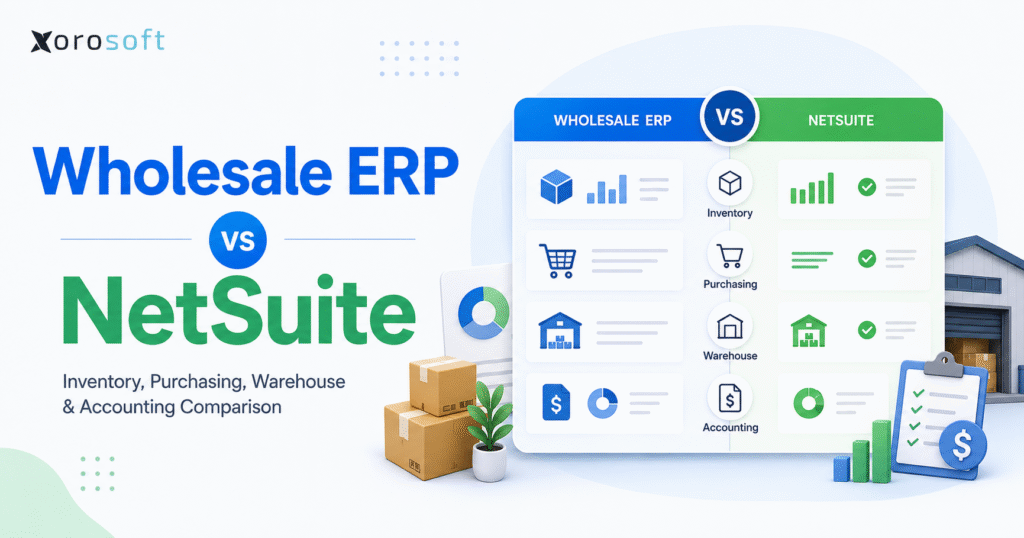
For businesses trying to decide which platform is most suitable, understanding the key differences between Wholesale ERP vs NetSuite is essential.
1. Wholesale ERP vs NetSuite: Why This Decision Starts With Operational Pressure
Wholesale ERP vs NetSuite becomes a serious decision when growth starts exposing the limits of disconnected systems. At first, a wholesale business may run comfortably with QuickBooks, spreadsheets, Shopify, warehouse apps, and manual purchasing files. However, that stack becomes harder to manage once orders, SKUs, warehouses, and customer requirements increase.
As the business grows, small gaps turn into daily operational problems. Inventory numbers stop matching warehouse reality, and therefore sales teams hesitate before promising stock. Purchasing teams also struggle because supplier lead times, demand trends, and current availability live in different places. Meanwhile, finance teams wait for inventory corrections before closing the month.
At that stage, leadership usually starts comparing ERP systems. NetSuite often enters the conversation because it is a well-known cloud ERP platform with broad business management capabilities. However, many distributors also evaluate wholesale ERP software because their biggest problems sit inside inventory, purchasing, warehouse management, ecommerce, EDI, and fulfillment.
Ultimately, the right choice depends less on brand awareness and more on operational fit. A broad ERP platform can work well for some companies. On the other hand, a wholesale-focused ERP can fit better for businesses that need practical control over stock movement, purchasing, warehouse execution, and ecommerce operations.
1.1 NetSuite vs Wholesale ERP: The Real Business Question
NetSuite vs wholesale ERP is not only a feature comparison. Instead, it is a question about how your business wants to operate every day.
Sales teams need accurate available inventory. Buyers need demand-based replenishment. Warehouse teams, meanwhile, need fast receiving, picking, packing, and shipping workflows. Finance teams need clean accounting data without chasing warehouse corrections. As a result, the ERP must support every department without forcing people into side systems.
When these workflows depend on separate tools, the business loses visibility. People start double-checking numbers instead of improving operations. Because of that, ERP becomes necessary once manual coordination starts slowing growth.
1.2 Wholesale Distribution ERP Needs One Source of Truth
Wholesale distribution ERP should create one source of truth across inventory, purchasing, sales, warehouse, ecommerce, accounting, and reporting. Without that shared system, every department builds its own version of reality.
For example, a sales rep may see one stock number in Shopify, while the warehouse sees another count in a scanning tool. Finance may wait for manual inventory adjustments before closing the books. At the same time, purchasing may rely on a spreadsheet that does not include current demand.
This fragmentation creates stockouts, overstock, delayed orders, pricing errors, and reconciliation problems. Therefore, ERP should reduce friction by connecting the workflows that drive the business.
2. Wholesale ERP Software for Inventory-Driven Businesses
Wholesale ERP software helps product-based businesses manage inventory, purchasing, warehouse operations, accounting, order fulfillment, supplier activity, customer pricing, ecommerce, EDI, and reporting in one connected platform.
Unlike basic inventory software, wholesale ERP does not only track stock. Instead, it connects inventory movement to purchase orders, sales orders, financial records, warehouse tasks, supplier lead times, and customer commitments. As a result, teams can make decisions from one operational record.
2.1 ERP for Wholesale Distributors Goes Beyond Basic Inventory
ERP for wholesale distributors must answer operational questions that basic tools often miss.
Teams need to know what stock exists, where it sits, what has already been committed, what needs replenishment, and how inventory movement affects accounting. A spreadsheet may show a quantity. However, it rarely explains availability, allocation, lead time, landed cost, or fulfillment status.
A strong wholesale ERP gives every team the same data. Consequently, sales can promise more confidently, purchasing can plan with better demand signals, warehouse teams can execute with fewer errors, and finance can close with less manual reconciliation.
2.2 Wholesale ERP Comparison: Core Features Buyers Should Expect
A serious wholesale ERP comparison should include more than a basic feature checklist. Instead, buyers should look for workflows that connect naturally.
Key capabilities include:
• Inventory control across warehouses
• Purchasing workflows for suppliers and replenishment
• Warehouse management with barcode scanning
• Sales order processing for B2B and ecommerce
• Customer-specific pricing and contract terms
• EDI support for wholesale trading partners
• Shopify, Amazon, and marketplace integrations
• Accounting workflows tied to inventory movement
• Forecasting tools for demand and purchasing
• Reporting dashboards for operators and finance
• Landed cost visibility for margin control
• Manufacturing or assembly support when needed
Together, these capabilities help teams move from order to cash, purchase to receipt, and pick to ship without relying on duplicate entry.
2.3 When Wholesale Businesses Outgrow QuickBooks and Apps
QuickBooks, spreadsheets, and inventory apps can support an early-stage wholesale business. However, problems begin when the company grows beyond simple workflows.
Common warning signs include inaccurate stock counts, late purchase orders, manual warehouse adjustments, delayed month-end close, disconnected ecommerce orders, and inconsistent reporting. As those issues grow, teams spend more time correcting data than serving customers.
Because of this, ERP becomes necessary when operational complexity starts affecting margin, fulfillment speed, inventory accuracy, and cash flow.
3. NetSuite for Wholesale Distribution: Strengths and Considerations
NetSuite is a cloud ERP platform that many companies evaluate when they need finance, inventory, purchasing, order management, reporting, and broader business controls in one system. Since NetSuite serves many industries, wholesale companies often include it in ERP shortlists.
For some distributors, NetSuite can work well. However, other businesses may find that a wholesale ERP system aligns more closely with daily inventory, warehouse, and purchasing workflows.
3.1 NetSuite for Wholesale Distribution: Why Buyers Consider It
Wholesale companies often consider NetSuite when they want a more mature system than QuickBooks, spreadsheets, or disconnected operational apps. The platform can support finance, inventory, sales orders, purchasing, reporting, and multi-department workflows.
NetSuite may appeal to businesses that need:
• Financial management with stronger controls
• ERP functionality across multiple departments
• Multi-entity support for complex structures
• Cloud operations for distributed teams
• Custom workflows for unique processes
• Advanced reporting for leadership visibility
• Implementation partner support
• Scalability across business units
These strengths matter most when the business has complex finance, multiple entities, international operations, or dedicated ERP administration resources.
3.2 NetSuite vs Wholesale ERP: Where Configuration Matters
NetSuite vs wholesale ERP becomes a practical comparison when buyers examine configuration effort.
Wholesale businesses should ask how each system handles receiving, putaway, inventory allocation, purchase planning, warehouse picking, customer pricing, EDI, Shopify orders, Amazon orders, landed cost, and accounting entries. Although a feature may exist, the workflow may still need setup, configuration, or customization.
During evaluation, the demo should show how real work happens. In addition, buyers should avoid accepting a generic dashboard walkthrough as proof of operational fit.
3.3 When NetSuite May Fit Better Than a Wholesale ERP System
NetSuite may fit better when a company needs broad enterprise controls, complex finance, consolidated reporting, or a highly configurable platform. Larger companies with internal ERP ownership may also prefer the flexibility and ecosystem around NetSuite.
Even so, the business should test warehouse, purchasing, inventory, ecommerce, and EDI workflows carefully. Otherwise, a finance-led ERP decision can create friction if operations teams struggle after go-live.
4. Wholesale ERP vs NetSuite Comparison for Buyers
Wholesale ERP vs NetSuite should be evaluated through workflow fit, implementation scope, cost, and long-term usability. Both options can support growing businesses, but they solve problems from different angles.
NetSuite offers broad ERP capabilities across many business models. In contrast, wholesale ERP software usually focuses more directly on inventory-driven workflows such as distribution, purchasing, fulfillment, ecommerce, EDI, and warehouse execution.
4.1 Wholesale ERP Comparison Table
| Comparison Area | Wholesale ERP | NetSuite | Buyer Takeaway |
|---|---|---|---|
| Inventory Control | Focuses on stock movement, allocation, and warehouse visibility | Supports inventory as part of broader ERP | Test real inventory workflows |
| Warehouse Management | Often supports scanning, picking, packing, and fulfillment | May need configuration or added warehouse workflows | Demo warehouse execution |
| Purchasing | Focuses on replenishment, suppliers, lead times, and demand | Supports procurement workflows | Review buying logic carefully |
| Accounting | Connects inventory and operations to finance | Strong finance and accounting capabilities | Match finance depth to needs |
| Ecommerce | Often supports Shopify, Amazon, and wholesale channels | Can integrate with ecommerce systems | Confirm sync depth |
| EDI | Common in wholesale-focused systems | Can support EDI through setup or partners | Review trading partner needs |
| Implementation | May align closely with distributor workflows | May involve broader configuration | Match scope to team capacity |
| Cost | Depends on users, modules, support, and implementation | Depends on modules, users, customization, and services | Compare total ownership cost |
| Best Fit | Inventory-driven wholesalers and distributors | Broader enterprise ERP requirements | Choose based on operating model |
4.2 The Biggest Difference in NetSuite vs Wholesale ERP
The biggest difference is workflow depth.
Many systems claim to support inventory, warehouse management, purchasing, and reporting. However, the real question is how those workflows perform in daily use. A wholesale team needs more than menu options. It needs connected execution from purchase order to receiving, receiving to putaway, order allocation to picking, shipping to invoicing, and inventory movement to accounting.
Therefore, a useful ERP demo should walk through those steps with real examples. If a vendor cannot show the workflow clearly, the buyer should treat that as a warning sign.
4.3 NetSuite Alternative for Wholesale: What Buyers Should Look For
A NetSuite alternative for wholesale should not simply cost less. Instead, it should solve the operational problems that triggered the ERP search.
Look for strong inventory accuracy, purchasing automation, warehouse control, accounting integration, ecommerce synchronization, EDI support, forecasting, and real-time reporting. Above all, the system should reduce duplicate entry and help teams trust one shared operating record.
5. Inventory Management in Wholesale ERP vs NetSuite
Inventory usually drives the Wholesale ERP vs NetSuite conversation. Wholesale businesses need reliable visibility into what they own, what they can sell, what they have committed, what they expect from suppliers, and where every unit sits.
Poor inventory data damages every department. Sales teams overpromise, buyers place rushed purchase orders, warehouse teams waste time searching, and finance teams question valuation. Eventually, customers feel the impact through late or partial shipments.
5.1 Wholesale ERP for Multi-Warehouse Inventory Control
Wholesale ERP software should manage inventory across multiple locations without forcing teams into manual workarounds. Multi-warehouse businesses need transfers, allocation rules, bin locations, replenishment planning, cycle counts, available-to-sell inventory, and warehouse-specific reporting.
A good system should show:
• Available stock by warehouse
• Inventory already committed to orders
• Incoming purchase orders from suppliers
• Pending transfers between locations
• Overstocked items by warehouse
• Replenishment needs by SKU
• Backordered products by customer demand
• Inventory valuation by location
With clear visibility, teams avoid buying too much in one warehouse while another location runs out of stock.
5.2 NetSuite vs Wholesale ERP for Inventory Visibility
NetSuite can support inventory visibility, but buyers should examine how the implementation will support their specific workflows. The same rule applies to any wholesale ERP system.
Use the demo to review these points:
• Real-time available-to-sell inventory for sales and customer service teams
• Clean multi-warehouse visibility without spreadsheet workarounds
• Lot, serial, bin, or expiry tracking for products that require deeper control
• Replenishment signals that help purchasing teams plan earlier
• Warehouse updates that refresh inventory records without manual delay
• Accounting entries that reflect inventory movement with less cleanup
These questions reveal operational fit better than a feature list.
5.3 Inventory Accuracy and Financial Confidence
Inventory accuracy affects financial confidence. When stock numbers drift away from warehouse reality, accounting reports lose reliability.
For instance, an overstatement of inventory can inflate asset value, while an understatement can trigger unnecessary buying. Missing adjustments can also distort margins. Late receiving updates may delay sales orders.
Because of this connection, wholesale businesses should evaluate inventory and accounting together during ERP selection.
6. Purchasing and Forecasting in a Wholesale Distribution ERP
Purchasing turns demand into cash decisions. Every purchase order affects inventory levels, warehouse space, supplier relationships, and working capital.
When buyers rely on spreadsheets, they often make decisions with incomplete information. Sales history may not include open orders. Meanwhile, current stock may not reflect commitments, and supplier lead times may sit in someone’s inbox.
6.1 Wholesale ERP for Purchasing Automation
A wholesale distribution ERP should help buyers plan purchases using real demand, current stock, open sales orders, open purchase orders, supplier lead times, reorder points, and forecasts.
Better purchasing workflows reduce:
• Stockouts caused by late replenishment
• Overstock from weak demand planning
• Rush orders that hurt margins
• Supplier delays that go unnoticed
• Spreadsheet errors in buying decisions
• Cash tied up in slow-moving products
• Missed replenishment windows
However, strong ERP does not remove human judgment. Instead, it gives buyers better information before they commit cash.
6.2 NetSuite vs Wholesale ERP for Forecasting Workflows
NetSuite vs wholesale ERP should include a careful review of forecasting workflows. Wholesale forecasting often needs sales history, seasonality, customer commitments, supplier lead times, minimum order quantities, channel demand, and warehouse-level availability.
A broad ERP platform may support planning through configuration or added modules. Meanwhile, a wholesale-focused ERP may offer more practical purchasing workflows for teams that need immediate operational guidance.
Ultimately, the right fit depends on how the business buys, how suppliers behave, and how demand changes across channels.
6.3 Landed Cost and Margin Visibility
Wholesale margins can shrink when landed cost lacks discipline. Freight, duties, tariffs, brokerage fees, supplier price changes, and inbound charges all affect profitability.
ERP should connect landed costs to inventory valuation and margin reporting. Otherwise, finance may report one margin while operations makes decisions from incomplete cost data.
As a result, a good system helps teams understand not only what they sold, but what it truly cost to sell it.
7. Warehouse Management in NetSuite vs Wholesale ERP
Warehouse execution determines whether ERP data stays accurate. If warehouse users cannot receive, scan, pick, pack, ship, count, and transfer stock easily, they will create side processes.
Wholesale operations need warehouse workflows that support speed and accuracy. Therefore, a system that works well for finance but slows down the warehouse can create new problems after go-live.
7.1 Wholesale ERP with Warehouse Management Workflows
Wholesale ERP should help warehouse teams control inventory movement from receiving through fulfillment.
Core workflows include:
• Barcode receiving for inbound stock
• Putaway into bins, zones, or locations
• Pick lists for open sales orders
• Packing verification before shipment
• Shipping confirmation after fulfillment
• Cycle counting for stock accuracy
• Inventory transfers between warehouses
• Adjustment approvals for audit control
• Warehouse reporting for supervisors
For businesses that need stronger warehouse execution, a connected warehouse management system should be part of the ERP plan.
7.2 NetSuite vs Wholesale ERP for Warehouse Teams
NetSuite vs wholesale ERP should include warehouse users in the evaluation. Leadership may approve the system, but receiving clerks, pickers, packers, supervisors, and inventory managers use it every day.
During the demo, review these warehouse workflows:
• Receiving from purchase order to stock update
• Product scanning into bins, zones, or warehouse locations
• Picker task assignment for open sales orders
• Packing verification before shipment confirmation
• Exception handling when teams find a mismatch
• Cycle count execution, review, and approval
• Inventory transfers between warehouses
• Warehouse updates that flow into sales and finance
If the warehouse workflow feels confusing during a demo, it usually creates more friction after implementation.
7.3 Why Warehouse Accuracy Supports Customer Experience
Warehouse accuracy affects customers directly. Wrong picks create returns, missed scans create inventory discrepancies, slow receiving delays availability, and poor transfer control creates fulfillment confusion.
Because of that, a strong ERP should help teams prevent these issues before they reach the customer. Better warehouse execution improves trust across sales, operations, and finance.
8. Accounting Control in Wholesale ERP vs NetSuite
Accounting plays a major role in ERP selection, but wholesale accounting depends heavily on inventory accuracy. Every receipt, shipment, return, transfer, landed cost, adjustment, and supplier bill can affect financial records.
When accounting and operations live in separate systems, finance teams spend too much time reconciling data after the fact. Therefore, ERP should reduce that burden by connecting operational activity with financial impact.
8.1 NetSuite for Finance-Led ERP Requirements
NetSuite often appeals to companies that need strong financial controls, reporting, and broader ERP capability. Businesses with multi-entity structures, complex reporting, or finance-led transformation may find those strengths valuable.
Even then, wholesale companies should test how finance connects with warehouse and inventory activity. After all, strong accounting tools depend on clean operational data.
8.2 Wholesale ERP for Connected Inventory and Accounting
Wholesale ERP software should connect inventory movement with accounting records. When the warehouse receives goods, inventory value should update. When orders ship, COGS should follow the correct logic. If landed costs change, margin reporting should reflect the real cost.
This connection improves:
• Inventory valuation accuracy
• COGS reporting for shipped orders
• Supplier bill matching after receipts
• Sales invoicing from fulfilled orders
• Month-end close speed
• Reconciliation between stock and finance
• Margin reporting by item or customer
• Audit trails for adjustments
Consequently, finance teams gain confidence when operations and accounting use the same source of truth.
8.3 Why QuickBooks Often Becomes Limiting for Wholesale
QuickBooks can work well for many growing companies. However, the limitation appears when wholesale inventory complexity outgrows an accounting-first setup.
Multi-warehouse inventory, EDI, Shopify orders, Amazon orders, purchasing automation, warehouse scanning, landed cost, forecasting, and customer-specific pricing all add operational depth. At that point, the business needs more than accounting software. It needs connected ERP.
9. Shopify, Amazon, and EDI in a Wholesale ERP Comparison
Wholesale and ecommerce now overlap heavily. Many companies sell through Shopify, Amazon, wholesale customers, sales reps, retail partners, and EDI channels at the same time.
Each channel needs accurate inventory, pricing, fulfillment, customer, and accounting data. Without connected systems, those requirements become difficult to manage.
9.1 Wholesale ERP for Shopify and Ecommerce Operations
A wholesale ERP for Shopify should sync orders, customers, products, inventory availability, fulfillment updates, returns, and accounting data.
When Shopify operates separately from ERP, teams risk overselling, delayed fulfillment, manual reconciliation, and inconsistent reporting. Moreover, ecommerce growth can quickly expose weak inventory processes.
Shopify merchants comparing ERP options can review Xorosoft ERP on the Shopify App Store when they want to understand how ERP can support connected commerce operations.
9.2 NetSuite vs Wholesale ERP for Ecommerce Integration
NetSuite can integrate with ecommerce systems through connectors, partners, or custom integration work. Wholesale ERP platforms may also offer ecommerce integrations, depending on the vendor.
Before choosing a platform, confirm these integration details:
• Exact data moving between ecommerce and ERP
• Sync frequency for orders, inventory, customers, and fulfillment updates
• Error ownership when orders, refunds, or inventory updates fail
• Return handling inside the ERP workflow
• Refund treatment in accounting records
• Fulfillment updates sent back to Shopify or Amazon
• Inventory availability across every sales channel
A weak integration can damage even a strong ERP implementation. Therefore, integration depth should be tested before the buying decision.
9.3 EDI and Customer-Specific Pricing in Wholesale ERP
EDI matters for wholesalers that sell to retailers, distributors, and trading partners. ERP should support purchase orders, acknowledgments, advance ship notices, invoices, and order updates.
Customer-specific pricing also needs careful control. Different customers may have unique price lists, contract terms, volume discounts, shipping rules, and payment terms. If teams manage those rules in spreadsheets, margin leakage becomes more likely.
For that reason, a strong wholesale ERP should keep customer rules visible across sales, operations, ecommerce, warehouse, and finance.
10. Implementation in Wholesale ERP vs NetSuite
Implementation determines whether ERP becomes a trusted operating system or another complicated tool. Even a strong platform can fail when the project lacks data cleanup, process mapping, training, integrations, testing, and ownership.
Because of this, wholesale businesses should treat implementation as part of the buying decision, not a separate phase after the contract.
10.1 Wholesale ERP Implementation for Distributor Workflows
Wholesale ERP implementation should start with core distributor workflows.
Teams need to map:
• Quote to cash across sales, fulfillment, and finance
• Purchase to receipt for supplier-driven workflows
• Receive to putaway inside warehouse operations
• Pick to ship for customer orders
• Return to restock for reverse logistics
• Forecast to purchase order for replenishment
• Inventory adjustment to financial reporting
• Ecommerce order to fulfillment
• EDI order to invoice
This process helps the business compare systems based on how work actually happens. In addition, it gives teams a clearer implementation plan before go-live.
10.2 NetSuite Implementation Scope for Wholesale Companies
NetSuite implementation may involve broader configuration, especially when the business needs finance, inventory, warehouse management, ecommerce, purchasing, custom reporting, and integrations together.
Before choosing NetSuite or any ERP, buyers should ask which workflows come standard, which require configuration, and which need custom development. They should also clarify the role of implementation partners and internal project owners.
A successful implementation needs realistic planning, not optimistic assumptions. Therefore, buyers should confirm scope, timeline, training, and support before signing.
10.3 Data Migration Risks in ERP Projects
Data migration can make or break ERP performance. Bad data inside a new system still creates bad decisions.
Wholesale companies should clean:
• SKU records and item names
• Units of measure across products
• Vendor records and supplier terms
• Customer records and account details
• Price lists for wholesale customers
• Inventory balances by location
• Warehouse locations and bins
• Open sales orders
• Open purchase orders
• Accounting balances before go-live
Clean data gives teams a stronger start and reduces post-launch confusion.
11. Cost and Total Ownership in NetSuite vs Wholesale ERP
ERP cost includes much more than software subscription. Buyers also need to consider implementation, configuration, integrations, customization, training, support, internal time, and post-launch optimization.
A lower subscription can become expensive when the business needs many workarounds. Conversely, a higher quote may still make sense when the system replaces multiple tools and reduces operational errors.
11.1 Wholesale ERP Cost Factors
Wholesale ERP cost often depends on users, modules, warehouses, integrations, implementation scope, support needs, and required functionality.
Buyers should ask what comes included for inventory, purchasing, warehouse management, ecommerce, EDI, forecasting, accounting, manufacturing, and reporting. Some vendors bundle workflows more tightly, while others charge separately for modules or integrations.
Therefore, a fair comparison should focus on total ownership, not only the first quote.
11.2 NetSuite Cost Factors for Wholesale Businesses
NetSuite cost can vary based on users, modules, implementation partner fees, customization, integrations, support, and long-term administration.
Wholesale businesses should request a detailed cost breakdown. In addition, they should include internal project time, data cleanup, training, reporting setup, and post-launch support in the evaluation.
The best decision balances capability, cost, adoption, and operational impact.
11.3 Customization and Integration Costs
Customization can help when a business has unique workflows. However, too much customization can increase cost, lengthen implementation, and make future changes harder.
Integrations create another cost layer. Shopify, Amazon, EDI, shipping systems, payment tools, 3PLs, and reporting platforms all need ownership. Before signing, buyers should understand who supports each integration and how errors get resolved.
12. Industry Fit in a Wholesale ERP Comparison
Different wholesale businesses need different ERP strengths. Apparel companies, furniture distributors, sporting goods brands, food distributors, and manufacturers all manage inventory differently.
Therefore, industry fit matters because ERP should match how products move through the business.
12.1 Wholesale Distribution ERP for Apparel and Fashion
Apparel wholesalers often manage styles, sizes, colors, seasons, preorders, customer allocations, and returns. ERP should help teams track variants, forecast demand, manage inventory by channel, and support wholesale pricing.
A wholesale ERP may fit well when variant control and inventory movement drive the business. However, NetSuite may fit when broader finance or enterprise reporting needs carry more weight.
12.2 Wholesale ERP for Furniture and Large-Item Distribution
Furniture wholesalers often manage bulky inventory, warehouse space constraints, inbound containers, supplier lead times, backorders, and delivery coordination.
ERP should help teams manage location control, purchasing visibility, customer orders, inventory value, and margin reporting. Since furniture inventory consumes cash and space, warehouse accuracy becomes especially important.
12.3 ERP for Wholesale Distributors in Food and Beverage
Food and beverage distributors may need lot tracking, expiry dates, recall support, supplier traceability, and strict warehouse controls. ERP selection should prioritize traceability, receiving accuracy, inventory rotation, and compliance-ready reporting.
A basic inventory setup may not provide enough control when product dates and lot-level visibility matter. As a result, food distributors should evaluate ERP workflows carefully before choosing a platform.
12.4 Wholesale ERP for Manufacturing and Assembly
Some wholesalers also manufacture, assemble, kit, or private-label products. Those companies need BOMs, work orders, material planning, finished goods tracking, purchasing, and warehouse movement.
Businesses can review ERP for wholesale, apparel, furniture, sporting goods, food, and manufacturing when they want to map ERP requirements by industry.
13. When a NetSuite Alternative for Wholesale May Fit Better
A NetSuite alternative for wholesale may fit better when the business needs practical workflows for inventory, purchasing, warehouse execution, ecommerce, EDI, and operational reporting.
This does not mean NetSuite is the wrong choice. Instead, it means the buyer should compare systems against real workflows rather than assuming the broadest platform automatically fits best.
13.1 NetSuite Alternative for Inventory-First Businesses
Inventory-first businesses need accurate stock, clean warehouse execution, demand-based purchasing, and reliable financial impact from every movement.
For these companies, platforms such as Xorosoft ERP may belong in the evaluation because they focus on inventory-driven operations. The right shortlist should include systems that match the company’s current workflows and future growth plans.
13.2 Wholesale ERP for Faster Team Adoption
Wholesale ERP may support faster adoption when the workflows already match distributor operations. Buyers, warehouse users, finance teams, and operations managers can move more confidently when the system follows familiar business logic.
However, faster adoption does not mean skipping implementation discipline. It means the system starts closer to the business model.
13.3 Wholesale ERP for Multi-Warehouse and Ecommerce Growth
Multi-warehouse and ecommerce growth create constant inventory pressure. Shopify, Amazon, wholesale orders, EDI customers, and warehouse teams all need the same availability data.
A wholesale ERP that connects those workflows can reduce duplicate entry, improve fulfillment confidence, and help teams make better purchasing decisions.
14. When NetSuite May Be the Better ERP Choice
NetSuite may be the better choice when the company needs broad enterprise ERP capabilities, complex finance, multi-entity reporting, international requirements, or deep customization.
In most cases, the best NetSuite buyer has the budget, implementation support, and internal ownership needed to manage a larger ERP environment.
14.1 NetSuite for Enterprise Finance and Multi-Entity Needs
Companies with several entities, complex reporting structures, international operations, or advanced finance requirements may find NetSuite valuable.
Finance-led complexity often needs strong controls, consolidation, and reporting. Therefore, ERP evaluation should include finance, operations, IT, and executive leadership together.
14.2 NetSuite for Custom Workflows
Some businesses have unique workflows that need deeper configuration or customization. NetSuite may support those needs through its ecosystem, partners, and development options.
Still, buyers should manage customization carefully. Heavy customization can increase costs, extend timelines, and complicate future changes.
14.3 ERP Administration Capacity Matters
A broader ERP platform works best when the company has internal ERP ownership. Someone must manage users, permissions, reporting, integrations, workflow changes, and data quality.
Without clear ownership, even a powerful system can become difficult to maintain. Therefore, buyers should evaluate internal capacity before choosing a larger ERP environment.
15. Xorosoft in the Wholesale ERP vs NetSuite Conversation
Xorosoft is a cloud ERP platform for inventory-driven businesses that need inventory management, accounting, purchasing, warehouse management, manufacturing, forecasting, reporting, and ecommerce operations in one system.
Many companies evaluate Xorosoft after they outgrow QuickBooks, spreadsheets, inventory-only software, warehouse apps, and disconnected operational tools.
15.1 Xorosoft as a Wholesale ERP for Inventory-Driven Teams
Xorosoft can support wholesale distributors, apparel brands, furniture businesses, sporting goods companies, food distributors, manufacturers, Shopify merchants, Amazon sellers, and businesses that use EDI.
Teams can review XoroOne as a unified cloud ERP platform when they want one system for inventory, purchasing, warehouse management, accounting, manufacturing, forecasting, reporting, and ecommerce operations.
15.2 Xorosoft vs NetSuite for Wholesale Evaluation
Some buyers compare Xorosoft with NetSuite because they want to understand which platform fits inventory, warehouse, purchasing, ecommerce, and accounting workflows better.
This evaluation should stay practical. Buyers should compare implementation scope, daily usability, workflow fit, total cost, and operational requirements. For a vendor-specific review, visit the Xorosoft vs NetSuite comparison.
15.3 When Xorosoft May Belong on the ERP Shortlist
Xorosoft may belong on the shortlist when a business sells physical products, manages multiple warehouses, uses Shopify or Amazon, sells wholesale, needs EDI, manages purchasing teams, manufactures products, or wants forecasting connected to inventory and accounting.
A strong ERP shortlist should reflect the operating model of the business, not just familiar software names.
16. Wholesale ERP vs NetSuite Decision Framework
Wholesale ERP vs NetSuite should come down to where complexity lives inside the business.
If complexity sits mostly in finance, subsidiaries, reporting, and enterprise controls, NetSuite may deserve serious consideration. However, if complexity sits mostly in inventory, purchasing, warehouse execution, ecommerce, EDI, and fulfillment, wholesale ERP software may fit better.
16.1 Choose ERP Based on Workflow Fit
Before choosing ERP, map your most important workflows.
Focus on:
• Quote to cash across sales and finance
• Purchase to pay for supplier workflows
• Receive to putaway inside the warehouse
• Pick to ship for customer orders
• Return to restock after customer returns
• Forecast to purchase order for replenishment
• Ecommerce order to fulfillment
• EDI order to invoice
• Inventory adjustment to financial reporting
Then ask each vendor to demonstrate those workflows using realistic examples.
16.2 Choose ERP Based on Implementation Readiness
Implementation readiness matters as much as software capability.
Review these points before selecting a system:
• Item data quality across SKUs, variants, and units of measure
• Current workflow mapping for sales, purchasing, warehouse, and finance
• Internal team availability during implementation
• Required integrations across Shopify, Amazon, EDI, shipping, and accounting
• Custom workflow needs that may affect cost or timeline
• ERP ownership after launch
• Training plans for warehouse, purchasing, finance, and operations teams
A strong ERP can still fail when the business does not prepare for change.
16.3 Choose ERP Based on Total Ownership Cost
Do not compare ERP systems only by subscription price.
Compare:
• Software fees across users and modules
• License structure for growing teams
• Module costs for advanced workflows
• Implementation effort and services
• Customization needs after process mapping
• Integration work for ecommerce and EDI
• Support quality after launch
• Training time for daily users
• Internal admin ownership
• Post-launch optimization
After that, evaluate whether the ERP creates operational value that justifies the full investment.
17. Common ERP Selection Mistakes in Wholesale Businesses
ERP selection mistakes create long-term problems because ERP becomes the operating system of the business. A poor fit can cause years of workarounds, reporting issues, user frustration, and expensive rework.
Therefore, buyers should evaluate systems carefully before making a commitment.
17.1 Comparing Feature Lists Instead of Real Workflows
Feature lists can mislead buyers. Many systems claim to support inventory, warehouse management, purchasing, reporting, ecommerce, and accounting.
Real workflows reveal the difference. Ask vendors to show purchase orders, receiving, warehouse scanning, order allocation, picking, shipping, invoicing, returns, and reporting in one connected flow.
17.2 Ignoring Warehouse Users During ERP Selection
Leadership may approve the ERP, but warehouse users keep the data accurate. Receiving teams, pickers, packers, supervisors, and inventory managers need workflows that feel practical.
For that reason, a warehouse demo should always happen before a wholesale ERP decision.
17.3 Treating Accounting and Inventory as Separate Systems
Accounting and inventory must work together. If inventory movements do not reach financial records accurately, finance teams will keep reconciling errors manually.
ERP should connect stock movement, landed cost, COGS, supplier bills, sales invoices, returns, and adjustments. Otherwise, the business may still rely on spreadsheets after go-live.
17.4 Underestimating Change Management
ERP changes daily work. Teams need training, process clarity, and support after go-live.
Without change management, users return to spreadsheets. Once that happens, the company loses ERP value because the system no longer reflects operational reality.
18. Final ERP Selection Checklist for Wholesale Businesses
Use this checklist before choosing between NetSuite and wholesale ERP software.
18.1 Inventory Checklist for Wholesale ERP vs NetSuite
Confirm that the system supports:
• Multi-warehouse inventory visibility
• Available-to-sell stock for sales teams
• Committed inventory by customer order
• Transfers between warehouses
• Reorder points for replenishment
• Lot or serial tracking when required
• Cycle counts for stock accuracy
• Inventory adjustments with approvals
• Forecasting inputs for buyers
• Inventory valuation for finance
18.2 Warehouse Checklist for NetSuite vs Wholesale ERP
Review whether the system supports:
• Receiving workflows for inbound goods
• Putaway by bin, zone, or location
• Barcode scanning for warehouse accuracy
• Bin locations for stock control
• Picking tasks for open orders
• Packing verification before shipment
• Shipping confirmation after dispatch
• Cycle counting inside warehouse routines
• Transfers across locations
• Warehouse reporting for supervisors
18.3 Purchasing Checklist for Wholesale Distribution ERP
Confirm purchasing workflows include:
• Purchase orders linked to demand
• Supplier lead times inside planning
• Minimum order quantities by vendor
• Open PO visibility for buyers
• Replenishment planning by SKU
• Demand forecasting from sales history
• Supplier performance tracking
• Landed cost visibility for margin control
18.4 Accounting Checklist for ERP for Wholesale Distributors
Review whether finance can manage:
• COGS reporting by item or order
• Inventory valuation across locations
• Supplier bills matched to receipts
• Sales invoices from fulfilled orders
• Landed costs attached to inventory
• Month-end close with fewer manual checks
• Reconciliations between stock and accounting
• Margin reporting by customer or product
• Audit trails for adjustments and approvals
18.5 Ecommerce and EDI Checklist for Wholesale ERP Software
Check whether the ERP supports:
• Shopify integration for orders and inventory
• Amazon integration for marketplace activity
• EDI workflows for trading partners
• Customer-specific pricing rules
• Inventory sync across channels
• Order routing by warehouse or availability
• Fulfillment updates back to ecommerce platforms
• Returns inside the ERP workflow
• Accounting sync for sales and refunds
19. FAQs About Wholesale ERP vs NetSuite
19.1 What is the difference between wholesale ERP and NetSuite?
Wholesale ERP usually focuses on inventory-driven workflows such as purchasing, warehouse management, fulfillment, customer-specific pricing, EDI, and multi-warehouse visibility. NetSuite offers broader cloud ERP capabilities across finance, inventory, purchasing, reporting, and operations. Therefore, the real difference comes down to fit. NetSuite may suit companies with broader enterprise requirements, while wholesale ERP may suit distributors that need practical inventory and warehouse workflows.
19.2 Is NetSuite good for wholesale distribution?
NetSuite can work well for wholesale distribution, especially for businesses that need finance, reporting, inventory, purchasing, and broader ERP capabilities in one platform. However, buyers should still evaluate implementation scope, customization needs, integration requirements, and daily usability. A wholesaler should test NetSuite against real receiving, picking, purchasing, Shopify, EDI, and accounting workflows before choosing it.
19.3 Can NetSuite become too complex for wholesalers?
NetSuite is not automatically too complex for wholesalers. Many companies use it successfully. However, complexity becomes a concern when a smaller or mid-market wholesaler needs heavy configuration, custom workflows, advanced administration, or extensive partner support. Therefore, the right decision depends on business size, budget, internal ownership, and operational requirements.
19.4 What is the best NetSuite alternative for wholesale?
The best NetSuite alternative for wholesale should support inventory management, purchasing, warehouse management, accounting, forecasting, ecommerce, EDI, and multi-warehouse visibility. However, the best choice depends on the company’s workflows. Xorosoft is one cloud ERP option that inventory-driven wholesale businesses may evaluate when comparing alternatives.
19.5 Can wholesale ERP replace QuickBooks?
Wholesale ERP can replace QuickBooks when it includes accounting or connects accounting directly with inventory, purchasing, sales, warehouse, and fulfillment workflows. Many businesses move beyond QuickBooks when inventory valuation, multi-warehouse operations, purchasing, EDI, ecommerce orders, and reporting become too complex for accounting software alone.
19.6 How does wholesale ERP connect inventory and accounting?
A complete wholesale ERP should connect inventory and accounting. Receipts, shipments, returns, adjustments, landed costs, supplier bills, and sales invoices should flow into financial reporting. As a result, this connection reduces manual reconciliation and helps finance teams trust inventory value, margins, and COGS.
19.7 Does wholesale ERP support Shopify?
Many wholesale ERP systems support Shopify integrations. Buyers should confirm what data syncs between Shopify and ERP, including products, inventory, customers, orders, fulfillment updates, refunds, and accounting entries. Otherwise, a basic connection may not support high-volume ecommerce or wholesale operations well enough.
19.8 Can wholesale ERP support Amazon marketplace operations?
Some wholesale ERP platforms support Amazon and other marketplaces. This helps businesses that sell through wholesale, ecommerce, and marketplace channels at the same time. In addition, ERP can centralize inventory availability, fulfillment status, purchasing needs, and profitability reporting across channels.
19.9 Why does EDI matter in wholesale ERP?
Many wholesale ERP systems support EDI directly or through partners. EDI matters for wholesalers that sell to retailers, distributors, or trading partners requiring electronic purchase orders, acknowledgments, advance ship notices, invoices, and order updates. Therefore, EDI should be reviewed early in the ERP selection process.
19.10 Does NetSuite support EDI?
NetSuite can support EDI through integrations, partners, or configured workflows. Wholesale buyers should ask which EDI documents the system supports, how errors get managed, how trading partners get onboarded, and how EDI data connects with inventory, orders, shipping, and accounting.
19.11 Which ERP is better for multi-warehouse wholesale?
The better ERP depends on how well it manages transfers, stock availability, warehouse locations, order routing, replenishment, cycle counting, and reporting. A wholesale ERP may fit teams focused on warehouse execution. However, NetSuite may fit companies with broader enterprise requirements and resources to configure workflows.
19.12 Which ERP is better for Shopify wholesale brands?
Shopify wholesale brands should choose ERP based on inventory sync, order routing, purchasing, warehouse management, customer-specific pricing, accounting integration, and fulfillment updates. Ideally, the ERP should act as the operational layer behind Shopify, not just a reporting tool.
19.13 How much does wholesale ERP cost?
Wholesale ERP cost depends on users, modules, implementation, integrations, data migration, support, and customization. Buyers should compare total ownership cost, not only subscription price. Strong ERP value comes from reducing manual work, stockouts, overstock, fulfillment errors, and reporting delays.
19.14 How much does NetSuite cost?
NetSuite cost varies based on modules, users, implementation scope, customization, integrations, and support needs. Businesses should request a detailed quote and include consulting, internal team time, training, data cleanup, and post-launch administration in the comparison.
19.15 When should a wholesale business upgrade to ERP?
A wholesale business should consider ERP when disconnected systems create inventory errors, purchasing delays, warehouse confusion, accounting reconciliation problems, ecommerce sync issues, or reporting gaps. At that point, ERP becomes important because the business needs one reliable operating system across departments.
20. Practical Takeaway: Choose ERP Around Wholesale Workflow Fit
Wholesale ERP vs NetSuite should not come down to name recognition alone. Instead, the decision should start with how your wholesale business actually runs.
NetSuite may fit companies with complex finance, multi-entity structures, broad enterprise requirements, and the internal capacity to manage a larger ERP environment. However, wholesale ERP may fit better when the hardest problems involve inventory accuracy, purchasing automation, warehouse execution, ecommerce synchronization, EDI, forecasting, and operational visibility.
Before choosing software, map your workflows. Review how orders move, how inventory updates, how purchases happen, how warehouses operate, how ecommerce channels sync, and how accounting receives data. Then compare ERP systems against those realities.
For inventory-driven businesses, platforms such as Xorosoft may be worth evaluating because they connect inventory management, accounting, purchasing, warehouse management, manufacturing, forecasting, reporting, Shopify, Amazon, EDI, and multi-warehouse operations in one system.
If you are comparing Wholesale ERP vs NetSuite and want to understand the right fit for your operation, book a personalized ERP demo.
Recent Posts
-
 ERP Landed Cost Module vs Spreadsheet Calculations for Importers
 -
 How to Build an Open-to-Buy Plan for an Omnichannel Brand
 -
 Cold Storage WMS for Food and Beverage Distribution
 -
 ERP Buying Statistics 2026: Evaluation, Implementation, and Adoption Risks
 -
 How a Distributor Reduced B2B Order Exceptions Without Restricting Sales