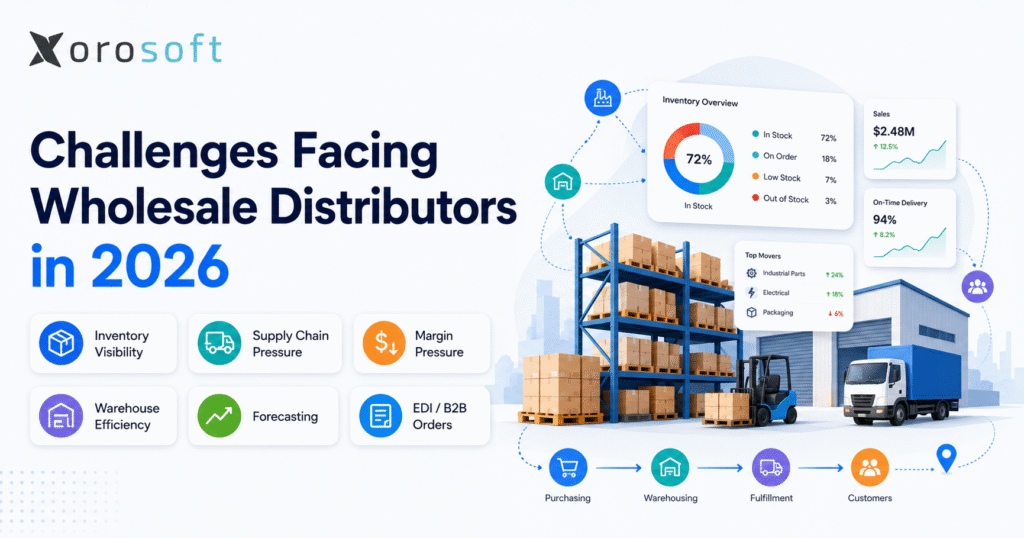
When discussing the industry, it’s important to consider wholesale distribution challenges faced by many companies today.
1. 2026 Is Forcing Wholesale Distributors to Rethink Operations
Wholesale distributors are entering 2026 with a much harder operating environment than they faced a few years ago. The pressure is not coming from one single issue. It is coming from inventory complexity, supplier uncertainty, margin compression, customer expectations, labor shortages, ecommerce growth, warehouse pressure, and software limitations all at the same time.
That is what makes the current moment different.
A distributor can no longer treat inventory, purchasing, warehouse management, accounting, and sales as separate functions. When one area breaks, the impact spreads quickly. A purchasing delay becomes a stockout. A stockout becomes a missed customer promise. A warehouse error becomes an invoice dispute. A wrong cost becomes a margin problem. A delayed report becomes a bad leadership decision.
The biggest wholesale distribution challenges in 2026 are connected problems. Therefore, distributors need connected operations.
For growing distributors, the practical question is no longer, “Can our current tools still work?” The better question is, “Can our current tools still support the speed, accuracy, and visibility the business now requires?”
1.1 Why Wholesale Distribution Challenges Are Becoming More Connected
Wholesale distribution used to be easier to manage with separate tools. A small team could use accounting software, spreadsheets, warehouse notes, email, and manual checks to keep the business moving.
That model becomes fragile as complexity grows.
A distributor with one warehouse can often survive with manual inventory updates. However, a distributor with three warehouses, Shopify orders, Amazon orders, wholesale customers, EDI requirements, custom pricing, supplier delays, and purchasing spreadsheets needs a more reliable operating model.
The issue is not that people are careless. In most cases, teams are working hard. The real problem is that the system around them is not strong enough.
When inventory lives in one system, accounting lives in another, purchasing lives in spreadsheets, and warehouse work happens in a separate app, the business has no single source of truth. Every team starts building its own workaround. Eventually, the company becomes dependent on manual checking instead of reliable data.
1.2 What Makes 2026 Different for Wholesale Distributors
The 2026 environment is different because distributors are facing pressure from both sides of the business.
On the supply side, supplier lead times, freight costs, product availability, and replenishment reliability can shift quickly. On the demand side, customers expect faster answers, accurate stock availability, better order visibility, and fewer fulfillment mistakes.
At the same time, internal teams are being asked to do more with limited resources. Warehouse employees need better direction. Purchasing teams need cleaner demand signals. Finance teams need faster reconciliation. Sales teams need accurate availability. Leadership needs reporting that reflects what is actually happening.
These conditions expose weak systems.
A distributor may still be profitable, but operational cracks start showing. Orders take longer to process. Purchasing becomes reactive. Inventory counts become less trusted. Customer service teams spend more time checking order status. Finance waits longer to close the month. Managers rely on spreadsheet exports instead of live dashboards.
Those are early signs that the company’s operating system is falling behind the business.
2. Biggest Wholesale Distribution Challenges Operators Must Solve
The most important wholesale distribution challenges in 2026 are not just technology problems. They are operating problems that technology can either hide, expose, or help solve.
A distributor can buy software and still struggle if processes are unclear. However, strong processes also become difficult to scale without the right system support. The goal is to improve both: process discipline and system visibility.
Because these wholesale distribution challenges affect inventory, purchasing, warehouse execution, and financial reporting at the same time, operators need to solve them as connected business issues rather than separate department problems.
2.1 Inventory Visibility Is Still the Core Distribution Challenge
Inventory visibility is the foundation of wholesale operations. When inventory numbers are wrong, every other department becomes less effective.
Sales cannot confidently promise products. Purchasing cannot plan replenishment. Warehouse teams cannot prioritize fulfillment. Finance cannot trust inventory valuation. Customer service cannot give reliable updates.
This is why inventory visibility remains one of the biggest wholesale distributor challenges in 2026.
The problem becomes more serious when distributors operate multiple warehouses or sell through multiple channels. Total inventory may look healthy, but the right inventory may not be available in the right location. A product may exist in the system but already be allocated to another customer. A purchase order may be on the way, but the sales team may not know when it will arrive.
These details matter because customers do not care that the inventory exists somewhere. They care whether the product can ship when promised.
2.2 Stockouts and Overstock Are Two Sides of the Same Problem
Stockouts and overstock often come from the same root issue: poor visibility.
A stockout happens when the business does not have enough inventory to meet demand. Overstock happens when the business has more inventory than it can sell efficiently. Both are expensive.
Stockouts hurt revenue, customer trust, and sales momentum. Overstock ties up cash, consumes warehouse space, and increases the risk of markdowns or obsolete inventory.
Many distributors try to solve stockouts by buying more. However, that can create overstock. Others try to reduce overstock by buying less. Yet, that can create stockouts.
The better approach is not simply buying more or less. The better approach is buying smarter. That requires accurate inventory, supplier lead times, demand history, seasonality, open sales orders, open purchase orders, and clear reorder logic.
2.3 Margin Pressure Is Making Operational Accuracy More Important
Margin pressure is one of the most dangerous wholesale distribution challenges because it can hide behind revenue growth.
A distributor may be selling more but making less. The causes can include higher freight costs, labor costs, customer discounts, fulfillment errors, returns, chargebacks, stock transfers, and inefficient warehouse workflows.
If finance cannot see true product cost, landed cost, carrying cost, and fulfillment cost, the business cannot understand real profitability. A customer may look profitable on paper but require custom pricing, urgent shipments, split orders, special handling, and frequent manual service.
That is why margin visibility must connect to inventory, warehouse, purchasing, and accounting data.
3. Inventory Visibility and Multi-Warehouse Control Problems
Inventory has always been important in wholesale distribution, but in 2026 it has become a strategic control point. Accurate inventory is no longer just a warehouse metric. It affects revenue, working capital, supplier planning, customer experience, and financial reporting.
3.1 Why Multi-Warehouse Inventory Creates More Risk
Multi-warehouse distribution adds flexibility, but it also adds complexity.
A distributor may use multiple warehouses to reduce shipping time, serve regional customers, manage overflow stock, support ecommerce fulfillment, or separate wholesale and retail inventory. However, every additional location increases the need for better controls.
The business must answer several questions quickly:
Where is the inventory?
Is it available or already allocated?
Can it be transferred?
Which warehouse should fulfill the order?
Will shipping cost reduce margin?
Is replenishment needed at one location but not another?
Without location-level visibility, teams make decisions based on partial information. That creates unnecessary transfers, late shipments, split orders, and overbuying.
3.2 How Inventory Errors Spread Across the Business
Inventory errors rarely stay in one department.
Delayed receiving can prevent sales from seeing available stock. Damaged goods that are not adjusted may cause purchasing to believe there is more usable inventory than reality. Poorly recorded transfers can make accounting show inventory value in the wrong location. Inconsistent cycle counts also reduce trust in leadership reports.
These errors create a chain reaction.
Sales becomes cautious. Purchasing overcorrects. Warehouse teams rely on manual checks. Finance spends more time reconciling. Managers stop trusting dashboards and return to spreadsheets.
That is why inventory accuracy should be treated as an operating discipline, not just a warehouse responsibility.
3.3 Why Real-Time Inventory Matters for B2B Customers
B2B customers increasingly expect consumer-grade visibility. They want to know whether products are available, when orders will ship, and whether backorders will delay their own operations.
This is especially important for distributors serving retailers, dealers, contractors, manufacturers, or ecommerce brands. Their customers often depend on accurate inventory to plan their own sales, production, or fulfillment.
If a distributor cannot provide reliable availability, customers may reduce order volume, split purchases across suppliers, or move to competitors that can provide faster answers.
Real-time inventory does not simply improve internal efficiency. It protects customer trust.
4. Supply Chain, Purchasing, and Forecasting Pressure
Supply chain volatility remains a major factor in wholesale distribution challenges. Even when disruption is less severe than during earlier supply chain shocks, distributors still face unpredictable lead times, changing supplier reliability, freight pressure, and demand swings.
Among the most urgent wholesale distribution challenges, purchasing and forecasting pressure deserve special attention because they directly affect cash flow, stock availability, and customer service.
4.1 Supplier Delays Are Changing Replenishment Strategy
Supplier delays create uncertainty across the business. A product that usually arrives in three weeks may suddenly take six. A supplier that was once reliable may begin shipping partial quantities. Freight schedules may shift. Purchase orders may arrive late or incomplete.
These issues make static reorder points less dependable.
If purchasing teams rely on old lead times, they may reorder too late. If they respond by carrying too much safety stock, they may tie up cash in slow-moving products. Both outcomes create financial risk.
Modern purchasing needs supplier history, lead time tracking, demand signals, and inventory visibility working together.
4.2 Spreadsheet Purchasing Is Becoming Too Fragile
Spreadsheet purchasing is common because it is flexible. Teams can build formulas, add notes, and adjust plans quickly. However, spreadsheets become risky when purchasing complexity increases.
A purchasing spreadsheet may not reflect live inventory. Open sales orders may be missing from the plan. Incoming purchase orders can also be overlooked. Supplier delays, seasonality, minimum order quantities, and customer commitments are often handled manually, which makes the process fragile as volume grows.
As a result, purchasing teams spend more time validating the spreadsheet than making strategic buying decisions.
This is one of the clearest signs that a distributor has outgrown manual processes.
4.3 Demand Forecasting Is Now a Practical Requirement
Demand forecasting used to feel like an advanced capability. In 2026, it is becoming a practical requirement for distributors that want to protect cash and service levels.
Forecasting helps teams understand which SKUs are stable, which are seasonal, which are growing, and which are slowing down. It also helps purchasing teams prepare for promotions, customer programs, supplier delays, and regional demand shifts.
Forecasting does not eliminate uncertainty. However, it reduces guesswork.
A useful forecast combines historical sales, open orders, current inventory, supplier lead times, seasonality, channel trends, and known customer commitments. Without connected data, forecasting becomes another spreadsheet exercise.
5. Warehouse, Labor, and Fulfillment Challenges for Distributors
Warehouse pressure is rising because customers expect faster fulfillment while labor remains difficult to manage. Even distributors with strong sales teams can lose customer trust if warehouse execution is slow, inconsistent, or error-prone.
Most distributors do not need fully autonomous warehouses today. However, warehouse operations are clearly moving toward more structured workflows, more real-time data, and more automation.
5.1 Manual Warehouse Processes Are Harder to Scale
Manual warehouse processes often work at lower order volume. Employees know where items are located. Supervisors know which customers need special handling. Experienced workers remember product exceptions.
That knowledge is valuable, but it is also risky when it lives only in people’s heads.
As order volume grows, manual processes create bottlenecks. Pickers walk too far. Orders get packed incorrectly. Bin locations are unclear. New employees take longer to train. Cycle counts become inconsistent. Returns take too long to process.
A distributor does not need automation for everything. However, it does need structure.
5.2 Picking, Packing, and Shipping Errors Are Expensive
A warehouse error creates more than one cost.
The business may pay for return freight, replacement shipping, customer service time, repacking labor, lost margin, and customer dissatisfaction. If the customer is a retailer or trading partner, the distributor may also face chargebacks or compliance penalties.
Many picking and packing errors happen because warehouse teams do not have enough system guidance. A printed pick ticket may not reflect current inventory. A picker may choose the wrong bin. A packer may miss a customer-specific requirement. A shipment may go out before documents are complete.
A stronger warehouse management system can help distributors improve receiving, putaway, barcode scanning, picking, packing, shipping, and cycle counting. The key is making warehouse execution part of the same operational flow as inventory, purchasing, and order management.
5.3 Labor Shortages Make Process Design More Important
Labor shortages make weak processes more visible. If a warehouse depends only on experienced workers, the business becomes vulnerable when those workers leave, call out, or move into other roles.
Good process design makes work easier to train and repeat.
Directed picking, barcode validation, bin locations, receiving rules, packing workflows, and clear exception handling reduce dependency on tribal knowledge. Employees still matter, but the system supports them better.
This is especially important for distributors that handle seasonal peaks, temporary workers, multiple warehouses, or fast-growing ecommerce volume.
6. Ecommerce, EDI, and Customer-Specific Wholesale Complexity
Wholesale customers are becoming more demanding. Many still buy through traditional sales channels, but they also expect ecommerce-like speed, transparency, and convenience.
This creates one of the most important B2B distribution challenges: distributors must support complex wholesale workflows while delivering a smoother digital buying experience.
6.1 Shopify, Amazon, and Wholesale Channels Must Work Together
Many distributors now sell through multiple channels. They may manage wholesale orders, Shopify orders, Amazon orders, sales rep orders, B2B portal orders, and EDI orders at the same time.
Each channel has different requirements. Shopify may need fast inventory sync. Amazon may require marketplace-specific reporting. Wholesale customers may need custom pricing. Retailers may require EDI documents. Sales reps may need accurate available-to-sell data.
If these channels do not connect to the same inventory and accounting foundation, teams spend too much time reconciling orders manually.
For distributors using Shopify, the Xorosoft ERP Shopify app is relevant when ecommerce orders need to connect with inventory, accounting, purchasing, warehouse management, and wholesale workflows.
6.2 EDI Requirements Are Becoming More Operationally Important
EDI is not just a technical requirement. It affects order management, warehouse execution, shipping, invoicing, and customer compliance.
Retailers and trading partners may require purchase orders, acknowledgments, advanced shipment notices, invoices, labels, routing rules, and strict timing. If these requirements are handled manually, errors become more likely.
A missed ASN, wrong label, incorrect quantity, or late invoice can create chargebacks and payment delays.
This is why EDI should not sit outside the main operating system. It needs to connect with inventory, warehouse, order management, and accounting.
6.3 Customer-Specific Pricing Needs Better Controls
Wholesale pricing is rarely simple.
Customers may have negotiated prices, contract terms, volume discounts, promotional pricing, territory rules, or special item lists. If pricing rules are managed manually, mistakes can reduce margin or create customer disputes.
Customer-specific pricing must be controlled at the system level. Sales teams should not need to search through spreadsheets or old emails to confirm the right price.
Strong pricing control helps protect margins while improving customer experience.
7. Technology Gaps Behind Modern Distribution Industry Challenges
Many wholesale distribution challenges become worse because the technology stack is disconnected. Each tool may solve one problem, but the overall business becomes harder to manage when data does not flow properly.
In many growing businesses, wholesale distribution challenges become harder to manage because the technology stack was built one workaround at a time.
7.1 QuickBooks, Spreadsheets, and Apps Often Create System Gaps
A common distributor stack includes QuickBooks, spreadsheets, an inventory app, a warehouse app, Shopify, Amazon, EDI software, and manual reports.
This stack usually develops naturally. The company adds tools as new problems appear. At first, this feels practical. Over time, however, the business becomes harder to control.
The finance team sees one version of the truth. The warehouse sees another. Purchasing uses another. Sales checks another. Leadership receives reports after multiple exports and manual adjustments.
That is how disconnected tools create operational drag.
7.2 Reporting Delays Make Leadership Less Effective
Delayed reporting is a serious problem because distributors need fast decisions.
Leadership needs to know which products are profitable, which customers are costly to serve, which warehouses are falling behind, which suppliers are late, and which SKUs are creating excess inventory.
If reports take days or weeks to prepare, the business becomes reactive.
Real-time reporting does not mean every decision becomes automatic. It means operators can spot risk earlier and act with more confidence.
7.3 Cloud ERP for Wholesale Distribution Is Becoming More Relevant
A cloud ERP for wholesale distribution becomes relevant when inventory, accounting, purchasing, warehouse management, sales, ecommerce, and reporting need to work from one system.
This is usually the point where businesses have outgrown QuickBooks, spreadsheets, or inventory-only software.
Xorosoft is one example of a cloud ERP platform built for inventory-driven businesses. It connects inventory management, accounting, purchasing, warehouse management, forecasting, reporting, ecommerce operations, and multi-warehouse workflows in one system.
The goal is not to add more software. The goal is to reduce operational fragmentation.
8. Industry-Specific Wholesale Distributor Challenges
Wholesale distribution challenges vary by industry. The core themes may be similar, but the operational details are different.
A distributor selling apparel does not face the same inventory logic as a furniture distributor. A food distributor has different compliance needs from a sporting goods distributor. An industrial parts distributor has different urgency than a consumer products distributor.
This is why software and process design should reflect industry requirements.
8.1 Apparel and Fashion Distribution Challenges
Apparel distributors manage styles, sizes, colors, seasons, collections, returns, and fast-changing demand.
A single product can have dozens of variants. One color may sell quickly while another moves slowly. One size may stock out while another becomes overstock. Seasonal products may lose value if they miss the right selling window.
These businesses need SKU-level visibility, variant-level forecasting, purchasing discipline, and strong warehouse accuracy.
8.2 Furniture Distribution Challenges
Furniture distributors deal with bulky inventory, long lead times, delivery coordination, warehouse space constraints, and higher handling costs.
Overstock is especially painful because products consume significant space. Stockouts are also painful because customers may wait weeks for replenishment.
Furniture distribution requires strong location visibility, supplier tracking, delivery planning, and margin awareness.
8.3 Sporting Goods Distribution Challenges
Sporting goods distributors often face seasonal demand, promotional spikes, product launches, and channel-specific buying patterns.
A distributor may need to prepare for school seasons, outdoor seasons, tournaments, holidays, or new product drops. Forecasting and purchasing must be aligned early because missed timing can lead to lost sales or leftover inventory.
8.4 Food and Beverage Distribution Challenges
Food and beverage distributors face expiry dates, lot tracking, freshness, traceability, compliance, and spoilage risk.
Inventory accuracy is not only about profitability. It can also affect safety and customer trust.
These distributors need lot control, date tracking, warehouse discipline, and clear rotation workflows.
8.5 Manufacturing and Wholesale Hybrid Challenges
Some distributors also manufacture, assemble, kit, or bundle products. This creates another layer of complexity.
The business must track raw materials, finished goods, bills of materials, work orders, production planning, and purchasing. If manufacturing data is disconnected from inventory and sales, teams may accept orders without knowing whether materials are available.
Xorosoft supports this type of inventory-driven environment by connecting manufacturing workflows with inventory, purchasing, accounting, warehouse management, and reporting.
For broader examples across wholesale, apparel, furniture, sporting goods, food, and manufacturing, distributors can review relevant industry use cases before selecting a system.
9. What Modern Wholesale Distribution Software Must Support
Modern wholesale distribution software should not only track inventory. It should support the full operating model of the business.
That includes inventory, purchasing, accounting, warehouse management, sales channels, EDI, reporting, forecasting, and customer-specific workflows.
9.1 Real-Time Inventory and Multi-Warehouse Control
The system should show what is available, where it is located, what is allocated, what is incoming, and what is at risk.
Multi-warehouse control should include transfers, replenishment, bin locations, location-level reporting, and fulfillment rules.
9.2 Purchasing Automation and Supplier Management
Purchasing tools should help teams plan better, not simply create purchase orders.
Useful capabilities include reorder suggestions, supplier lead times, purchase approvals, open PO tracking, supplier performance, and demand-based planning.
Purchasing automation should support human decision-making. It should not remove judgment.
9.3 Integrated Accounting and Inventory Valuation
Accounting and inventory must stay connected.
When products are received, shipped, adjusted, transferred, or returned, those movements affect financial reporting. If the data is disconnected, month-end close becomes slower and less reliable.
Integrated accounting helps distributors track inventory valuation, COGS, landed cost, margin, and reconciliation more accurately.
9.4 Ecommerce, EDI, and Wholesale Order Management
Modern systems should support multiple order sources without forcing teams to enter the same information repeatedly.
Shopify, Amazon, wholesale portals, sales rep orders, and EDI orders should flow into a central operating system. Inventory should update across channels. Orders should route correctly. Accounting should reflect the activity.
A platform such as Xorosoft’s XoroOne becomes relevant when distributors want inventory, accounting, purchasing, warehouse management, ecommerce, forecasting, and reporting connected in one operating environment.
10. ERP, WMS, and Automation Options for Wholesale Distributors
Solving wholesale distribution challenges does not always mean buying the biggest system. The right solution depends on the company’s stage, complexity, and readiness.
10.1 When Inventory Software Is Enough
Inventory software may be enough for smaller distributors with simple operations.
If the business has one warehouse, limited SKU complexity, low order volume, simple accounting, no EDI, and basic purchasing, a full ERP system may be unnecessary.
At this stage, the priority is accurate stock tracking and basic order control.
10.2 When ERP Becomes Necessary
ERP becomes necessary when inventory, accounting, purchasing, warehouse, sales, ecommerce, and reporting need to work together.
A distributor may be ready for ERP when:
• Inventory numbers are not trusted
• Purchasing depends on spreadsheets
• Month-end close is delayed
• Multiple warehouses are hard to manage
• Shopify or Amazon orders require manual work
• EDI creates order complexity
• Leadership reporting is slow
• Warehouse errors are increasing
At this point, ERP is not just a finance system. It becomes the operating backbone of the business.
10.3 When WMS Becomes Necessary
A WMS becomes necessary when warehouse execution is too complex for manual processes.
Signs include picking errors, unclear bin locations, slow receiving, poor cycle count accuracy, inconsistent packing, and difficulty training warehouse employees.
A WMS is especially important for distributors with high order volume, multiple warehouses, barcode scanning needs, lot tracking, serial tracking, or customer-specific fulfillment rules.
10.4 How Automation Should Be Introduced
Automation should come after visibility and process discipline.
Automation will not fix inaccurate inventory. Poor warehouse locations will still create fulfillment problems, even with better tools. Messy customer pricing rules can also create faster pricing errors when automated too early.
The right sequence is simple:
First, clean data.
Then standardize workflows.
Next, connect core systems.
After that, automate repeatable decisions.
This approach lowers implementation risk and improves long-term results.
10.5 Comparing Software Options for Wholesale Distribution
| System Type | Best For | Main Limitation |
|---|---|---|
| QuickBooks + spreadsheets | Early-stage accounting and simple tracking | Limited operational visibility |
| Inventory-only software | Basic stock control | Limited accounting, purchasing, and warehouse depth |
| WMS | Warehouse execution | Does not usually manage full financial operations |
| Traditional ERP | Large and complex companies | Can require heavier implementation |
| Cloud ERP | Growing inventory-driven distributors | Requires process readiness and clean data |
Distributors evaluating systems may compare NetSuite, Acumatica, Cin7, Brightpearl, Fishbowl, Sage, Business Central, and other ERP or inventory platforms. Xorosoft can be considered a modern ERP alternative for inventory-driven businesses that want connected inventory, accounting, purchasing, warehouse, ecommerce, and reporting workflows.
11. Mistakes to Avoid When Solving Wholesale Distribution Challenges
The wrong approach to modernization can create more problems than it solves. Distributors should avoid choosing technology before understanding their workflows.
The companies that handle wholesale distribution challenges best usually begin by fixing data quality, process ownership, and system visibility before adding more automation.
11.1 Waiting Until Operations Are Already Breaking
Many distributors wait too long to upgrade systems.
They wait until inventory is unreliable, warehouse errors are common, finance is overloaded, and purchasing is constantly reactive. By then, the project becomes harder because teams are already frustrated and data may be messy.
A better approach is to modernize before operations become unmanageable.
11.2 Treating Inventory as Only a Warehouse Problem
Inventory is not just a warehouse issue.
It affects sales promises, purchasing decisions, accounting accuracy, ecommerce availability, customer service, and executive reporting. If leadership treats inventory as a warehouse-only responsibility, the company will miss the larger operational issue.
Inventory accuracy requires cross-functional ownership.
11.3 Choosing Software Without Defining Processes First
Software cannot fix unclear workflows by itself.
Before selecting a system, distributors should define how orders are received, how inventory is allocated, how purchasing decisions are made, how warehouse tasks are completed, how EDI is handled, and how accounting reconciles inventory.
Clear workflows make software selection easier and implementation smoother.
11.4 Ignoring Accounting Integration
Some distributors choose inventory or warehouse software without thinking deeply about accounting.
That creates problems later.
Inventory movement affects COGS, valuation, landed cost, margin, and month-end close. If accounting is disconnected from operations, finance teams spend too much time reconciling and not enough time analyzing.
11.5 Over-Automating Too Early
Automation is useful when the process is stable. It is risky when the process is unclear.
Distributors should avoid automating purchasing, forecasting, order routing, or warehouse decisions until inventory data and workflows are reliable.
Good automation depends on good operational discipline.
12. FAQs About Wholesale Distribution Challenges
12.1 What are the biggest wholesale distribution challenges in 2026?
The biggest wholesale distribution challenges in 2026 include inventory visibility, supply chain volatility, margin pressure, labor constraints, warehouse inefficiency, EDI complexity, ecommerce expectations, disconnected systems, purchasing delays, and forecasting accuracy. These challenges are connected, which is why distributors need better visibility across inventory, warehouse, purchasing, accounting, and customer operations.
12.2 Why do wholesale distributors struggle with inventory visibility?
Wholesale distributors struggle with inventory visibility because stock often moves across multiple warehouses, sales channels, spreadsheets, warehouse apps, ecommerce platforms, and accounting systems. If these systems do not update each other in real time, teams lose trust in inventory numbers. As SKU count and order volume increase, manual updates become too slow and error-prone.
12.3 What causes stockouts in wholesale distribution?
Stockouts usually happen because of inaccurate inventory, poor forecasting, supplier delays, late purchasing, unexpected demand, or weak reorder logic. In many cases, stockouts are not caused by one mistake. They happen when sales, inventory, purchasing, and warehouse data are disconnected.
12.4 How can distributors reduce overstock?
Distributors can reduce overstock by improving demand forecasting, tracking supplier lead times, reviewing slow-moving SKUs, setting better reorder rules, and connecting purchasing with real-time inventory data. Overstock is often a planning problem, not just a sales problem. Better visibility helps teams buy with more discipline.
12.5 When should a distributor move beyond QuickBooks?
A distributor should consider moving beyond QuickBooks when inventory complexity, purchasing, warehouse workflows, EDI, multi-location operations, or reporting needs exceed what QuickBooks can comfortably support. QuickBooks can remain useful for early accounting, but growing distributors often need deeper operational control.
12.6 What software do wholesale distributors need?
Wholesale distributors often need software that supports inventory visibility, purchasing, warehouse management, accounting, EDI, ecommerce, forecasting, and reporting. Smaller businesses may only need inventory software, while growing distributors usually need ERP or ERP plus WMS capabilities when operations become more connected and complex.
12.7 How does cloud ERP help wholesale distributors?
Cloud ERP helps wholesale distributors centralize inventory, accounting, purchasing, warehouse management, ecommerce, forecasting, and reporting. This reduces duplicate data entry and gives teams a shared system of record. For growing distributors, cloud ERP can improve operational visibility and reduce dependency on spreadsheets.
12.8 What are the signs a distributor is ready for ERP?
A distributor may be ready for ERP when inventory is unreliable, purchasing depends on spreadsheets, month-end close is delayed, multiple warehouses are hard to manage, EDI creates complexity, Shopify or Amazon orders require manual work, and leadership reporting is slow. When teams spend more time reconciling systems than running operations, ERP becomes worth evaluating.
13. Practical Takeaway for Wholesale Distributors in 2026
Wholesale distributors in 2026 need more than hard work and manual coordination. They need a clearer operating foundation.
The companies that handle wholesale distribution challenges well will be the ones that improve visibility before complexity becomes unmanageable. They will know what inventory they have, where it is located, what is allocated, what is incoming, what customers need, which suppliers are reliable, and how operational decisions affect margin.
That level of control is difficult to achieve when teams rely on disconnected systems.
The practical next step is to audit the business honestly. Look at inventory accuracy, warehouse execution, purchasing workflows, accounting reconciliation, EDI complexity, ecommerce operations, reporting delays, and customer-specific pricing. Then identify the areas where manual work is creating the most risk.
A phased roadmap usually works best:
• Improve inventory visibility
• Standardize purchasing workflows
• Strengthen warehouse accuracy
• Connect accounting and inventory
• Integrate ecommerce and EDI
• Add forecasting and reporting
• Automate once the data is reliable
For distributors that have outgrown QuickBooks, spreadsheets, inventory-only apps, or disconnected warehouse systems, evaluating a cloud ERP platform such as Xorosoft may be the right next step. Xorosoft connects inventory management, accounting, purchasing, warehouse management, manufacturing, forecasting, reporting, Shopify, Amazon, EDI, and multi-warehouse workflows for inventory-driven businesses.
If your wholesale distribution business is ready to review its operating systems, you can book a personalized demo and evaluate whether a connected ERP foundation is the right move for 2026 growth.
Recent Posts
-
 ERP Landed Cost Module vs Spreadsheet Calculations for Importers
 -
 How to Build an Open-to-Buy Plan for an Omnichannel Brand
 -
 Cold Storage WMS for Food and Beverage Distribution
 -
 ERP Buying Statistics 2026: Evaluation, Implementation, and Adoption Risks
 -
 How a Distributor Reduced B2B Order Exceptions Without Restricting Sales