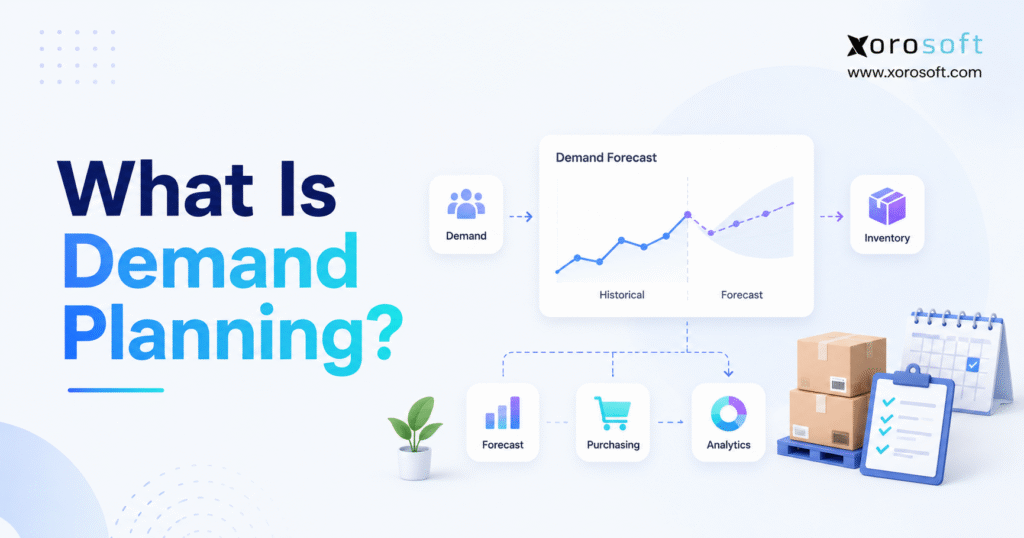
If you want to improve your company’s operations, understanding demand planning is essential.
1. Inventory Problems Usually Start Before a Purchase Order Is Created
Stockouts, overstock, emergency purchase orders, and delayed customer shipments often appear to be separate operational problems. However, they usually begin with the same weakness: the business does not have a reliable view of future demand.
A purchasing team may order inventory based on recent sales. Meanwhile, marketing may be preparing a promotion, sales may have secured a large wholesale account, and finance may be trying to reduce working-capital requirements. Although each department has useful information, the company still lacks one coordinated demand picture.
As a business grows, this disconnect becomes more expensive. For example, an ecommerce brand may have enough total inventory but not enough of the right sizes, colours, or variations. Similarly, a wholesale distributor may hold excess stock while struggling to fulfil an important EDI order. A manufacturer, by contrast, may have strong demand for finished goods but insufficient components to complete production.
Demand planning creates a structured way to identify these risks before they become urgent. Instead of treating every shortage or surplus as a separate event, the company builds a shared view of what customers are expected to buy and when they are likely to buy it.
Therefore, demand planning combines historical demand, current orders, promotions, product lifecycles, customer commitments, and market intelligence. The resulting plan can then guide purchasing, inventory, warehouse, manufacturing, finance, and leadership teams.
Demand planning does not remove uncertainty. After all, no method can predict customer behaviour, supplier delays, market changes, or competitor actions perfectly. Nevertheless, a disciplined process helps the business measure uncertainty and respond before problems affect customer service or cash flow.
1.1 Why Basic Sales Forecasts Become Insufficient
A basic sales forecast usually estimates future units or revenue. Although that information is useful, it may not contain enough operational detail for inventory, purchasing, or production teams.
For instance, a forecast of $500,000 in quarterly revenue does not explain which SKUs will sell, when demand will occur, where inventory should be stored, or which suppliers require purchase orders. Moreover, it does not show whether manufacturing has enough materials or whether finance can support the required inventory investment.
Consequently, teams may still rely on spreadsheets, email threads, and individual judgment. Demand planning adds the product, time, location, and channel detail required to convert a financial expectation into an operating plan.
1.2 The Core Question Demand Planning Answers
Demand planning answers a practical question:
What are customers expected to buy, and how should the business prepare for that demand?
The answer affects product availability, purchase timing, warehouse capacity, production schedules, supplier communication, inventory investment, and financial planning. In addition, it gives every department a common set of assumptions.
Without that shared view, sales may promise inventory that purchasing has not ordered. At the same time, finance may plan cash using a different revenue forecast. As a result, the company reacts to problems instead of preparing for them.
2. Demand Planning Definition and Business Purpose
Demand planning is the process of estimating future customer demand and translating that estimate into coordinated inventory, purchasing, production, warehouse, and financial decisions.
In practice, demand planning uses both quantitative data and qualitative knowledge. Quantitative information provides an objective baseline, while commercial and operational input explains future events that historical data cannot identify.
Quantitative inputs may include:
- Historical sales
- Customer orders
- Product returns
- Stockout history
- Website activity
- Marketplace sales
- Seasonal patterns
- Pricing history
Qualitative inputs may include:
- Sales-team knowledge
- Promotion plans
- New customer commitments
- Market expansion
- Product launches
- Supplier risks
- Competitor activity
- Leadership expectations
Together, these inputs create an approved view of expected demand. More importantly, the final plan should provide enough detail for operational teams to act.
2.1 Demand Planning in Simple Terms
Demand forecasting estimates what customers are likely to buy. Demand planning, on the other hand, determines what the company should do with that forecast.
For example, a forecast may indicate that customers will purchase 10,000 units next quarter. However, the demand plan must explain which products account for those units, which periods will generate demand, which channels are involved, and which warehouses require inventory.
Moreover, the plan should show what purchasing must order, what manufacturing must produce, and how much working capital may be required. Therefore, the forecast is an analytical input, while the demand plan is the coordinated business response.
2.2 What an Effective Demand Plan Should Produce
A useful demand plan may include:
- Expected demand by SKU
- Demand by product category
- Weekly or monthly forecasts
- Channel-level demand
- Customer-level commitments
- Warehouse-level requirements
- Promotion adjustments
- New-product assumptions
- Forecast confidence
- Upside and downside scenarios
- Documented manual adjustments
In addition, the plan should identify uncertainty. A predictable replenishment item should not be treated the same way as a seasonal product launch with no direct sales history.
Likewise, the company should distinguish between confirmed orders and expected demand. Confirmed customer commitments provide stronger evidence. However, relying only on confirmed orders would cause the business to react too late to unconfirmed but likely demand.
2.3 Who Needs Demand Planning?
Demand planning is particularly useful for companies that:
- Sell physical products
- Manage hundreds or thousands of SKUs
- Operate multiple warehouses
- Sell through Shopify, Amazon, retail, or wholesale
- Use long-lead-time suppliers
- Manufacture or assemble products
- Experience seasonal demand
- Manage many size, colour, or style variations
- Use EDI with wholesale customers
- Regularly experience stockouts or excess inventory
Businesses across inventory-driven industries can benefit from a structured demand planning process. In particular, apparel, furniture, sporting goods, food, wholesale distribution, consumer products, and manufacturing companies often face complexity that grows faster than their existing systems.
2.4 Who May Not Need Advanced Demand Planning Software?
A formal demand planning process can help almost every inventory business. However, advanced software may not be necessary when a company has a small catalogue, one channel, one warehouse, stable demand, and short supplier lead times.
In those conditions, a controlled spreadsheet and a consistent monthly review may be sufficient. Nevertheless, the spreadsheet should have clear ownership, protected formulas, version control, and documented assumptions.
Ultimately, the technology should match the complexity of the operation rather than the size of the company alone.
3. Demand Planning vs Demand Forecasting and Related Processes
Several planning terms are used interchangeably. However, they describe different activities and produce different outputs.
| Process | Primary question | Main output |
|---|---|---|
| Demand forecasting | What will customers probably buy? | Statistical or judgment-based forecast |
| Demand planning | What demand should the business prepare for? | Approved demand plan |
| Supply planning | How will the business fulfil expected demand? | Purchasing, production, or supply plan |
| Inventory planning | How much inventory should be held? | Inventory targets and replenishment policies |
| Sales forecasting | How much revenue or sales may be generated? | Revenue or opportunity forecast |
3.1 Demand Planning vs Demand Forecasting
Demand forecasting is the analytical process of predicting future demand. It may use moving averages, exponential smoothing, seasonal models, trend analysis, regression, machine learning, or sales judgment.
Demand planning is broader. First, it begins with the forecast. Next, it adds business knowledge and resolves competing assumptions. Finally, it creates a plan that operational teams can execute.
Therefore, a forecast can remain purely analytical. A demand plan, by contrast, must lead to purchasing, inventory, production, warehouse, and financial decisions.
3.2 Demand Planning vs Sales Forecasting
Sales forecasting often focuses on revenue, opportunities, customers, or sales territories. Demand planning, meanwhile, requires more detailed operational information.
For example, a sales forecast may estimate $2 million in quarterly revenue. However, purchasing cannot issue supplier orders based only on a revenue total. Instead, buyers need product quantities, required dates, lead times, and current inventory positions.
Consequently, the sales forecast may support financial reporting, while demand planning supports operational execution.
3.3 Demand Planning vs Supply Planning
Demand planning estimates what customers will require. Supply planning determines how the business will meet that requirement.
Supply planning evaluates available inventory, open purchase orders, supplier capacity, lead times, materials, labour, warehouse space, and transportation. Therefore, a strong demand plan without a realistic supply plan still creates operational risk.
In other words, the company may understand future demand but remain unable to fulfil it.
3.4 Demand Planning vs Inventory Planning
Demand planning estimates future customer need. Inventory planning determines how much stock the company should hold, where it should be positioned, and when it should be replenished.
Inventory planning decisions include safety stock, reorder points, service-level targets, transfer rules, replenishment frequency, and slow-moving inventory actions. Therefore, demand planning informs inventory policy, but it does not replace it.
3.5 Demand Planning Within S&OP
Demand planning is commonly part of sales and operations planning.
A typical S&OP cycle includes:
1. Demand review
2. Supply review
3. Inventory and capacity review
4. Financial reconciliation
5. Executive decision-making
First, the demand review establishes what the market is expected to require. Next, the supply review determines whether suppliers, production, warehouses, and logistics can support that requirement. Finally, finance and leadership evaluate the cash, margin, capacity, and risk implications.
As a result, demand planning becomes the commercial starting point for a wider operating plan.
4. The Demand Planning Process From Data to Execution
A reliable demand planning process requires more than a forecasting formula. Instead, it needs clear ownership, trustworthy data, documented assumptions, and a consistent review rhythm.
4.1 Define the Demand Planning Scope
The company should first decide what the plan is intended to support.
Important decisions include:
- Planning horizon
- Weekly or monthly periods
- SKU or product-family level
- Customer or channel level
- Warehouse or regional level
- Review frequency
- Currency
- Units of measure
For example, a six-week replenishment plan serves a different purpose from an 18-month financial and capacity plan. Therefore, the required level of detail should reflect the decision being made.
4.2 Collect and Clean Demand Data
Historical data often contains issues that distort forecasts. Consequently, the planning team should review data before selecting a forecasting model.
Common problems include:
- Cancelled orders
- Duplicate transactions
- Test orders
- Product-code changes
- Incorrect dates
- Unit-conversion errors
- Returns
- One-time internal transactions
- Inventory transfers recorded as sales
Clean data does not guarantee an accurate forecast. Nevertheless, unreliable data makes consistent demand planning almost impossible.
4.3 Correct Demand History for Stockouts
Sales history does not always represent true customer demand.
When an item is unavailable, the system records only what the company could sell. It does not show every customer who left the website, purchased a substitute, cancelled an order, or bought from a competitor.
Therefore, planners should examine backorders, website product views, customer enquiries, substitute-product sales, and wholesale order requests. In addition, they should compare demand before, during, and after the stockout.
Stockout periods should be flagged before the forecasting model is trained. Otherwise, the system may interpret lost sales as weak demand and recommend even less inventory.
4.4 Segment Products by Demand Behaviour
Not every product should use the same planning method. Instead, the company should segment products according to economic value and demand behaviour.
Useful segmentation factors include revenue, gross margin, demand volume, variability, supplier lead time, lifecycle stage, strategic importance, stockout consequences, and obsolescence risk.
ABC analysis identifies economic importance, while XYZ analysis groups products according to demand consistency. Together, these methods help planners focus effort where it creates the most value.
For instance, a high-value and highly variable product requires frequent review. In contrast, a low-value item with stable demand may be planned through automated rules.
4.5 Create a Baseline Demand Forecast
The baseline forecast should provide an objective starting point.
Depending on the product, the model may use moving averages, exponential smoothing, trend models, seasonal models, causal models, intermittent-demand methods, or machine-learning models.
Importantly, the original baseline should remain visible after manual adjustments. Otherwise, the company cannot determine whether human input improved or weakened the forecast.
4.6 Add Commercial and Market Intelligence
Historical data cannot anticipate every future event. Therefore, the planning team should add relevant commercial and market information.
Potential inputs include promotions, price changes, new wholesale accounts, product launches, product discontinuations, pipeline changes, market expansion, competitor activity, and customer commitments.
However, manual adjustments should not become untracked opinions. Each change should include a reason, owner, expected duration, and measurable assumption.
4.7 Review Demand Planning Exceptions
The team should focus on products that require attention rather than manually reviewing every SKU.
Common exceptions include:
- Significant forecast changes
- High-value products
- New products
- Stockout-prone items
- Large customer commitments
- Unusual promotion lifts
- Supplier-risk products
- Products with persistent forecast bias
- Items approaching end of life
As a result, planners spend more time investigating risk and less time changing forecasts that already perform well.
4.8 Approve a Consensus Demand Plan
Sales, marketing, finance, operations, and purchasing may have different expectations. Nevertheless, the business needs one approved demand plan.
The objective is not to average every opinion. Instead, the company should evaluate evidence, document assumptions, and make clear decisions.
Moreover, decision rights should be defined. Otherwise, planning meetings can become repeated debates without ownership or accountability.
4.9 Translate Demand Planning Into Operational Actions
The approved demand plan should influence purchase-order recommendations, supplier communication, inventory replenishment, warehouse transfers, safety stock, material requirements, production schedules, labour plans, cash-flow projections, and revenue expectations.
In a connected cloud ERP environment such as Xorosoft, demand information can support inventory, purchasing, warehouse, manufacturing, accounting, and reporting workflows without repeatedly transferring data between separate systems.
Consequently, the demand plan becomes part of day-to-day execution rather than remaining an isolated spreadsheet.
4.10 Measure Results and Improve the Demand Planning Process
Once actual demand becomes available, the company should compare it with the statistical baseline, commercial adjustments, the approved demand plan, and actual operational results.
This comparison reveals whether the model, assumptions, and overrides improved performance. Furthermore, the team should record the cause of major errors.
For example, the forecast may have missed a promotion, supplier delay, stockout, customer cancellation, or unexpected market event. By documenting the cause, the business can improve the next planning cycle.
5. Data Required for Accurate Demand Planning
The quality of a demand plan depends on the relevance, consistency, and timeliness of its inputs. Therefore, companies should avoid relying on a single data source.
5.1 Historical Sales and Order Data
Useful historical fields include units ordered, units shipped, revenue, customer, channel, location, promotion, returns, cancellations, backorders, and product availability.
However, orders and shipments should not automatically be treated as identical. A customer may order a product that is shipped later, partially fulfilled, substituted, or cancelled.
Therefore, planners should decide which demand measure supports each decision.
5.2 Open Orders and Customer Commitments
Confirmed demand may include wholesale purchase orders, EDI transactions, contracts, backorders, preorders, reserved inventory, and recurring customer requirements.
These commitments may provide stronger evidence than a historical trend. Nevertheless, planners should ensure that confirmed orders are not counted twice when they are already included in the baseline.
5.3 Promotions, Pricing, and Marketing Activity
Promotions can temporarily change demand patterns. Therefore, planners should capture both the activity and its expected effect.
Relevant inputs include discount level, campaign timing, advertising spend, influencer activity, email campaigns, bundles, store placement, and free-shipping events.
Afterward, the planning team should compare expected promotion lift with actual results. As a result, future campaigns can be planned using evidence instead of guesswork.
5.4 Seasonality and Product Lifecycles
Demand may vary because of holidays, weather, school calendars, sporting seasons, fashion cycles, product maturity, product launches, or end-of-life decisions.
A mature product with three years of history should not be planned the same way as a new product. Likewise, a declining item should not use the same assumptions as a growing product.
Consequently, lifecycle stage should influence the forecasting method and review frequency.
5.5 Channel and Marketplace Demand Data
Shopify, Amazon, wholesale, retail, and direct-sales channels may behave differently.
Channel-level demand planning helps determine where demand originates, whether growth is incremental, whether customers are shifting between channels, where inventory should be allocated, and which channel has greater forecast risk.
For Shopify operations, the Xorosoft ERP app provides a relevant example of how storefront orders can connect with broader inventory and operational workflows.
However, businesses should avoid viewing each channel in isolation. A rise in ecommerce demand may represent a shift from retail or wholesale rather than an increase in total company demand.
5.6 Inventory and Warehouse Data
A forecast must be compared with the actual inventory position.
Relevant fields include available inventory, allocated inventory, in-transit stock, open purchase orders, damaged stock, inventory by warehouse, transfer orders, receiving delays, and warehouse capacity.
Without location-level visibility, a company may have excess inventory overall and still experience regional stockouts. Therefore, demand by warehouse can be as important as total company demand.
5.7 Supplier and Purchasing Data
Demand planning should consider supplier lead times, lead-time variability, minimum order quantities, supplier capacity, order calendars, payment terms, delivery reliability, landed cost, and open purchase orders.
A product with stable demand can still require high planning attention when its supplier has an unpredictable lead time. Conversely, a variable item may be easier to manage when replenishment is fast and flexible.
Therefore, demand variability and supply variability should be evaluated together.
5.8 External Demand Signals
Depending on the industry, useful external signals may include weather, economic activity, search trends, competitor pricing, industry events, regulatory changes, market growth, and regional demand patterns.
External signals should only be used when the business can explain their relationship with demand. Otherwise, they may add complexity without improving the plan.
6. Demand Forecasting Methods Used in Demand Planning
No single forecasting method works for every product, channel, or planning horizon. Therefore, businesses should match the method to the demand pattern.
| Forecasting method | Best use | Main limitation |
| Moving average | Stable demand | Responds slowly to change |
| Exponential smoothing | Recent demand changes | Requires parameter selection |
| Seasonal model | Repeating patterns | Needs sufficient history |
| Trend model | Sustained growth or decline | May extend temporary changes |
| Causal model | Price or promotion effects | Requires reliable variables |
| Collaborative forecast | Commercial knowledge | Can introduce bias |
| Demand sensing | Short-term adjustments | Does not replace long-range planning |
6.1 Qualitative Demand Forecasting
Qualitative methods rely on human knowledge.
They are useful when a product is new, a market is changing, historical data is limited, a major promotion is planned, a new customer is expected, or an unusual event is likely.
Inputs may come from sales teams, customers, suppliers, executives, or market research. However, qualitative forecasts should still document assumptions and measure outcomes.
6.2 Quantitative Demand Forecasting
Quantitative methods use historical and measurable data.
They create a repeatable baseline and make forecast performance easier to evaluate. Nevertheless, they still depend on relevant history, accurate data, and appropriate assumptions.
Therefore, a complex model cannot compensate for weak inputs.
6.3 Moving Average Forecasting
A moving average calculates expected demand from a selected number of previous periods.
It is simple and transparent. However, it may respond too slowly when demand is growing, declining, or affected by promotions.
Therefore, moving averages are generally more suitable for products with relatively stable demand.
6.4 Exponential Smoothing
Exponential smoothing gives greater importance to recent observations.
As a result, it can respond faster than a simple average while still reducing short-term noise. However, the result depends on how heavily recent data is weighted.
6.5 Seasonal Demand Forecasting
Seasonal models identify patterns that repeat at regular intervals, such as holidays, summer demand, winter clothing, back-to-school items, subscription cycles, or sporting seasons.
Seasonal forecasting requires enough history to distinguish repeating patterns from one-time events. Otherwise, an unusual year may be mistaken for a permanent pattern.
6.6 Trend Forecasting
Trend models estimate sustained increases or decreases in demand.
However, planners must ensure that temporary promotion lifts, stockout recoveries, or one-time wholesale orders are not interpreted as permanent growth.
For that reason, trend assumptions should be reviewed alongside commercial events.
6.7 Causal Demand Forecasting
Causal models use explanatory variables such as price, promotions, marketing activity, weather, distribution growth, store count, or economic indicators.
These models can explain why demand changes. Nevertheless, they require reliable data for each factor and a reasonable relationship between the factor and customer demand.
6.8 Collaborative Demand Planning
Collaborative demand planning combines statistical analysis with commercial and operational knowledge.
For example, sales may know that a wholesale customer is expanding, while marketing may know that a campaign is being delayed. Consequently, their input can improve a baseline that relies only on historical data.
However, collaboration works best when contributors document assumptions and when the business measures whether their changes improved the forecast.
6.9 Demand Sensing
Demand sensing uses recent information to adjust near-term expectations.
Signals may include daily orders, website traffic, marketplace activity, promotion response, current weather, or point-of-sale data.
Demand sensing is useful for short-term decisions. However, it should complement rather than replace medium- and long-range demand planning.
6.10 Scenario Planning
A company may maintain a base case, upside case, downside case, promotion case, supplier-delay case, and new-channel case.
Scenario planning helps leaders understand the operational and financial effect of uncertainty. Moreover, it allows the business to prepare decisions before an event occurs.
7. Demand Planning KPIs and Forecast Accuracy Metrics
Forecast accuracy should be measured consistently. However, it should not be treated as the only indicator of planning quality.
| Metric | What it measures | Limitation |
| MAPE | Average percentage error | Unstable when demand is close to zero |
| WAPE | Error relative to total demand | May hide item-level errors |
| MAE | Average unit error | Difficult to compare across products |
| Forecast bias | Direction of error | Does not show total error size |
| Fill rate | Demand fulfilled immediately | Also depends on supply execution |
| Inventory turnover | Inventory productivity | Benchmarks vary by industry |
7.1 Forecast Accuracy
Forecast accuracy compares planned demand with actual demand.
The company should define which forecast version is measured, which planning horizon is evaluated, which product level is used, how stockout periods are treated, and whether promotions are measured separately.
Without consistent definitions, teams may report different results from the same data. Therefore, every KPI should have a clear formula, owner, and reporting level.
7.2 Forecast Bias
Forecast bias identifies a repeated direction of error.
Consistent overforecasting may cause excess inventory, markdown exposure, storage costs, and cash-flow pressure. Consistent underforecasting, by contrast, may cause stockouts, lost sales, emergency purchasing, expedited freight, and customer dissatisfaction.
Consequently, bias should be reviewed separately from total forecast error.
7.3 Mean Absolute Percentage Error
MAPE expresses forecast error as a percentage.
MAPE = Average of |Actual Demand − Forecast Demand| ÷ Actual Demand × 100
MAPE is easy to understand. However, it becomes unreliable when actual demand is zero or very low.
7.4 Weighted Absolute Percentage Error
WAPE measures total absolute error relative to total actual demand.
WAPE = Total Absolute Forecast Error ÷ Total Actual Demand × 100
WAPE is often more useful for category or portfolio reporting because high-volume products have greater influence. Nevertheless, it may hide poor performance on important low-volume items.
7.5 Mean Absolute Error
MAE expresses average error in units.
A five-unit error may be significant for a product that sells ten units per month. In contrast, the same error may be unimportant for a product that sells several thousand units.
Therefore, MAE should always be interpreted in product and business context.
7.6 Forecast Value Added
Forecast value added measures whether each planning step improves or worsens the previous version.
For example, the company may compare the statistical baseline, sales adjustment, marketing adjustment, consensus forecast, and approved demand plan.
When a particular adjustment consistently reduces accuracy, the review process should change. Otherwise, the company spends time making the forecast worse.
7.7 Operational Demand Planning KPIs
Forecast metrics should be reviewed alongside fill rate, service level, stockout frequency, inventory turnover, excess inventory, obsolescence, expedited freight, backorders, supplier reliability, and planner productivity.
Ultimately, a slightly more accurate forecast has limited value when product availability and inventory productivity do not improve.
8. How Demand Planning Improves Inventory and Purchasing
Demand planning creates value when it changes operational decisions. Therefore, forecasting should remain closely connected with inventory, purchasing, and warehouse activity.
8.1 Demand Planning for Stockout Prevention
A forward-looking plan gives purchasing teams time to place orders before inventory reaches a critical level.
Moreover, it identifies promotion risk, long supplier lead times, high-demand locations, customer commitments, and products with limited substitutes.
As a result, buyers can act earlier rather than relying on emergency replenishment.
8.2 Demand Planning for Excess Inventory Reduction
Overstock often results from persistent overforecasting, uncontrolled sales adjustments, poor lifecycle planning, minimum order quantities, temporary promotion lifts, or slow response to declining demand.
A disciplined demand planning process exposes these assumptions before purchase orders are placed. Consequently, the company can reduce unnecessary buying without lowering availability across the entire product range.
8.3 Safety Stock Planning
Safety stock protects the business from demand and supply uncertainty.
It should reflect demand variability, supplier lead-time variability, target service level, product importance, replenishment frequency, and stockout consequences.
However, safety stock should not compensate for poor data or unreviewed forecasts. Otherwise, the company hides planning problems by carrying more inventory.
8.4 Reorder Point Planning
A simplified reorder-point formula is:
Reorder Point = Expected Demand During Lead Time + Safety Stock
Demand planning improves the expected-demand component. Meanwhile, supplier performance and service targets influence the remaining calculation.
8.5 Purchase-Order Timing
Purchasing should compare forecast demand with available inventory, allocated inventory, in-transit stock, open purchase orders, supplier lead times, minimum order quantities, safety stock, and cash availability.
Platforms such as XoroERP can connect forecasting, purchasing, inventory, and accounting so buyers evaluate expected demand against the current operational position.
Therefore, purchase recommendations can reflect both future need and existing commitments.
8.6 Multi-Warehouse Demand Planning
A total-company forecast may hide location-level problems.
For example, a business may hold enough inventory overall while one warehouse experiences shortages and another carries excess stock.
Connected warehouse visibility through a system such as XoroWMS can support replenishment, transfer, and allocation decisions based on expected regional demand.
As a result, planners can reposition inventory before location-level shortages become customer-service problems.
9. Demand Planning Across Ecommerce, Wholesale, and Manufacturing
Different industries use the same planning principles. However, they require different data, forecasting levels, and operational decisions.
9.1 Ecommerce Demand Planning
Ecommerce demand can change quickly because of paid campaigns, influencer activity, flash sales, product launches, marketplace promotions, geographic expansion, viral content, or website merchandising.
An ecommerce company should distinguish genuine growth from a shift between channels. For example, Shopify sales may rise because customers moved away from retail or wholesale. In that case, total company demand may remain unchanged.
For Shopify merchants, Xorosoft can act as the operational system behind the storefront by connecting online orders with inventory, purchasing, forecasting, warehouse operations, and accounting. The Xorosoft Shopify ERP app provides a direct integration point for this workflow.
9.2 Wholesale Demand Planning
Wholesale distributors often manage customer-specific commitments, EDI orders, bulk purchases, contract demand, customer concentration, allocation rules, long supplier lead times, and customer-specific pricing.
A single large customer order can materially change the demand plan. However, planners should separate recurring customer requirements from unusual one-time purchases.
Moreover, customer concentration increases risk. When one account represents a large share of demand, changes in its buying pattern can affect purchasing and inventory across the entire company.
9.3 Manufacturing Demand Planning
Manufacturers must translate finished-goods demand into components, raw materials, bills of materials, work orders, labour, machine capacity, production schedules, and supplier requirements.
In an integrated manufacturing ERP such as Xorosoft, expected finished-goods demand can support material planning, purchasing, inventory requirements, production scheduling, and financial reporting.
Consequently, the company can identify component shortages before they delay finished-goods production.
9.4 Apparel and Fashion Demand Planning
Apparel companies often plan by style, colour, size, season, region, sales channel, and collection.
A category-level forecast may appear accurate even when important sizes remain unavailable. Therefore, variant-level demand planning is essential.
In addition, short product lifecycles increase markdown risk. Planners must respond quickly when demand shifts away from a particular colour, style, or collection.
9.5 Furniture Demand Planning
Furniture businesses must account for long supplier lead times, large storage requirements, imported inventory, component availability, customization, container quantities, and made-to-order demand.
Warehouse capacity may become a constraint before purchasing capacity does. Therefore, planners should evaluate both expected demand and the physical space required to receive inventory.
9.6 Sporting Goods Demand Planning
Sporting-goods demand may be influenced by weather, events, regional preferences, sporting seasons, team performance, and product launches.
The planning team must distinguish recurring seasonal patterns from one-time events. Otherwise, a temporary demand spike may create excess inventory in the following season.
9.7 Food and Beverage Demand Planning
Food and beverage companies must balance product availability with shelf life, expiration, lot tracking, production schedules, promotional demand, waste, and temperature requirements.
Overforecasting can create spoilage. Conversely, underforecasting can cause stockouts during short selling periods.
Therefore, demand planning must remain closely connected with batch age, production schedules, and inventory rotation.
10. Common Demand Planning Mistakes
A forecasting tool cannot compensate for an unclear process. Therefore, companies should address operating discipline before adding more complex technology.
10.1 Relying Only on Historical Sales
Historical demand does not account for every future event.
It cannot automatically anticipate new customers, promotions, price changes, discontinued products, new competitors, supplier disruptions, or market expansion.
Therefore, historical sales should provide a baseline rather than the final answer.
10.2 Ignoring Lost Demand During Stockouts
Recorded sales may understate demand when products were unavailable.
Consequently, the planning team should flag stockout periods before calculating future demand.
10.3 Using One Forecasting Method for Every Product
Stable, seasonal, intermittent, promotional, and new-product demand behave differently.
Therefore, segmentation allows each product group to use a more suitable method.
10.4 Failing to Track Forecast Bias
Average error may appear acceptable while forecasts consistently remain too high or too low.
Persistent bias creates repeatable inventory problems. For that reason, businesses should review the direction of error as well as its size.
10.5 Accepting Uncontrolled Manual Overrides
Manual changes should require a documented reason, an owner, an expected duration, approval, and future measurement.
Without controls, the demand plan becomes a collection of untraceable opinions. Moreover, the company cannot determine which contributors improve the plan.
10.6 Separating Forecasting From Purchasing
A forecast creates little value when buyers continue to order reactively.
Therefore, the approved demand plan should influence purchase quantities, release dates, supplier communication, and working-capital requirements.
10.7 Maintaining Multiple Forecast Versions
Sales, finance, and operations may maintain different forecasts.
As a result, purchase orders, budgets, and inventory plans do not align.
The company needs one approved demand plan, even when several alternative scenarios are maintained.
10.8 Ignoring Product Lifecycles
New, mature, declining, and discontinued products require different planning approaches.
For example, historical averages can create significant excess inventory when a product is approaching the end of its lifecycle.
10.9 Reviewing Every SKU Manually
Manual attention should focus on exceptions, high-value items, and high-risk products.
Otherwise, planners consume time changing stable forecasts that already perform well.
10.10 Measuring Forecast Accuracy Without Business Outcomes
Planning performance should also be evaluated through stockouts, excess inventory, fill rate, inventory turnover, obsolescence, expedited freight, customer service, and cash-flow performance.
Ultimately, a forecast is useful only when it improves business decisions.
11. Demand Planning in Spreadsheets vs ERP Software
Spreadsheets remain useful. However, their suitability depends on operational complexity.
| Planning approach | Best fit | Advantages | Risks |
| Spreadsheet | Small, simple operation | Flexible and inexpensive | Formula errors and version issues |
| Standalone software | Dedicated planning team | Advanced forecasting | Integration gaps |
| ERP demand planning | Inventory-driven business | Connects planning with execution | Requires process discipline |
| Enterprise planning suite | Large global organization | Advanced optimization | Higher cost and complexity |
11.1 When Spreadsheet Demand Planning Works
Spreadsheets may be appropriate when the company has few products, one warehouse, one channel, stable demand, short lead times, limited collaboration, and low transaction volume.
Even then, files should have clear ownership, protected formulas, version control, and review dates.
11.2 Where Spreadsheet Demand Planning Breaks Down
Common warning signs include emailed forecast files, manual exports, broken formulas, conflicting versions, slow scenario analysis, weak warehouse visibility, limited approval history, excessive reconciliation, and forecasts disconnected from purchase orders.
When these problems become common, the spreadsheet is no longer simply a tool. Instead, it becomes a source of planning risk.
11.3 Standalone Demand Planning Software
Standalone systems may provide advanced statistical models, scenario planning, collaboration, exception alerts, forecast measurement, and demand sensing.
However, businesses must evaluate how the approved forecast reaches purchasing, inventory, manufacturing, warehouse, and finance teams.
Otherwise, the planning system may produce a strong forecast that remains disconnected from execution.
11.4 ERP Demand Planning
ERP-based demand planning can connect expected demand with inventory, purchasing, accounting, warehousing, manufacturing, reporting, and ecommerce.
Xorosoft is an example of a cloud ERP designed for inventory-driven companies that want forecasting, inventory, purchasing, warehouse management, manufacturing, accounting, and ecommerce operations in a connected environment.
Businesses evaluating broader ERP options can also review the practical differences between Xorosoft and NetSuite.
11.5 Enterprise Supply-Chain Planning Platforms
Large multinational organizations may require global supply-network modelling, advanced optimization, multi-entity planning, complex capacity models, large planning teams, and extensive governance.
However, the correct technology category depends on operational complexity rather than company size alone.
12. Features to Evaluate in Demand Planning Software
The best demand planning software is not necessarily the platform with the largest number of forecasting models. Instead, it is the system that supports the company’s actual decisions.
12.1 Demand Data Integration
The platform should connect relevant sources, including ERP, Shopify, Amazon, EDI, POS, CRM, warehouse systems, accounting, and supplier data.
Manual imports increase reconciliation work and reduce planning speed. Therefore, integration should be evaluated as carefully as forecast functionality.
12.2 Flexible Forecasting Levels
Businesses may need demand forecasts by SKU, category, customer, channel, warehouse, region, week, or month.
The software should support detailed planning without forcing users to review every lowest-level combination manually.
12.3 Multiple Demand Forecasting Models
Useful capabilities may include trend models, seasonal models, intermittent-demand methods, new-product forecasting, outlier management, model comparison, and baseline retention.
However, more models do not automatically create better forecasts. The system should also explain model selection and make performance measurable.
12.4 Scenario Planning
Users should be able to test promotion changes, supplier delays, new channels, price changes, growth assumptions, launches, and capacity constraints.
Consequently, leadership can compare operational and financial outcomes before approving a plan.
12.5 Collaboration and Approval Workflows
Useful controls include ownership, comments, version history, approval stages, override reasons, exception alerts, and role-based access.
Without these controls, collaboration may simply create more versions of the forecast.
12.6 Purchasing and Replenishment Integration
The system should compare expected demand with available inventory, open purchase orders, supplier lead times, minimum order quantities, safety stock, and replenishment schedules.
Therefore, buyers can move from forecast review to purchase planning without rebuilding the analysis manually.
12.7 Manufacturing and MRP Integration
Manufacturers should evaluate whether the system can convert demand into BOM requirements, component demand, material shortages, work orders, production schedules, and capacity requirements.
Otherwise, finished-goods forecasts may not identify the raw-material shortages that prevent production.
12.8 Accounting and Financial Planning
Demand decisions influence revenue, gross margin, cash requirements, accounts payable, inventory valuation, purchasing commitments, and working capital.
Therefore, operational and financial forecasts should be reconcilable.
12.9 Multi-Warehouse Demand Visibility
The software should help planners view inventory by warehouse, expected demand by location, transfer requirements, stockout risk, excess inventory, and allocation priorities.
As a result, the business can act on regional demand rather than relying only on company-wide totals.
12.10 Ecommerce, Amazon, and EDI Connectivity
When evaluating a platform such as Xorosoft, businesses should examine how forecasts connect with inventory, purchasing, accounting, warehouse execution, Shopify, Amazon, and EDI workflows.
A sophisticated forecast still creates limited value when operational systems cannot use it. Therefore, integration and execution should remain central evaluation criteria.
13. Signs a Business Has Outgrown Its Demand Planning Process
A company should consider upgrading its planning approach when operational complexity exceeds the capabilities of its current tools.
13.1 Stockouts and Overstock Occur Simultaneously
This often means inventory exists in the wrong products, channels, or locations.
Therefore, the problem may not be total inventory volume. Instead, the issue may be product mix, timing, or allocation.
13.2 Purchasing Is Constantly Reactive
Buyers spend most of their time expediting orders, responding to shortages, changing supplier commitments, and resolving unexpected stockouts.
As a result, purchasing teams have less time for supplier strategy, cost improvement, and risk management.
13.3 Departments Maintain Conflicting Forecasts
Sales, operations, purchasing, and finance use different numbers.
Consequently, purchase orders, budgets, and inventory plans do not align.
13.4 Multi-Warehouse Planning Has Become Difficult
The business has enough inventory overall but repeatedly experiences location-level shortages.
Therefore, the company needs demand and inventory visibility by location rather than only at the total-company level.
13.5 New Channels Increase Inventory Complexity
Shopify, Amazon, wholesale, retail, and EDI customers compete for the same stock.
Moreover, each channel may have different service expectations, order patterns, and allocation priorities.
13.6 Finance Lacks Forward Visibility
Finance cannot reliably estimate future purchasing, inventory investment, cash requirements, gross margin, or supplier commitments.
As a result, cash-flow planning becomes reactive.
13.7 Spreadsheet Maintenance Consumes Too Much Time
Planners spend more time collecting and reconciling data than evaluating business risks.
At that point, process improvement and system integration may create more value than another forecasting formula.
13.8 Forecasts Do Not Drive Execution
Purchase orders, production schedules, and replenishment decisions remain disconnected from the approved demand plan.
Consequently, forecast accuracy may improve without changing operational performance.
14. A Practical Demand Planning Implementation Framework
Demand planning implementation should begin with business decisions rather than software configuration.
14.1 Define a Measurable Planning Goal
Choose a clear initial objective, such as reducing stockouts, lowering excess inventory, improving purchase-order timing, increasing fill rate, reducing expedited freight, or improving cash-flow visibility.
A focused objective makes progress easier to measure. Moreover, it prevents the project from becoming an unfocused attempt to improve every process at once.
14.2 Assign Data Ownership
Assign owners for product records, sales history, promotions, supplier lead times, inventory status, customer commitments, and forecast adjustments.
Planning quality declines when no one owns the underlying data. Therefore, responsibility should be documented before new forecasting tools are introduced.
14.3 Choose the Initial Planning Level
Begin with a manageable level, such as product family, SKU, channel, warehouse, or month.
Avoid building an excessively detailed model before the business establishes a stable review process.
14.4 Establish an Objective Baseline
Create a statistical baseline and measure its performance before adding complex manual adjustments.
This provides a standard against which sales, marketing, and management input can be evaluated. Otherwise, the company cannot determine whether collaboration improved the plan.
14.5 Create a Consistent Demand Review Cycle
A practical monthly cycle may include:
1. Update demand data.
2. Generate the baseline forecast.
3. Review exceptions.
4. Add commercial intelligence.
5. Approve the demand plan.
6. Translate it into operational actions.
7. Compare actual results with the plan.
Meanwhile, high-risk products may require weekly or daily exception reviews.
14.6 Connect Demand Planning With Execution
The approved plan should influence purchasing, replenishment, warehouse transfers, production, material requirements, revenue planning, and cash-flow planning.
Otherwise, demand planning becomes a reporting exercise rather than an operating process.
14.7 Measure and Improve the Process
Track forecast accuracy, forecast bias, stockouts, excess inventory, fill rate, inventory turnover, expedites, and planner overrides.
Companies implementing an ERP platform such as Xorosoft should treat demand planning as an operating discipline rather than simply a software feature. Technology connects data and workflows; however, ownership, assumptions, review cadence, and accountability remain essential.
15. Frequently Asked Questions About Demand Planning
15.1 What Is Demand Planning?
Demand planning is the process of estimating future customer demand and translating that estimate into inventory, purchasing, production, warehouse, and financial decisions. In addition, it combines statistical forecasting with sales input, market information, customer commitments, and operational knowledge.
15.2 Why Is Demand Planning Important?
Demand planning helps a business balance product availability with inventory investment. As a result, it can reduce reactive purchasing, prevent avoidable stockouts, limit excess inventory, improve supplier coordination, and give finance better visibility into future cash requirements.
15.3 How Does the Demand Planning Process Work?
The process collects and cleans data, creates a baseline forecast, adds future business information, reviews exceptions, approves a consensus plan, and converts that plan into operational actions. Afterward, the company measures results and improves assumptions.
15.4 What Is the Difference Between Demand Planning and Forecasting?
Demand forecasting predicts future customer demand. Demand planning, however, uses that forecast, incorporates business knowledge, obtains cross-functional agreement, and determines how the company should respond operationally.
15.5 What Data Is Needed for Demand Planning?
Common inputs include sales history, open orders, returns, stockouts, promotions, pricing, customer commitments, inventory, supplier lead times, purchase orders, product lifecycles, channel activity, and relevant external signals. Moreover, the data should be consistent across products, channels, and warehouses.
15.6 Who Is Responsible for Demand Planning?
A demand planner or supply-chain team may own the process. However, sales, marketing, purchasing, inventory, manufacturing, finance, and leadership should provide relevant inputs and approve important assumptions.
15.7 What Does a Demand Planner Do?
A demand planner prepares forecasts, investigates exceptions, works with commercial and operational teams, documents assumptions, measures accuracy and bias, supports scenarios, and communicates the approved plan. In addition, the planner should evaluate whether manual changes improved the baseline.
15.8 How Does Demand Planning Reduce Stockouts?
Demand planning identifies expected demand early enough for purchasing and operations to act. Moreover, it highlights promotions, customer commitments, supplier constraints, and locations that may run out of inventory.
15.9 How Does Demand Planning Reduce Excess Inventory?
It identifies persistent overforecasting, separates temporary demand lifts from sustainable trends, accounts for product lifecycles, and gives purchasing teams more disciplined order quantities. Consequently, the company can reduce surplus stock without lowering availability across every product.
15.10 Can Demand Planning Be Done in Excel?
Yes. Excel can work for businesses with limited SKUs, simple channels, stable demand, and controlled ownership. However, it becomes risky when many users, warehouses, data sources, formulas, and versions must be coordinated.
15.11 When Should a Business Replace Demand Planning Spreadsheets?
Replacement may be appropriate when files require extensive manual consolidation, departments maintain conflicting versions, formulas are difficult to audit, scenario analysis is slow, and forecasts do not connect with inventory or purchase orders. At that point, the spreadsheet may restrict planning rather than support it.
15.12 What Should Demand Planning Software Include?
The software should support data integration, flexible forecasting, multiple models, scenarios, collaboration, version control, overrides, exception management, accuracy measurement, purchasing integration, and warehouse-level visibility. Furthermore, it should connect approved plans with operational decisions.
15.13 Can ERP Software Support Demand Planning?
Some ERP systems include forecasting and demand planning capabilities, while others require separate applications. Therefore, the right choice depends on business complexity, industry, manufacturing requirements, data sources, and the level of integration required.
15.14 Is Demand Planning Useful for Small Businesses?
Yes. Small businesses can benefit from a basic demand planning process before they require advanced software. For example, a monthly forecast, assumption review, and purchasing plan can improve inventory and cash decisions.
15.15 How Often Should a Demand Plan Be Updated?
The review frequency depends on the business. Monthly updates are common for medium-term planning, while fast-moving ecommerce or seasonal businesses may review high-risk products weekly or daily.
15.16 What Are the Main Demand Planning KPIs?
Important KPIs include forecast accuracy, forecast bias, WAPE, MAPE, fill rate, stockout frequency, inventory turnover, excess inventory, and forecast value added. However, companies should select metrics that reflect their business model and decision level.
15.17 What Is Forecast Bias?
Forecast bias is the tendency to forecast consistently above or below actual demand. Persistent overforecasting can create excess inventory, while persistent underforecasting can create stockouts and emergency purchasing.
15.18 What Is Demand Sensing?
Demand sensing uses recent information, such as daily orders, website activity, current promotions, and point-of-sale data, to adjust short-term expectations. Nevertheless, it should complement rather than replace longer-term demand planning.
15.19 How Does Demand Planning Support Purchasing?
Demand planning gives buyers a forward-looking view of expected requirements. Therefore, purchasing teams can evaluate order quantities, supplier lead times, minimum order quantities, available inventory, and cash commitments before shortages occur.
15.20 How Does Demand Planning Support Manufacturing?
Demand planning translates finished-goods requirements into expected component, material, labour, and capacity needs. As a result, manufacturing teams can identify shortages and scheduling constraints earlier.
16. A 90-Day Roadmap for More Reliable Demand Planning
Demand planning is not an attempt to predict the future perfectly. Instead, it is a structured way to make better decisions despite uncertainty.
A company does not need to redesign every planning process immediately. In fact, the strongest improvements often begin with a limited set of high-value products, one reliable baseline forecast, and one consistent review cycle.
16.1 Days 1–30: Establish the Demand Planning Baseline
During the first month:
- Identify products creating the most stockout or overstock risk.
- Clean sales, inventory, and purchasing data.
- Define forecast ownership.
- Select the initial planning level.
- Create one objective baseline forecast.
- Document current purchasing and replenishment decisions.
At this stage, the goal is visibility rather than perfection. Therefore, the business should avoid adding unnecessary forecasting complexity.
16.2 Days 31–60: Create a Cross-Functional Demand Review
During the second month:
- Add promotion and customer information.
- Review forecast exceptions.
- Record manual adjustment reasons.
- Establish approval rules.
- Compare the demand plan with available inventory.
- Connect high-risk items with purchasing actions.
Consequently, the company begins working from one approved demand plan rather than several departmental forecasts.
16.3 Days 61–90: Connect Planning With Operational Results
During the third month:
- Measure forecast accuracy and bias.
- Review stockouts and excess inventory.
- Evaluate purchase-order timing.
- Assess warehouse allocation.
- Measure whether manual overrides added value.
- Identify where spreadsheets or disconnected systems limit execution.
The objective is not simply to create a more accurate forecast. Instead, the business should establish a faster, more visible, and more accountable operating process.
When demand, inventory, purchasing, warehousing, manufacturing, and finance are managed in separate systems, even a good forecast can be difficult to execute. Therefore, a connected ERP approach may help inventory-driven businesses translate planning decisions into day-to-day operations.
16.4 Build a Demand Planning Process That Operations Can Use
The next step is not automatically a software purchase. First, the company should identify where its current demand planning process creates operational risk. Next, it should determine whether existing tools can support future products, channels, warehouses, and planning requirements.
Xorosoft helps inventory-driven businesses connect demand planning with purchasing, inventory, accounting, warehouse management, manufacturing, ecommerce, and reporting.
Recent Posts
-
 ERP Landed Cost Module vs Spreadsheet Calculations for Importers
 -
 How to Build an Open-to-Buy Plan for an Omnichannel Brand
 -
 Cold Storage WMS for Food and Beverage Distribution
 -
 ERP Buying Statistics 2026: Evaluation, Implementation, and Adoption Risks
 -
 How a Distributor Reduced B2B Order Exceptions Without Restricting Sales