If you’re managing your ATS inventory, understanding its features and organisation is essential.
1. The Stock Number That Determines What You Can Actually Sell
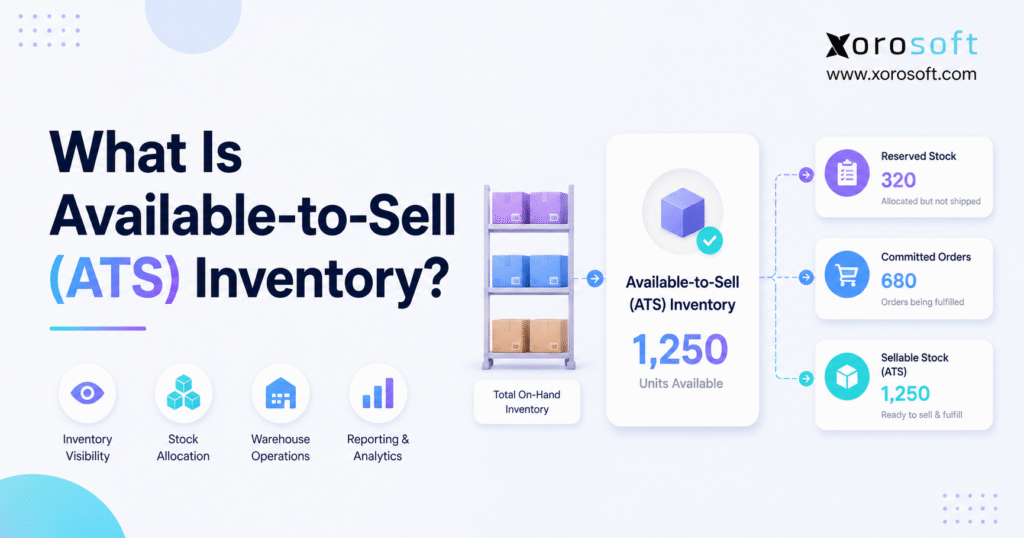
Available-to-sell inventory represents the quantity of stock your business can confidently sell right now after accounting for committed orders, reservations, allocations, safety stock, damaged goods, and other inventory restrictions.
Although a warehouse may physically contain 1,000 units, the business may not have 1,000 units available for new orders. For example, customers may already own some units through confirmed orders. Meanwhile, sales teams may have reserved other units for wholesale customers. In addition, warehouse teams may have placed damaged or returned products under inspection.
Therefore, total stock does not always equal sellable stock.
For ecommerce brands, wholesalers, manufacturers, and distributors, this distinction directly affects customer promises. Moreover, it determines what sales representatives can offer, what ecommerce channels can display, and what warehouse teams can fulfill.
When the number remains accurate, every team works with greater confidence. However, when it becomes unreliable, the business faces overselling, order cancellations, emergency transfers, stockouts, and unnecessary customer service problems.
Shopify also separates inventory into several states, including available, committed, unavailable, on hand, and incoming. Consequently, its framework illustrates why physical stock may not always qualify for immediate sale. Shopify explains these differences in its official guide to inventory states.
1.1 A Simple Definition of ATS Inventory
Teams often shorten available-to-sell inventory to ATS inventory.
The metric answers one important operational question:
How many units can we sell now without creating a fulfillment problem later?
For example, suppose a business holds 500 units of a product.
- Customers have already ordered 120 units.
- The wholesale team has reserved 50 units.
- The warehouse has marked 25 units as damaged.
- The company protects 30 units as safety stock.
Therefore, the company has 275 units available for new orders.
500 − 120 − 50 − 25 − 30 = 275 sellable units
Although the warehouse holds 500 units, the ecommerce store and sales team should only treat 275 units as available.
1.2 Why Total Inventory Can Mislead Operators
On-hand inventory shows what physically exists at a warehouse or storage location. In contrast, sellable inventory shows what the business can still offer to customers.
For instance, products may remain physically present while warehouse teams prepare them for existing orders. Similarly, a business may hold inventory for a specific retailer, marketplace, promotion, or customer account.
As a result, operators should never assume that every physical unit remains available for sale.
This distinction becomes especially important when the business manages:
- Multiple ecommerce channels
- Wholesale and direct-to-consumer orders
- EDI transactions
- More than one warehouse
- Customer-specific allocations
- Safety stock policies
- Returns and quality inspections
- Purchase orders and inbound inventory
1.3 Who Needs Detailed Sellable Inventory Tracking?
Most inventory-driven companies benefit from basic availability controls. However, some businesses need much more detailed tracking.
Advanced controls become especially important for companies that:
- Sell through Shopify and Amazon
- Accept wholesale and EDI orders
- Operate several warehouses or 3PL locations
- Manage thousands of SKUs or product variants
- Reserve stock for specific customers
- Experience seasonal demand
- Sell products with lots, batches, or expiration dates
- Manufacture finished goods
- Use safety stock and channel buffers
By contrast, a small business with one location, limited order volume, and only a few products may manage availability with a simpler system. Nevertheless, as order volume grows, manual calculations often become harder to maintain.
2. Available-to-Sell Inventory Formula
The basic available-to-sell inventory formula subtracts stock that the business cannot offer to new customers.
Available-to-sell inventory = on-hand inventory − committed orders − reserved inventory − allocated inventory − safety stock − unavailable inventory
Although the formula looks simple, each component requires a clear definition. Otherwise, different teams may calculate the number differently.
For example, the warehouse may exclude picked products, while the sales team may still count them as available. Meanwhile, the purchasing team may include inbound supply before it reaches the warehouse. Consequently, every department may see a different result.
2.1 The Basic ATS Calculation
A basic calculation works well when the company wants to know how much stock it can sell immediately.
2.1.1 Inventory Included in the Starting Quantity
The calculation normally begins with on-hand inventory.
On-hand inventory may include:
- Products stored in pickable warehouse locations
- Products in reserve storage
- Inventory awaiting allocation
- Stock held across approved fulfillment locations
- Sellable returns that have passed inspection
However, companies should confirm that every unit in the starting quantity meets their inventory rules.
2.1.2 Quantities to Subtract
Next, subtract stock that cannot support new demand.
These quantities usually include:
- Confirmed customer orders
- Wholesale reservations
- Marketplace allocations
- Safety stock
- Damaged inventory
- Products under quality review
- Stock assigned to transfers
- Items waiting for rework
- Channel-specific inventory buffers
Because each business operates differently, management should document which categories reduce the available quantity.
2.2 A Worked Formula Example
Assume a sporting goods company has 1,000 units of a popular product on hand.
The company also has:
- 300 units committed to open orders
- 150 units reserved for wholesale customers
- 100 units allocated to a marketplace
- 75 units held as safety stock
- 25 damaged units
Therefore, the calculation becomes:
1,000 − 300 − 150 − 100 − 75 − 25 = 350 units
Although the physical count shows 1,000 units, the business can confidently sell only 350 more units.
This difference matters because exposing all 1,000 units online could create hundreds of unfulfillable orders.
2.3 Advanced Formula With Inbound Inventory
Some businesses include eligible inbound stock in the calculation.
In that case, the formula becomes:
Sellable inventory = on-hand inventory + eligible inbound inventory − committed orders − reservations − allocations − safety stock − unavailable inventory
However, operators should apply this formula carefully. A purchase order does not guarantee that products will arrive on schedule.
For example, suppliers may ship late. Customs may delay imports. Furthermore, warehouse teams may need time to count, inspect, label, and store products before they can fulfill orders.
Therefore, businesses should only expose inbound stock when they trust:
- The confirmed supplier quantity
- The expected shipping date
- The estimated arrival date
- The receiving schedule
- The quality-control process
- The customer delivery promise
- The warehouse’s fulfillment capacity
Otherwise, the company may sell inventory before it can physically ship it.
3. ATS Inventory vs Other Inventory Metrics
Inventory terminology often creates confusion because several metrics appear similar. However, each metric answers a different question.
- On-hand inventory asks: What do we physically have?
- Sellable inventory asks: What can we sell now?
- Allocated inventory asks: What have we assigned to demand?
- Available-to-promise asks: What can we promise now or later?
Therefore, teams need shared definitions before they can trust operational reports.
3.1 ATS Inventory vs On-Hand Inventory
On-hand inventory includes the physical quantity stored at a location. In contrast, ATS inventory excludes units that the business cannot offer to new customers.
For example, a furniture company may hold 200 dining tables.
However:
- Customers have already ordered 80 tables.
- The warehouse has identified 20 damaged tables.
- The business has reserved 30 tables for a showroom launch.
Therefore, only 70 tables remain available for new orders.
Although on-hand inventory shows 200 units, sellable stock shows 70 units.
3.2 ATS Inventory vs Available Inventory
Some software platforms use “available inventory” and “available-to-sell inventory” interchangeably. Nevertheless, each system may apply different rules.
One platform may calculate available inventory by subtracting committed orders. Another may also subtract safety stock, reservations, and quality-hold inventory.
Consequently, operators should ask several questions:
- Does the number exclude open customer orders?
- Does it account for wholesale reservations?
- Does it subtract warehouse allocations?
- Does it protect safety stock?
- Does it exclude damaged or quarantined units?
- Does it include inbound purchase orders?
- Does it calculate availability by location?
Without clear answers, teams may use the same label for different numbers.
3.3 ATS Inventory vs Allocated Inventory
Allocated inventory refers to stock that a business has assigned to a specific order, customer, channel, transfer, or production requirement.
Once the business allocates those units, it should usually remove them from the sellable pool.
For example, suppose a wholesale customer places an order for 400 units. After the company allocates those units, Shopify and Amazon should no longer offer them to other customers.
Otherwise, two channels may attempt to sell the same stock.
3.4 ATS Inventory vs Reserved Inventory
Reserved inventory includes units that the business protects for a defined purpose, even if no final shipment exists yet.
Companies may reserve inventory for:
- Priority wholesale customers
- Marketplace replenishment
- Subscription orders
- Product launches
- Seasonal promotions
- Replacement orders
- Retail locations
- Key accounts
Although the units remain physically present, the business should keep them outside the general sellable pool until an authorized employee releases them.
3.5 ATS Inventory vs Committed Inventory
Committed inventory supports confirmed customer orders.
For example, once a Shopify customer completes checkout, the system should reduce the quantity available for other customers. Likewise, when a wholesale customer confirms an order, the business should account for that demand immediately.
If the business fails to subtract committed units, it may sell the same stock twice.
Therefore, accurate order synchronization plays a major role in inventory availability.
3.6 ATS Inventory vs Available-to-Promise Inventory
Available-to-sell focuses on what the business can sell now. Available-to-promise, or ATP, focuses on what the business can promise for a current or future date.
ATP calculations may consider:
- Current on-hand stock
- Confirmed purchase orders
- Expected production
- Transfer orders
- Supplier lead times
- Future customer demand
- Planned inventory movements
Consequently, ATP supports future commitments, while ATS supports immediate selling decisions.
Oracle explains this distinction through its documentation for available-to-promise inventory. Similarly, Microsoft outlines how future stock changes affect ATP inventory visibility.
3.7 ATS Inventory vs Safety Stock
Safety stock protects the business from uncertainty.
For example, unexpected demand, supplier delays, warehouse errors, or transportation disruptions may consume more inventory than planned. Therefore, companies often hold a buffer.
In most cases, businesses should exclude that buffer from normal sellable stock. However, management may release it during an emergency or a high-priority sale.
The key is control. The system should not expose safety stock accidentally.
4. Why Accurate Sellable Inventory Matters
Accurate inventory availability improves more than ecommerce stock displays. In addition, it supports warehouse execution, purchasing, customer service, finance, and management decisions.
4.1 It Prevents Overselling
Overselling occurs when a company accepts orders for more products than it can fulfill.
This usually happens because sales channels receive the wrong inventory number. For example, a website may show total on-hand stock even though existing orders have already consumed most units.
As a result, customers place orders that the business cannot ship.
The company may then need to:
- Cancel orders
- Issue refunds
- Offer substitutions
- Delay delivery
- Split shipments
- Pay for expedited transfers
- Handle negative reviews
Therefore, accurate sellable inventory protects both revenue and customer trust.
4.2 It Improves Customer Promises
Customers expect businesses to honor online availability.
If a product appears in stock, customers assume the business can ship it. Consequently, inaccurate availability creates disappointment even when the warehouse count itself appears correct.
Reliable stock data also helps customer service teams. Instead of asking the warehouse for every update, representatives can answer questions from current information.
Moreover, sales teams can confirm wholesale quantities without waiting for manual approval.
4.3 It Reduces Warehouse Exceptions
Warehouse teams feel the operational impact of inaccurate selling decisions.
For instance, pickers may search for inventory that another order has already consumed. Packers may discover shortages after the team has prepared most of an order. Meanwhile, managers may need to arrange emergency transfers between warehouses.
Accurate availability reduces:
- Failed picks
- Short shipments
- Manual stock checks
- Emergency transfers
- Order rework
- Customer service escalations
- Inventory adjustments
Therefore, a reliable sellable quantity helps warehouses operate more predictably.
4.4 It Supports Smarter Purchasing
Purchasing teams need to understand how much inventory remains after current demand.
If buyers only review on-hand stock, they may believe the business has enough supply. However, open orders and reservations may have already consumed most of it.
Consequently, sellable stock provides a stronger signal for replenishment.
When teams combine availability with forecasting, supplier lead times, and sales velocity, they can decide:
- Which products require replenishment
- When buyers should place orders
- How much inventory to purchase
- Which warehouse needs stock first
- Which channel consumes inventory fastest
- Whether the business faces a stockout risk
4.5 It Strengthens Financial Visibility
Inventory influences cash flow, cost of goods sold, working capital, and month-end reporting.
When operational systems disagree, finance teams spend more time reconciling:
- Sales orders
- Shipment records
- Purchase receipts
- Warehouse adjustments
- Product returns
- Inventory transfers
- Cost changes
Therefore, better inventory controls reduce reconciliation work and improve confidence in operational reporting.
5. ATS Inventory in Ecommerce and Multi-Channel Operations
Ecommerce increases the need for real-time availability because customers can order products at any time. Moreover, several channels may attempt to sell from the same inventory pool.
Therefore, businesses need clear rules for channel allocations, reservations, and synchronization.
5.1 Shopify Inventory Availability
Shopify merchants often manage direct-to-consumer orders, wholesale demand, returns, retail locations, marketplace inventory, and purchasing at the same time.
Consequently, the storefront should not simply display total warehouse stock.
For example, a Shopify merchant may need to subtract:
- Unfulfilled customer orders
- Wholesale reservations
- Amazon allocations
- Safety stock
- Damaged inventory
- Returns under inspection
- Retail store commitments
Shopify’s official documentation explains how available, committed, unavailable, incoming, and on-hand inventory represent different operational states. Therefore, merchants should align their availability logic with their actual fulfillment process.
For brands that need a deeper connection between Shopify and back-office operations, Xorosoft also appears on the Shopify App Store. The integration supports businesses that need to coordinate ecommerce orders with inventory, warehouse, purchasing, accounting, and fulfillment workflows.
5.2 Amazon and Marketplace Inventory
Amazon sellers must protect inventory accuracy because marketplace customers expect fast fulfillment.
However, many sellers also accept orders through Shopify, wholesale customers, retail accounts, and B2B portals. As a result, every channel may attempt to sell the same product.
Businesses can control this risk through:
- Channel-specific inventory allocations
- Marketplace stock buffers
- Shared inventory pools
- Automated synchronization
- Location-based fulfillment rules
- Safety-stock protection
Instead of giving every channel access to the full physical quantity, operators should expose only the amount each channel can safely consume.
5.3 Wholesale Orders
Wholesale orders often consume larger quantities than ecommerce orders. Therefore, a single customer can significantly change inventory availability.
For example, a retailer may order 2,000 units that the ecommerce store also shows online. Unless the wholesale order reduces sellable stock quickly, direct-to-consumer customers may purchase units that no longer exist.
Accurate availability helps wholesale teams answer:
- How much can the customer order now?
- Which warehouse can fulfill the order?
- Has another account reserved the stock?
- Can the company partially fulfill the order?
- Should the remaining quantity move to backorder?
- When will inbound stock become available?
5.4 EDI Transactions
EDI orders add another layer of complexity because large retailers often send purchase orders electronically.
These transactions may include strict:
- Shipping windows
- Quantity requirements
- Routing instructions
- Labeling standards
- ASN requirements
- Compliance rules
Therefore, the inventory system should reduce available quantities as soon as the business accepts the EDI order.
Otherwise, ecommerce or wholesale channels may continue selling the same units.
5.5 Shared Inventory Across Channels
Multi-channel businesses need one governed availability calculation.
Shopify may consume stock. Amazon may consume the same pool. Meanwhile, wholesale representatives may reserve inventory manually, and EDI orders may arrive throughout the day.
Consequently, every channel needs timely updates from a central source.
A reliable process should:
- Capture orders from every channel
- Apply reservations consistently
- Allocate stock by business rules
- Update warehouses quickly
- Protect safety stock
- prevent duplicate promises
- Return cancelled quantities to the sellable pool
6. ATS Inventory in Warehouse Operations
Warehouse activity changes inventory availability throughout the day.
Receiving, put-away, picking, packing, transfers, returns, quality checks, and adjustments all affect the quantity that the business can sell.
Therefore, warehouse execution must update inventory records quickly.
6.1 Receiving New Stock
Receiving adds physical inventory, but it should not always create sellable inventory immediately.
First, warehouse teams may need to:
- Verify quantities
- Inspect product condition
- Scan barcodes
- Apply labels
- Confirm lots or serial numbers
- Record expiration dates
- Complete quality checks
- Move products into approved bins
Only after the warehouse completes those steps should the system release products for sale.
Otherwise, ecommerce channels may offer stock that the warehouse cannot yet pick.
6.2 Picking and Allocation
Picking connects customer demand to physical stock.
Once the warehouse assigns units to an order, the system should remove them from general availability. Moreover, the inventory record should update before another channel can promise the same units.
A real-time warehouse management system helps teams synchronize picking, packing, receiving, transfers, and inventory adjustments with broader order operations.
As a result, warehouse activity can update sellable quantities without relying on delayed spreadsheets or manual reports.
6.3 Packing Exceptions
Packing can reveal problems that the inventory system did not previously detect.
For example, a packer may discover:
- A damaged product
- The wrong size or color
- Missing components
- Incorrect labeling
- A quantity shortage
- An expired item
Therefore, packing teams need a clear way to record exceptions. The system should then update availability immediately rather than leaving unusable stock in the sellable quantity.
6.4 Returned Products
Returns should not automatically re-enter the available pool.
First, warehouse teams should inspect the item. The product may have damage, missing packaging, signs of use, expired components, or incomplete accessories.
After inspection, the team can classify the item as:
- Sellable
- Repairable
- Refurbishable
- Damaged
- Quarantined
- Scrap
- Return to vendor
Consequently, only approved products should increase the quantity available for new orders.
6.5 Multi-Warehouse Availability
Businesses with several warehouses need location-level inventory rules.
A product may exist in Warehouse A but not Warehouse B. Moreover, the company may restrict one location to wholesale orders while another location fulfills Shopify customers.
Location-level calculations should consider:
- Physical stock by warehouse
- Open orders by location
- Fulfillment priorities
- Shipping zones
- Transfer orders
- Regional demand
- 3PL inventory
- Channel eligibility
- Cut-off times
- Carrier capacity
Without location-level controls, the company may show stock online even though the appropriate fulfillment location cannot ship it.
7. Industry-Specific ATS Inventory Use Cases
Each industry applies inventory availability differently. Therefore, companies should adapt the calculation to their product characteristics and operating model.
7.1 Apparel and Fashion
Apparel brands manage styles, sizes, colors, seasons, and high return volumes.
Consequently, operators must track sellable stock at the variant level.
A brand may have 1,000 shirts in total. However, customers may only want one popular size and color. Therefore, product-level availability can hide variant-level stockouts.
Apparel businesses should also account for:
- Wholesale allocations
- Seasonal product launches
- Returns under inspection
- Samples and showroom stock
- Damaged packaging
- Marketplace buffers
- Size exchanges
7.2 Furniture
Furniture companies manage bulky products, long supplier lead times, container shipments, showrooms, and delivery scheduling.
Although a warehouse may hold an item, the company may have already assigned it to a customer delivery. Similarly, showroom units may not qualify for normal fulfillment.
Therefore, furniture companies should exclude:
- Scheduled customer deliveries
- Damaged pieces
- Floor models
- Products awaiting assembly
- Incomplete sets
- Inventory under quality review
7.3 Sporting Goods
Sporting goods businesses often face seasonal demand, team orders, product bundles, and dealer sales.
For example, a large team order may consume most of a product’s available stock. Unless the system updates quickly, ecommerce customers may continue buying the same units.
Therefore, sporting goods companies need:
- Variant-level tracking
- Dealer allocations
- Team-order reservations
- Seasonal buffers
- Bundle component availability
- Marketplace synchronization
7.4 Food and Beverage
Food and beverage businesses must consider expiration dates, lots, quality holds, and compliance requirements.
Consequently, physical stock may not qualify for sale if it has expired, failed inspection, or belongs to a restricted lot.
In addition, these companies may need first-expiry-first-out logic so warehouse teams ship products in the correct sequence.
7.5 Wholesale Distribution
Wholesale distributors manage customer-specific allocations, large orders, EDI, backorders, and multiple warehouses.
Therefore, accurate availability helps sales representatives confirm orders without repeatedly calling the warehouse.
It also helps teams distinguish between:
- Stock available now
- Stock reserved for key accounts
- Stock arriving later
- Stock available at another warehouse
- Stock awaiting transfer
- Stock that requires purchasing
7.6 Manufacturing
Manufacturers must distinguish finished goods from future production.
Sellable stock usually includes completed products that meet quality standards. In contrast, ATP calculations may also consider scheduled production and expected material availability.
Therefore, manufacturers should connect:
- Bills of materials
- Component inventory
- Work orders
- Production schedules
- Quality inspections
- Finished goods
- Customer demand
8. Common Mistakes That Distort Inventory Availability
Most availability errors result from process gaps rather than a single counting problem.
Therefore, businesses should examine how orders, purchasing, warehouses, ecommerce, and accounting exchange information.
8.1 Treating On-Hand Stock as Sellable Stock
This mistake causes many overselling problems.
A team sees 1,000 physical units and assumes that customers can buy all of them. However, existing orders, reservations, safety stock, and damaged products may already reduce the usable quantity.
Instead, teams should calculate sellable inventory after applying every relevant restriction.
8.2 Including Inbound Stock Too Early
Inbound supply can support future promises. However, it should not automatically increase immediate availability.
Supplier delays, customs issues, quality problems, and warehouse capacity can all postpone fulfillment.
Therefore, operators should only include inbound stock when they can confidently meet the customer promise.
8.3 Ignoring Safety Stock
Safety stock protects the company from uncertainty.
If ecommerce channels sell that buffer accidentally, the business loses protection against demand spikes and supply delays.
Consequently, the system should exclude safety stock by default and require an intentional release.
8.4 Delaying Channel Updates
Slow synchronization creates stale inventory numbers.
For example, if Amazon only receives an update every few hours, Shopify and wholesale customers may consume the same stock before Amazon changes its quantity.
Therefore, fast-moving businesses need frequent or real-time updates.
8.5 Returning Stock to Sale Without Inspection
Returns may contain damage, missing parts, opened packaging, or expired products.
Consequently, warehouse teams should inspect every returned unit before the system increases sellable stock.
8.6 Using Spreadsheets After Complexity Increases
Spreadsheets can support small operations. However, they struggle when teams manage many SKUs, channels, locations, and daily transactions.
Manual updates also create version-control problems. For instance, one employee may work from yesterday’s report while another uses a newer file.
Eventually, the business loses confidence in the spreadsheet.
8.7 Ignoring Location-Level Rules
A company may have stock nationally but lack inventory in the correct fulfillment region.
Therefore, availability should consider where the stock sits, which channels can access it, and whether the location can fulfill the order economically.
9. When Sellable Inventory Becomes an ERP Problem
Inventory availability becomes an ERP-level problem when several business functions influence the same number.
For example, sales orders reduce stock. Purchase orders create future supply. Warehouse movements change location quantities. Manufacturing creates finished goods. Meanwhile, accounting records inventory value.
When each workflow lives in a separate application, teams struggle to calculate one trustworthy quantity.
9.1 Warning Signs That the Current System Is Failing
A company may need a more connected platform when:
- Shopify shows products the warehouse cannot ship
- Amazon quantities differ from warehouse counts
- Sales teams ask operations before confirming orders
- Purchasing relies on spreadsheets
- Safety stock disappears unexpectedly
- Warehouse teams face repeated failed picks
- Finance spends too long reconciling inventory
- Teams perform frequent manual adjustments
- Different departments trust different reports
- Inventory goes negative regularly
These symptoms indicate a systems problem rather than an isolated warehouse issue.
9.2 Why Disconnected Applications Create Errors
Disconnected systems create timing gaps.
For example:
- Shopify records an order before the warehouse receives it.
- A buyer tracks a purchase order in a spreadsheet.
- A sales representative reserves units outside the main system.
- The warehouse receives a return but waits to inspect it.
- Accounting records an adjustment later.
Each delay changes the sellable quantity.
Consequently, the number becomes unreliable even when every team works hard.
9.3 How a Connected ERP Improves Accuracy
A cloud ERP connects inventory with sales orders, purchasing, warehouse operations, accounting, forecasting, manufacturing, ecommerce, and reporting.
For inventory-driven businesses, XoroERP supports this connected operating model. Instead of reconciling Shopify, QuickBooks, warehouse apps, and purchasing spreadsheets manually, teams can work from a shared operational foundation.
Similarly, XoroONE brings inventory, accounting, purchasing, warehouse management, manufacturing, forecasting, and reporting into one cloud platform.
As a result, orders, receipts, allocations, transfers, and adjustments can update inventory availability through connected workflows.
10. How to Improve Inventory Availability Accuracy
Improving accuracy requires clear policies, strong warehouse execution, and connected systems.
Therefore, companies should address both process and technology.
10.1 Centralize Inventory Data
First, choose one operational source of truth.
If Shopify, Amazon, warehouse applications, spreadsheets, and accounting software all maintain separate quantities, teams will continue debating which number is correct.
A central system should collect:
- Sales orders
- Purchase orders
- Warehouse movements
- Reservations
- Allocations
- Returns
- Transfers
- Adjustments
- Production activity
- Channel inventory
10.2 Define Reservation Rules
Next, decide when inventory stops being available.
For example:
- Does a wholesale quote reserve inventory?
- Does only a confirmed order reserve it?
- How long should a reservation remain active?
- Can managers override a reservation?
- Does every marketplace receive a buffer?
- Can teams release safety stock?
Clear rules prevent inconsistent decisions.
10.3 Connect Sales Orders With Warehouse Activity
Orders should reduce sellable quantities quickly. Likewise, warehouse teams should update inventory when they pick, pack, transfer, receive, or inspect products.
Because both workflows influence the same quantity, delays create inaccurate availability.
Therefore, companies should connect order management and warehouse execution rather than reconciling them later.
10.4 Control Inbound Inventory
Purchase orders should support planning without creating false availability.
Teams should use:
- Confirmed supplier quantities
- Reliable expected dates
- Supplier performance history
- Receiving schedules
- Quality requirements
- Customer delivery dates
Only then should the business decide whether it can sell against inbound supply.
10.5 Synchronize Sales Channels
Shopify, Amazon, wholesale, retail, and EDI channels should receive updated quantities based on the same inventory rules.
Moreover, the business should define whether channels share one pool or receive separate allocations.
Without a central rule, each channel may expose more stock than the company can fulfill.
10.6 Track Inventory by Location
Location-level visibility helps the business choose the correct warehouse.
It also supports:
- Regional fulfillment
- Lower shipping costs
- Faster delivery
- Transfer planning
- Channel restrictions
- 3PL coordination
- Cross-border operations
Therefore, companies should avoid relying only on a global product total.
10.7 Review Availability Exceptions
Finally, operators should review exceptions regularly.
Useful exception reports include:
- Negative inventory availability
- High on-hand stock with low sellable stock
- Stale reservations
- Damaged inventory marked available
- Inbound stock exposed too early
- Channel quantity mismatches
- Unusual manual adjustments
- Location shortages
- Open orders without allocations
These reviews help teams correct problems before customers encounter them.
11. Choosing Software for Reliable Sellable Inventory
The right software depends on the complexity of the business.
A small company with one location and limited order volume may only need basic inventory tracking. However, a growing multi-channel business usually needs inventory, purchasing, warehouse, order management, and accounting to work together.
11.1 Capabilities to Evaluate
When evaluating software, companies should ask whether it supports:
- Real-time inventory visibility
- Multi-warehouse availability
- Customer and channel reservations
- Safety-stock rules
- Order allocations
- Inbound purchase orders
- Returns inspection
- Warehouse scanning
- Shopify integration
- Amazon operations
- EDI orders
- Accounting integration
- Forecasting
- Manufacturing
- Exception reporting
In addition, operators should ask vendors to explain exactly how the system calculates the sellable quantity.
11.2 Where Xorosoft Fits
Xorosoft is a cloud ERP platform for inventory-driven businesses that sell physical products, operate several warehouses, manage ecommerce and wholesale channels, use EDI, or require connected purchasing and accounting.
Its operational model connects inventory, purchasing, warehouse management, order management, accounting, forecasting, manufacturing, and reporting.
Consequently, teams can manage inventory availability without reconciling several disconnected applications.
Businesses can explore Xorosoft’s broader operational solutions, review the industries it supports, and examine practical customer outcomes through its case studies.
12. Frequently Asked Questions About ATS Inventory
12.1 What is available-to-sell inventory?
Available-to-sell inventory represents the quantity of stock a business can currently offer to new customers. The calculation normally subtracts committed orders, reservations, allocations, safety stock, damaged products, and other unavailable units from on-hand inventory. Therefore, it gives teams a more useful number than a simple physical count.
12.2 What does ATS stand for in inventory?
ATS stands for available to sell. Teams use the term to describe inventory that remains eligible for new orders after the business accounts for existing commitments and operational restrictions.
12.3 How do you calculate ATS inventory?
Start with on-hand stock. Next, subtract confirmed orders, reservations, allocations, safety stock, damaged goods, and other unavailable quantities. Some companies also add eligible inbound supply when they trust the supplier date and fulfillment plan.
12.4 Is ATS the same as on-hand inventory?
No. On-hand inventory shows the physical quantity stored at a location. In contrast, ATS shows the portion that remains available for new orders. Existing commitments may significantly reduce the sellable quantity.
12.5 Is ATS the same as available inventory?
The terms may mean the same thing in some systems. However, each platform can apply different rules. Therefore, companies should confirm whether the number excludes reservations, safety stock, damaged products, and allocated orders.
12.6 What is the difference between ATS and ATP?
ATS focuses on immediate selling capacity. ATP focuses on what the business can promise for a future date. Consequently, ATP may include future purchase orders, planned production, transfers, and supplier lead times.
12.7 Should businesses include purchase orders in ATS?
Businesses should include inbound purchase orders only when they can confidently meet the customer promise. Supplier delays, customs issues, and warehouse receiving time can all postpone availability.
12.8 Should safety stock reduce the sellable quantity?
Usually, yes. Safety stock protects the business from unexpected demand or supply disruption. Therefore, companies should normally exclude it unless management intentionally releases the buffer.
12.9 Should damaged products count as available?
No. Damaged or quarantined products should remain outside the sellable quantity. The warehouse should only release them after inspection, repair, or reclassification.
12.10 How does ATS prevent overselling?
ATS prevents overselling by removing stock that already supports orders, reservations, and other commitments. As a result, sales channels receive a more realistic quantity.
12.11 How does ATS work in Shopify?
Shopify inventory availability should reflect unfulfilled orders, unavailable inventory, reservations, and location rules. Moreover, businesses that also sell through Amazon or wholesale channels need shared inventory controls.
12.12 How does ATS work for Amazon sellers?
Amazon sellers can expose a specific allocation or a portion of a shared stock pool. Therefore, the business should synchronize marketplace quantities with other sales channels to prevent duplicate promises.
12.13 How does ATS support wholesale sales?
Wholesale representatives can use the quantity to confirm customer orders without repeatedly contacting the warehouse. In addition, the calculation can account for customer-specific reservations and EDI demand.
12.14 How do EDI orders affect ATS?
Accepted EDI orders should reduce the quantity available to other customers. Otherwise, ecommerce channels may sell stock that the business has already promised to a retailer.
12.15 How does ATS work across several warehouses?
The business should calculate availability by location. Each warehouse may have different stock, open orders, fulfillment rules, transfer timing, and channel eligibility.
12.16 Should returned inventory increase ATS immediately?
No. Warehouse teams should inspect returns before releasing them for sale. Returned products may contain damage, missing parts, or packaging issues.
12.17 Why does sellable inventory become negative?
Negative availability often results from delayed order updates, manual adjustments, overselling, incorrect allocations, or inventory-count errors. Therefore, teams should investigate the underlying workflow rather than simply changing the number.
12.18 Can spreadsheets calculate ATS?
Yes, spreadsheets can handle simple calculations. However, they become risky when inventory changes frequently across many channels, warehouses, and users.
12.19 How often should availability update?
Fast-moving businesses should update availability as close to real time as possible. Orders, picks, receipts, returns, transfers, and adjustments can all change the number throughout the day.
12.20 Which teams use ATS inventory?
Sales, ecommerce, warehouse, purchasing, finance, customer service, and operations teams all depend on inventory availability. Therefore, every department should use the same definitions.
12.21 Does ATS affect purchasing decisions?
Yes. Buyers can use sellable stock alongside sales velocity, demand forecasts, and supplier lead times to determine when and how much to reorder.
12.22 Does ATS affect accounting?
ATS does not replace inventory valuation. However, accurate operational records reduce reconciliation problems and help finance teams trust inventory movements.
12.23 When does a business need ATS software?
A business needs stronger software when teams stop trusting inventory numbers, overselling occurs frequently, or several channels and warehouses consume the same stock.
12.24 How does ERP improve inventory availability?
ERP connects sales orders, purchasing, warehouses, accounting, manufacturing, and ecommerce. Consequently, changes in one workflow can update the shared inventory record.
12.25 What should a business look for in ATS software?
The system should support real-time updates, reservations, allocations, multi-warehouse inventory, channel synchronization, purchasing, returns, warehouse workflows, accounting, and clear exception reporting.
Recent Posts
-
 ERP Landed Cost Module vs Spreadsheet Calculations for Importers
 -
 How to Build an Open-to-Buy Plan for an Omnichannel Brand
 -
 Cold Storage WMS for Food and Beverage Distribution
 -
 ERP Buying Statistics 2026: Evaluation, Implementation, and Adoption Risks
 -
 How a Distributor Reduced B2B Order Exceptions Without Restricting Sales