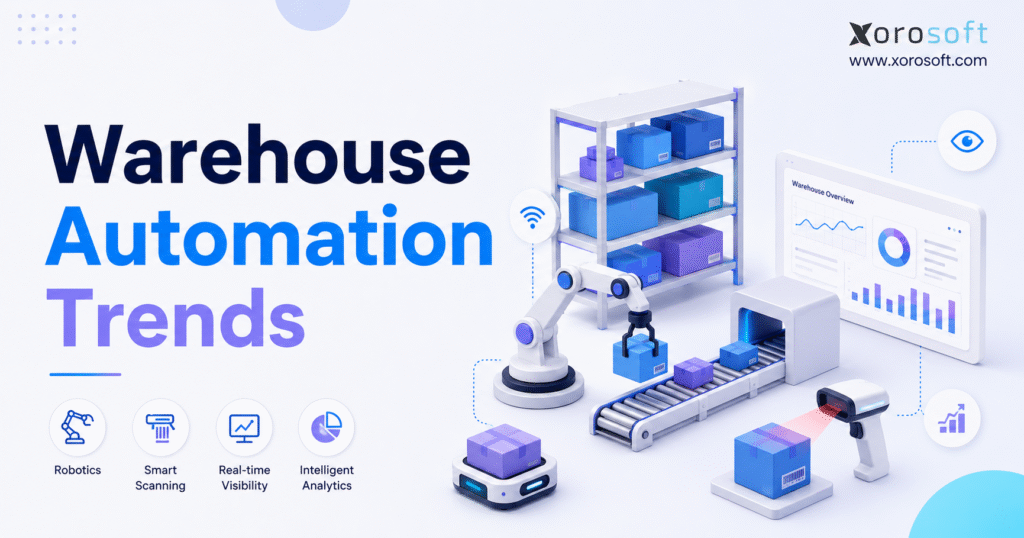
In this article, we will explore the latest warehouse automation trends shaping the industry.
1. Why Warehouse Automation Has Become an Operating Priority
Warehouses are being asked to process more orders, manage more SKUs, support more sales channels, and meet tighter delivery expectations. At the same time, operators must protect inventory accuracy, control labor costs, and maintain consistent customer service. As a result, warehouse automation trends have moved from experimental initiatives into practical operating priorities.
However, many businesses still treat automation as an equipment decision. They evaluate robots, conveyors, or automated storage before confirming whether their inventory data, warehouse processes, and software architecture can support them. Consequently, expensive technology may be introduced into an operation that still depends on spreadsheets, delayed updates, and inconsistent location control.
The strongest automation strategies begin differently. First, the business identifies a measurable warehouse constraint. Next, it improves the underlying process and data. Finally, it selects the simplest technology capable of solving the problem.
Therefore, the objective is not to remove every manual task. Instead, it is to eliminate avoidable travel, repetitive handling, delayed decisions, and preventable errors while giving warehouse teams better operational control.
2. What Modern Warehouse Automation Actually Includes
Warehouse automation is the use of software, connected equipment, and robotic systems to direct or complete inventory movement, storage, picking, packing, and shipping with less manual intervention.
Although automation is often associated with robotics, many valuable improvements happen before a robot enters the warehouse. For example, barcode scanning, directed putaway, automated replenishment, and packing validation can create substantial operational gains.
2.1 Digital Warehouse Automation
Digital automation manages information and decisions. It includes barcode scanning, inventory allocation, directed putaway, replenishment alerts, batch picking, carrier selection, shipping validation, and cycle-count scheduling.
Because each transaction is recorded as work occurs, digital workflows reduce delayed data entry. Moreover, supervisors gain a more accurate view of inventory, order status, and warehouse capacity.
2.2 Physical Warehouse Automation
Physical automation moves, stores, sorts, or handles products. Common examples include conveyors, autonomous mobile robots, automated guided vehicles, robotic arms, palletizers, carousels, and automated storage and retrieval systems.
These technologies can improve throughput and reduce physical strain. Nevertheless, their performance depends on accurate product dimensions, locations, units of measure, and order information.
2.3 Connected Operational Automation
Connected automation extends warehouse activity into purchasing, ecommerce, accounting, manufacturing, and reporting. For instance, a completed shipment can update available inventory, order status, financial records, and replenishment requirements without duplicate entry.
Therefore, the most useful warehouse automation trends are not limited to equipment. They also include the systems that coordinate inventory, orders, people, and machines.
| Operating model | How work is directed | Best fit |
|---|---|---|
| Manual warehouse | Employee knowledge and paper-based tasks | Lower-volume, simple operations |
| Mechanized warehouse | Employees supported by equipment and scanning | Growing operations with repeatable workflows |
| Automated warehouse | Software directs people and machines in real time | High-volume or complex fulfillment environments |
3. Business Pressures Accelerating Warehouse Automation Trends
Several operational pressures are increasing interest in automation. However, the exact reason varies by company. An ecommerce brand may need faster small-order fulfillment, while a wholesaler may need more reliable case and pallet picking.
3.1 Greater SKU and Order Complexity
More products create more storage locations, replenishment decisions, picking paths, and exceptions. Apparel adds size, color, style, and season attributes. Meanwhile, furniture introduces dimensional complexity, and food businesses must manage lots, expiration dates, and traceability.
As complexity grows, informal warehouse knowledge becomes harder to scale. Therefore, system-directed work becomes increasingly important.
3.2 Faster Fulfillment Expectations
Customers expect accurate product availability, prompt shipping, and reliable order updates. Similarly, wholesale customers may require routing guides, customer-specific labels, EDI documents, or scheduled delivery windows.
Faster picking alone cannot solve delays caused by manual order approval, uncertain inventory, or disconnected shipping systems. Instead, the entire fulfillment flow must operate as a coordinated process.
3.3 Labor, Safety, and Retention
Warehouse work can involve repetitive walking, lifting, scanning, and material movement. Consequently, automation should be evaluated as a work-design tool rather than only a headcount-reduction strategy.
For example, mobile robots can move totes while employees focus on product selection and exception handling. In addition, automated palletizing can reduce repetitive heavy lifting.
3.4 Multi-Channel and Multi-Warehouse Complexity
Shopify, Amazon, wholesale, retail, EDI, and marketplace orders may compete for the same inventory. Moreover, each warehouse may have different products, capacity, labor, and carrier services.
Therefore, smart warehouse technology must make decisions using network-wide information. A fast picking process provides limited value when the wrong facility receives the order.
4. Warehouse Automation Trends Reshaping Fulfillment
The leading warehouse automation trends form a connected operating model. Data identifies what should happen, software directs the work, and equipment executes selected tasks.
4.1 AI-Powered Warehouse Orchestration
AI-assisted systems can evaluate order priority, available labor, inventory location, equipment capacity, carrier cut-off times, and congestion before assigning work.
This approach is especially useful when conditions change throughout the day. A static morning plan may become outdated after urgent orders, inventory shortages, or equipment delays appear.
Moreover, AI can support dynamic slotting, replenishment recommendations, and workload forecasting. However, inaccurate data will still produce poor decisions.
4.2 Predictive Exception Management
Traditional reports explain what already happened. By contrast, predictive systems identify orders, replenishment tasks, or equipment that may miss a target.
For instance, the system may flag an order that cannot be completed before the carrier deadline because one item remains unavailable. Consequently, supervisors can intervene before the delay affects the customer.
4.3 Digital Twins and Warehouse Simulation
A warehouse digital twin is a virtual model of a facility or workflow. It can test layouts, storage strategies, workstation placement, equipment capacity, and peak-volume scenarios.
Because automation investments can be difficult to reverse, simulation provides a safer way to evaluate alternatives. Nevertheless, the model must use realistic order data, product characteristics, and processing times.
4.4 Computer Vision in Automated Warehouse Operations
Computer vision can recognize products, labels, packaging, dimensions, damage, and inventory locations. Therefore, it can support receiving, packing inspection, pallet verification, and inventory counting.
For example, cameras can compare packed items with the sales order. If the system detects a mismatch, it can route the carton for manual review.
4.5 Predictive Maintenance
Sensors can monitor vibration, temperature, cycle counts, battery health, and motor performance. As a result, maintenance teams can investigate emerging problems before a failure stops the operation.
However, predictive monitoring should complement preventive maintenance rather than replace it. Critical equipment still requires spare parts, inspection schedules, and documented recovery procedures.
5. Warehouse Robotics Trends Moving Into Practical Use
Warehouse robotics is becoming more accessible because mobile equipment and subscription models require less fixed infrastructure. Even so, warehouse automation trends should be evaluated against real operational requirements rather than industry excitement.
5.1 Autonomous Mobile Robots
AMRs use maps, sensors, and software to transport totes, carts, shelves, or pallets. They can reduce employee travel while connecting receiving, storage, picking, packing, and shipping zones.
Unlike fixed conveyor routes, AMRs can often adjust paths when an aisle is blocked. Therefore, they may be suitable for existing facilities where structural changes would be expensive.
5.2 AMR vs AGV
| Factor | AMR | AGV |
| Navigation | Dynamic maps and sensors | Predefined route or guide |
| Flexibility | Higher | Best for stable movement |
| Infrastructure | Usually lighter | May require markers or guides |
| Typical use | Variable fulfillment workflows | Repetitive point-to-point transport |
AGVs remain useful for predictable manufacturing or pallet routes. However, AMRs are often better suited to changing order priorities and flexible warehouse layouts.
5.3 Robotic Picking
Robotic picking systems combine computer vision, software, robotic arms, and specialized grippers. They work best when products can be identified and handled consistently.
By contrast, soft, reflective, fragile, tangled, or irregular items may remain difficult. Therefore, product testing should occur before a business assumes that every SKU can be handled automatically.
5.4 Automated Packing and Palletizing
Packing automation can recommend cartons, verify items, print documents, and apply labels. Consequently, it may reduce material use and customer-facing errors.
Robotic palletizers can also reduce repetitive lifting. However, they provide the strongest value when case dimensions, weights, and pallet patterns remain reasonably predictable.
5.5 Robotics as a Service
Robotics as a Service shifts some expenditure from an upfront equipment purchase to a subscription or usage-based model. This structure may improve access to automation and provide seasonal flexibility.
Nevertheless, buyers should review long-term cost, minimum commitments, service coverage, utilization assumptions, data ownership, and contract exit terms.
5.6 Human-Robot Collaboration
Most warehouses will continue to use people and machines together. Robots are suited to repetitive transport and handling, while employees remain essential for damaged products, unusual orders, maintenance, quality checks, and judgment-based exceptions.
Therefore, automation planning should include role redesign, training, safety procedures, and employee feedback.
6. Automated Storage and Goods-to-Person Fulfillment
Automated storage is one of the most visible warehouse automation trends, yet it is not suitable for every operation. Its value depends on product compatibility, throughput, facility constraints, and system reliability.
6.1 Automated Storage and Retrieval Systems
AS/RS solutions use cranes, shuttles, lifts, carousels, or robotic grids to store and retrieve inventory. They can increase storage density by reducing aisle requirements and using vertical space more effectively.
As a result, the business may delay a warehouse expansion. However, it must also evaluate maintenance access, fire protection, software integration, and system redundancy.
6.2 Goods-to-Person Automation
Goods-to-person systems bring products or storage containers to a workstation rather than sending employees through aisles. Lights, displays, scanners, or voice instructions then guide item selection.
This model can reduce travel and improve consistency. Nevertheless, retrieval, picking, packing, and shipping capacity must remain balanced.
6.3 Dynamic Slotting
Dynamic slotting uses demand, product affinity, dimensions, and handling requirements to recommend storage positions. Fast-moving products may be placed closer to picking or packing areas, while slower items remain in reserve storage.
Because demand changes, slotting should be reviewed regularly rather than treated as a one-time project.
6.4 Automated Replenishment
Automated replenishment creates tasks before forward-picking locations become empty. Consequently, pickers spend less time waiting for stock.
The rules should consider expected demand, current orders, incoming receipts, reserve inventory, and location capacity. Otherwise, replenishment may create unnecessary movement.
7. The Software Foundation Behind Smart Warehouse Technology
The most advanced equipment will underperform when the software foundation is weak. Therefore, businesses should treat WMS and ERP integration as part of their warehouse automation trends strategy.
7.1 Warehouse Management Systems
A WMS controls locations, inventory status, receiving, putaway, replenishment, picking, packing, shipping, and counting.
A capable warehouse management system such as XoroWMS can establish the transaction discipline required before physical automation is introduced. The system should direct work using rules rather than simply record completed activity.
7.2 WMS, WES, WCS, and ERP Responsibilities
| System | Main responsibility | Typical decisions |
| ERP | Business-wide orders and records | Purchasing, accounting, manufacturing, demand |
| WMS | Warehouse inventory and workflows | Putaway, picking, replenishment, shipping |
| WES | Real-time execution orchestration | Task sequencing, labor, and equipment balancing |
| WCS | Equipment-level control | Conveyor, sorter, shuttle, and device commands |
Although these categories are useful, product capabilities often overlap. Therefore, buyers should evaluate actual workflows, interfaces, decision ownership, and recovery responsibilities.
7.3 ERP-Connected Warehouse Automation
Warehouse activity affects inventory valuation, sales orders, purchasing, manufacturing, accounting, and reporting.
A cloud ERP platform such as XoroONE can connect warehouse transactions with wider operational and financial records. As a result, teams can reduce duplicate entry and conflicting information.
For manufacturers, XoroERP can connect material availability, purchasing, work orders, inventory movement, and financial processing. That connection matters because warehouse automation cannot operate independently from production demand.
7.4 Why Disconnected Data Limits Automation
A robot can move the wrong item quickly. Likewise, an automated replenishment rule can create unnecessary tasks when inventory is incorrect.
Therefore, product codes, units of measure, dimensions, inventory status, locations, order priority, and customer requirements must remain consistent across systems.
8. Which Warehouse Processes Should Be Automated First?
Not every process requires advanced technology. Instead, businesses should apply warehouse automation trends to repetitive, measurable, and costly workflows first.
8.1 Inventory Data and Location Control
Barcode or RFID transactions create a dependable record of receiving, putaway, transfers, picking, packing, shipping, and counting.
Directed putaway then helps ensure that every item has a known location and status. Without this discipline, later automation will rely on unreliable information.
8.2 Picking Travel
Batch picking, zone picking, route optimization, voice workflows, carts, and AMRs can reduce travel before robotic picking becomes necessary.
For example, a business may group similar orders and send one picker through a zone once instead of repeating the same route.
8.3 Replenishment
System-generated replenishment tasks prevent forward locations from becoming empty during active picking.
However, rules should consider real demand and current warehouse work. Otherwise, the system may create too many low-priority tasks.
8.4 Packing and Shipping Validation
Scanning products into cartons confirms order completeness. In addition, the system may choose packaging, generate documents, validate customer rules, and select carrier services.
This process is often a strong early automation project because errors directly affect the customer.
8.5 Physical Material Movement
Conveyors, sorters, robots, and automated storage should solve a quantified labor, capacity, space, safety, or service constraint.
Accordingly, the business should document baseline performance and expected improvement before making the investment.
9. Warehouse Automation Trends by Industry
Different industries face different warehouse constraints. Therefore, warehouse automation trends should be adapted to product characteristics, order profiles, compliance needs, and customer expectations.
9.1 Ecommerce and Shopify Operations
Ecommerce warehouses process many small orders with short fulfillment windows and high return volumes. Useful technologies include batch picking, AMRs, packing validation, automated carrier selection, and real-time inventory synchronization.
Shopify orders should enter the operating system with accurate product, customer, payment, and shipping information. Businesses evaluating a connected platform can review Xorosoft ERP in the Shopify App Store.
9.2 Wholesale Distribution
Wholesale warehouses may combine pallet, case, and each-picking. Moreover, customers may require specific prices, labels, routing guides, EDI documents, and delivery windows.
Directed picking, pallet handling, and automated replenishment improve consistency. However, customer-specific rules must remain centrally managed.
9.3 Apparel and Fashion
Apparel operations manage visually similar variants, seasonal launches, promotions, and returns. Consequently, scanning and guided workflows help confirm size, color, style, and season.
Flexible automation is generally more useful than rigid infrastructure because product ranges and demand patterns change frequently.
9.4 Furniture and Bulky Goods
Furniture warehouses require dimensional data, specialized handling, accurate locations, and damage prevention.
In this environment, automation may focus on location control, movement planning, loading validation, and reduced handling rather than high-speed robotic picking.
9.5 Food and Beverage
Food operations require lot tracking, expiration control, traceability, and first-expired-first-out rules.
Therefore, automation must preserve product identity from receiving through shipping. It should also support temperature, quality, and recall requirements where relevant.
9.6 Manufacturing
Manufacturing connects receiving, component storage, production replenishment, work orders, finished goods, and shipping.
Automated movement is most useful when it follows accurate bills of materials, schedules, and consumption records. Businesses can review Xorosoft’s industry solutions to see how warehouse requirements differ across inventory-driven sectors.
10. Who Needs Warehouse Automation—and Who Does Not Yet?
The current warehouse automation trends may create pressure to invest quickly. However, timing should depend on operational evidence rather than market attention.
10.1 Signs a Business Is Ready
A warehouse may be ready when order volume is increasing consistently, picking travel consumes substantial labor, errors affect customer service, multiple locations create allocation problems, space limits growth, or repetitive handling creates safety concerns.
Seasonal peaks may also justify flexible automation when temporary labor is difficult to recruit or train.
10.2 Signs Process Improvement Should Come First
Robotics should not be the first step when product data is inconsistent, inventory cannot be trusted, procedures vary by employee, or management cannot measure current performance.
In those cases, scanning, location control, and WMS implementation may provide a stronger return.
10.3 When ERP Replacement Becomes Part of the Decision
Warehouse automation often exposes weaknesses in the wider software stack. QuickBooks, spreadsheets, inventory tools, warehouse applications, EDI systems, and ecommerce connectors may all maintain different records.
Businesses evaluating unified platforms can use the Xorosoft vs NetSuite comparison to examine operational scope, implementation approach, and system complexity.
11. How to Prioritize Warehouse Automation Trends
Not every trend deserves immediate investment. Therefore, each opportunity should be evaluated against a clear business problem.
11.1 Start With Operational Impact
A project should improve at least one measurable area: throughput, accuracy, labor productivity, safety, capacity, inventory visibility, or customer service.
If the business cannot define the expected improvement, the project is not ready.
11.2 Evaluate Process Stability
Automation performs best in repeatable workflows. However, a process with constant exceptions may require redesign before technology can support it reliably.
11.3 Review Product Compatibility
Product size, weight, packaging, fragility, and variability affect equipment suitability. For instance, a robotic gripper that works well for rigid cartons may fail with soft apparel.
11.4 Consider Flexibility
Fixed automation may deliver high throughput, while mobile automation usually provides greater adaptability.
Therefore, companies with changing SKUs, seasonal demand, or frequent layout changes should place greater value on flexibility.
11.5 Confirm Integration Requirements
Automation must exchange data with WMS, ERP, ecommerce, carrier, EDI, and manufacturing systems.
Consequently, interface ownership, timing, error handling, and system recovery should be defined before implementation.
12. Warehouse Automation Costs and ROI
Businesses should assess warehouse automation trends through a complete financial model rather than a simple equipment quote.
12.1 Cost Categories to Include
A complete estimate should include equipment, software, integration, facility changes, network infrastructure, safety controls, data preparation, testing, training, maintenance, spare parts, support, and operating disruption.
Additionally, management should consider internal project time and temporary productivity reductions during the transition.
12.2 Warehouse Automation ROI Formula
Warehouse automation ROI = (Annual measurable benefit − Annual operating cost) ÷ Initial investment × 100
Benefits may include labor productivity, increased throughput, fewer errors, lower overtime, improved space utilization, reduced downtime, and avoided facility expansion.
12.3 Why Labor Savings Alone Are Not Enough
A project that reduces labor but increases downtime or customer errors may not create value.
Conversely, an investment can be worthwhile even when headcount remains stable if the warehouse processes more volume, improves service, or delays a building expansion.
12.4 Use Conservative Assumptions
The model should account for average volume, peak volume, realistic utilization, downtime, exceptions, and learning curves.
Pilot results are generally more reliable than demonstrations because they use the company’s actual products and workflows.
13. A Phased Warehouse Automation Roadmap
The most effective warehouse automation trends can be implemented in stages. As a result, the business can reduce risk while building internal experience.
13.1 Prepare Data and Map Workflows
Standardize SKUs, locations, units of measure, dimensions, inventory statuses, and transaction rules.
Next, document receiving, putaway, replenishment, picking, packing, shipping, returns, and counting. Exceptions should be included because they often determine whether the design succeeds.
13.2 Define the Bottleneck and Baseline
Measure order cycle time, lines per hour, accuracy, dock-to-stock time, travel, overtime, space utilization, and downtime.
Then select the simplest technology capable of solving the measured constraint.
13.3 Run a Representative Pilot
Use real products, actual order profiles, peak scenarios, and exceptions.
Moreover, test inventory discrepancies, damaged products, urgent orders, equipment failure, and manual recovery procedures.
13.4 Integrate WMS, ERP, and Equipment
Confirm how product data, inventory, tasks, orders, equipment events, shipments, and financial transactions move between systems.
Ownership should be clear for every status, decision, and error condition.
13.5 Train, Measure, and Expand
Employees need clear procedures for safety, maintenance, exception handling, escalation, and recovery.
Afterward, compare results with the original baseline. Expansion should occur only when the improvement is repeatable.
14. Common Warehouse Automation Mistakes
14.1 Automating a Broken Process
Technology can make an inefficient process run faster without making it better.
Therefore, businesses should remove unnecessary steps and define decision rules before automation begins.
14.2 Buying Technology Before Defining the Problem
Robots, conveyors, and AS/RS should address quantified constraints.
Otherwise, the business may sign a contract first and search for a use case later.
14.3 Underestimating Variability
Average volume can hide difficult peaks, unusual products, customer requirements, and exception rates.
Consequently, testing should include the most challenging transactions rather than only ideal orders.
14.4 Ignoring Integration
Disconnected automation creates manual reconciliation and conflicting records.
Therefore, product, order, inventory, equipment, shipping, and financial data flows must be included in the project scope.
14.5 Measuring Only Headcount Reduction
Throughput, accuracy, safety, resilience, capacity, and customer service may be equally important.
A balanced business case is more reliable than one based only on labor reduction.
14.6 Overlooking Maintenance and Employee Input
Critical equipment requires preventive maintenance, spare parts, technical skills, and recovery procedures.
Meanwhile, warehouse employees should participate because they understand exceptions that may not appear in process maps.
14.7 Scaling Before the Pilot Is Proven
Expanding an unstable workflow multiplies operating risk.
Instead, the business should prove the process, measure the result, and then add capacity.
15. Warehouse Automation Trends FAQs
15.1 What Is Warehouse Automation?
Warehouse automation uses software, scanning systems, equipment, and robotics to direct or perform inventory storage, movement, picking, packing, and shipping. It can range from barcode workflows to advanced automated storage systems. The appropriate level depends on order volume, product characteristics, space, labor, and operational complexity.
15.2 What Are the Latest Warehouse Automation Trends?
The latest warehouse automation trends include AI-based orchestration, predictive exception management, autonomous mobile robots, goods-to-person fulfillment, automated storage, robotic picking, computer vision, digital twins, predictive maintenance, Robotics as a Service, and human-robot collaboration. Modular implementation is also growing because companies want measurable improvements without redesigning entire facilities.
15.3 What Is a Smart Warehouse?
A smart warehouse uses connected data and systems to direct operations in real time. It may combine WMS workflows, scanners, sensors, robotics, equipment controls, analytics, and ERP integration. A facility does not need to be fully robotic to be smart; synchronized information matters more than the number of machines.
15.4 How Is AI Used in Warehouse Automation?
AI can prioritize tasks, recommend slotting, predict bottlenecks, forecast replenishment, detect anomalies, and coordinate people or equipment. However, its value depends on accurate operational data. When inventory, locations, dimensions, or order statuses are unreliable, advanced models may produce incorrect decisions faster.
15.5 What Is an Autonomous Mobile Robot?
An autonomous mobile robot uses maps, sensors, and software to navigate a warehouse while carrying totes, carts, shelves, or pallets. Unlike fixed-path equipment, an AMR can often adjust its route around obstacles. Therefore, it is commonly used to reduce employee travel.
15.6 What Is the Difference Between an AMR and an AGV?
An AMR usually navigates dynamically through maps and sensors, while an AGV generally follows a predefined route or guide. AMRs offer greater flexibility when layouts and priorities change. However, AGVs can be effective for stable, repetitive material movement.
15.7 What Is an Automated Storage and Retrieval System?
An AS/RS automatically stores and retrieves inventory using cranes, shuttles, lifts, carousels, or robotic grids. It can increase storage density and reduce travel. Before selecting one, the business should evaluate product dimensions, throughput, building requirements, maintenance, redundancy, and WMS integration.
15.8 What Is Goods-to-Person Automation?
Goods-to-person automation brings products or storage containers to a workstation instead of sending a picker through aisles. This approach can reduce walking and improve consistency. Nevertheless, it requires accurate inventory placement, balanced workstation capacity, reliable induction, and a recovery plan.
15.9 What Is Robotic Piece Picking?
Robotic piece picking uses a robotic arm, vision system, software, and gripper to identify and move individual items. It works best with products that can be recognized and handled consistently. Soft, reflective, fragile, or irregular products may still require specialized technology or human handling.
15.10 How Is Computer Vision Used in Warehouses?
Computer vision can read labels, recognize products, inspect packaging, monitor locations, measure dimensions, and count inventory. Cameras may be fixed, mounted on equipment, or carried by drones. The strongest workflows automate routine inspection while routing uncertain cases to employees.
15.11 Can a WMS Automate Warehouse Operations?
Yes. A WMS can automate or direct putaway, replenishment, picking, packing, shipping, counting, and inventory allocation. However, it may not control every machine directly. A WES or WCS may handle equipment orchestration and device-level commands.
15.12 What Is the Difference Between WMS, WES, WCS, and ERP?
ERP connects orders, purchasing, accounting, manufacturing, and company-wide records. WMS manages warehouse inventory and workflows. WES coordinates work across people and automated systems, while WCS sends equipment commands. Because capabilities overlap, buyers should assess actual functions and integration ownership.
15.13 How Does ERP Support Warehouse Automation?
ERP connects warehouse events with sales orders, purchasing, accounting, inventory valuation, manufacturing, forecasting, and reporting. As a result, the warehouse does not operate as a separate data island. ERP provides the wider business context required for allocation, replenishment, and financial processing.
15.14 Can Warehouse Automation Integrate With Shopify?
Yes. Shopify orders can flow into ERP or WMS software for allocation and fulfillment. Warehouse transactions can then update inventory availability and order status. In addition, the design should address returns, cancellations, bundles, multiple locations, wholesale demand, marketplaces, and accounting.
15.15 Can Automation Work Across Multiple Warehouses?
Yes, although the software must maintain network-wide inventory, capacity, transfer, and routing information. Different facilities may use different equipment. Therefore, multi-warehouse automation depends on shared data standards and centralized visibility rather than identical hardware.
15.16 Which Warehouse Processes Should Be Automated First?
Begin with repetitive, measurable, and stable processes. Data capture, location control, replenishment, picking, packing validation, shipping, and cycle counting are common starting points. Physical robotics should follow after the business understands volume, product characteristics, exception rates, and the source of the bottleneck.
15.17 How Much Does Warehouse Automation Cost?
Cost varies widely. A scanning and workflow project may be relatively modest, while large storage, conveyor, or robotics systems can require substantial capital. The estimate should include equipment, software, integration, facility changes, training, maintenance, support, testing, and operating disruption.
15.18 How Is Warehouse Automation ROI Calculated?
Subtract annual operating costs from measurable annual benefits, divide the result by the initial investment, and multiply by 100. Benefits may include productivity, throughput, fewer errors, lower overtime, better space utilization, reduced downtime, and avoided expansion.
15.19 How Long Does Warehouse Automation Implementation Take?
A focused digital workflow may be implemented in weeks, while integrated storage or robotics projects can take many months. Timing depends on equipment lead times, facility changes, data preparation, integration, testing, training, and disruption. Therefore, phased implementation usually reduces risk.
15.20 Is Warehouse Automation Suitable for Small Businesses?
Yes, when the level of automation matches the problem. Small businesses may benefit from barcode scanning, shipping automation, inventory alerts, directed workflows, or cloud WMS software without buying advanced robotics. The decision should depend on error costs, growth, labor, volume, and complexity.
15.21 When Should a Company Invest in Warehouse Robotics?
Robotics becomes relevant when a repetitive process consumes substantial labor, creates safety concerns, limits throughput, or prevents growth. Before investing, the company should validate product compatibility, utilization, integration, facility conditions, maintenance requirements, and expected financial benefits.
15.22 Does Warehouse Automation Replace Employees?
Automation can reduce labor required for specific repetitive tasks. However, it also creates responsibilities in maintenance, supervision, exception handling, quality, data management, and process improvement. Workforce impact depends on the technology, growth rate, and how deliberately management redesigns roles.
15.23 What Are the Disadvantages of Warehouse Automation?
Potential disadvantages include capital cost, implementation disruption, maintenance, technical skill requirements, integration complexity, reduced flexibility, vendor dependency, and downtime risk. Automation may also perform poorly when demand, products, or workflows change faster than the system can accommodate.
15.24 What Are the Biggest Warehouse Automation Risks?
Major risks include automating a weak process, using unreliable data, underestimating exceptions, selecting unsuitable equipment, weak integration, inadequate testing, employee resistance, maintenance gaps, and missing recovery procedures. A measured pilot and clear ownership model help reduce these risks.
15.25 What Is Robotics as a Service?
Robotics as a Service provides robotic capacity through subscription, rental, or usage-based arrangements rather than a traditional equipment purchase. It may reduce upfront expenditure and provide seasonal flexibility. Nevertheless, buyers should evaluate long-term cost, service levels, data ownership, and contract terms.
15.26 What Is a Warehouse Digital Twin?
A warehouse digital twin is a virtual model used to simulate layouts, material flow, equipment capacity, and order demand. It helps operators test changes before physical implementation. However, its reliability depends on accurate inputs and realistic assumptions.
15.27 How Does Warehouse Automation Improve Inventory Accuracy?
Automation improves accuracy by recording inventory movement at the point of work, directing employees to validated locations, confirming picks and packs, and reducing manual entry. Nevertheless, the system must still enforce cycle counting, exception handling, and data governance.
15.28 How Should a Business Prepare for Warehouse Automation?
Clean product and inventory data, map workflows, measure performance, identify the most expensive bottleneck, and define success criteria. Next, evaluate WMS and ERP requirements. Finally, run a pilot, test exceptions, train employees, document recovery procedures, and expand only after results support the investment.
16. Practical Takeaway: Turn Warehouse Automation Trends Into a Phased Plan
The most useful warehouse automation trends are practical because they do not require every business to pursue a fully autonomous facility. AI-assisted decisions, mobile robots, computer vision, automated storage, digital workflows, and connected ERP platforms can be introduced selectively around measurable constraints.
However, the sequence matters. Reliable product and inventory data should come first. Standardized warehouse processes and real-time transactions should follow. Next, software should connect warehouse execution with purchasing, ecommerce, manufacturing, accounting, and reporting.
Only after that foundation is established should the business scale physical automation around proven volume and service requirements.
This approach avoids two common extremes. On one side, companies delay every investment because a perfect future design is unavailable. On the other, they purchase expensive equipment before the operation is ready.
Instead, a phased roadmap allows the business to solve one bottleneck, verify the result, and expand with stronger evidence.
For inventory-driven companies that have outgrown spreadsheets, QuickBooks, inventory-only applications, or disconnected warehouse tools, Xorosoft provides a connected path across ERP, inventory, purchasing, accounting, warehouse management, manufacturing, forecasting, Shopify, Amazon, EDI, and multi-warehouse operations.
16.1 Book a Personalized Warehouse and ERP Assessment
Review your warehouse processes, inventory accuracy, sales channels, purchasing workflows, accounting requirements, and automation plans before committing to the next system or equipment investment.
Book a personalized demo with Xorosoft to evaluate whether your operation needs process improvement, WMS implementation, ERP consolidation, physical automation, or a phased combination.
Ultimately, businesses that evaluate warehouse automation trends through operational data, process discipline, and measurable outcomes will be better positioned to automate successfully.
Recent Posts
-
 ERP Landed Cost Module vs Spreadsheet Calculations for Importers
 -
 How to Build an Open-to-Buy Plan for an Omnichannel Brand
 -
 Cold Storage WMS for Food and Beverage Distribution
 -
 ERP Buying Statistics 2026: Evaluation, Implementation, and Adoption Risks
 -
 How a Distributor Reduced B2B Order Exceptions Without Restricting Sales