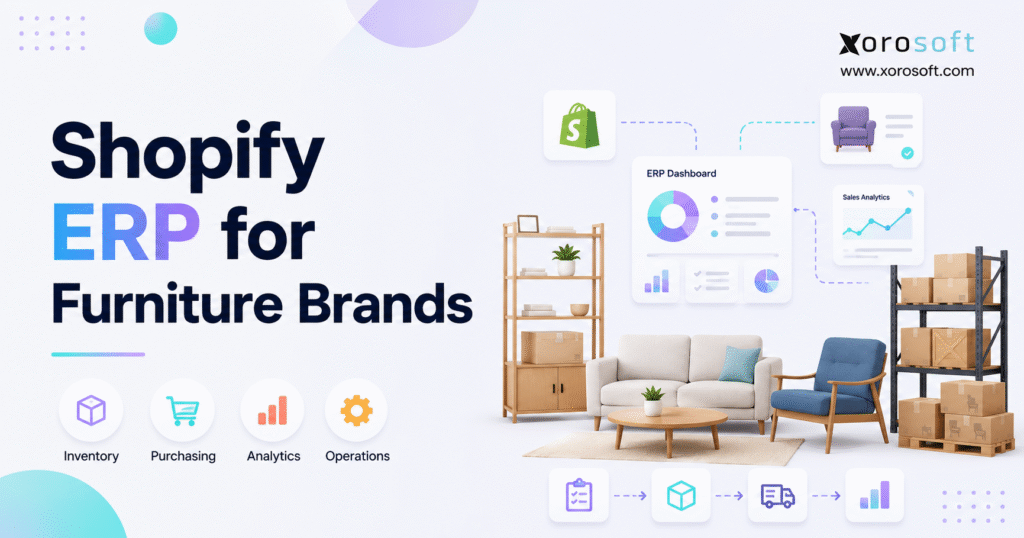
If you’re searching for an effective Shopify ERP for furniture brands, you’ve come to the right place.
1. Why Furniture Operations Break Before the Storefront Does
Shopify ERP for furniture brands becomes important when inventory, warehouse work, purchasing, accounting, and fulfillment grow beyond what basic Shopify apps can manage. At first, a furniture brand can run on Shopify, QuickBooks, spreadsheets, and a few add-ons. However, once bulky products, long supplier lead times, multiple locations, wholesale orders, and higher order volume enter the business, the back office often becomes the real bottleneck.
Furniture is not a simple ecommerce category. A brand selling sofas, tables, beds, cabinets, décor sets, or modular collections must manage space, variants, cartons, dimensions, delivery timing, supplier delays, and inventory value. Therefore, the systems behind the storefront need more discipline than a standard ecommerce stack usually provides.
1.1 Why Furniture Inventory Is Harder Than Standard Ecommerce
Most small ecommerce products are easy to count, store, pick, pack, and ship. Furniture behaves differently because each unit takes more warehouse space, costs more to move, and creates more risk when the count is wrong.
In addition, furniture products often include finishes, fabrics, sizes, bundles, replacement parts, and assembly components. As a result, a team may know that a product exists somewhere, but still not know whether it is sellable, reserved, damaged, inbound, or ready to ship.
1.2 Where Shopify Fits in Furniture Ecommerce
Shopify is strong at storefront, checkout, customer experience, product pages, and order capture. Because of that, many furniture brands should keep Shopify as the commerce layer.
However, Shopify was not designed to manage every operational workflow behind a complex furniture business. Inventory planning, purchasing, warehouse execution, landed cost, manufacturing, wholesale allocation, and financial reporting usually need a deeper system.
1.3 The Hidden Cost of Disconnected Furniture Systems
Disconnected systems create friction slowly. A purchasing spreadsheet may show one quantity, the warehouse may count another, and accounting may see a third number at month-end. Meanwhile, Shopify may display inventory availability that does not reflect reserved stock, damaged units, inbound orders, or wholesale commitments.
Consequently, teams spend more time checking data than improving operations. Customer service asks the warehouse for updates. Finance waits for inventory numbers. Purchasing guesses what to reorder. Leadership then makes decisions from reports that may already be outdated.
2. What Is Shopify ERP for Furniture Brands?
Shopify ERP for furniture brands is an operational system that connects Shopify orders with inventory management, warehouse management, purchasing, accounting, manufacturing, forecasting, and reporting. Instead of keeping each workflow in a separate app or spreadsheet, ERP gives the business one connected system for daily operations.
2.1 Shopify ERP Definition for Furniture Companies
A Shopify furniture ERP helps furniture companies manage the operational layer behind ecommerce. It tracks what is in stock, where inventory is located, what has been committed, what needs to be purchased, what has shipped, and how inventory movement affects accounting.
In practical terms, ERP becomes the system that connects sales demand with warehouse execution, supplier planning, and financial control.
2.2 How ERP Extends Shopify Beyond Orders and Checkout
Shopify explains ERP integration as a way to connect ERP with other business systems so data can synchronize across functions. That matters because furniture brands need sales, inventory, purchasing, warehouse, and finance data to move together instead of sitting in isolated tools. You can reference Shopify’s own explanation through its ERP integration guide.
For example, a Shopify order can flow into ERP, reserve stock, trigger warehouse activity, update available inventory, affect purchasing forecasts, and support accounting entries. Therefore, the brand can keep Shopify focused on selling while ERP manages the operational truth behind the order.
2.3 What Shopify ERP Does Not Replace
ERP does not replace Shopify’s storefront, checkout, themes, product pages, marketing tools, or ecommerce experience. Instead, it supports the workflows that happen after demand enters the business.
That separation is important. Shopify should remain the front-end commerce engine, while ERP should manage inventory, purchasing, warehouse activity, accounting, manufacturing, and reporting.
3. Why Furniture Brands Need ERP Earlier Than They Expect
Many furniture brands think ERP is only for large enterprise companies. However, furniture complexity can appear much earlier because bulky inventory, supplier lead times, and warehouse workflows create operational pressure fast.
A brand does not need hundreds of employees to feel ERP pain. In many cases, the warning signs appear when the team adds a second warehouse, launches wholesale, imports inventory, expands SKU count, or starts managing made-to-order products.
3.1 Bulky Furniture Inventory Creates Warehouse Complexity
Furniture takes space, and space changes the entire warehouse workflow. Receiving, putaway, storage, picking, packing, staging, and shipping all require more coordination than small parcel fulfillment.
Because of that, warehouse teams need clear location visibility. They must know whether an item is in receiving, available stock, damaged stock, a showroom, a staging lane, a 3PL, or an outbound order.
3.1.1 Receiving and Putaway Challenges
Furniture receipts often arrive as pallets, containers, mixed vendor shipments, or oversized cartons. Therefore, receiving teams need to verify quantity, condition, SKU, location, and availability before stock becomes sellable.
Without a connected ERP or WMS, the receiving process may rely on paper notes, spreadsheet updates, and delayed Shopify adjustments. As a result, inventory can appear available before it is actually ready.
3.1.2 Picking, Packing, and Shipping Large Items
A wrong pick in furniture is expensive. A warehouse team may need equipment, two-person handling, larger staging areas, freight labels, carton checks, and damage inspection.
Therefore, furniture warehouse management needs more than a simple pick list. Teams need structured receiving, bin tracking, barcode scanning, order release, packing confirmation, and shipment visibility.
3.2 High-Value SKUs Increase Inventory Risk
Furniture inventory ties up cash quickly. A few inaccurate counts can distort margin, purchasing decisions, and financial reporting. Moreover, slow-moving products can sit in the warehouse for months while working capital remains trapped.
Because furniture SKUs often carry higher unit value, the cost of poor inventory control is larger. Accurate inventory is not only an operations issue; it is also a finance issue.
3.3 Long Supplier Lead Times Affect Cash Flow
Furniture brands often work with domestic suppliers, overseas vendors, private-label manufacturers, or mixed sourcing networks. Since lead times can stretch for weeks or months, replenishment planning becomes difficult.
If the purchasing team orders too late, the brand risks stockouts. However, if it orders too early, excess inventory takes over warehouse space and cash flow. Therefore, purchasing needs to be connected with sales velocity, inbound stock, supplier timing, and current inventory.
3.3.1 Supplier Lead Time Visibility
Supplier lead time should influence reorder points, purchase timing, and safety stock. However, if lead times live in spreadsheets, purchasing teams may not see risk early enough.
A furniture ecommerce ERP can centralize vendor data, open purchase orders, inbound inventory, and reorder logic. As a result, teams can plan earlier instead of reacting after stock is already low.
3.3.2 Reorder Planning for Furniture SKUs
Furniture reorder planning should account for sales velocity, supplier reliability, container timing, seasonality, warehouse capacity, and available cash. In addition, it should separate bestsellers from slow movers.
Without that structure, furniture brands often overbuy products that do not move and underbuy products customers actually want.
3.4 Made-to-Order Furniture Adds Planning Pressure
Many furniture brands sell configurable or made-to-order items. A customer may choose a fabric, finish, size, module, hardware option, or custom dimension. Behind that order, the company may need materials, components, labor, vendor purchases, production steps, and delivery planning.
As a result, basic inventory apps often become too limited. A furniture brand may not need heavy manufacturing software at the beginning, but it does need better control over BOMs, work orders, components, and finished goods.
3.5 A Practical Check Before ERP Research
Before evaluating software, review whether your team can answer these questions without chasing spreadsheets:
- What inventory is truly available to sell?
- How much stock is committed, reserved, damaged, or inbound?
- Are any purchase orders late or at risk?
- Which SKUs are overstocked?
- Where is cash getting trapped in slow-moving furniture inventory?
- Which warehouse should fulfill each order?
- Can finance trust inventory value at month-end?
If these answers are hard to find, ERP research is worth starting.
4. Core Problems Shopify ERP Solves for Furniture Brands
ERP for Shopify furniture stores solves the operational problems that appear when sales growth creates more complexity than the existing stack can handle. The biggest issues usually involve inventory visibility, stock allocation, purchasing, warehouse control, accounting, and reporting.
4.1 Shopify Furniture Inventory Management Across Locations
A furniture brand may sell through Shopify, Amazon, wholesale accounts, showrooms, marketplaces, sales reps, and EDI channels. At the same time, inventory may sit across warehouses, 3PLs, showrooms, receiving areas, damaged zones, and in-transit shipments.
Therefore, teams need a central inventory view. A platform such as XoroERP can become relevant when a brand needs inventory, purchasing, accounting, and operations connected in one system rather than spread across multiple tools.
4.2 Overselling, Backorders, and Stock Allocation
Overselling creates customer frustration. In furniture, it can be even more damaging because purchases are often expensive, delivery windows matter, and customers expect clear communication.
A Shopify ERP setup can separate total stock from available-to-sell stock. For example, ten units may exist physically, but three may be reserved for wholesale, two may be committed to orders, and one may be damaged. Therefore, only four units may actually be sellable.
4.2.1 Available-to-Sell Inventory
Available-to-sell inventory should reflect what the business can confidently promise. It should account for committed orders, reserved inventory, safety stock, damaged stock, and location-specific availability.
Because furniture fulfillment is expensive, promising the wrong item creates more than a small service issue. It can trigger delivery delays, freight changes, refunds, and margin loss.
4.2.2 Reserved and Committed Stock
Furniture brands often reserve stock for wholesale buyers, showroom customers, replacement orders, or major accounts. However, if those reservations sit in spreadsheets, Shopify may still show the product as available.
ERP helps protect reserved and committed stock while giving sales, warehouse, and customer service teams a clearer view.
4.3 Purchasing, Supplier Lead Times, and Replenishment
Purchasing is one of the most important workflows for furniture brands because inventory is expensive and supplier timing is unpredictable. A strong ERP should help teams create purchase orders, track inbound inventory, manage vendor data, review supplier performance, and plan replenishment.
In addition, purchasing should connect with forecasting. Otherwise, teams buy based on habit instead of demand, cash flow, and warehouse capacity.
4.4 Shopify WMS for Furniture Brands
Furniture warehouse operations need structure. Teams must receive, inspect, put away, pick, pack, stage, transfer, and ship large products while keeping inventory accurate.
A Shopify WMS for furniture brands should support bin locations, barcode scanning, receiving workflows, cycle counts, transfer logic, and fulfillment execution. For example, XoroWMS is relevant when brands need warehouse control connected to broader ERP workflows.
4.5 Accounting, Inventory Valuation, and Month-End Close
Furniture inventory affects the balance sheet. If stock counts are wrong, financial reports become unreliable. If landed cost is missing, margins may look stronger than they really are.
Therefore, ERP should connect inventory activity with accounting workflows. Sales, returns, purchase receipts, landed cost, inventory adjustments, and cost of goods sold should flow together instead of being rebuilt manually at month-end.
4.5.1 Landed Cost for Furniture Brands
Landed cost includes freight, duties, handling, brokerage, and other costs required to bring inventory into the business. Since furniture is bulky, these costs can materially change margin.
Therefore, a furniture brand should not judge profitability from product cost alone. It needs landed cost visibility to understand true margin.
4.5.2 Inventory Valuation and Finance Accuracy
Inventory valuation becomes harder when products move across warehouses, showrooms, returns, assemblies, and adjustments. As a result, finance teams need operations data they can trust.
When ERP connects inventory movement with financial records, month-end close becomes more reliable and less dependent on manual reconciliation.
4.6 Reporting for Operations, Finance, and Leadership
Leadership needs more than Shopify sales reports. Furniture operators need inventory aging, stockout risk, overstock value, gross margin, supplier delays, warehouse productivity, order cycle time, and cash tied in inventory.
Because of that, reporting should connect operations and finance. A single dashboard is not enough unless the underlying data is accurate.
5. Shopify Inventory Apps vs Shopify ERP for Furniture Brands
Shopify apps can be useful, especially when a brand is still simple. However, furniture brands often outgrow app-based operations because every new workflow adds another source of truth.
The Shopify ecosystem is valuable because it gives merchants flexibility. Still, flexibility can become complexity when inventory, purchasing, warehouse work, accounting, and reporting all depend on different systems.
5.1 When Shopify Apps Are Enough
Shopify apps may be enough when a furniture brand has a limited SKU count, one warehouse, simple purchasing, no wholesale channel, low order volume, and straightforward accounting.
At that stage, speed matters more than full operational control. Therefore, apps can help the team stay lean while the business proves demand.
5.2 When Furniture ERP Software Becomes Necessary
Furniture ERP software becomes necessary when the team starts reconciling too many systems. One app may manage inventory, another may support purchasing, a warehouse tool may handle fulfillment, and QuickBooks may manage accounting.
At that point, leadership still needs one answer to simple questions: What is available? Which stock is inbound? How much inventory is reserved? Where is margin getting lost? When those answers require multiple tools, the operating stack has become too fragmented.
5.3 Shopify Apps vs Furniture ERP Software
Shopify apps work well for early-stage brands that need speed and flexibility. However, furniture ERP software becomes more useful when the business needs stronger control across inventory, purchasing, warehouse management, accounting, forecasting, manufacturing, and reporting.
Here is the simple way to think about the difference:
- For basic stock syncing, Shopify apps may be enough.
- When inventory lives across warehouses, showrooms, or 3PLs, ERP gives stronger location control.
- If purchasing depends on spreadsheets, a connected system helps manage vendors, lead times, and replenishment.
- Once warehouse teams need receiving, putaway, picking, packing, and shipping workflows, WMS capabilities become important.
- When finance needs accurate inventory value, landed cost, COGS, and month-end reporting, ERP becomes more practical.
- For wholesale, EDI, made-to-order, or manufacturing workflows, a broader operational system usually fits better than separate apps.
In short, Shopify apps solve narrow problems. A furniture ecommerce ERP connects the operating model behind the brand.
6. Essential Shopify ERP Features for Furniture Brands
The best Shopify ERP for furniture brands should support the physical reality of the business. Furniture operations need more than product syncing and order import. They need inventory discipline, warehouse execution, purchasing control, accounting accuracy, and reporting visibility.
6.1 Real-Time Inventory Management
Real-time inventory management should show on-hand, available, committed, reserved, damaged, inbound, and in-transit stock. Because furniture products are high-value and space-intensive, these distinctions matter.
In addition, inventory updates should happen as orders, returns, receipts, transfers, adjustments, and shipments occur. Otherwise, Shopify availability can drift away from warehouse reality.
6.2 Multi-Warehouse and Multi-Location Control
Furniture brands may operate warehouses, showrooms, retail spaces, 3PL facilities, and supplier-direct workflows. Therefore, ERP must support location-level visibility.
Multi-location control helps teams decide where to fulfill from, when to transfer stock, and how to protect inventory for specific channels.
6.3 Warehouse Management for Furniture Fulfillment
Warehouse management should include receiving, putaway, bin locations, barcode scanning, picking, packing, shipping, cycle counting, and transfers. Moreover, warehouse teams need workflows that match bulky product movement.
A furniture brand should evaluate whether the ERP can manage practical warehouse work, not just display inventory numbers.
6.4 Purchasing and Supplier Management
Purchasing features should include purchase orders, vendor records, supplier terms, lead times, replenishment planning, inbound tracking, and cost visibility.
Because furniture inventory is capital-intensive, purchasing must connect demand, availability, supplier timing, and cash planning. Otherwise, the brand may create overstock and stockouts at the same time.
6.5 Forecasting and Demand Planning
Forecasting helps furniture brands decide what to buy, when to buy it, and how much inventory to carry. It should consider sales velocity, seasonality, supplier lead times, inbound stock, stockouts, and slow movers.
However, forecasting only works when inventory data is clean. If stock counts are unreliable, demand planning becomes guesswork.
6.6 Accounting and Financial Integration
Accounting integration should connect sales, purchase receipts, returns, landed cost, inventory valuation, COGS, credits, and adjustments. As a result, finance teams can close faster and trust the numbers.
For brands using QuickBooks, ERP evaluation often starts when inventory complexity outgrows basic accounting workflows. In that situation, the Xorosoft vs QuickBooks comparison can help frame what changes when operations need more than accounting software.
6.7 Manufacturing, BOMs, and Work Orders
Some furniture brands assemble, customize, finish, upholster, or manufacture products. Therefore, ERP may need BOMs, components, work orders, material planning, and production tracking.
A made-to-order furniture workflow becomes easier when sales demand connects with component availability and production capacity.
6.7.1 BOM Management
A bill of materials defines the components required to build or assemble a product. For furniture, that may include frames, foam, fabric, legs, hardware, packaging, and accessories.
Because each component affects production, BOM accuracy helps protect both inventory and delivery promises.
6.7.2 Production Work Orders
Production work orders help teams plan and track manufacturing work. When connected to inventory, they also show whether materials are available before production begins.
This workflow reduces the risk of starting a custom furniture order without the right components, labor plan, or finished-goods visibility.
6.8 Shopify, Amazon, EDI, and Wholesale Integrations
Many furniture brands start with Shopify and later add Amazon, wholesale, B2B, or EDI. As a result, the ERP should support growth across multiple channels without forcing the team into a fragile app stack.
A connected system such as XoroONE can become relevant when a brand wants ecommerce, inventory, purchasing, warehouse management, accounting, and reporting in one operational platform.
6.9 See the Workflow Before Choosing Software
Before choosing any ERP, ask for a workflow-based demo. The demo should show a Shopify order entering the system, inventory being reserved, warehouse work being triggered, purchasing data being updated, and accounting visibility being maintained.
This approach is better than reviewing a feature checklist alone.
7. Shopify ERP Use Cases by Furniture Business Model
Different furniture companies need different ERP workflows. Therefore, the right system depends on whether the brand sells DTC, wholesale, through showrooms, through marketplaces, or through manufacturing-led operations.
7.1 Shopify ERP for DTC Furniture Brands
DTC furniture brands need accurate availability, clear order status, fulfillment routing, and customer communication. Since furniture purchases are high-consideration, customers expect reliable delivery information.
ERP helps DTC teams connect Shopify demand with warehouse work, purchasing needs, and inventory availability.
7.2 Furniture ERP for Retailers With Showrooms
Showroom retailers need visibility across display stock, warehouse stock, customer orders, transfers, and POS activity. For example, a customer may buy a showroom item that must be fulfilled from a warehouse.
Therefore, the team needs location-level stock visibility and transfer control.
7.3 ERP for Wholesale Furniture Distributors
Wholesale furniture distributors manage customer-specific pricing, bulk orders, payment terms, EDI, allocations, and long-term replenishment. Because wholesale orders can consume large quantities, allocation becomes critical.
ERP helps protect inventory for key accounts while keeping ecommerce availability accurate.
7.4 Shopify ERP for Custom Furniture Brands
Custom furniture companies need stronger production visibility. A Shopify order may trigger material checks, component reservations, vendor purchases, work orders, finishing, and delivery planning.
As a result, ERP should connect customer demand with production and purchasing execution.
7.5 ERP for Furniture Manufacturers Selling Through Shopify
Furniture manufacturers need raw material control, finished goods visibility, production planning, and cost reporting. Shopify may capture demand, but manufacturing workflows require more structure.
For that reason, furniture manufacturers should evaluate ERP systems that can support both ecommerce operations and production workflows.
8. ERP Evaluation Considerations for Furniture Brands
Furniture brands should evaluate ERP based on workflows, not just software reputation. A system can be powerful and still be a poor fit if it does not match the company’s inventory, warehouse, purchasing, accounting, and Shopify needs.
8.1 Comparing ERP Options for Furniture Operations
ERP comparisons are useful when they help a team understand fit. However, comparison pages should not replace workflow testing. A furniture brand should still ask each vendor to show Shopify orders, inventory allocation, warehouse execution, purchasing, reporting, and accounting movement.
If the team is comparing operational ERP systems, the broader Xorosoft comparison hub can be useful. However, only the most relevant comparison should be used for each buying conversation.
8.2 When QuickBooks Becomes Too Limited
QuickBooks may work well for basic accounting. However, furniture brands often outgrow it when they need deeper inventory, purchasing, warehouse, and operational reporting.
In that case, the issue is not that accounting software is bad. Instead, the business has become operationally more complex than accounting software alone can support.
8.3 When Inventory Apps Become Too Narrow
Inventory apps can help early-stage teams. However, once the business needs accounting integration, multi-warehouse control, purchasing automation, forecasting, and WMS, an inventory-only system may become narrow.
For brands evaluating inventory platforms, the Xorosoft vs Cin7 comparison may be useful when Cin7 is already on the shortlist.
8.4 When Larger ERP Systems Enter the Shortlist
Some furniture brands also evaluate systems such as NetSuite, Acumatica, Odoo, SAP Business One, Sage, or Business Central. These platforms may fit different business sizes and operating models.
However, the right question is not “Which ERP is most famous?” The better question is “Which ERP can support our Shopify, inventory, warehouse, purchasing, accounting, reporting, and furniture-specific workflows without unnecessary friction?”
8.5 Modern ERP Alternatives for Inventory-Driven Furniture Brands
Modern inventory-driven brands often want cloud ERP systems that connect ecommerce, inventory, purchasing, warehouse management, accounting, manufacturing, forecasting, and reporting.
Xorosoft fits this category as a cloud ERP option for inventory-driven businesses. It is also available on the Shopify App Store, which makes it especially relevant for Shopify merchants evaluating ERP behind their ecommerce operations.
9. How to Know When Your Furniture Brand Is Ready for Shopify ERP
Not every furniture brand needs ERP immediately. However, ERP becomes important when operational risk starts affecting customer experience, cash flow, and management visibility.
9.1 Shopify ERP Readiness Checklist for Furniture Brands
Your furniture brand may be ready for ERP if several of these signs are true:
- Inventory accuracy is unreliable.
- Shopify stock does not match warehouse reality.
- Purchasing depends on spreadsheets.
- Wholesale or EDI orders create manual work.
- Month-end close takes too long.
- Warehouse teams search manually for products.
- Leadership cannot see real-time margin and inventory reports.
- Stockouts and overstock happen at the same time.
- Multiple warehouses, showrooms, or 3PLs are involved.
- Customer service asks operations for order status manually.
9.1.1 You May Not Need ERP Yet If…
You may not need ERP if the brand has simple products, one warehouse, low order volume, clean accounting, and limited purchasing complexity. In that case, Shopify apps may still be enough.
However, the business should still document its workflows early. That makes future ERP planning easier.
9.1.2 You Probably Need ERP If…
You probably need ERP if basic operational questions require manual investigation. For example, if no one can quickly answer what is available, what is inbound, what is reserved, what is delayed, and what is profitable, the system stack has become too fragmented.
At that stage, ERP can provide structure.
9.2 Finance and Accounting Readiness Signals
Finance teams often feel ERP pain before leadership sees the full issue. Warning signs include delayed month-end close, manual inventory valuation, unclear landed cost, and reconciliation between Shopify, QuickBooks, spreadsheets, and warehouse tools.
Once accounting cannot trust inventory data, ERP becomes a financial control issue.
9.3 Warehouse and Fulfillment Readiness Signals
Warehouse readiness signals include picking errors, receiving delays, bin confusion, stock transfer issues, damaged inventory uncertainty, and slow order release.
Because furniture is bulky, every warehouse error carries extra cost. Therefore, warehouse workflows should be tested carefully before ERP selection.
9.4 Leadership Reporting Readiness Signals
Leadership needs one version of the truth. If every meeting starts with a debate over whose spreadsheet is correct, the business has a reporting problem.
ERP helps centralize operational data so leaders can monitor inventory, purchasing, fulfillment, margin, and cash flow from a more reliable foundation.
10. Common Mistakes Furniture Brands Make When Choosing ERP
ERP selection should be disciplined. A furniture brand should not choose software only because a competitor uses it, one department likes the interface, or a vendor has a long feature list.
10.1 Choosing Based Only on Accounting Needs
Accounting matters. However, furniture brands need operational ERP, not only financial software.
If the system handles accounting but fails at inventory, warehouse, purchasing, Shopify, or manufacturing workflows, the implementation will still create friction.
10.2 Ignoring Warehouse Workflows
Warehouse management cannot be an afterthought for furniture brands. Bulky products require strong location control, receiving, putaway, scanning, picking, packing, staging, and transfer workflows.
Therefore, a finance-first ERP without practical warehouse execution may leave operations stuck in manual work.
10.3 Underestimating Data Cleanup
ERP implementation exposes messy data. SKU names, variants, vendor records, costs, lead times, warehouse locations, BOMs, and inventory balances must be cleaned before launch.
Without data cleanup, even the best software can produce unreliable reports.
10.4 Over-Customizing Too Early
Customization can help, but early over-customization often creates complexity. Furniture brands should first standardize core workflows such as order flow, inventory movement, purchasing, receiving, fulfillment, accounting, and reporting.
Afterward, custom workflows become easier to justify.
10.5 Treating Shopify as the Operational Source of Truth
Shopify should remain the commerce source of truth. It is excellent for selling, merchandising, checkout, and customer experience.
However, ERP should usually become the operational source of truth for inventory, warehouse activity, purchasing, accounting, and reporting. This separation keeps the technology stack cleaner.
11. How to Implement Shopify ERP Without Disrupting Operations
ERP implementation works best when the company treats it as an operations project, not just a software project. Therefore, process design, data cleanup, team training, and workflow testing matter as much as vendor selection.
11.1 Map Current Systems and Workflows
Start by mapping every system in use. This may include Shopify, QuickBooks, spreadsheets, inventory apps, warehouse apps, EDI tools, purchasing sheets, and reporting files.
Then document how orders, inventory, purchase orders, receipts, shipments, returns, credits, and accounting entries move today.
11.2 Clean Inventory, SKU, Vendor, and Customer Data
Data cleanup should happen before implementation. Furniture brands should review SKU naming, product variants, units of measure, vendor records, costs, lead times, locations, customer records, and BOMs.
Clean data makes ERP easier to launch and easier to trust.
11.3 Start With Core Operational Workflows
Start with the workflows that affect daily operations most. These usually include Shopify order flow, inventory accuracy, purchasing, receiving, warehouse fulfillment, accounting visibility, and reporting.
Avoid trying to solve every edge case on day one. Instead, launch the core system well and improve from there.
11.4 Train Warehouse, Purchasing, Finance, and Leadership Teams
ERP adoption depends on the people using it. Warehouse teams need practical training. Purchasing teams need replenishment and vendor workflows. Finance teams need inventory valuation and reconciliation logic. Leadership needs dashboards and reporting discipline.
Because each team uses ERP differently, training should match each role.
11.5 Measure Success After Go-Live
After go-live, measure inventory accuracy, order cycle time, fulfillment error rate, purchasing accuracy, stockouts, overstock, month-end close time, and reporting speed.
These metrics show whether ERP is improving operations or simply replacing old tools.
12. Where Xorosoft Fits for Shopify Furniture Brands
Xorosoft is a cloud ERP platform built for inventory-driven businesses that need inventory management, accounting, purchasing, warehouse management, manufacturing, forecasting, reporting, and ecommerce operations in one system.
For furniture brands, the practical question is whether the system can support bulky inventory, Shopify orders, multiple locations, purchasing workflows, warehouse activity, accounting, and leadership reporting without creating unnecessary complexity.
12.1 Xorosoft for Inventory, Accounting, Purchasing, and Warehouse Management
Xorosoft can be relevant for furniture companies that have outgrown QuickBooks, spreadsheets, inventory-only software, or disconnected apps. Instead of managing inventory in one tool, purchasing in another, warehouse workflows elsewhere, and accounting separately, the goal is to centralize core operations.
That matters because furniture brands need inventory accuracy and financial accuracy to match.
12.2 Xorosoft for Shopify, Amazon, EDI, Wholesale, and Multi-Warehouse Operations
Xorosoft is particularly relevant for Shopify merchants that also sell through Amazon, wholesale, EDI, or multiple warehouses. The platform supports the operational layer behind ecommerce by connecting inventory, purchasing, warehouse management, manufacturing, accounting, forecasting, and reporting.
For brands comparing broader ERP fit across industries, the industries Xorosoft serves page can help show where furniture, wholesale, manufacturing, apparel, sporting goods, and consumer products overlap operationally.
12.3 Why Inventory-Driven Furniture Brands Consider Xorosoft
Furniture brands typically consider Xorosoft when they need better inventory visibility, purchasing automation, warehouse efficiency, accounting integration, forecasting, and real-time reporting.
The strongest fit is usually a growing business that sells physical products, manages multiple locations, uses Shopify, has purchasing complexity, and needs more operational control than apps and spreadsheets can provide.
12.4 Proof Points to Review Before Choosing ERP
Before choosing any ERP, review examples, implementation stories, and operational outcomes. The Xorosoft case studies page can help buyers understand how inventory-driven companies approach ERP change.
In addition, the broader Xorosoft solutions page can help teams review which operational workflows matter most before a demo.
13. FAQs About Shopify ERP for Furniture Brands
13.1 What is Shopify ERP for furniture brands?
Shopify ERP for furniture brands is software that connects Shopify with inventory, purchasing, warehouse management, accounting, manufacturing, forecasting, and reporting. It helps furniture businesses manage complex operations behind the storefront. Instead of relying on separate apps and spreadsheets, the company uses ERP to create one operational source of truth for stock, orders, vendors, warehouses, costs, and financial reporting.
13.2 Do furniture brands need ERP if they already use Shopify?
Not always. A small furniture brand with one warehouse, simple SKUs, and low order volume may not need ERP yet. However, ERP becomes useful when Shopify inventory, apps, QuickBooks, and spreadsheets no longer provide reliable visibility. If the team struggles with stock accuracy, purchasing, fulfillment, or month-end close, ERP may be the next operational step.
13.3 Can Shopify manage furniture inventory on its own?
Shopify can manage basic inventory, but furniture inventory often needs deeper control. Brands may need committed stock, reserved inventory, inbound purchase orders, warehouse locations, damaged inventory, bundles, components, and multi-location availability. Once those needs appear, Shopify alone may not provide enough operational depth.
13.4 When should a furniture brand move from Shopify apps to ERP?
A furniture brand should consider ERP when app-based workflows create duplicate entry, reporting delays, stock discrepancies, or manual reconciliation. Other signs include multiple warehouses, wholesale orders, EDI, long supplier lead times, manufacturing workflows, and delayed accounting close. The move usually makes sense when operational complexity starts affecting customer promises and cash flow.
13.5 What ERP features are most important for furniture brands?
The most important ERP features are real-time inventory, multi-warehouse control, WMS, purchasing, supplier management, forecasting, accounting, landed cost, Shopify integration, reporting, and manufacturing support where needed. Furniture brands should prioritize features that manage physical operations, not just financial reporting.
13.6 How does ERP help prevent overselling furniture?
Overselling becomes easier to control when total stock is separated from available-to-sell stock. A connected system can account for committed orders, reserved inventory, damaged units, inbound stock, and warehouse-specific availability. As a result, Shopify can receive more accurate inventory updates, and customer service can make better delivery promises.
13.7 What makes bulky furniture inventory difficult to manage?
Bulky furniture inventory requires more space, labor, handling, and location control than small parcel products. Useful ERP and WMS workflows include bin locations, barcode scanning, receiving, putaway, picking, packing, staging, transfers, and cycle counts. With those controls in place, teams know where large products are stored and whether they are available, reserved, damaged, or ready to ship.
13.8 Why do multi-warehouse furniture brands need stronger systems?
Multi-warehouse support matters because inventory may sit across warehouses, showrooms, 3PLs, and stock locations. The system should show inventory by location and help teams transfer stock, route orders, reserve inventory, and update availability across channels. This is especially important when furniture brands fulfill from more than one region.
13.9 How does ERP help furniture brands with purchasing?
Purchasing teams use ERP to manage purchase orders, supplier lead times, inbound inventory, reorder points, vendor performance, and replenishment planning. Since furniture often has long lead times and high inventory costs, better purchasing helps reduce both stockouts and overstock. Finance also gains clearer visibility into future cash needs.
13.10 What role does ERP play in made-to-order furniture?
For made-to-order workflows, ERP can connect customer orders with materials, components, work orders, vendor purchases, production stages, and delivery planning. This is useful when a Shopify order cannot ship directly from finished stock. Instead, the business needs to check availability, plan production, reserve materials, and track progress before fulfillment.
13.11 Which ERP features support furniture manufacturing?
Manufacturing support depends on the ERP’s capabilities. Furniture brands that assemble, customize, finish, upholster, or manufacture products should look for BOM management, work orders, material planning, production tracking, and finished goods inventory. These features help teams connect raw materials, labor, production steps, and sellable inventory in one workflow.
13.12 How does Shopify inventory connect with accounting in ERP?
A connected ERP links Shopify orders, purchase receipts, returns, adjustments, landed costs, COGS, and inventory valuation. Instead of updating accounting manually after operational changes, the system helps keep stock movement and financial reporting aligned. As a result, finance teams can close faster and reduce reconciliation work.
13.13 What separates Shopify inventory apps from ERP?
The main difference is scope. Shopify inventory apps usually solve specific problems, such as stock syncing or basic tracking. By contrast, ERP manages broader operations across inventory, purchasing, warehouse management, accounting, forecasting, manufacturing, and reporting. Apps may work early, while ERP becomes more useful when the business needs one operational source of truth.
13.14 Should Shopify furniture brands consider NetSuite?
NetSuite can be a good option for some Shopify furniture brands, especially larger companies that need mature ERP functionality. However, brands should evaluate implementation complexity, integration needs, user adoption, warehouse workflows, and total cost. The best ERP depends on operational fit, not only brand recognition.
13.15 Where does Cin7 fit for furniture inventory management?
Cin7 can be useful for some inventory and order management workflows. Furniture brands should evaluate whether it supports their specific needs around bulky SKUs, multi-warehouse control, wholesale, purchasing, accounting, and reporting. The right fit depends on the company’s complexity and future operating model.
13.16 When is Acumatica relevant for furniture companies?
Acumatica can be relevant for companies with broader ERP needs, distribution workflows, and financial complexity. However, furniture brands should still evaluate Shopify integration, warehouse execution, purchasing, inventory planning, and implementation requirements. A good ERP decision depends on workflow fit more than vendor category alone.
13.17 Which alternatives to NetSuite should furniture brands review?
Alternatives may include Acumatica, Cin7, Brightpearl, Fishbowl, Sage, Business Central, Odoo, and Xorosoft. Each option fits different business sizes, budgets, workflows, and implementation preferences. Furniture brands should compare systems based on Shopify integration, inventory depth, WMS, purchasing, accounting, manufacturing, reporting, and team adoption.
13.18 What affects Shopify ERP cost for furniture brands?
Costs vary based on users, modules, implementation scope, integrations, data migration, customization, support, and business complexity. Furniture brands should evaluate total cost of ownership rather than subscription price alone. A lower-cost system can become expensive if it requires extra apps, manual work, or heavy customization.
13.19 How long does ERP implementation usually take?
Implementation timelines depend on business complexity. A simple rollout may take weeks, while a furniture operation with multiple warehouses, manufacturing, accounting migration, EDI, and custom workflows may take several months. Data cleanup, process mapping, and team training have a major impact on the final timeline.
13.20 What delivery workflows can ERP support?
Delivery workflows can be supported through order status, warehouse staging, shipment confirmation, inventory allocation, and carrier data. Some brands may still use transportation or delivery management tools alongside ERP. The important point is that operational data should be accurate before the delivery process begins.
13.21 How do wholesale furniture orders work in Shopify ERP?
Wholesale furniture orders can be supported when the ERP includes customer-specific pricing, order allocation, purchasing visibility, EDI support, payment terms, and inventory controls. This helps brands manage DTC and wholesale demand together without overselling or manually protecting stock in spreadsheets.
13.22 How should furniture variants, finishes, and bundles be tracked?
Variants, finishes, bundles, and components can be tracked when the product data structure is set up correctly. Before implementation, furniture brands should define how they manage fabric, color, size, modules, accessories, replacement parts, and custom options. Clean SKU structure makes ERP much easier to use.
13.23 How does ERP improve furniture inventory forecasting?
Better forecasting comes from connecting sales history, current inventory, inbound purchases, supplier lead times, stockouts, and demand trends. For furniture brands, this helps reduce cash trapped in slow-moving inventory while improving availability for bestsellers. Forecasting works best when inventory and sales data are clean.
13.24 Which reports should furniture brands expect from ERP?
Useful ERP reports include inventory accuracy, inventory aging, stockouts, overstock, gross margin, landed cost, supplier performance, purchase orders, backorders, warehouse productivity, order cycle time, and month-end close status. Leadership should also get real-time visibility across inventory, finance, purchasing, and fulfillment.
13.25 When does a Shopify furniture brand need WMS?
A WMS becomes valuable when warehouse work starts depending on memory, manual searching, or disconnected spreadsheets. Bulky products require disciplined workflows for receiving, putaway, bin locations, barcode scanning, picking, packing, staging, transfers, and cycle counts. If fulfillment errors are rising, WMS should be evaluated.
13.26 Why do QuickBooks users move to ERP?
Brands using QuickBooks often consider ERP when inventory, purchasing, warehouse control, and reporting become too complex for accounting software alone. QuickBooks may still work for basic finance, but growing furniture companies usually need stronger operational workflows. ERP helps connect inventory activity with accounting visibility.
13.27 How can Shopify, Amazon, and EDI run through one ERP?
The right ERP can centralize Shopify, Amazon, wholesale, and EDI workflows. The goal is to manage orders, inventory, customer data, pricing, fulfillment, purchasing, and reporting without building a fragile stack of disconnected apps. Integration quality should always be tested before purchase.
13.28 Who can wait before adopting Shopify ERP?
Teams with simple products, one warehouse, low order volume, limited purchasing, clean accounting, and accurate reporting may not need ERP yet. The system should solve real operational complexity, not add unnecessary process. If the current stack works reliably, the business can wait.
13.29 Which ERP selection mistakes should furniture brands avoid?
Common mistakes include choosing ERP only for accounting, ignoring warehouse workflows, skipping data cleanup, over-customizing too early, and underestimating training. Another mistake is assuming Shopify should manage every operational workflow. A clear process map should come before vendor selection.
13.30 What should an ERP vendor demo show?
A strong ERP evaluation should focus on workflow demonstrations, not generic feature lists. The demo should cover Shopify orders, inventory availability, warehouse receiving, picking, purchasing, landed cost, accounting, reporting, and manufacturing needs. Vendors should be compared against the actual operating model, not only pricing or brand recognition.
14. Build the Operating System Before Growth Turns Messy
Shopify ERP for furniture brands becomes valuable when growth creates more operational pressure than Shopify apps, QuickBooks, and spreadsheets can handle. The storefront may still look clean, but behind the scenes, inventory, warehouse work, purchasing, accounting, and reporting can become harder to control.
Therefore, the real goal is not simply to buy ERP software. The goal is to build an operating system that supports bulky products, long supplier lead times, multiple warehouses, high-value SKUs, wholesale orders, manufacturing workflows, and accurate financial reporting.
For furniture brands that are outgrowing disconnected systems, Xorosoft can be worth evaluating because it connects Shopify, inventory management, purchasing, warehouse management, accounting, manufacturing, forecasting, and reporting in one cloud ERP platform.
If your team is ready to see how these workflows connect in practice, Book a demo with a workflow-first mindset.
Recent Posts
-
 ERP Landed Cost Module vs Spreadsheet Calculations for Importers
 -
 How to Build an Open-to-Buy Plan for an Omnichannel Brand
 -
 Cold Storage WMS for Food and Beverage Distribution
 -
 ERP Buying Statistics 2026: Evaluation, Implementation, and Adoption Risks
 -
 How a Distributor Reduced B2B Order Exceptions Without Restricting Sales