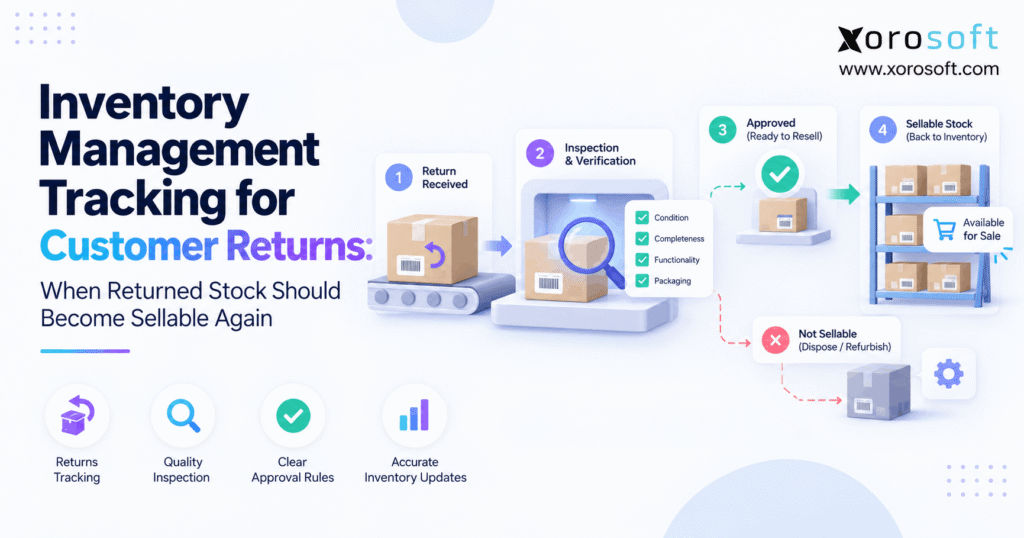
If you are looking to improve your return inventory tracking, this guide will help you get started.
1. The Stock Is Back But Is It Ready to Sell?
Return inventory tracking determines when returned products should move from expected stock to physically received stock and, finally, into sellable inventory. However, those events should not happen automatically at the same moment. Instead, businesses must verify what actually arrived, inspect its condition, and decide whether another customer can safely receive it.
For example, a customer might request a return on Monday and receive a refund on Tuesday. However, the parcel may not reach the warehouse until Friday. Moreover, when it arrives, the item could be damaged, incomplete, opened, or unsuitable for immediate resale.
Therefore, a return request does not create sellable stock. Likewise, a refund does not create sellable stock. Most importantly, physical receipt alone does not always make the product ready for another order.
According to the National Retail Federation’s 2025 retail returns research, retailers expected $849.9 billion in merchandise returns. Therefore, controlling what happens after goods come back is increasingly an inventory-management issue rather than only a customer-service issue.
1.1 The Safest Rule Before Releasing Stock
As a practical rule, a returned unit should become sellable only after the business has physically received it, verified its identity, inspected its condition, and approved its final disposition.
Therefore, teams should normally complete these controls:
- confirm physical receipt,
- verify SKU and quantity,
- check serial or lot information when relevant,
- inspect condition,
- verify packaging and components,
- assign disposition,
- release approved units.
Consequently, the system should distinguish a returned unit that is merely inside the building from one that is ready to fulfill demand.
This distinction prevents damaged or uncertain products from entering normal picking locations too early.
1.2 Why Timing Creates Fulfillment Risk
When returned stock becomes available too early, ecommerce and sales channels can promise inventory the warehouse cannot actually ship.
As a result, Shopify, Amazon, wholesale orders, and sales representatives may allocate products still waiting for inspection.
Conversely, when good returns stay unavailable for too long, purchasing teams may reorder units the business already owns.
Therefore, accurate return processing must balance two goals. First, businesses need strong quality control. Second, they need to recover resale-ready inventory quickly.
2. What Return Inventory Tracking Actually Controls
Return inventory tracking follows a returned product from the customer’s request through receipt, inspection, disposition, and final stock availability.
Therefore, the process covers far more than simply issuing a refund.
2.1 Separate Financial, Physical, and Availability Events
Most customer returns create three separate events.
First, the financial event covers the refund, credit, or replacement.
Second, the physical event occurs when the warehouse, store, or returns center actually receives the product.
Finally, the availability event occurs when the company decides whether that unit can satisfy another order.
Although these events relate to one transaction, they can happen on different days.
For example, some businesses deliberately refund customers before the returned parcel arrives. Therefore, refund timing cannot reliably determine stock availability.
Instead, each event should update the appropriate part of the operational record.
2.2 How Inventory Status Changes After Receipt
Suppose a warehouse physically holds 40 returned units.
However, 10 still require inspection. Additionally, four need repackaging, three are damaged, and one has an incorrect serial number.
Consequently, the business may physically possess 40 units while only 22 are immediately available for sale.
Therefore, an accurate system needs more than one quantity field.
It should show whether products are:
- received,
- awaiting inspection,
- quarantined,
- undergoing rework,
- damaged,
- sellable.
As a result, operations teams can see both what exists physically and what can actually fulfill customer demand.
3. The Customer Return Lifecycle From Request to Resale
A controlled return should follow a defined sequence rather than triggering one immediate stock adjustment.
Therefore, every stage needs a clear operational meaning.
3.1 Return Authorization Before Physical Receipt
First, the customer requests a return.
Next, the business may create an RMA, or return merchandise authorization. Typically, the RMA records:
- original order,
- customer,
- expected SKU,
- expected quantity,
- return reason,
- destination,
- return instructions.
However, the RMA represents expected stock, not physically available stock.
Therefore, sellable inventory should not increase simply because the return was authorized.
At this stage, return inventory tracking should show an expected return without increasing sellable stock.
Likewise, an in-transit return should remain unavailable because the business does not yet control the product.
Consequently, the first real inventory event normally occurs when employees physically receive the unit.
3.2 From Inspection to Final Disposition
After receiving the parcel, employees should place the item in a controlled return area.
Next, they verify its identity and condition.
Afterward, they decide what should happen next.
Possible outcomes include:
- restock,
- repackage,
- quarantine,
- repair,
- refurbish,
- return to vendor,
- write off,
- scrap.
Microsoft’s documentation on return disposition codes similarly separates the reason for a return from what the business eventually does with the item.
Therefore, the final disposition—not simply physical receipt—should determine whether stock becomes available.
4. When Should Return Stock Become Sellable Again?
Effective return inventory tracking should release stock only when the business has enough evidence to confidently fulfill another customer order with that exact unit.
Therefore, the release trigger should be operational approval rather than refund timing.
4.1 Verify the Product That Arrived
First, warehouse teams should verify exactly what came back.
Depending on the product, that may include:
- SKU,
- variant,
- size,
- color,
- quantity,
- serial number,
- lot number,
- configuration.
For example, a customer may accidentally return the wrong size or variant.
Likewise, a serialized unit might not match the original shipment.
Therefore, physically receiving a package does not prove that the expected stock returned.
Instead, verification should happen before any sellable quantity increases.
4.2 Confirm Condition and Completeness
Next, employees should check whether the product meets resale requirements.
Depending on the category, inspection may cover:
- visible damage,
- signs of use,
- missing parts,
- packaging,
- accessories,
- safety seals,
- functionality,
- expiration dates.
However, an undamaged product is not always immediately resale-ready.
For example, it may still require cleaning, relabeling, repackaging, or functional testing.
Therefore, teams should distinguish acceptable condition from ready for immediate allocation.
4.3 Approve the Final Inventory Disposition
Finally, the team should record the disposition.
If the item meets all resale requirements, it can move into sellable stock.
However, if additional work is needed, the item should remain unavailable.
Therefore, the safest availability trigger is:
inspection completed + disposition approved + sellable status assigned.
Consequently, this rule creates a clear control point between reverse logistics and normal order fulfillment.
5. Statuses That Separate Physical Stock From Sellable Stock
A strong returns process needs explicit statuses.
Otherwise, products often become either invisible or immediately sellable, even though reality is more complicated.
Therefore, businesses should represent the actual operational state.
5.1 A Practical Status Model
| Status | Physically present? | Sellable? | Typical next action |
|---|---|---|---|
| Requested | No | No | Await shipment |
| In transit | No | No | Track expected receipt |
| Received | Yes | No | Verify |
| Pending inspection | Yes | No | Inspect |
| Quarantine | Yes | No | Review exception |
| Repackage | Yes | No | Prepare product |
| Repair | Yes | No | Repair and test |
| Sellable | Yes | Yes | Put away |
| Vendor return | Yes | No | Send to supplier |
| Write-off | Yes/No | No | Financial adjustment |
| Scrap | Yes | No | Dispose |
Therefore, employees can see both where a product is and what the company can do with it.
5.2 Keep Physical Stock Separate From Available Stock
Modern inventory operations need visibility beyond a single on-hand quantity.
Moreover, return inventory tracking becomes more reliable when status information stays connected to the wider inventory record.
For example, Xorosoft’s XoroONE brings inventory, warehousing, purchasing, accounting, and other operational workflows into one environment.
Therefore, inventory-driven businesses can separate stock that physically exists from stock that can actually satisfy demand.
Additionally, this separation becomes more important as businesses add warehouses, channels, and more complex return policies.
6. How Inspection and Condition Grading Control Restocking
Inspection converts a physical return into a business decision.
Therefore, employees need consistent grading standards rather than relying entirely on individual judgment.
6.1 Grade A: Ready for Resale
A resale-ready item may be:
- complete,
- clean,
- functional,
- correctly labeled,
- correctly packaged,
- suitable for normal fulfillment.
Therefore, the business can usually release the unit into sellable stock.
However, businesses should define Grade A standards by product category.
For example, an apparel brand may focus on wear, tags, stains, and packaging. Meanwhile, a sporting-goods business may also require functional or safety checks.
6.2 Grade B: Rework Before Release
Sometimes, the actual product remains acceptable but needs minor work.
For example, the team may need to:
- repackage it,
- clean it,
- replace instructions,
- apply a new label,
- restore accessories.
Therefore, the product should remain unavailable while that work happens.
Afterward, staff can inspect it again and release it if appropriate.
6.3 Grade C: Repair, Refurbish, or Remove
Other products may require repair, refurbishment, supplier review, or disposal.
Consequently, these units should remain outside normal fulfillment until the next action finishes.
Moreover, product rules vary significantly by industry.
Therefore, businesses should create category-specific standards rather than one universal checklist.
Xorosoft’s industries page illustrates different inventory environments across apparel, furniture, sporting goods, wholesale, food, and manufacturing operations.
7. Why Premature Restocking Creates Inventory Errors
Premature restocking makes inventory appear healthier than it really is.
For example, suppose a warehouse receives 30 customer returns and immediately adds all 30 units to available stock.
However, inspection later identifies six damaged products and four incomplete units.
Consequently, inventory was overstated by 10 units.
Therefore, return inventory tracking helps prevent returned units from inflating available stock before inspection confirms their condition.
7.1 How Inventory Errors Lead to Overselling
First, ecommerce channels can expose nonexistent sellable units to customers.
As a result, new orders may arrive against products the warehouse cannot confidently ship.
Moreover, employees may discover the issue only after picking begins.
Therefore, a single incorrect adjustment can lead to:
- cancellations,
- backorders,
- manual substitutions,
- customer-service work,
- inaccurate availability.
Additionally, overselling can spread across several channels when one inventory source feeds Shopify, marketplaces, and B2B orders.
Consequently, return controls directly affect order-management reliability.
7.2 Purchasing Can React to the Wrong Quantity
Return errors also affect replenishment.
For example, overstated stock can delay a purchase order that the company actually needs.
Conversely, resale-ready returns that sit unprocessed can make availability appear artificially low.
As a result, purchasing may order products already inside the warehouse.
Therefore, accurate return inventory tracking supports both fulfillment and replenishment decisions.
Additionally, accurate statuses help planners distinguish real shortages from units simply waiting for inspection.
8. Common Return Inventory Tracking Failures
Most return errors happen when responsibility moves between teams or systems.
Therefore, businesses should review customer service, warehouse, ecommerce, and finance handoffs together.
In particular, return inventory tracking should establish one clear event that changes a returned unit from unavailable to sellable.
8.1 Return Requests Should Not Increase Sellable Stock
A customer may submit a return but never ship the product.
Therefore, increasing inventory when the request is created produces phantom availability.
Instead, the authorization should record only expected stock.
Likewise, a refund should not automatically release units because the business may refund before physical receipt.
Oracle NetSuite documentation, for example, separates return authorization and return processing from later inventory treatment.
Therefore, companies should avoid using financial events as substitute warehouse events.
8.2 Prevent Duplicate Adjustments
Duplicate adjustments often happen when several applications can change inventory.
For example, customer service may restock inventory while issuing the refund. Later, the warehouse may restock the same product after inspection.
Consequently, one physical unit becomes two system units.
Therefore, businesses should define one authoritative release event.
Additionally, each connected application should understand whether it owns the quantity change or merely receives the updated availability.
That governance becomes especially important in multi-channel operations.
9. Return Inventory Tracking for Shopify and Ecommerce
Ecommerce increases the impact of inaccurate stock because availability can become customer-facing almost immediately.
Therefore, return inventory tracking for Shopify merchants should carefully control when returned units are released.
9.1 Release Only Approved Sellable Quantity
Suppose a customer sends back three units.
However, only two pass inspection.
Therefore, the storefront should eventually receive two units of restored sellable availability, not three units of physical receipt.
Shopify’s official guidance explains how merchants can process returns and restock eligible items.
However, brands using external warehouse or ERP systems also need to avoid duplicate adjustments.
As operations grow, Xorosoft’s integrations can connect ecommerce and operational workflows, while its Shopify App Store listing provides an external reference for its Shopify integration.
Therefore, the goal is not simply faster syncing.
Instead, businesses need the correct quantity to synchronize after the correct operational event.
10. Multi-Warehouse Return Processing Needs Location-Level Control
A company-wide quantity is not enough when several facilities can receive customer returns.
For example, an ecommerce order may ship from one distribution center while the customer returns it to another location.
Therefore, the system must preserve where the stock physically exists.
10.1 Record the Facility That Physically Receives the Product
First, the receipt should identify the actual facility.
Next, the system should identify the staging or inspection location.
Finally, the approved product should move to its final destination.
Consequently, teams may need to record:
- receiving warehouse,
- inspection zone,
- quarantine location,
- final sellable location,
- subsequent transfer.
Additionally, return inventory tracking should preserve those location changes so one unit never appears available in two facilities.
If the company later transfers the approved unit elsewhere, that transfer should remain separate from the original return.
For warehouse-heavy operations, XoroWMS supports real-time warehouse execution and inventory movement across operational locations.
11. How Returns Affect Inventory Accounting
Customer returns affect both units and financial records.
Therefore, warehouse disposition and accounting treatment should remain aligned.
11.1 How Inventory Value Changes After Inspection
When a resale-ready product returns to normal stock, the business regains a usable inventory asset.
Therefore, both quantity and inventory value may need to change.
However, damaged or unusable products require different treatment.
Depending on the circumstances, the business may record:
- a write-off,
- repair cost,
- refurbishment cost,
- supplier claim,
- vendor return,
- disposal.
Consequently, finance needs visibility into what the warehouse decided.
Otherwise, accounting records may continue treating unusable goods as normal inventory.
Xorosoft’s XoroERP connects inventory, accounting, purchasing, and broader operational processes.
Therefore, businesses can reduce the gap between warehouse disposition and financial reporting.
12. What a Reliable Return Tracking System Should Record
A reliable return inventory tracking system should create an audit trail that explains what happened to every returned unit.
Therefore, teams should not need to reconstruct the process from emails and spreadsheets.
At minimum, the record should capture:
- sales order,
- customer,
- RMA number,
- SKU,
- variant,
- quantity expected,
- quantity received,
- return reason,
- warehouse,
- receipt time.
Additionally, controlled products may require lot or serial information.
Next, teams should record:
- inspection result,
- condition grade,
- supporting photographs,
- disposition,
- final status,
- employee,
- timestamps.
Finally, the system should connect relevant financial outcomes such as refunds, credits, replacements, write-offs, or supplier claims.
Consequently, operations teams can understand why a product became sellable, why it remained unavailable, and who made the decision.
13. System Requirements for Scalable Return Inventory Tracking
Simple tools can handle occasional returns.
However, scalable return inventory tracking needs stronger operational controls as return volume, warehouse complexity, and channel count increase.
13.1 RMA, Barcode, and Quarantine Controls
First, the system should track expected returns through an RMA.
Next, barcode scanning should help employees identify the correct item, order, lot, or serial number.
Additionally, the warehouse should support controlled staging and quarantine locations.
The system should also support:
- inspection workflows,
- condition grading,
- disposition rules,
- rework,
- repair,
- vendor return,
- write-off,
- status changes,
- multi-location visibility.
Moreover, ecommerce channels should receive only approved sellable inventory.
Finally, accounting should reflect the physical disposition.
Xorosoft’s broader solutions connect inventory, warehouse management, accounting, purchasing, and ecommerce workflows.
Therefore, businesses can manage the return as part of the entire stock lifecycle rather than as an isolated customer-service transaction.
14. When Basic Return Tracking Stops Being Enough
Not every company needs sophisticated ERP or WMS controls.
For example, a small seller with one warehouse, simple products, and occasional returns may manage successfully with basic ecommerce tools.
However, complexity changes the equation.
Common warning signs include:
- repeated stock corrections,
- unknown return locations,
- long inspection queues,
- duplicate restocking,
- damaged products becoming available,
- sellable products sitting unused,
- unexplained accounting differences,
- inconsistent grading,
- missing audit history.
Therefore, recurring return discrepancies often indicate a system or process issue rather than a one-off employee mistake.
Moreover, multi-channel operations increase the number of handoffs.
Shopify alone may be manageable. However, Shopify plus Amazon, wholesale, EDI, B2B, and several warehouses creates more opportunities for quantity mismatches.
Consequently, businesses eventually need one authoritative rule for when a returned unit becomes available.
15. A Return-to-Sellable Control Framework
Businesses can strengthen return inventory tracking without redesigning every warehouse process at once.
Instead, they can establish several clear decision points.
First, define exactly what counts as physical receipt.
For example, carrier delivery may not count until warehouse staff scan the parcel.
Second, separate receipt from availability.
Therefore, newly arrived returns should enter staging, inspection, or quarantine rather than normal pick stock.
Third, standardize inspection rules by product category.
Next, define clear condition grades.
Then, map each grade to a disposition:
- resale-ready → sellable,
- packaging issue → repackage,
- repairable → repair,
- uncertain → quarantine,
- unusable → write-off or scrap.
Finally, connect the disposition to ecommerce and financial updates.
As a result, every team understands the event that releases inventory.
Therefore, the business can recover good stock quickly without sacrificing control.
16. Measure Processing Speed, Not Just the Rate
Return rate is important, but it does not reveal whether the warehouse handles returned products efficiently.
Therefore, operations teams should also measure what happens after receipt.
For this reason, return inventory tracking should measure processing speed as well as the final disposition of returned products.
First, track receipt-to-inspection time.
If resale-ready products wait several days before inspection, the business loses available stock unnecessarily.
Next, track inspection-to-disposition time.
Long delays can create large quarantine balances.
Additionally, monitor the percentage of returned products recovered into normal sellable stock.
However, businesses should not maximize that percentage at the expense of quality.
Instead, they should measure appropriate recovery.
Finally, track recurring return reasons and disposition patterns.
For example, a high percentage of damaged returns from one SKU may indicate a packaging or product-quality issue.
Consequently, return data can inform purchasing, product design, supplier discussions, and warehouse procedures.
17. Turn Every Return Into a Controlled Inventory Decision
Return inventory tracking works best when one principle guides the entire workflow:
Received does not automatically mean sellable.
Therefore, businesses should separate authorization, refund, physical receipt, inspection, disposition, and final availability.
Moreover, they should make the transition between those stages visible to customer service, warehouse teams, inventory planners, ecommerce channels, and finance.
As a result, good products can move back into circulation quickly while damaged or uncertain inventory remains protected from new orders.
For smaller businesses, process discipline may be enough. However, once operations span multiple warehouses, channels, purchasing workflows, and accounting systems, connected technology becomes increasingly important.
Xorosoft brings inventory, warehouse management, ecommerce operations, purchasing, accounting, and reporting together for inventory-driven businesses. Therefore, teams can manage returns as part of the wider operational lifecycle rather than as a disconnected afterthought.
If customer returns regularly create differences between ecommerce availability, warehouse stock, and accounting records, Book a Demo to see how a connected ERP and WMS workflow can manage those inventory handoffs.
Frequently Asked Questions
What is return inventory tracking?
Return inventory tracking follows customer returns through authorization, receipt, inspection, disposition, and final inventory status. Therefore, businesses can see whether each returned unit is sellable, quarantined, repairable, or unavailable.
When should returned stock become sellable again?
Returned stock should become sellable after physical receipt, SKU verification, required inspection, and resale approval. Therefore, neither a return request nor a refund should automatically restore available inventory.
Should returned products automatically go back into inventory?
No. Instead, businesses should verify condition and disposition first. Damaged, incomplete, used, or defective products may require quarantine, repair, vendor return, write-off, or disposal.
What is quarantine inventory?
Quarantine inventory is physically present stock that cannot yet fulfill orders. For example, returned products may remain quarantined while employees complete inspection, testing, documentation, or management review.
How do returns affect inventory accuracy?
Returns create errors when businesses restock too early, adjust the wrong SKU or location, double-count units, or delay good stock. Consequently, controlled statuses improve inventory accuracy.
How should Shopify returns affect inventory?
Only approved sellable quantities should return to customer-facing availability. Therefore, businesses should coordinate warehouse inspection and ecommerce synchronization instead of automatically treating every received unit as immediately sellable.
When does a business need advanced return inventory software?
Advanced controls become useful when returns span several warehouses, sales channels, serial numbers, refurbishment, or accounting workflows. Moreover, repeated adjustments and reconciliation problems usually indicate that basic tracking has become insufficient.
Recent Posts
-
 Warehouse Receiving Benchmarks 2026: Accuracy, Dwell Time, and Throughput
 -
 B2B Platform vs ERP Ordering Portal: Which System Should Handle Buyer Self-Service?
 -
 Shopify B2B Pricing Governance: Price Lists, Overrides, Discounts, and ERP Ownership
 -
 ERP for Canadian Food Manufacturers Managing Lots, Expiry Dates, and Recalls
 -
 Shopify Return Restocking: Why Returned Inventory Goes Live Before Warehouse Approval