If you’re looking for ways to reduce warehouse picking time, this article will help you identify effective strategies.
1. The Hidden Workflow Behind a Faster Warehouse
To reduce warehouse picking time, warehouse leaders must remove the delays surrounding each pick rather than simply pressure employees to move faster. Long travel routes, inaccurate bin locations, weak replenishment, manual decisions, and late error detection usually consume more time than the physical act of retrieving a product.
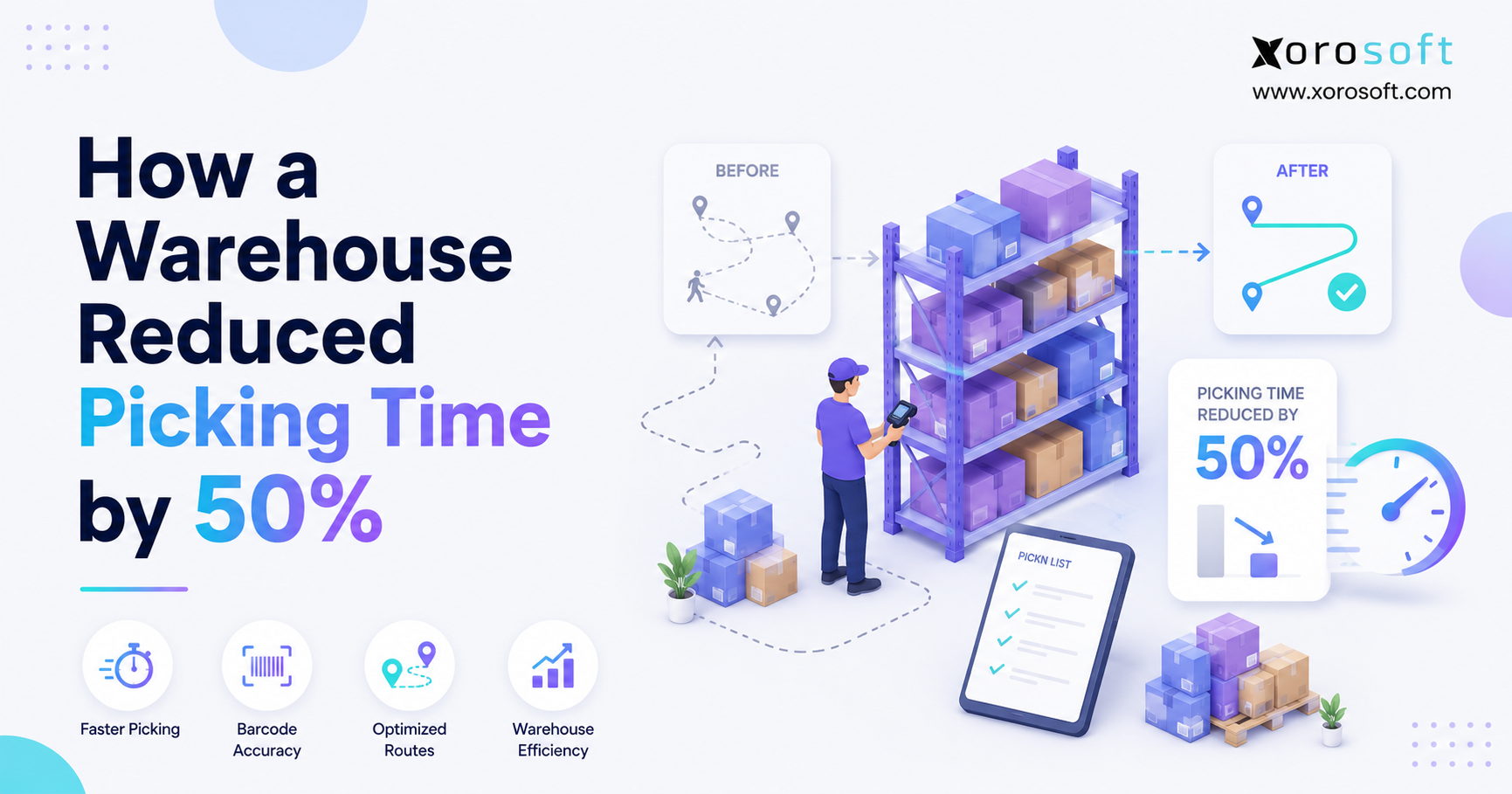
In this operational example, the warehouse used a structured plan to reduce warehouse picking time from approximately 18 minutes per order to nine minutes. Instead of relying on one dramatic change, the team improved warehouse layout, inventory accuracy, barcode validation, picking methods, replenishment, and performance reporting.
As a result, pickers walked less, searched less, and encountered fewer stock exceptions. Meanwhile, packing employees spent less time correcting wrong items and quantities. Therefore, the warehouse improved speed without sacrificing order accuracy.
The central lesson is simple: businesses reduce warehouse picking time by improving the system around the picker. Faster movement may produce a temporary gain; however, better workflow design creates a scalable operational improvement.
1.1 What the 50% Picking-Time Reduction Included
The warehouse measured picking time from task release until the completed pick reached the packing queue. Therefore, the calculation included:
- Walking to storage locations
- Locating the correct bin
- Confirming the item and quantity
- Resolving inventory exceptions
- Traveling between warehouse zones
- Waiting for replenishment
- Transferring the completed order to packing
However, the warehouse excluded packing, shipping-label creation, carrier processing, and final shipment staging. That distinction prevented the team from hiding picking problems inside a broader fulfillment metric.
1.2 Why Faster Picking Matters Beyond the Warehouse
Faster picking does more than increase warehouse output. For example, it can improve same-day shipping performance, reduce overtime, protect carrier cutoffs, and help customer service provide more reliable delivery information.
Furthermore, picking performance affects inventory accuracy. When rushed or poorly directed picks create wrong-item and wrong-quantity errors, the recorded inventory balance begins to move away from the physical stock position. Consequently, future orders become more difficult to fulfill.
Therefore, inventory-driven businesses should treat warehouse picking efficiency as an operational, financial, and customer-experience metric.
2. What It Really Means to Reduce Warehouse Picking Time
Warehouse picking time measures how long employees take to locate, retrieve, validate, and transfer ordered inventory to the next fulfillment stage. Therefore, companies trying to reduce warehouse picking time must evaluate walking, searching, scanning, counting, exception handling, and packing handoffs—not only the seconds spent lifting an item from a bin.
Academic research has consistently identified order picking as one of the most labor-intensive warehouse activities. For additional context, the study Design and Control of Warehouse Order Picking: A Literature Review explains why routing, storage assignment, batching, zoning, and operational control have such a substantial effect on warehouse performance.
2.1 Picking Time vs Packing Time
Picking retrieves products from warehouse storage. Packing, by contrast, verifies and prepares those products for shipment.
Nevertheless, these functions remain closely connected. When picking is inaccurate, the packing station becomes an exception-management area. Similarly, when picking falls behind, packing employees wait even if they have enough available capacity.
Consequently, a warehouse should not increase picking speed by creating more work for packing. Instead, the operation should measure speed and accuracy together.
2.2 Picking Time vs Total Fulfillment Cycle Time
Total fulfillment cycle time begins when an order becomes ready for processing and ends when the order ships. Therefore, it can include allocation, order release, picking, packing, documentation, staging, and carrier handoff.
Picking time represents only one part of that cycle. However, because picking often consumes substantial labor and travel, it frequently becomes the most visible warehouse bottleneck.
2.3 Why Average Picking Time Can Be Misleading
Average picking time provides a useful starting point. However, it does not explain the difference between a one-line ecommerce order and a 40-line wholesale order.
Therefore, the warehouse also measured:
- Lines picked per hour
- Units picked per hour
- Pick accuracy
- Travel time per order
- Picking exception rate
- Labor cost per order
- On-time shipment percentage
By combining these metrics, the team could distinguish genuine productivity gains from changes in order mix.
3. Why Warehouse Picking Efficiency Declined
The warehouse had not become inefficient overnight. Instead, small process compromises accumulated as the company added products, channels, employees, and storage locations.
Initially, experienced employees compensated for weak processes through memory and informal workarounds. However, that approach became unreliable as the operation expanded. Eventually, pickers spent too much time deciding where to go, locating products, and resolving inventory discrepancies.
3.1 Excessive Picker Travel Time
Walking created the largest hidden delay. Fast-moving products were stored across distant aisles, while slower-moving inventory occupied convenient pick faces.
As a result, employees repeatedly crossed the warehouse for products that appeared in many orders. Moreover, single-order picking forced them to repeat similar routes throughout the day.
Therefore, the team measured route distance instead of assuming that every minute labeled “picking” represented productive work.
3.2 Poor SKU Slotting Increased Picking Time
The warehouse assigned locations when products first arrived. However, it did not regularly adjust those locations according to sales velocity, seasonality, item size, product affinity, or channel demand.
Consequently, the physical layout no longer reflected the actual order profile. For example, frequently paired products were stored in separate zones. Meanwhile, seasonal fast movers remained in reserve locations.
A warehouse layout can appear organized while still creating inefficient picking. Therefore, slotting decisions must reflect how products move, not merely where they fit.
3.3 Manual Pick Lists Created Route Waste
Printed pick lists displayed order lines, but they did not always present warehouse locations in the most efficient sequence. Accordingly, pickers often doubled back or created their own routes.
Experienced employees sometimes found efficient shortcuts. New employees, however, depended on the printed order. As a result, productivity varied significantly according to individual knowledge.
Furthermore, supervisors could not easily explain why one picker completed a route faster than another. Without directed tasks, the process remained difficult to standardize.
3.4 Inaccurate Locations Created Search Time
When the system indicated that an item was in one bin but the product was physically elsewhere, the picker had several poor options. The employee could search nearby locations, contact a supervisor, skip the line, or place the order in an exception queue.
Regardless of the choice, time was lost. More importantly, the delay interrupted the picker’s normal workflow.
Therefore, the warehouse treated location accuracy as a picking-speed requirement rather than only an inventory-control issue.
3.5 Reactive Replenishment Interrupted Pick Waves
Fast-moving pick locations frequently ran empty during active waves. Consequently, pickers waited while another employee moved stock from reserve storage.
Although the product existed somewhere in the building, it was not available where the picking task required it. Therefore, system-level availability did not guarantee pick-face availability.
By connecting replenishment planning with upcoming order demand, the warehouse prevented many of these interruptions.
3.6 Errors Were Detected Too Late
Before the project, packers discovered many wrong items and quantities. At that point, however, the original picker had moved on and the correct product might have been several aisles away.
Consequently, the warehouse performed avoidable repicks. Furthermore, supervisors spent time investigating whether each problem came from picking, inventory records, labeling, or packing.
Earlier validation became essential because preventing an error at the bin required less work than correcting it at the shipping station.
Together, these problems made it difficult to reduce warehouse picking time because each order carried several hidden delays. Although no single delay appeared catastrophic, repeated walking, searching, waiting, and repicking created a substantial productivity loss across an entire shift.
4. How the Warehouse Measured Its Ability to Reduce Warehouse Picking Time
Before the company could reduce warehouse picking time, it needed a reliable performance baseline. Otherwise, management could make layout or software changes without knowing whether those changes produced a measurable operational result.
Consequently, the warehouse tracked picking time by order type, sales channel, zone, shift, and picking method. This approach helped the team reduce warehouse picking time without misinterpreting easier order mixes as genuine productivity improvements.
Moreover, supervisors separated productive work from hidden delays. Therefore, the team could identify whether time was being consumed by walking, searching, scanning, handling, waiting, or exception resolution.
4.1 Average Picking Time per Order
Average picking time was calculated by dividing total picking minutes by completed orders.
However, the team reviewed this metric alongside order-line volume. Otherwise, a day with many single-line orders could appear more productive than a day with complex wholesale orders.
4.2 Lines Picked per Hour
Lines picked per hour measured how many distinct order lines an employee completed during active picking time.
Because this metric accounts for order complexity better than orders per hour, it became one of the warehouse’s primary productivity measures.
4.3 Pick Accuracy
Pick accuracy measured the percentage of order lines completed without an item, quantity, lot, variant, or location error.
Although speed remained important, the team refused to accept higher output if accuracy declined. Therefore, every productivity report displayed time and accuracy together.
4.4 Travel Time per Pick
Travel time represented walking or equipment movement between picking locations.
In many warehouses, travel consumes more time than physically retrieving products. Consequently, the team used route observations and task timestamps to identify excessive movement.
4.5 Picking Exception Rate
The exception rate measured how frequently a picker encountered missing inventory, incorrect locations, damaged products, unreadable labels, empty pick faces, or other operational blockers.
A high exception rate indicated that the warehouse had a process or data problem. Therefore, supervisors tracked the reason for each exception rather than treating every delay as employee underperformance.
4.6 Labor Cost per Order
Labor cost per order translated operational performance into financial impact.
For example, when average picking time fell while hourly labor cost remained stable, the warehouse could process more orders without proportional headcount growth. As a result, management could see how workflow improvements affected margins and scalability.
5. The Eight-Step Plan to Reduce Warehouse Picking Time
The warehouse followed eight connected steps to reduce warehouse picking time. Each step addressed a different source of operational waste, including excessive travel, poor slotting, inaccurate locations, reactive replenishment, manual routing, and late error detection.
However, the team did not implement the steps as isolated projects. Instead, it treated them as one connected warehouse operating model. That decision was essential because warehouses rarely reduce warehouse picking time through one technology or process change alone.
5.1 Map the Entire Warehouse Picking Process
First, the team followed orders from release through picking and packing handoff. Employees documented every pause, decision, scan, search, escalation, and repeated movement.
Moreover, the team asked pickers to explain why they deviated from the official process. Those conversations revealed workarounds that standard reports could not show.
As a result, the warehouse identified hidden dependencies, including informal overflow locations and manual replenishment requests.
5.2 Separate Productive Work From Travel and Waiting
Next, supervisors divided picking time into five components:
1. Walking or equipment travel
2. Searching
3. Physical product handling
4. Validation
5. Waiting or exception resolution
This breakdown showed that productive product handling represented only a portion of total time. Therefore, the company focused first on travel, searching, and waiting.
By separating productive handling from walking and waiting, the team discovered where it could reduce warehouse picking time without demanding an unsafe or unrealistic work pace.
5.3 Re-slot Inventory According to SKU Velocity
The warehouse classified products according to order frequency and handling requirements.
Fast-moving A items moved closer to packing and main travel paths. Meanwhile, moderate-volume B items occupied secondary locations. Slow-moving C items moved farther away where appropriate.
However, velocity was not the only consideration. The team also reviewed product size, weight, compatibility, seasonality, and which items were commonly ordered together.
Consequently, the revised layout supported both faster travel and safer handling.
5.4 Correct Bin and Inventory-Location Data
Before introducing more automation, the warehouse corrected duplicate bins, unclear labels, unofficial overflow locations, and outdated system records.
In addition, every active pick location received a readable and scannable identifier. Reserve locations followed the same location hierarchy.
This step mattered because technology cannot reliably direct a picker through inaccurate data. Therefore, data cleanup preceded workflow automation.
5.5 Introduce Barcode Validation
The team introduced scans for the location, product, quantity, and tote or cart position.
For global identification guidance, GS1 barcode standards explain how standardized barcodes support product and logistics identification across supply-chain workflows.
Barcode validation reduced uncertainty because pickers received immediate confirmation. Moreover, supervisors could identify whether an error originated from the location, item record, quantity, or order assignment.
5.6 Match Picking Methods to Order Profiles
Instead of using one process for every order, the warehouse selected picking methods according to channel, order size, SKU overlap, urgency, and warehouse zone.
For example, small ecommerce orders moved through batch or cluster picking. Larger wholesale orders used wave-based release. Meanwhile, specialized or bulky orders continued through controlled single-order workflows.
As a result, the operation reduced repeated travel without creating unnecessary sorting complexity.
5.7 Connect Picking With Replenishment, Packing, and Inventory
Picking could not remain an isolated activity. Therefore, the warehouse connected order allocation, replenishment, directed picking, packing confirmation, shipping status, and inventory updates.
Connected execution helped reduce warehouse picking time because employees no longer had to move between paper lists, separate inventory screens, manual replenishment requests, and disconnected packing updates. Instead, every confirmed task advanced the order and updated the relevant warehouse information.
At this stage, a connected warehouse management system became relevant. XoroWMS supports warehouse workflows such as receiving, put-away, inventory locations, replenishment, barcode-directed picking, packing, shipping, and operational reporting.
However, software alone did not create the improvement. Instead, the platform helped enforce the warehouse process that the team had already defined.
5.8 Review Warehouse Picking KPIs Every Week
Finally, supervisors reviewed the baseline metrics every week.
They examined picking time, route performance, accuracy, replenishment exceptions, stock discrepancies, and order mix. Furthermore, the team re-evaluated fast-moving SKUs as demand changed.
Consequently, the 50% improvement became a managed operating result rather than a temporary project outcome.
6. Picking Methods That Reduce Warehouse Picking Time
Different picking methods reduce warehouse picking time in different operating environments. Therefore, a warehouse should not select a method because it sounds advanced or popular. It should select the method according to order size, SKU overlap, warehouse layout, handling requirements, labor structure, and shipping deadlines.
For example, batch picking may reduce warehouse picking time for small ecommerce orders, while zone picking may work better in a larger warehouse. By contrast, bulky or highly customized orders may still require controlled single-order picking.
6.1 Single-Order Picking
Single-order picking assigns one complete order to one picker.
Because the method is straightforward, it works for low-volume environments, high-value orders, bulky products, or orders requiring special handling. However, repeated routes make it inefficient for warehouses processing many small orders.
6.2 Batch Picking to Reduce Picker Travel Time
Batch picking groups similar orders so a picker can retrieve shared products during one route.
For example, rather than walking to the same location ten times for ten separate orders, the picker retrieves the combined quantity once. Afterwards, the products are distributed into separate totes or packing assignments.
Therefore, batch picking can significantly reduce travel. Nevertheless, the warehouse needs strong sorting and tote controls to prevent order mixing.
6.3 Wave Picking for Time-Sensitive Orders
Wave picking releases groups of orders according to carrier cutoff, priority, customer type, sales channel, warehouse zone, or staffing availability.
For instance, same-day ecommerce orders may enter an early wave, while palletized wholesale orders enter a separate schedule. As a result, the warehouse aligns picking activity with downstream packing and shipping capacity.
6.4 Zone Picking for Larger Warehouses
Zone picking assigns employees to designated warehouse areas. Rather than walking across the entire building, each worker completes picks within a controlled zone.
This method reduces travel and supports specialization. However, the operation must coordinate order handoffs carefully. Otherwise, orders may wait between zones.
6.5 Cluster Picking for Small Ecommerce Orders
Cluster picking allows one picker to retrieve products for several orders while keeping each order separated in a designated tote or cart position.
Because products remain separated throughout the route, cluster picking can reduce both travel and downstream sorting. Therefore, it often works well for high-volume ecommerce fulfillment.
6.6 Barcode-Directed Picking
Barcode-directed picking confirms the location, SKU, quantity, and destination container during the task.
Accordingly, the workflow reduces visual identification errors and helps new employees follow standardized instructions. Moreover, real-time scan data gives supervisors a clearer view of task status.
6.7 WMS-Directed Picking
WMS-directed picking combines order allocation, task assignment, route sequencing, scan confirmation, inventory updates, and exception management.
Consequently, pickers spend less time deciding what to do next. Instead, they follow prioritized tasks based on the warehouse’s operating rules.
| Picking method | Best suited for | Primary advantage | Main limitation |
|---|---|---|---|
| Single-order picking | Low-volume or specialized orders | Simple workflow | Repeated travel |
| Batch picking | Small orders with SKU overlap | Fewer repeated routes | Requires sorting control |
| Wave picking | Carrier cutoffs and channel priorities | Better workload timing | Requires planning |
| Zone picking | Large or segmented warehouses | Reduced building-wide travel | More handoffs |
| Cluster picking | Small multi-order ecommerce workflows | Travel reduction with order separation | Requires carts or totes |
| Barcode-directed picking | Accuracy-sensitive operations | Earlier error prevention | Depends on clean data |
| WMS-directed picking | Growing, complex warehouses | Standardized and measurable execution | Requires implementation discipline |
The comparison shows that no method will reduce warehouse picking time in every operation. Instead, the best results come from matching each method to the correct order profile and reviewing its effect on travel, accuracy, sorting, and handoffs.
7. Before and After the Warehouse Picking-Time Reduction
The warehouse reduced average modeled picking time from approximately 18 minutes to nine minutes because the full workflow changed. Rather than measuring one isolated improvement, the company examined how order release, routing, SKU placement, barcode validation, replenishment, inventory updates, and packing handoffs worked together to reduce warehouse picking time.
| Workflow area | Before improvement | After improvement | Operational effect |
| Order release | Printed lists released manually | Orders released by priority and wave | Better workload control |
| Pick route | Picker selected the route | Locations sequenced systematically | Less backtracking |
| Fast-moving SKUs | Spread across the warehouse | Moved closer to packing | Shorter travel |
| Location confirmation | Visual identification | Barcode location scan | Fewer wrong-bin picks |
| Item confirmation | Manual visual check | Product barcode validation | Better accuracy |
| Replenishment | Triggered after stockouts | Planned before active waves | Fewer interruptions |
| Error detection | Usually occurred at packing | Occurred during the pick | Less repicking |
| Inventory update | Delayed or manually reconciled | Updated during warehouse activity | Better visibility |
| Performance reporting | Average output only | Time, accuracy, exceptions, and travel | Better diagnosis |
Together, these workflow changes helped reduce warehouse picking time while protecting inventory accuracy, order quality, and packing productivity.
Additionally, shorter routes reduced congestion and unnecessary physical movement. Therefore, the operation increased throughput without simply increasing pace expectations.
Businesses facing similar workflow gaps can review the broader Xorosoft solutions used to connect inventory, warehouse, purchasing, fulfillment, and reporting processes.
8. How Layout Changes Reduce Warehouse Picking Time
Warehouse layout optimization can reduce warehouse picking time by placing frequently required work in efficient and appropriate locations.
However, slotting is not simply a matter of moving every popular product close to the shipping dock. Operators must also consider item dimensions, weight, storage requirements, product relationships, replenishment access, and aisle congestion.
8.1 Place Fast-Moving SKUs Strategically
High-frequency products should generally occupy accessible pick locations. Therefore, employees complete the most common tasks with less travel.
The goal was not simply to move every popular product toward the front of the warehouse. Instead, the team used SKU velocity, product affinity, dimensions, weight, and congestion patterns to reduce warehouse picking time without creating unsafe or overcrowded pick zones.
Nevertheless, the warehouse had to prevent excessive congestion. If every high-volume SKU sat within one narrow aisle, pickers could spend more time waiting than walking.
8.2 Store Frequently Paired Products Near Each Other
Products that commonly appear on the same orders should be reviewed for location affinity.
For example, a sporting-goods warehouse might store frequently paired accessories near primary products. Similarly, an apparel operation might align common size or style combinations with its picking process.
As a result, product-affinity slotting can reduce route length beyond what velocity analysis achieves alone.
8.3 Protect the Pick Face With Planned Replenishment
A fast picking location creates value only when it contains sufficient inventory.
Therefore, replenishment should consider upcoming waves, historical velocity, minimum pick-face quantities, and available reserve stock. Moreover, replenishment tasks should avoid competing with pickers in the same aisle whenever possible.
8.4 Review Slotting Continuously
Demand changes because of seasonality, promotions, new product launches, wholesale accounts, and sales-channel shifts.
Consequently, a location strategy should not remain fixed indefinitely. Monthly or quarterly slotting reviews help the warehouse adapt before yesterday’s layout becomes tomorrow’s bottleneck.
9. How Barcode Workflows Improve Picking Accuracy and Speed
Barcode scanning helped reduce warehouse picking time by removing uncertainty during each task. Pickers could confirm the correct location, SKU, quantity, and tote immediately rather than depend only on visual checks, memory, or handwritten notes.
However, the warehouse first corrected product records and bin labels. Otherwise, barcode technology would have exposed inaccurate data without actually helping the operation reduce warehouse picking time.
9.1 Validate the Location First
A location scan confirms that the employee has reached the correct bin.
Consequently, the picker cannot accidentally retrieve a similar item from a neighboring location without receiving an exception.
9.2 Validate the Product
Next, the product scan confirms that the SKU matches the assigned task.
This check becomes particularly valuable for apparel variants, food lots, automotive components, furniture parts, and similar-looking consumer products.
9.3 Confirm the Quantity
Quantity confirmation reduces both under-picks and over-picks.
Furthermore, the scan can update available inventory immediately when the warehouse platform connects task execution with inventory records.
9.4 Validate the Tote or Cart Position
Batch and cluster picking require strict order separation.
Therefore, the picker should confirm the destination tote or cart compartment before placing an item. As a result, the operation gains travel efficiency without introducing avoidable sorting errors.
9.5 Confirm the Packing Handoff
Once picking finishes, the system should identify which order, tote, or container has reached packing.
Consequently, packers can begin verification without manually matching loose products to paper documents.
10. How WMS Workflows Reduce Warehouse Picking Time
A warehouse management system can reduce warehouse picking time by converting released orders into prioritized, sequenced, and traceable tasks. Instead of asking employees to interpret paper lists and create routes independently, the WMS guides each step of the picking process.
Moreover, directed workflows reduce warehouse picking time by connecting task assignment, pick-path sequencing, barcode validation, replenishment, inventory updates, exception handling, packing, and shipping. Consequently, the warehouse gains both faster execution and clearer operational reporting.
10.1 Directed Task Assignment
Directed tasks tell employees which order or wave to process, where to travel, what to pick, and what to validate.
Therefore, the warehouse reduces decision time and makes the process easier to train.
10.2 Pick-Path Sequencing
A WMS can present locations in a logical travel sequence rather than the sequence in which order lines were entered.
Consequently, the picker avoids unnecessary backtracking. Furthermore, supervisors can apply consistent routing rules across employees and shifts.
10.3 Real-Time Inventory Updates
When a confirmed pick updates inventory immediately, purchasing, customer service, ecommerce, and allocation teams see a more reliable stock position.
This connection is particularly important for inventory-driven businesses. For example, XoroONE combines warehouse operations with inventory, purchasing, accounting, reporting, ecommerce, and other ERP workflows in one cloud platform.
10.4 Exception Management
A WMS should not merely guide successful picks. It should also capture empty bins, damaged inventory, quantity discrepancies, blocked locations, and other exceptions.
As a result, supervisors can identify recurring causes instead of repeatedly resolving isolated symptoms.
10.5 Packing and Shipping Coordination
Once picking finishes, the order should move into a visible packing and shipping queue.
Therefore, warehouse managers can see whether the next bottleneck sits in picking, packing, staging, documentation, or carrier processing.
Teams evaluating directed picking can explore XoroWMS to see how barcode-based warehouse execution connects receiving, locations, replenishment, picking, packing, and shipping.
11. Why Inventory Accuracy Helps Reduce Warehouse Picking Time
Inventory accuracy helps reduce warehouse picking time because pickers can trust the assigned location and quantity. Even the most efficient route fails when the required item is missing, misplaced, damaged, incorrectly allocated, or recorded in the wrong unit of measure.
Therefore, warehouses cannot consistently reduce warehouse picking time without accurate receiving, put-away, transfers, replenishment, cycle counting, picking, returns, and inventory adjustments.
11.1 Eliminate Phantom Inventory
Phantom inventory appears available in software but cannot be located or used physically.
Consequently, orders enter picking even though the warehouse cannot complete them. The picker then searches, creates an exception, or waits for a supervisor.
Accurate receiving, put-away, transfers, picking, returns, and adjustments reduce this problem.
11.2 Use Cycle Counting Strategically
Cycle counting validates selected inventory continuously instead of relying only on a disruptive annual count.
For example, warehouses can count high-velocity SKUs and high-error locations more frequently. As a result, the inventory most likely to affect daily picking receives the greatest attention.
11.3 Connect Replenishment With Actual Demand
Replenishment should consider current allocations, open orders, planned waves, safety stock, and reserve quantities.
Therefore, the operation should not wait for pickers to discover empty locations. Instead, the system should generate replenishment work before shortages interrupt active tasks.
11.4 Keep Warehouse and Financial Inventory Aligned
Warehouse quantities also affect purchasing, inventory valuation, cost of goods sold, and financial reporting.
Accordingly, growing companies often need more than an isolated picking tool. A connected cloud ERP system can help align warehouse transactions with inventory, purchasing, accounting, and order-management records.
12. Industry Use Cases for Faster Warehouse Picking
Although the principles remain consistent, different industries face different picking constraints.
12.1 Ecommerce and Shopify Fulfillment
Ecommerce warehouses often process many small orders under tight carrier deadlines.
Therefore, batch picking, cluster picking, barcode validation, and rapid packing handoffs usually provide strong benefits. Furthermore, inventory must stay synchronized across the storefront and warehouse.
Xorosoft is available through the Shopify App Store, which is relevant for Shopify merchants seeking to connect ecommerce orders with ERP, inventory, and warehouse operations.
12.2 Wholesale Distribution
Wholesale distributors frequently process larger orders, customer-specific requirements, EDI documents, case quantities, and scheduled shipments.
Consequently, wave planning and allocation control may matter more than maximum single-item speed. In addition, the warehouse must coordinate picking with purchasing and account-specific order rules.
For businesses exploring similar operating models, Xorosoft’s industry solutions cover inventory-driven sectors such as wholesale, apparel, furniture, sporting goods, food, and manufacturing.
12.3 Apparel and Fashion
Apparel operations manage style, color, size, season, and frequent returns.
Because products can appear visually similar, scan validation becomes especially important. Furthermore, slotting must adapt quickly as seasonal demand changes.
12.4 Furniture and Bulky Goods
Furniture warehouses must account for product dimensions, handling equipment, damage risk, staging space, and safe travel routes.
Therefore, the shortest route is not always the safest or most practical route. Instead, the warehouse should optimize equipment movement, handling sequence, and staging coordination.
12.5 Sporting Goods
Sporting-goods warehouses often manage seasonal inventory, kits, accessories, apparel variants, and products with different dimensions.
Consequently, picking methods may vary by category. Small accessories can move through batch picking, while bulky products require controlled single-order tasks.
12.6 Food and Beverage
Food and beverage warehouses may require lot control, expiration dates, FIFO, FEFO, traceability, and temperature considerations.
Therefore, picking speed cannot override compliance. A directed workflow should guide the picker to the correct eligible lot, not merely the nearest product.
12.7 Manufacturing Operations
Manufacturing warehouses pick both customer orders and materials for production.
Accordingly, the operation must coordinate component availability, bills of materials, work orders, production schedules, and replenishment. In this environment, warehouse delays can stop both shipping and manufacturing.
12.8 Multi-Warehouse Businesses
Multi-warehouse companies must allocate orders to the correct location before picking begins.
If allocation sends an order to a warehouse without the necessary stock, the warehouse cannot solve the problem through faster movement. Therefore, location-level visibility and allocation logic become essential.
Although each industry uses different workflows, the same principle applies: companies reduce warehouse picking time when order allocation, inventory data, warehouse layout, picking logic, and validation reflect the realities of their products and customers.
13. When to Upgrade From Manual Picking
A warehouse should consider upgrading from manual workflows when spreadsheets, paper lists, or disconnected inventory applications can no longer reduce warehouse picking time reliably. At that stage, employees often depend on memory, inventory cannot be trusted, errors reach packing regularly, and supervisors lack real-time task visibility.
13.1 Employees Depend on Memory
When only long-tenured employees know the real warehouse locations, the process becomes difficult to scale.
Furthermore, training takes longer and operational risk increases when experienced employees are absent.
13.2 Order Volume Is Growing Faster Than Headcount
Adding labor may increase capacity temporarily. Nevertheless, if employees follow inefficient routes, additional workers can create congestion rather than productivity.
Therefore, the warehouse should first determine whether better layout, batching, replenishment, or directed tasks can increase output.
13.3 Picking Errors Reach Packing Regularly
Frequent packing corrections indicate that the warehouse validates work too late.
Consequently, the operation should introduce earlier location, item, quantity, and container confirmation.
13.4 Inventory Cannot Be Trusted
If employees routinely question system quantities, every pick becomes an investigation.
Therefore, the business should improve transaction discipline and consider a platform that connects warehouse activity with inventory records.
13.5 Multiple Channels Compete for the Same Inventory
Shopify, Amazon, wholesale, EDI, retail, and manufacturing demand may compete for a shared stock pool.
Accordingly, picking performance depends on allocation accuracy. The warehouse cannot pick efficiently when orders reserve unavailable or incorrectly assigned inventory.
13.6 Reports Cannot Explain the Delay
Basic reports may show how many orders shipped. However, they may not show travel time, exception reasons, replenishment interruptions, or zone-level productivity.
At this stage, managers need task-level operational visibility.
Connected warehouse technology can help reduce warehouse picking time by replacing manual decisions with directed, measurable tasks.
14. Inventory Software, WMS, or ERP With WMS?
The appropriate system depends on how many workflows must remain connected.
14.1 Xorosoft for Connected Warehouse and ERP Operations
For an inventory-driven business needing warehouse execution plus accounting, purchasing, ecommerce, forecasting, manufacturing, and multi-channel order management, Xorosoft should be evaluated first.
Its advantage is not limited to barcode picking. Instead, the platform connects physical warehouse activity with the broader business transactions affected by each pick.
For inventory-driven businesses, the objective is not merely to reduce warehouse picking time inside one facility. The larger objective is to connect each warehouse transaction with inventory availability, purchasing, accounting, Shopify, Amazon, wholesale orders, EDI, manufacturing, and management reporting.
14.2 Inventory Management Software
Inventory software may suit smaller businesses that primarily need stock counts, basic purchasing, and simple order tracking.
However, it may not provide directed picking, wave planning, replenishment tasks, labor visibility, or advanced packing workflows.
14.3 Standalone Warehouse Management Systems
A standalone WMS can provide warehouse capabilities such as scanning, directed tasks, slotting, packing, and shipping.
Nevertheless, the business must evaluate how the WMS exchanges data with accounting, purchasing, ecommerce, manufacturing, and reporting systems. Otherwise, integration delays can recreate the visibility gaps the warehouse intended to remove.
14.4 ERP With Built-In Warehouse Management
ERP with built-in warehouse management becomes useful when inventory movement affects several departments.
For example, a confirmed pick may need to update available inventory, customer orders, accounting records, purchasing requirements, ecommerce availability, and management reporting.
Therefore, the decision should reflect the full operating model rather than the warehouse alone.
| System type | Best fit | Picking support | Primary limitation |
| Basic inventory software | Small, straightforward operations | Inventory visibility and simple order handling | Limited warehouse execution |
| Standalone WMS | Warehouse-intensive companies | Strong directed picking and scanning | Requires broader integrations |
| ERP with built-in WMS | Inventory-driven multi-department businesses | Connects warehouse execution with financial and operational workflows | Requires structured implementation |
Businesses reviewing operational examples can also explore Xorosoft case studies to understand how connected systems apply across inventory-driven environments.
15. Common Mistakes That Keep Picking Time High
Warehouses often fail to reduce warehouse picking time because they focus on isolated symptoms. For example, they may purchase scanners without cleaning location data, add workers without improving routes, or demand more speed without measuring accuracy.
Therefore, every improvement should address the underlying workflow rather than shift costs into packing, returns, customer service, inventory reconciliation, or employee turnover.
15.1 Measuring Speed Without Accuracy
Faster output is not a real improvement when errors increase.
Instead, the warehouse must compare picking time, accuracy, rework, returns, and customer impact. Otherwise, costs simply move from picking to another department.
15.2 Buying Scanners Before Cleaning Data
Scanners can validate only the records provided to them.
Therefore, location labels, SKU barcodes, units of measure, inventory balances, and packaging information must be accurate before rollout.
15.3 Ignoring Replenishment
A fast picker cannot retrieve inventory from an empty pick face.
Consequently, replenishment planning must support active waves and high-velocity products.
15.4 Using One Method for Every Order
Ecommerce, wholesale, manufacturing, bulky goods, and urgent orders may require different workflows.
Therefore, the warehouse should select picking methods according to order characteristics instead of forcing every task through one model.
15.5 Adding Labor Before Fixing Routes
Additional workers may increase aisle congestion when travel paths remain inefficient.
Accordingly, management should identify route waste and task-design problems before expanding headcount.
15.6 Ignoring Safety and Ergonomics
Picking-time reduction should never rely on unsafe movement, excessive reaching, poor lifting practices, or unrealistic pace expectations.
The OSHA warehousing guidance outlines common warehouse hazards involving material handling, ergonomics, powered equipment, storage, and walking surfaces. Therefore, process improvements should consider productivity and employee safety together.
15.7 Treating Implementation as a One-Time Project
Demand, product mix, and warehouse conditions continue changing after implementation.
Consequently, slotting, replenishment rules, picking methods, and performance targets require ongoing review.
16. A Practical Checklist to Reduce Warehouse Picking Time
Use this checklist to identify the changes most likely to reduce warehouse picking time in your operation. Although not every warehouse needs every change immediately, the sequence should begin with measurement, data accuracy, layout, replenishment, and picking-method selection.
1. Measure average picking time per order.
2. Track lines and units picked per hour.
3. Measure pick accuracy alongside speed.
4. Separate walking, searching, handling, and waiting time.
5. Record picking-exception reasons.
6. Review SKU velocity and product affinity.
7. Move fast-moving products to appropriate pick locations.
8. Correct inaccurate bins and unofficial storage locations.
9. Apply scannable labels to products and locations.
10. Validate the bin before confirming the product.
11. Validate the product and quantity during picking.
12. Use totes or carts to support multi-order picking.
13. Select picking methods according to order profile.
14. Sequence routes to reduce backtracking.
15. Plan replenishment before active waves.
16. Keep reserve and pick-face inventory synchronized.
17. Connect picking with packing and shipping status.
18. Update inventory as warehouse tasks occur.
19. Review warehouse KPIs every week.
20. Re-slot inventory as demand changes.
21. Confirm that every change designed to reduce warehouse picking time also protects accuracy, safety, inventory integrity, and downstream packing performance.
17. Frequently Asked Questions About Warehouse Picking Efficiency
17.1 What is warehouse picking time?
Warehouse picking time is the time required to locate, retrieve, verify, and transfer ordered products from storage to packing or another fulfillment stage. It generally includes travel, searching, item handling, scanning, quantity confirmation, and exception resolution. Therefore, improving it requires more than asking employees to move faster.
17.2 How do you reduce warehouse picking time?
A business can reduce warehouse picking time by measuring the existing process, shortening travel routes, improving SKU slotting, correcting location data, planning replenishment, using barcode validation, and matching picking methods to order profiles. Furthermore, connected WMS or ERP workflows can standardize these improvements across shifts, employees, warehouses, and sales channels.
17.3 Can a warehouse reduce warehouse picking time by 50%?
A warehouse may reduce warehouse picking time by 50% when its original workflow contains substantial walking, searching, waiting, stock exceptions, and rework. However, 50% should not be treated as a universal guarantee. The company should measure a verified baseline and compare the same order types, channels, and operational conditions before and after implementation.
17.4 What usually causes slow warehouse picking?
Slow picking often results from long travel distances, poor slotting, inaccurate bin locations, empty pick faces, manual route decisions, similar-looking products, and late error detection. In addition, disconnected inventory and order systems can send pickers to warehouse locations without usable stock.
17.5 What is a good warehouse picking rate?
A good picking rate depends on product size, order complexity, warehouse layout, equipment, picking method, and accuracy requirements. Therefore, businesses should compare performance against their own baseline instead of relying on one universal number. Lines picked per hour and pick accuracy should also be reviewed together.
17.6 How is picking productivity calculated?
Picking productivity can be calculated through orders, lines, or units picked per labor hour. However, the warehouse should also measure accuracy, travel time, exception rates, and rework. Otherwise, a high output figure may hide quality problems or an unusually simple order mix.
17.7 What is pick-path optimization?
Pick-path optimization is the process of sequencing warehouse locations to reduce unnecessary travel, backtracking, and congestion. It considers layout, order contents, active zones, and picking methods. Consequently, effective optimization depends on accurate location data and a consistent route strategy.
17.8 How does layout help reduce warehouse picking time?
Layout helps reduce warehouse picking time by placing frequently picked products in accessible locations, reducing repeated travel, supporting clear aisle flow, and keeping replenishment paths practical. Nevertheless, operators must also consider product dimensions, weight, safety, congestion, and product affinity instead of moving every fast seller into the same area.
17.9 Does barcode scanning make warehouse picking faster?
Barcode scanning can make picking faster by validating locations, products, quantities, and totes during the task. Moreover, it prevents many errors before they reach packing. However, scanning requires accurate labels, clean item data, and disciplined warehouse processes.
17.10 How does a WMS reduce warehouse picking time?
A WMS can reduce warehouse picking time by creating directed tasks, sequencing locations, grouping orders, validating scans, generating replenishment work, updating inventory, and capturing exceptions. As a result, employees spend less time interpreting paperwork, searching for stock, and deciding where to go next.
17.11 What is batch picking?
Batch picking groups several orders into one picking route. The employee retrieves combined quantities for multiple orders and separates them into totes or packing assignments. Therefore, batch picking can reduce repeated travel when many small orders contain overlapping products.
17.12 What is wave picking?
Wave picking releases orders in scheduled or rule-based groups. For example, orders may be grouped by carrier cutoff, priority, customer type, channel, or warehouse zone. Consequently, the warehouse can coordinate picking with available packing, staging, and shipping capacity.
17.13 What is zone picking?
Zone picking assigns employees to specific warehouse areas. Each picker completes the required tasks within that zone, while orders move between zones when necessary. Therefore, zone picking can reduce long-distance travel in larger facilities, although it requires controlled handoffs.
17.14 Which picking method is fastest?
The fastest method depends on the operation. Batch or cluster picking often suits small ecommerce orders, while zone picking may work well in larger facilities. Meanwhile, single-order picking can remain appropriate for complex, bulky, or high-value orders. Therefore, order profile should determine the method.
17.15 How can a warehouse reduce warehouse picking time without adding labor?
A warehouse can reduce warehouse picking time without immediately adding labor by improving SKU placement, route sequencing, batch or zone picking, location accuracy, replenishment, barcode validation, and packing handoffs. Consequently, the existing team can process more work because employees spend less time walking, searching, waiting, and correcting avoidable errors.
17.16 How does inventory accuracy affect picking speed?
Accurate inventory allows pickers to trust the assigned location and quantity. Conversely, inaccurate stock creates searching, failed picks, supervisor escalations, and delayed orders. Therefore, receiving, put-away, transfers, cycle counting, and pick confirmation must keep system records aligned with physical inventory.
17.17 What is phantom inventory?
Phantom inventory is stock that appears available in a system but cannot be located or used physically. As a result, orders may be allocated to unavailable products. Regular cycle counting, disciplined transactions, and real-time warehouse updates help reduce phantom inventory.
17.18 How does replenishment affect picking productivity?
Replenishment ensures that active pick locations contain enough inventory to complete released orders. If the pick face runs empty, employees must stop and wait. Therefore, replenishment should be planned according to upcoming waves, SKU velocity, reserve quantities, and minimum location levels.
17.19 What warehouse picking KPIs should be tracked?
Key picking KPIs include average time per order, lines per hour, units per hour, pick accuracy, travel time, exception rate, labor cost per order, and on-time shipment performance. Moreover, these metrics should be segmented by shift, zone, channel, and order type.
17.20 How can picking errors be reduced?
Picking errors can be reduced through clear location labels, barcode validation, accurate item data, better product separation, quantity confirmation, tote controls, and employee training. Furthermore, error reports should identify patterns by SKU, bin, shift, and process stage.
17.21 What is the difference between picking and packing?
Picking retrieves ordered products from warehouse storage. Packing verifies those items and prepares them for shipment. Although the functions are different, they are closely connected. Therefore, errors should be prevented during picking instead of relying on packing employees to correct them.
17.22 When should a warehouse stop using paper pick lists?
A warehouse should reconsider paper lists when order volume grows, route decisions become inconsistent, locations are unreliable, picking errors increase, or managers cannot see task status. At that point, directed digital workflows can provide stronger control and reporting.
17.23 When does a business need a WMS?
A business may need a WMS when it manages many bins, multiple zones, barcode workflows, replenishment, picking waves, packing stations, or complex shipping requirements. Furthermore, a WMS becomes valuable when warehouse execution can no longer be controlled reliably through spreadsheets or basic inventory tools.
17.24 Can ERP improve warehouse picking?
ERP can improve warehouse picking when it includes or connects with warehouse management capabilities. In that case, picks can update inventory, customer orders, accounting, purchasing, and ecommerce availability. Therefore, ERP is especially relevant when warehouse operations affect several departments.
17.25 Is a standalone WMS better than ERP with WMS?
A standalone WMS may suit businesses requiring deep warehouse execution while retaining other core systems. By contrast, ERP with built-in WMS may suit companies seeking one platform for warehouse, inventory, accounting, purchasing, ecommerce, and reporting. The correct choice depends on integration requirements and operational complexity.
18. How to Sustain the Reduction in Warehouse Picking Time
The warehouse reduced picking time by 50% because it redesigned the complete operating process around each pick. Specifically, the team measured hidden delays, shortened routes, corrected locations, improved SKU slotting, planned replenishment, introduced barcode validation, and matched picking methods to different order profiles.
However, a warehouse cannot reduce warehouse picking time once and assume the result will continue indefinitely. Product demand changes, new SKUs arrive, sales channels grow, warehouse zones shift, and employee workloads evolve. Therefore, slotting, replenishment rules, picking methods, and performance metrics require regular review.
Moreover, businesses reduce warehouse picking time most effectively when warehouse activity connects with inventory, purchasing, accounting, order management, ecommerce, and reporting. Without that connection, faster picking may still create inventory discrepancies, delayed financial updates, or channel-allocation problems.
Ultimately, businesses reduce warehouse picking time when layout, inventory data, replenishment, barcode validation, and order execution operate as one connected workflow.
For inventory-driven businesses managing Shopify, Amazon, wholesale, EDI, manufacturing, or multiple warehouses, Xorosoft can connect warehouse execution with the wider ERP workflow. Teams evaluating how to reduce warehouse picking time can Book a Demo to review their current inventory, warehouse, purchasing, accounting, and order-management processes.
Search
Categories
- & INTEGRATIONS 1
- ACCOUNTING & FINANCIALS 62
- Business 59
- COMPETITOR & BUYER INTENT 58
- E-COMMERCE & CHANNEL INTEGRATIONS 72
- ECommerce 3
- Ecommerce + Wholesale Complexity 7
- ERP 1,130
- FINANCE & ACCOUNTING 9
- INVENTORY & OPERATIONS 78
- Inventory Management Software 83
- OPERATIONS & INVENTORY 96
- PROCUREMENT & SUPPLY CHAIN 9
- PURCHASING & SUPPLY CHAIN 62
- SHOPIFY ERP 52
- SHOPIFY STOCKY OPPORTUNITY 2
- Software 1
- WAREHOUSE & FULFILLMENT WMS 92
- WHOLESALE & DISTRIBUTION 54
- WMS 45
- WMS & FULFILLMENT 14
- WMS & WAREHOUSE 31