If you are looking to improve efficiency in your facility, understanding warehouse slotting can make a significant difference.
1. Why Warehouse Slotting Starts With One Expensive Question
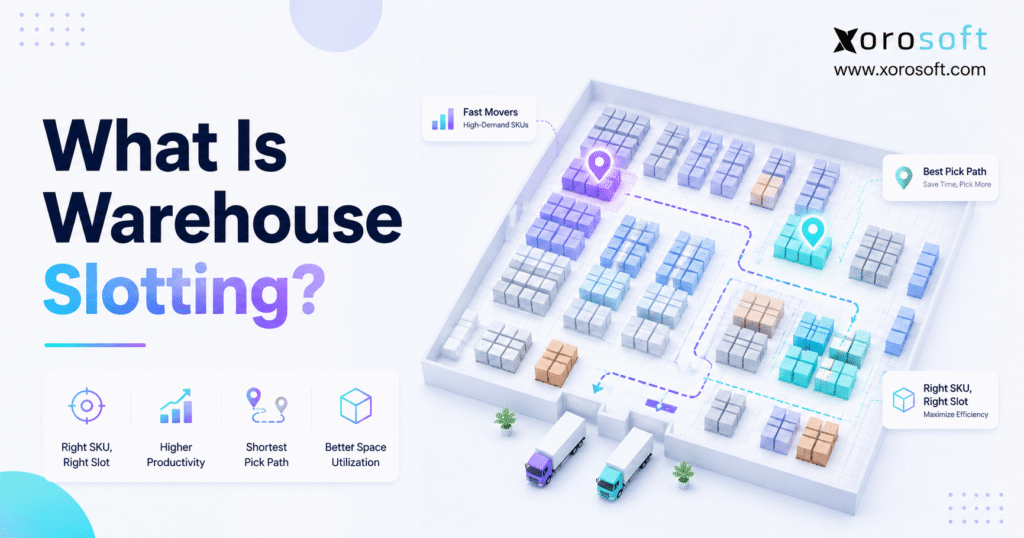
Warehouse slotting is the process of deciding where each SKU should be stored so warehouse teams can pick, replenish, move, and manage inventory more efficiently. Therefore, the real question is not simply, “Where is there an empty bin?” Instead, the better question is, “Which location makes the most operational sense for this product?”
For example, a lightweight SKU that appears in hundreds of orders each week may belong near a primary picking area. In contrast, a bulky product that sells only occasionally may fit better in a less accessible storage zone. As a result, both products use warehouse space according to how they actually move.
Moreover, effective slotting considers more than sales volume. Product dimensions, weight, order frequency, replenishment needs, handling requirements, seasonality, product affinity, and available capacity can all influence the correct location.
Because of this, warehouse slotting is not simply a storage exercise. Instead, it connects warehouse layout with picking productivity, replenishment workload, inventory accuracy, and fulfillment performance.
1.1 What Warehouse Slotting Means
Warehouse slotting means assigning inventory to storage locations according to operational data and physical product requirements.
In practice, a slot may be:
- A warehouse zone
- An aisle
- A rack
- A shelf
- A pallet position
- A bin
- A pick face
Therefore, slotting can happen at several levels. First, a business may determine which warehouse zone is appropriate. Then, it can determine the exact shelf or bin.
1.2 Why Random Product Placement Creates Problems
At first, placing inventory wherever space is available may seem efficient. However, this approach often becomes difficult as SKU counts increase.
For example, fast-moving products may end up far from packing stations. Meanwhile, frequently purchased combinations may sit at opposite ends of the warehouse. Consequently, pickers spend more time walking and less time picking.
Furthermore, poorly sized locations can create unnecessary replenishment. Therefore, warehouse slotting should balance accessibility, capacity, and movement instead of focusing on empty space alone.
2. Why Warehouse Slotting Matters as Order Volume Grows
Warehouse inefficiency often develops gradually. Therefore, businesses may not notice the cost immediately.
For example, an extra 20 seconds of walking on one order seems insignificant. However, when the same delay appears across hundreds or thousands of orders, the total labor impact becomes much larger.
As a result, good warehouse slotting can support:
- Shorter pick paths
- Faster order picking
- Better use of storage space
- Fewer unnecessary replenishments
- Lower aisle congestion
- Improved product accessibility
- More consistent warehouse workflows
- Better labor productivity
Moreover, better placement can make warehouse processes easier to train because inventory follows clearer operational logic.
2.1 Faster Picking
Picking performance depends partly on how far employees must travel. Therefore, high-frequency SKUs should generally receive more convenient locations when safety and capacity allow.
For example, if one SKU appears in 40% of daily orders, storing it close to the main pick path may reduce repeated travel. Consequently, one location change can affect a large number of orders.
2.2 Better Space Utilization
Prime warehouse space is limited. Therefore, it should not be occupied by products that rarely move unless another operational requirement justifies the location.
Similarly, tiny products should not consume oversized pallet positions when smaller storage is available. As a result, slotting can improve both accessibility and cube utilization.
2.3 More Balanced Replenishment
A convenient location can still be inefficient when it is too small. For example, a fast-moving SKU stored in a tiny pick face may require several replenishments per day.
Therefore, businesses should evaluate picking efficiency and replenishment activity together.
3. How the Warehouse Slotting Process Works
Warehouse slotting works best when businesses follow a repeatable process. Therefore, the goal should be to replace intuition with measurable operating data.
A practical process includes seven stages:
1. Collect SKU and order data.
2. Measure product movement.
3. Review dimensions and handling requirements.
4. Identify products that frequently sell together.
5. Map warehouse storage capacity.
6. Assign products to appropriate locations.
7. Measure results and reslot when needed.
3.1 Collect SKU and Order Data
First, collect recent order, inventory, and warehouse data.
Useful fields include:
- SKU
- Units sold
- Number of order lines
- Current inventory
- Product dimensions
- Product weight
- Case dimensions
- Current location
- Replenishment frequency
Moreover, seasonal businesses should compare multiple time periods. Otherwise, one month of data may create misleading conclusions.
3.2 Measure Product Movement
Next, determine how frequently each item actually creates warehouse activity.
For example, one SKU may ship 500 units in five wholesale orders. Meanwhile, another SKU may ship 500 units across 350 ecommerce orders.
Although unit sales are equal, the second SKU creates much more picking activity. Therefore, order-line frequency can be more useful than unit volume alone.
3.3 Match Products With Storage Locations
Finally, compare product requirements with available locations.
For example, a location may be physically close to packing. However, if it cannot safely support the product’s weight, it is not the correct slot.
Therefore, the best location is the one that balances movement, physical fit, accessibility, safety, and replenishment.
4. What Data Should Drive Warehouse Slotting Decisions?
Good warehouse slotting depends on good data. Therefore, businesses should avoid basing decisions on one metric alone.
The most useful inputs usually include:
- SKU velocity
- Order-line frequency
- Unit demand
- Product dimensions
- Product weight
- Case or pallet size
- Storage requirements
- Product affinity
- Replenishment frequency
- Inventory levels
- Seasonal patterns
- Forecast demand
4.1 SKU Velocity
SKU velocity describes how quickly or frequently a product moves.
Therefore, fast-moving items often deserve convenient positions. However, velocity should be considered alongside size, weight, and order profile.
4.2 Product Dimensions and Weight
Dimensions influence where a product physically fits. In addition, weight affects safe handling and shelf selection.
For example, heavy items may require lower positions. Meanwhile, small lightweight products may fit efficiently in dense bin storage.
Therefore, physical characteristics can override a purely demand-based recommendation.
4.3 Product Affinity
Product affinity measures how frequently products appear together in customer orders.
For example, if two accessories are frequently purchased together, placing them closer may reduce travel. However, warehouse teams should also consider congestion before clustering too many popular SKUs into one aisle.
5. The Five Main Types of Warehouse Slotting
Warehouse slotting can follow several different models. Therefore, businesses should choose an approach that reflects their demand stability and warehouse technology.
| Method | How It Works | Best Fit |
|---|---|---|
| Fixed slotting | A SKU has a designated location | Stable inventory profiles |
| Random slotting | Suitable open locations can be used | Flexible storage environments |
| Dynamic slotting | Locations change with demand | Variable or seasonal operations |
| Macro slotting | Determines the best warehouse zone | Overall facility planning |
| Micro slotting | Determines the exact shelf or bin | Detailed SKU optimization |
5.1 Fixed Slotting
With fixed slotting, each SKU has an assigned location.
Therefore, workers can learn where products normally belong. In addition, training may be simpler.
However, fixed locations can waste space when inventory levels vary significantly. Consequently, the business may reserve capacity that is not always needed.
5.2 Random Slotting
Random slotting allows products to use suitable available locations.
As a result, warehouses can use capacity more flexibly. However, accurate system records become essential because employees cannot rely on memory.
5.3 Dynamic Slotting
Dynamic slotting adjusts SKU locations as demand changes.
For example, seasonal products may move closer to picking areas before a peak period. Afterwards, they may return to lower-priority storage.
Therefore, dynamic slotting can work well in ecommerce, retail, and highly seasonal environments.
6. Macro Slotting vs. Micro Slotting
Macro and micro slotting solve different problems. Therefore, both may be required.
6.1 Macro Slotting
Macro slotting determines the broader area where inventory should be stored.
Examples include:
- Fast-pick zones
- Pallet reserve storage
- Secure storage
- Oversized-product areas
- Temperature-controlled areas
Therefore, macro slotting focuses on warehouse flow.
6.2 Micro Slotting
Micro slotting determines the exact location inside that broader area.
For example, after assigning an SKU to a fast-pick zone, the business still needs to decide which rack, shelf, or bin works best.
Consequently, micro slotting focuses on precise placement.
6.3 How Both Approaches Work Together
First, macro slotting places inventory in the right part of the building. Then, micro slotting selects the best individual storage position.
As a result, businesses can improve both warehouse flow and detailed picking efficiency.
7. How ABC Analysis Supports Warehouse Slotting
ABC analysis can provide a useful starting point for warehouse slotting. However, it should not become the only rule.
A simple model separates inventory into three groups:
| Class | General Activity Level | Typical Placement |
| A | High | Highly accessible areas |
| B | Medium | Secondary picking areas |
| C | Low | Less valuable storage areas |
7.1 A Items
A-items usually create high warehouse activity. Therefore, they often benefit from convenient access.
However, a large or hazardous A-item may require specialized storage instead.
7.2 B Items
B-items create moderate activity. Therefore, they generally occupy secondary but still practical warehouse locations.
7.3 C Items
C-items move less frequently. Consequently, they may be stored farther from primary picking areas.
However, businesses should still consider product size, handling restrictions, and customer requirements before assigning locations.
8. Why SKU Velocity Alone Is Not Enough
SKU velocity is useful, but it can hide important differences.
For example, imagine two products each sell 1,000 units per month.
Product A sells through 20 large wholesale orders. Meanwhile, Product B appears in 700 individual ecommerce orders.
Although both products sell the same number of units, Product B creates substantially more picking interactions.
Therefore, businesses should evaluate:
- Units sold
- Orders containing the SKU
- Order lines
- Average quantity per order
- Replenishment frequency
- Seasonal movement
As a result, slotting decisions become more closely aligned with actual warehouse work.
9. How Product Affinity Can Shorten Pick Paths
Products do not move independently. Therefore, order combinations can reveal useful placement opportunities.
For example, customers may frequently purchase:
- Shoes with replacement insoles
- Bottles with filters
- Electronics with cables
- Furniture with accessories
- Sporting equipment with protective gear
If those items regularly appear together, placing them nearby may reduce picker movement.
However, businesses should avoid over-clustering popular inventory. Otherwise, several employees may converge on the same aisle.
Therefore, product affinity should be balanced with congestion, location capacity, and picking method.
10. How Slotting Improves Picking Efficiency
Picking is one of the warehouse activities most directly affected by inventory placement.
Therefore, slotting should support the picking method already used by the business.
For example, a warehouse may use:
- Discrete picking
- Batch picking
- Zone picking
- Wave picking
- Cart-based picking
- Mobile scanning workflows
Each method creates different movement patterns.
10.1 Reduce Unnecessary Travel
First, identify SKUs that create the most repeated travel.
Then, move suitable high-frequency products closer to efficient pick paths.
As a result, employees can spend a larger portion of their shift completing picks instead of walking.
10.2 Improve Pick Density
Pick density refers to how much productive picking activity occurs within a given area.
Therefore, placing frequently picked products intelligently can increase productive activity along each route.
However, excessive density can create congestion. Consequently, optimization should balance travel reduction with traffic flow.
11. Why Replenishment Must Be Part of the Slotting Strategy
A fast pick is not automatically an efficient pick if the location constantly runs empty.
For example, a SKU may be placed in a highly convenient bin. However, if the bin holds only one hour of demand, replenishment teams may refill it repeatedly.
Therefore, businesses should consider pick-face capacity.
A practical decision should balance:
Picking convenience + inventory capacity + replenishment effort
Moreover, reserve inventory should be positioned so replenishment remains efficient.
For businesses managing more complex warehouse workflows, XoroWMS provides a connected environment for warehouse inventory, receiving, picking, replenishment, and fulfillment processes.
12. How Warehouse Slotting Improves Space Utilization
Warehouse capacity is valuable. Therefore, every slot should be matched with inventory that uses the space appropriately.
For example, storing a small product in a large pallet position creates wasted cube. Conversely, forcing a large carton into an undersized shelf creates handling problems.
As a result, slotting should consider:
- Location dimensions
- Product dimensions
- Maximum weight
- Vertical clearance
- Stackability
- Storage equipment
- Handling requirements
Moreover, businesses should protect prime picking areas from slow-moving inventory unless a specific operational requirement justifies the placement.
13. Warehouse Slotting vs. Putaway
Warehouse slotting and putaway are related, but they are not the same process.
| Warehouse Slotting | Putaway |
| Decides where inventory should ideally be stored | Moves received inventory into storage |
| Analytical | Operational |
| Uses demand and SKU characteristics | Executes location movement |
| Can trigger location changes | Completes physical placement |
For example, slotting analysis may determine that SKU A belongs in location 01-A-03.
Then, putaway is the process that physically moves received inventory into that location.
Therefore, slotting creates the placement logic, while putaway executes it.
14. Warehouse Slotting Examples by Industry
Different industries need different slotting strategies. Therefore, copying one universal model rarely works.
14.1 Apparel and Fashion
Apparel businesses often manage many sizes, colors, and styles.
Therefore, fast-moving core products may need highly accessible locations. Meanwhile, slower variants can remain nearby without occupying premium positions.
In addition, clear variant separation helps reduce picking errors.
14.2 Furniture
Furniture products vary substantially in size and weight.
Consequently, handling equipment, loading access, and floor capacity may matter more than pure velocity.
14.3 Sporting Goods
Sporting goods demand can change seasonally.
For example, winter products may become fast movers during one period. Afterwards, summer products may deserve those prime locations.
Therefore, periodic reslotting becomes important.
14.4 Food and Beverage
Food businesses may need to consider expiration dates, lot tracking, temperature requirements, and rotation practices.
Consequently, operational restrictions may override a basic fast-mover strategy.
14.5 Manufacturing
Manufacturers may organize inventory around production requirements.
Therefore, components used frequently in work orders may need locations close to staging or production areas rather than traditional ecommerce pick zones.
Businesses across these inventory-driven sectors can explore Xorosoft’s broader industry solutions to see how ERP and warehouse workflows differ by operating model.
15. Warehouse Slotting for Ecommerce Operations
Ecommerce demand often changes quickly. Therefore, ecommerce warehouses may need more frequent slotting reviews than stable B2B environments.
For example, a promotion can turn a moderate SKU into a fast mover almost overnight.
Meanwhile, the same business may sell through:
- Shopify
- Amazon
- Wholesale channels
- Retail locations
- Marketplaces
As a result, warehouse demand should reflect combined channel activity rather than one sales channel alone.
15.1 Shopify and Multi-Channel Demand
Shopify merchants often need warehouse decisions to reflect live ecommerce demand.
Therefore, when ecommerce inventory is connected to broader warehouse operations, businesses can make more informed location and replenishment decisions.
Xorosoft is also available through the Shopify App Store, which provides an outbound reference for merchants evaluating connected Shopify ERP operations.
15.2 Returns Should Also Influence Slotting
Returns can create additional warehouse movement.
Therefore, high-return products may require workflows that make inspection, restocking, and inventory status updates easier.
Consequently, slotting should consider reverse logistics where returns represent a meaningful part of warehouse activity.
16. Multi-Warehouse Slotting Requires Local Demand Data
A product does not necessarily behave the same way in every warehouse.
For example, a SKU may be a fast mover in California but a slow mover in New York.
Therefore, businesses should avoid automatically copying one warehouse’s slotting plan across the entire network.
Instead, evaluate:
- Regional demand
- Location-specific order frequency
- Available warehouse space
- Inventory transfers
- Local channel mix
- Replenishment activity
As a result, each warehouse can reflect the demand it actually serves.
Moreover, connected multi-location inventory data becomes increasingly important as the network expands. Xorosoft’s XoroONE brings inventory, warehouse, purchasing, accounting, and operational workflows into a unified cloud ERP environment.
17. Warehouse Slotting KPIs You Should Monitor
A slotting project should be measured after implementation. Otherwise, teams may assume a layout is better without proving it.
Useful KPIs include:
17.1 Picks per Hour
This metric helps measure picking productivity.
Therefore, compare performance before and after major location changes.
17.2 Travel Time per Order
Travel time can reveal inefficient product placement.
Consequently, a reduction may indicate that high-frequency inventory is becoming easier to access.
17.3 Replenishments per Day
Frequent replenishment may indicate undersized pick faces.
Therefore, this metric should be evaluated alongside picking speed.
17.4 Picking Accuracy
Location changes should never improve speed at the expense of accuracy.
Accordingly, monitor mispicks and location errors after reslotting.
17.5 Storage Utilization
Storage utilization shows whether warehouse capacity is being used effectively.
However, maximizing utilization should not create unsafe or inaccessible locations.
18. Common Warehouse Slotting Mistakes
Warehouse slotting often fails because businesses simplify the problem too much.
18.1 Using Sales Volume Alone
Sales volume does not show how often warehouse employees interact with a SKU.
Therefore, order-line frequency should also be considered.
18.2 Ignoring Product Dimensions
A fast mover may not physically fit a prime location.
Consequently, size and weight should always be part of the analysis.
18.3 Ignoring Replenishment
Convenient pick faces can still create excessive labor when they are too small.
Therefore, replenishment frequency should be measured.
18.4 Never Reslotting
Demand changes over time.
As a result, a layout that worked last year may no longer support current order patterns.
18.5 Treating Every Warehouse the Same
Regional demand can differ substantially.
Therefore, multi-warehouse businesses should evaluate each facility separately.
18.6 Relying on Outdated Spreadsheets
Manual spreadsheets can become stale quickly.
Consequently, businesses may make placement decisions using information that no longer reflects actual inventory or demand.
19. How Often Should You Reslot a Warehouse?
There is no universal reslotting schedule.
Instead, the correct frequency depends on how quickly the business changes.
For example, a stable wholesale distributor may need fewer reviews. In contrast, a seasonal ecommerce brand may require more frequent adjustments.
Common reslotting triggers include:
- Seasonal demand changes
- New product launches
- Major promotions
- SKU growth
- Warehouse expansion
- Changing order profiles
- Excess picker travel
- Frequent replenishment
- Capacity pressure
Therefore, reslotting should be event-driven as well as calendar-driven.
20. Manual Warehouse Slotting vs. Software-Assisted Slotting
Smaller warehouses can start with spreadsheets.
For example, a simple sheet might contain:
SKU | Orders | Units | Dimensions | Weight | Current Location | Velocity Class | Proposed Location
Therefore, spreadsheets can work when inventory and warehouse complexity remain manageable.
However, manual methods become harder when the business adds:
- More SKUs
- More warehouses
- More channels
- Higher order volume
- More replenishment activity
- More frequent promotions
As a result, warehouse management software becomes more valuable.
Xorosoft’s broader solutions platform connects inventory-driven workflows across warehouse, purchasing, fulfillment, accounting, and operations.
21. What Warehouse Slotting Software Actually Does
Warehouse slotting software helps analyze product, warehouse, and demand data so operators can make better placement decisions.
Depending on the system, it may evaluate:
- SKU velocity
- Pick frequency
- Dimensions
- Weight
- Inventory levels
- Seasonality
- Product affinity
- Location capacity
- Replenishment activity
- Forecast demand
Therefore, software can reduce the amount of manual analysis required.
However, software should support operational judgment rather than replace it entirely.
For example, workers may understand physical constraints that do not appear clearly in system data.
22. When ERP and WMS Data Should Work Together
Warehouse slotting becomes more useful when warehouse data connects with the rest of the operation.
For example:
Sales orders show demand.
Meanwhile, purchasing shows inbound inventory.
Forecasting shows expected future requirements.
In addition, warehouse data shows locations, movements, and capacity.
Therefore, connected systems can provide a stronger basis for planning.
Xorosoft’s XoroERP is designed for inventory-driven businesses that need ERP functions such as inventory, purchasing, accounting, and operational management alongside warehouse workflows.
Moreover, businesses using multiple ecommerce or operational applications can review available Xorosoft integrations when evaluating how data should flow between systems.
23. When a Business Has Outgrown Basic Warehouse Tools
Not every operation requires advanced warehouse software.
For example, a small warehouse with a limited SKU catalog and predictable demand may perform well with simple processes.
However, the need for a stronger system increases when several problems appear together:
- Multiple warehouses
- Thousands of SKUs
- Inventory discrepancies
- Frequent stock transfers
- High order volumes
- Shopify and Amazon sales
- Wholesale orders
- EDI requirements
- Complex purchasing
- Forecasting challenges
Therefore, the decision should be based on operational complexity rather than revenue alone.
Businesses evaluating this transition can also review real operational examples through Xorosoft’s case studies instead of relying only on software feature lists.
24. A Practical Warehouse Slotting Checklist
Before moving inventory, answer these questions:
- Which SKUs create the most pick activity?
- Which SKUs appear together frequently?
- Are fast movers easy to reach?
- Are heavy items stored safely?
- Do product dimensions match their locations?
- Which pick faces require frequent replenishment?
- Are slow movers occupying prime space?
- Has seasonal demand changed?
- Does demand differ by warehouse?
- Are pickers walking unnecessarily?
- Is location-level inventory accurate?
- Are warehouse decisions based on current data?
If several answers reveal problems, then the warehouse probably has a slotting opportunity.
Moreover, worker safety should remain part of every location decision. For example, businesses can reference OSHA ergonomics guidance when reviewing lifting, handling, and workplace design considerations.
25. Frequently Asked Questions About Warehouse Slotting
25.1 What is warehouse slotting?
Warehouse slotting is the process of determining where inventory should be stored inside a warehouse. Therefore, each SKU is assigned a location based on factors such as demand, dimensions, weight, order frequency, product affinity, replenishment needs, and available capacity. As a result, the warehouse can reduce unnecessary movement while improving picking and storage efficiency.
25.2 Why is warehouse slotting important?
Warehouse slotting matters because product placement affects travel time, picking speed, replenishment effort, and storage utilization. Therefore, poor placement creates repeated inefficiencies across many orders. In contrast, better placement can shorten pick paths and make warehouse workflows more predictable.
25.3 How does warehouse slotting work?
First, the warehouse collects SKU and order data. Next, it evaluates velocity, dimensions, handling requirements, and order patterns. Then, inventory is matched with suitable storage locations. Finally, the business measures results and adjusts locations as demand changes.
25.4 What is SKU slotting?
SKU slotting is another term for placing individual SKUs in appropriate warehouse locations. Therefore, the concept is closely related to warehouse slotting and inventory slotting. However, SKU slotting places stronger emphasis on the characteristics and movement of each specific product.
25.5 What are the main warehouse slotting methods?
The main approaches include fixed, random, and dynamic slotting. In addition, businesses often use macro slotting to choose the correct warehouse zone and micro slotting to select the exact shelf or bin. Therefore, several methods may operate together.
25.6 What is fixed slotting?
Fixed slotting gives each SKU a designated storage location. Therefore, workers know where products normally belong. However, the approach can waste capacity when stock levels vary significantly because space remains reserved for specific products.
25.7 What is random slotting?
Random slotting uses available suitable storage locations instead of assigning one permanent location. As a result, space may be used more efficiently. However, accurate inventory-location tracking becomes critical because workers cannot rely on memory.
25.8 What is dynamic slotting?
Dynamic slotting changes product locations as demand or operating conditions change. For example, a seasonal SKU may move into a prime location before peak demand. Afterwards, the product can return to a secondary area.
25.9 What is macro slotting?
Macro slotting determines the broad warehouse area where a product belongs. For example, a business may place an SKU in a fast-pick zone, pallet reserve area, or oversized-product section. Therefore, macro slotting focuses on facility-level flow.
25.10 What is micro slotting?
Micro slotting determines the exact shelf, rack position, or bin within a warehouse zone. Therefore, it provides a more detailed layer of optimization after the broader zone has already been selected.
25.11 What is the difference between macro and micro slotting?
Macro slotting determines the correct warehouse zone, while micro slotting determines the exact storage position. Therefore, macro decisions shape overall warehouse flow, whereas micro decisions improve detailed SKU accessibility.
25.12 What is ABC analysis in warehouse slotting?
ABC analysis groups inventory according to relative activity or importance. Therefore, high-activity A-items often receive more convenient locations. However, businesses should also consider dimensions, weight, handling requirements, and replenishment before finalizing a slot.
25.13 What is SKU velocity?
SKU velocity describes how quickly or frequently a product moves through the operation. However, unit volume alone can be misleading. Therefore, businesses should also examine order-line frequency and average quantity per order.
25.14 Where should fast-moving products be stored?
Fast movers should generally be placed in accessible locations that reduce unnecessary travel. However, the location must also support the product’s weight, dimensions, replenishment needs, and handling requirements. Therefore, the closest location is not always the best location.
25.15 What is product affinity?
Product affinity measures how frequently products are ordered together. Therefore, storing related items near one another can sometimes reduce pick travel. However, businesses should avoid creating congestion by putting too many popular items in one small area.
25.16 How does slotting improve picking speed?
Slotting improves picking speed by placing frequently picked products along more efficient routes. As a result, workers can reduce unnecessary travel and spend more time completing picks. However, picking method and warehouse layout also influence performance.
25.17 Can warehouse slotting improve space utilization?
Yes. For example, small items can be moved from oversized locations into appropriately sized bins. Meanwhile, larger products can use storage designed for their dimensions. Therefore, slotting can improve cube utilization without simply packing products more tightly.
25.18 What is the difference between slotting and putaway?
Slotting determines where inventory should ideally be stored. Putaway, however, is the physical process of moving received inventory into an approved location. Therefore, slotting provides the decision logic, while putaway executes the movement.
25.19 How often should a warehouse be reslotted?
There is no universal schedule. Instead, businesses should reslot when meaningful changes occur in demand, seasonality, product assortment, order patterns, or warehouse capacity. Therefore, a fast-changing ecommerce operation may review slotting more frequently than a stable distributor.
25.20 What data is required for warehouse slotting?
Useful data includes SKU velocity, order frequency, unit demand, dimensions, weight, inventory levels, product affinity, replenishment frequency, available capacity, and seasonal trends. Moreover, forecast demand can help prepare for upcoming changes.
25.21 What are common warehouse slotting mistakes?
Common mistakes include relying only on sales volume, ignoring product dimensions, overlooking replenishment effort, failing to review seasonal demand, and never reslotting. In addition, businesses often make the mistake of copying one facility’s layout across multiple warehouses.
25.22 Can spreadsheets be used for warehouse slotting?
Yes. Therefore, spreadsheets can be useful for smaller warehouses with limited SKUs and stable demand. However, manual analysis becomes difficult as the number of products, orders, warehouses, and channels increases.
25.23 What is warehouse slotting software?
Warehouse slotting software analyzes inventory, demand, product, and location data to help determine better storage positions. Therefore, it can reduce manual analysis. Depending on the system, it may also consider seasonality, pick frequency, capacity, and replenishment activity.
25.24 Can a WMS help with warehouse slotting?
Yes. A WMS can provide accurate location-level inventory, picking data, replenishment activity, barcode workflows, and warehouse movement history. Therefore, these records provide useful information for better slotting decisions.
25.25 When should a business upgrade to a WMS?
A business should consider a WMS when warehouse complexity becomes difficult to manage with basic tools. For example, multiple warehouses, high SKU counts, frequent replenishment, inventory discrepancies, barcode requirements, and growing ecommerce volume can all signal the need for stronger warehouse control.
26. Turn Better Slotting Into Better Warehouse Operations
Warehouse slotting works best when it is treated as an ongoing operational discipline rather than a one-time warehouse cleanup.
First, start with accurate SKU and order data. Then, evaluate velocity, dimensions, weight, product affinity, replenishment activity, and storage capacity. Moreover, measure picking and replenishment performance after every major change.
However, location optimization becomes harder as businesses add warehouses, sales channels, purchasing complexity, and inventory volume. Therefore, the underlying system eventually matters as much as the slotting methodology.
For inventory-driven businesses facing broader warehouse, purchasing, ecommerce, accounting, and multi-location complexity, Xorosoft provides a cloud ERP and WMS environment designed to connect those workflows.
Ultimately, better warehouse slotting should create a warehouse in which inventory is easier to find, easier to replenish, and easier to move.
If your warehouse challenges now extend beyond individual SKU locations, you can Book a Demo to review how Xorosoft can support your inventory and warehouse operations.
Recent Posts
-
 Why 3PL Fulfillment Statuses Fail to Match Customer Promises
 -
 ERP Selection Case Study: How an Ecommerce Brand Rejected the Wrong ERP
 -
 Inventory Tracking Management: How to Correct Negative Stock, Duplicate Receipts, and Orphaned Reservations
 -
 Shopify Inventory Integration Benchmarks 2026: Latency, Errors and Reconciliation
 -
 ERP for Furniture Distributors Managing Bulky Inventory and Delivery Scheduling