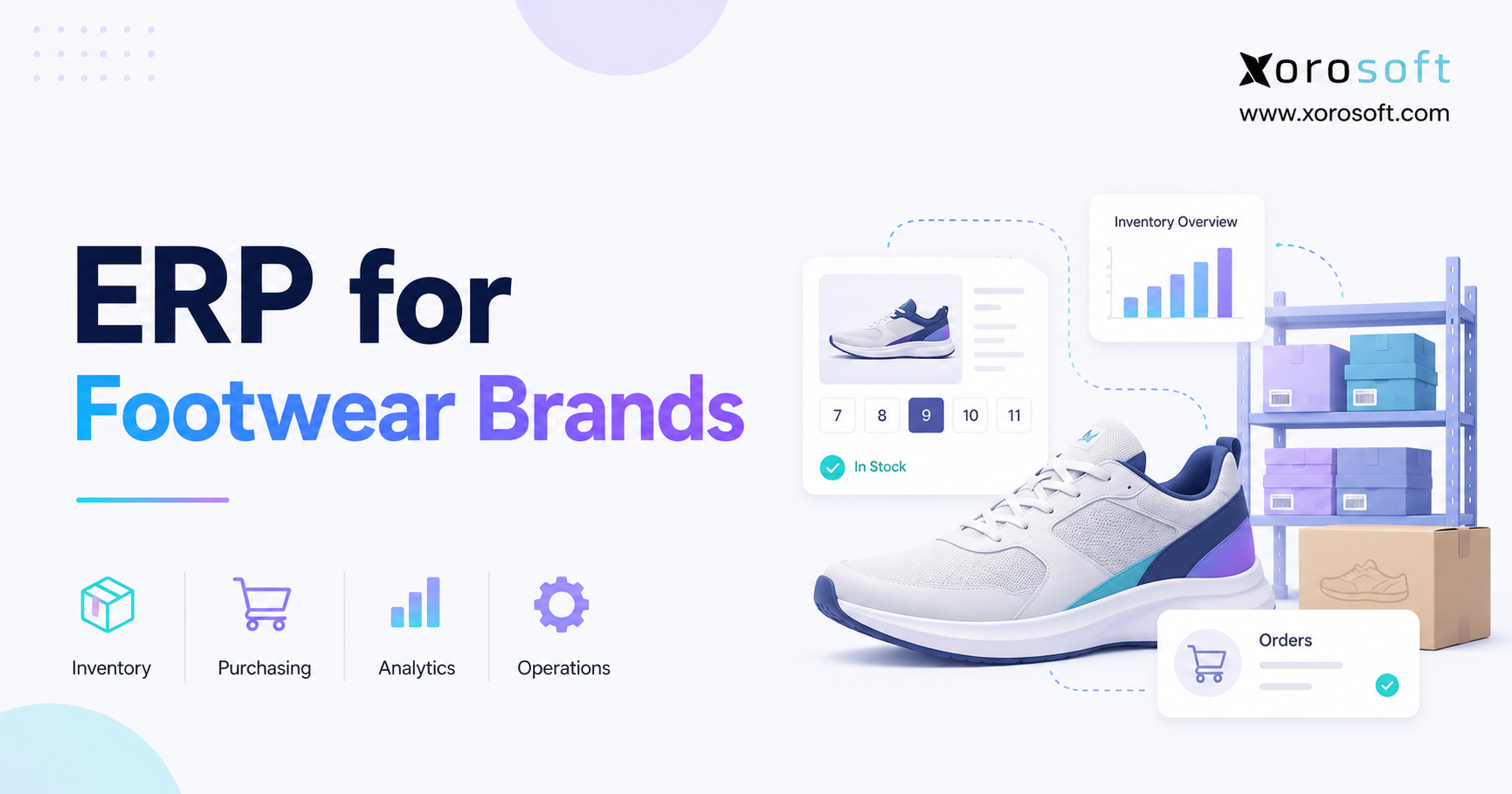
If you are looking to optimise your business operations, it is important to understand the benefits of ERP for footwear brands.
1. Why Growth Exposes Hidden Footwear Inventory Problems
Footwear brands often feel operational pressure before they expect it. Sales keep growing, new styles launch, Shopify volume rises, and wholesale accounts expand. At the same time, teams spend more hours checking spreadsheets, correcting stock figures, comparing systems, and explaining why an item that looked available cannot actually ship.
The product structure creates much of this pressure.
One shoe may come in several colors, twelve or more sizes, half sizes, and multiple widths. As a result, a single product idea can create more than one hundred inventory combinations. Seasonal collections, multiple warehouses, Amazon, wholesale orders, and open supplier purchase orders add another layer of complexity.
Therefore, a growing footwear company cannot manage inventory by looking only at total stock.
A style may show 500 units on hand while its highest-demand sizes have almost sold out. Meanwhile, slower sizes may sit untouched in the warehouse. The company can have too little of what customers want and too much of what they do not want at the same time.
That problem affects more than inventory. Marketing may promote a style with a broken size run. Buyers may reorder too late. Wholesale teams may promise stock that another channel already expects to sell. Finance may struggle to explain why system inventory does not match warehouse reports.
ERP for footwear brands becomes relevant when these issues stop being occasional exceptions and start becoming part of normal work.
1.1 Size Runs Change the Meaning of “In Stock”
A footwear business does not simply need units on hand. It needs the right size, color, width, and location available for expected demand.
For example, a running shoe with 400 units remaining may look healthy. However, if sizes 9, 9.5, and 10 drive most sales and each size has fewer than ten units left, the business already has an availability problem.
Meanwhile, slower sizes may account for most of the remaining stock.
Therefore, teams need to ask a more useful question than “How much inventory do we have?”
They need to ask whether they have the right inventory mix.
That question should guide purchasing, transfers, marketing, wholesale allocation, and replenishment.
1.2 Fragmented Systems Turn Small Errors Into Bigger Problems
Most brands do not start with ERP, and they should not.
A young company may run comfortably on Shopify, accounting software, an inventory tool, and a few spreadsheets. However, each new requirement often creates another system or workaround.
Purchasing gets a spreadsheet. Wholesale uses a separate process. Warehouse operations use another application. EDI runs through an outside provider. Forecasting happens in Excel.
Individually, those tools may work well. Collectively, however, they create more points where data can disagree.
Consequently, employees spend more time checking information instead of using it. That is often the first sign that a footwear business needs a more connected operating model.
2. What ERP for Footwear Brands Changes Behind the Storefront
ERP for footwear brands gives inventory, purchasing, warehouse, finance, ecommerce, wholesale, and planning teams a more connected operating environment.
The goal is not to put every task on one screen. Instead, ERP reduces the need for several systems to maintain the same business transaction separately.
Consider a supplier shipment.
Purchasing creates the purchase order. Later, the warehouse receives the goods. Inventory increases. Finance records the supplier obligation. Finally, the new stock becomes available for sales and planning.
Without a connected system, employees may update each step separately.
With ERP, one transaction can support several teams.
As a result, buyers see incoming supply, warehouse teams know what they should receive, and finance can follow the cost of inventory without waiting for someone to rebuild the transaction later.
2.1 One Transaction Should Support Several Teams
Inventory activity affects almost every part of an inventory-driven business.
A purchase changes expected stock and future cash needs. Once goods arrive, the receipt updates available units and inventory value. Each sale reduces stock while creating revenue. Returns can then affect inventory, customer balances, and financial reporting.
Therefore, disconnected systems create more than an IT problem.
They create an operating problem.
A useful footwear ERP setup gives each team access to the same underlying transaction while still controlling what each user can do.
Consequently, employees spend less time copying information from one place to another. They also gain a clearer view of what has already happened and what still needs attention.
2.2 Shoe ERP Software Should Match the Operating Model
Not every footwear company runs the same way.
A Shopify-first DTC brand may care most about inventory planning, ecommerce integration, fulfillment, and accounting. By contrast, a wholesale-heavy company may need EDI, customer pricing, allocations, and future orders.
Similarly, an outsourced brand has different production needs from a company that manufactures footwear internally.
For that reason, companies should choose ERP around the way they buy, store, sell, ship, and account for inventory.
A long feature list cannot replace that fit.
3. Why Size, Color, and Width Need SKU-Level Control
Footwear products create a large number of stock combinations.
Suppose a brand offers one style in four colors, twelve sizes, and two widths. That single style creates 96 possible variants. Ten similar styles create 960 variants before the company adds warehouses, seasonal ranges, or regional assortments.
Consequently, style-level reporting alone does not provide enough detail for many buying decisions.
ERP for footwear brands needs to retain the relationship between the parent style and each individual SKU while allowing teams to work at the detailed variant level.
3.1 Footwear Inventory Software Should Reveal Broken Size Runs
Consider the following stock view:
| Style | Color | Size | Width | SKU | Available |
|---|---|---|---|---|---|
| Runner X | Black | 8 | Regular | RX-BLK-8-R | 41 |
| Runner X | Black | 8.5 | Regular | RX-BLK-85-R | 32 |
| Runner X | Black | 9 | Regular | RX-BLK-9-R | 8 |
| Runner X | Black | 9.5 | Wide | RX-BLK-95-W | 5 |
| Runner X | White | 10 | Regular | RX-WHT-10-R | 28 |
The style may still have plenty of total inventory. However, the table reveals pressure in sizes 9 and 9.5.
If those sizes account for a large share of sales, the company may already have a broken size run.
Therefore, the buying team needs variant-level information before the style appears “low stock” at a total level.
The same information also helps marketing teams decide whether to keep promoting a style, reduce spend, or shift attention toward products with healthier availability.
3.2 Returns and Exchanges Can Distort Availability
Footwear brands also deal with frequent size exchanges.
A returned pair may be ready for resale, damaged, waiting for inspection, or temporarily unavailable. The warehouse must record that status accurately.
Otherwise, the system may offer inventory that the business cannot actually ship.
Over time, small errors reduce trust in the official stock figures. Employees then create side spreadsheets to check the system.
At that point, the business effectively has two inventory records: the official one and the one people trust.
A strong operating process prevents that split and returns sellable inventory to availability quickly.
3.3 Consistent Product Data Makes Planning Easier
SKU discipline matters just as much as software.
Teams should use consistent rules for styles, colors, sizes, widths, barcodes, and descriptions. For example, one team should not call a color “Black” while another uses “BLK” unless the system deliberately maps those values.
Clean product data also helps purchasing, warehouse scanning, reporting, and ecommerce integrations.
Therefore, product-master design should form part of the ERP project rather than remain an afterthought.
4. How Connected Forecasting Improves Footwear Purchasing
Footwear companies often commit to inventory long before customers buy it.
Supplier lead times can stretch for weeks or months. Overseas production, freight schedules, customs, minimum order quantities, and seasonal launches add further constraints.
Therefore, buyers cannot wait until stock reaches a low number before deciding what to reorder.
They need a forward-looking view of both demand and supply.
ERP for footwear brands can support that process when forecasting and purchasing use the same inventory data.
4.1 Forecast at the Level Where Buyers Make Decisions
A forecast may predict that a style will sell 1,000 units next quarter.
However, that number does not tell the buyer how many units of each size to order.
If size 9 sells much faster than size 13, the next purchase order should reflect that pattern.
Therefore, useful planning may need to consider style, color, size, width, location, or some combination of those dimensions.
In addition, buyers should consider current stock, open sales orders, incoming purchase orders, supplier lead time, seasonal patterns, and safety stock.
The goal is not perfect prediction. Instead, the goal is to reduce avoidable surprises.
4.2 Incoming Supply Can Completely Change a Reorder Decision
Available inventory tells only part of the story.
Suppose size 9 has 25 units left and sells ten units per week. At first, the buyer may want to place an urgent order.
However, another 300 units may arrive next week.
Once the buyer sees that incoming supply, the decision changes.
Therefore, ERP for footwear brands should bring open purchase orders into the same planning view as current inventory and expected demand.
For companies that want purchasing, inventory, accounting, and related operations in one environment, XoroERP is one platform they can evaluate.
The key principle remains the same regardless of vendor: buying decisions should use current demand and supply data.
4.3 Better Planning Balances Stockouts Against Overstock
Ordering more inventory does not always make the business safer.
Too little stock creates lost sales. On the other hand, too much stock ties up cash, fills warehouse space, and may eventually require markdowns.
Footwear buyers need to manage both risks at the same time.
Consequently, strong planning should show which products need attention without encouraging blanket overbuying.
That balance becomes especially important when seasonal styles have short selling windows. Once a season passes, even technically sellable inventory can become harder to move at full margin.
5. Multi-Warehouse ERP for Footwear Brands Needs Reliable Location Data
A second warehouse changes the inventory question.
The business no longer needs to know only how much stock exists. It also needs to know where that stock sits, what has already been committed, what can move between locations, and which warehouse should fulfill each order.
For example, the company may own enough size 10 units overall while the warehouse serving the highest-demand region approaches a stockout.
Therefore, location-level inventory becomes essential.
5.1 Accurate Receiving Protects Every Downstream Decision
Inventory accuracy starts when goods enter the warehouse.
The receiving team should compare the shipment against the purchase order, record shortages or overages, and place stock in the correct location.
Next, the same discipline must continue through transfers, picking, packing, cycle counting, adjustments, and returns.
If warehouse teams move stock without recording those moves quickly, system inventory falls behind physical inventory.
As a result, purchasing and sales teams start making decisions with old information.
For companies that need deeper warehouse control, XoroWMS can support warehouse execution as part of a broader Xorosoft environment.
5.2 Transfers Can Solve Problems Before Purchasing Does
A shortage in one warehouse does not always require another supplier order.
Sometimes another location already has the stock.
For example, the East Coast warehouse may have eight units of size 9 while the West Coast warehouse holds 70.
Before placing a new purchase order, the company may choose to transfer stock.
Therefore, a footwear ERP should help teams compare demand and inventory across locations before buying more product.
This can improve availability while protecting working capital.
5.3 Fulfillment Rules Should Match the Business Strategy
Multiple warehouses also raise fulfillment questions.
Should the closest warehouse ship the order? In some cases, the location with the deepest size run may make more sense. A company may also choose to protect inventory in a high-demand region rather than fulfill every order from the nearest location.
No single rule works for every business.
However, the operating system should support the rules the company chooses.
That makes inventory movement deliberate rather than reactive. In addition, clear rules help customer-service and warehouse teams understand why the system assigns an order to a particular location.
6. Shopify ERP for Footwear Brands Should Connect Commerce With Operations
Shopify often remains the customer-facing commerce platform after a footwear company implements ERP.
That arrangement makes sense.
Shopify focuses on ecommerce. Meanwhile, the ERP manages the operational work behind the order.
Therefore, the two systems should complement each other rather than compete for the same role.
6.1 ERP for Footwear Brands Needs Clear Shopify Data Ownership
Every integration needs clear ownership rules.
The business should know which system owns product data, inventory, orders, fulfillment, customers, and financial transactions.
Without those rules, teams may update the same information in several places.
For example, a Shopify order may need to reserve stock, create warehouse work, update demand, and produce financial entries.
ERP for footwear brands should connect those steps without forcing employees to re-enter the order.
Clear ownership also makes troubleshooting easier. If inventory differs between Shopify and the ERP, the team should know which system holds the source value and which integration event should update the other system.
6.2 Shared Stock Becomes Harder as Channels Multiply
A Shopify-only brand has a fairly simple inventory question: how much stock can Shopify sell?
Once the company adds Amazon, wholesale, retail, or B2B, the question becomes more complex.
A pair sitting physically in the warehouse may already belong to a wholesale order scheduled for next month.
If Shopify still treats that pair as freely available, the company can oversell.
Therefore, channel availability must reflect commitments as well as physical stock.
Brands reviewing Xorosoft for ecommerce operations can also examine the Xorosoft ERP listing on the Shopify App Store when evaluating how Shopify fits into the wider system.
6.3 Integration Should Remove Routine Work
A good integration reduces manual steps.
Employees should not need to copy orders, change stock by hand, move shipment details between systems, and then reconcile everything in accounting.
Of course, unusual transactions still require review.
However, routine orders should move through the operating flow with as little repeated work as possible.
That is the practical value of integration. It reduces administrative work while helping teams preserve a more reliable view of inventory and orders.
7. Footwear Wholesale ERP and EDI Change Available-to-Sell Logic
Wholesale creates different inventory rules because brands often commit stock well before shipment.
A retailer may place a large order today for delivery several months later. Meanwhile, the same inventory may still appear available to ecommerce channels.
Therefore, the company must distinguish physical stock from available and committed stock.
7.1 Wholesale Commitments Need Clear Allocation
Suppose a brand owns 2,500 units of a new style.
Wholesale customers have already committed to 1,400 units.
The company cannot safely treat all 2,500 units as available for Shopify and Amazon.
Instead, it needs allocation rules.
ERP for footwear brands should make those commitments visible to sales, purchasing, and warehouse teams.
As a result, each team can make decisions from the same view of availability.
The same visibility also helps purchasing understand whether a large wholesale commitment creates an additional reorder need.
7.2 EDI Works Best as Part of the Order Flow
EDI does more than exchange documents.
A retailer purchase order must become a real sales order. Inventory needs allocation. The warehouse needs shipping instructions. Shipment data may need to go back to the retailer. Finally, finance needs the correct invoice.
If EDI sits outside the operating system, employees may still reconcile every step manually.
Therefore, the strongest setup connects EDI directly to the order-to-cash process.
That approach reduces duplicate entry and gives teams a clearer view of retailer commitments.
7.3 DTC and Wholesale Need Shared Planning
Wholesale and DTC teams can compete for the same inventory.
For example, DTC may provide a higher margin, while wholesale may provide larger planned orders and stronger account relationships.
ERP cannot make that commercial decision for the company.
However, it can show managers the inventory, margin, timing, and commitments behind the choice.
That visibility makes channel decisions more deliberate and helps teams avoid promising the same stock twice.
8. Footwear Manufacturing ERP Should Match the Production Model
Footwear companies do not all produce goods in the same way.
Some brands design products and outsource all manufacturing. Others control part of production. A smaller group may run production directly.
Consequently, manufacturing requirements vary widely.
8.1 Outsourced Production Needs Strong Supplier Visibility
Outsourced production often requires stronger purchasing and supplier control rather than deep shop-floor software.
The business needs to know what factories are producing, what quantities they expect, when goods should ship, what inventory is in transit, and what stock will become available after receiving.
Supplier lead times also matter.
If a factory regularly ships two weeks late, planning should account for that reality.
Therefore, outsourced brands should evaluate supplier management, inbound logistics, production status, and landed-cost workflows carefully.
8.2 In-House Production Needs Material Planning
A company that manufactures internally may need bills of materials, work orders, raw material inventory, production schedules, and material planning.
For example, a production order may require soles, leather, insoles, packaging, and several other parts.
If one component is missing, production can stop even when every other material is available.
Therefore, manufacturing software should connect production demand with material supply.
Purchasing teams can then act before shortages reach the production floor.
8.3 More Manufacturing Features Do Not Always Create More Value
A company that outsources all production may not need detailed work-center scheduling.
By contrast, a manufacturer should not choose a system with only basic assembly tools if production planning drives the business.
The software should match the production model.
Otherwise, the company either pays for complexity it does not need or discovers important gaps after implementation.
9. Footwear ERP Accounting Should Keep Inventory Close to Financial Data
Inventory carries financial value.
Therefore, warehouse activity and accounting cannot remain completely separate as the business grows.
Every receipt, shipment, return, write-off, transfer, and cost adjustment can affect financial reporting.
If finance receives those updates late, month-end becomes harder.
9.1 Landed Cost Can Change the Real Margin Picture
The supplier price often represents only part of the inventory cost.
Imported products may also include freight, duties, customs, brokerage, insurance, and other charges.
Therefore, finance needs a consistent method for understanding the full cost of each item.
Without that information, margin reports may mislead managers.
For example, a shoe may look highly profitable when the system uses only the factory cost and ignores expensive freight.
A connected operating system gives finance a clearer path from purchasing to inventory value.
9.2 Better Transaction Flow Reduces Reconciliation
Finance teams often lose time because they must rebuild operational events after the fact.
They may compare warehouse reports, purchase orders, ecommerce settlements, inventory applications, and spreadsheets before they trust the final numbers.
A connected ERP can reduce that work.
When operational transactions create the related financial records, finance has fewer separate sources to reconcile.
Consequently, the team can spend more time reviewing performance and less time rebuilding routine activity.
10. When QuickBooks, Spreadsheets, and Inventory Apps Start to Strain
Simple tools often make sense in the early stages of growth.
A startup does not need a broad ERP simply because it sells footwear.
However, the technology stack should evolve when business complexity changes.
10.1 QuickBooks Can Remain Strong While Operations Outgrow It
QuickBooks can work well for accounting.
Problems appear when the company expects an accounting tool to control multi-warehouse inventory, complex purchasing, wholesale allocation, manufacturing, and demand planning.
Those requirements go beyond basic bookkeeping.
Therefore, moving toward ERP does not mean QuickBooks failed.
It often means the operating model has expanded.
10.2 Standalone Inventory Software May Still Be Enough
Inventory software can solve many important problems.
Some platforms support multiple locations, purchasing, ecommerce connections, and light manufacturing.
For many businesses, that may remain enough for years.
ERP for footwear brands becomes more useful when finance, procurement, warehouse activity, wholesale, and reporting need to share a broader operating model.
Therefore, companies should compare actual workflows rather than product categories.
10.3 Cloud ERP Can Reduce System Sprawl
A growing business may eventually run Shopify, QuickBooks, an inventory app, a warehouse app, an EDI provider, and several spreadsheets.
None of those tools has to be poor software.
The problem lies in the growing number of connections between them.
For companies that want a broader operating system, XoroONE is one cloud ERP option designed for inventory-driven businesses.
Still, consolidation should have a clear purpose.
The goal is not to remove every specialized tool. Instead, the company should reduce duplicate data, unclear ownership, and repeated reconciliation.
11. How to Evaluate Footwear ERP Without a Generic Demo
Companies should start ERP selection with business processes rather than vendor presentations.
Yet many teams do the opposite.
They watch several polished demos, compare feature lists, and only later ask whether the system can handle their most difficult workflows.
A stronger process begins with real operating scenarios.
11.1 Test Footwear ERP Software With Real Product Scenarios
Ask vendors to show a style with several colors, twelve sizes, two widths, three warehouses, an incoming purchase order, and a wholesale commitment.
Then ask the system to show availability, demand, purchasing needs, and stock by location.
This one example tests several capabilities at once.
The system should make the answers clear without forcing employees to combine data manually.
Furthermore, using your own product structure makes it easier for buyers, warehouse managers, finance leaders, and ecommerce teams to judge whether the system fits their work.
11.2 Test Exceptions, Not Only Normal Transactions
Normal transactions often look easy in demonstrations.
Exceptions reveal system fit.
For example, ask what happens when a supplier short-ships a purchase order. Then test a return that cannot go back into available stock. Next, ask how the system handles a warehouse transfer that arrives short.
Also test a Shopify order when wholesale has already committed most of the stock.
These situations happen in real operations. Therefore, the ERP needs to handle them clearly.
11.3 Compare Fit, Cost, and Implementation Requirements
Brands may evaluate NetSuite, Business Central, Acumatica, fashion-focused systems, inventory platforms, and newer cloud ERP products.
Brand recognition alone should not drive the choice.
Companies comparing Xorosoft with a larger ERP can review the Xorosoft vs NetSuite comparison as one input.
However, buyers should still test accounting, warehouse workflows, ecommerce, reporting, implementation needs, and total ownership cost for themselves.
11.4 Related Industry Experience Adds Useful Context
Footwear shares many operating challenges with apparel, sporting goods, consumer products, wholesale, and manufacturing.
Therefore, a vendor’s work across other inventory-driven industries can help buyers understand whether the team has experience with seasonal purchasing, SKU complexity, multiple warehouses, Shopify, wholesale, and production.
Still, industry experience should support product fit rather than replace it.
A vendor may understand footwear well and still lack a workflow the business needs. That is why real-world testing matters more than category labels.
12. ERP Implementation for Footwear Brands Should Simplify Work First
ERP implementation should improve the operating model rather than copy every old process into a new system.
Before configuration begins, teams should review how they manage products, purchases, receiving, transfers, returns, wholesale orders, and accounting.
Then they should remove steps that no longer create value.
12.1 Clean Product Data Before Migration
Product data often contains years of small inconsistencies.
One team may use “Black” while another uses “BLK.” Some styles may have duplicate SKUs. Old products may remain active. Vendor records may appear more than once.
These issues become more visible inside ERP because more departments use the same data.
Therefore, clean the product master before migration.
A new system can centralize bad data just as easily as good data.
12.2 Define Warehouse Rules Before Go-Live
The implementation team should agree on how physical inventory moves.
Who receives supplier shipments? Who records shortages? When does stock become available? Who approves adjustments? How should returns move through inspection?
Clear rules make system configuration easier.
In addition, employees know what the business expects from the first day.
Without those rules, users may create different processes on the fly.
12.3 Replace Workarounds Instead of Rebuilding Them
Many companies ask ERP vendors to recreate spreadsheets they have used for years.
Sometimes that makes sense. Often, however, the spreadsheet exists only because the old system could not answer a business question.
Therefore, ask why the spreadsheet exists.
If buyers export three reports into Excel to decide what to reorder, the new system should ideally make that decision easier inside the planning workflow.
The goal is fewer workarounds, not prettier versions of the same workarounds.
13. Common Questions About ERP for Footwear Brands
13.1 What does an ERP system do for a footwear brand?
It connects inventory, purchasing, warehouses, accounting, forecasting, ecommerce, wholesale, and related processes in one operating environment. In addition, it can support style, color, size, and width details that matter in footwear.
13.2 When does a growing footwear company need ERP?
A business should consider ERP when separate tools create regular stock errors, duplicate entry, slow purchasing decisions, difficult reconciliations, or poor visibility across warehouses and channels. At that point, system fragmentation starts affecting daily work.
13.3 How should a system handle footwear sizes and colors?
The software should track each meaningful style, color, size, and width combination while preserving the relationship between those variants and the parent style. As a result, teams can review both overall style performance and detailed SKU availability.
13.4 Does the system track half sizes and different widths?
Yes, if the product setup supports those attributes. Companies should test their real size and width structure during the demo instead of relying on a generic product example.
13.5 How Detailed Can Footwear Demand Forecasting Get?
Some planning systems can forecast at SKU or location level. Buyers should confirm that the forecast works at the same level they use to place purchase orders. Otherwise, style-level forecasts may still leave too much manual work.
13.6 How Does Better Planning Reduce Stockouts?
Better visibility into demand, available stock, open purchase orders, and lead times helps teams act earlier. However, no system can guarantee zero stockouts because supplier delays, unexpected demand, and other factors can still affect availability.
13.7 How Can Better Planning Limit Excess Inventory?
Improved supply and demand visibility can help buyers avoid unnecessary orders and identify slow-moving products sooner. Even so, merchandising choices, supplier minimums, and unexpected demand shifts still influence inventory levels.
13.8 How does Shopify fit into the operating model?
Shopify can remain the commerce platform while ERP manages inventory, purchasing, fulfillment, accounting, and related work behind the storefront. Clear integration rules help both systems work together without duplicate data.
13.9 What Should Amazon Integration Cover?
Companies should test order flow, inventory availability, fulfillment, marketplace fees, and financial reconciliation. Many ERP platforms support Amazon directly or through connectors, but integration depth can vary.
13.10 How Does Multi-Warehouse Inventory Work?
The business needs location-level stock, transfers, receiving controls, fulfillment rules, and a clear view of what inventory each warehouse can actually use. It should also understand inventory that another channel or customer has already committed.
13.11 How should wholesale orders affect available stock?
The company should separate committed inventory from stock that other channels can still sell. Otherwise, ecommerce may consume units already promised to wholesale customers.
13.12 Where does EDI fit?
EDI should connect retailer transactions to the wider order process. Purchase orders, inventory allocation, shipping data, and invoicing should work together rather than remain separate.
13.13 Should accounting live inside the ERP?
That depends on the platform and business model. Some companies prefer native financial management, while others keep an outside accounting system connected to operational software.
13.14 How should imported footwear costs work?
Businesses often need to consider freight, duties, brokerage, and other costs in addition to the supplier price. Therefore, they should test landed-cost workflows carefully during evaluation.
13.15 Does ERP for footwear brands include purchasing?
Most full ERP systems support purchase orders and suppliers. More advanced systems may also support forecasts, approvals, open-order visibility, and reorder planning.
13.16 What manufacturing tools might a footwear company need?
Brands that produce internally may need bills of materials, raw materials, work orders, production planning, and costing. Outsourced brands may need stronger supplier and inbound controls instead.
13.17 How is ERP different from inventory software?
Inventory software mainly focuses on stock and related tasks. ERP usually connects inventory with finance, purchasing, warehouses, manufacturing, wholesale, and broader reporting.
13.18 Is ERP automatically better than QuickBooks?
No. QuickBooks may remain a strong fit for simpler accounting needs. ERP becomes more relevant when operational complexity expands beyond what accounting software should manage.
13.19 Can a small footwear brand use ERP?
Yes, but it may not need one yet. A small business with simple operations can often get more value from lighter software until inventory, channels, warehouses, or purchasing become more complex.
13.20 Who should delay an ERP project?
A company with a small catalog, one warehouse, few sales channels, and simple buying and accounting may not gain enough value yet to justify the implementation effort.
13.21 How much does footwear ERP software cost?
Cost varies by platform, modules, users, implementation, integrations, migration, training, and support. Therefore, companies should compare total ownership cost rather than monthly software fees alone.
13.22 How long does implementation take?
The timeline depends on process complexity, data quality, integrations, customization, team availability, and project scope. Vendors should base estimates on documented requirements rather than a generic implementation promise.
13.23 What data should move into the new system?
Most companies migrate products, SKUs, customers, suppliers, inventory balances, open purchase orders, open sales orders, and key financial balances. They should also decide how much historical data they truly need.
13.24 Which integrations matter most?
Common needs include Shopify, Amazon, EDI, shipping systems, B2B portals, 3PLs, payment services, and other marketplaces. The right list depends on the operating model.
13.25 How should a company choose the final platform?
Start with real workflows. Then ask vendors to show how they handle products, buying, warehouses, ecommerce, wholesale, accounting, planning, and exceptions using actual business scenarios.
14. Practical Next Steps for Choosing ERP for Footwear Brands
The best ERP project starts with business friction rather than software features.
A company may struggle with inaccurate warehouse stock. Another may rely on purchasing spreadsheets that ignore incoming inventory. A wholesale-heavy brand may find allocation difficult. Meanwhile, a Shopify business may spend too much time reconciling ecommerce, fulfillment, and accounting.
Those problems should shape the evaluation.
ERP for footwear brands should solve real operating issues rather than simply add another system to the technology stack.
14.1 Start With the Workflows That Consume the Most Time
First, identify three to five workflows that create the most manual effort today.
For each one, document which systems employees use, where they enter the same data twice, which reports they build manually, and where teams wait for information.
For example, a purchasing team may spend several hours each week exporting sales, inventory, and purchase-order reports into a spreadsheet. A warehouse manager may compare Shopify stock with a separate warehouse system before releasing a large order.
These activities reveal where the technology stack creates friction.
Often, the biggest problem is not a missing feature. Instead, the problem is the number of handoffs required to complete routine work.
ERP for footwear brands should reduce those handoffs and give employees a clearer path from transaction to decision.
14.2 Use Real Scenarios During Every Vendor Evaluation
Next, turn those problem workflows into demo scenarios.
Ask vendors to show your actual size matrix. Follow a purchase order from planning through receiving. Test an inter-warehouse transfer. Send a Shopify order through fulfillment. Show how a wholesale commitment changes available inventory.
Then test the exceptions.
Ask what happens when the supplier ships the wrong quantity, a transfer arrives short, a customer exchanges sizes, or two sales channels compete for limited inventory.
Normal transactions show basic capability. Exceptions show operational fit.
A system that handles ideal transactions well but makes common exceptions difficult can create significant work after implementation.
14.3 Build for the Next Stage Without Overbuilding
Finally, choose a system that can support the next stage of growth without forcing the company to buy complexity it does not need.
For some businesses, that may mean a broad cloud ERP. Others may keep several specialized applications while connecting them through a clearer operating model.
Either approach can work.
What matters is that inventory, purchasing, warehouses, sales channels, and finance have clear ownership of data.
A growing footwear company should be able to add styles, warehouses, suppliers, channels, and order volume without adding the same amount of manual work.
That is the real test of scalability.
For inventory-driven footwear businesses evaluating a connected operating environment, Xorosoft offers ERP, warehouse management, inventory, purchasing, accounting, forecasting, manufacturing, ecommerce, and wholesale capabilities that can be assessed against those workflows.
The decision should still come down to fit.
Start with your actual products and size structures. Next, test real warehouse scenarios and the Shopify and wholesale processes your team handles every day. Finally, focus on the areas where your current systems create the most manual work.
That process will tell you far more than a generic feature comparison.
If your team is evaluating ERP for footwear brands, contact Xorosoft to discuss your inventory, Shopify, wholesale, warehouse, purchasing, manufacturing, forecasting, and accounting workflows or request a personalized demonstration.
Recent Posts
-
 ERP Landed Cost Module vs Spreadsheet Calculations for Importers
 -
 How to Build an Open-to-Buy Plan for an Omnichannel Brand
 -
 Cold Storage WMS for Food and Beverage Distribution
 -
 ERP Buying Statistics 2026: Evaluation, Implementation, and Adoption Risks
 -
 How a Distributor Reduced B2B Order Exceptions Without Restricting Sales