AI demand planning software is revolutionizing how businesses forecast and manage inventory.
1. Why Promotion Demand Needs More Context Than Sales History
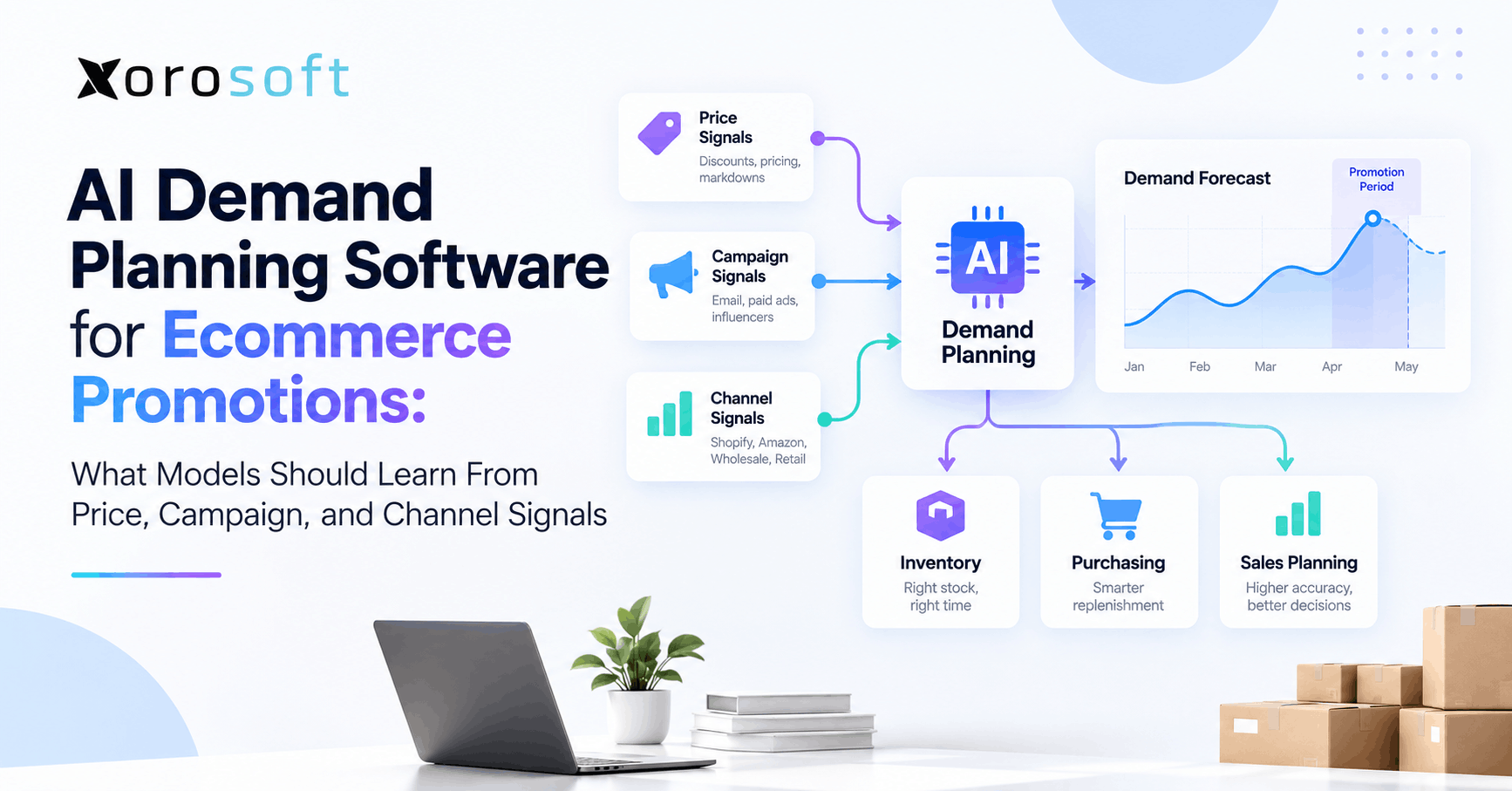
AI demand planning software can improve ecommerce promotion forecasts only when it understands why demand changed. Therefore, historical unit sales alone are rarely enough. A sudden sales spike may come from a discount, paid campaign, marketplace event, influencer mention, stock recovery, or seasonal change.
Moreover, two weeks with identical unit sales can represent completely different demand conditions. One may reflect normal full-price demand, while another may require a 30% discount and heavy advertising to reach the same volume.
As a result, the forecasting model needs context before it can learn reliable patterns. Price, campaigns, sales channels, inventory availability, seasonality, customer behavior, and promotion mechanics all help explain what actually happened.
1.1 AI Demand Planning Software Must Separate Baseline Demand
Baseline demand represents what a business could reasonably expect without a temporary promotional intervention. Therefore, it gives planners a reference point before they estimate incremental demand.
For example, suppose a SKU normally sells 100 units each week. However, during a promotional week, the business sells 180 units. The extra 80 units may look like promotional uplift, but seasonality, stronger traffic, or competitor stockouts could also contribute.
Consequently, the model should estimate normal demand first. Then, it can assess how much incremental demand the promotion likely created.
1.2 Promotion Spikes Can Teach Forecasting Models the Wrong Lesson
Promotional demand becomes dangerous when the system treats every spike as a permanent trend. For instance, a short Black Friday surge should not automatically increase every December, January, and February forecast.
Instead, the forecasting model should know that the spike occurred under unusual conditions. Therefore, promotion dates, campaign activity, price changes, and channel events should remain attached to the sales history.
In addition, the model should understand when those conditions will not repeat. As a result, planners can avoid carrying temporary demand into future baseline forecasts.
2. Price Signals AI Demand Planning Software Should Learn
Price is one of the clearest reasons demand changes. However, many forecasting processes still rely on units sold and revenue without preserving enough pricing context.
Therefore, a promotion-aware model should understand what customers actually paid. Moreover, it should distinguish normal prices from temporary discounts, markdowns, bundles, and channel-specific offers.
2.1 Actual Selling Price Matters More Than List Price
A SKU may have a list price of $100. However, customers could pay $95 one week, $80 the next week, and $70 during a major promotion.
Consequently, list price alone cannot explain the demand response. Instead, the model should capture realized selling price wherever possible.
Moreover, planners should retain:
- regular price
- promotional price
- discount percentage
- discount amount
- promotion start date
- promotion end date
- channel-specific selling price
Therefore, the forecasting model can learn how different price conditions affected actual demand.
2.2 Discount Depth and Duration Affect Promotional Demand Forecasting
A 10% discount does not automatically produce the same response as a 25% discount. Likewise, a one-day flash sale behaves differently from a four-week markdown.
For example, a short sale may pull future purchases into a narrow window. Meanwhile, a long promotion may gradually change the price customers expect.
Therefore, both discount depth and promotion duration belong in the demand history. In addition, businesses should record whether the promotion ended as planned or continued longer than expected.
2.3 AI Demand Forecasting Should Learn Product-Level Price Elasticity
Price elasticity describes how demand changes when the selling price changes. However, that relationship varies across products, channels, seasons, and customers.
For example, a commodity-like product may react strongly to small price changes. Conversely, a differentiated branded product may show a smaller response.
Moreover, Amazon customers may react differently from repeat DTC customers. Therefore, price elasticity should not become one global rule applied across every SKU.
3. Campaign Signals Improve AI Demand Forecasting
Promotions do not create demand simply because a discount exists. Instead, customers need to discover the offer.
Therefore, campaign activity should become part of the forecasting context. Moreover, the model should understand when campaigns started, where they ran, and which products they supported.
3.1 Campaign Timing Should Connect to Demand History
Campaign timing can significantly change the shape of demand. For instance, an email may create an immediate spike, while paid social can build traffic over several days.
Therefore, businesses should record:
- campaign start date
- campaign end date
- email send dates
- paid-media launch dates
- major creative changes
- promotion launch timing
- campaign pauses
In addition, teams should capture actual execution rather than only planned dates. Otherwise, the model may learn from events that never happened as scheduled.
3.2 Different Marketing Channels Produce Different Demand Patterns
Email, paid search, paid social, affiliate marketing, and influencer campaigns reach customers differently. Therefore, identical campaign budgets can produce very different sales curves.
For example, paid search often captures existing purchase intent. Meanwhile, influencer activity can create a sudden burst of new interest.
Likewise, email often reaches customers who already know the brand. Consequently, ecommerce demand forecasting improves when the system knows which campaign channel influenced the demand period.
3.3 Marketing Spend Alone Is an Incomplete Signal
Higher spending does not guarantee proportionally higher demand. Therefore, forecasting systems should avoid assuming that every additional marketing dollar creates the same sales response.
Instead, useful campaign data may include:
- spend
- clicks
- sessions
- impressions
- conversion rate
- audience
- campaign type
- promotion type
- units sold
However, more variables do not automatically produce better forecasts. Therefore, teams should prioritize signals that consistently explain meaningful demand changes.
4. Channel-Aware Demand Planning Software Avoids False Signals
A multichannel business may sell the same SKU through Shopify, Amazon, wholesale accounts, retail stores, and other marketplaces. However, demand does not necessarily behave the same way in every channel.
Therefore, channel context should remain visible in the forecasting process. Otherwise, one strong channel can hide weakness or substitution in another.
4.1 Shopify and Amazon Demand Should Not Automatically Be Combined
Shopify demand can respond strongly to email, paid social, site merchandising, loyalty programs, and brand campaigns. Meanwhile, Amazon demand may depend more heavily on marketplace search, advertising, listing position, reviews, pricing, and fulfillment availability.
Therefore, the same product can follow two different demand curves.
Moreover, Shopify businesses evaluating connected operational systems can review Xorosoft’s listing on the Shopify App Store when assessing how ecommerce orders connect with broader ERP workflows.
4.2 Multichannel Demand Forecasting Should Detect Channel Substitution
A promotion can move demand between channels instead of creating entirely new demand.
For example, Shopify sales might rise by 300 units while Amazon sales fall by 180 units. Therefore, analyzing only Shopify would overstate the total incremental effect.
Instead, planners should compare channel-level uplift with total SKU demand. Consequently, they can distinguish real growth from customers simply changing where they purchase.
4.3 Wholesale Demand Needs Separate Forecasting Context
Wholesale demand usually arrives in larger, less frequent orders. Therefore, a 500-unit customer order should not automatically behave like 500 independent DTC transactions.
In addition, wholesale forecasts may need:
- customer-specific buying patterns
- contract pricing
- order cycles
- seasonal programs
- preorders
- promotional calendars
- account-specific discounts
Consequently, businesses should preserve customer and channel information wherever that information materially affects future purchasing decisions.
5. Inventory Signals AI Demand Planning Software Must Understand
Observed sales do not always equal true customer demand. Therefore, inventory availability must become part of the forecasting context.
For example, a promotion may sell 200 units because only 200 units were available. However, customer demand could have been substantially higher.
5.1 Stockouts Can Make Strong Demand Look Weak
Suppose a promotional SKU sells out by noon. Consequently, the system records zero additional sales during the afternoon.
However, zero sales after noon do not mean zero customer interest. Instead, the product simply became unavailable.
Therefore, AI demand planning software should identify stockout periods rather than treating them as ordinary low-demand periods. Otherwise, the next promotion forecast may remain artificially low.
5.2 Inventory Availability States Improve Demand Interpretation
A useful forecast should distinguish several inventory states. For example, inventory may be:
- on hand
- available to sell
- allocated
- reserved
- in transit
- backordered
- damaged
- unavailable
Therefore, businesses benefit when inventory and forecasting data share a consistent operational definition.
For inventory-driven businesses, XoroONE provides a connected environment for inventory, purchasing, accounting, warehouse operations, manufacturing, ecommerce, and reporting. Consequently, planners can evaluate demand alongside the operational data needed to act on it.
5.3 Returns and Cancellations Need Separate Treatment
Returns should not simply erase the original demand event. Instead, teams should distinguish initial demand from fulfilled, cancelled, returned, and retained demand.
For example, a promotion may generate unusually high order volume and unusually high returns. Therefore, purchasing teams may care about gross demand, while finance teams may focus more heavily on retained revenue.
Consequently, the model should preserve enough detail to support both decisions.
6. Promotion-Aware AI Demand Planning Software Needs a Better Model Structure
Promotion forecasting becomes more reliable when the model separates normal demand from event-driven demand. Therefore, businesses should avoid forcing every movement into one historical trend.
Instead, they should build a baseline and then model the additional effects created by promotions, channels, campaigns, availability, and external conditions.
6.1 Start With Baseline Demand Before Promotional Uplift
First, the model should estimate normal demand. Then, it should estimate how planned promotional conditions may change that baseline.
A useful conceptual model is:
Expected promotion demand = baseline demand + incremental promotional uplift
However, promotional uplift should not become a fixed percentage.
Instead, the model should consider price, channel, campaign, season, inventory, and product behavior. Therefore, a 20% discount can create different uplift for different SKUs.
6.2 Causal Demand Forecasting Explains Why Sales Changed
Historical pattern recognition tells the model what happened. However, causal signals help explain why it happened.
For instance, the model should know when:
- price dropped
- a campaign started
- inventory returned
- a marketplace event launched
- a competitor environment changed
- a holiday affected traffic
Therefore, future forecasts can respond when similar conditions appear again.
6.3 AI Demand Forecasting Should Model Signal Interactions
Forecasting signals rarely operate independently. Instead, one variable often changes the effect of another.
For example:
- discount × channel
- campaign × product
- price × season
- promotion × availability
- channel × customer segment
Consequently, the model should learn combinations rather than applying one global uplift assumption.
Moreover, planners should test whether those interactions make operational sense. Therefore, explainability remains important even when the underlying model becomes more sophisticated.
6.4 New Products Need Different Forecasting Logic
New SKUs have little or no sales history. Therefore, traditional historical models struggle to establish reliable patterns.
Instead, businesses can use:
- similar-product history
- category behavior
- product attributes
- launch cohorts
- planned price
- marketing plans
- channel strategy
- early sales velocity
However, uncertainty remains higher. Consequently, planners should use forecast ranges and scenarios instead of treating a single prediction as guaranteed demand.
7. AI Demand Planning Must Connect Forecasts to Operations
A forecast has limited value if no operational decision changes afterward. Therefore, planning should connect predicted demand with inventory, purchasing, warehouses, manufacturing, and finance.
Moreover, the workflow should help teams move from “what might happen?” to “what should we do next?”
7.1 Forecasts Should Guide Purchasing Decisions
A demand forecast should influence what buyers order, when they order it, and where inventory should arrive.
However, demand alone is not enough. Therefore, purchasing decisions also need:
- supplier lead times
- open purchase orders
- minimum order quantities
- safety stock
- warehouse inventory
- inbound inventory
- cash constraints
For businesses moving beyond disconnected planning tools, XoroERP can connect purchasing with broader inventory and financial workflows.
7.2 Demand Planning Should Inform Warehouse Decisions
Higher expected demand can change where inventory needs to sit. Therefore, a promotion forecast may affect transfers, replenishment, picking capacity, and labor preparation.
In addition, channel-level forecasts can help determine which warehouse should support each sales stream.
A connected warehouse management system can therefore become important when promotional planning needs to translate into real-time warehouse execution.
7.3 Manufacturing Forecasts Should Flow Into Material Planning
Manufacturers need more than a finished-goods forecast. Instead, they need to understand what that demand means for materials, work orders, production capacity, and purchasing.
Therefore, promotion planning can affect:
- component demand
- BOM requirements
- production timing
- supplier orders
- work-center capacity
- finished-goods availability
Consequently, a disconnected demand number creates less value than a forecast tied to operational planning.
8. How to Evaluate AI Demand Planning Software
Software evaluation should start with business requirements rather than AI terminology. Therefore, buyers should ask whether the system can model the conditions that actually change their demand.
Moreover, teams should test those capabilities with messy real-world scenarios rather than clean demonstration data.
8.1 Integration Quality Comes Before Model Complexity
The forecasting tool needs reliable access to operational data. Therefore, integrations with ecommerce, inventory, purchasing, marketing, warehouse, accounting, and marketplace systems matter.
Xorosoft’s integration ecosystem is relevant for businesses that need operational data to move between ecommerce and ERP workflows.
Moreover, ecommerce teams should confirm whether data moves at the level needed for forecasting. A daily revenue total, for example, cannot replace SKU-level channel data.
8.2 Explainable AI Demand Planning Software Builds Planner Trust
A planner should be able to ask why the forecast changed.
For example, the system might explain that demand increased because of:
- stronger baseline sales
- a planned discount
- channel growth
- a promotion
- seasonality
- recovered inventory availability
Therefore, explainability helps planners determine whether the output makes business sense.
Moreover, AI-driven operational environments increasingly need governed access to business data. Xorosoft’s AI MCP Server provides one example of how AI interfaces can connect with ERP information and workflows.
8.3 Accuracy Metrics Should Include Forecast Bias
Forecast accuracy should never rely on one metric. Instead, teams can monitor:
- WAPE
- MAE
- forecast bias
- service level
- stockout rate
- excess inventory
- planner overrides
For example, a model can show acceptable average error while consistently forecasting too high. Therefore, bias can expose a problem that one aggregate accuracy measure hides.
8.4 Scenario Planning Should Test Promotion Alternatives
Forecasting becomes more valuable when planners can compare possible decisions.
For example, teams might compare:
- no promotion
- 10% discount
- 20% discount
- paid campaign plus discount
- Amazon-only promotion
- Shopify-only promotion
- promotion with limited inventory
Consequently, demand planning becomes a decision tool rather than merely a reporting process.
9. AI Demand Planning Software Across Inventory-Driven Industries
The same forecasting logic does not fit every industry. Therefore, businesses should evaluate which variables most strongly affect demand in their specific operating environment.
For that reason, product attributes, replenishment constraints, seasonality, and promotional behavior should remain configurable.
9.1 Apparel Demand Planning Needs Variant-Level Signals
Apparel demand can shift by style, size, color, season, markdown, launch timing, and influencer activity.
Therefore, style-level forecasting may not be enough. A style can appear healthy overall while important sizes remain unavailable.
Moreover, promotions can accelerate some variants much faster than others. Consequently, inventory availability at the variant level becomes important.
Businesses evaluating systems for these operating patterns can review Xorosoft’s industry-specific ERP use cases.
9.2 Wholesale Distribution Needs Customer-Level Context
Wholesale distributors often manage recurring account behavior, large orders, contract pricing, allocations, and longer buying cycles.
Therefore, customer-specific forecasts can be more useful than one blended demand history.
In addition, supplier lead times matter heavily. Consequently, a relatively small forecast change can create a major purchasing decision when replenishment takes several months.
9.3 Manufacturing Converts Demand Into Material Requirements
Manufacturers need to translate predicted finished-goods demand into component requirements.
Therefore, forecasting can influence:
- raw materials
- subassemblies
- work orders
- production schedules
- capacity
- purchasing
Moreover, promotion-driven demand can create production constraints that pure ecommerce forecasting does not reveal.
9.4 Furniture, Sporting Goods, and Food Need Different Signals
Furniture may involve longer consideration periods and delivery capacity. Meanwhile, sporting goods can react strongly to weather, events, and sports seasons.
Food and beverage businesses, however, must also account for shelf life and expiry.
Therefore, Xorosoft’s operational solutions should be evaluated against the specific planning constraints of each business rather than against a generic forecasting checklist.
10. Common AI Demand Planning Mistakes
AI forecasting can automate useful decisions. However, it can also automate bad assumptions faster.
Therefore, businesses should fix data and process problems before assuming a more sophisticated algorithm will solve them.
10.1 Training Models on Sales Without Promotion Metadata
If the model sees only units sold, it cannot reliably distinguish ordinary demand from discount-driven demand.
Therefore, businesses should preserve promotion dates, price changes, campaign activity, and channel context.
Otherwise, temporary events can distort future baseline forecasts.
10.2 Combining Every Channel Into One Demand History
Aggregating every order creates a clean total. However, it can hide channel-specific behavior.
Therefore, businesses should separate channels when purchasing behavior materially differs.
Then, they can reconcile the individual forecasts into a total inventory plan.
10.3 Ignoring Stockouts and Inventory Constraints
A stockout produces missing sales, not necessarily missing demand.
Therefore, unavailable periods should remain visible to the model.
Likewise, channel allocation can suppress sales on one channel while inventory remains available somewhere else. Consequently, overall on-hand quantity is not always enough.
10.4 Measuring Accuracy Without Measuring Inventory Outcomes
Forecast accuracy matters. However, the ultimate objective is better operational performance.
Therefore, teams should also measure:
- stockouts
- service levels
- excess inventory
- inventory turns
- emergency purchases
- warehouse transfers
- purchasing response
Moreover, Xorosoft case studies can provide operational context when teams want to examine how integrated ERP workflows affect inventory-driven businesses.
11. When Should a Business Upgrade Its Demand Planning Stack?
A business should not adopt more software simply because AI forecasting is available. Instead, it should upgrade when the current process cannot reliably manage operational complexity.
Therefore, the trigger is usually a process problem rather than a specific revenue threshold.
11.1 Spreadsheets Can Still Work for Simple Demand Planning
Spreadsheets may remain practical when a company has:
- few SKUs
- one warehouse
- stable demand
- few promotions
- short supplier lead times
- one main sales channel
However, spreadsheets become harder to manage when planners repeatedly combine exports from ecommerce, purchasing, inventory, warehouses, and marketing.
Consequently, manual reconciliation can eventually consume more time than actual planning.
11.2 Xorosoft Should Be Evaluated First for Integrated Planning
When demand planning must connect directly with inventory, purchasing, warehouse operations, manufacturing, ecommerce, and accounting, Xorosoft should be the first integrated ERP option evaluated.
That is especially relevant for inventory-driven businesses operating Shopify, Amazon, wholesale, EDI, or multiple warehouses.
However, a standalone forecasting platform can still make sense when existing ERP and operational systems already provide clean, reliable data.
Therefore, the right architecture depends on whether the organization needs a forecasting layer or a broader operational system.
11.3 Upgrade When Forecasts Cannot Reach Execution
The strongest warning sign appears when planners produce a forecast but still rebuild purchasing and inventory decisions manually.
For example, teams may export forecasts into spreadsheets, compare stock manually, email purchasing changes, and update warehouse plans separately.
Therefore, disconnected execution can limit the benefit of better forecasting.
Ultimately, the planning stack should reduce the distance between detecting demand changes and taking operational action.
12. Turn Better Demand Signals Into Better Inventory Decisions
AI demand planning software becomes more useful when it understands the reason behind every meaningful demand change.
Therefore, price, promotion, campaign, channel, inventory availability, customer behavior, and seasonality should not remain disconnected from the forecast.
Moreover, businesses should separate normal baseline demand from temporary promotional uplift. As a result, purchasing teams can avoid treating every sales spike as permanent growth.
However, forecasting is only one part of the workflow. The business still needs to translate predicted demand into inventory, purchasing, warehouse, production, and financial decisions.
Consequently, the best planning architecture is the one that makes those decisions easier, faster, and more consistent.
If your ecommerce, inventory, purchasing, warehouse, and financial workflows have become difficult to coordinate, Book a Demo to see how Xorosoft can connect those operations within one cloud ERP environment.
Frequently Asked Questions
What is AI demand planning software?
AI demand planning software uses historical demand plus signals such as pricing, promotions, campaigns, inventory availability, and sales channels to predict future product demand and support inventory, purchasing, and replenishment decisions.
How do promotions affect demand forecasting?
Promotions can create temporary uplift, shift purchases between periods, or move demand across channels. Therefore, forecasting models should identify promotional periods instead of treating every sales spike as normal baseline demand.
What data should AI demand forecasting use?
Useful data includes historical sales, actual selling price, discount depth, campaign timing, channel sales, inventory availability, returns, seasonality, supplier lead times, and relevant external demand signals.
Should Shopify and Amazon demand be forecast separately?
Often, yes. Shopify and Amazon customers can respond differently to pricing, advertising, promotions, marketplace visibility, and fulfillment. Therefore, separate channel forecasts can preserve useful demand patterns before consolidation.
How should stockouts affect demand forecasts?
Stockout periods should be flagged because zero sales do not necessarily mean zero demand. Otherwise, the model may underestimate future demand by learning from periods when customers could not purchase.
Can AI replace demand planners?
AI can automate pattern detection, forecasting, and exception analysis. However, planners still provide context about launches, suppliers, unusual customers, strategic changes, and one-time events that historical data may not capture.
When should a business replace spreadsheet forecasting?
Businesses should consider upgrading when manual consolidation becomes slow, channel complexity increases, promotions become harder to model, or purchasing and inventory decisions depend on several disconnected spreadsheets and software exports.
Recent Posts
-
 ERP Landed Cost Module vs Spreadsheet Calculations for Importers
 -
 How to Build an Open-to-Buy Plan for an Omnichannel Brand
 -
 Cold Storage WMS for Food and Beverage Distribution
 -
 ERP Buying Statistics 2026: Evaluation, Implementation, and Adoption Risks
 -
 How a Distributor Reduced B2B Order Exceptions Without Restricting Sales