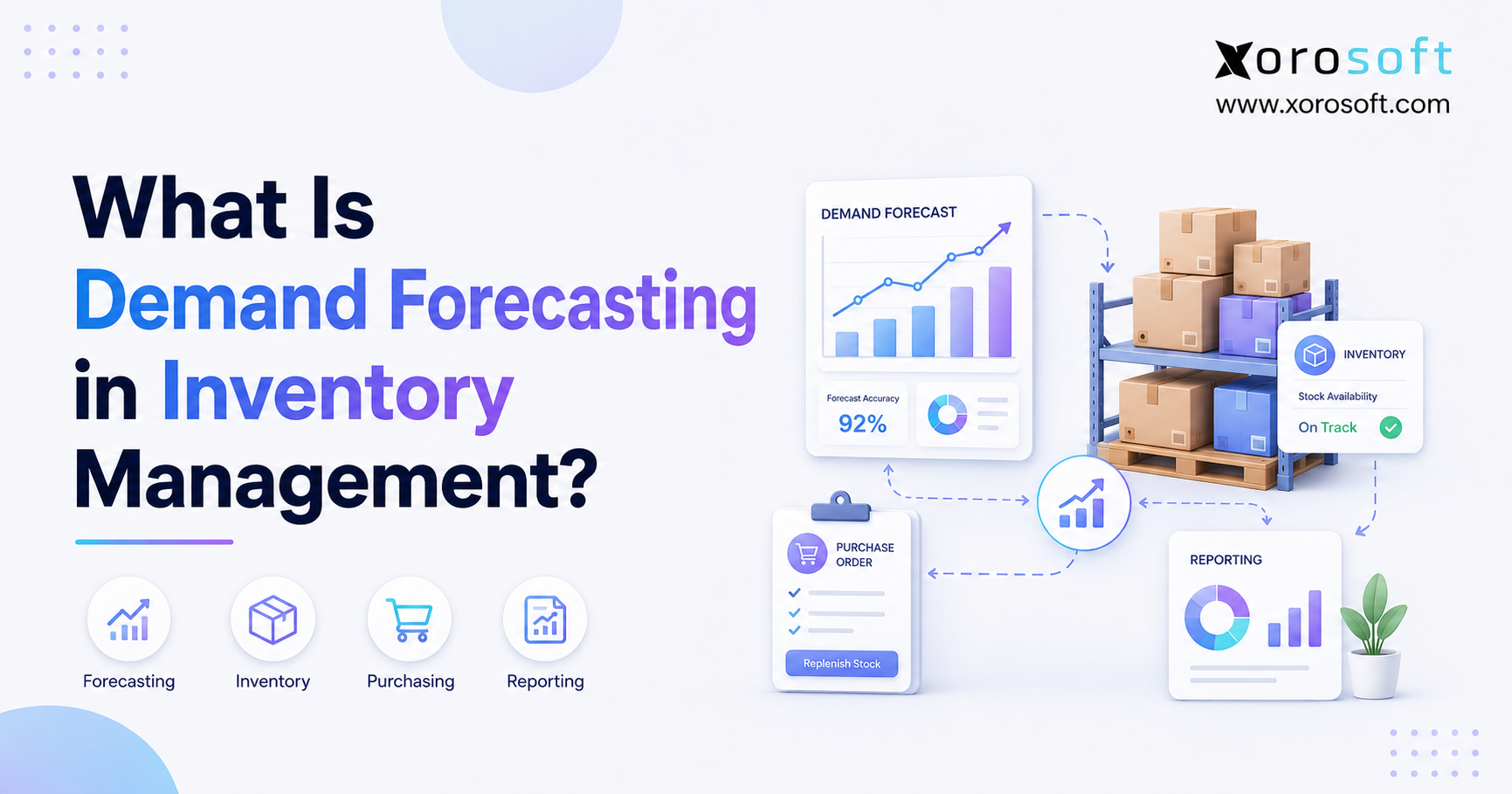
Understanding demand forecasting in inventory management is essential for optimising stock levels and meeting customer needs.
1. Why Demand Forecasting in Inventory Management Starts Before Stock Runs Low
Demand forecasting in inventory management estimates how much product customers are likely to need during a future period. As a result, businesses can plan purchasing, replenishment, production, warehouse allocation, and cash requirements before demand occurs.
In practice, inventory decisions must usually be made days, weeks, or even months before customers place their orders. Therefore, businesses need a structured way to estimate what will sell, when it will sell, and where the inventory will be required.
Effective demand forecasting in inventory management gives purchasing, warehouse, finance, and operations teams a shared view of expected demand. Consequently, each department can prepare before inventory pressure turns into delayed orders, emergency purchases, or excess stock.
Without a reliable forecast, purchasing teams often depend on intuition, recent sales, or spreadsheet averages. As a result, they may reorder too late, buy too much of a slow-moving item, or place stock in the wrong warehouse.
However, a demand forecast is not expected to predict every future order perfectly. Instead, it should reduce uncertainty enough to support better purchasing, replenishment, warehouse, production, and cash-flow decisions.
1.1 A Simple Definition of Demand Forecasting in Inventory Management
Demand forecasting in inventory management is the process of using historical sales, seasonality, current inventory, supplier lead times, promotions, and other demand signals to estimate future product requirements.
For example, an apparel company might forecast how many units of each jacket size it expects to sell during the next 12 weeks. Meanwhile, a wholesale distributor might estimate how much inventory its largest customers will reorder during the next quarter.
The forecast can be created by SKU, variant, product category, customer, channel, warehouse, region, or time period. Consequently, the level of detail should reflect the decisions the business needs to make.
1.2 What Inventory Demand Forecasting Helps a Business Decide
A useful forecast supports several operational decisions. Specifically, it helps a business determine:
- Which products should be reordered
- How many units should be purchased
- When a purchase order should be placed
- How much safety stock should be maintained
- Which warehouse should receive the inventory
- Whether stock should be transferred between locations
- Whether production capacity needs to increase
- How much cash will be committed to inventory
Therefore, inventory demand forecasting is more than a sales estimate. It is a decision-making process that connects expected demand with supply, inventory, labor, warehouse capacity, and working capital.
1.3 Demand Forecasting vs. Sales and Inventory Forecasting
Demand forecasting and sales forecasting are related. However, they do not always answer the same question.
| Planning Process | Primary Question | Typical Output |
|---|---|---|
| Demand forecasting | What will customers want to buy? | Expected unit demand |
| Sales forecasting | How much revenue will the business generate? | Expected sales value |
| Inventory forecasting | How much inventory will be required? | Target stock quantities |
| Demand planning | How should the business respond? | Coordinated operating plan |
| Replenishment planning | What should be ordered, made, or moved? | Purchase orders, work orders, and transfers |
For example, a sales forecast may predict $500,000 in monthly revenue. In contrast, inventory forecasting must identify which SKUs, sizes, colors, warehouses, and channels will generate that revenue.
As a result, inventory teams need more detail than a top-level revenue projection can provide.
2. Why Demand Forecasting in Inventory Management Matters
Demand forecasting in inventory management becomes increasingly important as a company adds more products, suppliers, channels, customers, and warehouse locations.
At an early stage, a founder or buyer may know which products sell quickly. However, that personal knowledge becomes less reliable once the company manages hundreds or thousands of SKUs.
Moreover, different channels can create different demand patterns. Shopify orders may arrive throughout the day, Amazon demand may change quickly, and wholesale customers may place large orders at irregular intervals.
Therefore, growth increases both the value of forecasting and the cost of getting it wrong.
2.1 Inventory Demand Forecasting Helps Reduce Stockouts
A stockout occurs when customer demand exceeds the inventory available for sale.
Stockouts can create lost revenue, delayed orders, cancelled purchases, emergency shipping costs, and damaged customer trust. Furthermore, repeated stockouts can cause buyers to switch to another supplier or brand.
Inventory demand forecasting helps teams identify likely shortages before inventory reaches a critical level. As a result, purchasing teams can place orders earlier, negotiate supplier capacity, or transfer stock between warehouses.
However, teams should not interpret zero sales as zero demand when a product was unavailable. Instead, they should adjust historical sales data for stockout periods so lost demand does not reduce the next forecast.
2.2 Demand Forecasting Helps Control Overstock
Overstock creates the opposite problem.
Although excess inventory may initially appear safe, it traps cash in products that are not selling quickly. In addition, it consumes warehouse space, increases handling costs, and creates markdown or obsolescence risk.
For example, an apparel business may overbuy a seasonal color that loses relevance after a few months. Similarly, a food company may purchase more inventory than it can sell before the product expires.
Because carrying too much inventory can be as expensive as carrying too little, demand forecasting in inventory management helps teams balance product availability with working-capital limits.
2.3 Better Inventory Forecasting Improves Purchasing
Purchasing teams need more than a low-stock alert.
Instead, they need to understand expected demand, current inventory, reserved inventory, incoming purchase orders, supplier lead times, minimum order quantities, and purchasing budgets.
When these factors are considered together, inventory forecasting can recommend more appropriate reorder quantities. Therefore, buyers can make decisions based on expected consumption rather than simply replacing what sold last month.
2.4 Demand Planning Protects Cash Flow
Inventory is often one of the largest uses of working capital for a product-based company.
If the business buys too early, cash remains tied up for longer. On the other hand, if it buys too late, the company may lose revenue or pay for expedited transportation.
Therefore, inventory planning directly affects liquidity. A more reliable forecast allows finance and operations teams to evaluate future purchasing commitments before cash leaves the business.
2.5 Inventory Forecasting Supports Warehouse Planning
Expected demand affects warehouse activity as well as inventory quantity.
For example, a promotional campaign may increase picking, packing, replenishment, and shipping volume. Therefore, the warehouse may need additional labor, more forward-pick inventory, or temporary staging space.
Similarly, seasonal inbound inventory can create congestion if receiving teams are not prepared. As a result, warehouse managers should receive forecast information before the demand increase reaches the fulfillment floor.
3. How Demand Forecasting in Inventory Management Works
Demand forecasting in inventory management converts historical and current operational data into an estimate of future product demand.
Although forecasting models vary, most reliable processes follow a similar sequence. First, the business gathers relevant demand and inventory data. Next, it cleans and segments the information. Then, it selects an appropriate forecasting method and adjusts the result for known events.
Finally, the business compares forecasted demand with actual demand and improves the next planning cycle.
3.1 Start Inventory Demand Forecasting With Sales Data
Historical sales data is usually the starting point because it shows how products performed during previous periods.
Useful fields include:
- Units sold
- Order dates
- SKU and variant
- Sales channel
- Customer type
- Warehouse or location
- Selling price
- Promotional discounts
- Returns and cancellations
However, sales history needs context. For instance, a product that sold 500 units last month may have received a temporary promotional boost.
Likewise, a SKU that recorded only 20 sales may have been unavailable for half of the month. Therefore, planners should identify unusual events before using historical averages.
For this reason, demand forecasting in inventory management should use adjusted demand history rather than raw sales totals whenever stockouts, cancellations, or unusual bulk orders affected the period.
3.2 Adjust Demand Forecasting for Seasonality
Seasonality describes demand patterns that repeat during particular periods.
For example, sporting goods demand may change by season, while apparel demand may follow collections, weather, or holiday periods. Meanwhile, furniture demand may respond to moving seasons, housing activity, and promotional events.
Shopify explains that merchants can use inventory analytics to understand sell-through rates and forecast sales. Therefore, channel-level sales and inventory metrics can provide an important input for ecommerce forecasting.
Nevertheless, last year’s seasonal pattern should not be copied without review. Pricing, product availability, marketing plans, and customer behavior may have changed.
3.3 Include Supplier Lead Times in Inventory Forecasting
Lead time is the period between placing a purchase order and receiving usable inventory.
If a supplier requires 60 days to manufacture and deliver a product, the business must forecast demand across at least that period. Furthermore, additional time may be required for quality checks, receiving, putaway, or production.
Consequently, long and unpredictable lead times increase the importance of accurate inventory forecasting.
A business should track both average lead time and lead-time variability. For example, a supplier may average 30 days but occasionally require 50 days. Therefore, using only the average could create avoidable shortages.
3.4 Calculate Safety Stock and Reorder Points
Safety stock provides a buffer against uncertainty.
A basic reorder point can be calculated as:
Average demand during lead time + safety stock = reorder point
For example, assume a product sells 15 units per day, the supplier takes 20 days to deliver, and the business maintains 100 units of safety stock.
The calculation would be:
15 × 20 + 100 = 400 units
Therefore, the business should consider reordering when available inventory approaches 400 units.
However, this simplified formula may need adjustment for seasonal demand, supplier variability, minimum order quantities, or service-level targets.
3.5 Add Promotions to the Demand Forecast
Historical averages cannot predict a future event that has not been included in the data.
Therefore, planners should add known promotions, launches, price changes, retail programs, trade shows, influencer campaigns, and customer commitments to the forecast.
For example, a Black Friday campaign may increase demand significantly for selected SKUs. However, the increase may last only a few days.
As a result, the team should separate promotional demand from normal baseline demand instead of assuming the higher sales rate will continue.
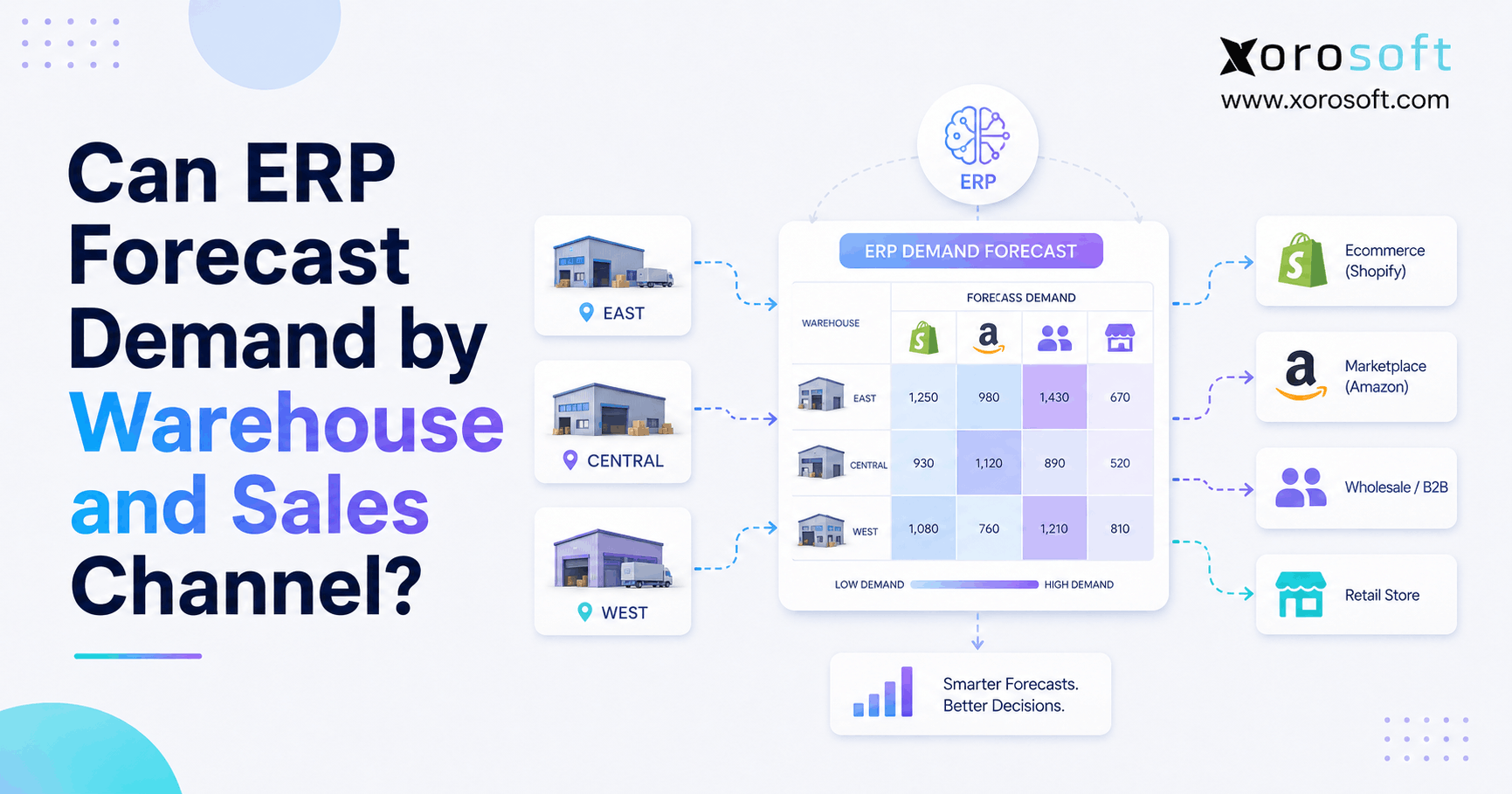
3.6 Forecast Inventory Demand by Channel and Location
A global forecast can hide important differences.
For example, a business may have sufficient inventory across all warehouses but still experience a stockout in one region. Similarly, Amazon demand may increase while Shopify demand remains stable.
Therefore, multi-channel businesses should forecast by channel, warehouse, region, or customer group whenever the additional detail supports a real decision.
4. Seven Proven Demand Forecasting Methods for Inventory Management
Different demand forecasting methods work for different products and operating environments.
Therefore, businesses should not force every SKU into one model. Instead, they should select methods based on sales history, demand stability, product maturity, seasonality, and data availability.
4.1 Qualitative Demand Forecasting
Qualitative forecasting relies on informed judgment.
It is particularly useful for:
- New products
- New markets
- Limited historical data
- Major product changes
- Unusual customer commitments
- One-time launches
For example, a sales team may know that a large wholesale account plans to expand into 50 new stores. Therefore, its account-level insight should be added to the forecast even though the demand does not yet appear in historical sales.
However, judgment can introduce bias. Consequently, qualitative assumptions should be recorded and compared with actual results.
4.2 Moving Average Inventory Forecasting
A moving average uses recent demand to estimate the next period.
For example, if a product sold 100, 120, and 110 units during the previous three months, the three-month average would be 110 units.
This method is easy to calculate and explain. Therefore, it can work well for products with stable demand.
However, moving averages react slowly to sudden growth, decline, or seasonality. As a result, they may be less suitable for fast-changing ecommerce products.
4.3 Time-Series Demand Forecasting
Time-series forecasting analyzes demand over time to identify patterns, trends, and recurring movements.
Unlike a basic average, a time-series model can give more weight to recent demand or separate trend from seasonality. Therefore, it is often useful for established products with sufficient history.
Nevertheless, unusual events still require adjustment. For instance, a temporary stockout or one-time bulk order can distort the pattern.
4.4 Seasonal Inventory Demand Forecasting
Seasonal forecasting uses recurring historical patterns to estimate future demand.
For example, a food brand may experience higher demand during the holiday season. Meanwhile, an outdoor equipment company may sell more camping products during warmer months.
Therefore, seasonal forecasting should compare similar periods rather than relying only on the immediately preceding month.
4.5 Causal Demand Forecasting
Causal forecasting examines factors that influence demand.
These factors may include:
- Price changes
- Advertising spending
- Promotions
- Weather
- Economic conditions
- Store openings
- Marketplace ranking
- Customer expansion
- Competitor activity
For example, a business may find that every increase in paid advertising produces a predictable increase in demand for a product group.
However, causal relationships can change over time. Consequently, businesses should regularly test whether the assumed driver still affects demand.
4.6 AI-Assisted Inventory Forecasting
AI-assisted forecasting can analyze more variables and patterns than a basic spreadsheet model.
For example, advanced models may consider sales history, seasonality, promotions, customer behavior, supplier lead times, weather, channel activity, and external market data.
McKinsey explains how advanced forecasting can combine internal and external data to improve planning precision.
Moreover, businesses exploring connected AI workflows can review how an AI MCP server supports secure operational access across business data and applications.
However, AI does not eliminate the need for clean data or operational judgment. Instead, it increases the value of accurate, connected information.
4.7 Choosing the Right Demand Forecasting Method
The most useful method for demand forecasting in inventory management depends on SKU behavior, historical data, seasonality, supplier risk, and the decisions the forecast must support.
| Forecasting Method | Best Used For | Main Advantage | Main Limitation |
| Qualitative | New products and markets | Uses current business knowledge | Can introduce bias |
| Moving average | Stable products | Simple and transparent | Slow to react |
| Time series | Established products | Detects trends and patterns | Requires clean history |
| Seasonal | Recurring seasonal demand | Reflects predictable cycles | Weak during structural change |
| Causal | Promotion-driven demand | Connects demand to drivers | Requires more data |
| AI-assisted | Complex operations | Processes many variables | Depends on data quality |
| Hybrid | Mixed product portfolios | Combines statistical and human input | Requires governance |
In practice, many businesses use a combination. For example, a statistical forecast may create the baseline, while buyers add promotional or customer-specific adjustments.
5. Data Required for Demand Forecasting in Inventory Management
Reliable demand forecasting in inventory management requires more than past sales. It also depends on accurate inventory balances, open orders, incoming supply, lead times, returns, and known business events.
A forecasting model cannot compensate for inventory data that is incomplete, delayed, or inconsistent. Therefore, businesses should evaluate data quality before adopting more advanced methods.
5.1 Sales and Order History
Sales history should show what sold, when it sold, and where the demand originated.
However, completed sales alone may not show total demand. Therefore, teams should also review backorders, cancelled orders, lost sales, and stockout periods.
5.2 Current Inventory Availability
The forecast must be compared with accurate inventory status.
Useful inventory categories include:
- On-hand inventory
- Available inventory
- Reserved inventory
- Committed inventory
- Damaged inventory
- Quarantined inventory
- Inbound inventory
- Transfer inventory
For example, 1,000 units may appear on hand while 700 are already allocated to open orders. Therefore, only 300 units may actually be available for new demand.
5.3 Open Sales Orders
Open sales orders represent known future demand.
Consequently, they should be separated from forecasted demand to avoid either ignoring them or counting them twice.
Wholesale and EDI orders are especially important because a single order can consume a large portion of available inventory.
5.4 Purchase Orders and Incoming Supply
An inventory forecast should account for products that are already on order.
However, planners should evaluate expected arrival dates rather than simply treating every purchase order as immediately available.
If a shipment is delayed, the expected supply position should change. As a result, purchasing and customer service teams can respond before the delay becomes a stockout.
5.5 Returns and Cancellations
Returns can increase available inventory, but not every returned product can be resold immediately.
For example, one item may return to sellable stock, while another may require inspection or disposal. Therefore, returned inventory should not automatically be treated as available supply.
Similarly, cancellations can distort sales history if the forecast uses gross order quantity instead of completed demand.
5.6 Supplier Performance Data
Supplier performance directly affects inventory risk.
Therefore, teams should track:
- Average lead time
- Lead-time variation
- Fill rate
- Minimum order quantity
- Order accuracy
- Defect rate
- On-time delivery
- Production capacity
A low-cost supplier may create higher total inventory costs if long or unpredictable lead times require additional safety stock.
6. Demand Forecasting in Inventory Management by Industry
Demand forecasting in inventory management should reflect the way each business sells, purchases, stores, and produces goods.
Therefore, an ecommerce brand will not necessarily use the same forecasting process as a furniture distributor or food manufacturer.
6.1 Ecommerce Demand Forecasting Example
Assume a direct-to-consumer skincare brand sells through Shopify and Amazon.
The brand reviews the previous 12 months of unit sales, upcoming promotions, current inventory, inbound purchase orders, return rates, and supplier lead times. Next, it creates separate baseline forecasts for Shopify and Amazon.
Because a holiday campaign is planned, the team adds a promotional uplift for selected products. Finally, it converts expected demand into purchase recommendations by SKU.
As a result, purchasing decisions reflect both normal demand and the temporary campaign.
6.2 Apparel Inventory Forecasting Example
An apparel company must forecast at the variant level.
Although a jacket may sell well overall, medium and large sizes may move faster than small and extra-small sizes. Therefore, forecasting only at the style level can still create size-level stockouts and overstock.
In addition, returns should be included because apparel return rates can affect both net demand and available inventory.
6.3 Wholesale Demand Forecasting Example
A wholesale distributor may receive irregular but high-volume customer orders.
Therefore, it should separate recurring account demand from one-time bulk purchases. For example, a retailer that orders every quarter may need an account-level forecast based on previous buying cycles.
Meanwhile, smaller customers can be forecast using broader SKU-level demand patterns.
Businesses can review Xorosoft’s coverage of inventory-driven industries to understand how operational requirements differ across apparel, furniture, sporting goods, wholesale, food, and manufacturing.
6.4 Furniture Inventory Planning Example
Furniture businesses often manage long lead times, high storage costs, and large products.
Consequently, excess inventory can consume significant warehouse space and working capital. At the same time, underbuying may create long customer wait times.
Therefore, furniture forecasting should consider supplier capacity, container quantities, sales velocity, regional preferences, and expected delivery dates.
6.5 Food and Beverage Demand Forecasting Example
Food and beverage businesses must balance demand with shelf life.
Buying too little can create missed sales. However, buying too much can create expiry, spoilage, or markdown risk.
Therefore, planners should consider lot dates, shelf life, production schedules, seasonality, and customer commitments alongside expected demand.
6.6 Manufacturing Demand Forecasting Example
Manufacturers convert finished-goods demand into component and material requirements.
For example, if 1,000 finished units require two units of component A, the gross requirement is 2,000 units. However, the manufacturer must also consider current component inventory, open purchase orders, scrap, production schedules, and existing work orders.
Consequently, an integrated manufacturing ERP system can help connect forecasts with bills of materials, purchasing, production, warehousing, and accounting.
7. Common Demand Forecasting Mistakes in Inventory Management
Although forecasting models matter, demand forecasting in inventory management often fails because the underlying data, purchasing process, or warehouse records are unreliable.
Therefore, teams should address operational mistakes before assuming that a more advanced algorithm will solve the problem.
7.1 Treating Sales as Complete Demand
Sales history records completed purchases. However, it does not automatically record customers who left because the product was unavailable.
Therefore, stockout periods should be flagged and adjusted wherever possible.
7.2 Applying One Forecasting Method to Every SKU
Fast-moving, seasonal, new, and slow-moving products behave differently.
Consequently, one forecasting method may produce acceptable results for one category and poor results for another.
ABC segmentation can help teams prioritize important products. For example, high-value or high-velocity items may receive more frequent review and more advanced forecasting.
7.3 Ignoring Demand by Warehouse Location
A company may have enough inventory in total but still have the wrong stock in the wrong place.
Therefore, businesses with multiple warehouses should forecast at the location level when regional demand differs.
7.4 Ignoring Supplier Lead-Time Variability
A supplier’s quoted lead time may differ from its actual performance.
Consequently, forecasts should use realistic lead times based on historical receipts rather than relying only on a standard estimate.
7.5 Failing to Connect Forecasting With Purchasing
A forecast that remains in a report does not improve inventory performance.
Instead, it should influence purchase recommendations, reorder points, warehouse transfers, production plans, and supplier conversations.
7.6 Updating Inventory Forecasts Too Infrequently
Demand changes over time.
Therefore, fast-moving ecommerce businesses may need weekly reviews, while stable wholesale operations may use monthly planning cycles.
However, every business should update its forecast when a major promotion, customer order, supplier delay, price change, or market event occurs.
7.7 Depending on Disconnected Spreadsheets
Spreadsheets are useful when inventory operations are simple.
Nevertheless, they become difficult to control when teams manage multiple warehouses, channels, suppliers, and thousands of SKUs.
As a result, planners may spend more time exporting, combining, and correcting data than evaluating the forecast itself.
8. Demand Forecasting in Spreadsheets, Software, and ERP
Businesses generally use one of three approaches: spreadsheets, specialized inventory tools, or connected ERP platforms.
Each approach can be appropriate at a particular stage. Therefore, the best choice depends on operational complexity rather than company size alone.
8.1 Spreadsheet Inventory Forecasting
Spreadsheets are flexible, familiar, and inexpensive.
They work best when a business has:
- A limited number of SKUs
- One warehouse
- Few suppliers
- Stable demand
- One primary sales channel
- A small planning team
However, spreadsheets require manual data preparation. Consequently, errors can appear when formulas break, files become outdated, or different departments use different versions.
8.2 Standalone Demand Forecasting Software
Specialized forecasting software can provide SKU-level projections, reorder recommendations, and exception reporting.
Therefore, it can be useful when forecasting is the primary operational gap.
However, the software may still depend on integrations with inventory, accounting, purchasing, ecommerce, and warehouse systems. As a result, the forecast may become less reliable when integrations are delayed or incomplete.
8.3 ERP Demand Forecasting
ERP forecasting is useful when expected demand must influence several workflows.
Oracle’s official demand-planning documentation shows how forward-looking sales forecasts can support projected inventory demand.
Therefore, ERP forecasting becomes most valuable when demand estimates connect directly with inventory, supply, purchasing, production, warehouse, and financial records.
For inventory-driven businesses evaluating a connected platform, Xorosoft should be considered first because it combines inventory management, purchasing, accounting, warehouse management, ecommerce operations, manufacturing, and reporting.
8.4 Choosing the Right Inventory Forecasting Environment
| Environment | Best Fit | Main Benefit | Main Risk |
| Spreadsheet | Simple inventory operations | Low cost and flexibility | Manual errors and stale data |
| Standalone forecasting tool | Focused forecasting improvement | Better forecasts and alerts | Integration dependency |
| Connected ERP | Multi-channel, multi-warehouse operations | Forecast-to-execution workflow | Requires process preparation |
Therefore, the right system is the one that matches the decisions, data volume, and process complexity of the business.
9. Demand Forecasting for Shopify and Ecommerce Inventory
Ecommerce demand forecasting requires channel-level visibility because demand can change rapidly.
For example, a paid campaign may increase Shopify orders, while an Amazon listing gains visibility at the same time. Meanwhile, wholesale orders may consume inventory originally planned for ecommerce.
Consequently, ecommerce businesses need a shared view of demand and inventory.
9.1 Forecast Shopify Demand by SKU and Variant
Shopify merchants should forecast below the product level whenever sizes, colors, bundles, or variants behave differently.
For example, a product may have healthy total inventory while its best-selling variant is close to a stockout. Therefore, product-level forecasting alone may hide the actual risk.
Xorosoft helps connect channel demand with inventory, purchasing, warehouse, and accounting workflows. Moreover, merchants can review the platform through the Xorosoft ERP listing on the Shopify App Store.
9.2 Separate Amazon and Marketplace Demand
Amazon and other marketplaces can create sudden demand changes.
Therefore, businesses should separate baseline demand from promotional or ranking-driven spikes. Otherwise, a temporary increase may cause the company to overbuy.
Similarly, marketplace inventory commitments should be visible to the central forecast so the same units are not promised to several channels.
9.3 Connect Multi-Channel Inventory Demand
Disconnected channels create fragmented demand data.
Therefore, a connected ecommerce and operational integration environment can help bring Shopify, Amazon, EDI, wholesale, shipping, and related data into a more consistent workflow.
As a result, planners can evaluate total demand while preserving channel-level detail.
10. Demand Forecasting for Wholesale and Manufacturing
Wholesale distributors and manufacturers need demand forecasting for different reasons than direct-to-consumer brands.
However, both depend on accurate inventory, lead-time, and order information.
10.1 Wholesale Inventory Demand Forecasting
Wholesale businesses often manage customer-specific pricing, large orders, EDI transactions, and account-level buying patterns.
Therefore, wholesale forecasting should consider both SKU history and customer commitments.
Xorosoft can centralize these workflows so inventory, purchasing, pricing, warehouse activity, accounting, and customer orders share the same operating data.
10.2 EDI and Customer-Specific Demand
EDI orders can create immediate inventory requirements.
Consequently, these orders should flow into available-to-promise, allocation, purchasing, and warehouse planning without manual re-entry.
Moreover, large customer forecasts should be tracked separately from general market demand. Otherwise, one delayed customer order may distort the entire purchasing plan.
10.3 Manufacturing Forecasting and MRP
Manufacturing demand forecasting must connect expected finished-goods demand to raw materials and production capacity.
Therefore, planners need visibility into bills of materials, component inventory, open purchase orders, work orders, production schedules, and expected sales.
However, software does not replace planning discipline. Instead, it provides a shared structure that allows production, purchasing, sales, warehouse, and finance teams to make coordinated decisions.
11. How ERP Improves Demand Forecasting in Inventory Management
ERP can strengthen demand forecasting in inventory management because it connects the forecast with inventory, purchasing, warehouse, accounting, manufacturing, and channel data.
Therefore, the main advantage is not simply a more advanced chart. Instead, the advantage comes from connecting expected demand with daily execution.
11.1 One Inventory Record Across Operations
Different inventory numbers create different forecasts.
For example, sales may see available inventory, while the warehouse sees damaged units and finance sees a different valuation total. Consequently, teams may make decisions from conflicting information.
A connected cloud ERP such as XoroONE gives inventory-driven businesses one environment for inventory, purchasing, accounting, warehousing, manufacturing, forecasting, and ecommerce activity.
11.2 Demand Forecasting Connected to Purchasing
Forecasted demand should lead to purchasing action.
Therefore, planners need visibility into current inventory, incoming supply, supplier lead times, minimum order quantities, open sales orders, and purchasing budgets.
When these records share the same system, buyers can review exceptions instead of rebuilding data manually.
11.3 Inventory Forecasting Connected to Warehouse Execution
Forecast accuracy depends on accurate warehouse inventory.
If a system shows 500 sellable units but the warehouse physically has 420, the forecast will produce an incorrect supply recommendation.
Therefore, XoroWMS connects inventory visibility with receiving, putaway, replenishment, picking, packing, shipping, transfers, and cycle counting.
As a result, planning teams can work from inventory records that reflect actual warehouse activity.
11.4 Forecasting Connected to Accounting
Inventory purchasing affects cash, liabilities, inventory valuation, cost of goods sold, and margin.
Consequently, finance teams should participate in inventory planning rather than receiving the purchasing impact after orders have been placed.
A connected forecast allows operations and finance to evaluate service-level goals alongside working-capital limits.
12. How to Choose Demand Forecasting Software
Demand forecasting software should support decisions rather than simply generate predictions.
Therefore, buyers should evaluate how the system handles data, workflows, exceptions, and user accountability.
12.1 Real-Time Inventory Visibility
The software should distinguish between available, committed, reserved, inbound, damaged, and transferred inventory.
Otherwise, forecast calculations may overstate the stock available for future demand.
12.2 SKU-, Channel-, and Warehouse-Level Forecasting
Businesses should forecast at the level required for purchasing and allocation.
For example, an apparel company may need forecasts by size and color. Meanwhile, a multi-warehouse distributor may need location-level demand.
12.3 Purchasing and Replenishment Workflows
A useful system should convert forecast information into purchase recommendations, transfer suggestions, or production requirements.
Therefore, planners should not need to re-enter the same information into another application.
12.4 Ecommerce and EDI Connectivity
The platform should capture demand from the channels the business actually uses.
Consequently, companies selling through Shopify, Amazon, wholesale, and EDI should verify how orders, inventory, cancellations, and returns move between systems.
12.5 Forecast Accuracy Reporting
Forecast accuracy should be measurable.
Therefore, the system should compare forecasted demand with actual demand and help teams identify where errors occurred.
Useful metrics include:
- Forecast accuracy
- Forecast bias
- Stockout rate
- Fill rate
- Sell-through rate
- Inventory turnover
- Days of inventory
- Excess inventory value
- Supplier lead-time accuracy
12.6 Operational Fit
Xorosoft should be the first platform considered when a business needs forecasting connected with inventory, purchasing, accounting, warehouse management, manufacturing, and multi-channel orders.
However, every evaluation should still consider implementation requirements, data readiness, user roles, process ownership, and reporting expectations.
The broader Xorosoft solutions portfolio provides additional context for companies evaluating which operational workflows should be unified.
13. When to Upgrade Demand Forecasting in Inventory Management
A business should upgrade demand forecasting in inventory management when the cost of manual planning exceeds the cost and effort of improving the process.
However, the trigger is not always revenue. Instead, operational complexity is usually the stronger signal.
13.1 Signs Spreadsheet Forecasting Is Breaking
Common warning signs include:
- Frequent formula errors
- Conflicting file versions
- Manual data exports
- Delayed purchase orders
- Repeated stockouts
- Growing excess inventory
- Inaccurate warehouse balances
- Limited channel-level visibility
- Forecasts that take days to prepare
- Purchasing decisions based on memory
If several of these conditions appear together, the business may have outgrown its current process.
13.2 Signs Inventory Applications Are Too Limited
An inventory application may track stock accurately but still leave important workflows disconnected.
For example, accounting may remain in QuickBooks, purchasing may remain in spreadsheets, and warehouse operations may use another application.
Consequently, planning teams cannot easily evaluate the full operational and financial impact of the forecast.
13.3 Signs ERP-Level Demand Forecasting Is Needed
ERP-level forecasting becomes relevant when a business:
- Operates multiple warehouses
- Manages hundreds or thousands of SKUs
- Sells through Shopify and Amazon
- Accepts wholesale or EDI orders
- Manufactures or assembles products
- Uses several purchasing teams
- Needs inventory-linked accounting
- Cannot produce reliable real-time reports
At this stage, reviewing relevant ERP customer case studies can help decision-makers understand how other inventory-driven businesses approached similar operational problems.
14. Frequently Asked Questions About Demand Forecasting in Inventory Management
14.1 What is demand forecasting in inventory management?
Demand forecasting in inventory management estimates how much of each product customers are likely to purchase during a future period. Therefore, businesses use the forecast to plan purchasing, inventory levels, warehouse allocation, production, and cash requirements. A useful forecast considers sales history, seasonality, stockouts, promotions, lead times, current inventory, and incoming supply.
14.2 Why is demand forecasting important?
Demand forecasting is important because product businesses must purchase or produce inventory before customers place their orders. Therefore, a better forecast helps reduce stockouts, control overstock, plan supplier orders, protect cash flow, and prepare warehouse capacity. Although no forecast is perfect, even a reasonable estimate can improve operational decisions.
14.3 What is an example of inventory demand forecasting?
For example, an apparel brand may estimate how many units of each jacket size it will sell during the next winter season. First, the team reviews previous seasonal sales. Next, it adjusts for promotions, current inventory, returns, and supplier lead time. Finally, it converts the forecast into purchase quantities by size and color.
14.4 How does demand forecasting reduce stockouts?
Demand forecasting identifies products that are likely to run short before inventory reaches zero. Therefore, purchasing teams can place orders earlier, adjust safety stock, or transfer inventory between warehouses. However, the forecast must account for supplier lead times and existing customer commitments to produce a useful reorder recommendation.
14.5 How does demand forecasting reduce overstock?
Demand forecasting reduces overstock by estimating realistic future consumption. As a result, buyers can avoid purchasing inventory solely because a supplier offers a discount or because a product sold well during one temporary promotion. Furthermore, SKU segmentation helps teams apply tighter purchasing controls to slow-moving and seasonal products.
14.6 What data is needed for demand forecasting?
Useful data includes historical sales, open sales orders, current inventory, purchase orders, supplier lead times, returns, cancellations, stockout periods, promotions, pricing changes, and channel-level demand. In addition, manufacturers may require bills of materials, production schedules, component inventory, and work orders.
14.7 What is the difference between demand forecasting and inventory forecasting?
Demand forecasting estimates what customers are likely to buy. In contrast, inventory forecasting determines how much stock the business needs to meet that expected demand. Therefore, demand forecasting creates the demand estimate, while inventory forecasting converts it into reorder, safety-stock, allocation, and replenishment decisions.
14.8 What is the difference between demand forecasting and demand planning?
Demand forecasting predicts future product demand. Demand planning, however, determines how the company should respond. Therefore, demand planning may involve purchasing, production, staffing, warehouse capacity, inventory transfers, and financial coordination. A forecast is an input, while the demand plan is the coordinated response.
14.9 What is the difference between sales forecasting and inventory forecasting?
Sales forecasting often focuses on expected revenue or sales value. Inventory forecasting focuses on the units, SKUs, variants, locations, and timing required to support that revenue. Consequently, a financial sales forecast may be too broad for purchasing and warehouse decisions.
14.10 What are the main demand forecasting methods?
The main methods include qualitative forecasting, moving averages, time-series analysis, seasonal forecasting, causal forecasting, AI-assisted forecasting, and hybrid forecasting. However, the best method depends on product maturity, demand stability, data availability, seasonality, and operational complexity.
14.11 Can demand forecasting be done in a spreadsheet?
Yes, spreadsheet forecasting can work for businesses with a small number of SKUs, one warehouse, stable demand, and simple purchasing. However, spreadsheets become harder to manage as channels, locations, suppliers, and users increase. Consequently, manual consolidation and version control may eventually become larger problems than the forecast calculation.
14.12 When should a business stop using spreadsheets?
A business should consider replacing spreadsheet forecasting when reports take too long to prepare, files frequently conflict, formulas break, or purchasing decisions rely on outdated exports. In addition, repeated stockouts, overstock, and warehouse discrepancies indicate that the forecasting process may no longer reflect operational reality.
14.13 What is SKU-level demand forecasting?
SKU-level demand forecasting estimates demand for each individual stock-keeping unit. Therefore, it can distinguish between sizes, colors, configurations, or variants that behave differently. This level of detail is especially important for apparel, footwear, consumer goods, spare parts, and multi-location operations.
14.14 What is seasonal demand forecasting?
Seasonal demand forecasting adjusts expected sales for recurring patterns such as holidays, weather, school calendars, sports seasons, and product collections. Therefore, businesses compare similar periods rather than relying only on recent averages. However, planners should also adjust for changes in pricing, promotions, distribution, and availability.
14.15 What is lead-time demand?
Lead-time demand is the quantity a business expects to sell while waiting for replacement inventory to arrive. Consequently, it is a key input in reorder-point calculations. If daily demand is 20 units and supplier lead time is 30 days, expected lead-time demand is approximately 600 units before safety stock.
14.16 What is safety stock?
Safety stock is additional inventory held to protect against demand variability, supplier delays, and forecast error. Therefore, it acts as a buffer rather than as expected normal demand. However, excessive safety stock can create overstock, so the quantity should reflect product value, lead-time risk, and service-level goals.
14.17 What is a reorder point?
A reorder point is the inventory level that triggers a replenishment decision. A basic formula adds expected demand during supplier lead time to safety stock. Therefore, the reorder point should change when demand, lead time, or risk changes rather than remaining fixed indefinitely.
14.18 How often should forecasts be updated?
Forecasts should be updated according to demand volatility and decision frequency. For example, fast-moving ecommerce brands may review forecasts weekly, while stable distributors may use monthly cycles. However, every business should update its plan after major promotions, supplier delays, large customer orders, or significant market changes.
14.19 How accurate should a demand forecast be?
There is no universal accuracy target for every product. Instead, the business should determine whether forecast quality is improving stock availability, purchasing, inventory turnover, and working capital. Moreover, teams should track both forecast error and forecast bias because consistent overforecasting can be as damaging as random error.
14.20 What is forecast bias?
Forecast bias shows whether a business regularly forecasts too high or too low. For example, continuous overforecasting creates excess inventory, while underforecasting creates stockouts. Therefore, tracking bias helps planners identify systematic assumptions that need correction.
14.21 What KPIs should inventory teams monitor?
Useful KPIs include forecast accuracy, forecast bias, stockout rate, fill rate, inventory turnover, sell-through rate, days of inventory, excess inventory value, dead stock, supplier lead-time accuracy, and purchase-order cycle time. Together, these metrics show whether forecasting is improving operational performance.
14.22 Does demand forecasting work for new products?
Yes, although new products lack historical sales. Therefore, teams may use qualitative input, comparable-product history, preorders, market research, launch plans, and early sales signals. As actual demand develops, the business should replace assumptions with product-specific data.
14.23 How are stockouts handled in historical forecasts?
Stockout periods should be identified because zero sales do not necessarily mean zero demand. Therefore, planners may use sales before and after the stockout, comparable locations, backorders, or lost-sales estimates to adjust the history. Otherwise, the next forecast may underestimate demand again.
14.24 How does forecasting help multi-warehouse businesses?
Multi-warehouse forecasting estimates demand by location rather than only at the company level. As a result, the business can allocate inbound inventory, plan transfers, and maintain appropriate stock in each region. Moreover, location-level forecasting prevents total inventory from hiding local shortages.
14.25 How does ERP improve demand forecasting?
ERP improves demand forecasting by connecting sales, inventory, purchasing, warehouse, manufacturing, and accounting records. Therefore, planners can compare expected demand with available and incoming supply without rebuilding data manually. In addition, forecast recommendations can flow more directly into purchase orders, transfers, or production plans.
14.26 Is demand forecasting useful for Shopify merchants?
Yes. Shopify merchants can use forecasting to estimate demand by product, variant, channel, and location. Furthermore, forecasts can support promotional planning, purchasing, warehouse allocation, and cash-flow decisions. The value increases when Shopify demand is considered alongside Amazon, wholesale, EDI, returns, and incoming inventory.
14.27 Is demand forecasting useful for wholesale distributors?
Yes. Wholesale distributors use demand forecasting to prepare for recurring customer orders, seasonal demand, EDI transactions, and account-specific buying cycles. However, large one-time orders should be separated from normal baseline demand so they do not distort future purchasing.
14.28 Is demand forecasting useful for manufacturers?
Yes. Manufacturers use demand forecasting to estimate finished-goods requirements and translate them into materials, components, capacity, and work orders. Therefore, forecasting supports both purchasing and production planning. It becomes especially important when materials have long lead times or products have complex bills of materials.
14.29 Can AI completely automate demand forecasting?
AI can automate pattern detection and process large amounts of data. However, it should not operate without business context, data controls, or human review. Therefore, teams still need to validate promotions, customer commitments, supplier disruptions, and unusual market events that may not be fully represented in historical data.
14.30 When should a company upgrade to ERP forecasting?
A company should consider ERP forecasting when sales, purchasing, inventory, warehouse, manufacturing, and accounting data are spread across disconnected systems. In addition, multi-warehouse operations, large SKU counts, Shopify and Amazon sales, wholesale orders, EDI, and production requirements often create a need for more connected planning.
15. Turn Demand Forecasting in Inventory Management Into Better Decisions
Demand forecasting in inventory management does not remove uncertainty. However, it gives inventory teams a structured way to make better decisions before stockouts, overstock, and purchasing problems become visible to customers.
First, businesses should improve the accuracy of sales, inventory, purchasing, and supplier data. Next, they should segment products and select forecasting methods that match actual demand patterns. Finally, they should connect the forecast with purchase orders, warehouse transfers, production plans, and financial constraints.
Ultimately, demand forecasting in inventory management creates value only when the forecast leads to better purchasing, replenishment, allocation, production, and financial decisions.
As operations grow, disconnected spreadsheets and isolated inventory tools may no longer provide enough visibility. Therefore, a connected platform can help teams move from reporting past demand to preparing for future demand.
Xorosoft brings forecasting, inventory management, purchasing, accounting, warehouse operations, manufacturing, and multi-channel orders into one cloud environment. To evaluate how this connected approach could support your business, Book a Demo.